Tuesday’s Tech Bounce Holds as Elections Take the Stage
Semiconductors led a rebound that broke the S&P 500’s three-day losing streak, but the average stock fell.
You've reached your free article limit
You've read 0 of 1 free Pro articles.
Executive Summary
The Tech bounce that reversed Monday, as covered in last night’s update, held on its second try Tuesday, with chipmakers leading a rebound that broke the three-day losing streak for the S&P 500 and Nasdaq even as the broader market weakened.
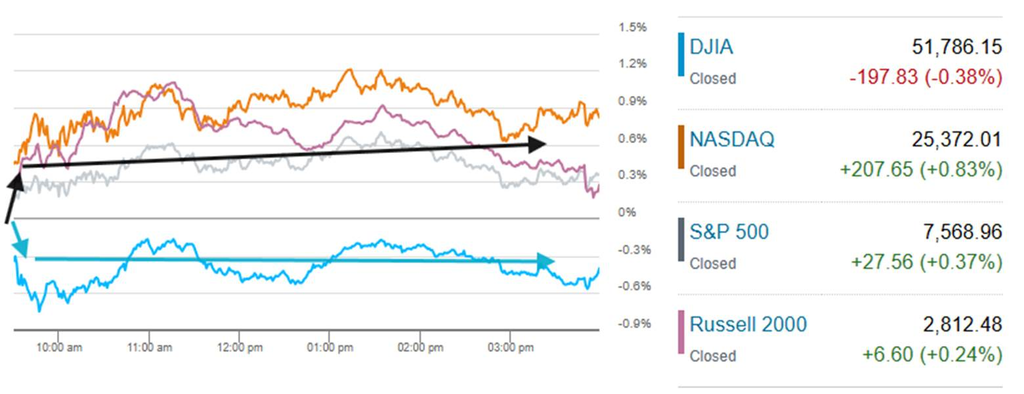
The S&P 500 Tech sector rose 1.3%, led by a 2.6% gain in the Philadelphia Semiconductor Index (SOX), lifting the Nasdaq (+0.8%) and S&P 500 (+0.4%), their first gains in four sessions. The Russell 2000 (+0.2%) followed them higher, while the Dow Jones Industrial Average (DJIA) traded inversely again finishing lower by 0.4%. The Nasdaq-100 edged back out of correction territory. The S&P 500’s gain was about in line with its 0.44% average on midterm Election Days going back to 1970, per the WSJ.
Schwab
The inverse trade between the cap- and equal-weighted S&P 500 continued, but this time the equal-weighted index lost, falling 0.3% to trail the cap-weighted index for the first time in four sessions. Only 189 S&P 500 stocks rose while 313 fell. Just four of 11 sectors were higher, with Consumer Staples and Materials down about 2% each.”
In economic data, September JOLTS job openings rose to 7.5 million, the most since May and well above the 7.1 million Briefing.com consensus, while quits rose the most since May 2023 and layoffs fell to the lowest since March 2025 (more here: JOLTS Report Strong Across the Board). I also wrote up Monday’s construction spending report, where the drop came almost entirely from a record decline in remodeling (Construction Spending Drops the Most Since April 2020 on Record Remodeling Decline), and the Fed’s loan officer survey (Bank Business Loan Demand Falls Despite Surging Equipment Spending). September factory orders rose 1.8% (1.2% Briefing.com consensus), with broad-based gains (write-up later this week).
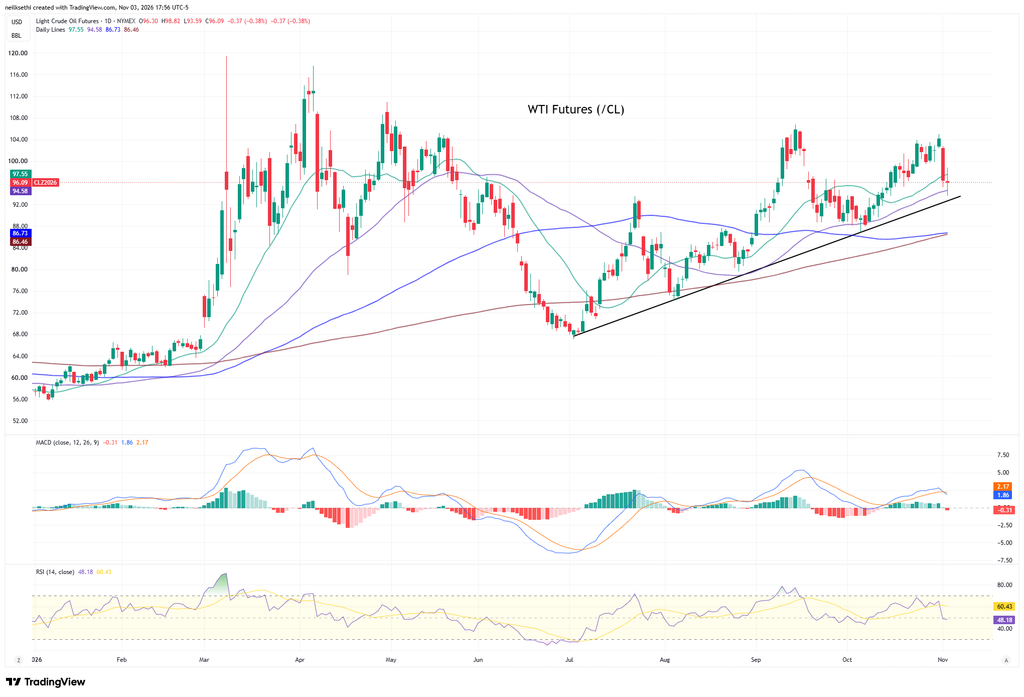
Treasuries fell after the JOLTS report, with the 2-year yield up 3 basis points to 4.62% and the 10-year up 6 basis points to 4.95% in the cash session, per Briefing.com. Fed rate hike bets edged higher, with the odds of a December hike up to 79% from 72% and 59 basis points of hikes priced through December 2027, per CME FedWatch. Oil slipped after President Trump said the US would stop paying military aid to Israel by year-end, per the WSJ, with WTI settling 0.4% lower at $96.16, per Briefing.com. Gold fell 0.9% and copper 2.4%, while bitcoin rose 1.6%.
After the close, Advanced Micro Devices (AMD) rose about 7%, after beating on sales and net income and giving a strong forecast on the back of data center demand (see AMD Shares Higher After Beat and Raise On Data Center Strength), as did Super Micro Computer (SMCI) (+6%), per Bloomberg.
Arista Networks (ANET) and Block (XYZ) also rose about 7% to 8% after their reports, while Skyworks Solutions (SWKS) fell about 13% and Booking Holdings (BKNG) about 2%.
The election results will suck up most of the oxygen on Wednesday, but we’ll also get Treasury’s quarterly refunding announcement, October ADP employment and the final services PMIs, with McDonald’s (MCD), Uber (UBER) and CVS Health (CVS) reporting before the open and Qualcomm (QCOM) after the close.
Market Commentary
Equities:
- “At present, virtually every alarm bell warning of a substantial bear market ahead is ringing,” Elliott Management, the $80 billion hedge-fund firm, wrote in an October investor letter reviewed by The Wall Street Journal.
- “Every number of days, I feel like markets are broken,” Bill Ackman said on CNBC’s “Squawk Box.” “Stocks trade at prices that make no sense to me. Yes, it’s good if you’re a long-term investor and you can buy at a stupid price. I don’t think it’s good for the country generally.” He added, “We’re back to the casino-type markets when there was 95% leverage… it’s leading to these massive moves in stocks.”
- “I don’t think this is a concern about current earnings because current earnings are strong. It’s not a concern around the current cycle because we’ve just seen the [U.S. ISM figures] yesterday… the cycle is still doing well,” Willem Sels, HSBC’s chief investment officer, told CNBC’s “Squawk Box Europe.” “But it is mostly that mismatch between current spending and future revenues… coming from the data centers,” he said, adding, “Ultimately, the demand for AI will continue to pick up exponentially in our view.”
- “We believe the debate is increasingly about sustaining acceleration against a larger base, rather than whether underlying demand remains strong,” said Jefferies analyst Brent Thill.
- “We know that society will use dramatically more computing power in the future,” that demand for chips will remain strong, “and that AI capabilities are improving at an extraordinary rate,” Apollo President Jim Zelter said on a call with analysts Tuesday. “What we don’t know is how pricing and economics will evolve.”
- “The better the Democrats perform, the more nervous the market is likely to become regarding AI regulations,” Ian Lyngen, head of U.S. rates strategy at BMO Capital Markets, said in a note to clients. “Even with this backdrop, and the price action of the last week, the equity market is holding up relatively well — all things considered.”
- “Tuesday’s elections could reshape the balance of power in Washington,” said Ken Mahoney at Mahoney Asset Management. “This will be good to put behind us as it has been an anticipated volatility event for quite some time.”
- “The concerns about the cost of capital and the level of debt financing necessary [are] going to persist for quite some time,” Shawn Snyder of Potomac Fund Management told CNBC. But he said the AI trade could be getting close to oversold, with “maybe… a little bit more downside, 4% or 5%, but eventually, if there’s not a recession associated with these drawdowns, normally that’s kind of where it stops.” He added, “You’re looking at an AI trade that’s already taken a hit. That, combined with the idea that the uncertainty from the midterm fades, probably argues for relief rally no matter what.”
- “Markets still assign premium valuations to companies that demonstrate strong demand, rising AI-related revenue, and the ability to fund additional investment internally,” said Brian Therien at Edward Jones. “We continue to recommend an overweight allocation to equities, with a preference for US large- and mid-cap stocks, due in part to the relative strength of the US economy.”
- “A lot of good news for the health care sector has likely been priced in, and if the polls and betting markets are wrong, then unwind risk is quite high,” said Jonathan Krinsky, chief market technician at BTIG. “Therefore, we see a ‘sell the news’ as a likely outcome for XLV in either scenario over the coming weeks.”
- Ed Yardeni says “a blue wave could deliver a cold shower for stocks,” though he “would view a significant selloff as a buying opportunity given the remarkable strength of the economy and corporate earnings.”
Stock and Sector Breakdown
Schwab
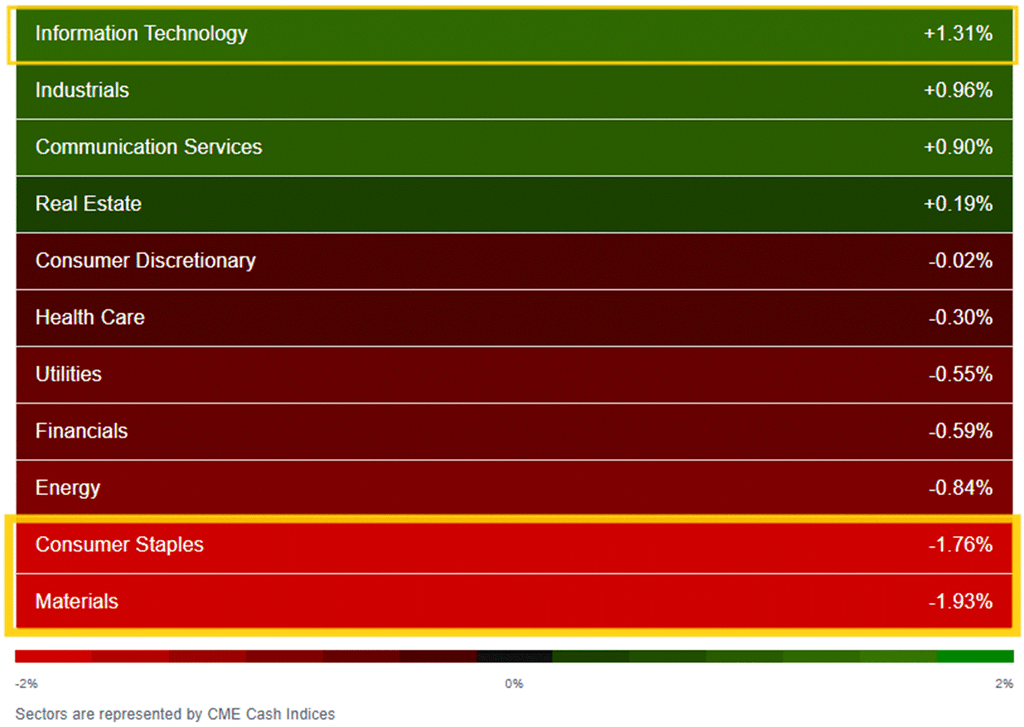
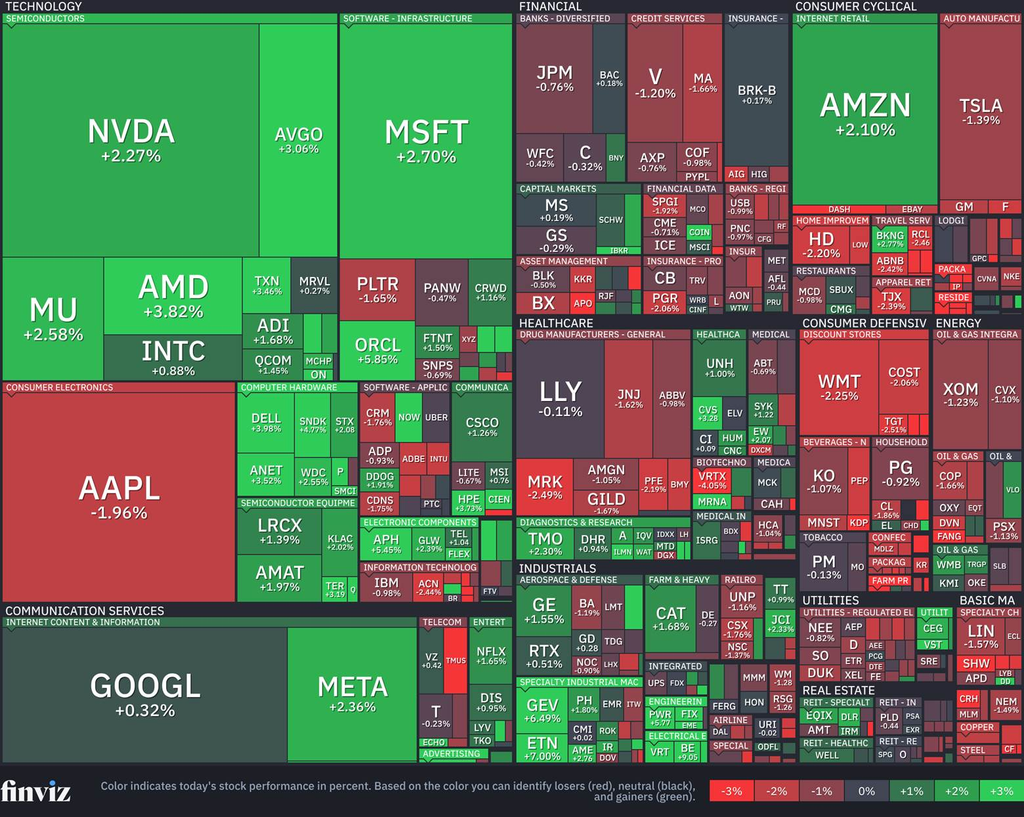
A much narrower 3.2-point spread than Monday’s 6.2, with the leadership flipped. Tech (+1.31%) led, its 13th straight session in the top two or bottom two sectors, followed by Industrials (+0.96%) and Communication Services (+0.90%), with Real Estate (+0.19%) the only other gainer.
To the downside, Materials (-1.93%) and Consumer Staples (-1.76%) were the worst, with the Staples ETF (XLP) having its worst day since July 30. Energy (-0.84%), Financials (-0.59%), Utilities (-0.55%) and Health Care (-0.30%) also fell, and Consumer Discretionary (-0.02%) was flat.
Fiserv (FISV) (+12%) was the best performer in the S&P 500, its best day since March 2020, after its earnings and a new round of layoffs under CEO Takis Georgakopoulos’ streamlining plan (TipRanks). Gartner (IT) (-13%) was the worst, its worst day since February, after it reported a 1% drop in revenue and just 2.5% contract value growth (TipRanks).
AI infrastructure bounced back, with semis leading and Oracle (ORCL) up about 6% after Monday’s 9% drop. Power and data center names did even better, led by Bloom Energy (BE) (+9%), Comfort Systems USA (FIX) (+7%) and Eaton (ETN) (+7%), which beat and raised its outlook. Chris Versace upgraded Eaton in the Portfolio (Upgrading Eaton After Beat-and-Raise Results).
Earnings hit food names, with Sysco (SYY) (-9%) and Archer-Daniels-Midland (ADM) (-7%) missing on revenue and Keurig Dr Pepper (KDP) (-6%) falling despite a beat on worries about its US coffee business, per Briefing.com. Zebra Technologies (ZBRA) (-9%) also fell after its report, and homebuilders Lennar (LEN) and D.R. Horton (DHI) dropped about 5% as yields rose.
Among the megacaps, Microsoft (MSFT) rose about 3%, and Nvidia (NVDA), Meta Platforms (META) and Amazon (AMZN) about 2%, while Alphabet (GOOGL) edged up. Meta’s gain came as it kicked off a $15 billion bond sale, per Bloomberg. Apple (AAPL) fell about 2%, its worst day since September 29, after guiding to weaker-than-expected gross margins (more in my article: Apple Tops Estimates but Shares Fall After Hours on Poor Margin Guidance). Versace trimmed his price target (We’re Trimming Our Apple Price Target After Earnings), and Doug Kass is still kicking himself over covering his Apple short Friday (Mea Culpa (Part Deux)). Palantir Technologies (PLTR) also slipped about 2% despite strong results and guidance, with investors focused on a sharp slowdown in bookings growth, per Briefing.com.
The number of large SPX winners (up over 3%) fell to 47 from 92 Monday, while large losers (down over 3%) fell to 31 from 51.
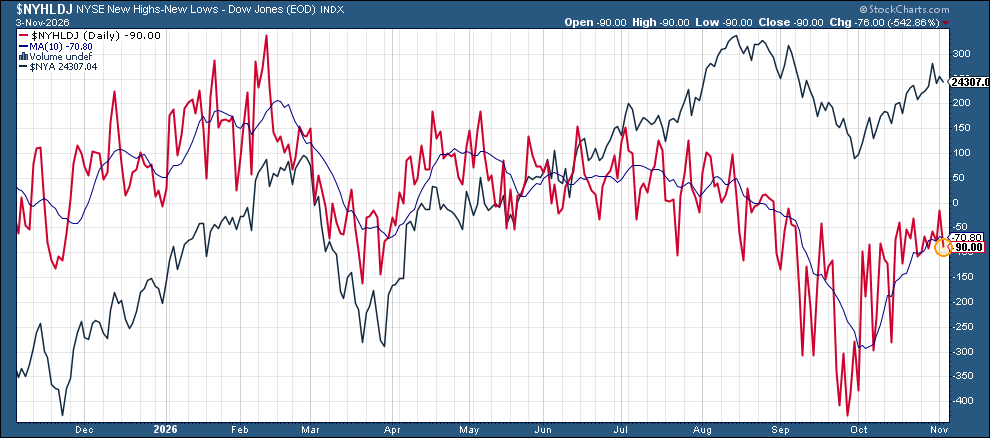
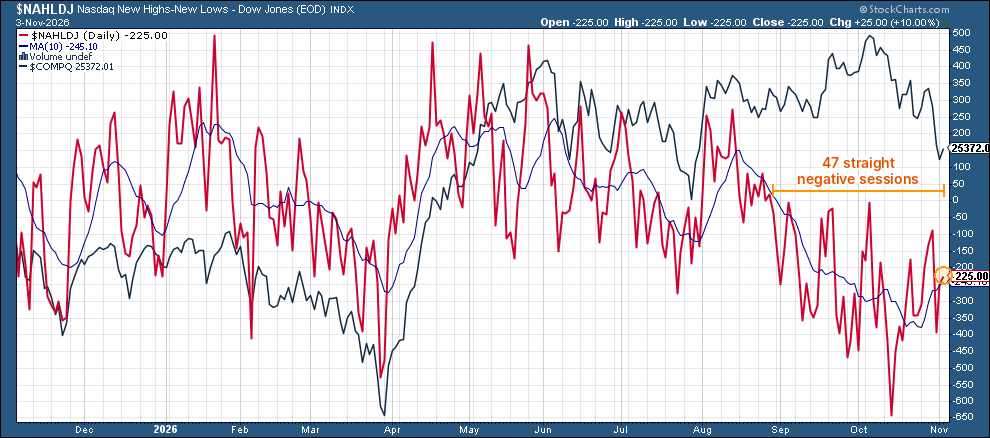
52-week highs minus lows fell back to -90 on the NYSE from -14 Monday, while the Nasdaq improved to -225, though it was still the 47th straight negative session for the Nasdaq, the longest stretch since a run of more than 50 sessions that ended in mid-November 2023.
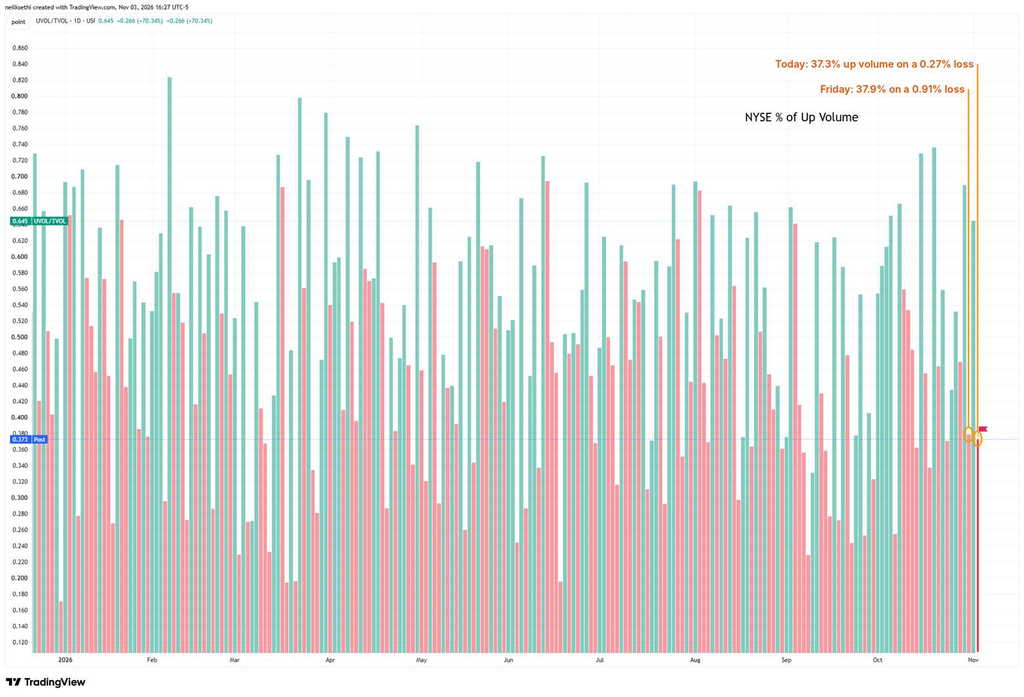
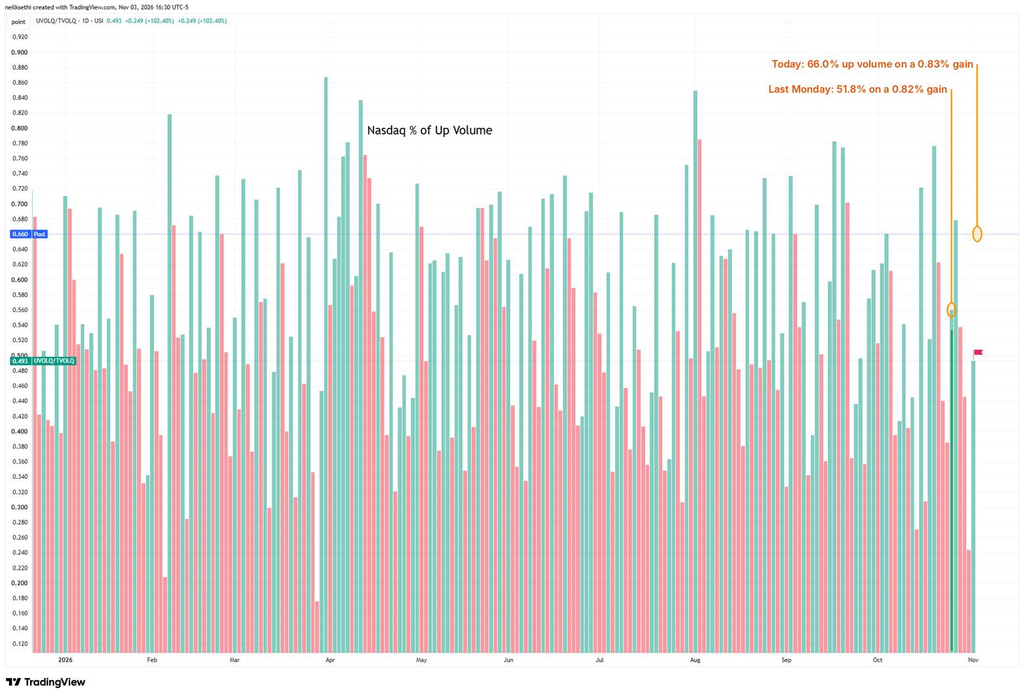
Positive volume was weak on the NYSE at just 37.3% on a 0.27% loss, about the same as Friday’s 37.9% on a much bigger 0.91% loss. The Nasdaq was more in line at 66.0% on a 0.83% gain, compared with 51.8% last Monday on a similar 0.82% gain.
Some other stock-specific commentary from TheStreet Pro:
Stephen Guilfoyle —
Chris Versace — Sticking With This Palantir Price Target Despite Changes
James “Rev Shark” DePorre — Looking for Relative Strength? This Little-Known Stock Checks the Boxes
Ed Ponsi — Time to Diversify Out of Semiconductors
Bob Lang — Chart of the Day: Axon’s Flat Base Gives Bulls Some Hope
A Look At The Charts
Note on all charts the colored lines are moving averages (the average price over the lookback period — days on the daily charts, weeks on the weekly charts):
20 = green
50 = purple
100 = blue
200 = brown
Exception is monthly charts where blue is 10-month moving average and brown is 20-month moving average.
MACD = Moving average convergence/divergence line, a measure of momentum that compares longer term and shorter term momentum to gauge if a move is strengthening or weakening. This is probably my favorite individual indicator.
RSI = Relative Strength Index (basically what it sounds like) = measures the strength of the move comparing gains to losses over the given lookback window (I use the standard 14 periods).
SPX
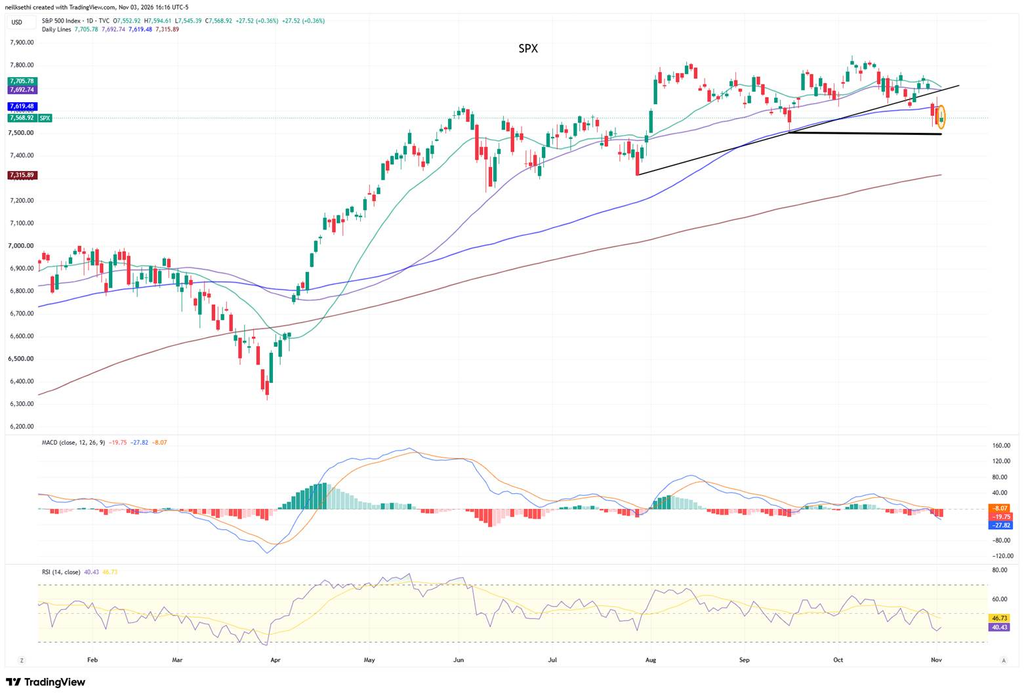
The SPX rose 0.36% to 7,569, snapping a three-day losing streak and closing back above its September 16 closing low (7,552) after Monday’s break. It remains below its 20-, 50- and 100-DMAs (the 100-DMA is at 7,619), with the MACD in “go short” positioning and the RSI at 40.
As I noted, I took off half my SPY position Monday and will take off the other half if it breaks the September intraday low (7,508).
Nasdaq Composite
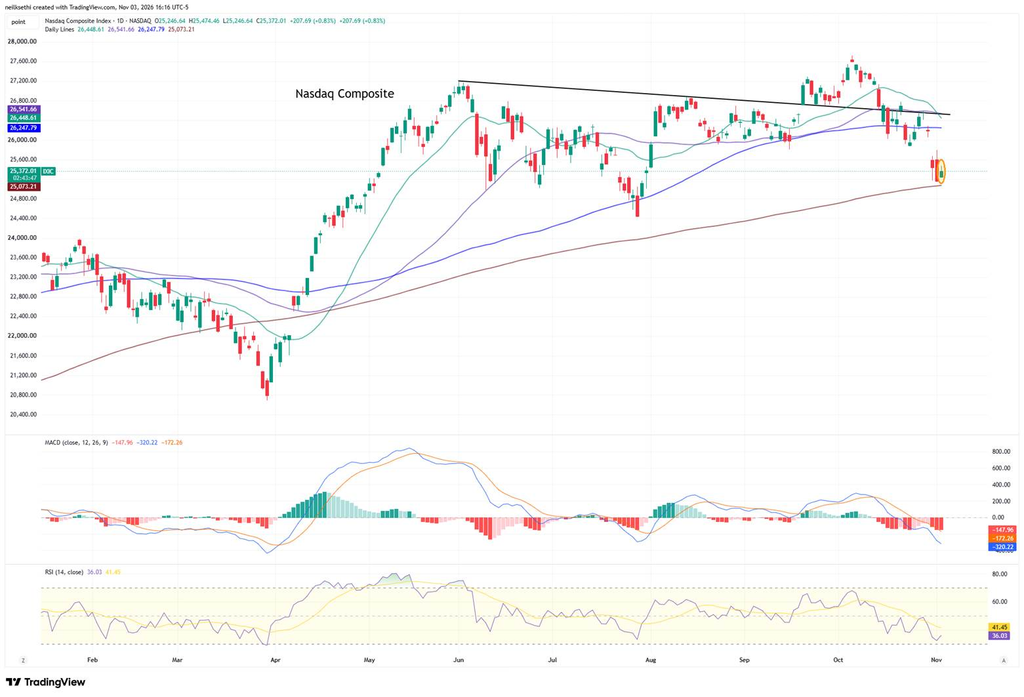
The Nasdaq Composite rose 0.83% to 25,372, 1.2% above its 200-DMA (25,073). The MACD remains in “go short” positioning, and the RSI is at 36.
The Nasdaq-100 (QQQ)
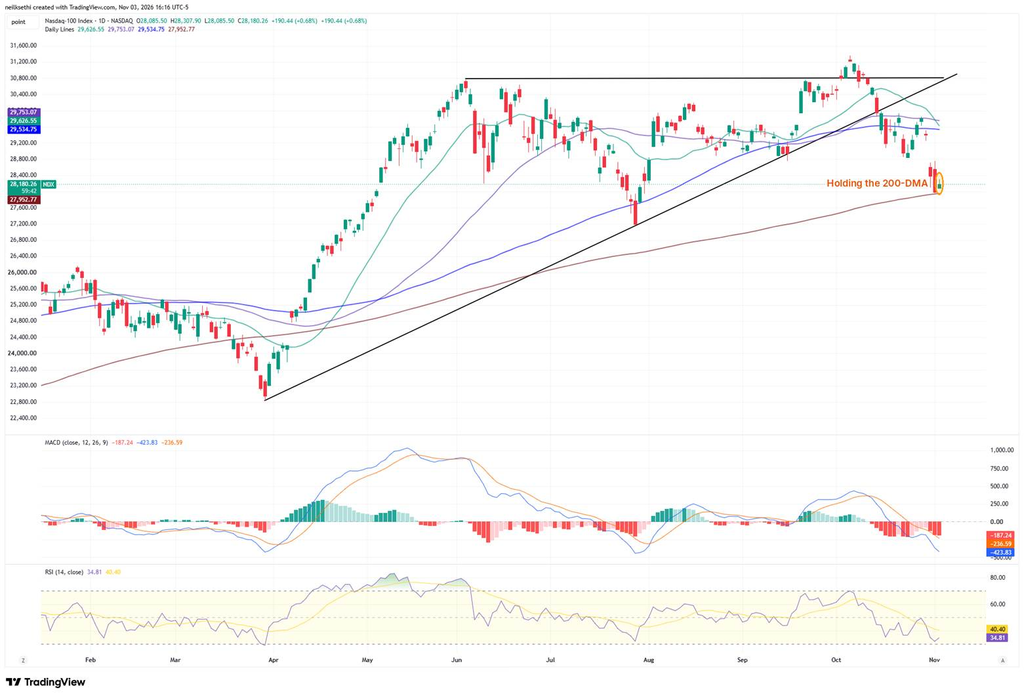
The Nasdaq-100 rose 0.68% to 28,180, holding its 200-DMA (27,953) for a second day and moving back out of correction territory (9.7% below its October 6 record). The MACD is in “go short” positioning, and the RSI is at 35.
The Russell 2000 (IWM)
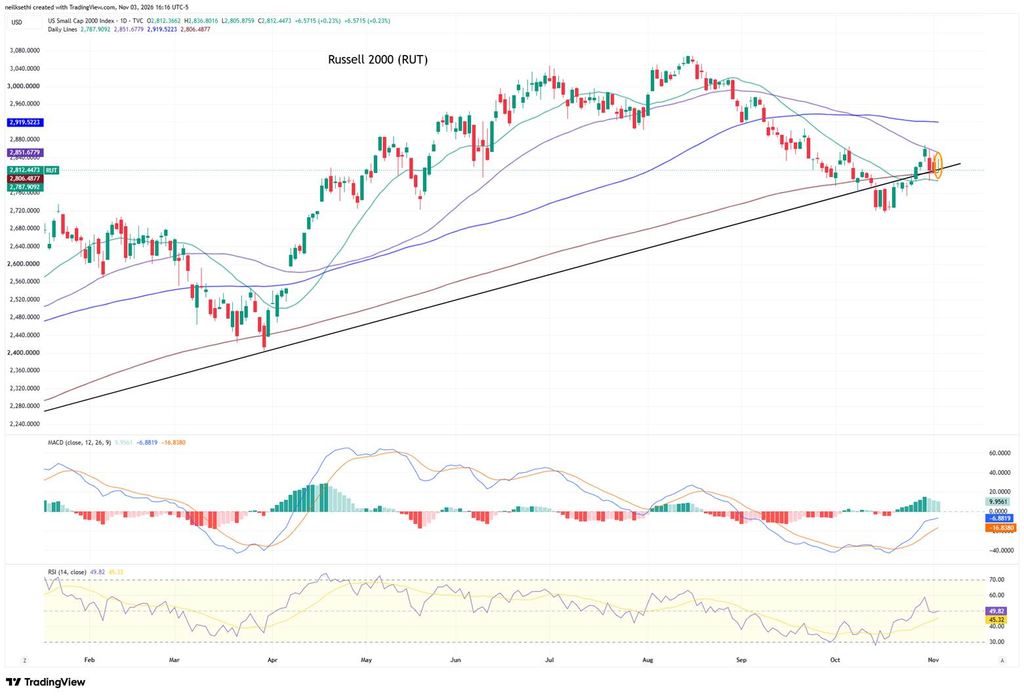
The Russell 2000 rose 0.23% to 2,812, just above its 200-DMA (2,806) but still below its 50-DMA (2,852). The MACD remains in “cover shorts” positioning, and the RSI is at 50. I’m still holding my IWM position and would like to see it get back over that 50-DMA.
The equal-weighted SPX (RSP)
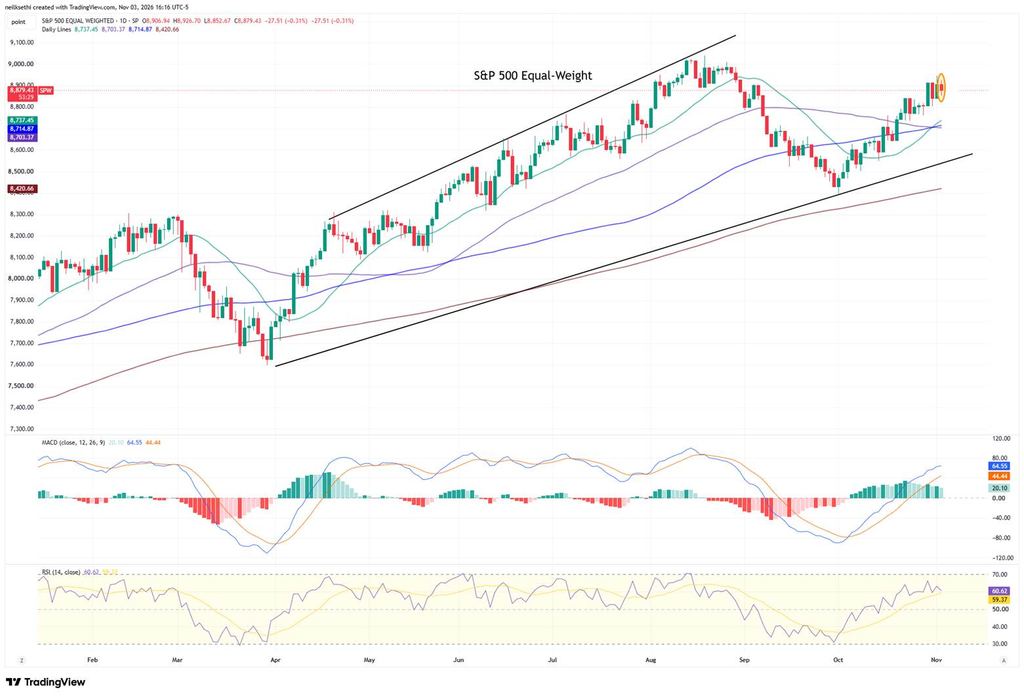
The equal-weighted SPX fell 0.31% to 8,879, trailing the cap-weighted index by about 0.7 points after beating it by more than a point in each of the prior three sessions. It remains above all its moving averages, with the MACD in “buy longs” positioning and the RSI at 61.
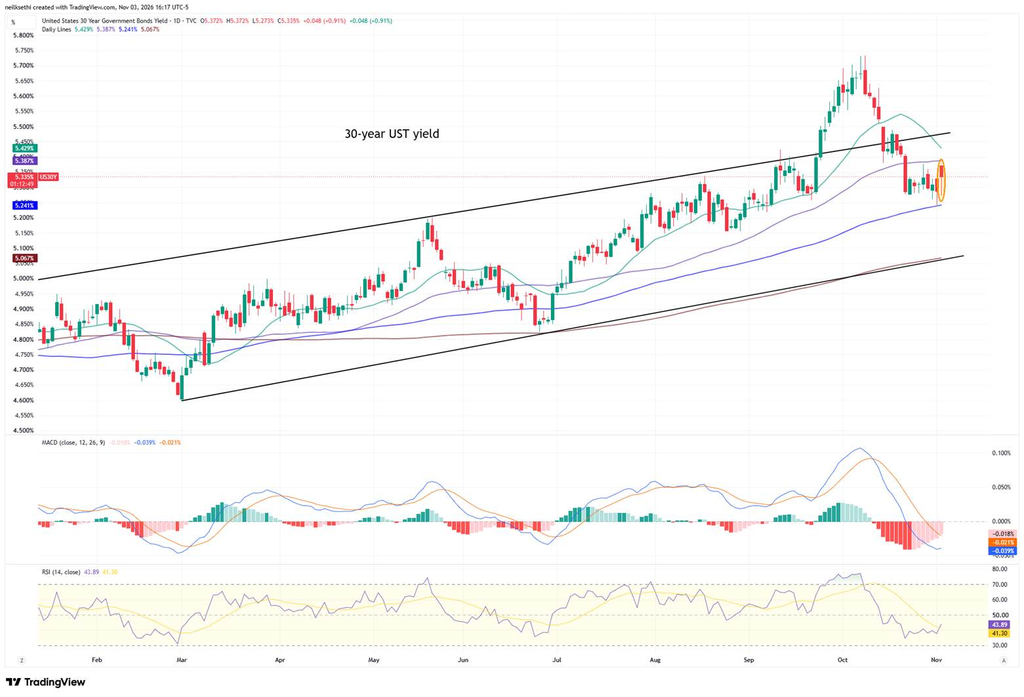
You’ll notice I’ve started leaving the moving averages, MACD and RSI on the Treasury yield charts. More and more respected rates strategists, including BMO’s Ian Lyngen and JPMorgan’s Bob Michele, have been referencing them, so I thought it worth including them.
The 2-year Treasury
The 2-year yield rose 3.1 basis points (including post-market) to 4.63%, about 75bp above the EFFR (3.88%), and remains below its 20- and 50-DMAs. The MACD is in “go short” positioning, and the RSI is at 44.
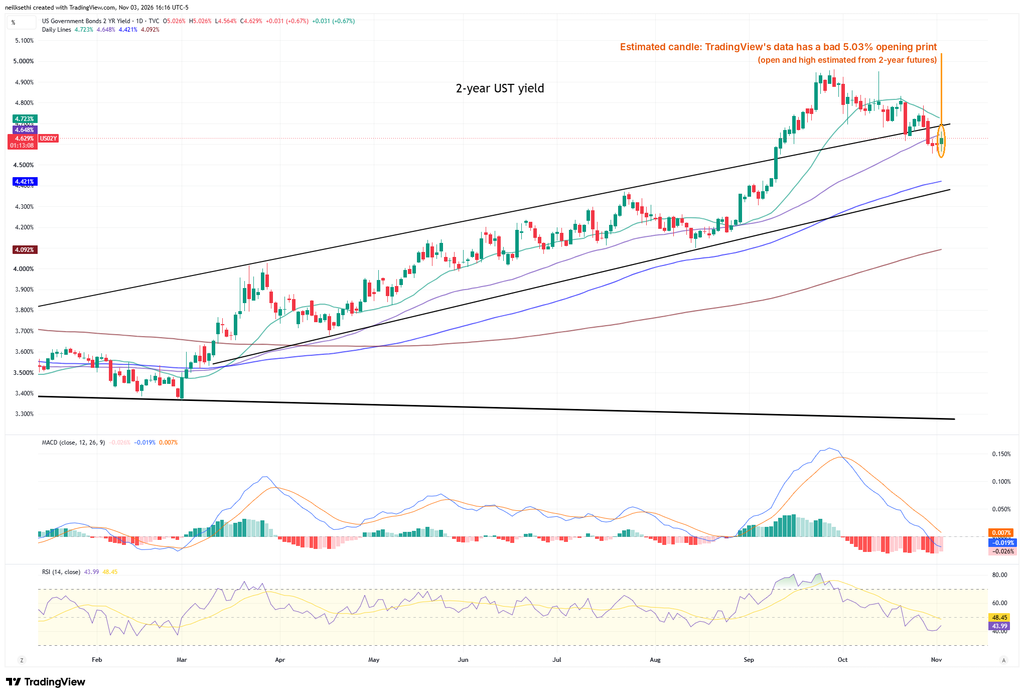
Fed rate hike bets edged slightly higher, with a December hike now at 79% (from 72%) and 59 basis points priced through December 2027 (from 58), per CME FedWatch.
10-year yields
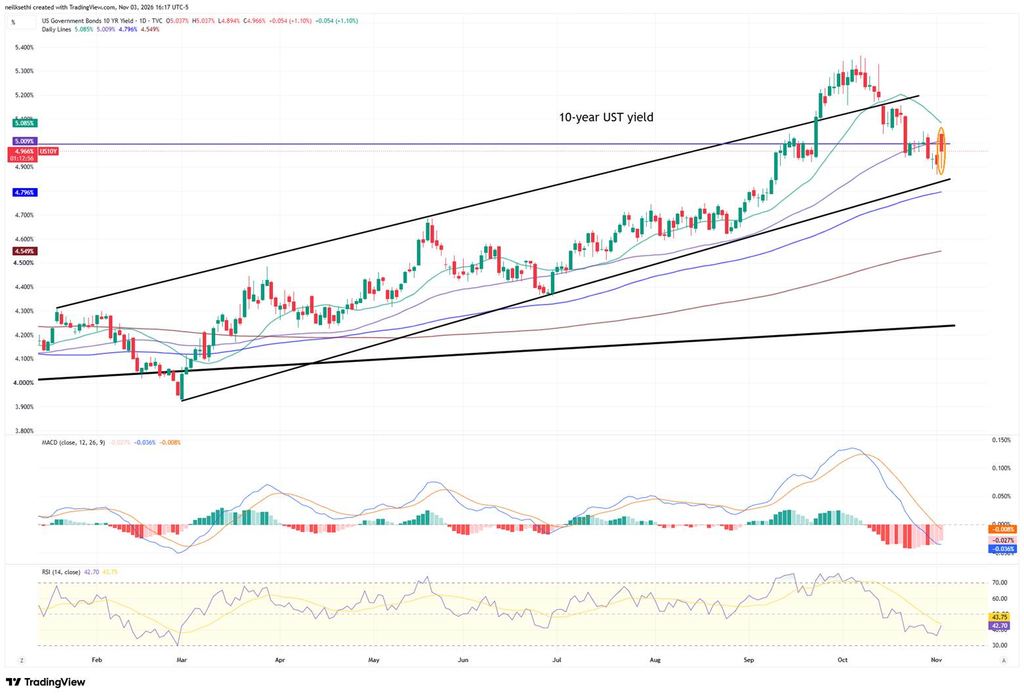
The 10-year yield rose 5.4 basis points (including post-market) to 4.97%, its biggest rise since October 28, but stayed below its 20- and 50-DMAs and the 5% level, where the 50-DMA sits. The MACD is in “go short” positioning, and the RSI is at 43.
30-year yields
The 30-year yield rose 4.8 basis points (including post-market) to 5.34% ahead of Wednesday’s refunding announcement. The MACD is in “go short” positioning, and the RSI is at 44.
VIX
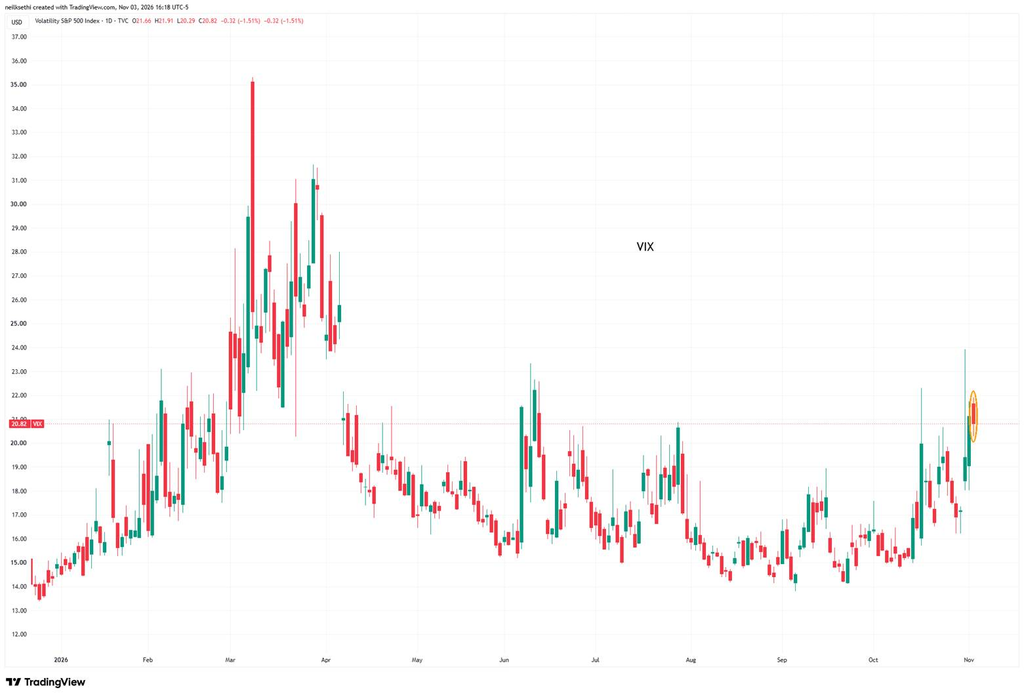
The VIX eased 1.51% to 20.82, implying a daily move of about 1.31% over the next 30 days.
Helene Meisler looked at what the recent jumps in the VIX may be signaling (Is a Jumpy VIX Trying to Tell Us Where the Market Is Headed Next?).
VVIX
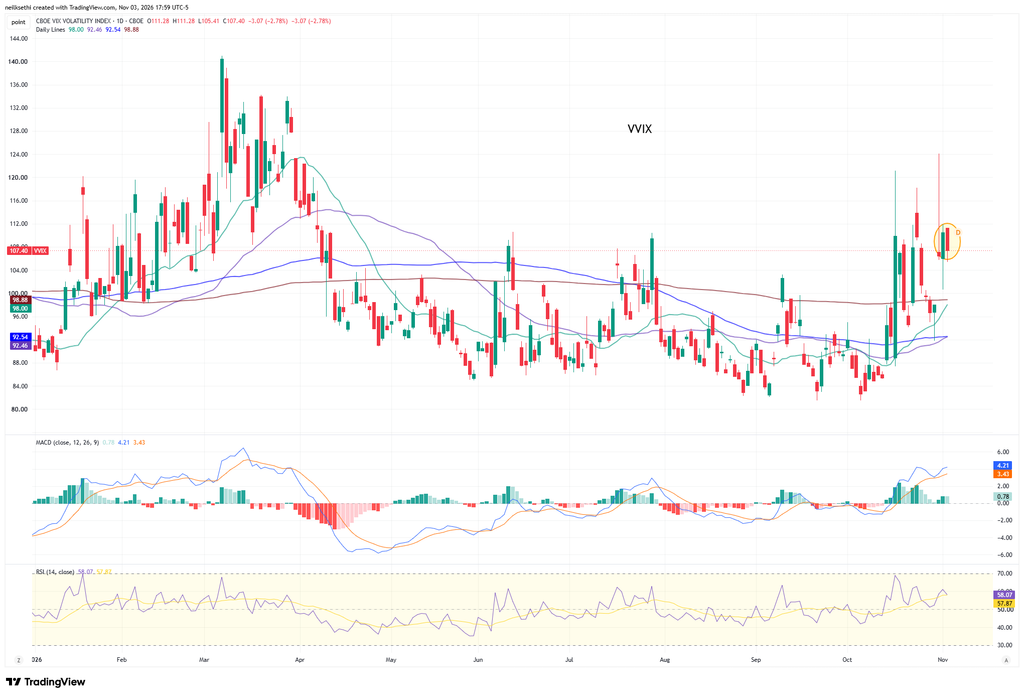
The VVIX (the VIX of the VIX) fell 2.88% to 107.29. The current level is consistent with “elevated” daily moves in the VIX over the next 30 days (historically, normal is 80-100, although we haven’t been below 80 since July 2024), and it remains above the 100 level flagged by Charlie McElligott as indicating higher stress.
1-day VIX
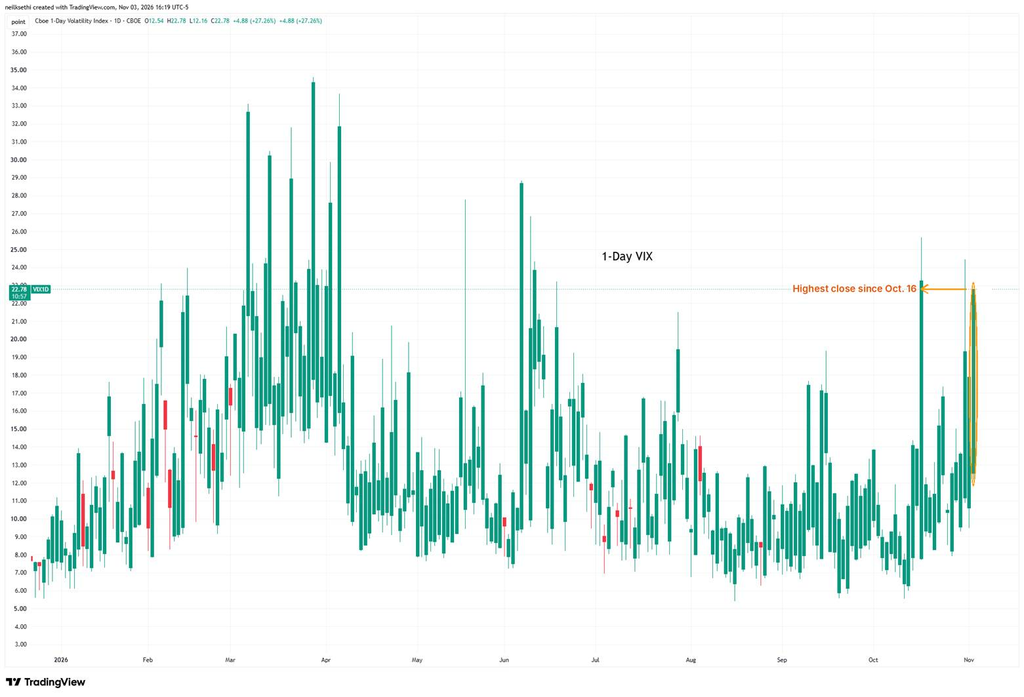
Monday’s 1-day VIX reading implied a move of about 1.16% for Election Day, and the SPX came in well under that at 0.36%. With the election results entering the 24-hour window, the 1-day VIX then jumped 27.26% to 22.78, its highest close since October 16, and second highest since early June, implying a move of about 1.44% for Wednesday.
WTI futures (/CL)
WTI futures, which TradingView has at December currently, rose 0.36% (including post-market) to $96.81, just below their 20-DMA ($97.58) and above their 50-DMA ($94.59). The MACD crossed below its signal line into “sell longs” positioning, and the RSI is at 49. This will continue though to trade on headlines rather than technicals for the time being, although it has respected that trendline since late June.
DXY
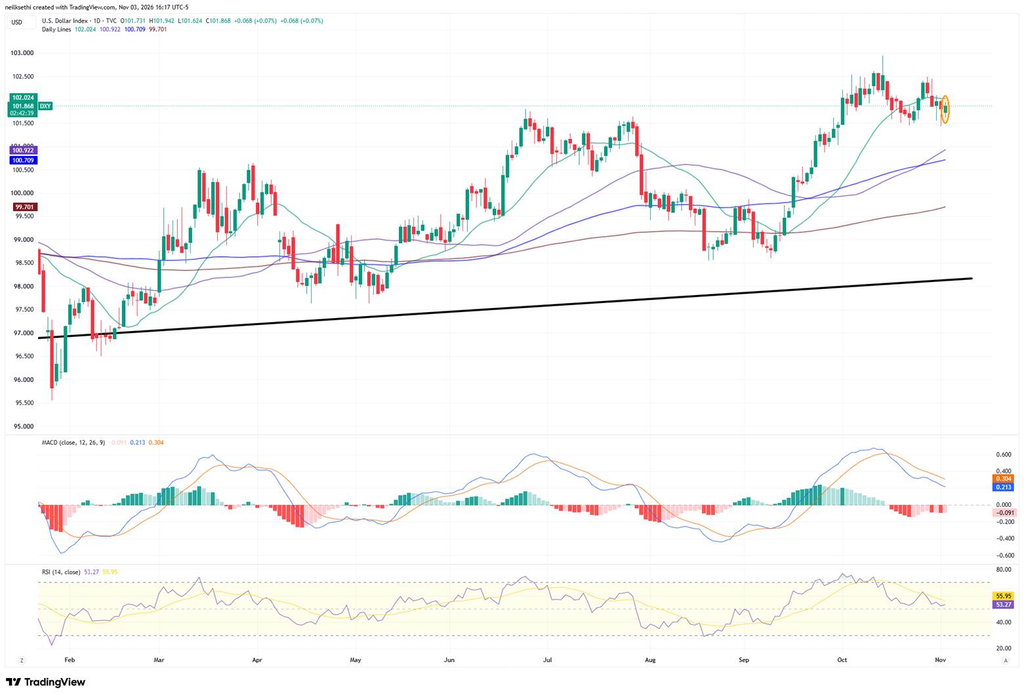
The DXY dollar index (which is fixed weighted with a heavy — 57% — allocation to the euro) rose 0.07% to 101.87, just below its 20-DMA (102.02). The MACD remains in “sell longs” positioning, and the RSI is at 53. So in the short term, the easier path is lower.
Gold futures (/GC)
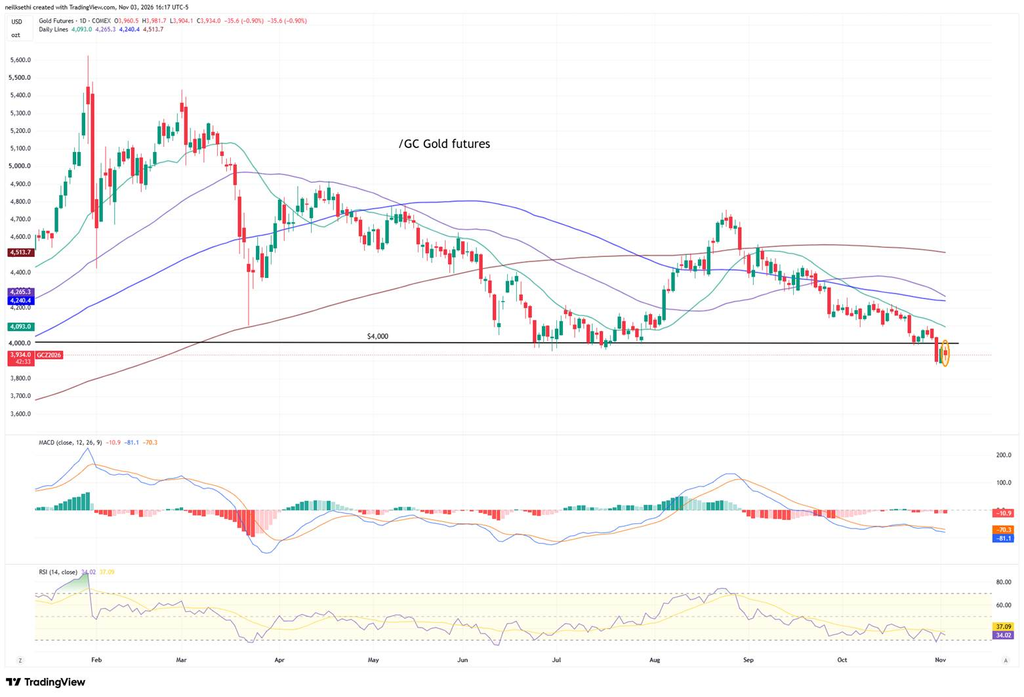
Gold futures fell 0.90% (including post-market) to $3,934, giving back more than half of Monday’s rebound, and remain below $4,000 and all their moving averages. The MACD is in “go short” positioning, and the RSI is at 34. Doug Kass was in and out of GLD again, buying premarket and selling for a quick gain (Out of Gold).
US copper futures (/HG)
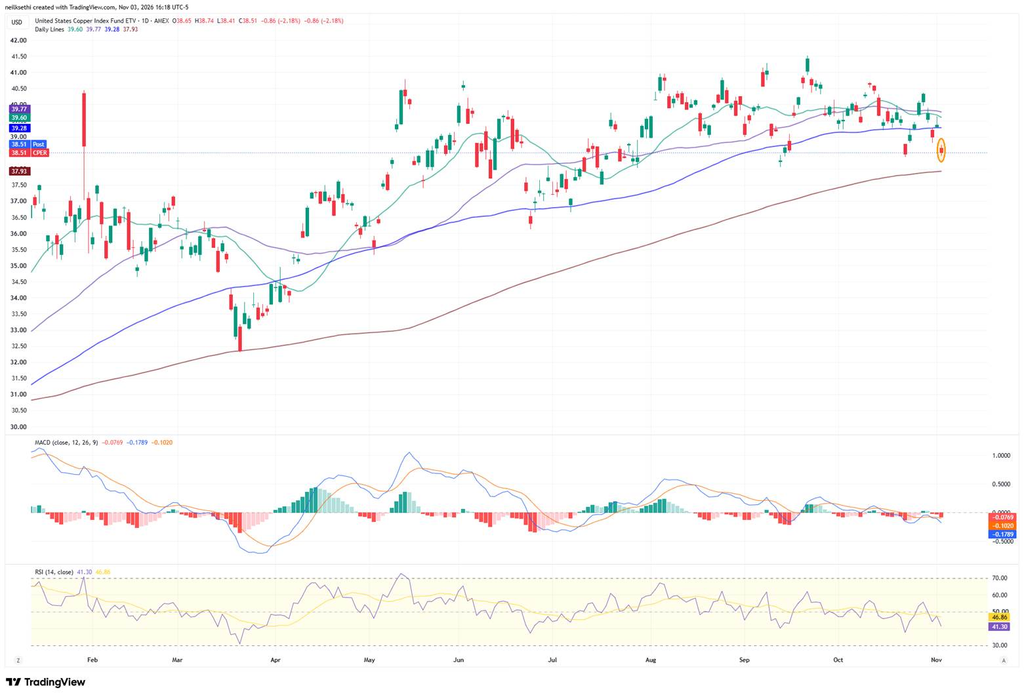
Copper futures fell 2.44% (including post-market) to $6.41, back below their 100-DMA ($6.51) and toward their 200-DMA ($6.25), after trading as low as $6.32 intraday. The MACD is in “go short” positioning, and the RSI is at 41, not inspiring a lot of confidence given it couldn’t bounce with Tech stocks.
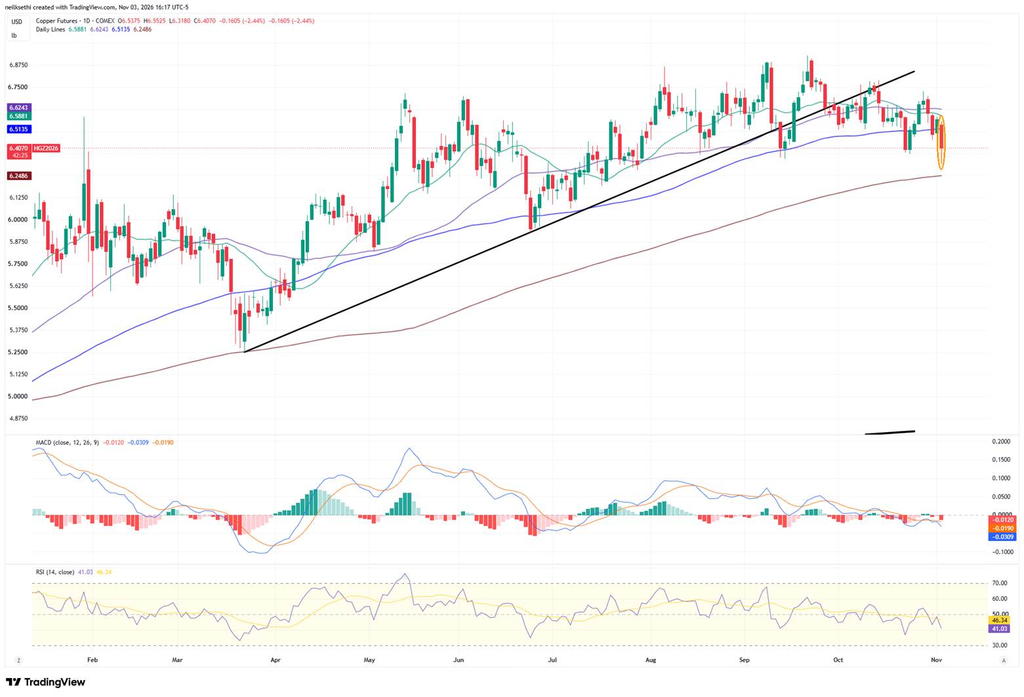
The copper ETF (CPER) has held up better (-2.18% to $38.51), closing just above its October 22 low ($38.47 close), so I haven’t sold yet. As I noted, I’ll hold it unless it breaks the October lows, and at this point probably will give it the benefit of the rising 200-DMA.
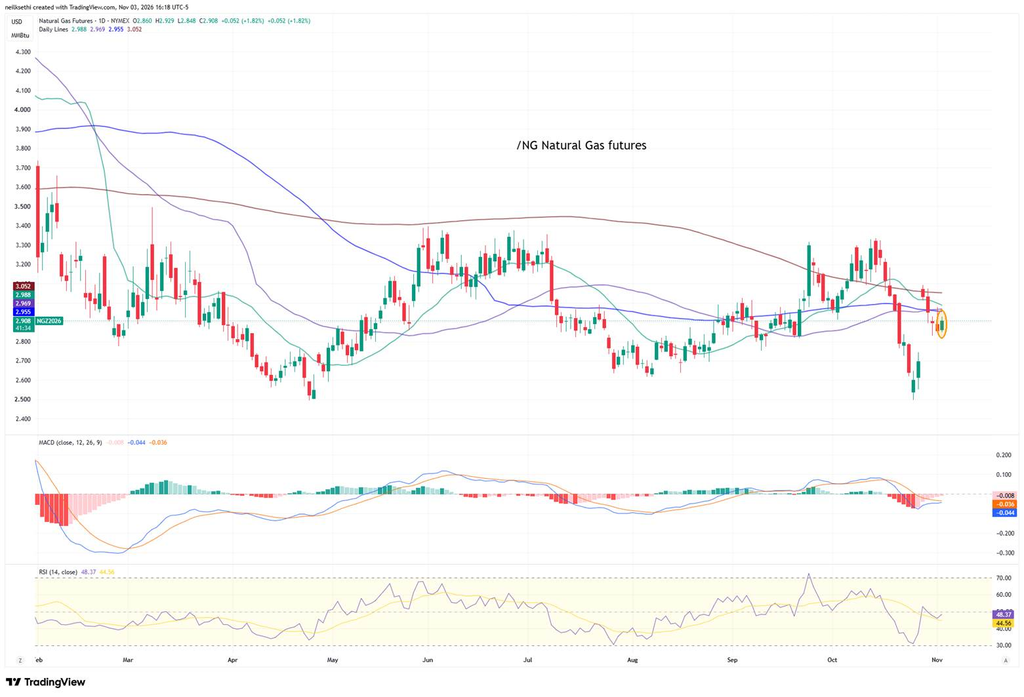
US natural gas futures (/NG)
Natural gas futures rose 1.82% (including post-market) to $2.91 but remain below all their moving averages. The MACD is in “go short” positioning, and the RSI is at 48.
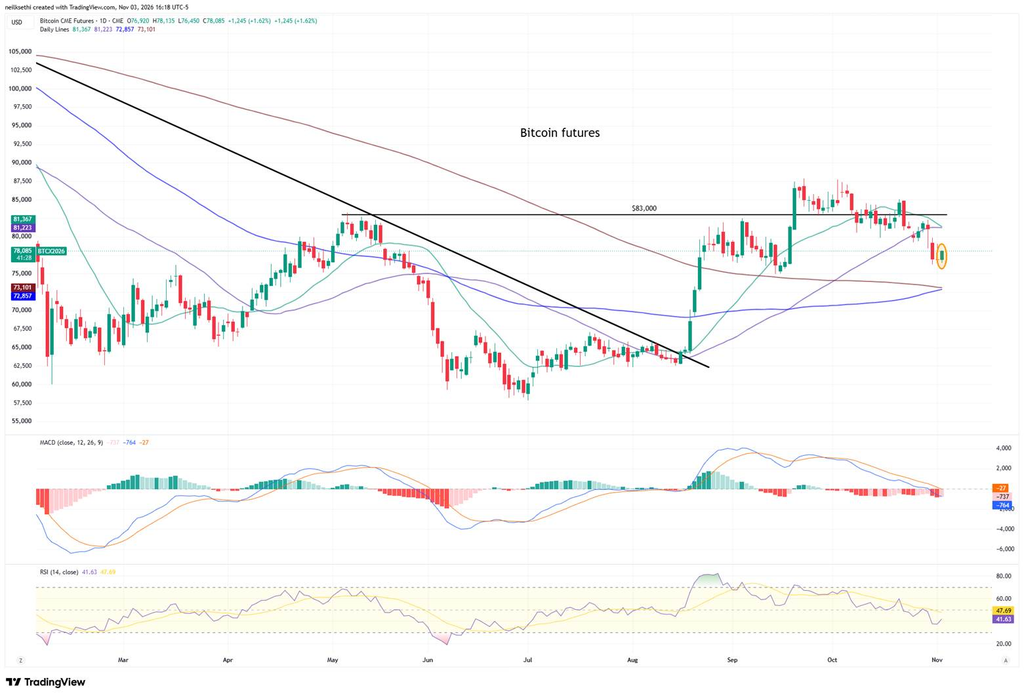
Bitcoin futures
Bitcoin futures rose 1.62% to $78,085, still below $80,000 and their 20- and 50-DMAs (both around $81,200-$81,400). The MACD is in “go short” positioning, and the RSI is at 42. Nothing to get excited about here unless you’re bearish.
More From TheStreet Pro
Helene Meisler — Is a Jumpy VIX Trying to Tell Us Where the Market Is Headed Next?
James “Rev Shark” DePorre — Apple and Palantir Slip, but the Focus Is on Rotation and the Election
Stephen Guilfoyle — Time to Think Like an Investor
Chris Versace — Apple Price Target Cuts, Palantir Earnings Reaction: 8 Key Items Shaping the Stock Market Tuesday
Doug Kass —
- S&P Oscillator Becomes More Overbought
- Frost/Niles
- JPMorgan’s Election Cheat Sheet
- Boockvar on Midterms, Gold, Earnings
- Cannabis M&A!
- Market Observations
- Boockvar on Job Openings
- Shoulda, Coulda, Woulda
And From Me If You Missed It
- Apple Tops Estimates but Shares Fall After Hours on Poor Margin Guidance
- Elections, JOLTS, and AMD Highlight Tuesday’s Calendar
- Have We Front-Run Post-Midterm Strength?
- JPM’s Post-Election Day Scenario Analysis
- China Reloads Its 2024 Stock Rescue Tools, but Markets Aren’t Buying It
- Construction Spending Drops the Most Since April 2020 on Record Remodeling Decline
- JOLTS Report Strong Across the Board
- Bank Business Loan Demand Falls Despite Surging Equipment Spending
Miscellaneous
Wrap-Up – Turnaround Tuesday
I said Friday (Chip Rout Sends Nasdaq to Worst Month Since March 2025):
A lot of damage has been done, but I don’t think we’ve reached levels that I would say mean more than a bounce is likely. But after a session like Friday’s, some sort of bounce wouldn’t be unusual on a Monday (although there’s a reason they call it “Turnaround Tuesday”).
And I noted yesterday, “we got the bounce, but also the selloff – all in one day!” But true to the “Turnaround Tuesday” moniker, we got another bounce Tuesday, and this one stuck. While only a sliver of the selloff that took the Nasdaq-100 into correction territory, every turnaround has to start somewhere. But as I also mentioned, until it proves otherwise, for now it’s just a bounce. That doesn’t mean you can’t make money trading it, but it has a lot to go to prove we’re back to something more than that. It looks like markets are embracing the AMD results which could be just what the sector needs to get back on track.
So that keeps me “watching and waiting” on Tech overall, as I have mentioned repeatedly, but also adding to names that seem to have relative strength (like Arista Networks (ANET) today) or other areas that are continuing to see strength (but also subtracting where I think maybe the rotation needs to consolidate or pullback like trading out of Walmart (WMT) and Apple today). As I have said in the past “we have to take what the market gives us.”
Of course there’s the election (I somehow made it this far without talking about it). I am hopeful that we get some sort of resolution by tomorrow morning that gives us clarity on the path forward. I think whatever it is, markets will come to grips with it fairly quickly. That still leaves the risk of how President Trump responds, but we’ll just have to deal with that if/when it happens.
As always, let’s see what we get and go from there.
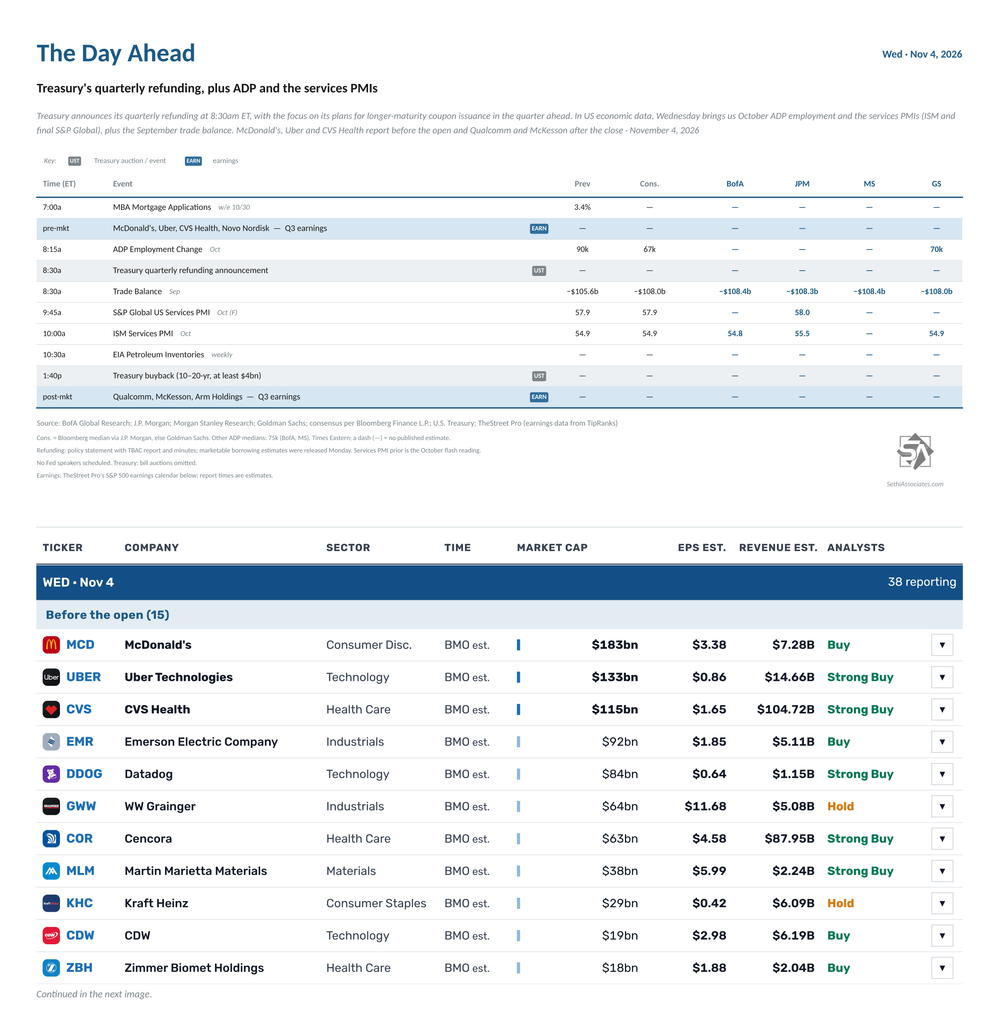
The Day Ahead — Refunding, ADP and the Services PMIs
In US economic data, Wednesday brings us October ADP private employment growth and the services PMIs (ISM and final S&P Global), plus the September trade balance. We’ll also get weekly MBA mortgage applications and EIA petroleum inventories.
There are no Fed speakers scheduled.
There are no non-Bill (>1yr in maturity) US Treasury auctions, but Treasury announces its quarterly refunding at 8:30am ET, with the focus on its plans for longer-maturity coupon issuance in the quarter ahead. It also holds a buyback of 10- to 20-year securities in the afternoon.
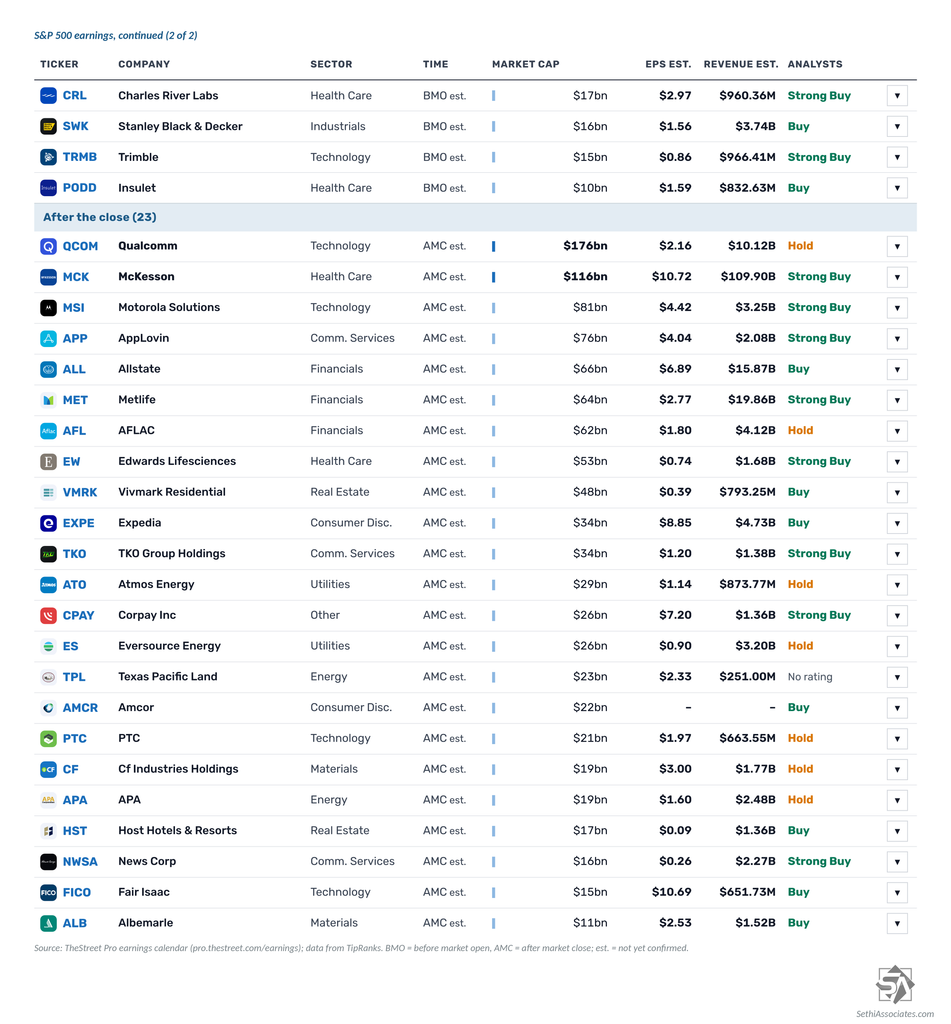
38 S&P 500 components report, five of them with market caps over $100bn:
Before the open: McDonald’s (MCD), Uber (UBER), CVS Health (CVS), Emerson Electric (EMR), Datadog (DDOG), W.W. Grainger (GWW), Cencora (COR), Martin Marietta Materials (MLM), Kraft Heinz (KHC), CDW (CDW), Zimmer Biomet (ZBH), Charles River Laboratories (CRL), Stanley Black & Decker (SWK), Trimble (TRMB) and Insulet (PODD)
After the close: Qualcomm (QCOM), McKesson (MCK), Motorola Solutions (MSI), AppLovin (APP), Allstate (ALL), MetLife (MET), Aflac (AFL), Edwards Lifesciences (EW), Vivmark Residential (VMRK), Expedia (EXPE), TKO Group (TKO), Atmos Energy (ATO), Corpay (CPAY), Eversource Energy (ES), Texas Pacific Land (TPL), Amcor (AMCR), PTC (PTC), CF Industries (CF), APA (APA), Host Hotels & Resorts (HST), News Corp (NWSA), Fair Isaac (FICO) and Albemarle (ALB)
Outside the S&P 500, Novo Nordisk (NVO) reports before the open and Arm Holdings (ARM) and MercadoLibre (MELI) after the close.
Also, opening arguments are scheduled in a Los Angeles trial over claims that Meta and Snap designed their platforms to be addictive and harmful to young users, per Bloomberg.
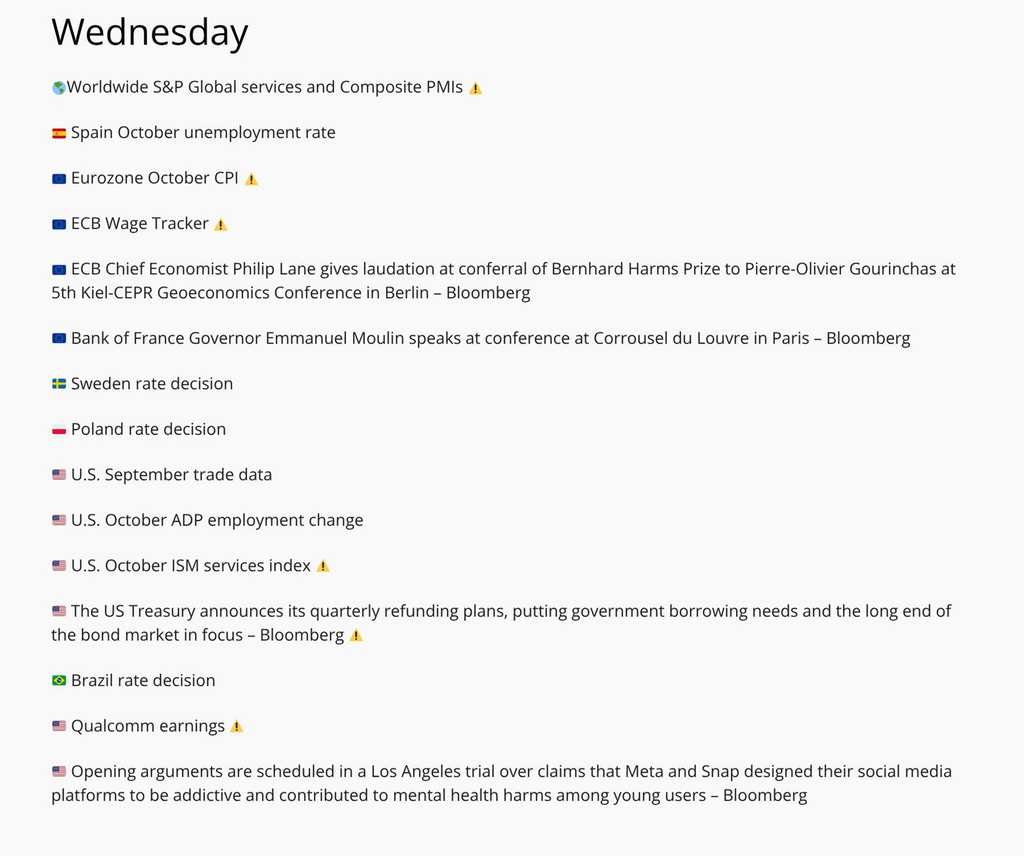
Ex-US highlights include the final October services PMIs (including China’s RatingDog services PMI), Eurozone October CPI, Spain’s October unemployment rate, UK October official reserves changes and Canada’s September trade balance. There are rate decisions from Sweden’s Riksbank, Poland and Brazil, the ECB releases its wage tracker, ECB Chief Economist Lane and Bank of France Governor Moulin speak, and the Bank of Japan releases the minutes of its September meeting.
From Christophe Barraud’s international Week Ahead rundown:
At the time of publication, in terms of securities mentioned, Sethi was long AAPL, AMZN, BKNG, ETN, FICO, GOOGL, MSFT, NVDA, ORCL, PLTR, UBER, QQQ, SPY, IWM, RSP, CPER and numerous Treasury ETFs, and short AMD. In the last 24 hours Sethi moved long ANET and short WMT.