Chip Rout Sends Nasdaq to Worst Month Since March 2025
Intel’s record drop leads a cascade in chip names with the S&P 500 and Nasdaq seeing their worst session since June, while defensive buying gave the Consumer Staples ETF its best month on record.
You've reached your free article limit
You've read 0 of 1 free Pro articles.

Executive Summary
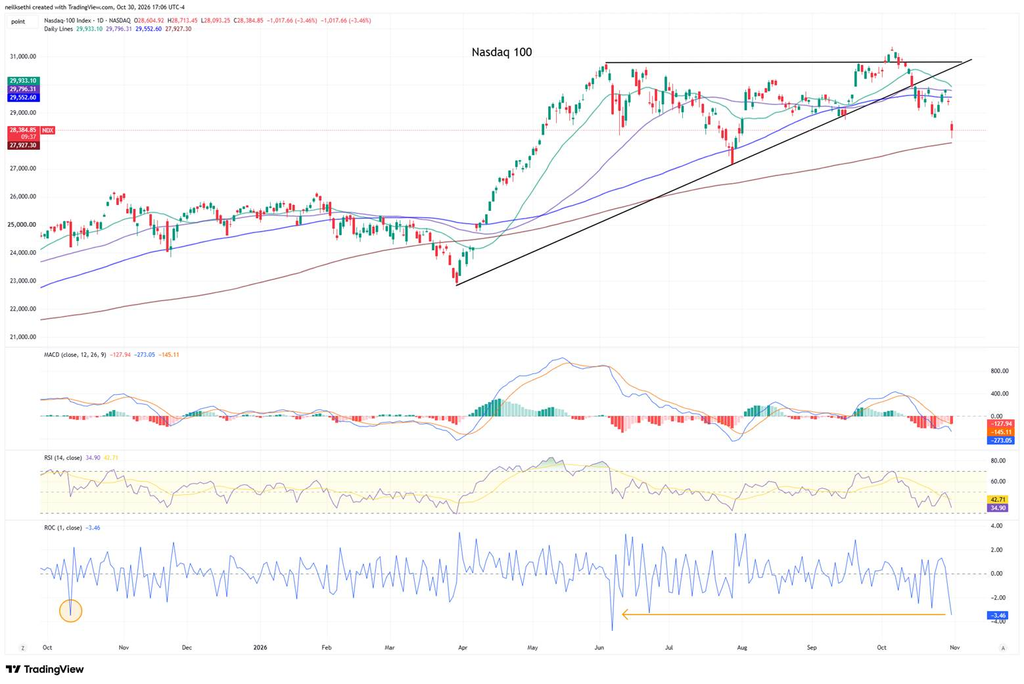
The disappointing Tech results discussed in last night’s update spurred the worst drop for the S&P 500 and Nasdaq since June, with the Nasdaq-100 briefly crossing the threshold of a technical correction.
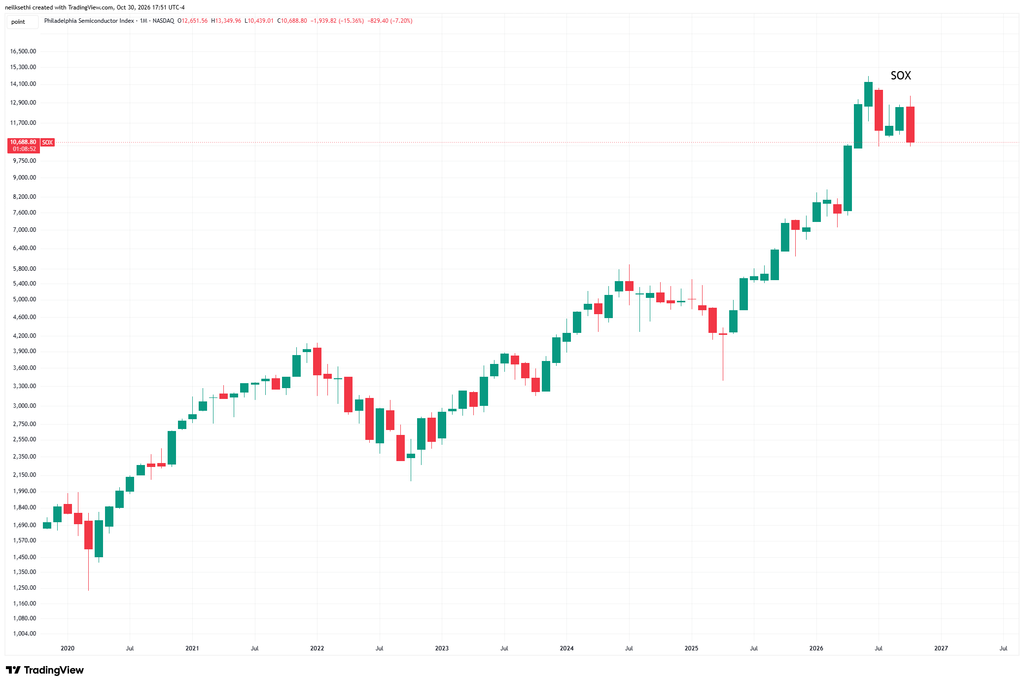
The S&P 500 Tech sector would fall 4.2%, its second worst session since April 2025, sending the Nasdaq (-2.9%) and S&P 500 (-1.8%) to their worst days since June 5, with the S&P closing at its lowest since September 16, while the Russell 2000 (-1.7%) and Dow Jones Industrial Average (DJIA) (-1.1%) also fell. The Philadelphia Semiconductor Index (-7.2%) had its worst day since June 23.
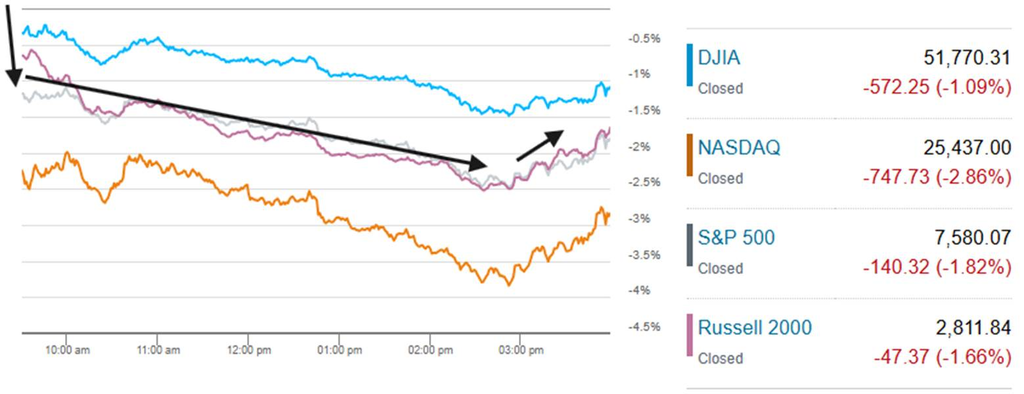
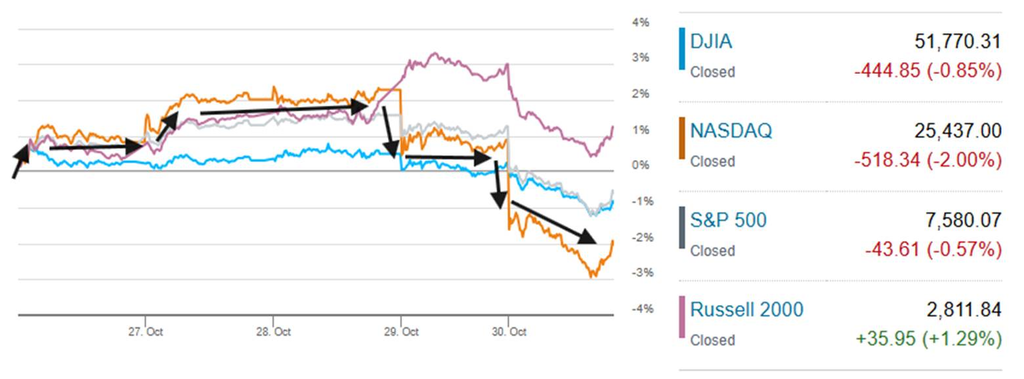
For the week, indices were all in the green until Friday, even with Thursday’s weakness. The Russell 2000 avoided the red all week, ending up 1.3%, but the large-cap indices all finished lower, led by the Nasdaq (-2.0%), with the DJIA down 0.9% and the S&P 500 0.6%.
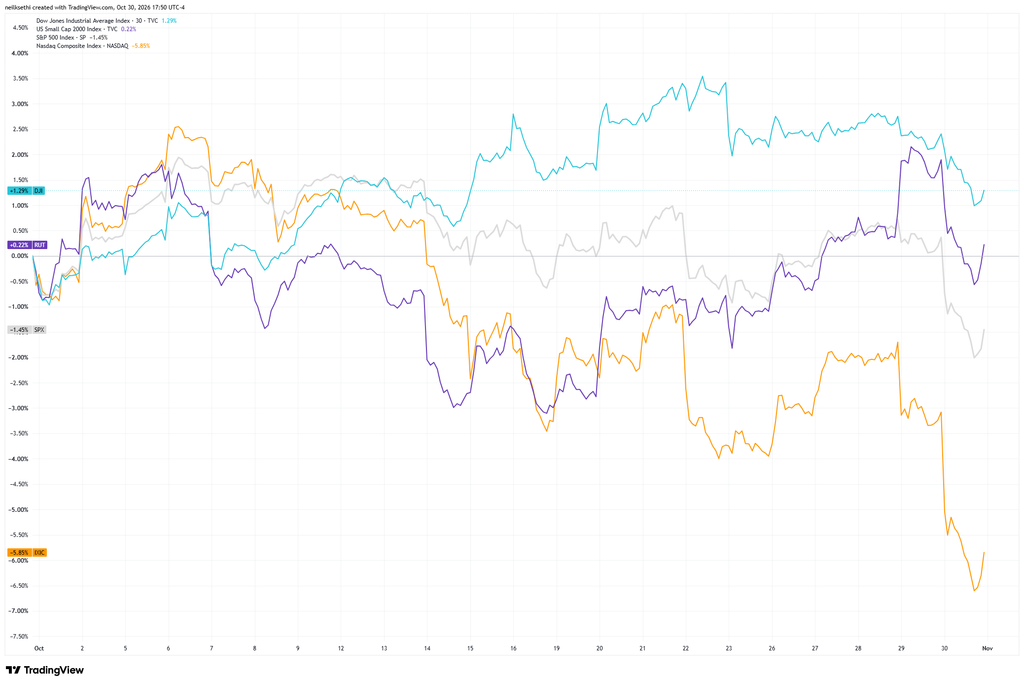
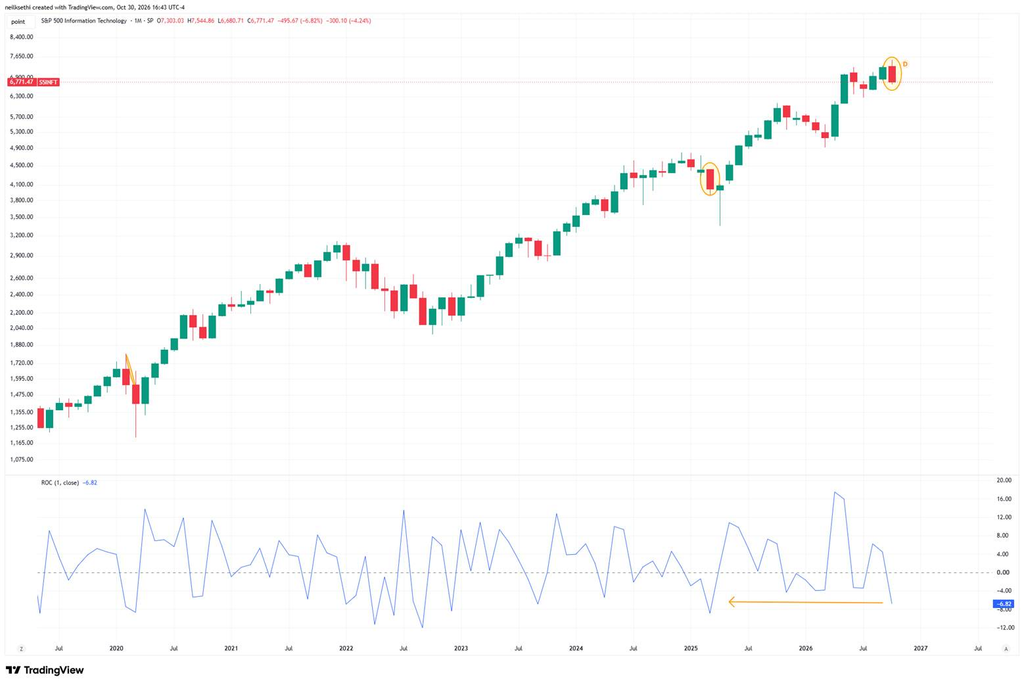
For October, the Nasdaq fell 5.3% with the S&P 500 Tech sector down 6.8%, both their worst months since March 2025, while the SOX fell 15.4%. The S&P 500 slipped 0.9%, while the DJIA rose 1.7% and the Russell 2000 edged up 0.5%. Year to date, the Russell 2000 is up 13.3%, the S&P 500 10.7%, the Nasdaq 9.4% and the DJIA 7.7%, per Briefing.com.
Intel (INTC) (-28.6%) had its worst day ever, per the WSJ, after its weak fourth-quarter forecast (more here: Intel Sinks as PC Slump, Supply Snags Swamp 78% Data Center Surge), leading chip stocks lower. Reddit (RDDT) (-29.2%) had its biggest one-day decline since its 2024 IPO following a dire warning about search traffic and user volume in the months ahead, as investors worried that its plan to limit access for logged-out users will weigh on traffic while it’s already dealing with a drop in active US users (Bloomberg), drawing analyst downgrades and price target cuts (TipRanks).
The rotation helped less than on Thursday. The equal-weighted S&P 500 fell 0.8%, less than half the cap-weighted index’s drop, but the selling was broader, with small and mid caps also lower, per Briefing.com. Still, six of 11 sectors rose, led by Energy and Consumer Staples, while Tech (-4.2%) as noted was the worst. Helene Meisler says the rotation remains alive and well.
In economic data, Q3 employment costs rose 0.8% quarter-over-quarter, in line with expectations, with year-over-year compensation growth slowing to 3.37%, the least since Q2 2021, and real compensation falling further negative (more here: Fed’s Favorite Wage Metric Shows Slowest Annual Gain Since 2021 as Real Pay Remains Negative). The Atlanta Fed’s GDPNow started Q4 tracking at 3.22% (more here: GDPNow Tracking Slowdown in Q4).
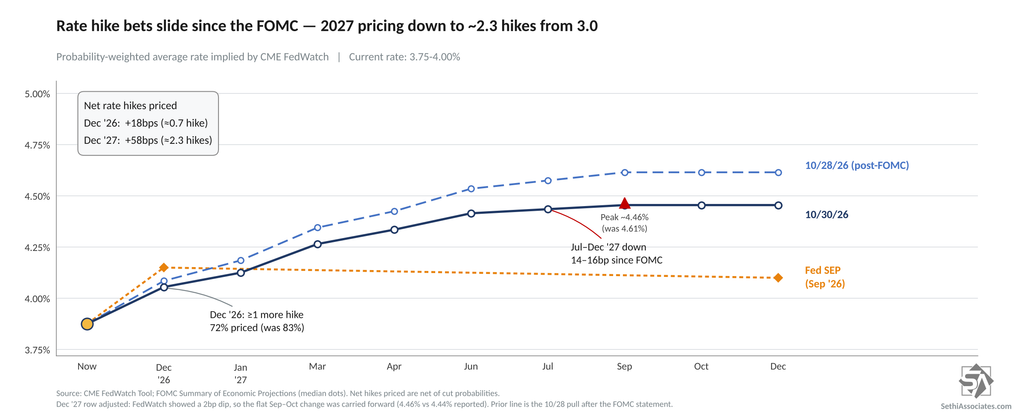
Fed officials backed more rate hikes at a gradual pace (Bloomberg). Dallas Fed President Lorie Logan said the FOMC needs at least two more 25-basis-point hikes, St. Louis Fed President Alberto Musalem said “additional firming of monetary policy will be necessary, and soon,” and Richmond Fed President Tom Barkin said a “gradual approach” makes sense because the Fed is “not much behind the curve,” per the WSJ. Hike expectations kept falling with the AI trade: December is now a 72% chance of a hike, down from 83% after the FOMC, and just 58 basis points of hikes are priced through December 2027 (about 2.3 hikes), down from 74bp, per CME FedWatch.
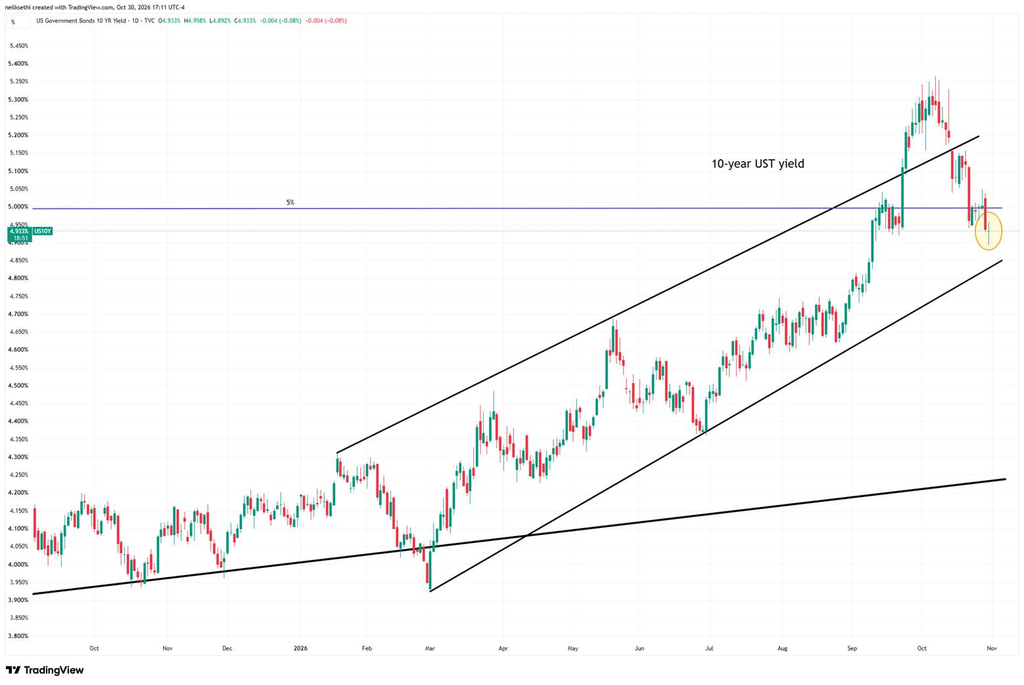
Treasuries were the anti-AI trade again Friday, with the 2-year yield down 7 basis points to 4.59% (-9 basis points for the week) in the cash session and the 10-year down 6 basis points to 4.93% (-6 for the week), per Briefing.com. Gold fell 3.3% to its lowest close since October 2, 2025, back below $4,000, and bitcoin futures fell 5.1% after a record $6.3 billion hack at Binance, per the WSJ. WTI settled just above $104 a barrel, per Briefing.com, while Brent climbed to $117.64 after a tanker transiting the Strait of Hormuz came under attack, per the WSJ, citing UK Maritime Trade Operations.
Next week is a packed schedule with notable economic reports every session, more earnings including Apple (AAPL) and Advanced Micro Devices (AMD), Fed speakers return, the Treasury makes its much-anticipated quarterly refunding announcement, and, of course, the US midterm elections are Tuesday. As a reminder, US clocks fall back Sunday.
Market Commentary
Equities:
- “This earnings season has been tough on AI players, with most getting punished against a backdrop of AI bubble and inflation fears,” said Anna Wu, an investment strategist and founder of Floodlines Research. “Higher funding costs and credit risk could eventually force hyperscalers to slow their build-out.” She added, “Nvidia’s results [November 17] could be the last chance we have to lift the mood during this results season.”
- “If the major averages begin to drop in a more compelling manner, it is very likely that investors will stop rotating into other sectors and start rotating into cash,” said Matt Maley at Miller Tabak. “This is especially true since they have been hearing about a bubble for over a year now.”
- “The tone has changed a bit, and whether that changes the sustainability of the rotation is still yet to be determined,” said Globalt’s Keith Buchanan, who noted that this is a “scrutinizing” and “discerning” market. “Last year was hope. This year is: At the end of day, how does this all work in real world terms, like how to finance [it] and who gets the economics. Those questions are much more difficult to answer.” He added, “There are real economy risks, and the market’s picking up on that.”
- While AI demand remains robust, there’s a rising risk of mid-cycle capital expenditures indigestion, according to Ulrike Hoffmann-Burchardi at UBS Chief Investment Office. “We continue to see scope for equity gains overall and believe investors should focus on building a resilient portfolio that includes exposure beyond tech,” she said.
- “Now that the combined capital spending boom at the hyperscalers is becoming partly dependent on external financing, investors are becoming more nervous about the sums they are collectively investing and how they are doing it,” said John Higgins, chief economic adviser for financial markets at Capital Economics.
- “Investors are heading into the election long the dollar and short duration, with little protection against volatility — particularly in equity markets,” Corpay strategist Karl Schamotta said. “The consensus expects a narrow Democratic victory to produce gridlock in Congress, leaving the president to pursue his objectives through executive action, but there are significant tail risks.”
- “The midterms will be critical not for the immediate risk of federal policy restricting data centers but to lay the groundwork for potential legislation toward that end in 2029,” said Ariana Salvatore, head of US public policy research at Morgan Stanley.
- “With renewed fears over AI Monetization, the Equity rotation is likely to continue today but the broader indices will reflect Tech’s downside,” JPMorgan traders said in a Friday note.
- The VIX is jumping in “an uncomfortable way,” said Katie Stockton, founder of Fairlead Strategies, in a phone interview with MarketWatch. “It’s not a big extreme, but it’s getting into that territory where you feel like it’s a shift,” Stockton said. “Emotions are running really high,” although most of the selling appears relatively “localized” around tech and the AI trade, she added.
Bonds/Fed:
- “Treasuries are willing to remain quite responsive to the vagaries of the sentiment on AI valuations and equity market wobbles,” said Padhraic Garvey at ING. “Nothing terribly sinister went down here, but the ongoing mood music has just turned that bit sour. What we can say is the move was more a back-end thing than a front-end one.”
- “In our view, the decision was puzzling. It reminds us of someone standing in a room with a fire alarm blaring and smoke pouring under the door, yet insisting on more evidence before calling the fire department. Thursday’s economic data only reinforced our conviction that the Fed should have raised rates by 25bps on Wednesday,” Yardeni Research wrote (see my X post below).
Stock and Sector Breakdown
Schwab
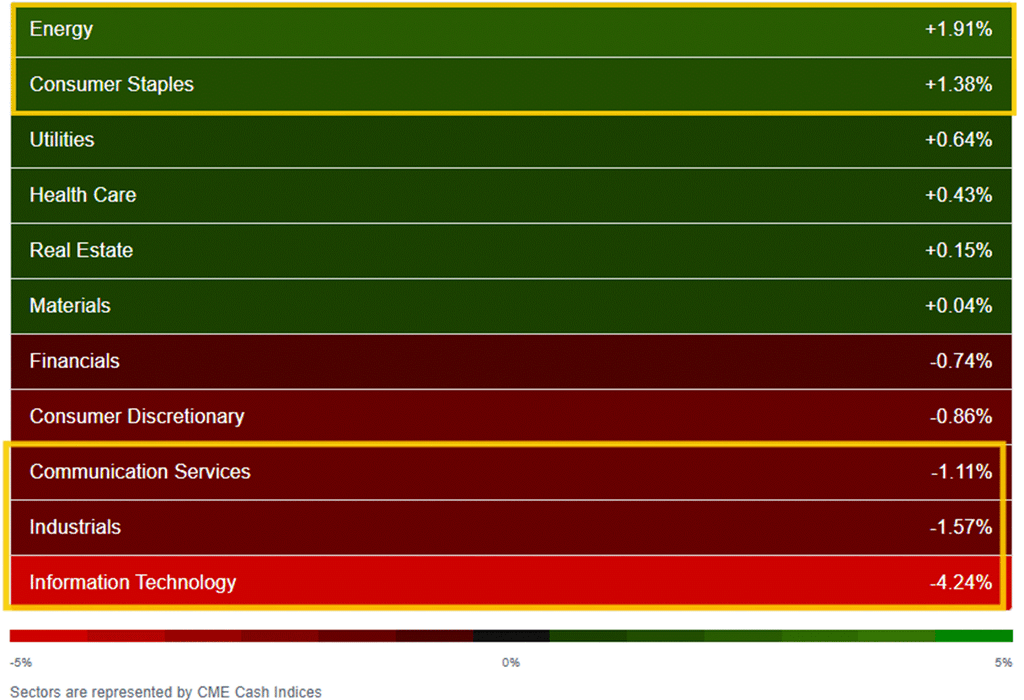
A narrower range than Thursday’s 9-point spread, but still a wide one at about 6.2 points. Despite the awful index action, six of 11 sectors rose, led by Energy (+1.91%) and Consumer Staples (+1.38%), with Utilities (+0.64%), Health Care (+0.43%), Real Estate (+0.15%) and Materials (+0.04%) also higher.
To the downside, Tech (-4.24%) was the worst, its 11th straight session in the top two or bottom two sectors, with Industrials (-1.57%), Communication Services (-1.11%), Consumer Discretionary (-0.86%) and Financials (-0.74%) also lower.
For October, the S&P 500 Tech sector fell 6.8%, its worst month since March 2025, while the Consumer Staples ETF (XLP) rose 10.9%, its best month since its 1999 inception, and the Health Care ETF (XLV) 9.8%, its best since April 2020.
Tech Sector
Staples Sector
Health Care Sector
FedEx Freight (FDXF) (+14.9%) was the best performer in the S&P 500 after it forecast earnings for the holiday quarter above analysts’ estimates on Thursday, citing improvement in volumes after reporting bigger-than-expected quarterly profit and revenue thanks to better pricing (Reuters). Reddit (RDDT) (-29.2%) was the worst, just edging out Intel (INTC) (-28.6%), which had its worst day in data going back to 1980. Tier1Alpha warned this morning that the damage could extend well beyond Intel’s 0.70% weighting in the S&P 500, since it’s the second-largest holding in the semiconductor ETF (SOXX) at about 8.3%, and rebalancing in the 3x leveraged SOXL (back over $25 billion in assets) could drive selling across the rest of the index (see my X post below). The outlook also weighed on PC makers HP Inc. (HPQ) (-9.6%) and Dell Technologies (DELL) (-10.8%), per Briefing.com. Canaccord called Intel a battleground stock (TipRanks). Stephen Guilfoyle looked at the Intel C-suite’s major error.
Likely in part due to the connection Tier1Alpha noted, the rest of the chip complex followed, with the SOX (-7.2%) closing below its 200-DMA at its lowest since July 29.
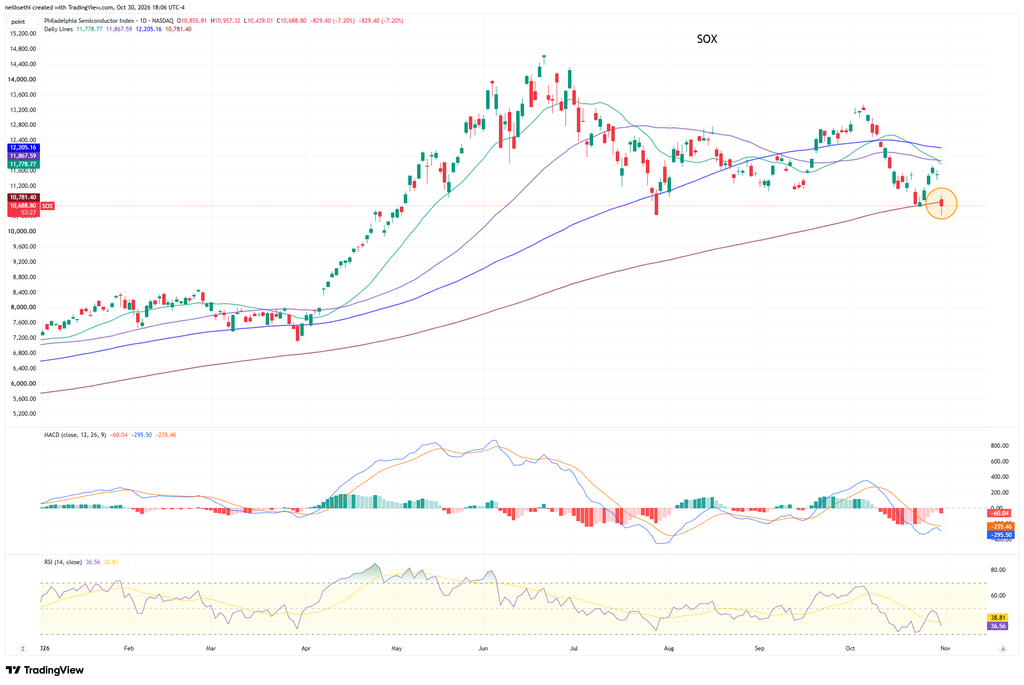
Qualcomm (QCOM) fell 11.1%, Advanced Micro Devices (AMD) 10.9%, Marvell Technology (MRVL) 10.0%, Micron Technology (MU) 5.3%, Broadcom (AVGO) 5.5% and Nvidia (NVDA) 4.2%, while Sandisk (SNDK) sank 13.5% as another cash flow miss got punished (chart below): first-quarter operating cash flow of $6.4 billion missed the $6.7 billion expected even as sales, adjusted EPS and gross margin all beat and revenue guidance came in ahead of estimates, per Bloomberg. That said, the giveback is a tiny slice of its roughly 450% rise this year coming into Friday.
The VanEck Semiconductor ETF (SMH) closed at $522.49, 0.5% above the $520 line BofA’s Michael Hartnett said needs to hold “before year-end rally starts” (see the Hartnett post below), although the Roundhill Magnificent 7 ETF (MAGS) slipped further below his other “line to hold,” closing at $68.48 vs. his $70 level.
Neoclouds CoreWeave (CRWV) (-9.7%) and Nebius Group (NBIS) (-10.4%) also fell, finishing October down 37% and 35%, respectively, while the Roundhill Memory ETF (DRAM) fell about 20% for the month.
Earnings hit several other names. Illumina (ILMN) (-18.6%) had its worst day since October 11, 2016, and Twilio (TWLO) fell 15.2% even after a third-quarter beat and a stronger long-term outlook (TipRanks). Coinbase Global (COIN) fell 10.6% after returning to profitability on lower revenue and as a record hack at Binance hit crypto (Bloomberg), and SpaceX (SPCX) lost 6.4%. Adding to the downbeat tone, the Financial Times reported that Blackstone told investors Anthropic may not receive an investment-grade rating after its debut.
On the upside, Regeneron (REGN) (+13.3%) jumped after its third-quarter profit and revenue materially topped expectations, per Doug Kass (Mondelez Up, Intel Down), and Global Payments (GPN) (+13.0%) soared on rumors of take-private talks (TipRanks). GoDaddy (GDDY) (+10.7%), Veralto (VLTO) (+6.8%), Cboe Global Markets (CBOE) (+6.8%) and Mondelez (MDLZ) (+3.9%) rallied on their reports. Exxon Mobil (XOM) (+2.2%) and Chevron (CVX) (+1.8%) beat profit expectations on record refining results (Bloomberg), helping Energy lead the sectors, while defensive buying lifted Walmart (WMT) (+1.9%), Coca-Cola (KO) (+1.4%) and Eli Lilly (LLY) (+3.2%), per Briefing.com. Cognizant Technology Solutions (CTSH) (+4.1%) rebounded from Thursday’s drop.
The megacaps held up relatively well. Amazon (AMZN) (-1.4%) pared most of its after-hours loss even as it set up supplier financing to borrow as much as $80 billion against the hardware it buys (Bloomberg), with Chris Versace flagging the support level he’s watching, while Apple (AAPL) (-1.2%) slipped ahead of Monday’s report, as Doug Kass covered the rest of his Apple short. Microsoft (MSFT) (-1.6%), Alphabet (GOOGL) (-1.4%) and Meta Platforms (META) (-1.5%) also fell. Alphabet’s $500 billion wipeout on Thursday was the second-largest one-day loss in market value ever, behind Nvidia’s in January 2025, per Dow Jones Market Data. Ed Ponsi made the best argument to buy Alphabet and Meta now, and Kass took trading long rentals in several tech names off the oversold.
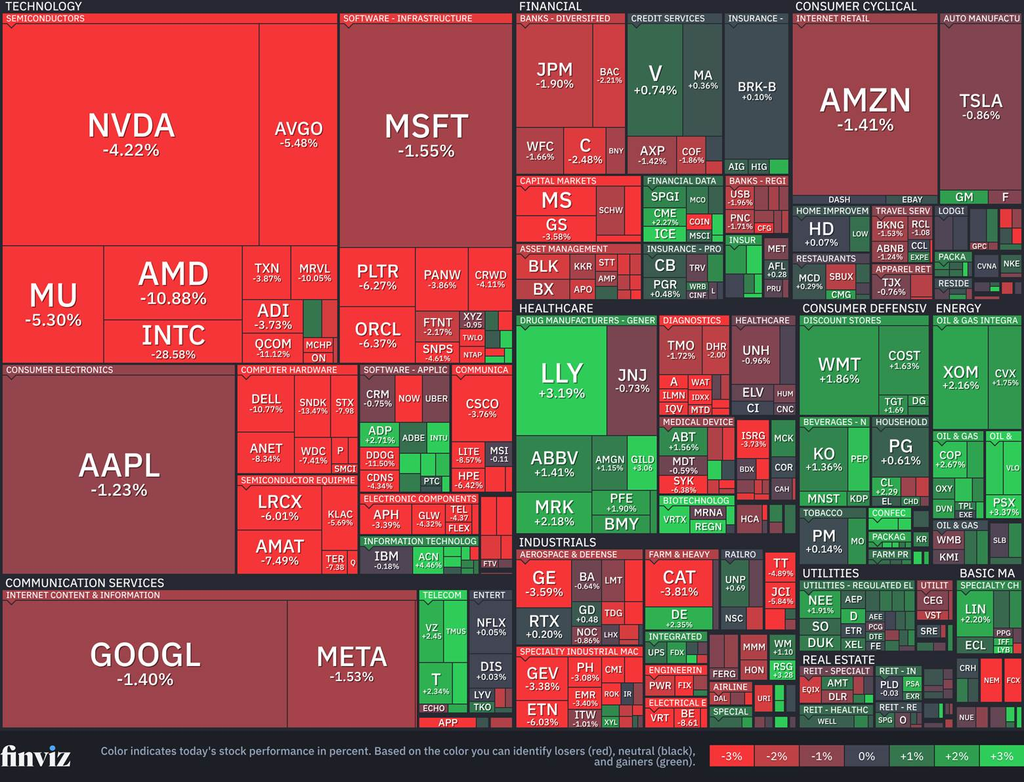
The number of large SPX losers (down over 3%) jumped to 89 from 26 Thursday, while large winners (up over 3%) fell to 35 from 75.
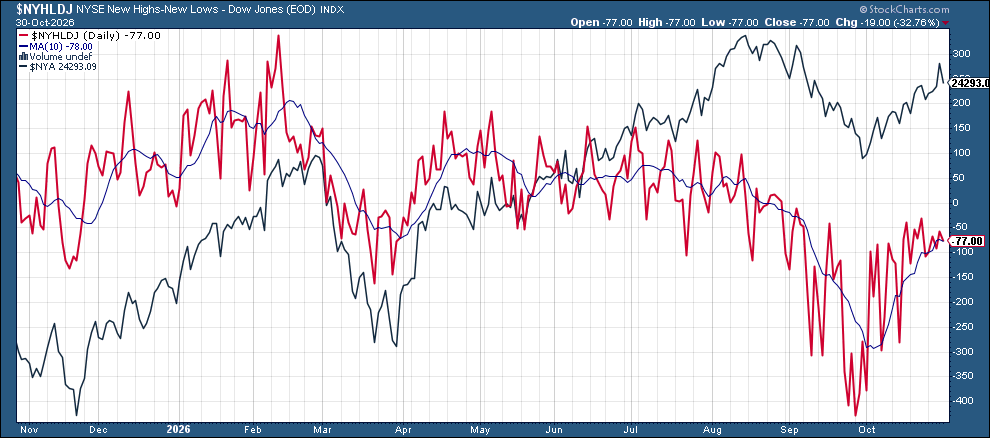
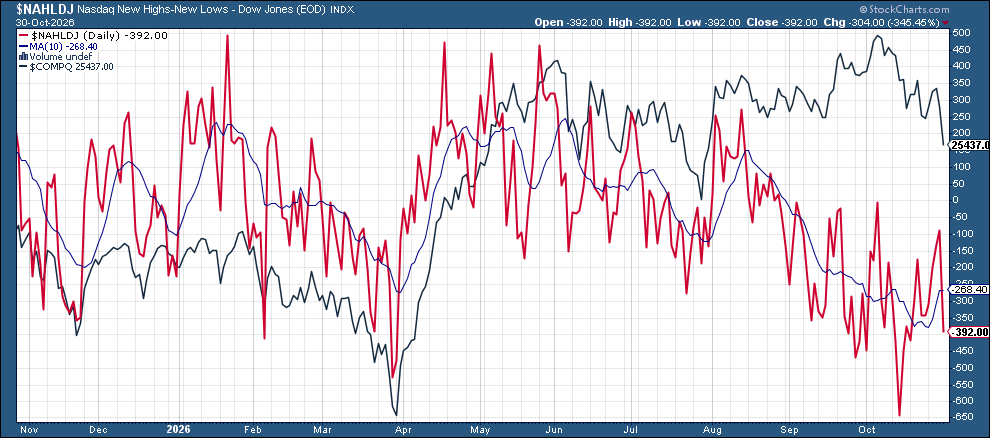
52-week highs minus lows deteriorated to -77 on the NYSE and -392 on the Nasdaq, the 45th straight negative session for the Nasdaq, the longest stretch since a run of over 50 sessions that ended in mid-November 2023. Over 60% of S&P 500 components are now in bear market territory, down 20% or more from their record highs, per a post Doug Kass highlighted (Tweet of the Day (Part Deux)).
Some other stock-specific commentary from TheStreet Pro:
Bret Jensen — Can’t Stomach Tech Stocks Today? Then Check Out This Biopharma
Stephen Guilfoyle — Adding to 6 Small-Cap Positions Amid Risk-Off Session
A Look At The Charts
Note on all charts the colored lines are moving averages (the average price over the lookback period — days on the daily charts, weeks on the weekly charts):
20 = green
50 = purple
100 = blue
200 = brown
Exception is monthly charts where blue is 10-month moving average and brown is 20-month moving average.
MACD = Moving average convergence/divergence line, a measure of momentum that compares longer term and shorter term momentum to gauge if a move is strengthening or weakening. This is probably my favorite individual indicator.
RSI = Relative Strength Index (basically what it sounds like) = measures the strength of the move comparing gains to losses over the given lookback window (I use the standard 14 periods).
SPX
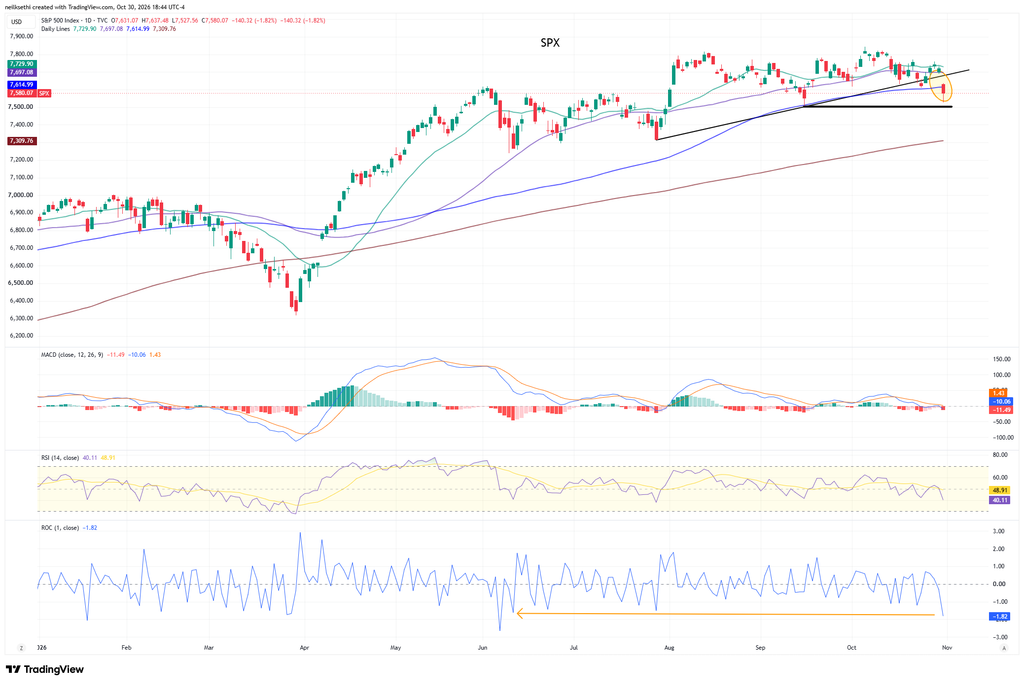
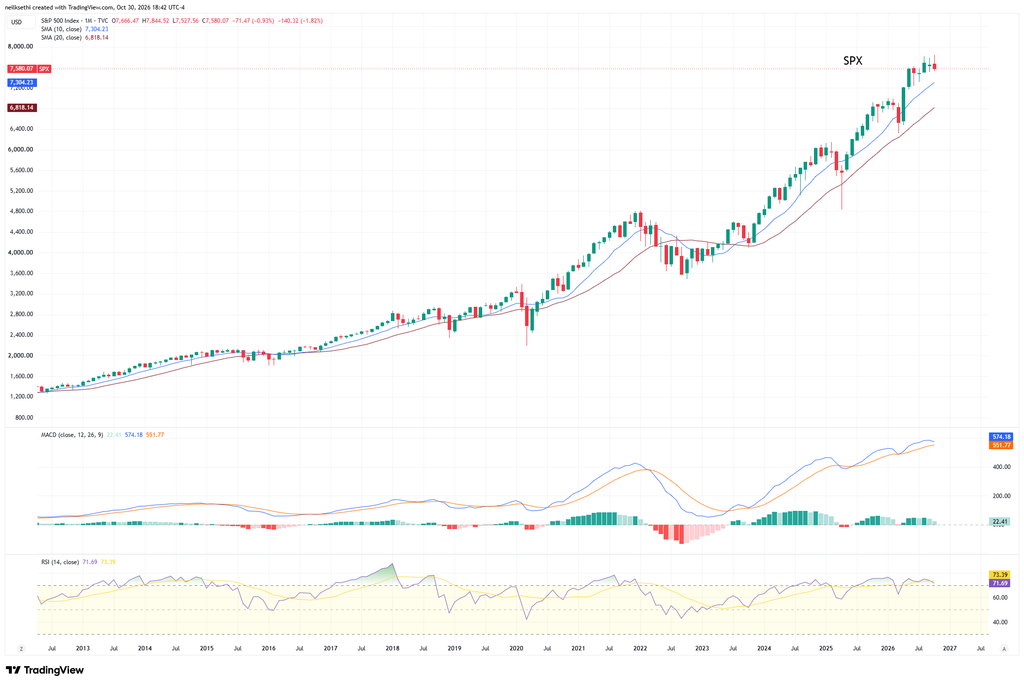
The SPX fell 1.82% to 7,580.07, its worst day since June 5 and lowest close since September 16, falling through its 50-DMA (7,697) and 100-DMA (7,615). The MACD is has fallen to “go short” positioning, and the RSI is at 40. I held on to my SPY position hoping it will find support at the September low, but if that breaks, I’m selling and may short.
Nasdaq Composite
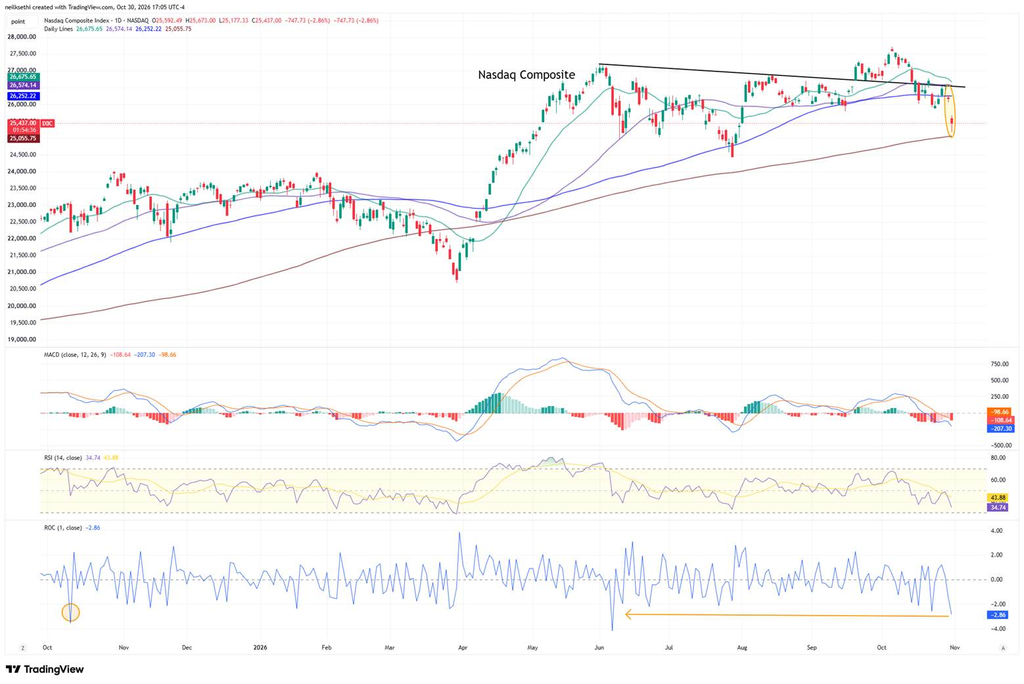
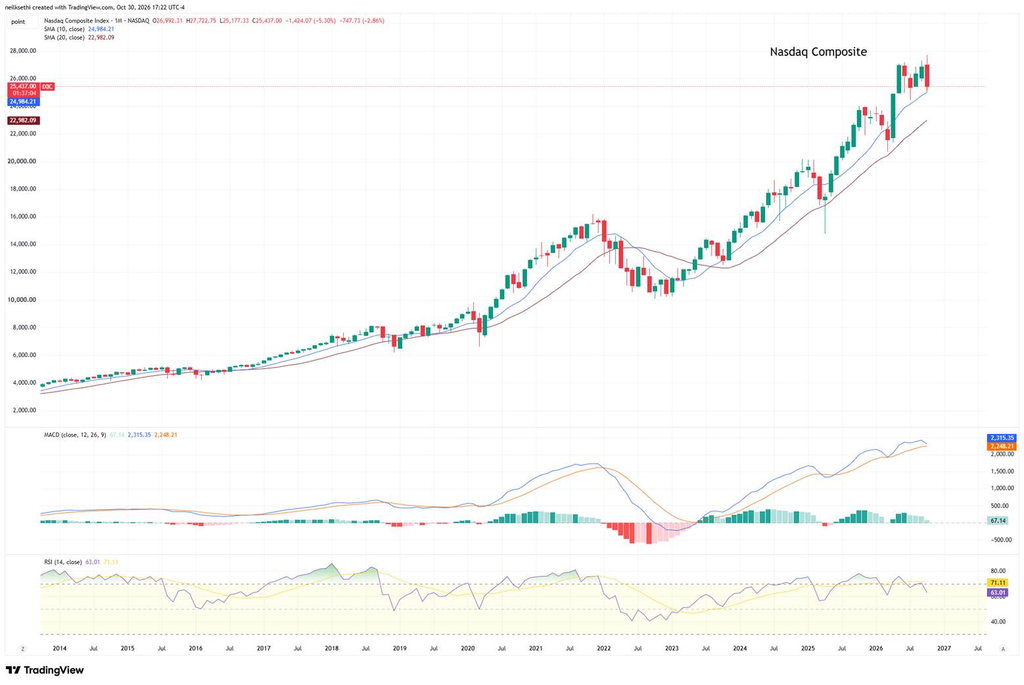
The Nasdaq Composite fell 2.86% to 25,437.00, also its worst day since June 5 and lowest close since July 31, extending its drop below the 100-DMA (26,252) toward its 200-DMA (25,056). The MACD is now in “go short” positioning, and the RSI is at 35.
The Nasdaq-100 (QQQ)
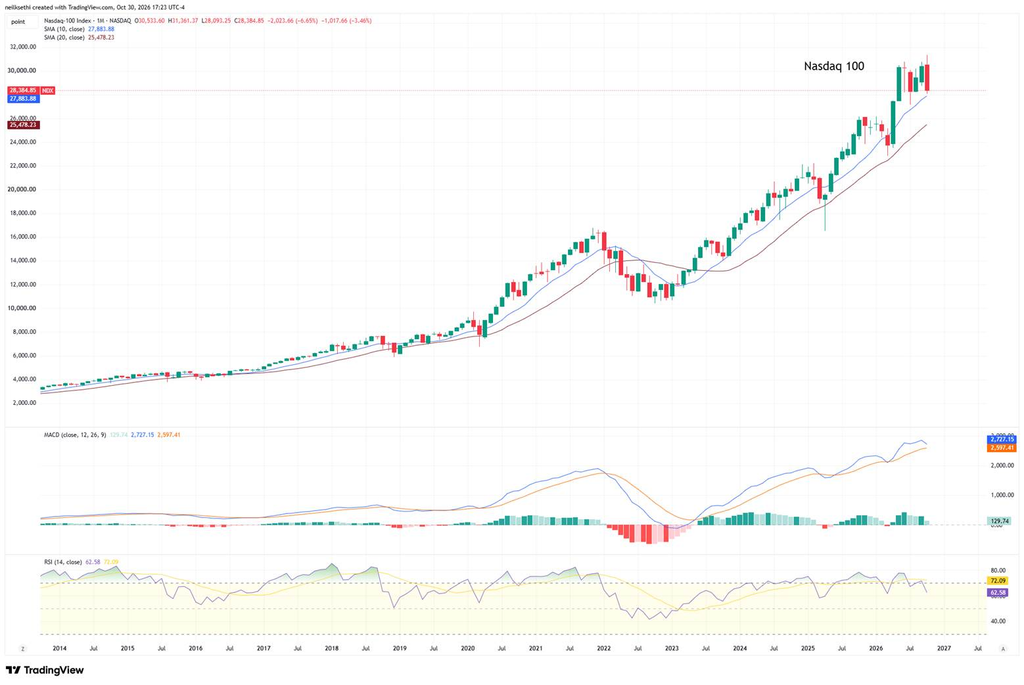
The Nasdaq-100 fell 3.46% to 28,384.85, also its worst day since June 5, after being turned back at its 50-DMA Wednesday. It briefly crossed into correction territory intraday, per Bloomberg. As I noted, I’d sell bounces until it reclaims that level. The MACD remains in “go short” positioning, and the RSI is at 35.
The Russell 2000 (IWM)
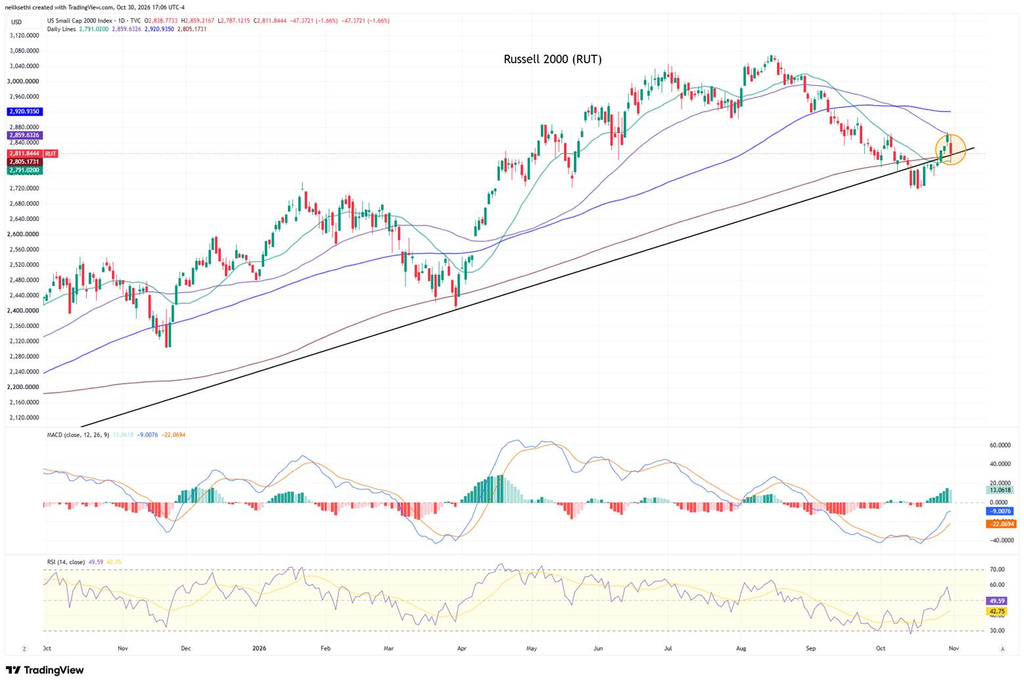
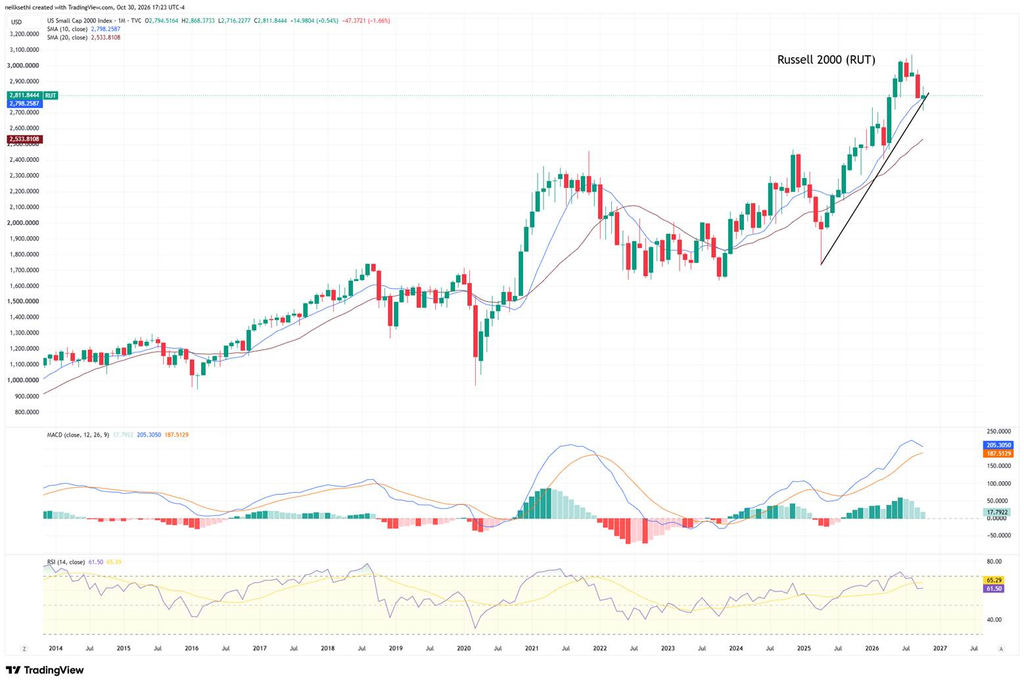
The Russell 2000 fell 1.66% to 2,811.84, snapping a four-day winning streak after being turned back at its 50-DMA (2,860) Thursday, but it held above its 200-DMA (2,805) and finished the week up 1.3%. The MACD remains in “cover shorts” positioning, and the RSI is at 50.
The equal-weighted SPX (RSP)
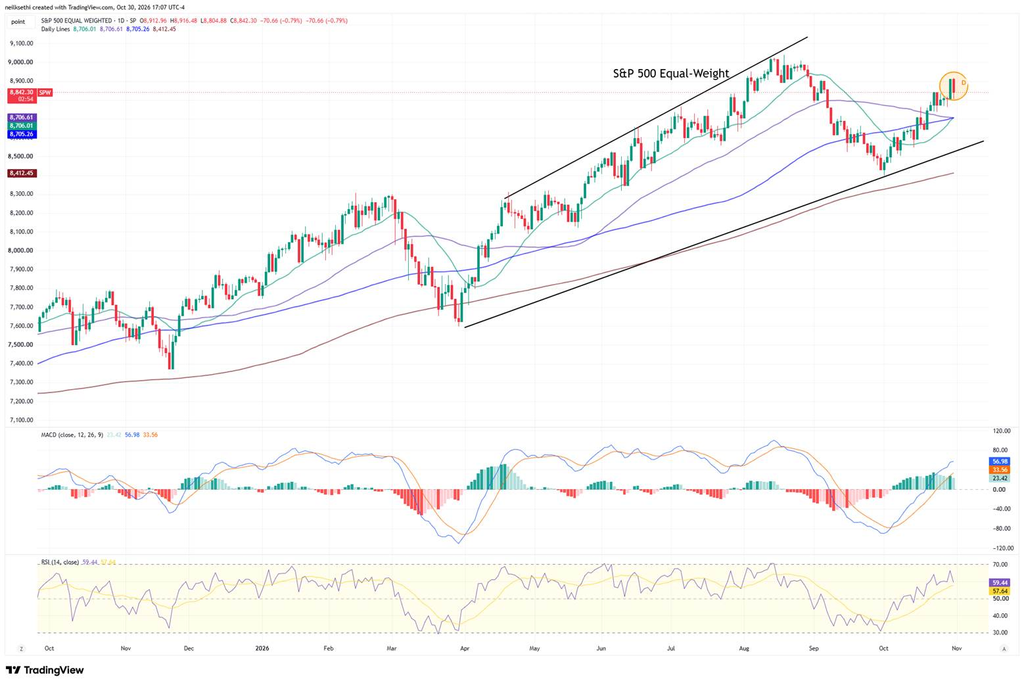
The equal-weighted SPX fell 0.79% to 8,842.30, less than half the cap-weighted index’s drop, and remains above all its moving averages, with the MACD in “go long” positioning and the RSI at 60.
Monthly charts all remain consistent with a longer-term uptrend, although the NDX has lost momentum.
The 2-year Treasury
The 2-year yield fell 0.8 basis points (including post-market) to 4.594%, about 71bp above the Effective Fed Funds Rate (3.88%). It was down about 30 basis points in October and 9 basis points this week.
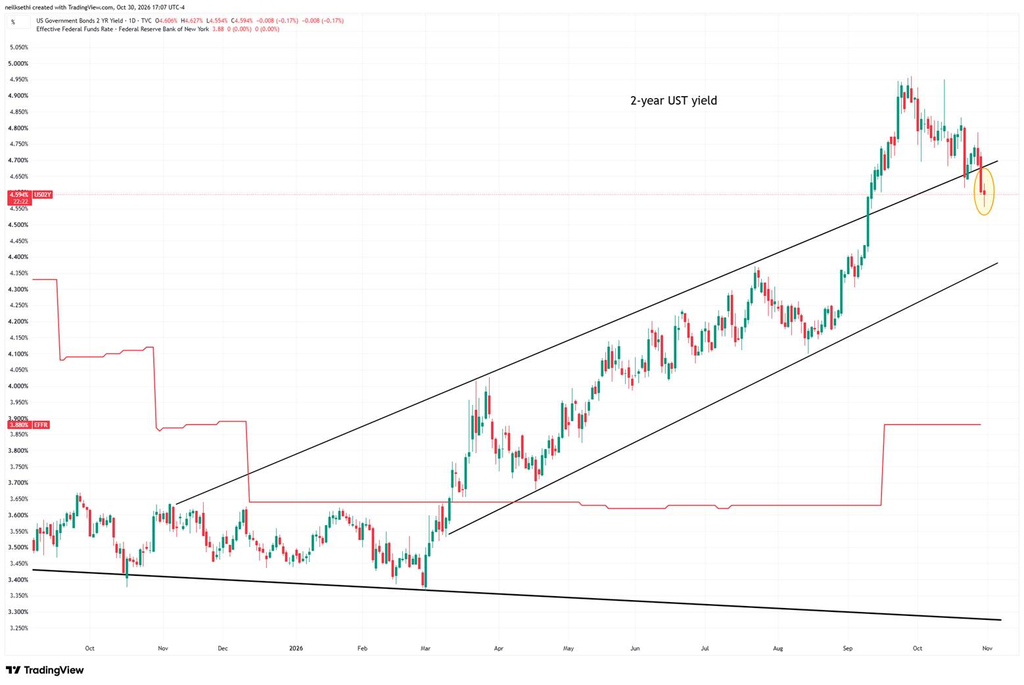
Fed rate hike expectations continued to fall back since Wednesday’s FOMC meeting, following the AI trade lower. December is now a 72% chance of a hike, down from 83% after the FOMC, with 18 basis points of hikes priced by December 2026 (from 21bp) and just 58 basis points through December 2027 (about 2.3 hikes), down from 74bp (about three hikes), per CME FedWatch.
Dallas Fed President Logan (an FOMC voter this year), who dissented in favor of a hike in July but, a little surprisingly given her hawkish bent, went along with this week’s hold, made clear in remarks to Davidson College students today that the skip changes the timing, not the destination. She said the FOMC “needs to implement at least two more 25-basis-point rate increases. After that, it would make sense in my view to pause and examine economic and financial developments to determine what further action may be appropriate.” More in the post below:
10-year yields
The 10-year yield fell 0.4 basis points (including post-market) to 4.933%, holding below 5%. The inverse correlation between the AI trade and Treasuries has pulled 10-year yields down 36 basis points in October, their first monthly decline since the start of the Iran conflict, with a Bloomberg index of Treasury returns up about 2%, on track for its biggest monthly gain since February 2025 (see my X post below).
30-year yields
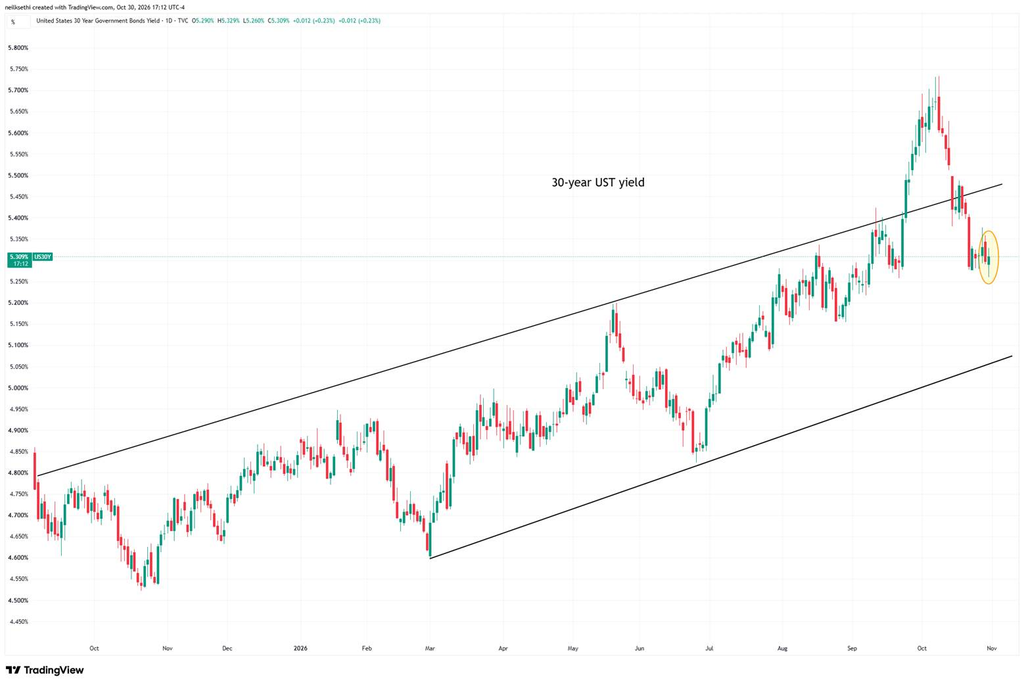
The 30-year yield rose 1.2 basis points (including post-market) to 5.309%, down 32 basis points in October.
VIX
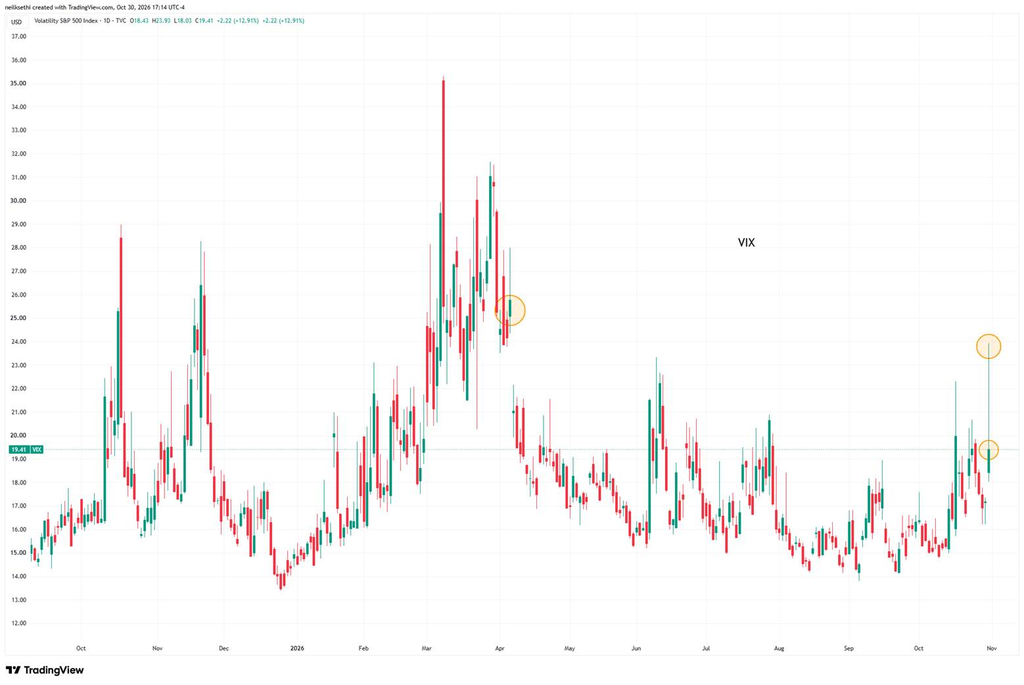
The VIX rose 12.91% to 19.41, its highest close since October 23, after hitting 23.93 intraday, at one point the highest since April. It was at 21.9 around 3pm, on track for its highest close since June 10, before easing into the close. That implies a daily move of about 1.22% over the next 30 days.
The VVIX
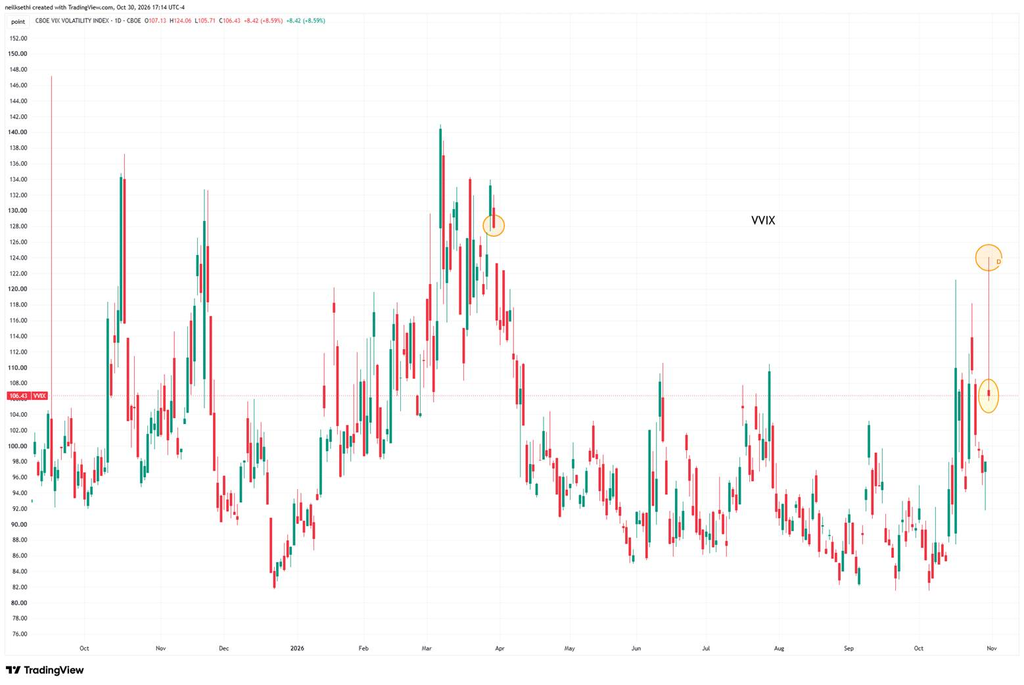
The VVIX (the VIX of the VIX) rose 8.59% to 106.43, back above 100 for the first time since Monday. The current level is consistent with “elevated” daily moves in the VIX over the next 30 days (historically, normal is 80-100, although we haven’t been below 80 since July 2024), and it’s back above the 100 level flagged by Charlie McElligott as indicating higher stress.
1-day VIX
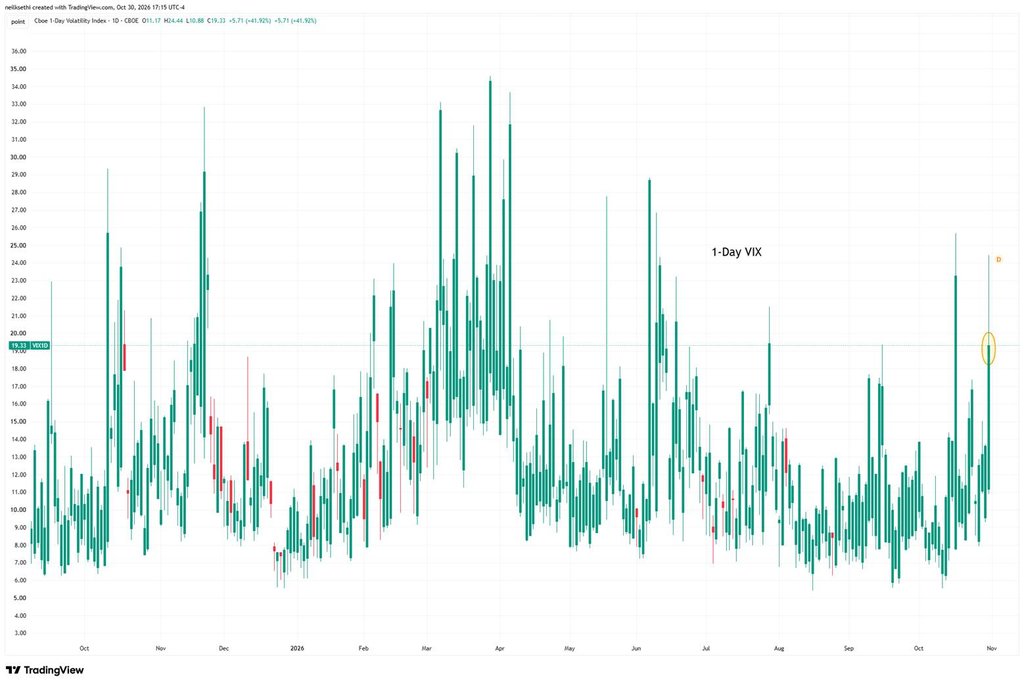
The 1-day VIX jumped 41.92% to 19.33. Thursday’s level (13.62) implied a move of about 0.86% for Friday, and the SPX came in well over that at 1.82%. Tonight’s reading implies a move of about 1.22% for Monday.
WTI futures (/CL)
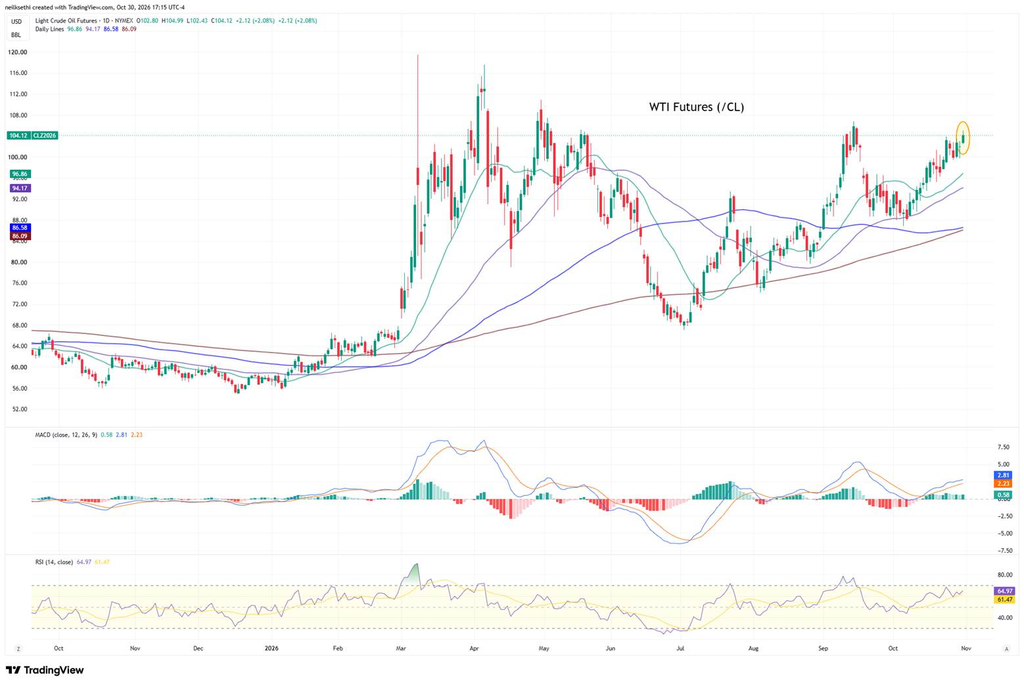
WTI futures, which TradingView has at December currently, rose 2.08% (including post-market) to $104.12, as a tanker transiting the Strait of Hormuz came under attack and Ukraine struck a Russian oil refinery, per the WSJ. They were up 15% in October and remain above all their moving averages, with the MACD in “go long” positioning and the RSI at 65.
DXY
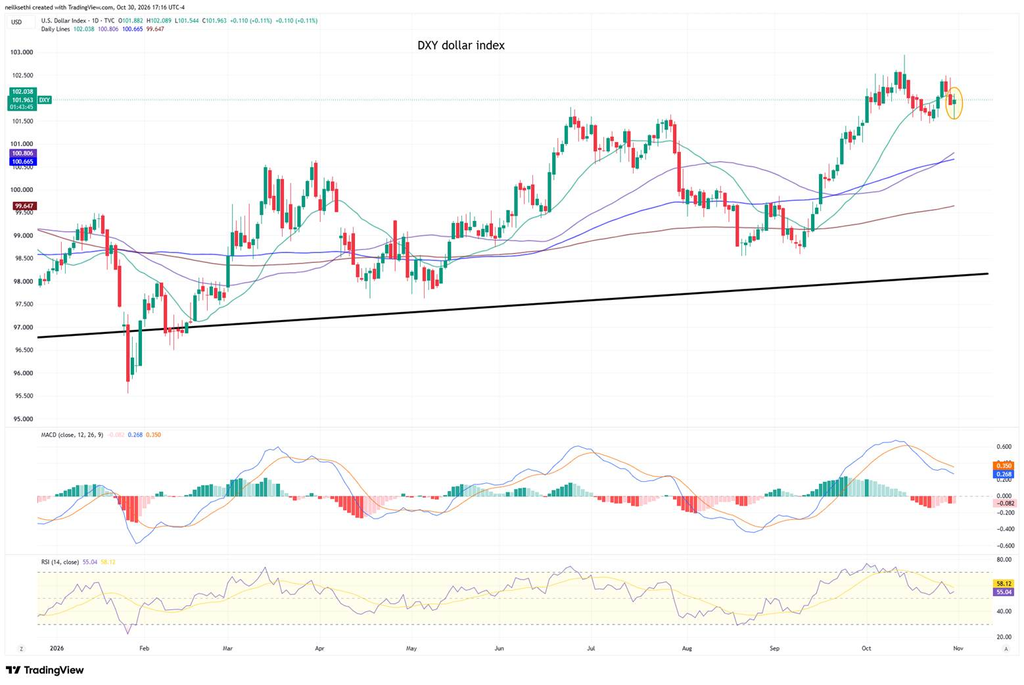
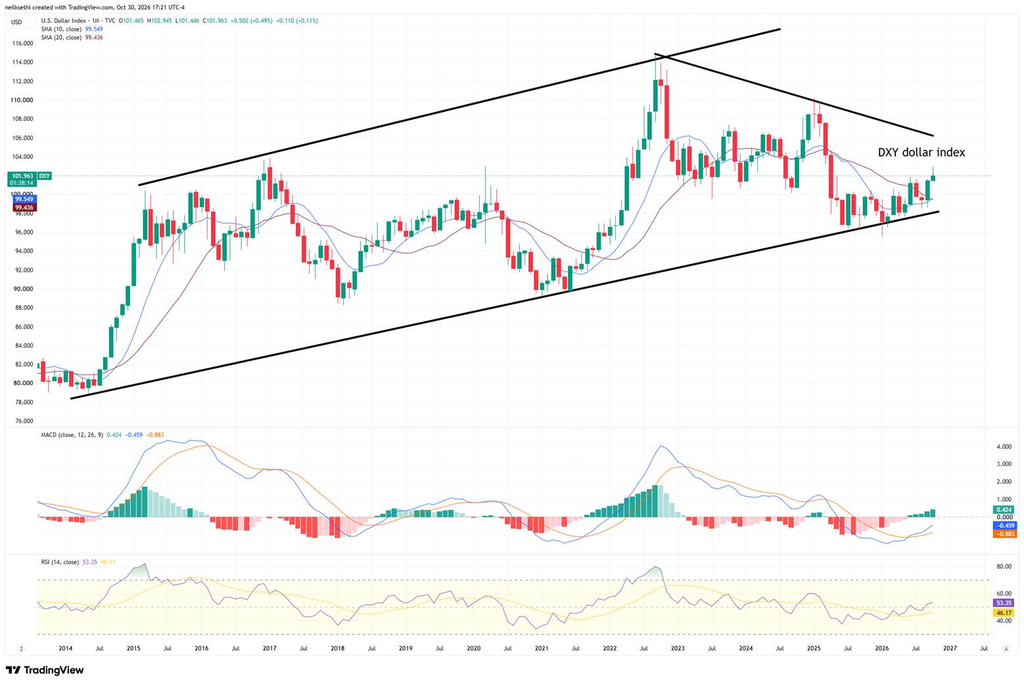
The DXY dollar index (which is fixed weighted with a heavy — 57% — allocation to the euro) was little changed at 101.963 (+0.11%), just below its 20-DMA (102.038). The MACD remains in “sell longs” positioning, and the RSI is at 55.
The monthly chart continues to look favorable with positive monthly MACD and RSI and above the 10 and 20-month moving averages.
Gold futures (/GC)
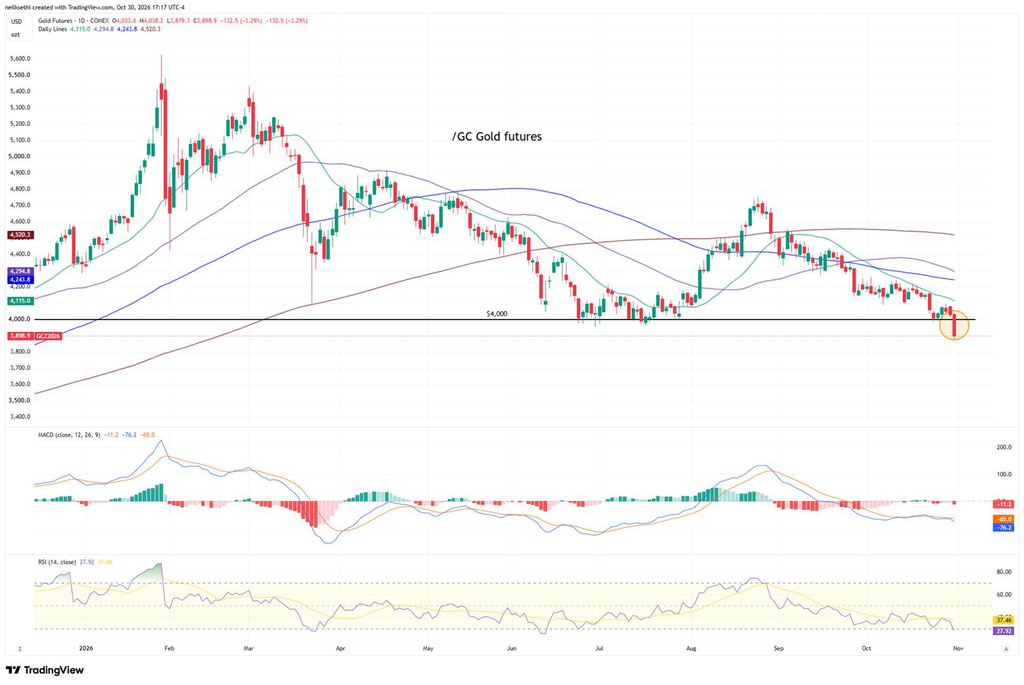
Gold futures fell 3.29% (including post-market) to $3,898.90, their worst day since September 28, breaking below $4,000 to the lowest close since October 2, 2025. They remain below all their moving averages, with the MACD in “go short” positioning and the RSI at 28.
US copper futures (/HG)
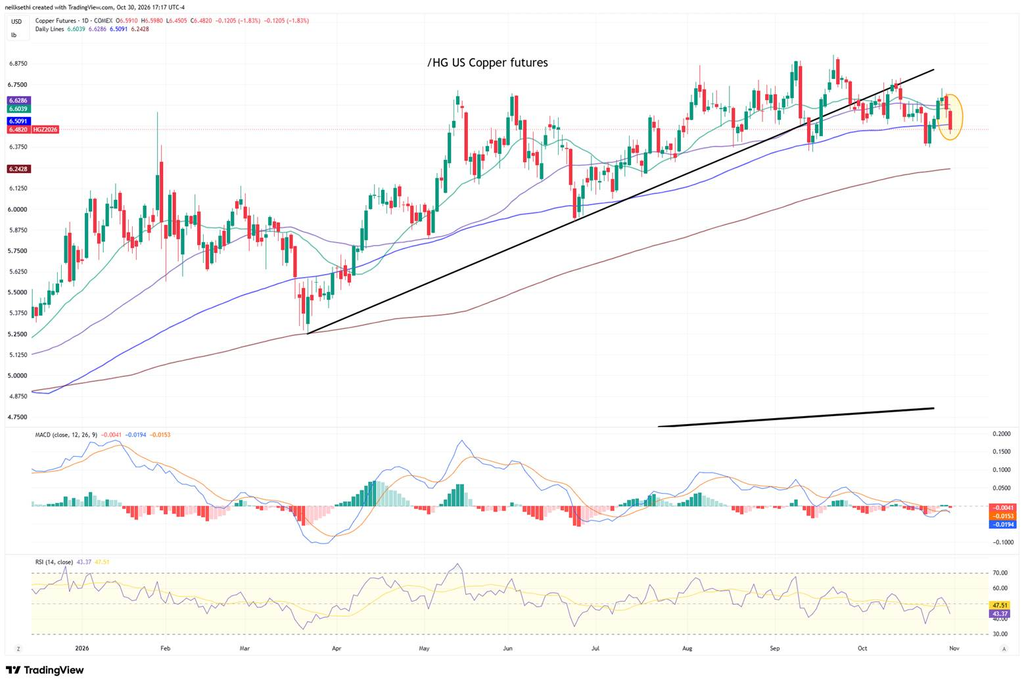
Copper futures fell 1.83% (including post-market) to $6.4820, slipping below their 100-DMA (6.5091) and further below their 20- and 50-DMAs. The MACD is in “sell longs” positioning, and the RSI is at 43. I’ll hold the copper ETF (CPER) unless it breaks the October lows.
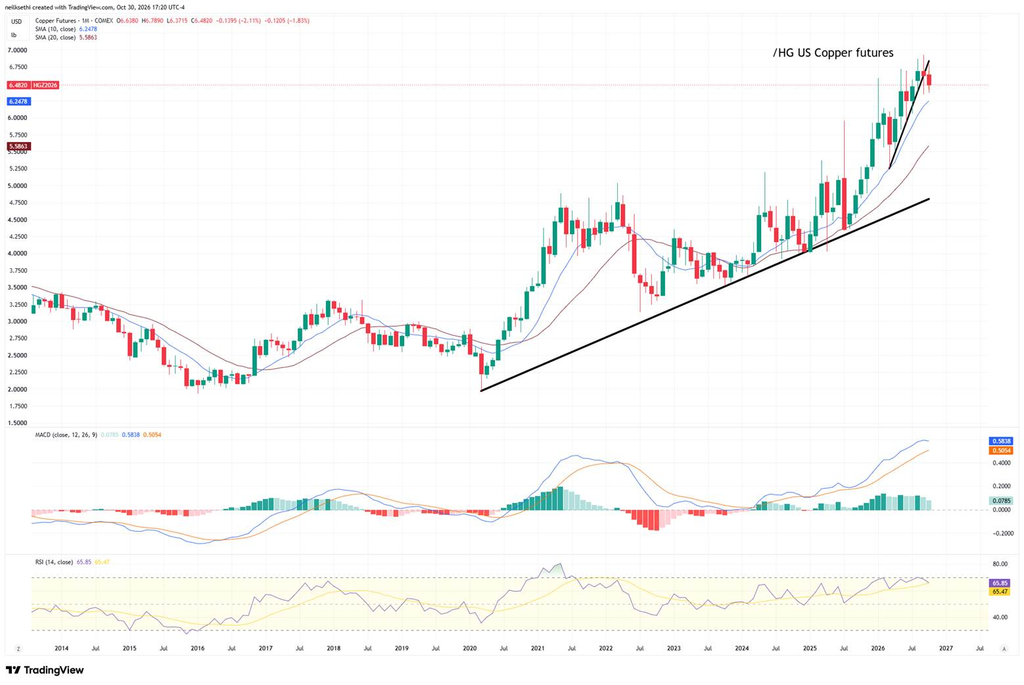
The monthly chart broke the uptrend line, but other indicators remain relatively bullish. Some consolidation might be expected after that run.
US natural gas futures (/NG)
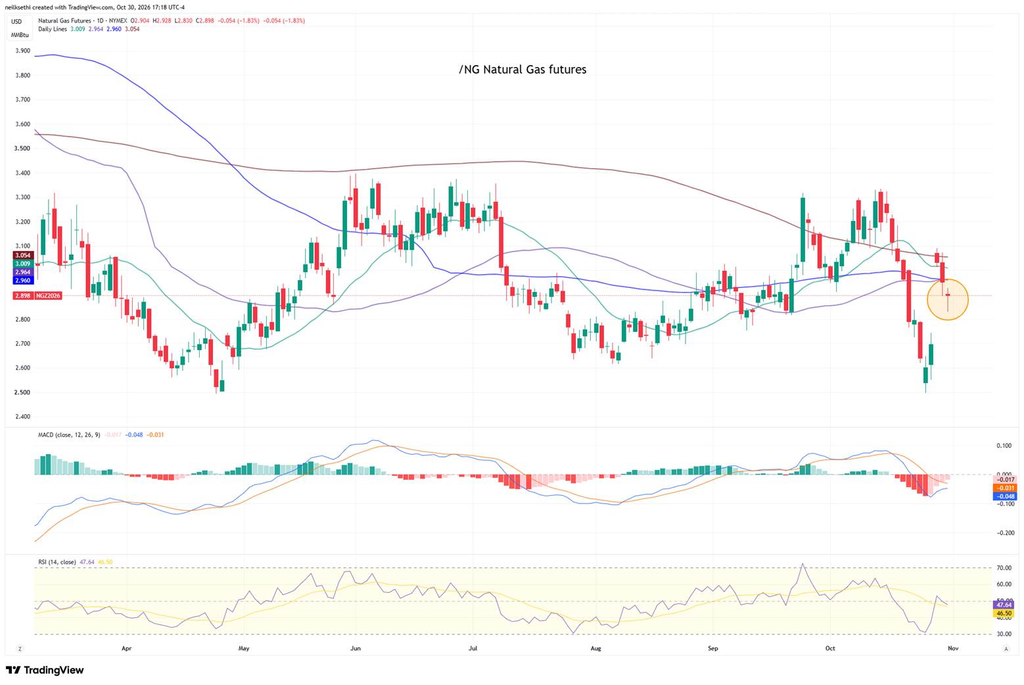
Natural gas futures fell 1.83% (including post-market) to $2.898, continuing to fill Wednesday’s “roll gap.” The MACD is in “go short” positioning, and the RSI is at 48.
Bitcoin futures
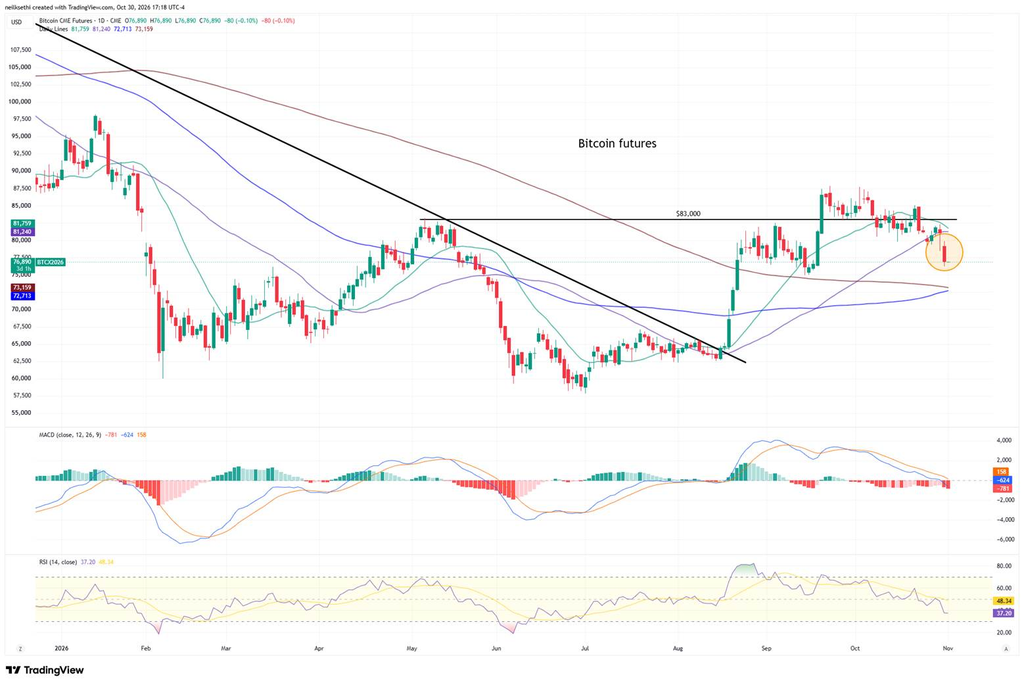
Bitcoin futures fell 5.07% to $76,970 after a record $6.3 billion hack at Binance, per the WSJ, extending their drop below $80,000 and their 50-DMA ($81,240). The MACD has now flipped to “go short” positioning, and the RSI is at 37.
More From TheStreet Pro
Helene Meisler — Rotation Remains Alive and Well
James “Rev Shark” DePorre — Will Investors Rotate or Run as the AI Reset Gains Traction?
Stephen Guilfoyle — An Ugly End to a Big Week on Wall Street
Chris Versace —
- Tech Weighs on the Market, Midterms and Inflation Data Around the Corner: 8 Key Items Shaping the Stock Market Friday
- Updating Our Portfolio Table and Shopping List
Doug Kass —
- Oscillator Still Slightly Overbought
- Taking Some Trading Rentals
- I’m ‘BAC’ Trading in Financials
- I’ve Got a ‘Soft’ Spot for This Long Rental
- My Gnome…
- ARKK Short Covered
- Boockvar Sums Up a Busy Week
And From Me If You Missed It
- The Day Ahead: US Calendar is Light, but Tech Continues Selloff
- GDPNow Tracking Slowdown in Q4
- Europe Gives a Lesson in the Danger of Relying on Commodity Forward Curves
- Fed’s Favorite Wage Metric Shows Slowest Annual Gain Since 2021 as Real Pay Remains Negative
Miscellaneous
Wrap-Up — Worst Day Since June
I said yesterday:
And it turned out that Alphabet would be more than a drag on the indices. Along with the lower-than-expected capex guide from Microsoft (MSFT), disappointing construction numbers from Caterpillar (CAT) and the other notables mentioned earlier, it instigated a broad pivot away from not only the AI beneficiaries but also most of Tech.
However, that broadening trade I mentioned continued to gain steam, with the average company making solid gains, as evidenced by the equal-weighted S&P 500’s best day in two weeks (+1.2% vs. -0.3% for the cap-weighted index).
With Amazon (AMZN) and Intel (INTC) sharply lower after hours, it looks like we’re likely in for another day of this on Friday.
And that proved accurate, although I don’t know that I had the second-worst day for Tech since April 2025 in mind. But it did confirm my inclination to sell bounces in Tech for now, at least until we see some better evidence of stability than we got this week (and preferably until some of the commentators I’ve mentioned who have called the twists and turns of the past couple of years astutely turn more bullish).
A lot of damage has been done, but I don’t think we’ve reached levels that I would say mean more than a bounce is likely. But after a session like Friday’s, some sort of bounce wouldn’t be unusual on a Monday (although there’s a reason they call it “Turnaround Tuesday”).
Let’s see what all the indicators say Sunday.
The Week Ahead — You Thought This Week Was Hectic
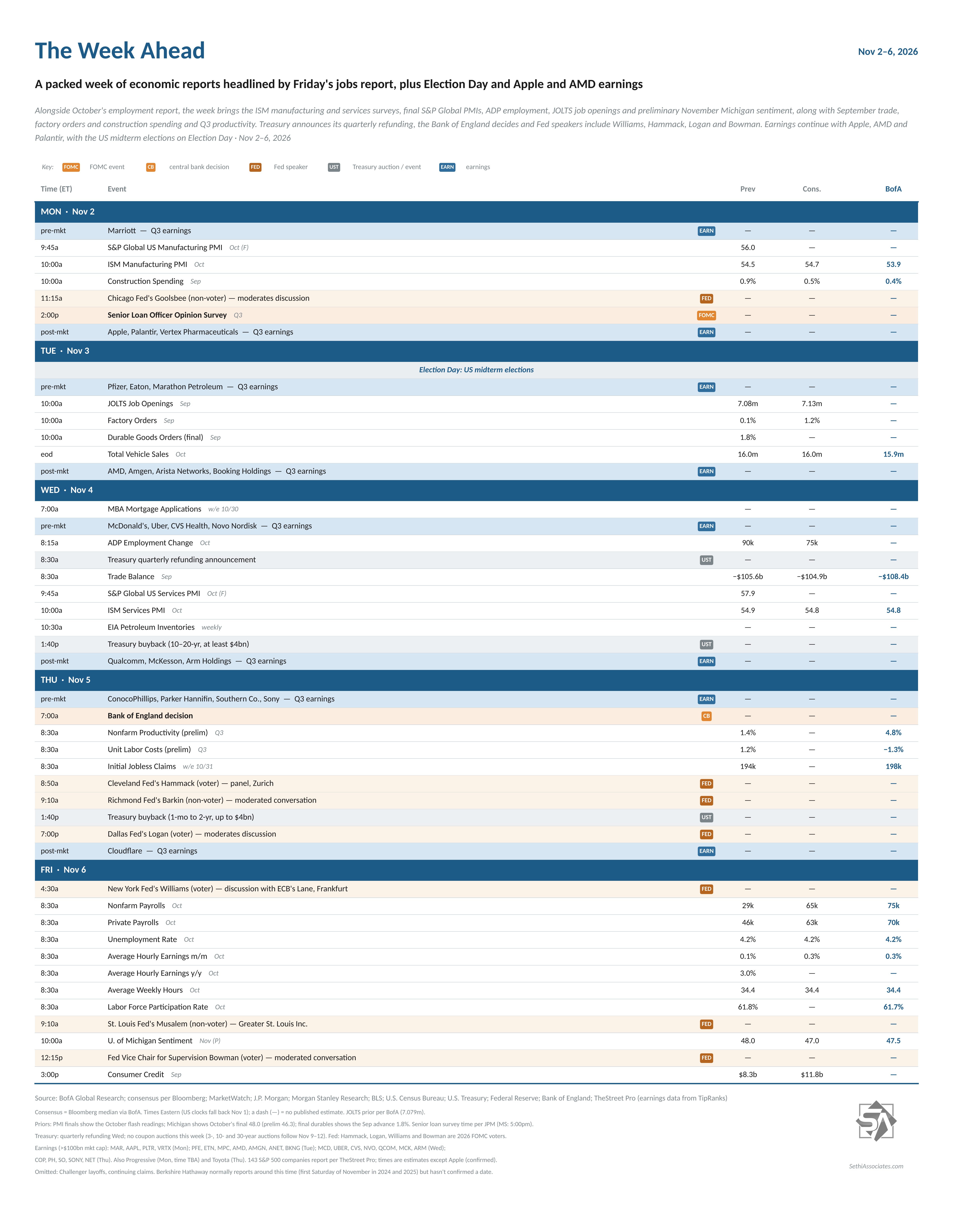
Next week is packed. We get notable economic reports every session, more earnings including Apple and AMD, Fed speakers return, the Treasury makes its much-anticipated quarterly refunding announcement, and, of course, the US midterm elections are Tuesday.
US economic reports are headlined by Friday’s employment situation report. Other October reports are the ISM manufacturing and services surveys, final S&P Global PMIs, ADP employment and vehicle sales. September reports include JOLTS job openings, the trade balance, factory orders and construction spending. We’ll also get Q3 productivity and unit labor costs, preliminary November University of Michigan consumer sentiment and the usual weekly reports (mortgage applications, unemployment claims, etc. — no weekly ADP report this week with the monthly report out).
Fed speakers return in force after last week’s meeting. Chicago Fed President Goolsbee (non-voter) speaks Monday. Cleveland Fed President Hammack (voter), Richmond Fed President Barkin (non-voter) and Dallas Fed President Logan (voter) speak Thursday. New York Fed President Williams (voter), St. Louis Fed President Musalem (non-voter) and Fed Vice Chair for Supervision Bowman speak Friday. The Fed also releases its Senior Loan Officer Opinion Survey Monday. The Bank of England announces its decision Thursday.
There are no non-Bill (>1yr in maturity) US Treasury auctions, but, perhaps more importantly, Treasury announces its quarterly refunding Wednesday, ahead of the 3-, 10- and 30-year auctions the following week.
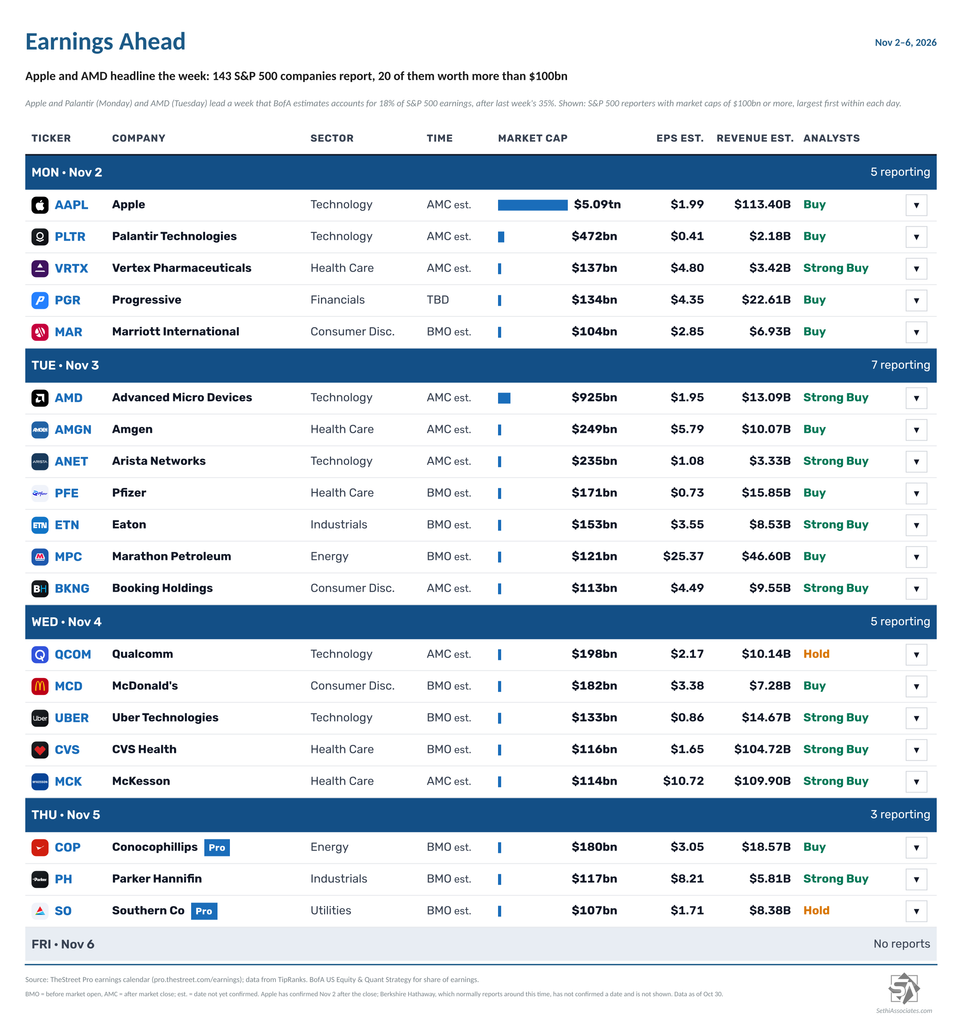
Q3 earnings season continues with 143 S&P 500 components reporting (18% of index earnings, according to BofA), 20 of them with market caps over $100bn:
- Monday: Apple (AAPL), Palantir (PLTR), Vertex Pharmaceuticals (VRTX), Progressive (PGR) and Marriott (MAR)
- Tuesday: AMD (AMD), Amgen (AMGN), Arista Networks (ANET), Pfizer (PFE), Eaton (ETN), Marathon Petroleum (MPC) and Booking Holdings (BKNG)
- Wednesday: Qualcomm (QCOM), McDonald’s (MCD), Uber (UBER), CVS Health (CVS) and McKesson (MCK)
- Thursday: ConocoPhillips (COP), Parker Hannifin (PH) and Southern Co. (SO)
Berkshire Hathaway (BRK.B) normally reports around this time as well but hasn’t confirmed a date.
Outside the S&P 500, Novo Nordisk (NVO), Arm Holdings (ARM), Sony (SONY), Toyota (TM) and Cloudflare (NET) also report.
At the time of publication, in terms of securities mentioned, Sethi was long AAPL, AMZN, AVGO, BKNG, BRK/B, CTSH, CVX, ETN, GOOGL, GPN, MSFT, NVDA, PLTR, SPCX, SPY, UBER, XOM, IWM, RSP, CPER and numerous Treasury ETFs and short AMD and DELL.