Stock Market Today

Market updates and conversation from TheStreet Pro team. Follow the latest and join the conversation below.

Stock Market Today: November 3, 2026

Newest first · All times Eastern · 5 updates

DATE:
By Neil Sethi

AMD Shares Higher After Beat and Raise On Data Center Strength

Semiconductor heavyweight Advanced Micro Devices (AMD) earnings are out, coming in above expectations with a big boost to current quarter guidance on surging data center sales that masked a drop in cash flow and a lack of buybacks.

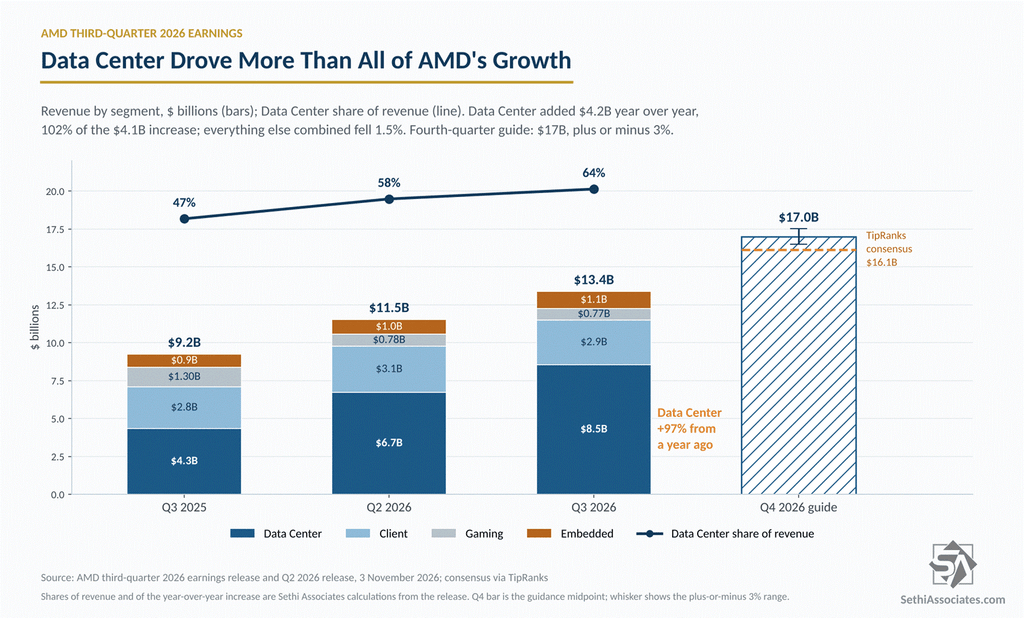
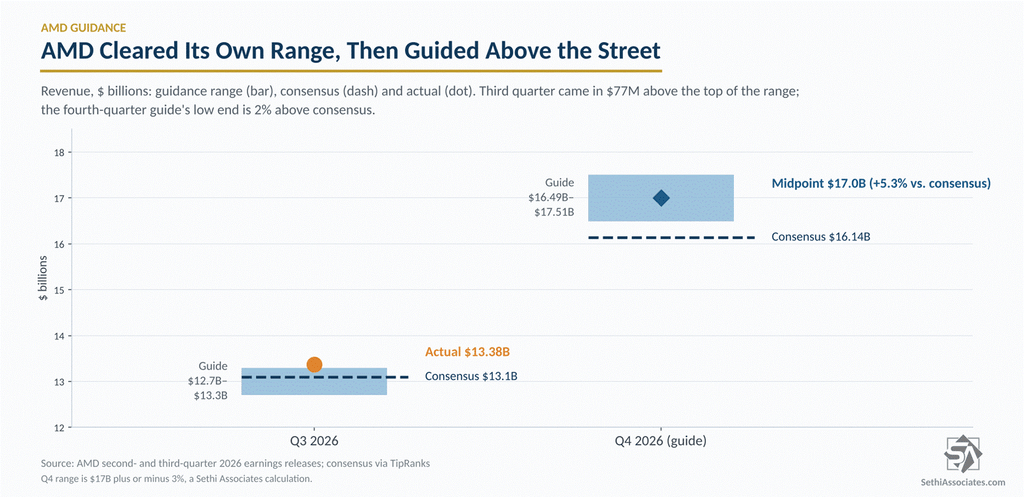
earned $2.09 a share on an adjusted basis, above the $1.95 analysts expected, according to TipRanks. Revenue rose 45% to a record $13.4 billion, beating both estimates and the top of the range AMD gave in August. For the fourth quarter, AMD expects about $17 billion in revenue, versus the roughly $16.1 billion analysts had penciled in. Nearly all of the growth came from one business: data centers.
Data Centers Did the Heavy Lifting

AMD’s data center business, which sells server processors and AI chips to cloud giants, nearly doubled its sales from a year ago to a record $8.5 billion, according to the earnings release. That beat forecasts, and the unit now makes up almost two-thirds of AMD’s revenue, up from less than half a year ago.

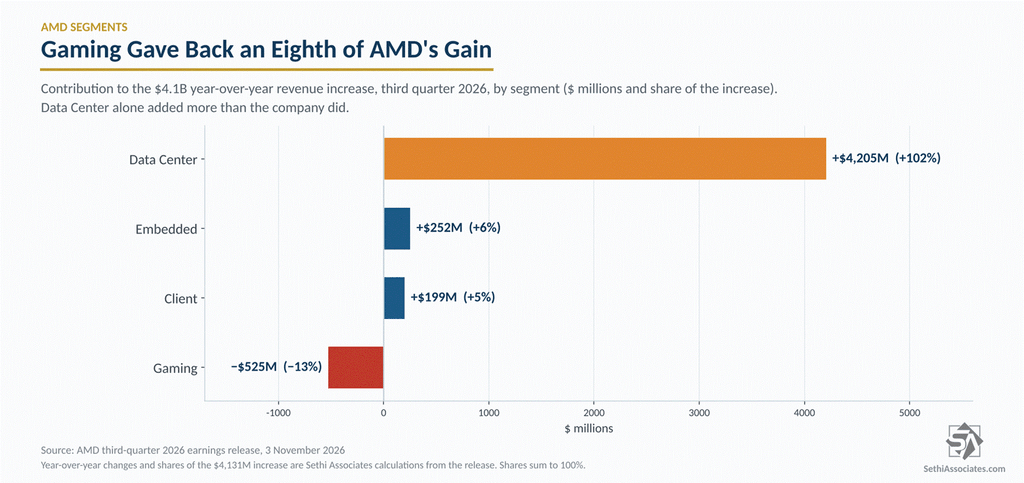
Outside of data centers, AMD’s sales actually slipped a little. PC chip sales grew 7% but came in a bit below estimates, MarketWatch reported, with Bloomberg pointing to higher memory prices weighing on the PC market. Sales of chips for game consoles fell 40%, though that was still better than analysts feared. Embedded chips, used in cars, factories and defense systems, grew 29%.
Profits Are Growing Faster Than Sales

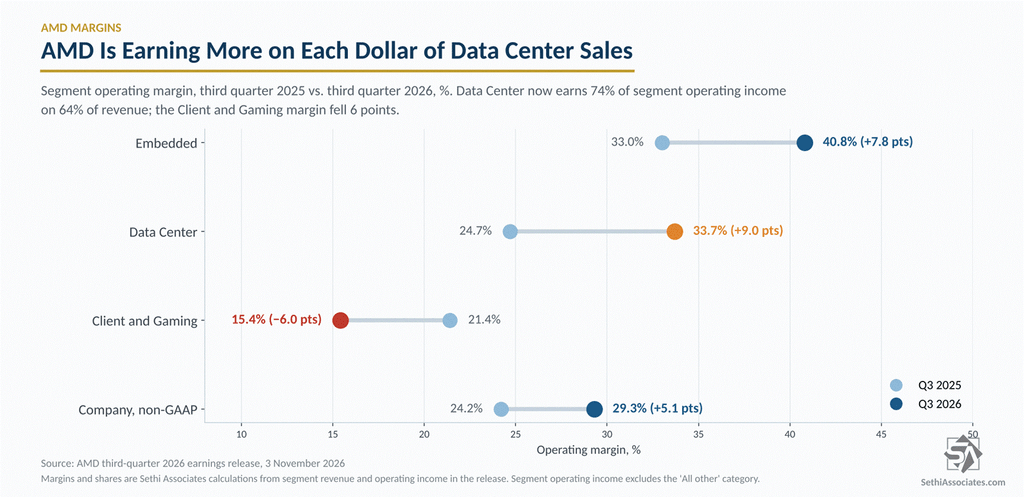
Data centers are now where most of AMD’s profit comes from, and that business is getting more profitable as it grows, so earnings rose faster than revenue. Adjusted operating income rose 75% and beat estimates, per Wall St Engine, while operating expenses grew far more slowly than sales. AMD now keeps about 34 cents of operating profit on each dollar of data center sales, up from about 25 cents a year ago.

The one soft spot was gross margin, the share of sales left after the cost of making the chips. AMD expects it to slip to about 55% in the fourth quarter from 56%, slightly below what analysts expected, according to CNBC. More of AMD’s growth is coming from AI chips and full Helios server racks, which include memory and other parts it buys from suppliers, just as memory prices are rising. Investors will want to hear on the call how much of the slip comes from that and how long it lasts.
A Forecast That Raises the Bar

The $17 billion outlook would put revenue up about two-thirds from a year ago. Even the bottom of AMD’s forecast range is above what analysts expected. CEO Lisa Su said growth should speed up as AMD ramps production of its Helios AI server racks and its next server processor, code-named Venice. HPE’s first Helios order, a $12 billion deal with cloud provider Vultr, gives a sense of the size of the orders now coming in.
Cash Flow Didn’t Keep Up

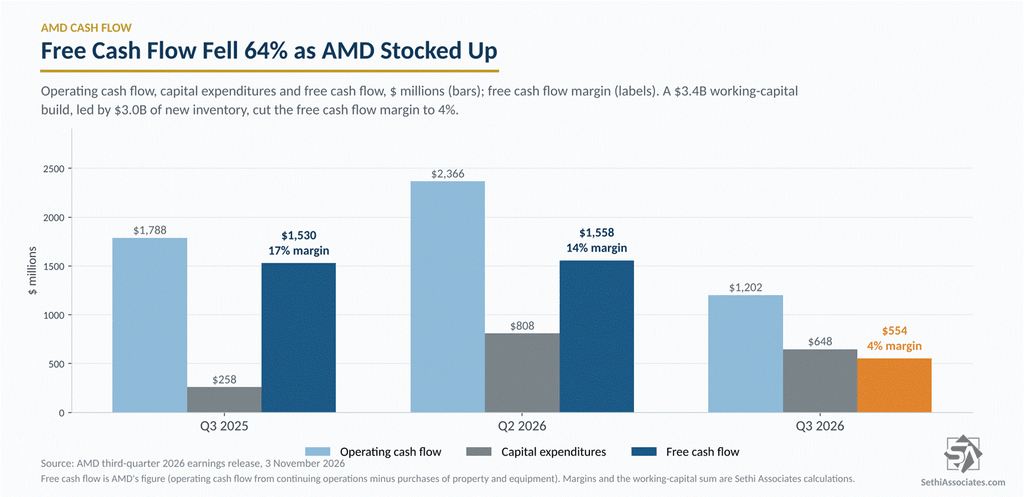
The weak spot in the quarter was cash. Free cash flow, the cash left over after running the business and investing in it, fell 64% from a year ago to $554 million, about half what analysts expected, per Wall St Engine Much of the cash went into inventory, which is up about 45% since the end of last year. With a $17 billion quarter ahead, that may simply be stocking up, but the fourth quarter will show whether it turns back into cash.

AMD also bought back no stock during the quarter, took on $4.7 billion in new debt, and its earnings were held down by a $1.1 billion charge tied to stock warrants it has given some customers. The cost of those warrants rises with AMD’s share price, so a rally adds to that expense. AMD is also investing in some of its customers: it agreed to put $1 billion into Meta’s stock offering and up to $5 billion into Anthropic, CNBC reported.
Big Tech’s Spending Is AMD’s Opportunity

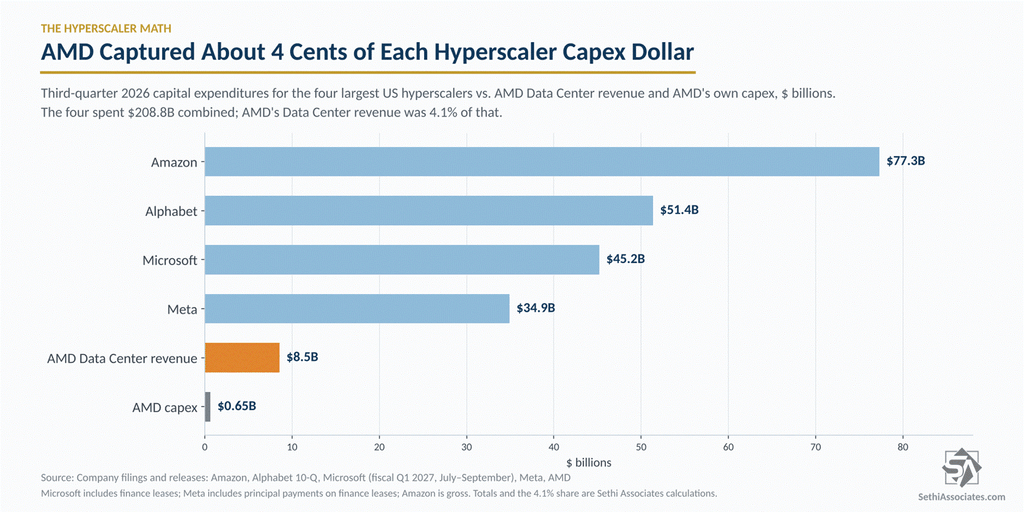
Amazon, Alphabet, Microsoft and Meta together spent more than $200 billion on capital projects last quarter, much of it on data centers. AMD’s data center sales were only about 4% of that. Each extra slice of that spending AMD wins is worth billions in quarterly sales. And the spending is still climbing, with Alphabet and Microsoft both signaling bigger budgets next year.
What to Watch

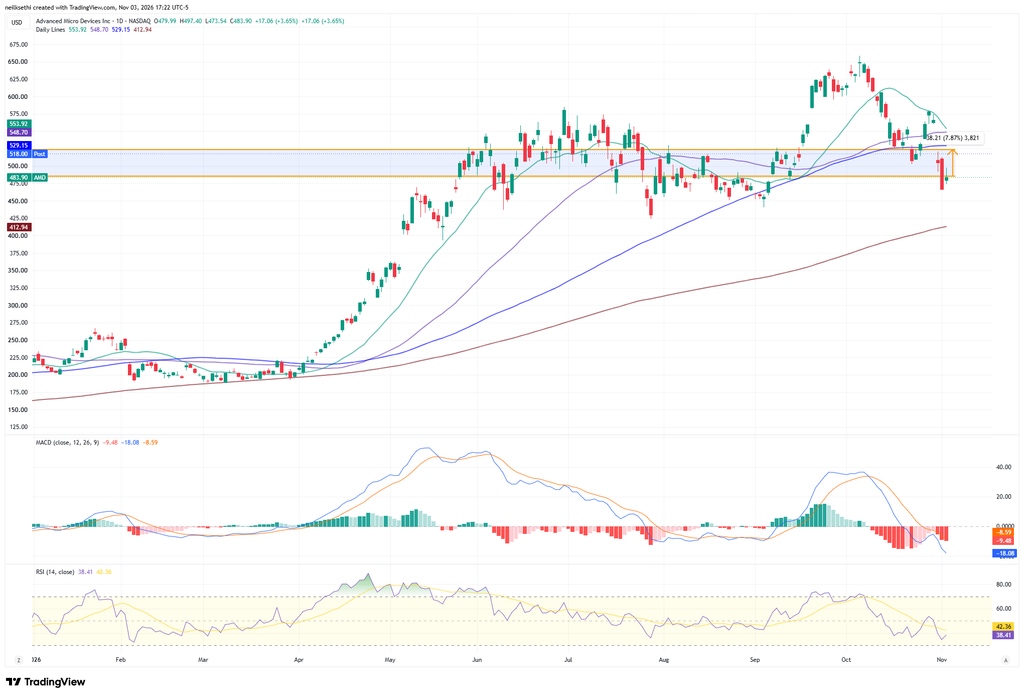
The after-hours jump put the stock around $520, still roughly 20% below its early-October high and not clearing important resistance at the 100-DMA or 50-DMA above that.
The question now is whether cash catches up with sales. On the call and in the next quarter, watch for detail on AI chip and Helios demand into 2027, whether the inventory build turns back into cash, and whether margins hold up as more server racks ship. PC and gaming chips remain soft, so the data center business has to keep carrying the company.
By Neil Sethi

China Reloads Its 2024 Stock Rescue Tools, but Markets Aren’t Buying It

Meanwhile in China…

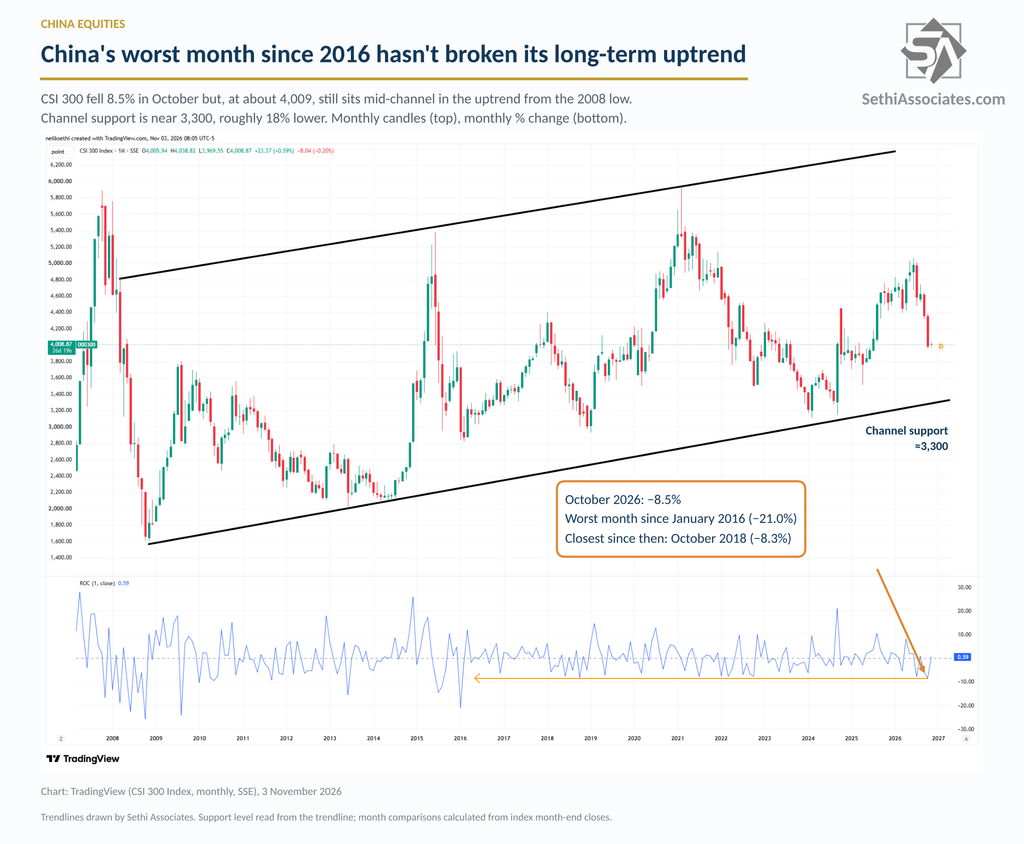
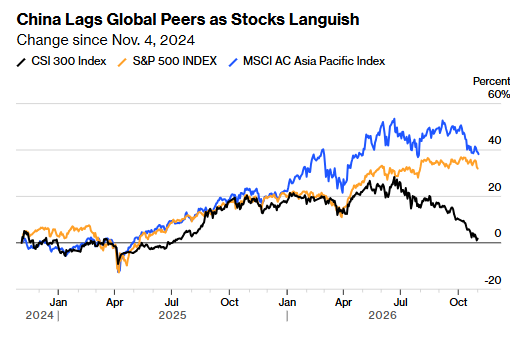
A little under the radar, China’s CSI 300 fell 8.5% in October, its worst month since January 2016 (−21.0%), narrowly beating October 2018 (−8.3%) at the height of the trade war. The index also fell for a record 12 straight weeks through Friday, according to Bloomberg, and is down 15% this year.

That happened despite state-fund buying since July and earlier curbs on share sales, so Beijing went back to the toolbox on Monday. The People’s Bank of China cut the rate on its buyback relending facility to 1% from 1.25% and made it permanent. It also restarted the swap facility that lets brokers, funds and insurers trade assets for liquidity to buy stocks, with 31 firms applying for more than 100 billion yuan of quotas. The China Securities Regulatory Commission will make buybacks easier and is studying looser margin-financing rules. Separately, regulators told banks to pause initial public offerings and suspended large share sales by existing holders, the Financial Times reported.

The market was less than impressed. The tech-heavy Star 50 fell 3.8% on Tuesday, November 3, wiping out Monday’s rally. The CSI 300 was down as much as 1.2% before closing 0.2% lower.

Why? These are the September 2024 tools without the September 2024 punch. Back then, the facilities came with rate cuts, and the CSI 300 jumped about 21% in a single month. This time there is no rate cut, and a Shanghai chief investment officer told Bloomberg the tools have been around for two years and add no new support. History on initial public offering freezes isn’t encouraging either. Beijing halted listings in early July 2015, and the CSI 300 still fell 14.7% that month and another 11.8% in August before finding a floor.

What to watch for according to analysts: whether the People’s Bank of China adds a policy-rate or reserve-requirement cut, how fast the swap quotas are used, and whether state-favored exchange-traded fund volume stays high.

For now, it doesn’t appear policy is sufficient to catalyze a turnaround in China shares.

By Neil Sethi

JPM’s Post-Election Day Scenario Analysis

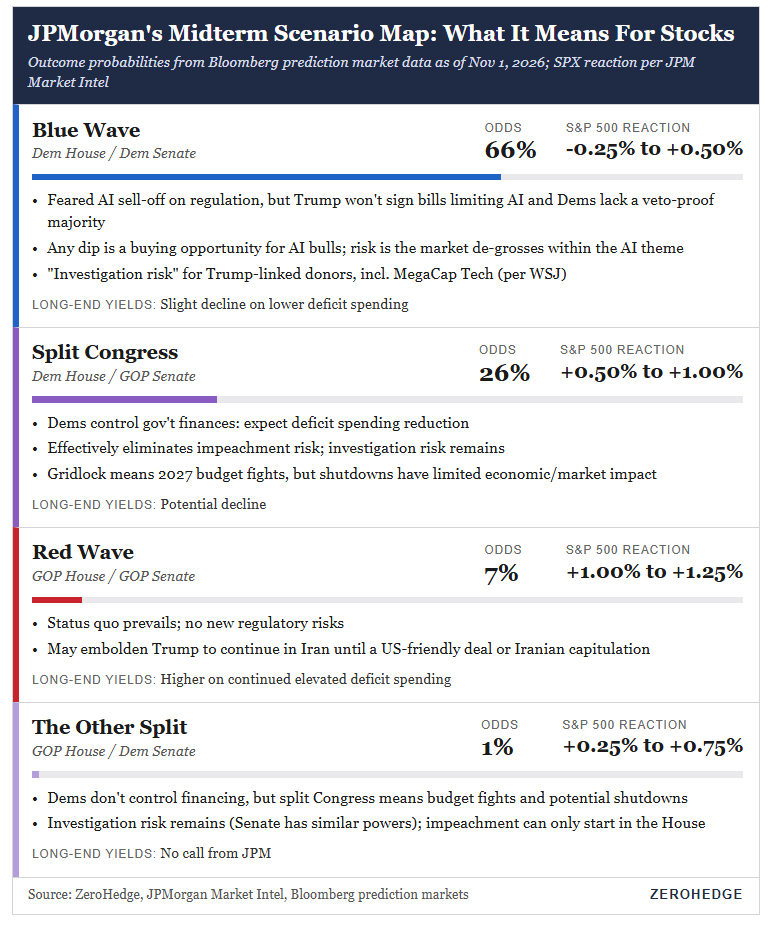
Just for fun, here are the thoughts from JPMorgan’s trading desk via ZeroHedge:

Blue Wave (Dem House / Dem Senate), 66% odds: S&P 500 ranges from down 0.25% to up 0.50%. The feared AI sell-off on regulation is likely limited because Trump won’t sign bills restricting AI and Dems lack a veto-proof majority. JPM sees any dip as a buying opportunity for AI bulls, with the main risk being de-grossing within the AI theme. There’s also “investigation risk” for Trump-linked donors, including megacap tech. Long-end yields are seen slightly lower on reduced deficit spending.

Split Congress (Dem House / GOP Senate), 26% odds: S&P 500 up 0.50% to 1.00%. Dems control government finances, so JPM expects deficit spending to come down. Impeachment risk is effectively gone, but investigation risk remains. Gridlock points to 2027 budget fights, though shutdowns have had limited economic and market impact. Long-end yields could decline.

Red Wave (GOP House / GOP Senate), 7% odds: S&P 500 up 1.00% to 1.25%. The status quo holds with no new regulatory risks. This outcome may embolden Trump to stay the course in Iran until there’s a US-friendly deal or Iranian capitulation. Long-end yields move higher on continued elevated deficit spending.

The Other Split (GOP House / Dem Senate), 1% odds: S&P 500 up 0.25% to 0.75%. Dems don’t control financing, but a split Congress still means budget fights and possible shutdowns. Investigation risk remains because the Senate has similar powers, while impeachment can only start in the House. JPM makes no call on long-end yields.

The most likely outcome is also the weakest one for stocks. Even so, JPM’s worst case across all four scenarios is only a 0.25% decline

By Neil Sethi

Have We Front-Run Post-Midterm Strength?

If you didn’t make it down to the end of the Week Ahead this week (The Week Ahead – Apple, Midterms and Jobs Test a Market on Edge), I mentioned that some caution on the post-midterm rally everyone is expecting may be appropriate.

Based on a Truist composite chart of midterm seasonality since 1950, the S&P 500 is normally up only about 1% at the end of October, then finishing up about 5%. This year, though, the S&P 500 was already up 10.7% through October.

Bulls, though, can argue that while equities generally rise from the start of October into the election, in this case they are down approximately 3.5% from the October peak.

By Neil Sethi

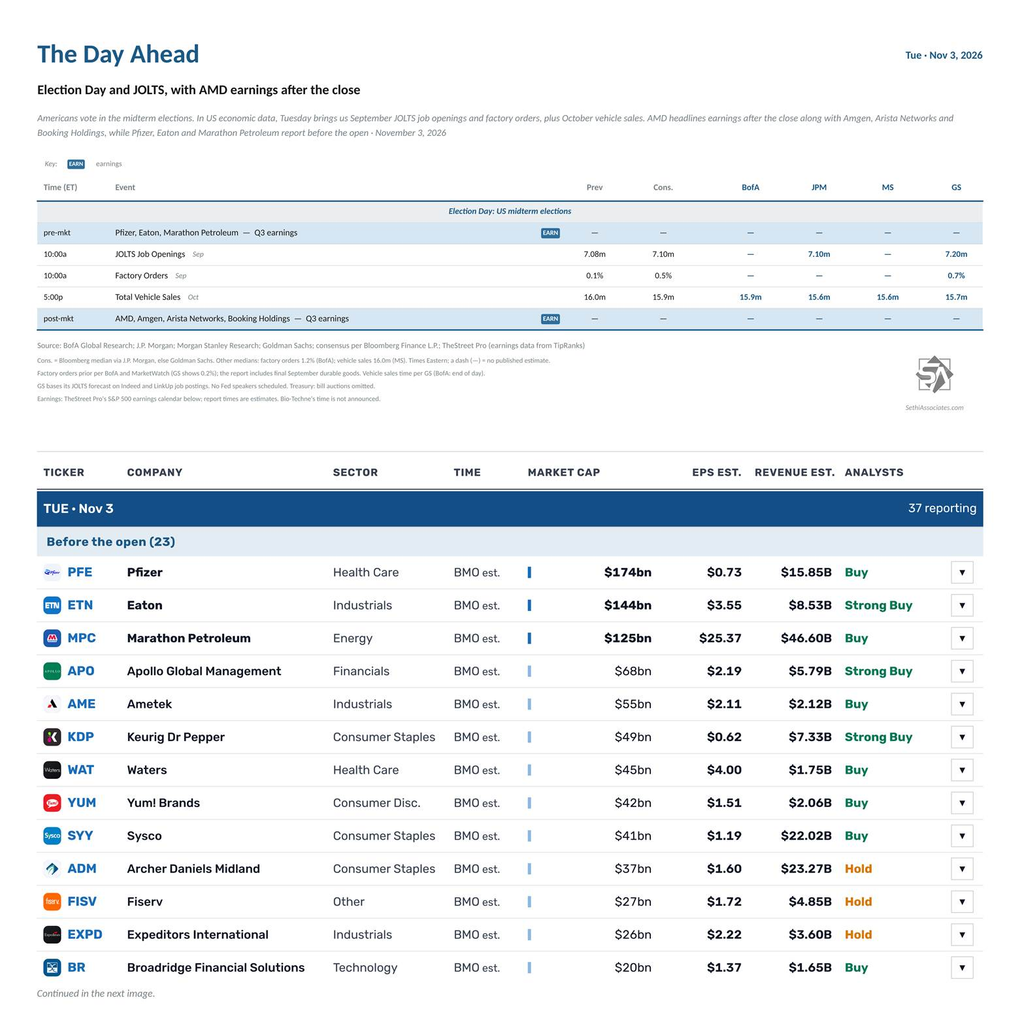
Elections, JOLTS, and AMD Highlight Tuesday’s Calendar

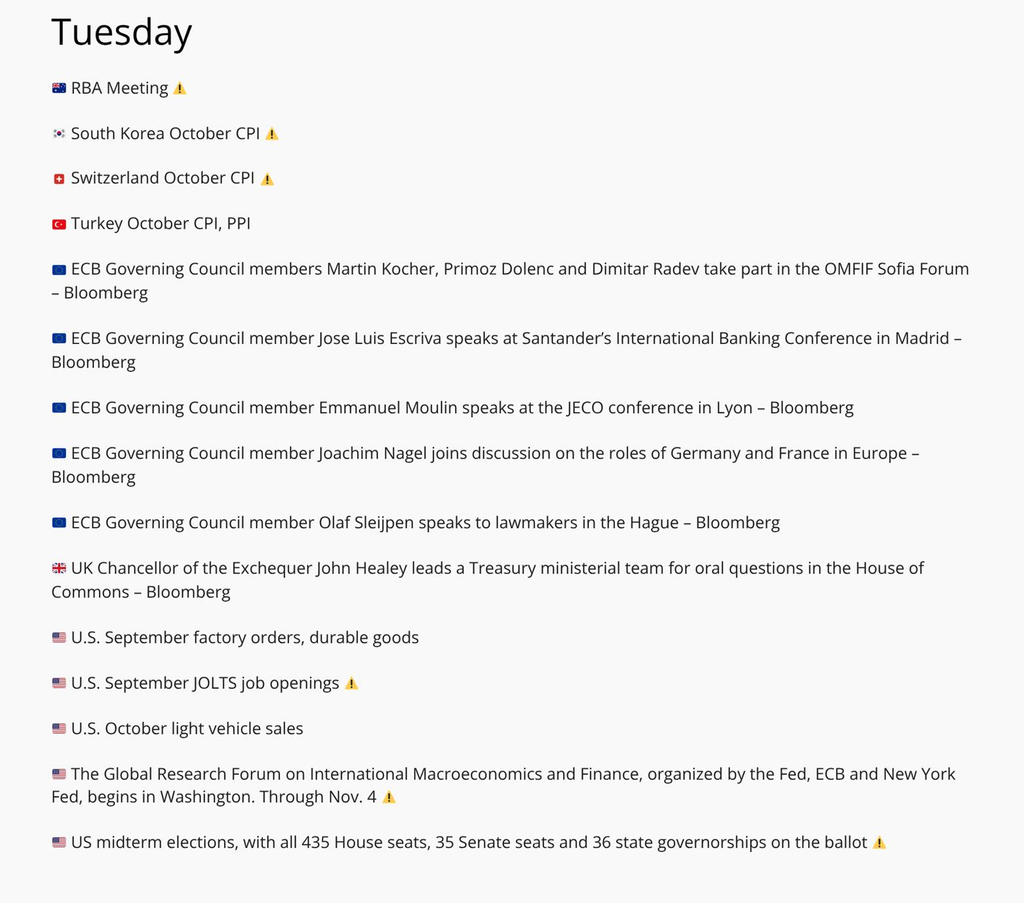
It’s Election Day, with Americans voting in the midterm elections (all 435 House seats, 35 Senate seats and 36 governorships are on the ballot).

In US economic data, Tuesday brings us September JOLTS job openings and factory orders (which include final durable goods), and October vehicle sales.

There are no Fed speakers scheduled, although the Global Research Forum on International Macroeconomics and Finance, organized by the Fed, ECB and New York Fed, begins in Washington (through November 4), so there may very well be media interviews.

There are no non-Bill (>1yr in maturity) US Treasury auctions this week.

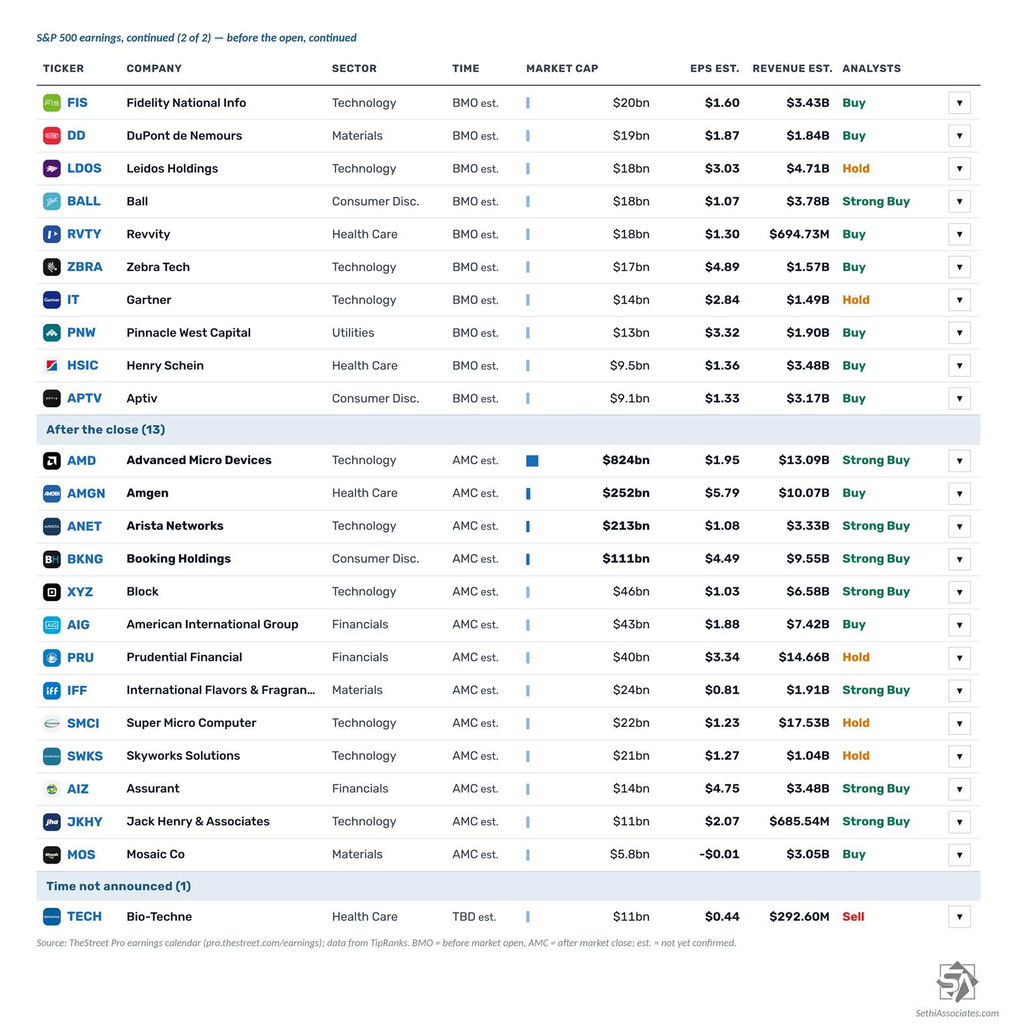
37 S&P 500 components report, seven of them with market caps over $100bn:

After the close: AMD (AMD), Amgen (AMGN), Arista Networks (ANET), Booking Holdings (BKNG), Block (XYZ), AIG (AIG), Prudential Financial (PRU), International Flavors & Fragrances (IFF), Super Micro Computer (SMCI), Skyworks Solutions (SWKS), Assurant (AIZ), Jack Henry & Associates (JKHY) and Mosaic (MOS)

Before the open: Pfizer (PFE), Eaton (ETN), Marathon Petroleum (MPC), Apollo Global Management (APO), Ametek (AME), Keurig Dr Pepper (KDP), Waters (WAT), Yum! Brands (YUM), Sysco (SYY), Archer-Daniels-Midland (ADM), Fiserv (FISV), Expeditors International (EXPD), Broadridge Financial (BR), Fidelity National Information Services (FIS), DuPont (DD), Leidos (LDOS), Ball (BALL), Revvity (RVTY), Zebra Technologies (ZBRA), Gartner (IT), Pinnacle West (PNW), Henry Schein (HSIC) and Aptiv (APTV)

Time not announced: Bio-Techne (TECH)

Outside the S&P 500, Shopify (SHOP), Energy Transfer (ET), Ferrari (RACE), Bayer (BAYRY) and Intesa Sanpaolo (ISNPY) report.

Ex-US highlights include the Reserve Bank of Australia’s decision (10:30pm ET Monday; Deutsche Bank expects a hold), October CPI from Switzerland, South Korea and Turkey (plus Turkey PPI), New Zealand’s Q3 labor force survey, Japan’s October monetary base and France’s September budget balance. ECB Governing Council members Kocher, Dolenc, Radev, Escriva, Moulin, Nagel and Sleijpen speak, as do the Bank of Canada’s Macklem and Rogers, and UK Chancellor of the Exchequer Healey takes oral questions in the House of Commons.

Japanese markets are closed for Culture Day.

From Christophe Barraud’s international Week Ahead rundown:

Conversation 0 Comments

One ongoing discussion across all days. Everyone can read; sign in to take part.

Your voice matters. Discussions are moderated for civility. Read our guidelines .

Log in to join the conversation

Loading comments...