New Market Catch-22: Meta Spends Too Much, Tesla Too Little
Meta’s spending warnings and share-class fine print, Tesla’s capex cut, and a ‘not good enough’ beat from Lam Research are dragging Tech lower adding to a broader risk-off tape.
You've reached your free article limit
You've read 0 of 1 free Pro articles.

Last night’s after-hours enthusiasm for Meta Platforms (META), which I covered here, didn’t survive the conference call. The stock hit $748.80 after hours, per ZeroHedge, before giving back nearly all of the gain. As of 9.50 a.m. it was down over 6%. Tesla (TSLA), which also flipped lower on its call as I updated last night, has since recovered to slightly green although is struggling with its 200-day moving average.
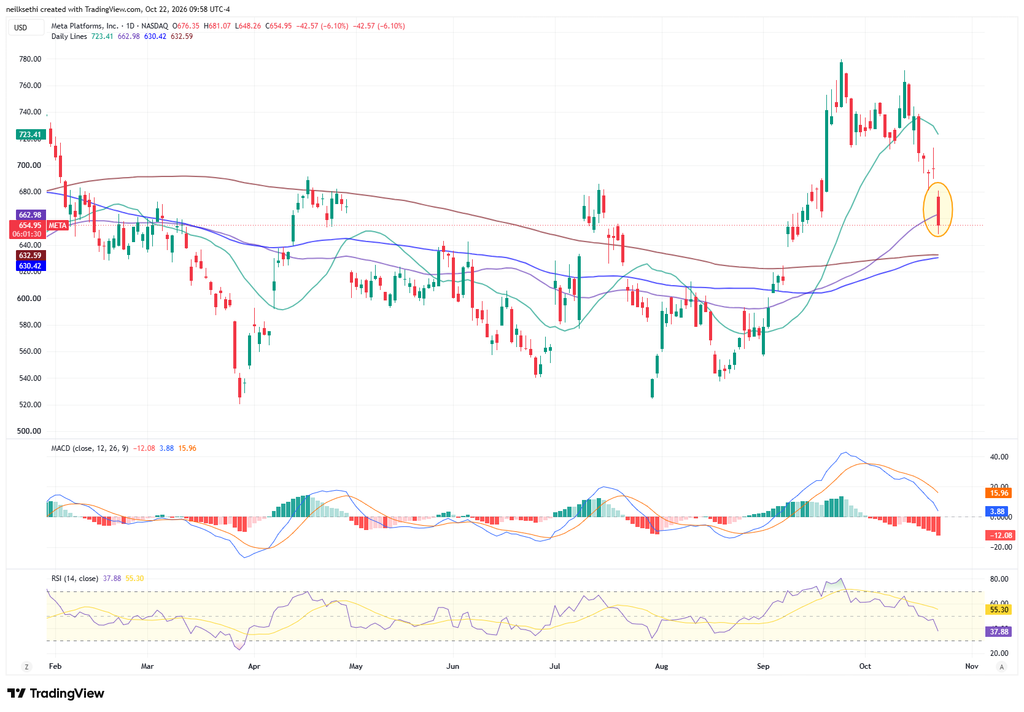
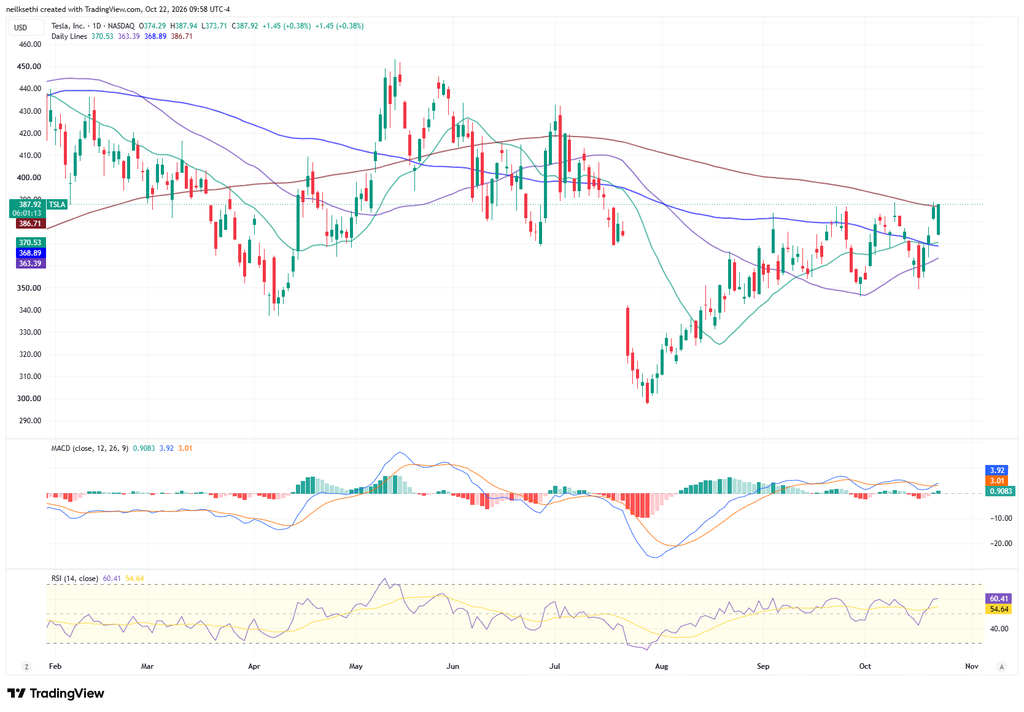
Meta
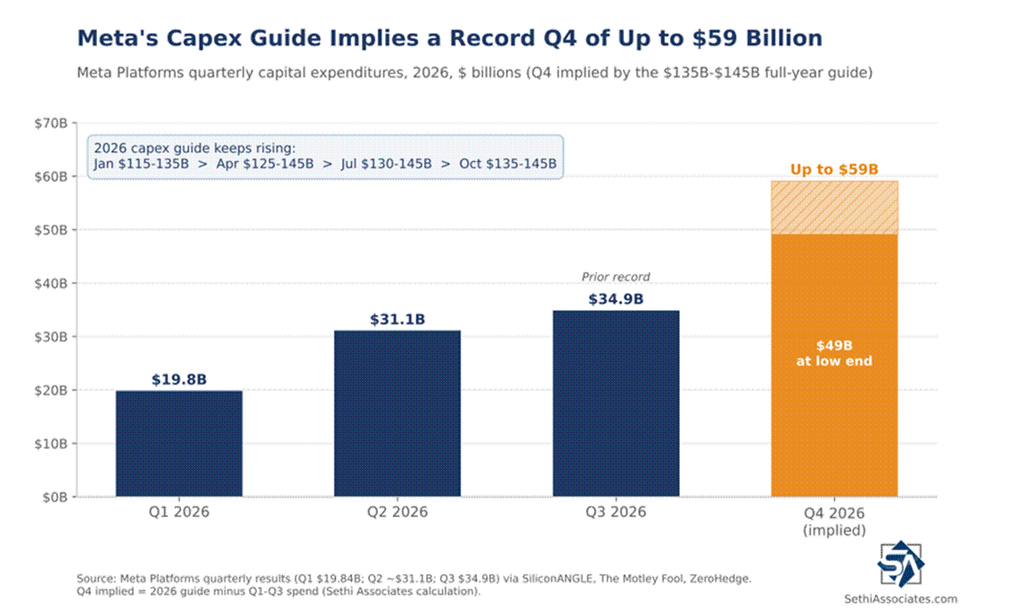
Looking at Meta, CFO Susan Li told analysts that growing the user base of Meta’s Muse AI product will require “significant investment” and that total serving costs will rise. She said this even as Meta targets a more than 10-fold improvement in compute-cost efficiency over the next year, per ZeroHedge. That comes on top of the higher 2026 capex guide of $135 billion to $145 billion, up from $130 billion to $145 billion. ZeroHedge calculates that range implies as much as $59 billion in the fourth quarter alone, versus the record $34.9 billion Meta just spent in the third.
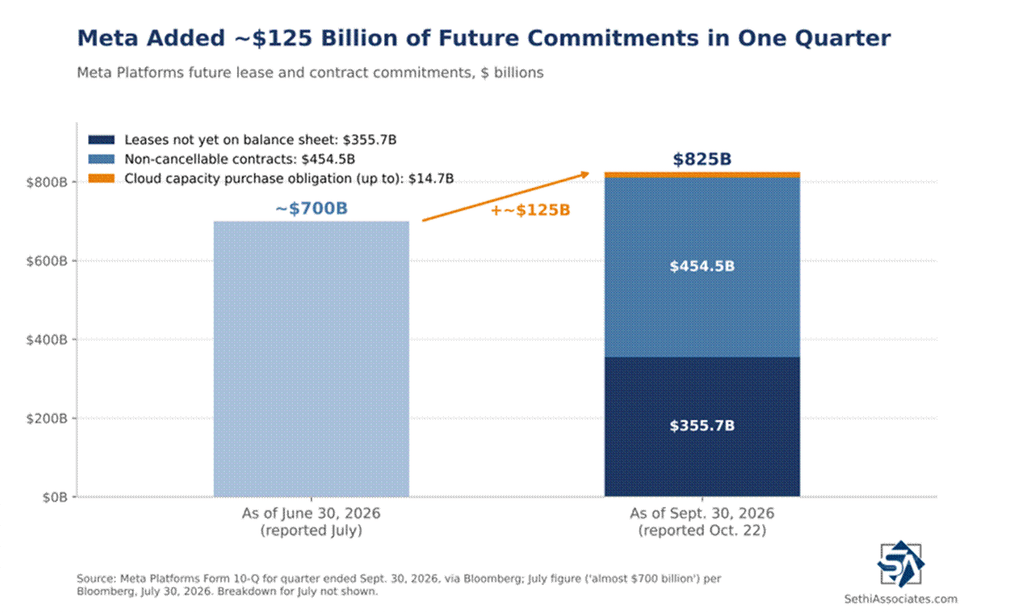
Thursday’s quarterly filing added another number. Meta now has about $825 billion in future lease and contract commitments, Bloomberg reports, up from almost $700 billion in July. That total breaks down as $355.7 billion in leases not yet on the balance sheet, $454.5 billion in non-cancellable contracts and up to $14.7 billion in cloud capacity. So Meta added roughly $125 billion of new spending commitments in a single quarter.
Then there’s the new Class C stock. Meta is pitching the non-voting shares as a currency to raise capital, pay employees and fund acquisitions without diluting voting power. Every holder gets one Class C share per existing share on Jan. 19, effectively a 2-for-1 split. The funding need is real per the spending commitments noted earlier: the information statement says management’s long-range plan shows Meta needing to raise “hundreds of billions of dollars” over several years, beginning as early as this fall.
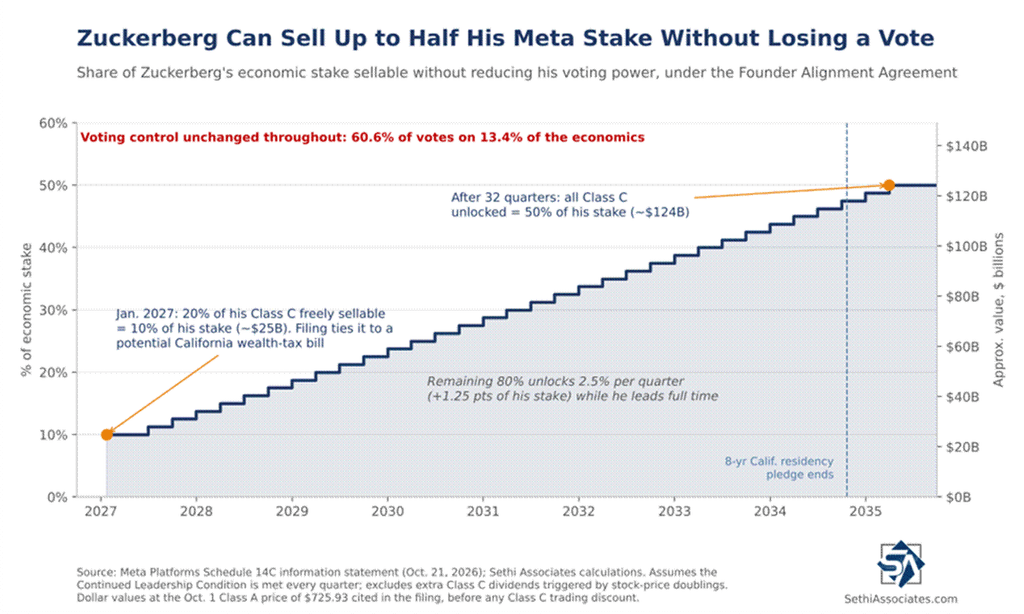
But the same filing makes clear the structure is also a way for Mark Zuckerberg to cash out. He can sell 20% of his Class C shares immediately. That’s 10% of his total economic stake, and the filing explicitly ties it to a potential California wealth-tax bill (Proposition 40 is on the Nov. 3 ballot). The other 80% are tied to his voting shares, but they unlock at 2.5% a quarter for as long as he stays in a full-time leadership role. After eight years he can sell all of them, which is up to half his economic stake and roughly $124 billion at early-October prices, without giving up a single vote.
More Class C dividends follow each time the stock doubles, and those are also unrestricted if he’s still running the company. The filing concedes the change could significantly extend his control. It also notes he wasn’t at risk of losing it, since he holds 60.6% of the vote on a 13.4% economic stake, and that he refused sunset provisions on his supervoting shares. Other shareholders got no vote, because Zuckerberg-controlled entities approved the change by written consent. So outside shareholders absorb the economic dilution of future Class C issuance, while Zuckerberg keeps full control and gains a path to sell down.
Analysts mostly stood by the stock. Barclays raised its target to $880 from $780 and Susquehanna to $850 from $650, while Piper Sandler ($850 from $875) and TD Cowen ($850 from $865) trimmed theirs. Morningstar maintained its $850 fair value, citing early Muse adoption, even as adjusted operating margin fell 5 points to 35% on AI costs.
Tesla
Tesla’s initial decline was the mirror image: it’s being punished for promising less. On the surface it was a clean beat. Free cash flow was $1.53 billion against expectations of a nearly $5 billion burn, per ZeroHedge. But ZeroHedge calculates roughly half of that swing came from money Tesla didn’t spend. Third-quarter capex of $4.73 billion fell well short of the $7.95 billion analysts expected, per TipRanks. With about $13 billion spent through September, hitting the $25 billion target would have taken roughly $12 billion in the fourth quarter alone. Instead, Tesla cut its 2026 guide to about $20 billion. Roundhill’s Dave Mazza said the cut raises concerns that the timeline for Optimus and Cybercab may be slipping.

Meanwhile, the AI push is squeezing profits: ZeroHedge notes operating expenses rose 39% from a year earlier, and operating income fell 56% to $718 million, a 2.6% margin. Musk also pushed out timelines, per CNBC. He said Optimus’s design and reliability problems should be solved around the end of 2027, and that the robotaxi fleet won’t move the financials until mid-to-late 2027.

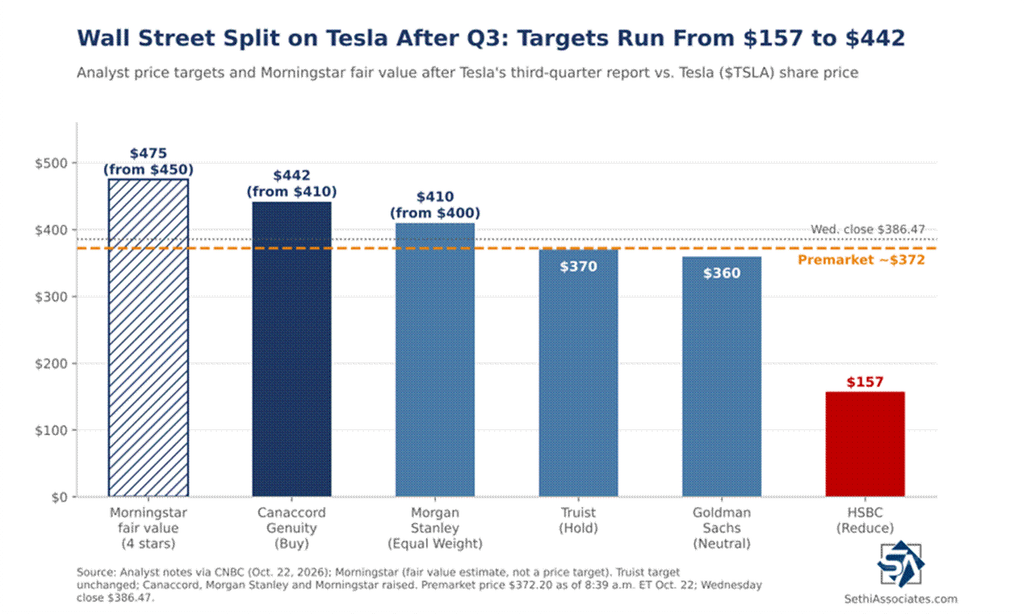
Analysts remain divided, per TipRanks. Piper Sandler raised its target to $475 from $450, Goldman Sachs held at $360, and the consensus is a Moderate Buy with an average target around $410. Canaccord ($442) and Morgan Stanley ($410) also raised, while HSBC sits way down at $157 per CNBC.
Lam Research
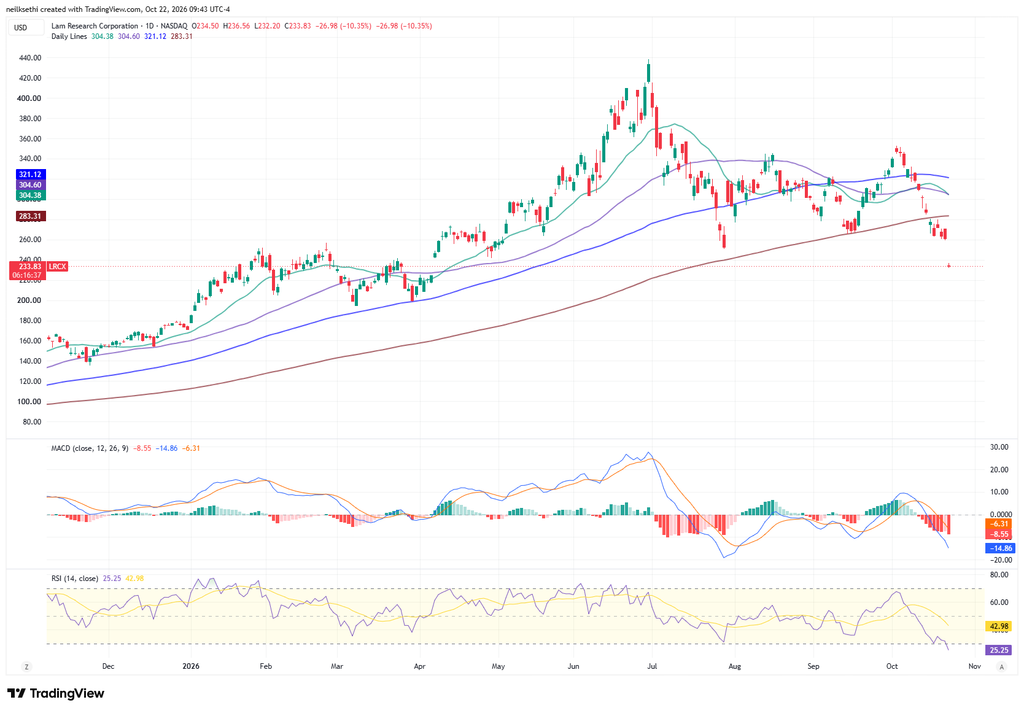
Lam Research (LRCX) is another high-profile loser this morning, showing how high the bar is now for AI winners. The chip-equipment maker’s results were records nearly across the board. Fiscal first-quarter revenue jumped 54% from a year earlier to $8.22 billion, and adjusted earnings per share of $2.20 edged past the $2.19 expected, per TipRanks. Operating margin topped 40% for the first time.
Management also sees 2026 wafer-fab equipment spending in the mid-$150 billion range and gave a preliminary 2027 outlook above $200 billion, per 24/7 Wall St. Even so, the stock is down over 10%, falling to the lowest levels since April, apparently on disappointment that December-quarter guidance of $8.6 billion in revenue and $2.33 in adjusted EPS at the midpoint was only marginally above estimates. Management said supply constraints are capping its outlook. And China, which rose to 35% of revenue from 26% in June, is expected to be a meaningfully smaller share in the December quarter. Wall Street remains firmly behind the stock: 21 of 24 analysts rate it a Buy, with an average target of $401.68, per TipRanks.
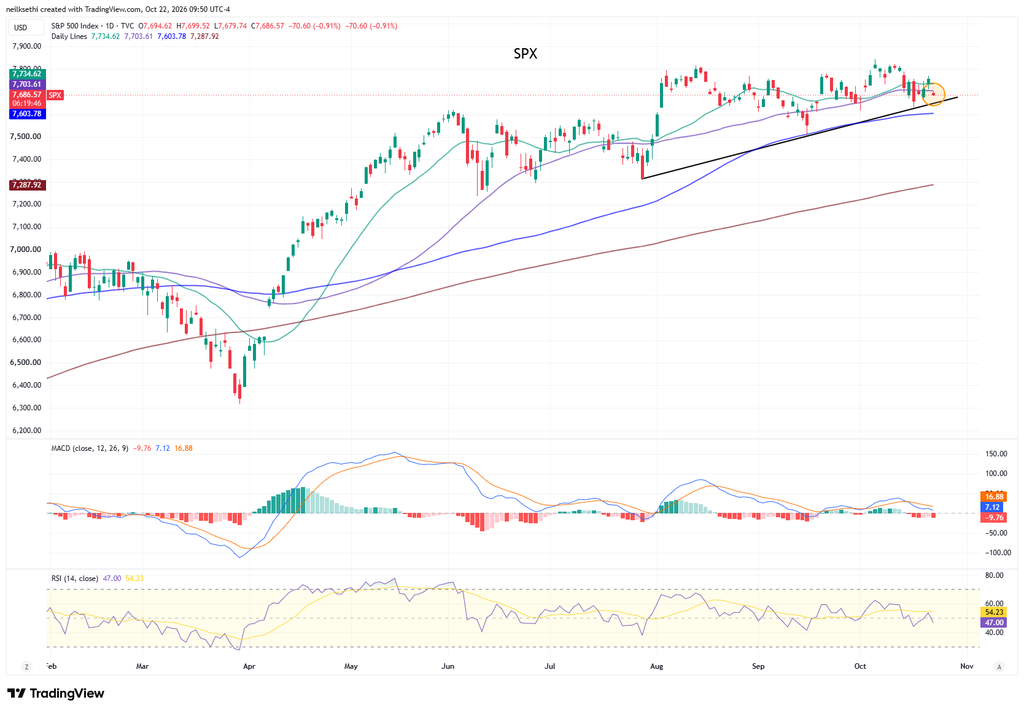
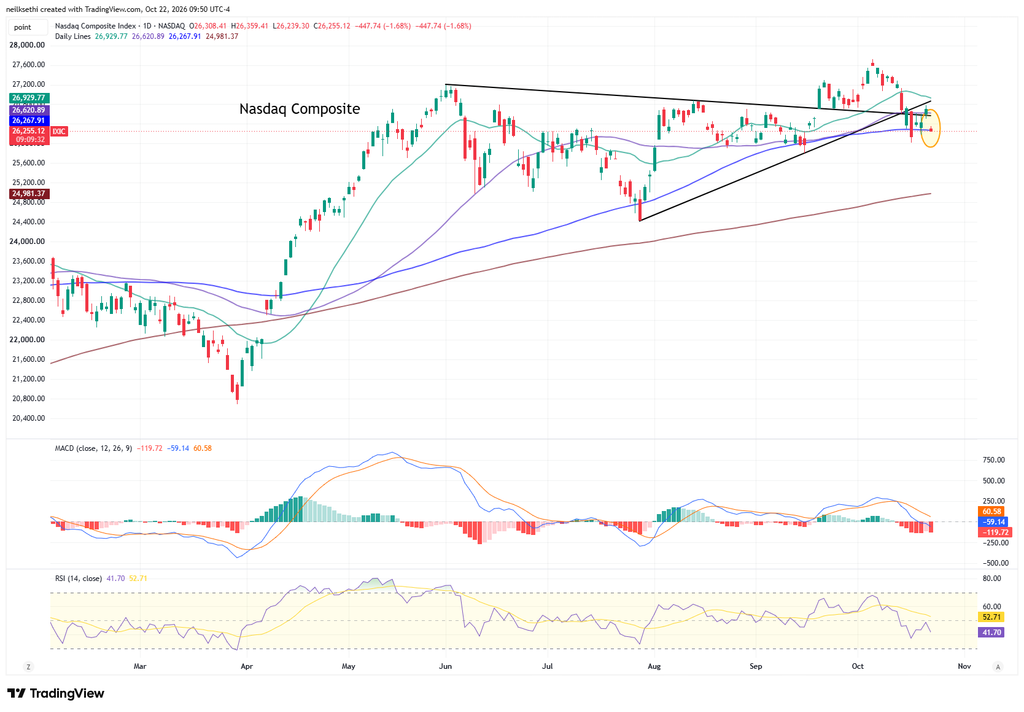
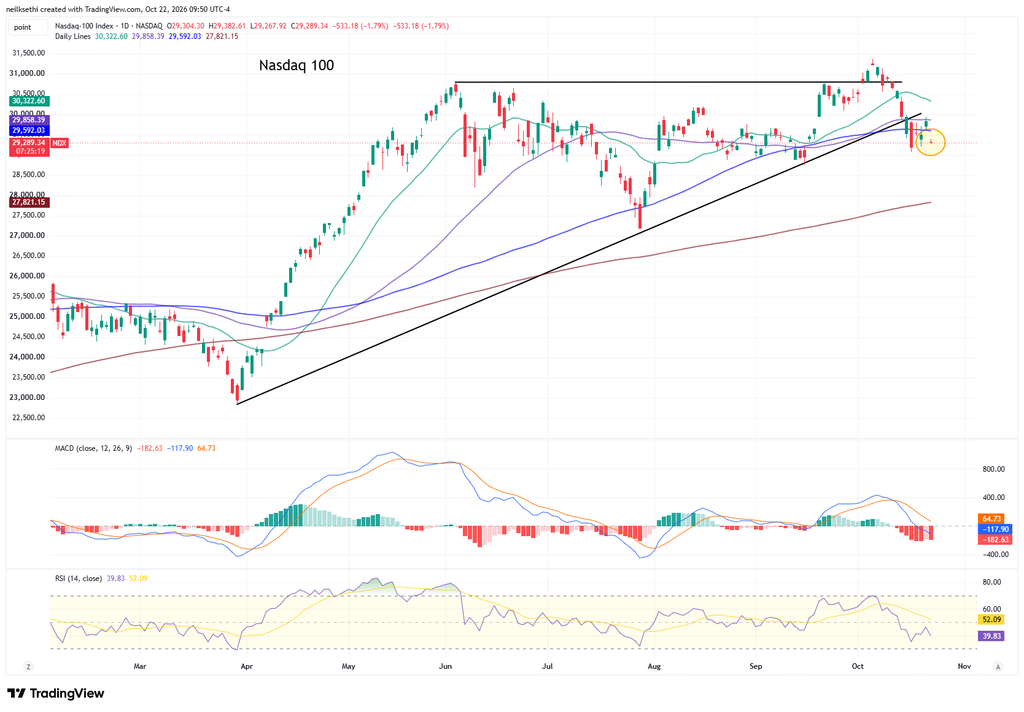
None of the stocks are getting help from a risk-off tape. As of 9.50 am the S&P 500 was down 1%, the Nasdaq 1.7% and the Nasdaq-100 1.9%. For more on the broader market:
After Overnight Selloff, Where Are the Indexes Headed Next?
Fool Me Once… Fool the Trading Algos Over and Over Again
Key Earnings See Negative Reactions as Rotation Hits a Bump in the Road
Market Braces for Even Higher Oil Prices: 8 Key Items Shaping the Stock Market Thursday
At the time of publication Sethi was long TSLA and will take a position in META (prior disclosures incorrectly stated Sethi had an existing META position).