JOLTS Report Strong Across the Board
Job openings rose while quits jumped to the most since May 2023.
You've reached your free article limit
You've read 0 of 1 free Pro articles.

Job openings rose 333,000 to 7.52 million and quits jumped 321,000, the most since May 2023, though restaurants and hotels accounted for most of the quits gain.
- US JOLTS Job Openings, September: 7.523 million (estimate 7.164 million; previous 7.079 million; previous revised 7.190 million)
- Job Openings Rate: 4.5% (previous 4.3%)
- Quits Level: 3.365 million (estimate 3.096 million; previous 3.066 million; previous revised 3.044 million)
- Quits Rate: 2.1% (previous 1.9%)
- Layoffs Level: 1.641 million (estimate 1.679 million; previous 1.641 million; previous revised 1.768 million)
- Layoffs Rate: 1.0% (previous 1.0%; previous revised 1.1%)
Executive Summary
- September job openings rose 333,000 to 7.523 million, the highest since May, topping every estimate in Bloomberg’s survey of economists, and August was revised up 111,000. There were 1.06 openings per unemployed worker, the highest since July and above 1.0 for a sixth straight month.
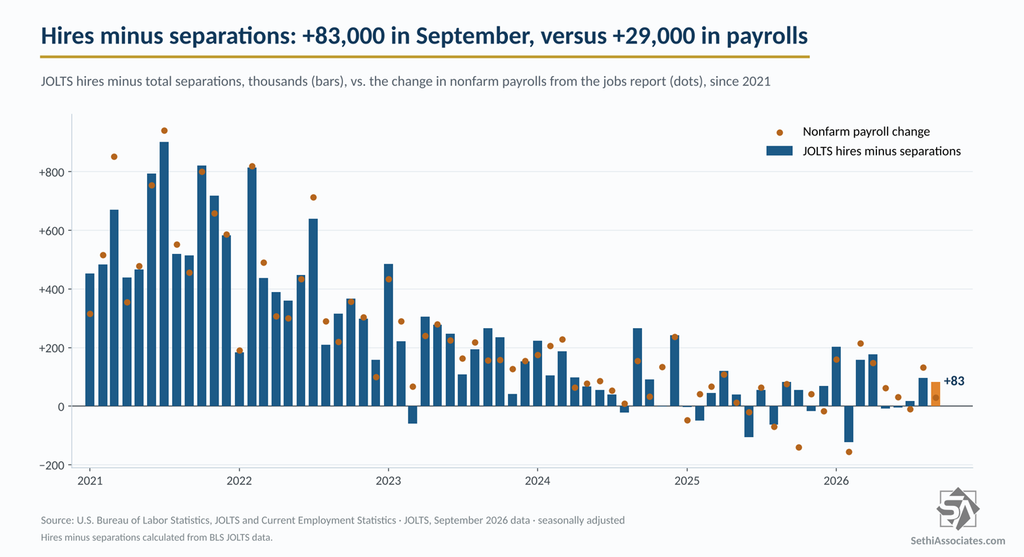
- Hires rose 131,000 to 5.402 million, the highest since March, lifting the hires rate a tenth to 3.4%. Hires minus separations, an employment proxy, was 83,000, against a 29,000 gain in September payrolls.
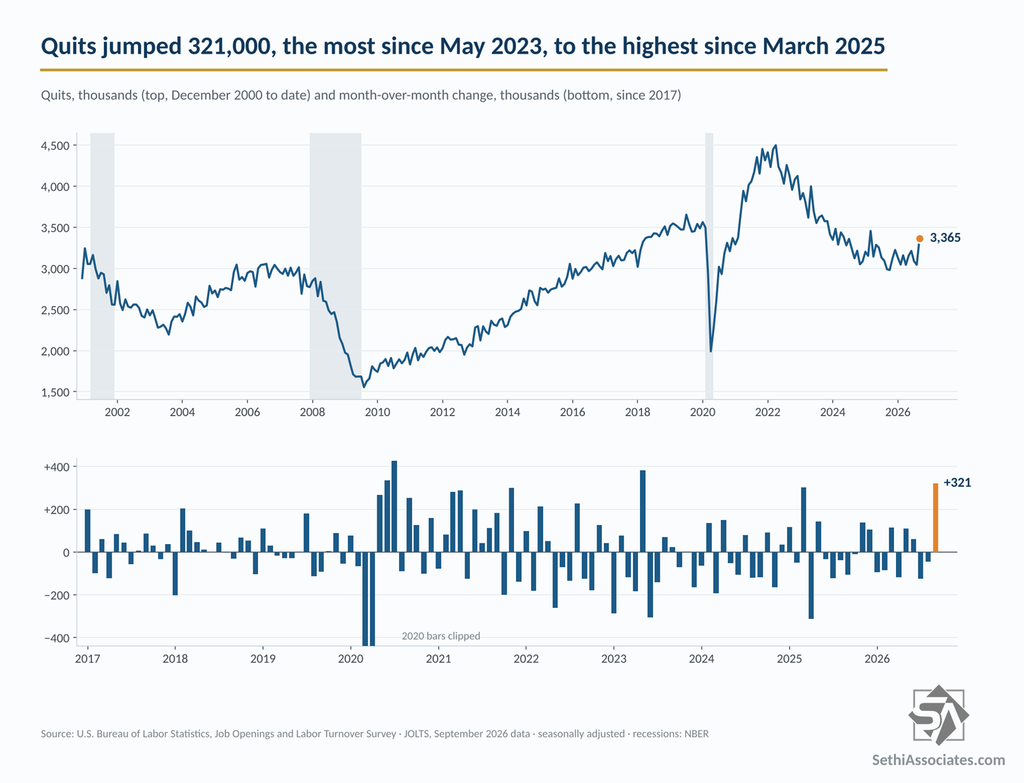
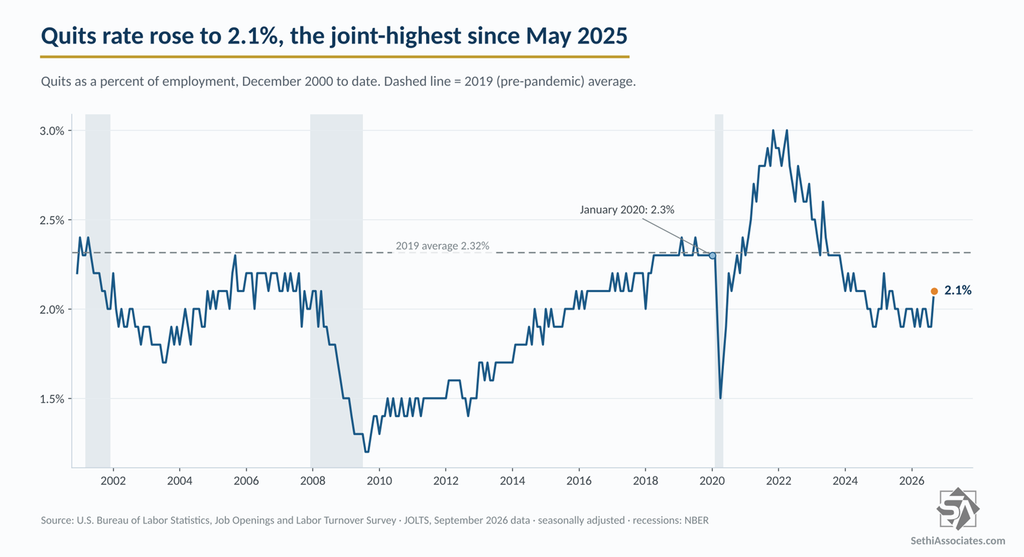
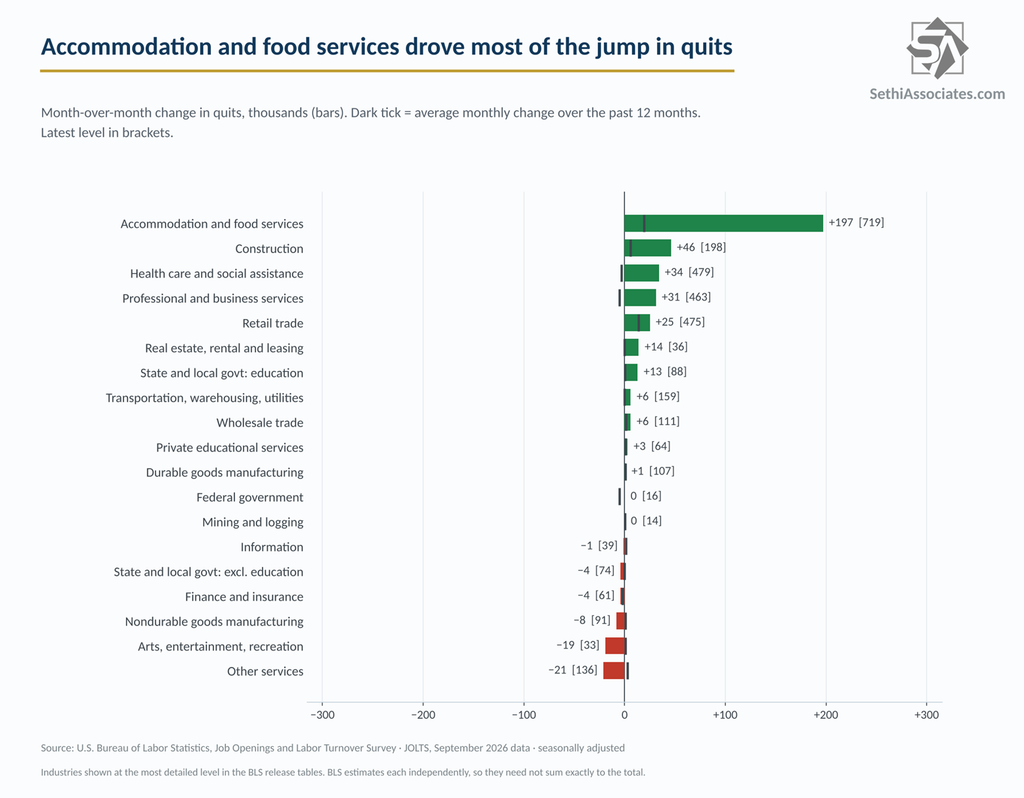
- Quits jumped 321,000, the most since May 2023, to 3.365 million, the highest since March 2025, and the quits rate rose two tenths to 2.1%. Accommodation and food services though accounted for 197,000 of the increase.
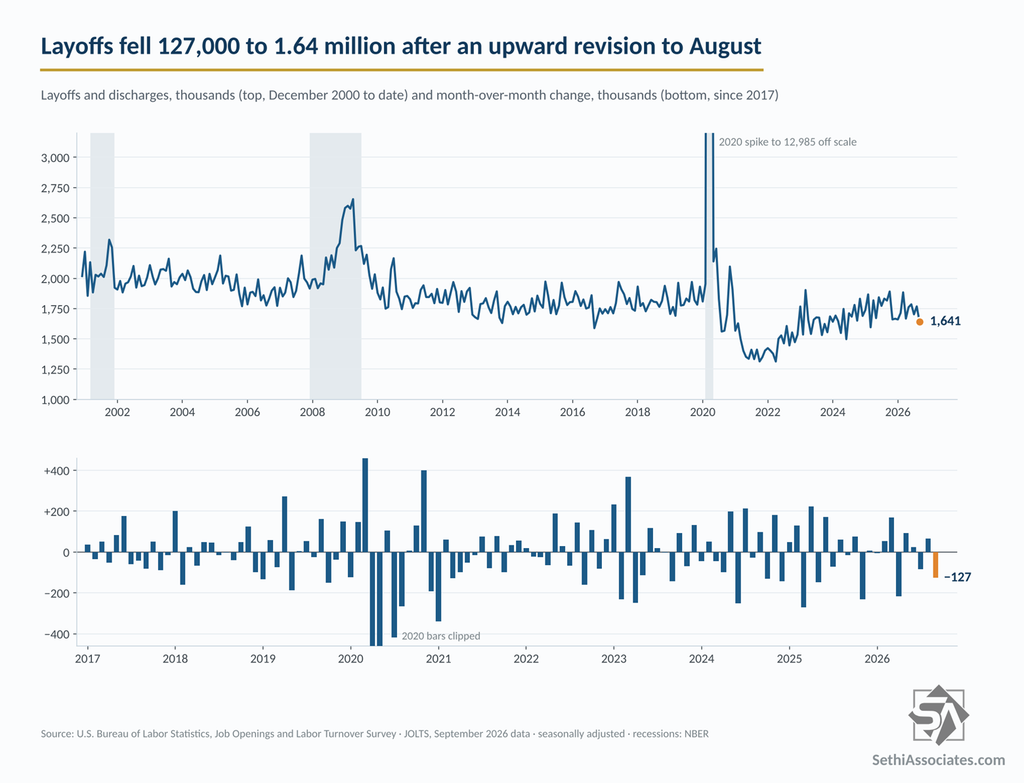
- Layoffs fell 127,000 to 1.641 million, the lowest since March 2025, with the layoffs rate back at 1.0%. But August was revised up by the same 127,000, so August layoffs rose rather than fell as first reported.
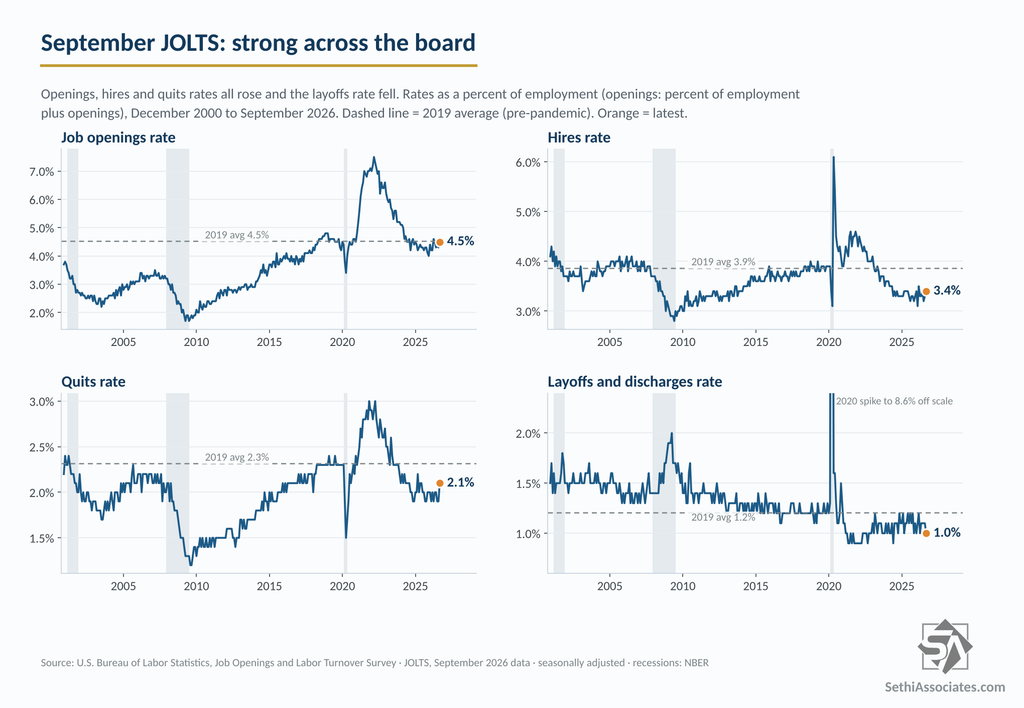
Numbers reported are month-over-month and seasonally adjusted unless otherwise indicated (seasonal adjustment can cause distortions). The note goes through openings, then hires, then quits, then layoffs.
Job Openings
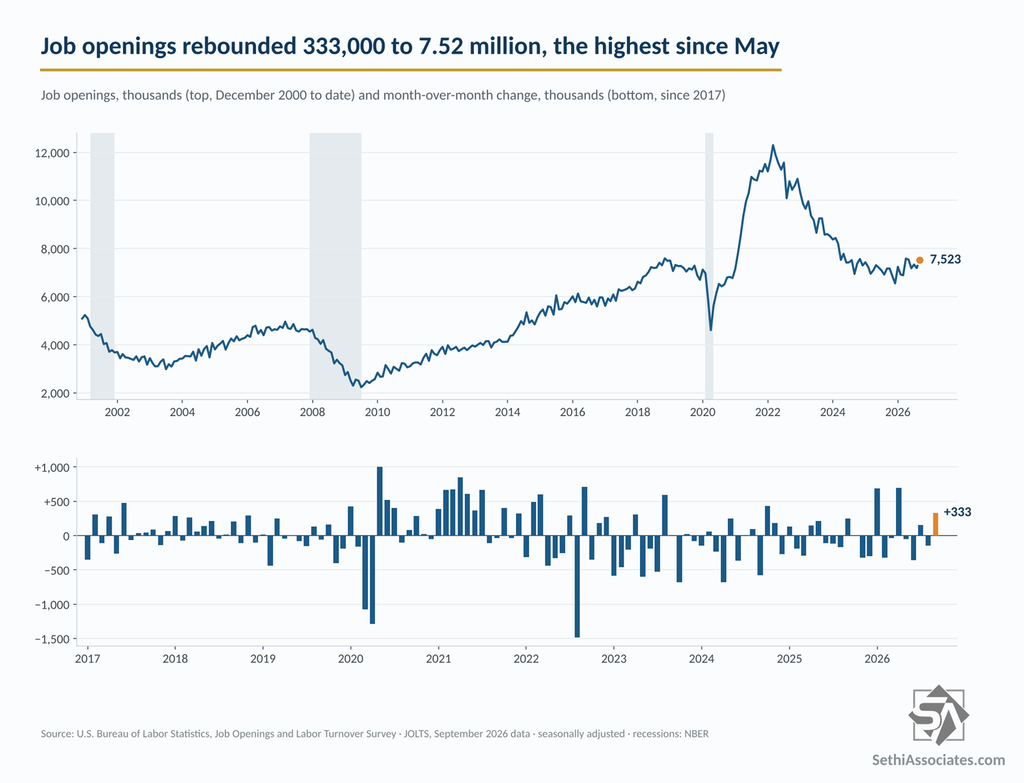
Job openings rose 333,000, the largest increase since April, to 7.523 million, the highest since May above every estimate in Bloomberg’s survey of economists (Bloomberg). August was also revised up 111,000 to 7.190 million, so the original August drop of 256,000 is now 145,000. Openings are now 399,000 above January 2020’s 7.124 million but well below the March 2022 peak of 12.301 million.
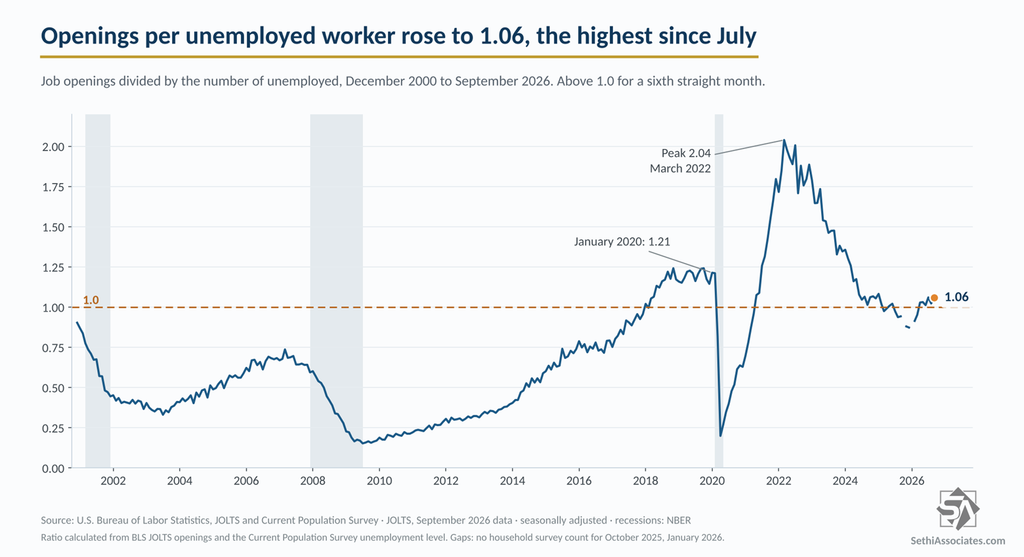
The openings rate (job openings divided by total employment plus job openings) rose two tenths to 4.5%, the joint-highest since May and level with January 2020. There were 1.06 openings per unemployed worker, the highest since July and above 1.0 for a sixth straight month, a surplus of 414,000 openings. That is still about half the March 2022 peak of 2.04 and below January 2020’s 1.21.
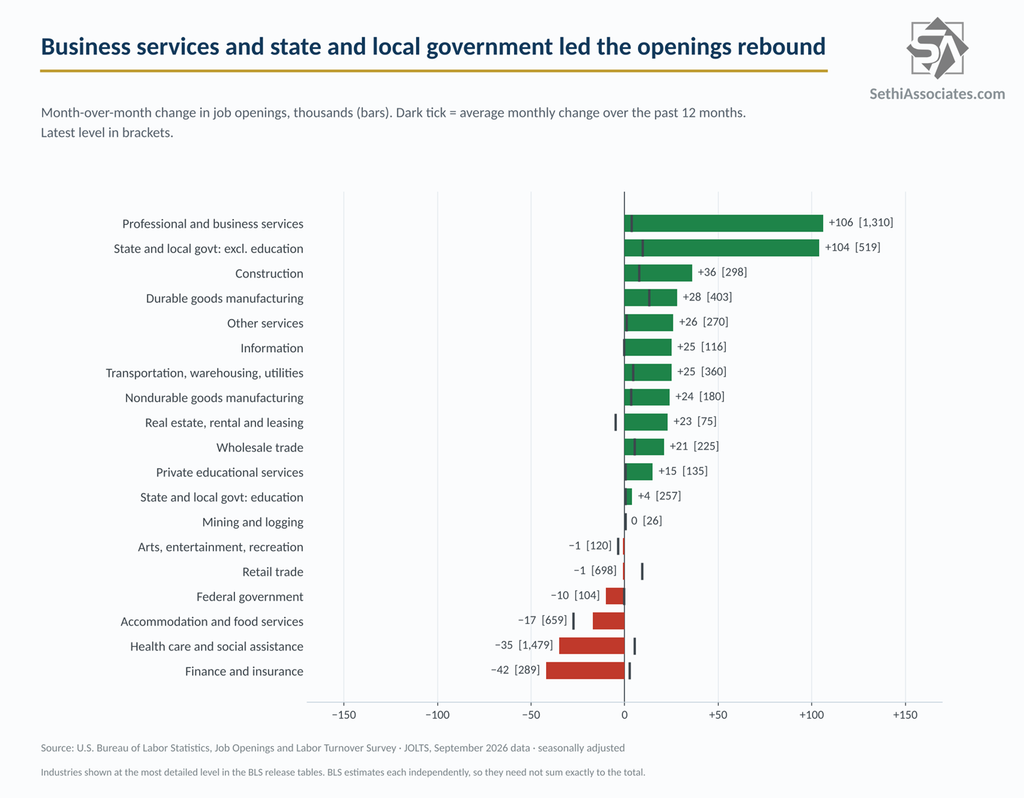
Professional and business services led with a 106,000 increase. State and local government excluding education added 104,000, its biggest gain since September 2021 and the only industry change BLS called out. Finance and insurance (down 42,000) and health care and social assistance (down 35,000) led declines, though health care’s August was revised to a 40,000 gain from a 115,000 drop.
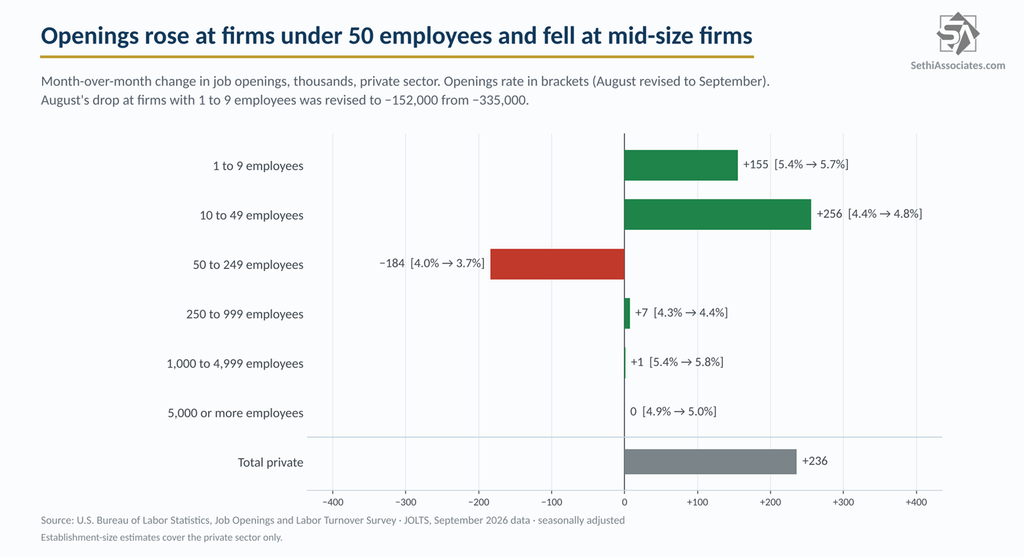
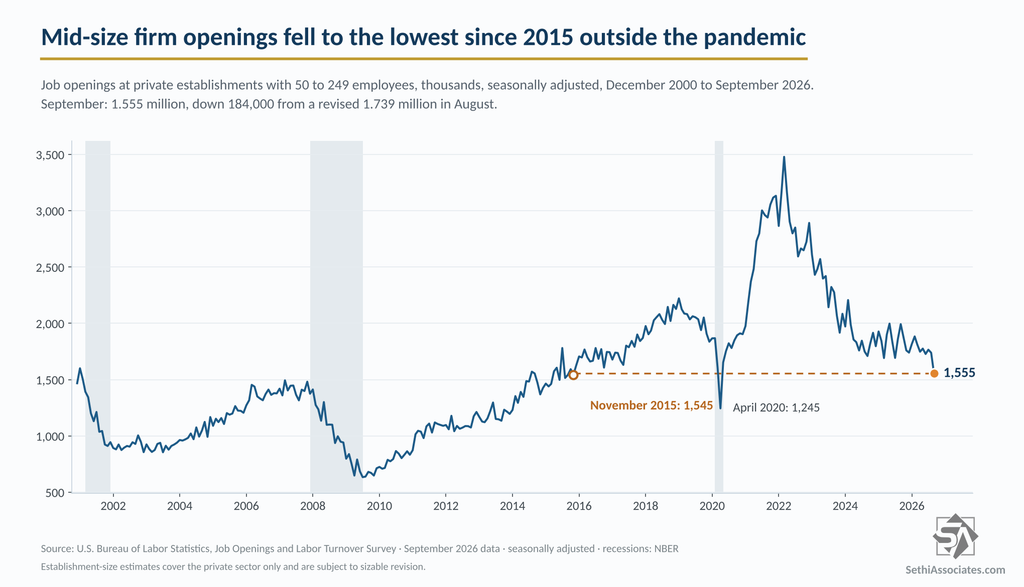
Last month’s collapse at the smallest firms was significantly revised: August’s decline at establishments with one to nine employees is now 152,000, not 335,000. This month firms with 10 to 49 employees led (up 256,000 to the highest since November 2023), while those with 50 to 249 fell 184,000 to the lowest since November 2015 outside the pandemic.
Hires
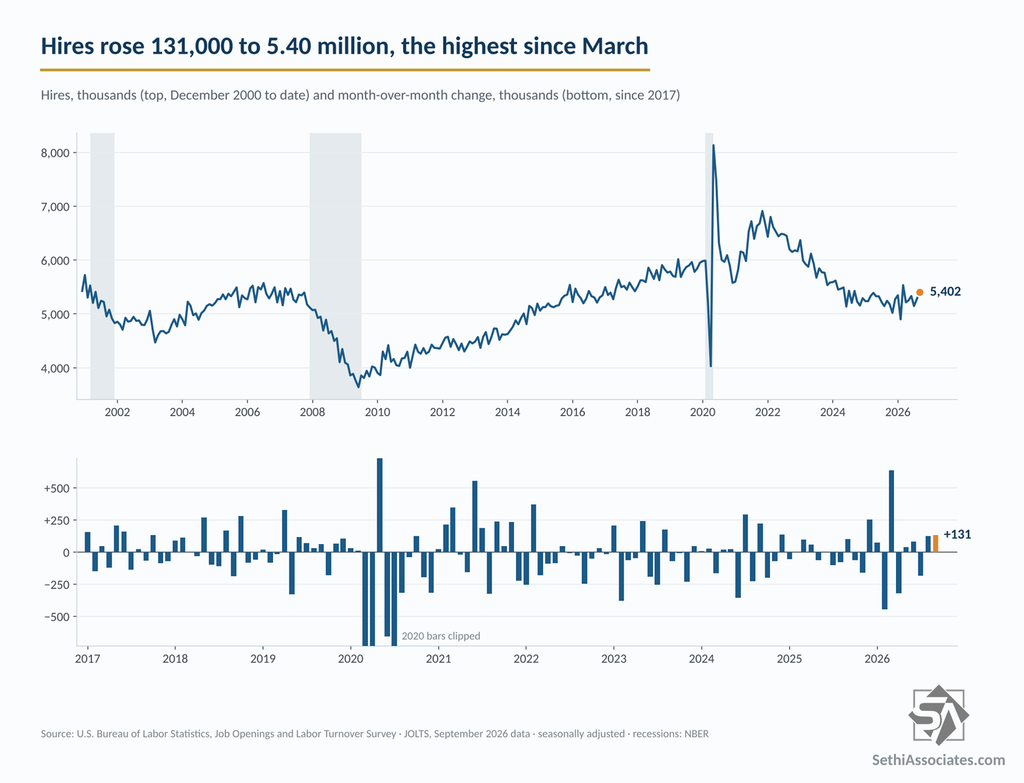
Hires rose 131,000 to 5.402 million, the highest since March, after August was revised up 79,000. The level is still though 588,000 below February 2020.
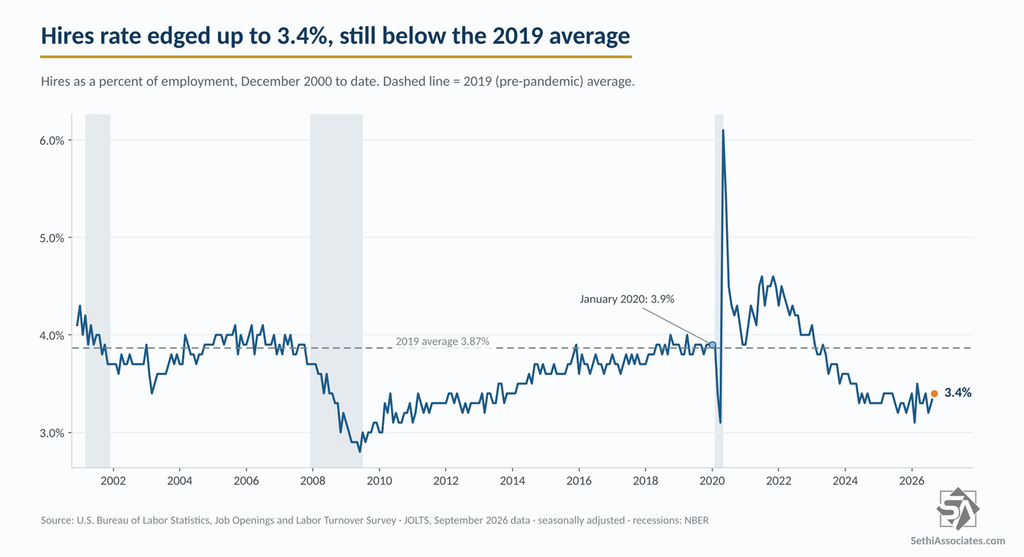
The hires rate (hires divided by total employment) rose a tenth to 3.4%, still below its 2019 average of 3.87%. Before the pandemic it was last this low in February 2014; economist Guy Berger noted on X that the rate is comparable to mid-2013 to early 2014, “when the unemployment rate was just above 7%.”
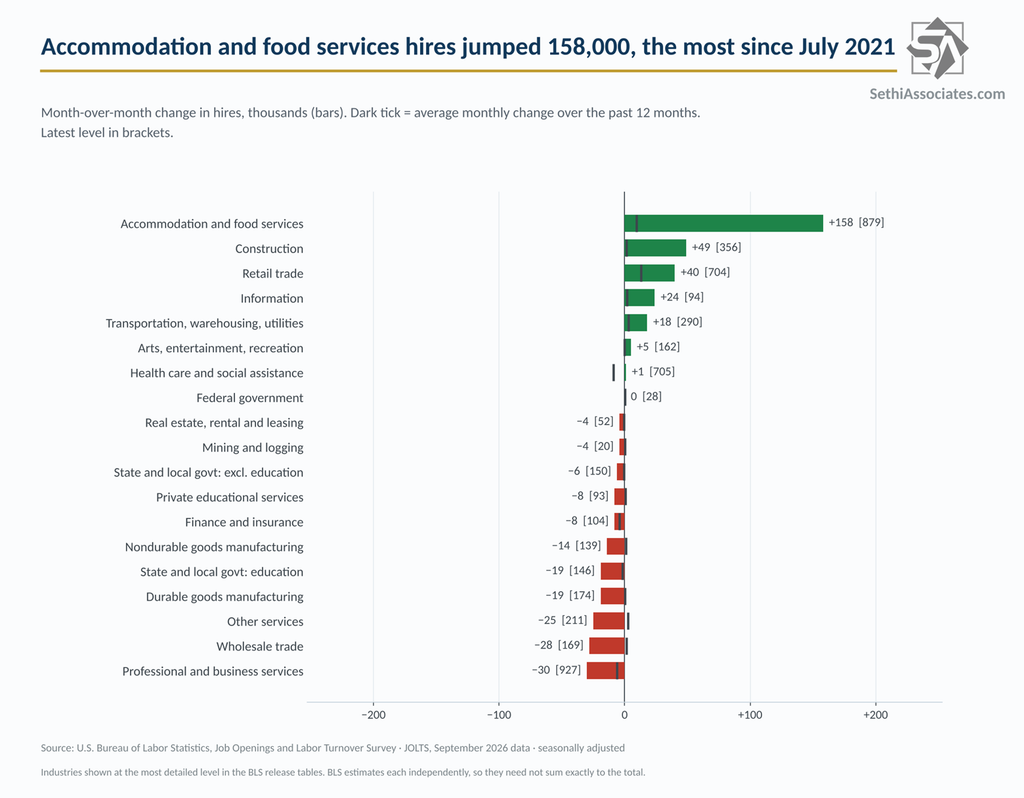
Accommodation and food services led with 158,000, the most since July 2021, followed by construction (49,000) and retail trade (40,000). Professional and business services (down 30,000) and wholesale trade (down 28,000) led declines. Private-sector hires rose 155,000 while government fell 24,000. Revisions also changed August’s story: private hires now show a 76,000 gain there, not the 1,000 decline first reported.
With separations at 5.319 million, hires minus separations was a positive 83,000, the third straight positive month, after August was revised down to 96,000 from 122,000. That outpaces the 29,000 gain in September payrolls, hinting at a possible upward revision.
Quits
JOLTS quits (considered a measure of labor market tightness — people don’t quit their job unless they are confident they can find another one) jumped 321,000, the most since May 2023, to 3.365 million, the highest since March 2025, and well above the 3.096 million estimate. Quits are up 12.5% from a year ago.
The quits rate (quits divided by total employment) rose two tenths to 2.1%, the joint-highest since May 2025 (it was last higher in March 2025 at 2.2%), but still below January 2020’s 2.3%. Berger called it “a pleasant surprise” but still low for 4.2% unemployment: in the 30 months from June 2017 through 2019 when unemployment was 4.3% or lower, the quits rate averaged 2.27%.
Over half the jump was due to accommodation and food services (+197,000). But even excluding that sector quits rose 124,000, the most since March 2025. Construction quits rose 46,000 to the highest since May 2023.
Layoffs
Layoffs fell 127,000, the largest decrease since April, to 1.641 million, the lowest since March 2025, and below the 1.679 million estimate. However, August was revised up 127,000 to 1.768 million, which turns its first-reported 61,000 decline into a 66,000 increase. So effectively September returned this to where August was originally reported.
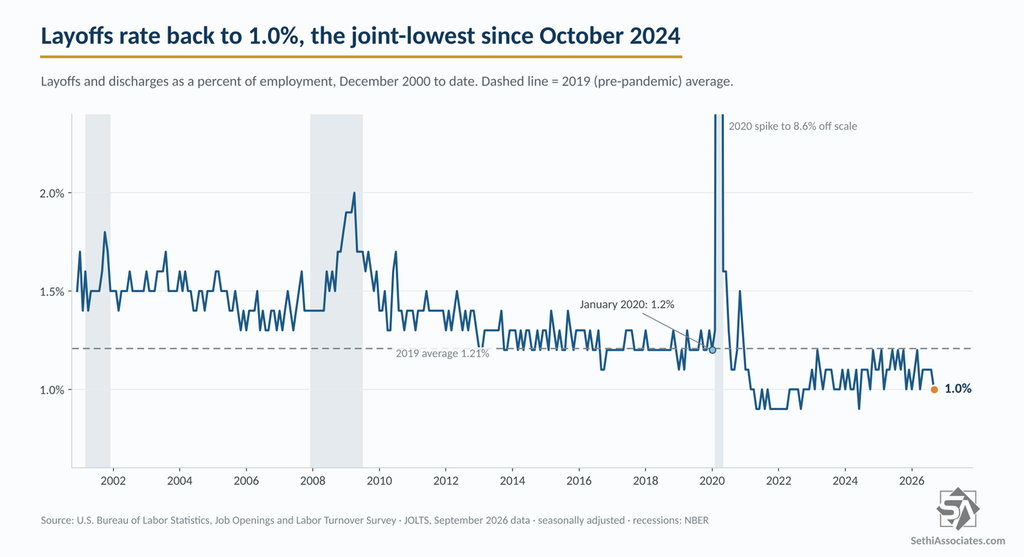
The layoffs rate (layoffs divided by total employment) fell a tenth to 1.0%, the joint-lowest since October 2024 (it was last lower in June 2024 at 0.9%), and below January 2020’s 1.2%.
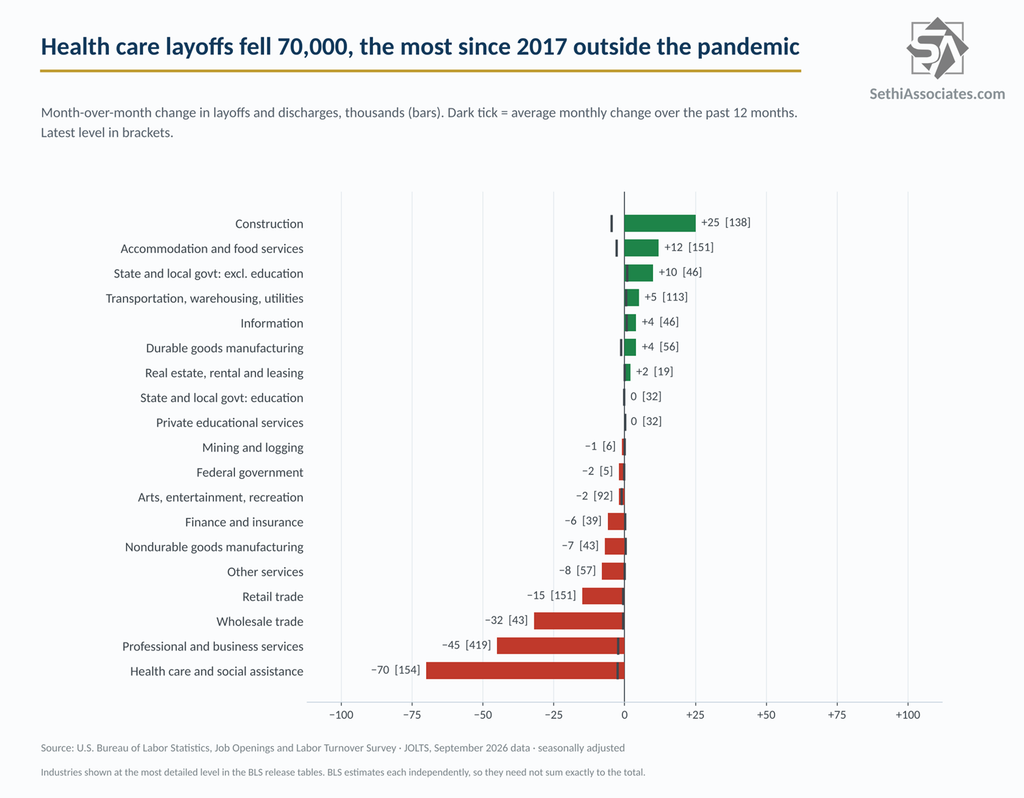
Health care and social assistance led the decline at 70,000, the largest outside the pandemic since September 2017, followed by professional and business services (down 45,000) and wholesale trade (down 32,000). Construction led increases at 25,000.
What to Watch
September’s openings, hires and quits all rose and layoffs stayed near cycle lows, which fits the read Fed Chair Kevin Warsh gave at the October 28 press conference that “on the employment side of the Fed’s dual mandate, conditions are quite positive.” It also gives some ammunition to the hawks, although there is a lot of data between now and the December 8-9 meeting, and Bloomberg cautioned that such a pickup “would need to be sustained over several months to signal the labor market is shifting into a higher gear.”
Berger noted that “the improvement this year has been very small”: compared with the second half of 2025, monthly hires are up 1.7% this year, quits 1.6%, and layoffs down 2.3%. The October jobs report on Friday, November 6, will be a bigger test.