Palantir’s Earnings Look Excellent. But My Next Move Isn’t What You’d Expect
Palantir’s balance sheet is strong and its fundamentals stellar. But technically … it’s a bit of a mess.
You've reached your free article limit
You've read 0 of 1 free Pro articles.

Software-driven AI platform king Palantir Technologies (PLTR) revealed Monday night a third-quarter beat with unadjusted earnings per share of $0.44 on revenue of $2.313 billion. The sales print was good for year-over-year growth of 95.8%. This was the 12th consecutive quarter where Palantir was able to accelerate the pace of growth for that top-line number from the quarter prior, an incredible feat.
Not just the U.S. government, but corporate America is rapidly increasing its reliance on Palantir for the big-data analysis and AI-enhanced intelligence needs. U.S.-driven revenue grew 119% y/y and 23% sequentially to $1.937 billion. Within that total, U.S. commercial revenue grew 148% y/y and 29% sequentially to $984 million. U.S. government revenue grew 96% y/y and 18% sequentially to $953 million. For the first time yet, U.S. commercial revenue surpassed U.S. government revenue. In addition, over these three months, Palantir closed 212 deals of at least $1 million, 107 deals of at least $5 million, and 64 deals of at least $10 million.
From Alex Karp
I like to give Alex Karp his own section in these as he is very entertaining in the least. Palantir CEO Alex Karp commented in the press release… “The Sovereign AI movement is imposing the most dramatic dichotomy between haves and have nots that I have witnessed in 30 years of business. Every institution — government and commercial — is rapidly being forced, voluntarily or not, into one of these two categories.”
Karp added, “The Sovereign AI moment is purpose-built for Palantir. Our products — from Foundry and Ontology to AIP with its ontologized, fine-tuned open-weight models — ignite a self-improvement loop that joins and aligns the workflow with its optimal model and us with our partners. This dialectic drives transformational value for both Palantir and our partners—and works only in artistic combination. Each becomes stronger as the sum becomes more powerful.”
Operations
As revenue generation grew 95.8% to $2.313 billion, the cost of that revenue increased 84.9% to $383.286 million. That left a gross profit of $1.93B (+98.2%) as gross margin improved from 82.4% to 83.4%. Operating expenses grew 45.6% to $845.28 million, leaving a unadjusted operating income of $1.085 billion (+176.1%). That took GAAP operating margin all the way up to 46.9% from 33.3%. Adjusted operating income landed at $1.427 billion for an adjusted operating margin of 62%.
After accounting for interest, other income & expenses and taxes, GAAP net income attributable to shareholders printed at $1.128 billion (+137%). This works out to $0.44 per fully diluted share, up from the year ago comparison of $0.16. Note that Palantir did adjust for stock-based compensation among other items, but the adjusted EPS print also landed at $0.44 up from $0.18).
Guidance
For the quarter reported, Palantir is projecting revenue of $2.649 billion to $2.653 billion, bringing the lower end of the range well above the $2.46 billion that Wall Street was looking for. Adjusted
operating income is seen at $1.64 billion to $1.644 billion.
For the full year, Palantir is now predicting revenue of $8.53 billion to $8.534 billion. again bringing the lower end of the range way above the $8.22 billion that had been the consensus view. The company is also raising its U.S. commercial revenue guidance to “in excess of” $3.559 billion (would be +143%). The firm is also raising its guidance for adjusted operating income to $5.2465 billion – $5.249 billion and for free cash flow to between $4.8 billion and $5 billion.
Fundamentals
For the period, Palantir generated operating cash flow of $1.205 billion. Out of that number, comes capital spending of $8.014 million. Added to that number is $19.521 million in cash paid for payroll taxes related to stock-based compensation. That leaves free cash flow of $1.216 billion (+125.2%). Palantir does not return capital to shareholders.
Turning to the balance sheet, Palantir ended the quarter with a cash position of $10.562 billion, putting current assets at $12.768 billion. Current liabilities add up to $1.798 billion, of which there is no short-term debt and $661.255 million is labeled as deferred revenue. As we know, that is not a true financial obligation. That leaves Palantir with a muscular current ratio of 7.1 at the headline and an incredible 11.23 once adjusted for those deferred revenues.
Total assets amount to $13.413 billion. None of that total is hiding behind labels such as “goodwill” or “other intangibles.” It’s all legit. Total liabilities less equity comes to $2.068 billion. There’s a little more deferred revenue in there, but no long-term debt. There is no debt on this balance sheet.
My Take
I know that the shares have reacted negatively to this release. That, in my opinion, is not a result of anything that Palantir is doing. That is a result of the AI trade falling out of favor and PLTR’s own valuation, which has always been a bit wild. The stock trades at 110-times 12-month forward-looking earnings. That alone has some folks running for the exits in this environment and I cannot really blame them.
That said, Palantir is firing on all cylinders. The quarter was beyond excellent. The guidance is spectacular. Cash flows are more than robust. The balance sheet is probably the strongest balance sheet, for its size, in corporate America. I say it every quarter, and it’s still true. This is one of the financially soundest companies I have ever analyzed. Palantir is elite. Nobody is in its class.
While Palantir stands alone, fundamentally, the same cannot be said technically. The chart is a mess. Readers will see that when looking back more than a year on a daily chart that the stock had developed a giant “double top” pattern of bearish reversal. The downside pivot for that pattern is all the way down at $106. That pivot alone might scare the “long” crowd. By the way, I am part of that crowd.
The bears are also probably eyeing that unfilled gap from early August that would need a tick of $127 or lower to fill. Remember, unfilled gaps do not have to be filled. It does seem, though, that they usually do. The stock has now lost its 21-day exponential moving average and 50-day simple moving average. That will turn the swing crowd against PLTR and force some professional managers to reduce exposure. The bulls will look to the 200-day simple moving average down at $153 for support.
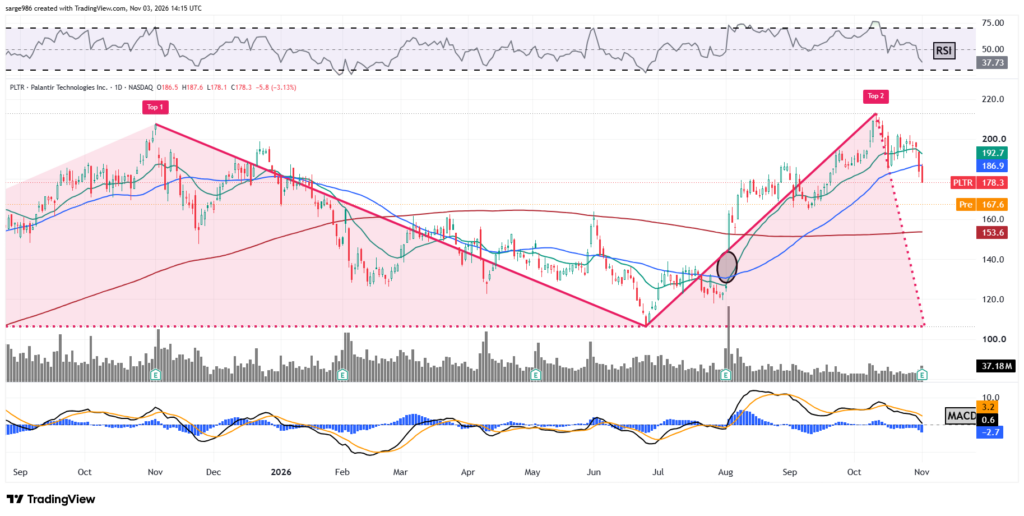
Moving on to the indicators, Relative Strength is now weaker than neutral, but a long way from entering into a technically oversold state. Below the chart, within the daily moving average convergence divergence, we see that the histogram of the 9-day EMA remains in negative territory, which is short-term bearish. The 12-day EMA is also running below the 26-day EMA. That’s a bearish signal as well.
My Plan
I hate to say this, but it is time to take some profits in PLTR and try to reload as the stock trades off. We may not be near the top, but most of us (if you’ve been with us) are up ridiculous percentages since entry. I will reduce. I haven’t decided yet if I will exit for now.
At the time of publication, Guilfoyle was long PLTR equity.