Apple Tops Estimates but Shares Fall After Hours on Poor Margin Guidance
Rising memory costs, a slowing Services business, and a beat padded by tariff refunds put pressure on a stock that has added $1 trillion in recent months.
You've reached your free article limit
You've read 0 of 1 free Pro articles.

iPhone and Mac drove nearly 90% of revenue growth, but tariff refunds and a lower tax rate supplied most of the EPS beat. Buybacks and dividends outran free cash flow, and memory supply clouds the outlook. Plus, at 36x forward earnings, AAPL has little room for a margin miss.
Apple (AAPL) shares are lower in after-hours trading on Monday (-2.6% as of 8.20 pm ET) after warnings about memory costs on the company’s first earnings call under CEO John Ternus outweighed a revenue beat and stronger-than-expected holiday sales guidance. The drop follows a rally that added roughly $1 trillion to Apple’s market value in recent months, according to Bloomberg.
Fiscal fourth-quarter revenue rose 11.7% to $114.5 billion, topping the $113.4 billion consensus, and EPS of $2.10 beat $1.99, according to TipRanks, although the beat was less than it appeared as I’ll get to below.
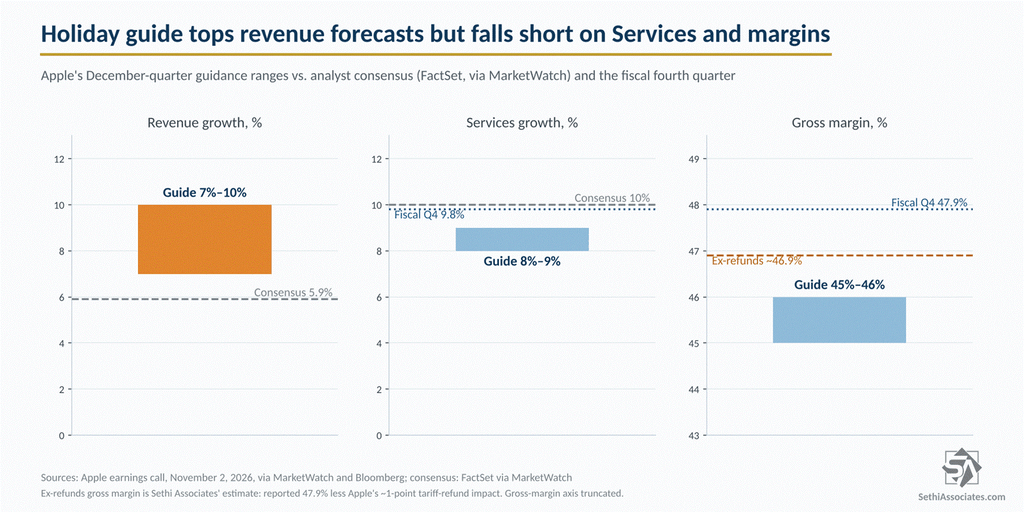
And for the December quarter, Apple guided to revenue growth of 7% to 10%, above the 5.9% FactSet consensus. But what sent shares lower is it sees gross margin of 45% to 46%, below the 47% analysts expected, according to Bloomberg, and down from 47.9%, as Services growth is expected to slow to 8% to 9%, short of the 10% analysts expected.
iPhone and Mac Carried the Quarter
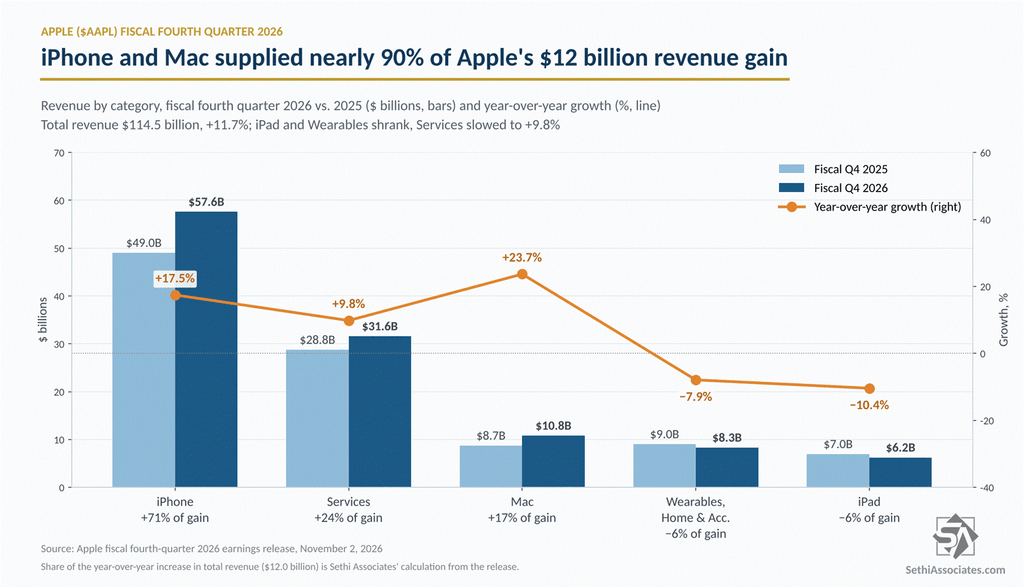
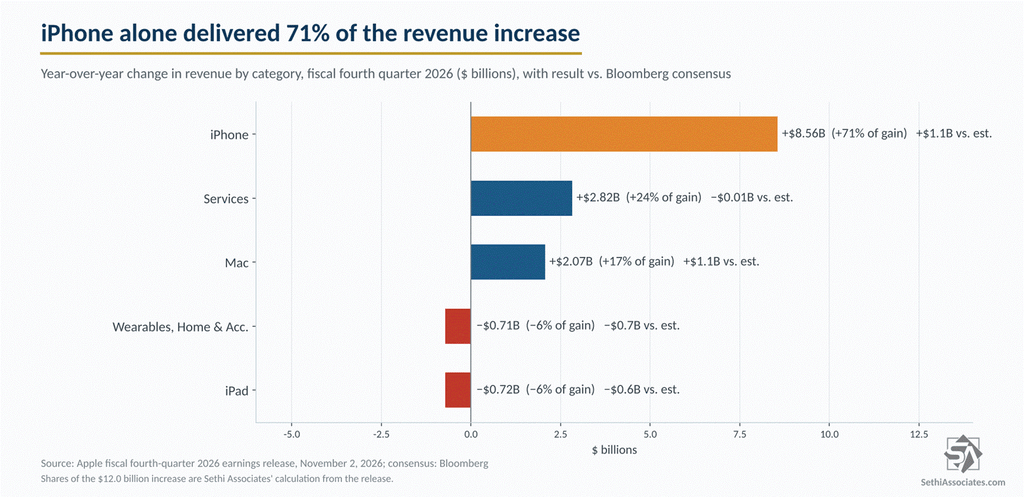
In the prior quarter, revenue was driven by iPhone and Mac sales. iPhone sales rose 17.5% to $57.6 billion, $1.1 billion above Bloomberg’s consensus, and Mac sales jumped 23.7% to $10.8 billion. Together they supplied nearly 90% of the $12 billion revenue increase. Ternus said Apple had its best fiscal year ever for iPhone upgraders and has never sold more Macs in a year. However, iPad fell 10.4% and Wearables, Home and Accessories fell 7.9%, each missing by $0.6 billion to $0.7 billion, which Chief Financial Officer Kevan Parekh pinned on tough comparisons with year-ago launches.
iPhone Duo, which shipped in October, sold out, and Chief Operating Officer Sabih Khan said Apple can’t yet predict when supply will catch up with demand.
Memory Costs Though Are an Issue
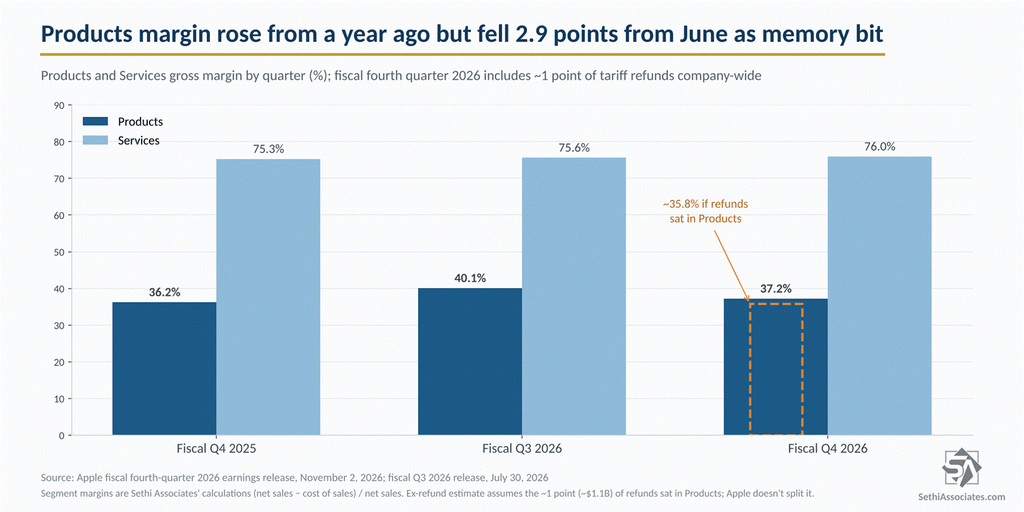
Gross margin of 47.9% landed in the upper half of Apple’s 47% to 48% guidance, but about 1 point came from tariff refunds. Without them it was about 46.9%, below the roughly 47.5% implied by Bloomberg’s consensus. The Products margin was 37.2%, a point higher than a year earlier but nearly 3 points below June.
Parekh said memory was the main pressure, and the December guide reflects higher memory costs plus spending on the Siri AI ramp, MarketWatch reported. He also said Apple received most of its expected tariff refunds in the September quarter, per Bloomberg, so the cleaner comparison for the guide is 46.9%, implying a decline of 1 to 2 points. Ternus expects memory costs to keep rising beyond December, and Apple’s manufacturing purchase obligations rose $33 billion from June to September.
Even excluding tariff refunds, gross margin guidance implies a decline of 1 to 2 points.
Services Growth the Slowest in 2026
Services revenue rose 9.8% to $31.6 billion, in line with estimates but the slowest growth of fiscal 2026, after 14%, 16% and 12% in the first, second and third quarters. Parekh blamed a roughly 4-point currency headwind between the March and September quarters, along with softness in mobile gaming and third-party licensing in the App Store, according to MarketWatch.
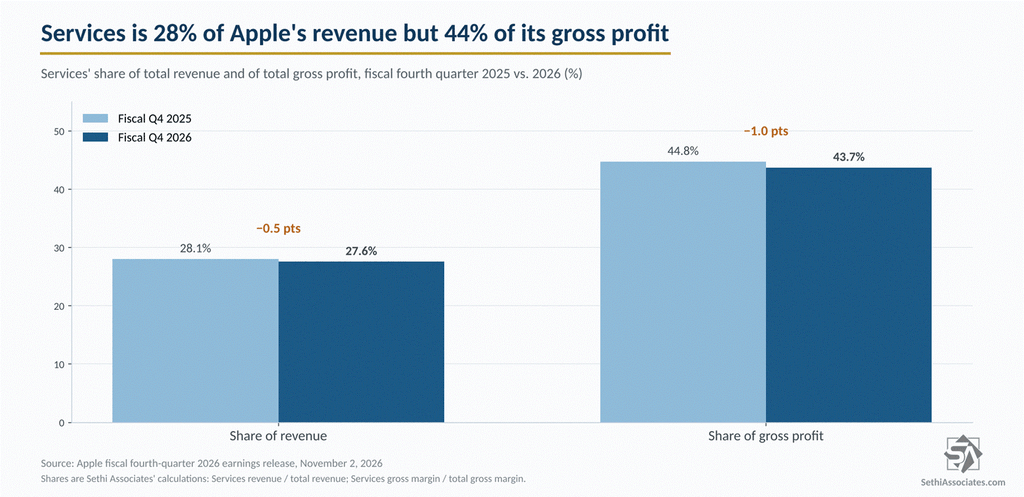
That matters because Services is 28% of Apple’s revenue but 44% of its gross profit.
Greater China Fell Short
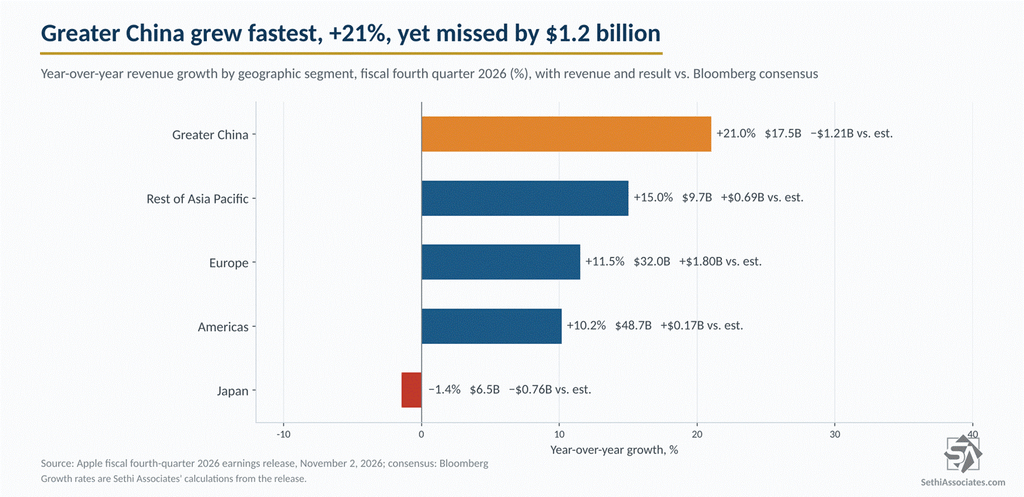
Greater China grew 21% to $17.5 billion, the fastest of Apple’s five regions, yet missed estimates by $1.2 billion. Parekh cited supply constraints, the Financial Times reported. Europe more than covered the miss with a $1.8 billion beat, sales were at a record in India, and Japan was the only region to shrink, down 1.4%.
A Lower-Quality Beat
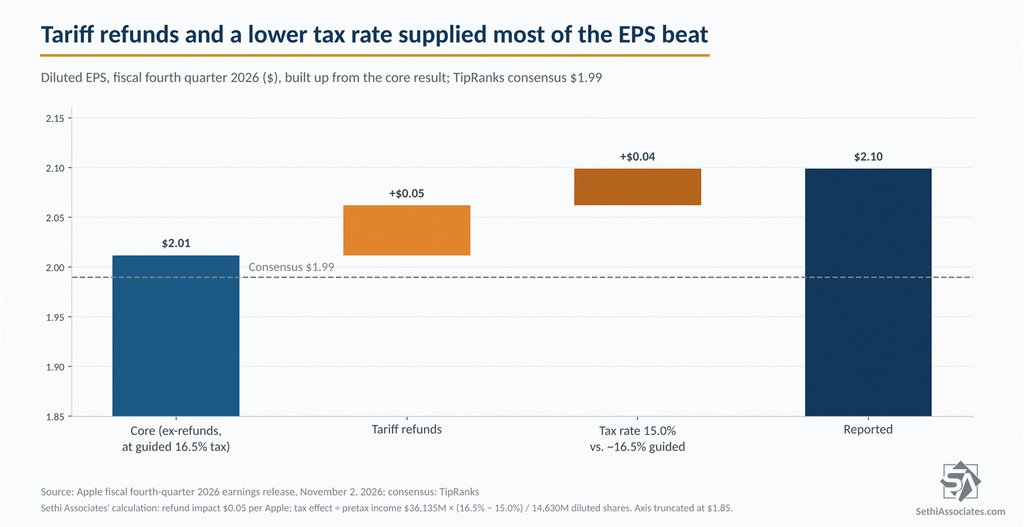
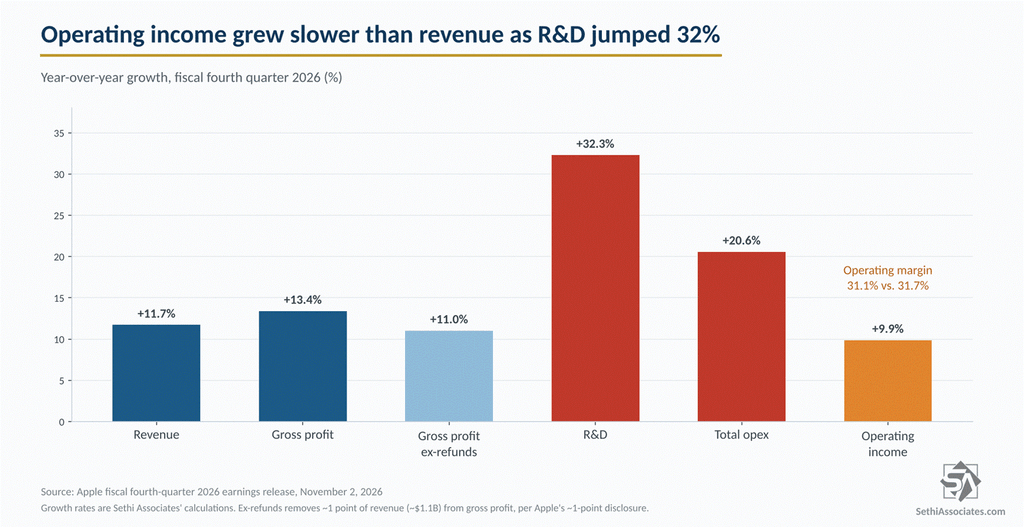
Of the $0.11 EPS beat, $0.05 came from tariff refunds, according to the release, and about $0.04 from a 15.0% tax rate, below the roughly 16.5% Apple guided in July. Excluding refunds, EPS grew 10.8% instead of 13.5%. Operating expenses rose 20.6%, led by a 32% jump in research and development, so operating income grew 9.9%, less than revenue.
So about $0.09 of the $0.11 EPS beat came from refunds and taxes.
Cash Flow Slipped as Inventory Swelled
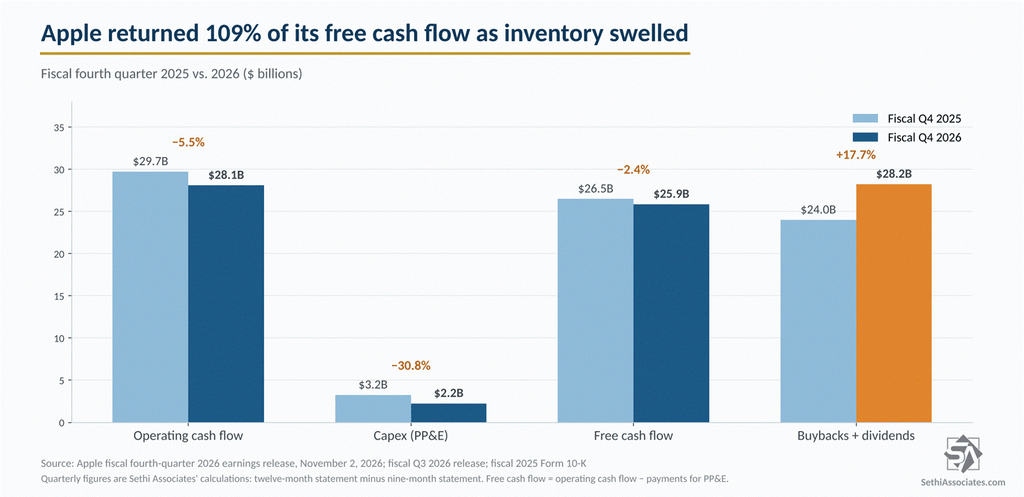
Per Claude’s analysis (Apple doesn’t provide cash flow numbers), free cash flow was $25.9 billion, down 2.4% even as net income rose 11.8%. Inventory was the main drag. It reached $14.5 billion, up from $5.7 billion a year earlier, as Apple stockpiles components to blunt memory inflation, MarketWatch noted.
Buybacks and dividends totaled $28.2 billion, 109% of free cash flow. For the full year, though, Apple returned 75% of free cash flow, and net cash rose to $56.8 billion from $33.8 billion. Parekh said Apple will now evaluate debt and cash separately rather than aim for net cash neutral, giving it more room to invest.
Capex Remains a Sliver of the Hyperscalers
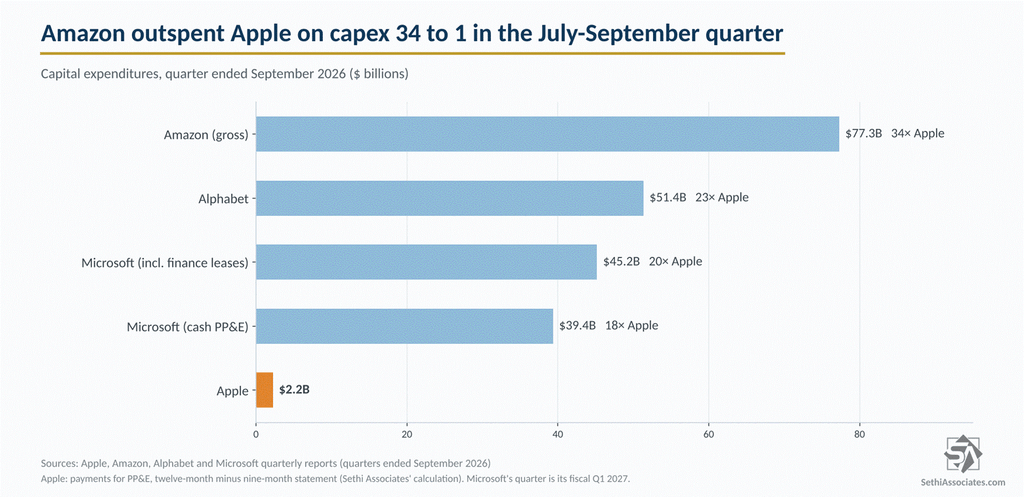
Apple spent $2.2 billion on capex in the quarter. Over the same three months, Amazon spent $77.3 billion Alphabet $51.4 billion and Microsoft $39.4 billion in cash on property and equipment. Amazon’s single quarter exceeds Apple’s combined capex for its last seven fiscal years. That gap is why investors have treated Apple as a port in the AI storm, as The Wall Street Journal put it.
Holiday-Quarter Outlook
Apple guided to December-quarter revenue of $153.8 billion to $158.1 billion, or growth of 7% to 10% from the year-ago quarter. Parekh said that reflects constrained supply and would still be the company’s best quarter ever. Khan expects memory-related constraints on Mac and iPad. Gross margin is guided to 45% to 46% and Services growth to 8% to 9% both below expectations.
That matters at Apple’s valuation: the stock trades at 36 times next year’s expected earnings, with expected earnings growth of only 1%, per Oppenheimer’s Martin Yang in The Wall Street Journal. Each point of gross margin on the guided revenue midpoint is worth about $0.09 a share in the December quarter, so falling 1 to 2 points short of the 47% estimate costs roughly $0.09 to $0.18 in EPS.