Stock Market Today

Market updates and conversation from TheStreet Pro team. Follow the latest and join the conversation below.

Stock Market Today: November 2, 2026

Newest first · All times Eastern · 4 updates

DATE:
By Neil Sethi

Borrowing Update

As an update to this morning’s post on the Treasury’s Quarterly Refunding (Mo’ Bills Mo’ Problems?), Treasury released its quarterly borrowing estimates this afternoon, and while the headline figure for this quarter edged lower due to a higher starting cash balance, the underlying need moved up and next quarter’s number is projected to be much larger, meaning an even greater reliance on bills if non-Bill borrowing remains constant or shrinks.

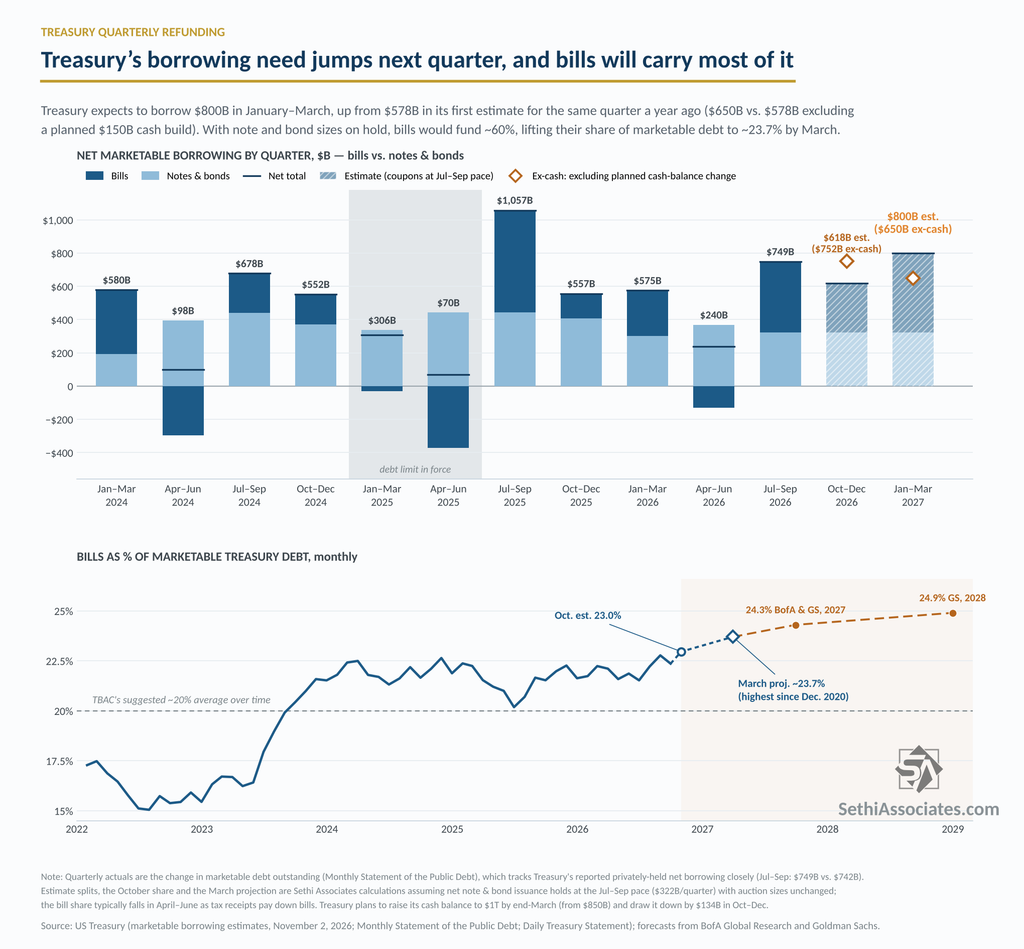
For the October–December quarter, the Treasury expects to borrow $618 billion in privately held net marketable debt, $10 billion less than it estimated in August. That cut came entirely from starting the quarter with $34 billion more cash than assumed ($984 billion versus $950 billion). Excluding the cash balance, borrowing is $24 billion higher than August’s estimate, meaning the deficit is running wider than expected.

For January–March, the Treasury expects to borrow $800 billion, up 38% from $578 billion in its first estimate for the same quarter a year ago. About $150 billion of that is a planned build in the cash balance to $1 trillion at the end of March, from $850 billion. Excluding that, the need is $650 billion, still up 12% from a year ago. Across both quarters, borrowing excluding cash-balance swings totals about $1.4 trillion, versus $1.19 trillion in last November’s estimates, an 18% increase.

Last quarter came in a little better than feared. The Treasury borrowed $742 billion in July–September versus its $739 billion estimate, but $34 billion of that went to a larger cash pile, so the underlying need was $30 billion below its August projection.

If note and bond auction sizes are held steady Wednesday, as noted this morning, bills will have to carry most of the increase. Net note and bond issuance ran $322 billion in the July–September quarter. At that pace, bills would fund roughly half of this quarter’s borrowing and about 60% of next quarter’s, or roughly $480 billion of net new bills. By Claude’s math, that would lift the bill share of marketable debt to about 23.7% by the end of March, with around $7.9 trillion of bills outstanding. That would be the highest share since December 2020. It’s also already close to Bank of America’s projection of 24.3% (about $8 trillion) by next September, as reported by the Financial Times, before any shift away from 20- and 30-year bonds.

The usual caveat applies: April tax receipts typically pay down bills, so March would likely mark a near-term high. Last April–June, bills outstanding fell $129 billion and the share dropped from 22.1% to 21.5%.

The Treasury will release its full refunding announcement at 8:30 a.m. ET on Wednesday, November 4.
By Chris Versace

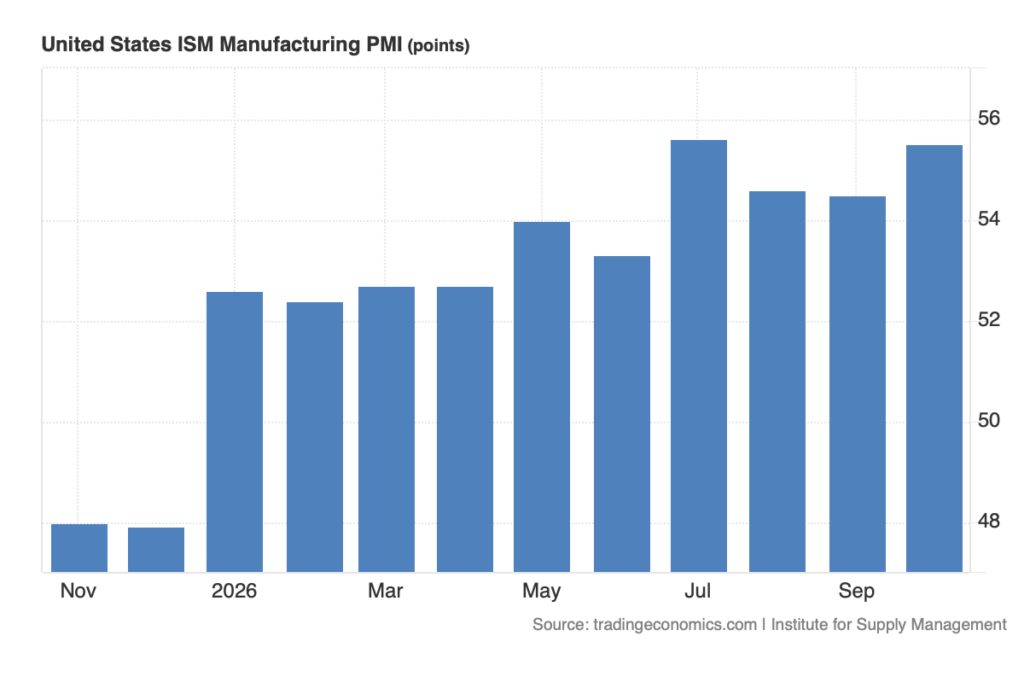
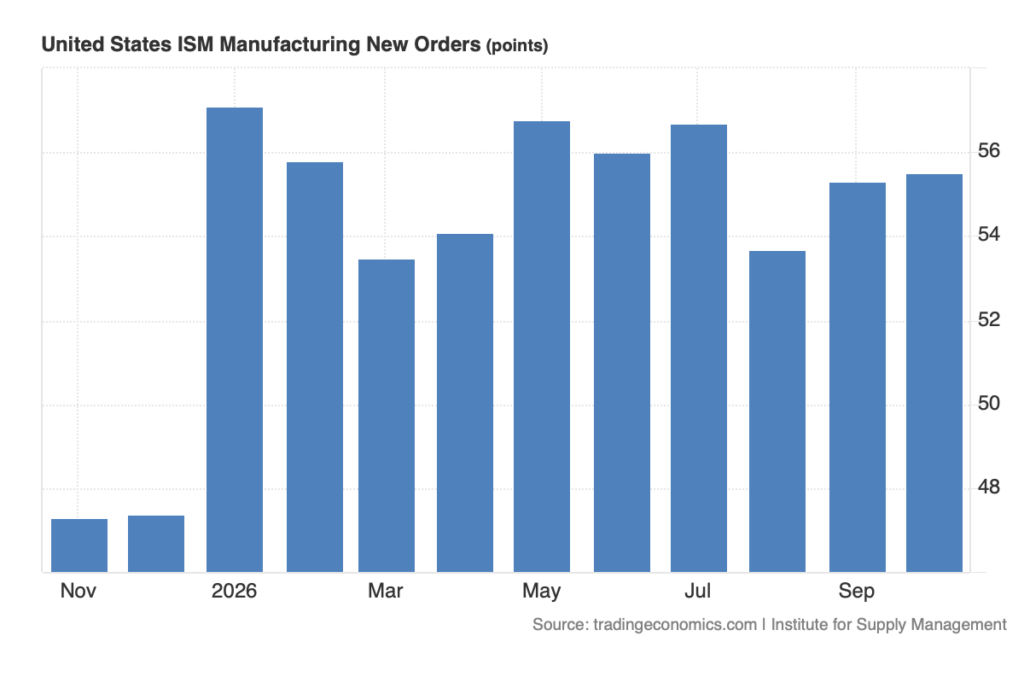
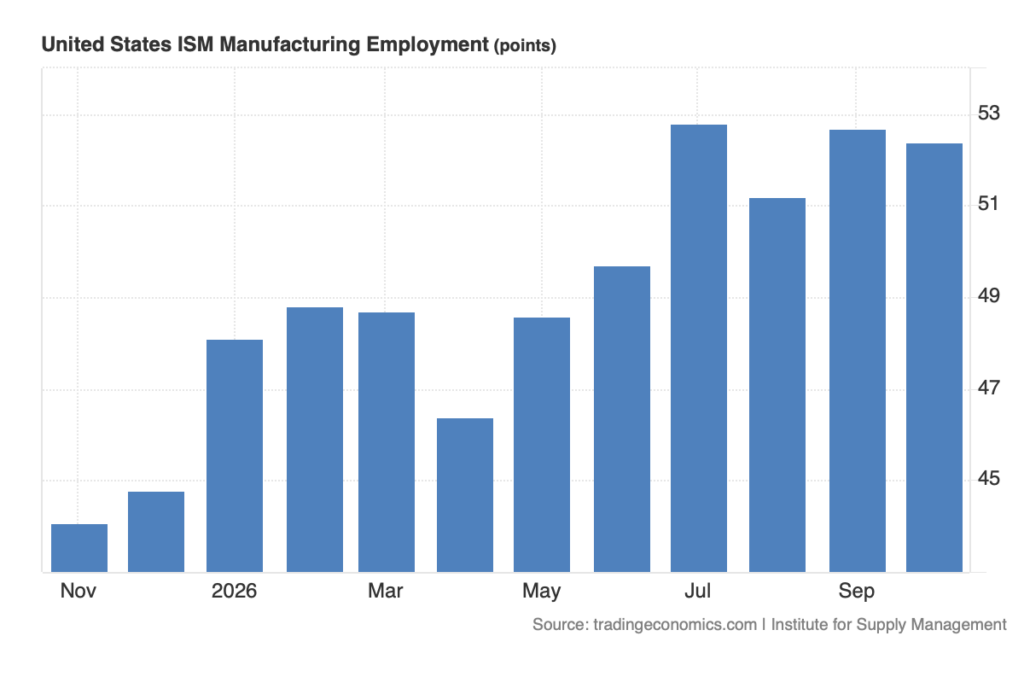
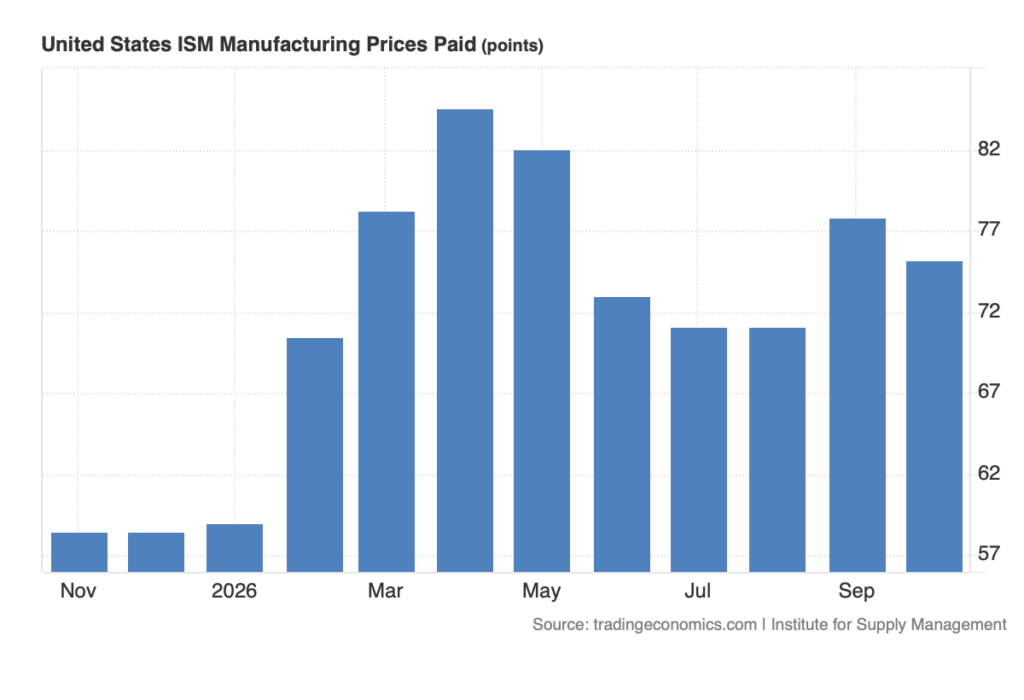
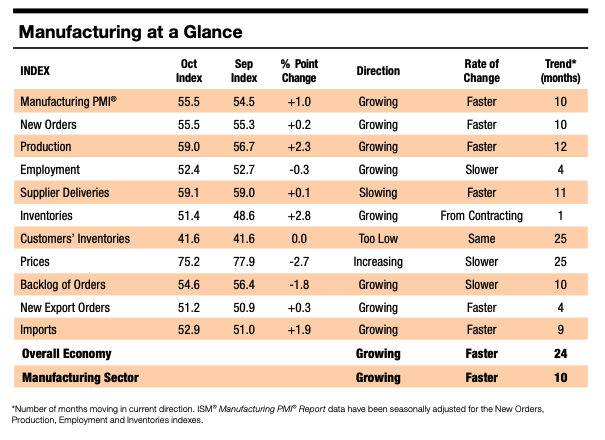
ISM October Manufacturing PMI at a Glance

By Neil Sethi

Mo’ Bills Mo’ Problems?

At Wednesday’s Quarterly Refunding Announcement, Treasury will set note and bond auction sizes for the next quarter. That starts with next week’s refunding auctions, which would total $125B if sizes are unchanged: $58B of 3s, $42B of 10s and $25B of 30s. It will also update its guidance on future coupon sales.

Some on the Street are speculating that Treasury will shift supply away from the long end, particularly 20- and 30-year bonds, and toward T-bills. Citi expects cuts to 20s and 30s starting this month. BofA, Goldman, UBS and Barclays are among those looking for a change to the “at least the next several quarters” language in place since January 2024, although UBS sees no actual change in issuance until May. JPMorgan is the notable dissent. It expects the language to hold into 2027 and argues that cutting long bonds wouldn’t be prudent given the borrowing ahead and early signs that bill demand is stalling.

The motive is yields. The 30-year was still above 5.30% on Friday after long rates hit their highest in more than two decades in early October.

That shift though would push the T-bill share of debt further above the ~20% average the TBAC advised in 2024:

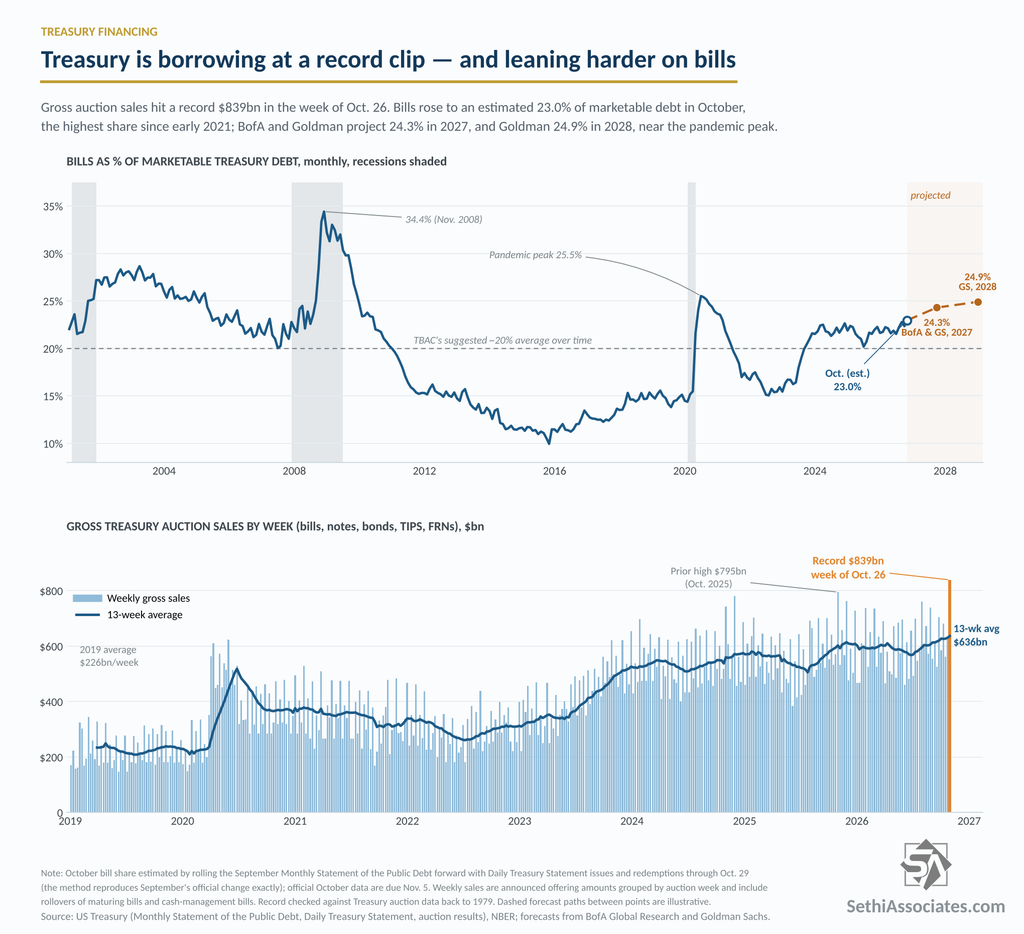
â–Ș Bills were 22.4% of marketable debt at the end of September. Rolling that forward with daily Treasury data puts October at ~23.0%, the highest since early 2021.

â–Ș BofA and Goldman already see 24.3% in 2027, and Goldman 24.9% in 2028, near the 25.5% pandemic peak. That’s before any shift out of the long end.

â–Ș For scale, Treasury sold ~$445B of nominal 20- and 30-year bonds over the past 12 months. Moving half of that into bills would add roughly 0.7 points a year to the bill share.

Heavier bill reliance is also why gross issuance is already at a record given they need to be rolled over frequently. Treasury auctioned $839B last week, the most in data back to 1979. The 13-week average is $636B, nearly 3x the 2019 average of $226B.

The downside of this moves to shorter maturities is that this leaves Treasury’s interest costs more exposed to swings in short-term rates, with the market pricing three more rate hikes from the Fed by the end of 2027. And while investors have piled into bills since the pandemic, there’s no assurance that demand will continue.

Bills outstanding have nearly tripled, from $2.6T in February 2020 to $7.1T in September. JPMorgan is already flagging early signs of stalling, and the stablecoin bid Treasury officials have touted has yet to show up at scale.

Treasury also updates its quarterly borrowing estimates this afternoon.

By Neil Sethi

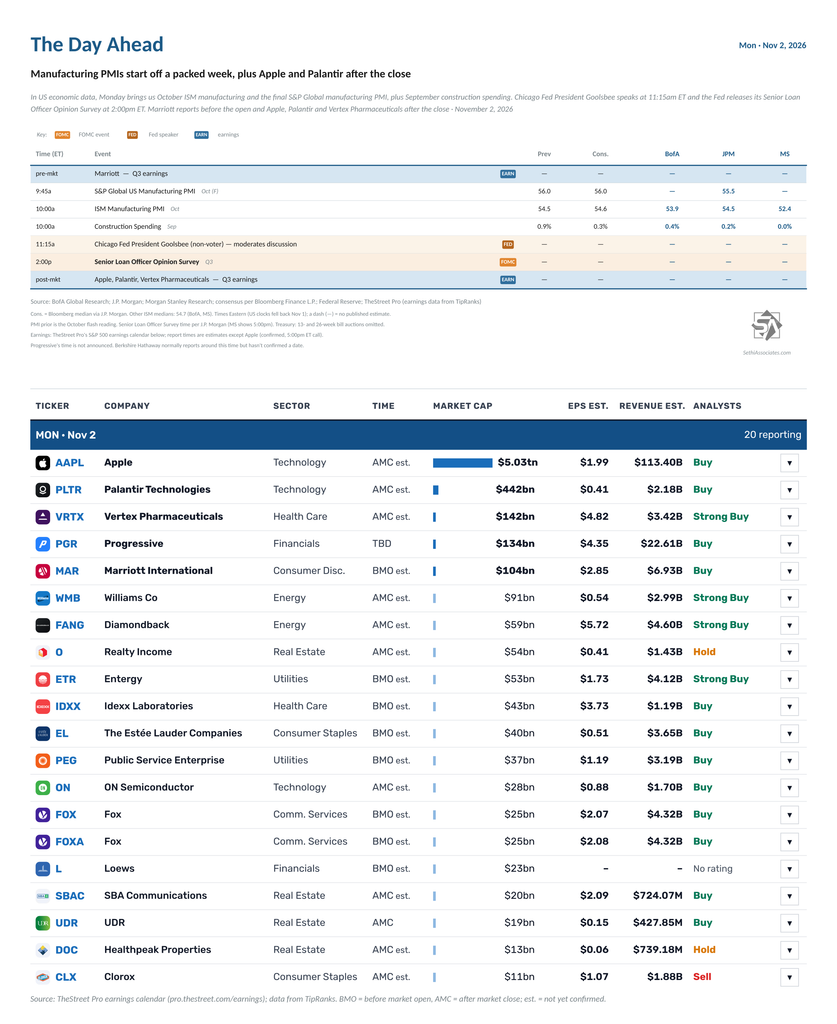
Manufacturing PMIs and Apple Earnings Kick Off a Packed Week

In US economic data, Monday brings us October ISM manufacturing and the final S&P Global manufacturing PMI. September reports are construction spending.

In terms of the Fed, Chicago Fed President Goolsbee (non-voter) moderates a discussion at 11:15am ET, and the Fed releases its Senior Loan Officer Opinion Survey at 2pm ET.

There are no Non-Bill (>1yr in maturity) US Treasury auctions this week, but we’ll get the Treasury’s borrowing amounts for the fourth quarter today.

19 S&P 500 components report, five of them with market caps over $100B:

Before the open: Marriott (MAR), Entergy (ETR), Idexx Laboratories (IDXX), Estée Lauder (EL), Public Service Enterprise Group (PEG), Fox (FOXA) and Loews (L)

After the close: Apple (AAPL), Palantir (PLTR), Vertex Pharmaceuticals (VRTX), Williams (WMB), Diamondback Energy (FANG), Realty Income (O), ON Semiconductor (ON), SBA Communications (SBAC), UDR (UDR), Healthpeak Properties (DOC) and Clorox (CLX)

Time not announced: Progressive (PGR)

Conversation 0 Comments

One ongoing discussion across all days. Everyone can read; sign in to take part.

Your voice matters. Discussions are moderated for civility. Read our guidelines .

Log in to join the conversation

Loading comments...