Mo’ Bills Mo’ Problems?
At Wednesday’s Quarterly Refunding Announcement, Treasury will set note and bond auction sizes for the next quarter. That starts with next week’s refunding auctions, which would total $125B if sizes are unchanged: $58B of 3s, $42B of 10s and $25B of 30s. It will also update its guidance on future coupon sales.
Some on the Street are speculating that Treasury will shift supply away from the long end, particularly 20- and 30-year bonds, and toward T-bills. Citi expects cuts to 20s and 30s starting this month. BofA, Goldman, UBS and Barclays are among those looking for a change to the “at least the next several quarters” language in place since January 2024, although UBS sees no actual change in issuance until May. JPMorgan is the notable dissent. It expects the language to hold into 2027 and argues that cutting long bonds wouldn’t be prudent given the borrowing ahead and early signs that bill demand is stalling.
The motive is yields. The 30-year was still above 5.30% on Friday after long rates hit their highest in more than two decades in early October.
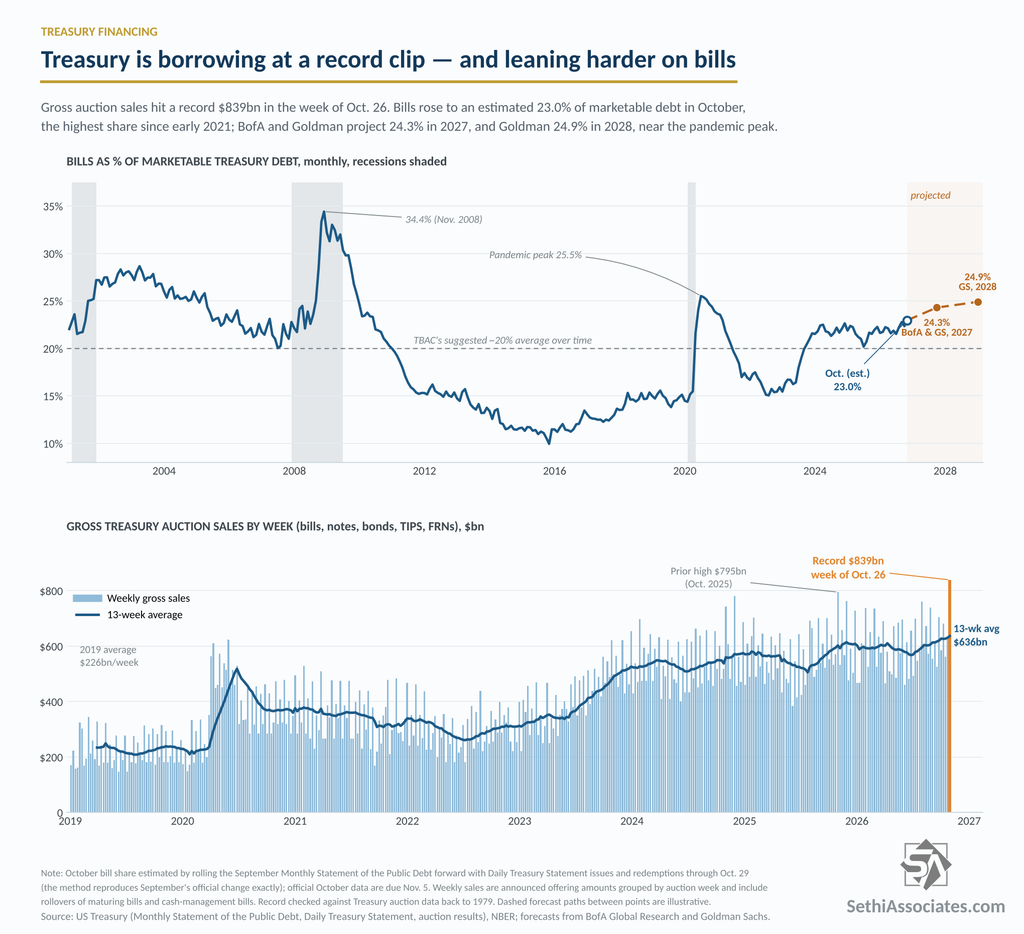
That shift though would push the T-bill share of debt further above the ~20% average the TBAC advised in 2024:
▪ Bills were 22.4% of marketable debt at the end of September. Rolling that forward with daily Treasury data puts October at ~23.0%, the highest since early 2021.
▪ BofA and Goldman already see 24.3% in 2027, and Goldman 24.9% in 2028, near the 25.5% pandemic peak. That’s before any shift out of the long end.
▪ For scale, Treasury sold ~$445B of nominal 20- and 30-year bonds over the past 12 months. Moving half of that into bills would add roughly 0.7 points a year to the bill share.
Heavier bill reliance is also why gross issuance is already at a record given they need to be rolled over frequently. Treasury auctioned $839B last week, the most in data back to 1979. The 13-week average is $636B, nearly 3x the 2019 average of $226B.
The downside of this moves to shorter maturities is that this leaves Treasury’s interest costs more exposed to swings in short-term rates, with the market pricing three more rate hikes from the Fed by the end of 2027. And while investors have piled into bills since the pandemic, there’s no assurance that demand will continue.
Bills outstanding have nearly tripled, from $2.6T in February 2020 to $7.1T in September. JPMorgan is already flagging early signs of stalling, and the stablecoin bid Treasury officials have touted has yet to show up at scale.
Treasury also updates its quarterly borrowing estimates this afternoon.
Conversation 0 Comments
One ongoing discussion across all days. Everyone can read; sign in to take part.
Your voice matters. Discussions are moderated for civility. Read our guidelines .
Log in to join the conversation