Time to Diversify Out of Semiconductors
Energy and pharmaceuticals offer some compelling alternatives.
You've reached your free article limit
You've read 0 of 1 free Pro articles.

If you need proof that the price action in the semiconductor sector is worse than the action in the overall market, look no further than the Philadelphia Semiconductor Index.
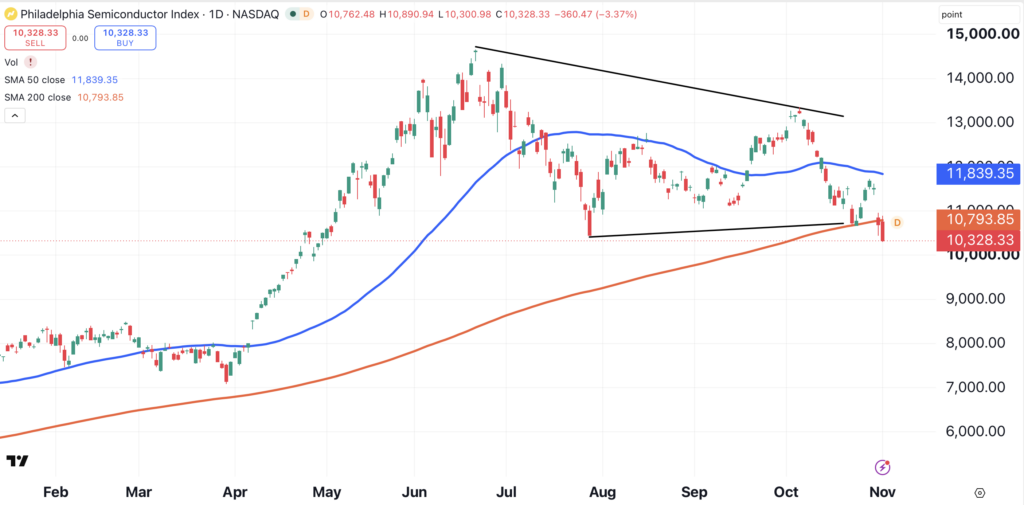
The (SOX) closed at a six-month low on Monday, losing 3.37% after breaking through a major support level (black horizontal line). The move occurred after the index formed a bearish pattern known as a descending triangle. Two weeks ago, we warned readers that this pattern was forming.
The index closed firmly below its 200-day moving average for only the second time this year.
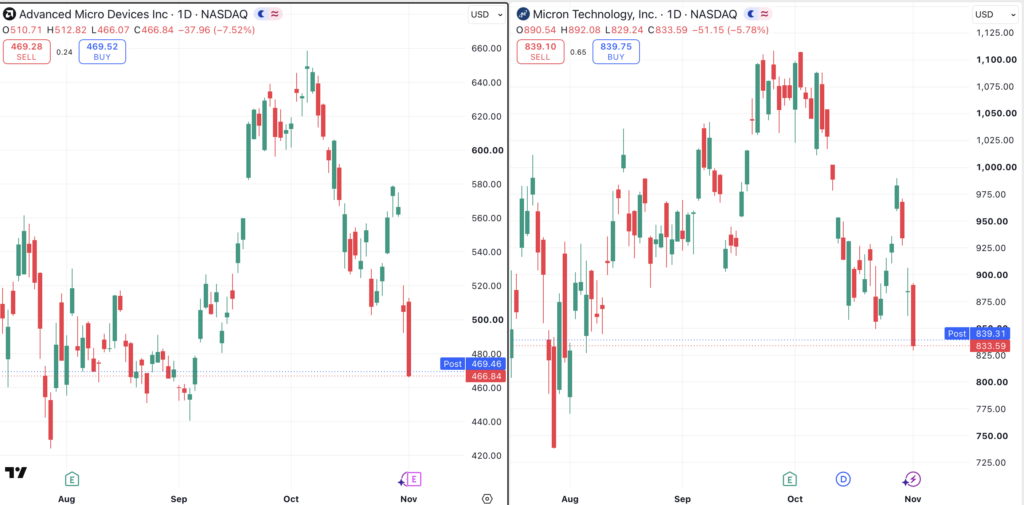
On Monday, Advanced Micro Devices (AMD) (left chart) lost 7.5%, and Micron (MU) (right chart) fell by 5.7%. Both stocks are at their lowest levels in months.
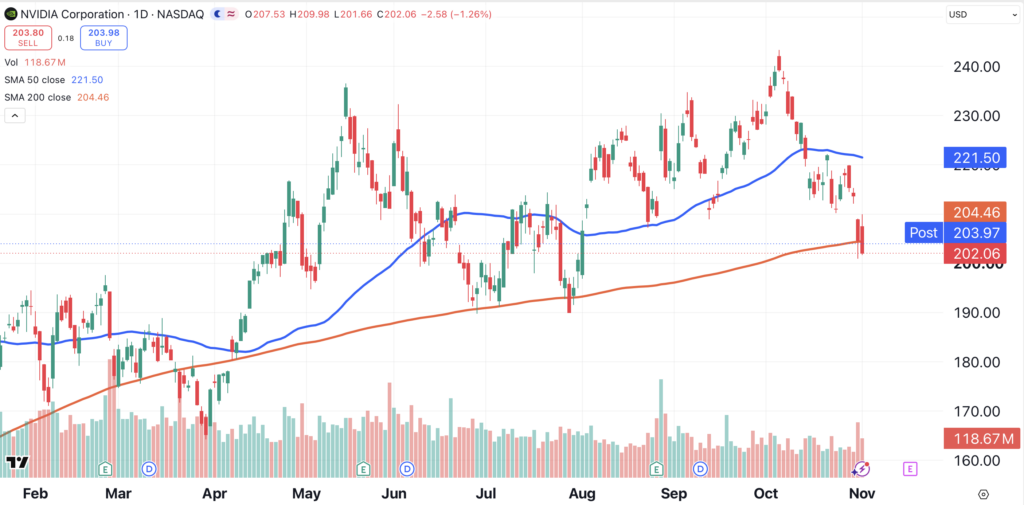
Nvidia (NVDA) closed at a two-month low, and closed below its 200-day moving average (red) for the first time since July. Semiconductor bulls will be watching closely when Nvidia reports earnings on November 17.
We’ve cut back on semiconductors, trimming our positions by half nearly a year ago, and cutting them in half again in July.
Some of that capital was reallocated to the healthcare/pharmaceutical industry. Two of our holdings in that area reported earnings on Monday.
Tempus AI
Shares of Tempus AI (TEM) shot higher by 8.6% on Monday after the Chicago-based company reported strong third quarter earnings.
The precision medical and health technology company earned seven cents per share, crushing estimates of a loss of nine cents. Tempus AI also raised revenue guidance for the full year, and now anticipates year-over-year revenue growth of 25%.
53% Potential Upside
Needham and Co. maintained its buy rating on the stock, while raising its target price from $75 to $89. We are maintaining our target of $120 for Tempus AI, as indicated here. A rally of that magnitude would generate a return of nearly 53% from Monday’s closing price.
Tempus AI uses artificial intelligence to accelerate drug development and run genomic diagnostics. The company’s gene sequencing products are used by Merck and Moderna, and are key to those companies’ attempts to jointly develop personalized vaccines for melanoma and other forms of cancer.
Charting Tempus AI
Technically, Tempus AI has formed a bullish channel (black diagonal lines). This channel contains a series of higher lows (HL) and higher highs (HH), indicative of a bullish trend.
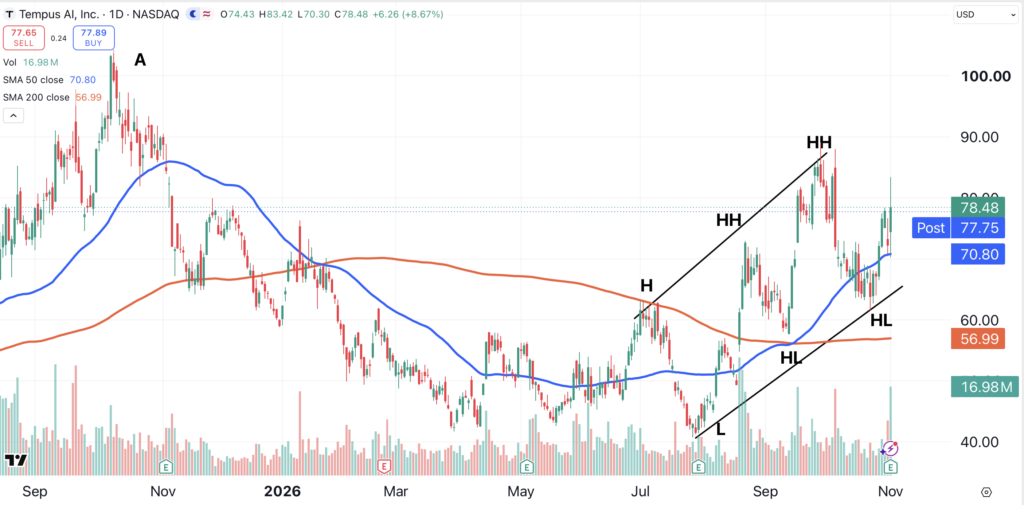
Tempus AI has gained 40.6% over the past six months, and is trading above its 50-day (blue) and 200-day (red) moving averages. The stock’s all-time closing high of $103 was set last October (point A).
Tempus AI announced a new partnership with Bristol Myers Squibb (BMY) and privately held Pathos AI to develop medicines for Alzheimer’s Disease and other neurological conditions.
Vertex Misses Earnings, Raises Guidance
After Monday’s close, Vertex reported earnings for its second quarter. The company missed earnings estimates of $4.74 per share by a penny, but raised full-year revenue guidance. As a result, the stock, which fell by 1% on Monday, bounced higher in after hours trading.
Like Tempus AI, Vertex is also trading in a bull channel (diagonal lines). A higher high (HH) and a higher low (HL) are visible, and the stock is trading above its key 50-day (blue) and 200-day (red) moving averages.
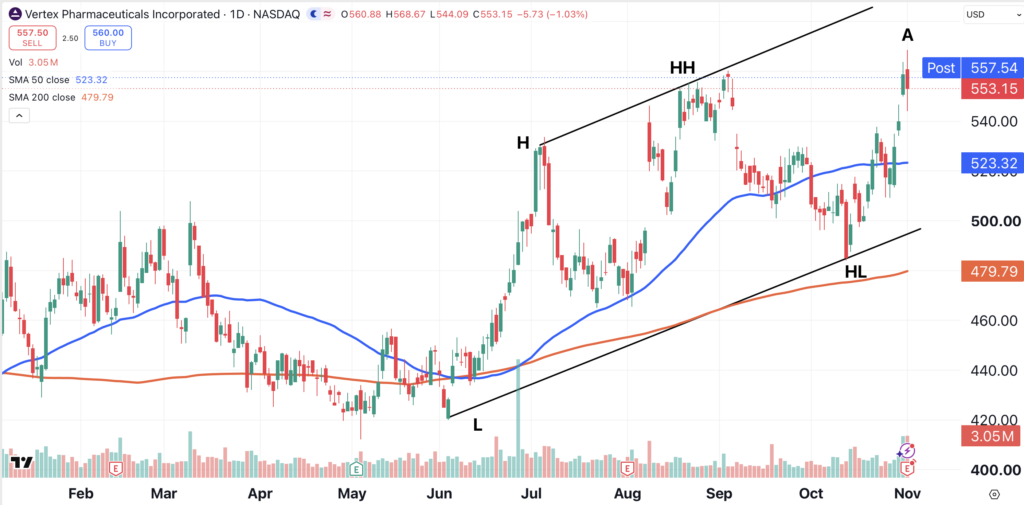
Prior to reporting earnings, Vertex reached its all-time intraday high of $568 on Monday (point A). Our target price for Vertex remains $590, representing a potential gain of about 6.7% from Monday’s closing price.
Bottom Line
If you’re still loaded up on semiconductor stocks, it’s not too late to diversify. While reducing our footprint in semis, we’ve stepped into energy and pharmaceuticals. We’ve also added mega-cap tech names like Alphabet (GOOG) and Meta Platforms (META), picking up both names well below their recent highs.
At the time of publication, Ponsi was long TEM, VRTX, NVDA, AMD, META and GOOG.