AI Frenzy Returns to Wall Street as Chip Stocks Explode Higher Before Big Tech Earnings
A wave of AI-related deals sent semiconductor shares soaring, helping the Nasdaq rally while investors prepared for the Fed and crucial earnings from Microsoft and Google parent Alphabet.
You've reached your free article limit
You've read 0 of 1 free Pro articles.

Quick Summary
- The AI rally extended into a third day, with the Philadelphia Semiconductor Index (SOX) adding another 3.6%, its best session since September 22nd, taking its three-day gains to around 7%.
- Semiconductors continued to receive support on a variety of fronts. Broadcom (AVGO) rose 4% on a reported $63 billion financing arrangement for Anthropic’s purchases of its chips and networking gear, while Advanced Micro Devices (AMD) jumped 5.5% on an expanded AI partnership with Meta (TipRanks). Meta Platforms (META) meanwhile reportedly drew about five times demand for its $25 billion common stock sale, part of a nearly $98 billion funding plan (TipRanks). AI names were also boosted by Anthropic’s surging revenue and “Claude’s broad and diversifying adoption among business customers,” per Bloomberg.
- US equity indices again started higher and, after an early dip, climbed until around noon before flattening out. Tech led again, pushing the Nasdaq up 1.2%, matched by the Russell 2000 (+1.2%), while the S&P 500 rose 0.6%, closing back above its 50-day moving average. The Dow Jones Industrial Average though finished flat.
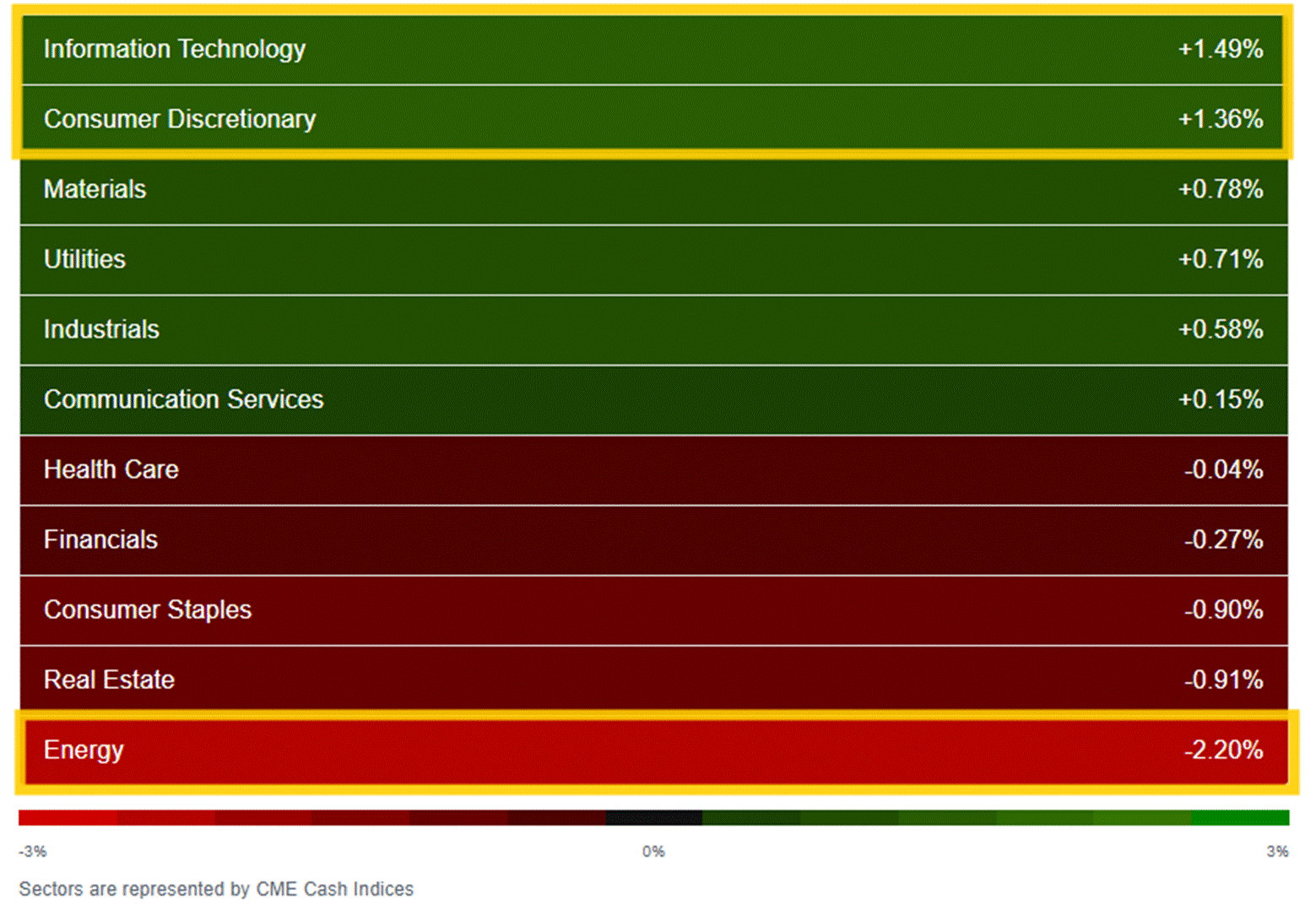
- Sector participation was mixed: six of 11 sectors rose, led by Tech (+1.49%) and Consumer Discretionary (+1.36%), while Energy (-2.20%) fell the most as oil slid. The equal-weight S&P 500 added just 0.08%.
- The bounce in AI names has halted the drop in Treasury yields, but they also haven’t bounced, little changed for a third session with the 2-year up 3 basis points to 4.78% and the 10-year up 1 basis point to 4.99% in the cash session, per Briefing.com, after a $70 billion 5-year auction (more here: 5-Year Auction Tails but Big Improvement from September’s Rout). CME FedWatch puts the odds of a hold Wednesday at ~93%.
- The data were solid:
- September durable goods orders rose 1.8%, boosted by aircraft orders, but core equipment shipments grew at their fastest quarterly pace since 2020 (see more here: Business Investment Gauge Sees Fastest Quarterly Growth Since 2020).
- Conference Board consumer confidence jumped to the highest since June, even as consumers planned less spending on services and durable goods (more here: Consumer Confidence Rebounds to Highest Since June).
- September new home sales came in better than expected even as prices rebounded from the lowest since 2021 (more here: New Home Sales Hold Near Year’s High Even as Prices Rebound).
- WTI fell 1.9% to $99.87, back below $100, and Brent slid 1.7% to $113.88 as traders weighed moves to de-escalate tensions in the Persian Gulf, per Bloomberg. Israelis also voted in parliamentary elections (more here: Israel Votes Today in Its Most Consequential Election in Decades, but It May Take Months to Settle).
- Wednesday brings the Fed’s decision at 2 p.m. ET and Chair Kevin Warsh’s press conference at 2:30, followed by results from Microsoft (MSFT) and Alphabet (GOOGL) after the close.
Market Commentary
Equities:
- “Today, focus would be on the AI trade and whether yesterday’s momentum would last,” wrote Mohit Kumar, chief economist and strategist at Jefferies. “We see the capex cycle remaining strong and the earnings remaining robust. However, as with any cycle, there would be winners and losers in the AI trade.”
- “The Anthropic IPO announcement is a clear positive for the sector, but all will depend on how much demand it can attract, especially ahead of the US mid-terms,” said Andrea Gabellone, head of global equities at KBC Securities. “Depending on the outcome, sentiment on AI could be dented, especially in case of a Democratic sweep. Today’s move is dictated by some cautiousness ahead of next week’s voting.”
- “This has become almost the norm these days, with SPX price and breadth moving in opposite directions on 33% of all trading days this year, by far the most of any year since at least 1996,” said Jonathan Krinsky, chief market technician at BTIG.
- “The period of a rising market lifting all stocks has started to shift,” said Chris Brigati at SWBC. “Future expectations are more focused upon execution risk and how much future success is already embedded in the current stock price.”
Bonds/Fed:
- “Markets are going to be more focused on the Fed, which will determine global financial conditions and that matters for credit markets,” said Geoff Yu, a senior macro strategist at BNY. “While we don’t expect a rate move this week, we wouldn’t be against a hike even though we’re not convinced of its urgency. However, we think maintaining credibility is paramount for the Fed.”
- “If, as expected, there is no change in rates, it will still be interesting to see what the vote is after the swings in the last two meetings,” wrote Thomas Block, Washington policy strategist at Fundstrat. “While the Fed views itself above partisan politics, it would be unlikely that the Fed would move rates a week before a national election.”
- “We think an increase at the end of the year is likely, with one further rate hike anticipated for 2027, as the central bank looks to combat inflation and lean against any acceleration in growth,” said James McCann at Edward Jones.
Stock and Sector Breakdown
Schwab
Six of 11 sectors rose, led by Tech (+1.49%) — its eighth straight session in the top two or bottom two sectors — and Consumer Discretionary (+1.36%), with Materials (+0.78%), Utilities (+0.71%), Industrials (+0.58%) and Communication Services (+0.15%) also higher. Energy (-2.20%) was the clear laggard as oil fell and refiners gave back some of their recent gains, per Briefing.com, with Valero Energy (VLO) (-9.2%), Marathon Petroleum (MPC) (-7.4%) and Phillips 66 (PSX) (-7.0%) among the S&P 500’s biggest decliners. Real Estate (-0.91%) and Consumer Staples (-0.90%) also lagged.
Pentair (PNR) (+12.8%) was the best performer in the S&P 500 after its third-quarter adjusted EPS of $1.18 beat the $1.07 consensus on revenue of $976.4 million (MarketBeat). Xylem (XYL) (-14.2%) was the worst after a third-quarter earnings miss and guidance cut (TheFly), just ahead of Boeing (BA) (-10.7%), which fell after CEO Kelly Ortberg said the 737 MAX production increase won’t come until the second half of 2027 (TipRanks).
Chips and AI infrastructure did the heavy lifting again. Broadcom (AVGO) gained 4.0% after it set up a backstop for financial partners taking on AI-rack purchase and lease agreements for a major customer (TipRanks), part of the reported $63 billion Anthropic financing. Advanced Micro Devices (AMD) rose 5.5%, and Oracle (ORCL) added 3.6% on an expanded AI push with Nvidia, OpenAI and Snowflake and a deal for the first external rollout of Google’s custom chips (TipRanks). Hardware names filled out the leaders, with Flex (FLEX) (+8.3%), Dell Technologies (DELL) (+7.5%), Super Micro Computer (SMCI) (+7.3%) and Western Digital (WDC) (+7.0%), while Seagate Technology (STX) climbed 3.7% ahead of its report after the close.
Note: Lots more on these and other names in TheStreet Pro columns listed later.
The neoclouds bounced hard, with Nebius Group (NBIS) up 11.2% and the Roundhill Neocloud ETF (NCLD) up 8.8%, per Briefing.com, and CoreWeave (CRWV) up 7.9%, per The Wall Street Journal. Tesla (TSLA) added 4.0% as SpaceX deal hopes kept building.
General Motors (GM) +5.5% rose after it said it’s switching its listing from the New York Stock Exchange to the Nasdaq, setting the stage for the automaker to join the Nasdaq-100 (TipRanks).
Earnings drove many of the rest of the big movers. UPS (UPS) rose 5.8% after its CEO said the company will make more money on fewer holiday packages (TipRanks), and Royal Caribbean (RCL) gained 5.5%. Coca-Cola (KO) fell 1.6% despite beating estimates and raising guidance (TipRanks). Outside the index, SoFi Technologies (SOFI) jumped 13.4% on its third-quarter beat and outlook hike (TipRanks), and JetBlue (JBLU) soared 19% after reporting $2.2 billion in cash and raising its revenue forecast (TipRanks).
Note: Sarge wrote about SoFI today: Sticking With This SoFi Price Target After ‘Remarkable’ Bounce Back Results.
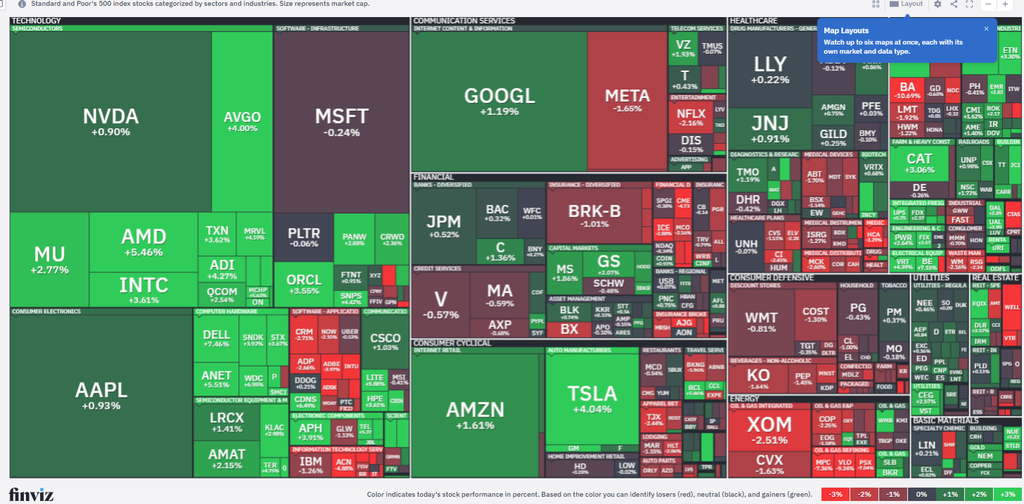
The number of large SPX winners (up over 3%) jumped to about 70 from about 40 Monday, while large losers (down over 3%) rose to about 30 from 13.
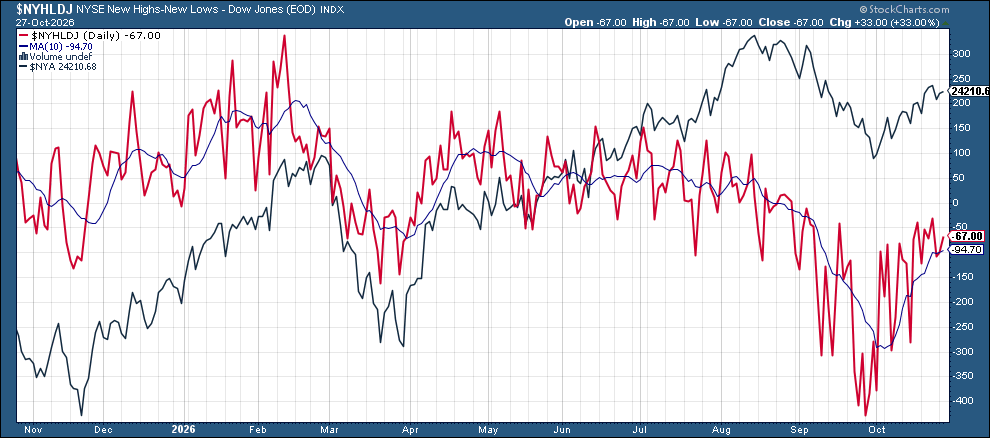
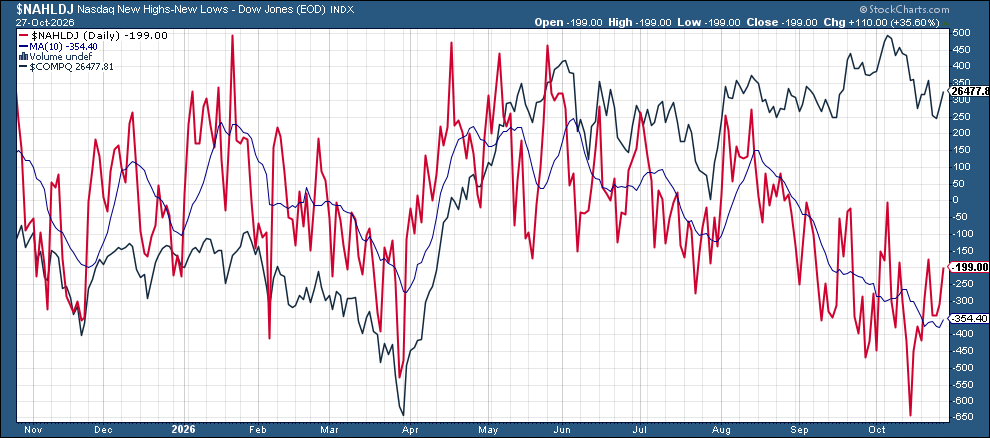
New 52-week highs minus lows improved on the NYSE to -67 (from -100) and on the Nasdaq to -199 (from -309). The Nasdaq reading has still been negative for 42 straight sessions, one shy of the 43-day stretch that ended April 22, 2025.
Positive volume (intensity of buying in stocks up on the session) improved notably to 53.2% on the NYSE from 43.4% Monday, even as the NYSE’s gain was just 0.10% versus 0.29% Monday. The Nasdaq also improved, to 68.0% from 51.8%.
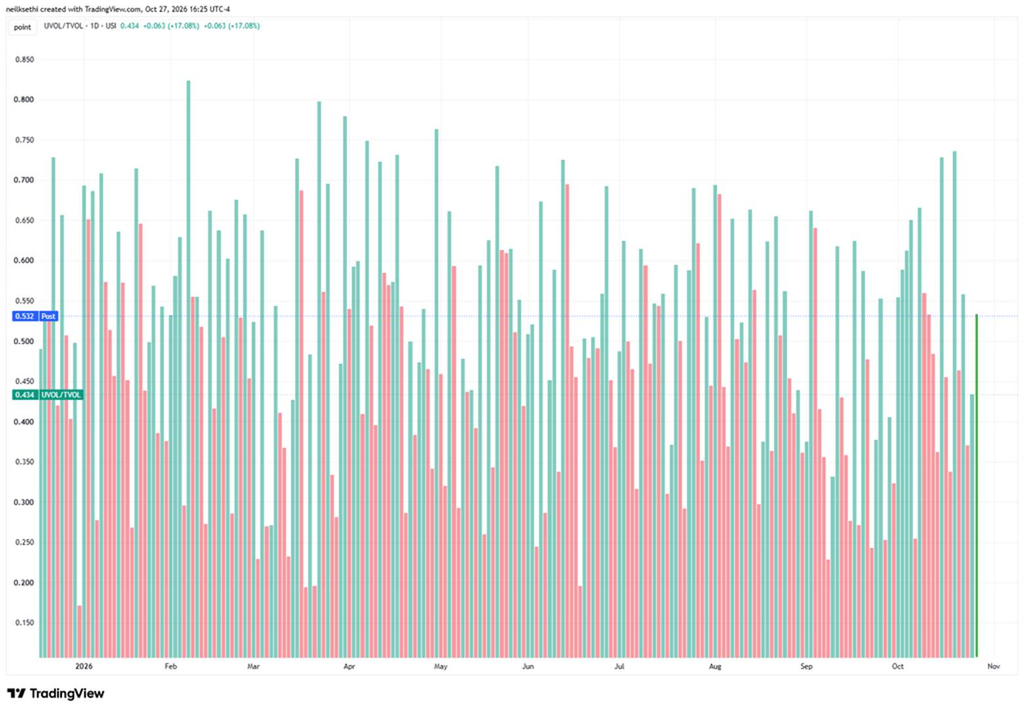
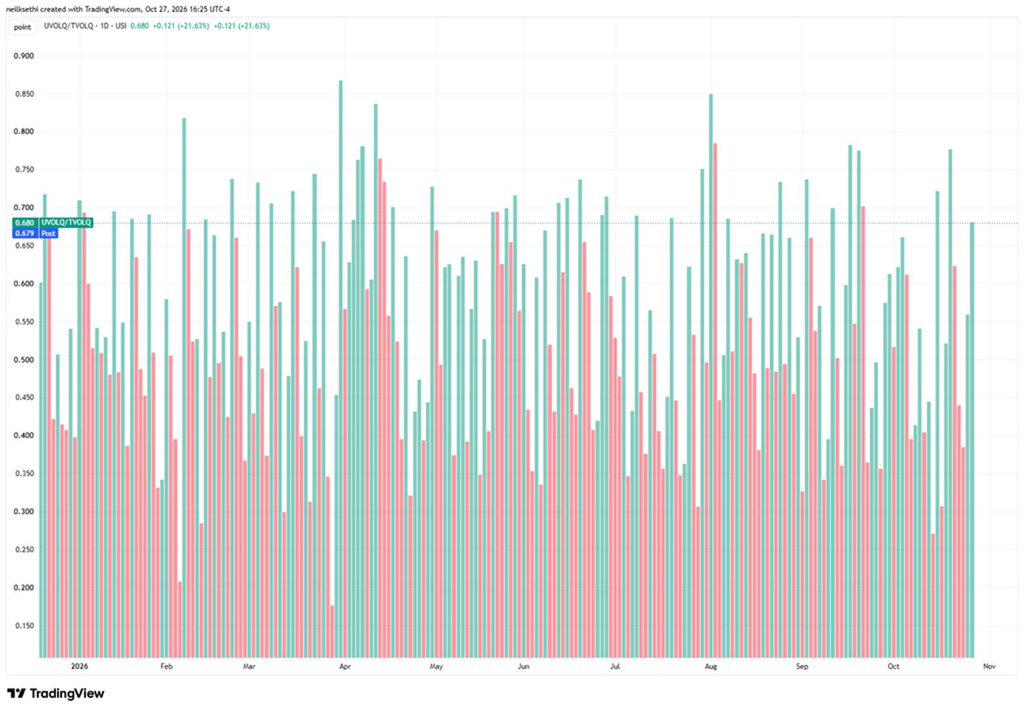
Speculation is also starting to bubble up on the Nasdaq, with four penny stocks trading more than 200 million shares and three other stocks more than 100 million.
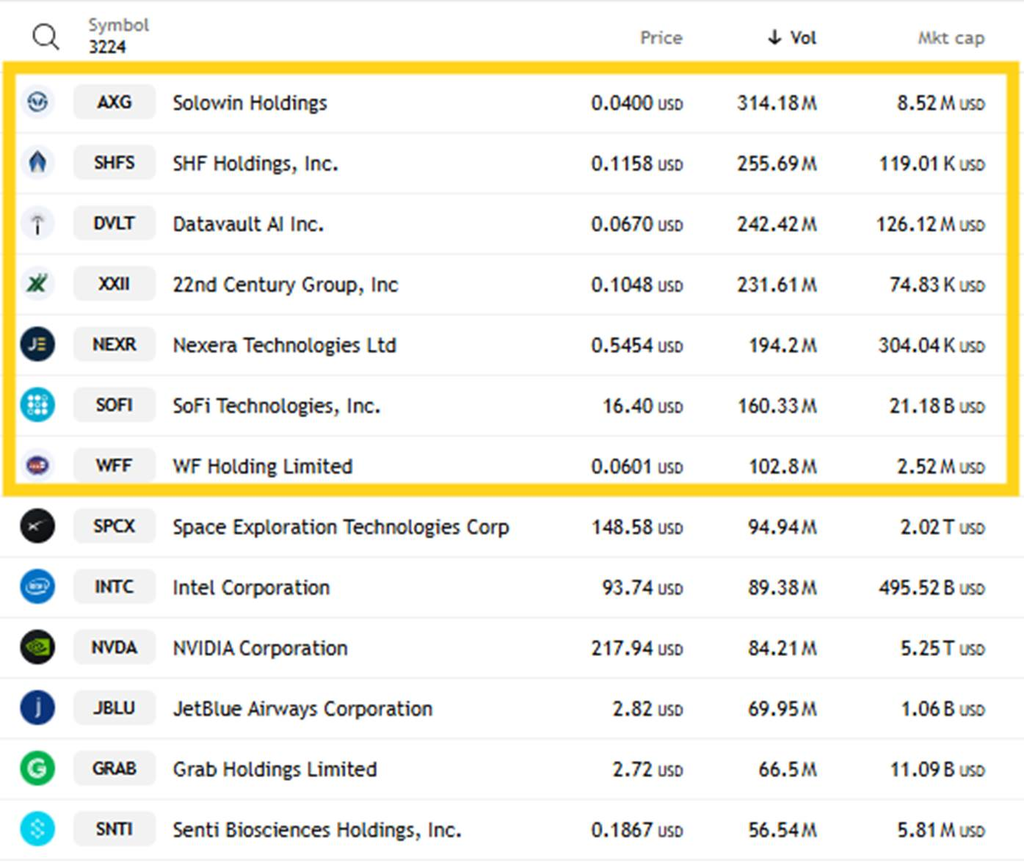
Some other stock-specific commentary from TheStreet Pro:
Doug Kass — Shades of Dot.com: Doug flags the circular financing behind Amazon’s (AMZN) stake in Anthropic. He also moved to a medium-sized short in SPY, initiated a QQQ short, added to his Apple short, and warned that staples are unstable as Coca-Cola, Procter & Gamble (PG) and PepsiCo (PEP) slid among other moves.
Chris Versace — New Boeing Rating as Credibility Weakens and Shares Take a Nosedive
Pricing, Production Drive Incremental Margin Gains for This Truck Holding
Adding to This REIT Holding on Weakness and Lifting Our Rating
We’re Buying Shares of 3 Portfolio Holdings
Bob Lang — Chart of the Day: Waste Management Proves Garbage Is Hot: Waste Management (WM) reports after the close.
Bob Byrne — Would You Pay Your CEO $6 Billion to Sell the Company to His Other Company?: Byrne on the math behind a SpaceX (SPCX) deal for Tesla and how he’d trade it.
A Look At The Charts
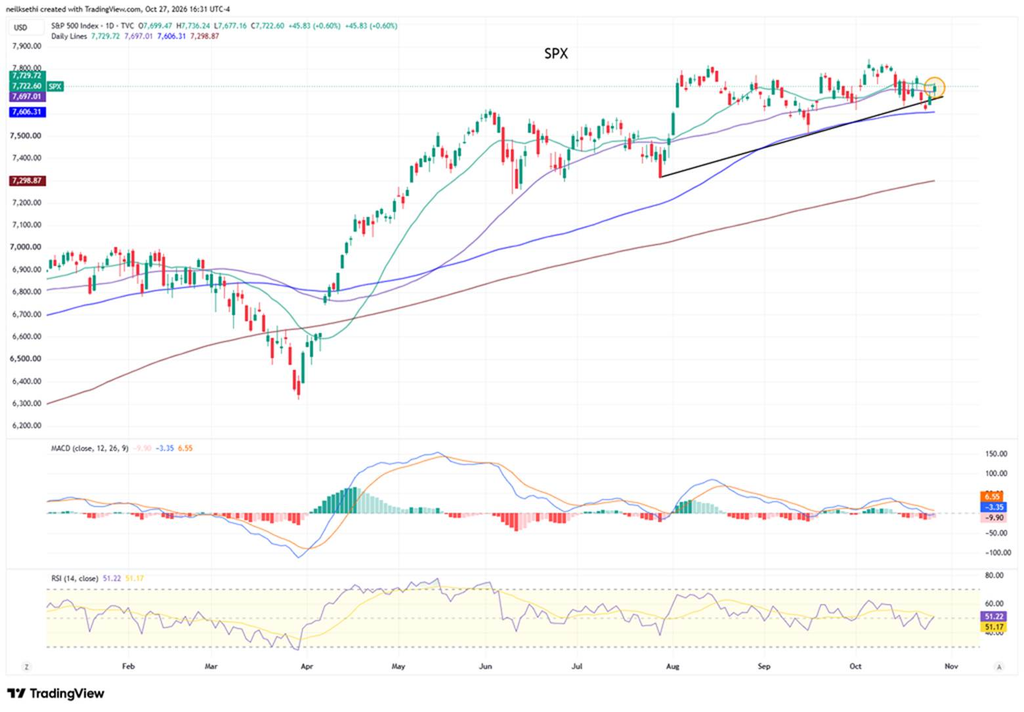
Note on all charts the colored lines are moving averages (the average price over the lookback period — days on the daily charts, weeks on the weekly charts):
20 = green
50 = purple
100 = blue
200 = brown
Exception is monthly charts where blue is 10-month moving average and brown is 20-month moving average.
MACD = Moving average convergence/divergence line, a measure of momentum that compares longer term and shorter term momentum to gauge if a move is strengthening or weakening. This is probably my favorite individual indicator.
RSI = Relative Strength Index (basically what it sounds like) = measures the strength of the move comparing gains to losses over the given lookback window (I use the standard 14 periods).
SPX
The SPX rose 0.60% to 7,722.60, closing back above its 50-DMA (7,697) after failing to hold it Monday and staying above the trendline from the July low. It tagged its 20-DMA (7,730) intraday but closed just under it, and finished just above Goldman’s short-term CTA pivot of 7,717 (see Miscellaneous). The daily MACD remains in “sell longs” positioning, though the gap is narrowing, and the RSI is at 51.
Nasdaq Composite
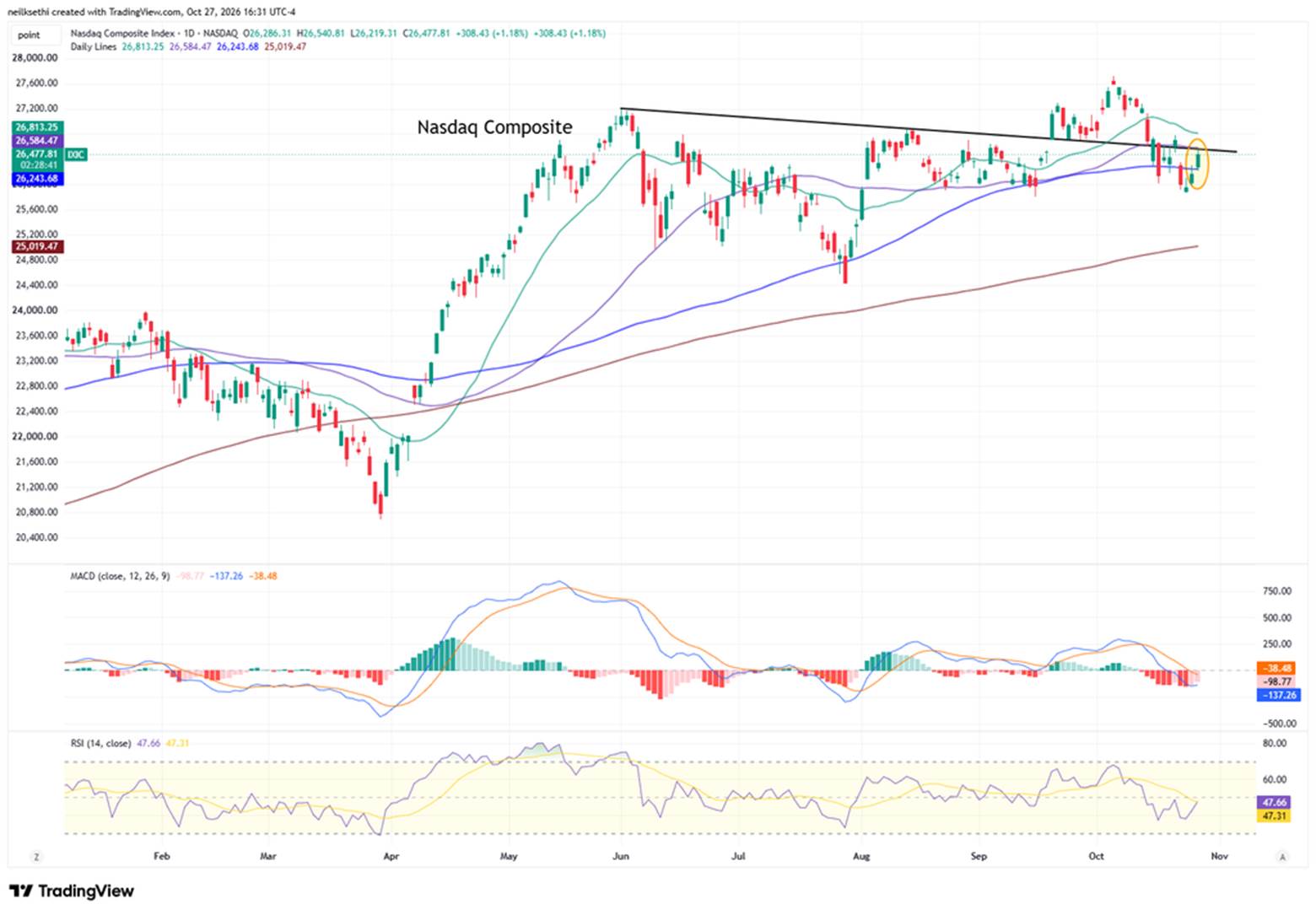
The Nasdaq Composite gained 1.18% to 26,477.81, closing back above its 100-DMA (26,244) and right at the downtrend line from the June high (circled), though it’s still below its 50-DMA (26,584). The MACD remains in “sell longs” positioning but is narrowing, and the RSI is at 48.
The Nasdaq-100 (QQQ)
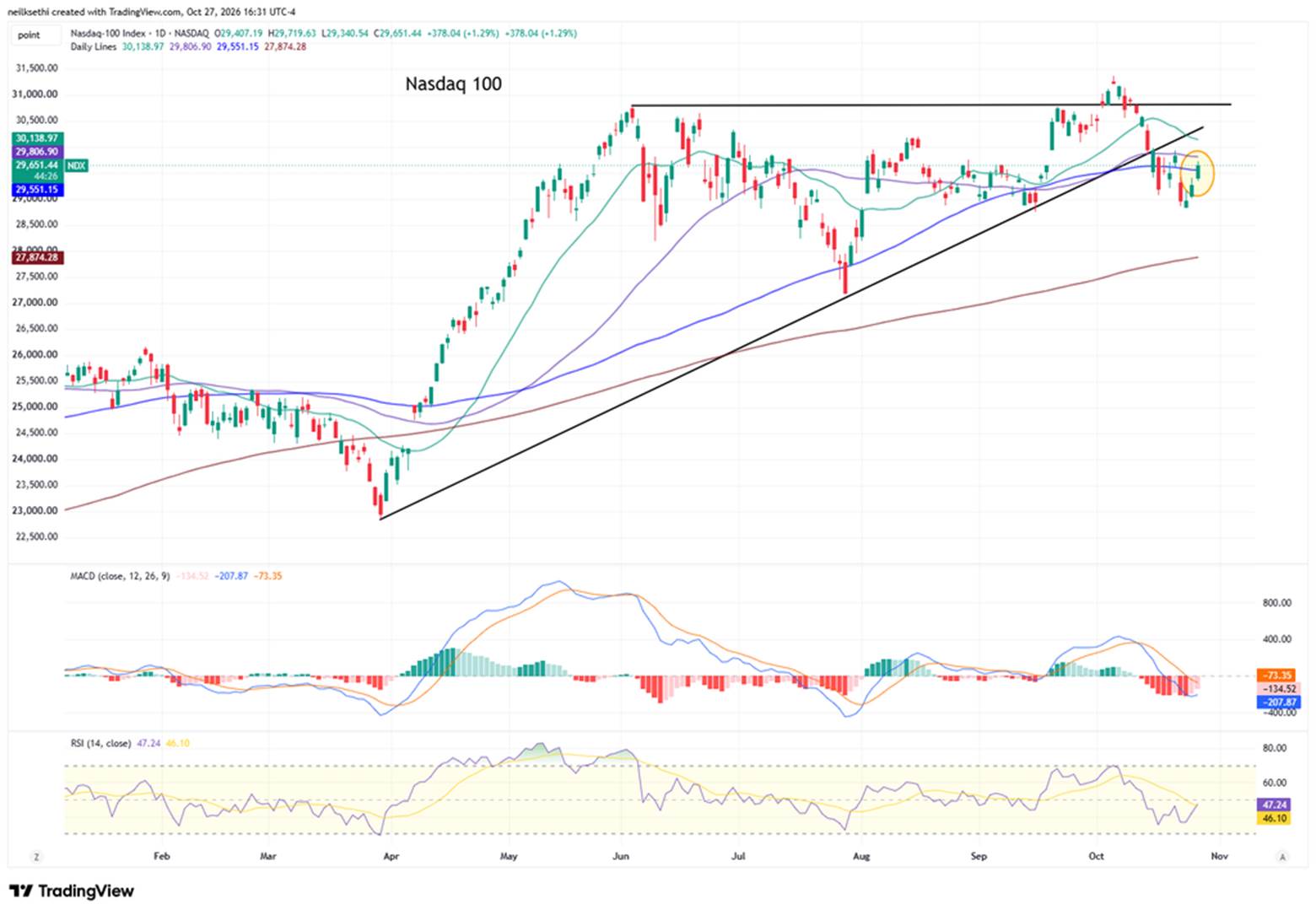
The Nasdaq-100 rose 1.29% to 29,651.44, its biggest gain in five weeks, per Bloomberg, and closed back above its 100-DMA (29,551). It’s still below its 50-DMA (29,807), though, so I’m more inclined to sell bounces until it reclaims that level. The MACD remains in “sell longs” positioning, and the RSI is at 47.
The Russell 2000 (IWM)
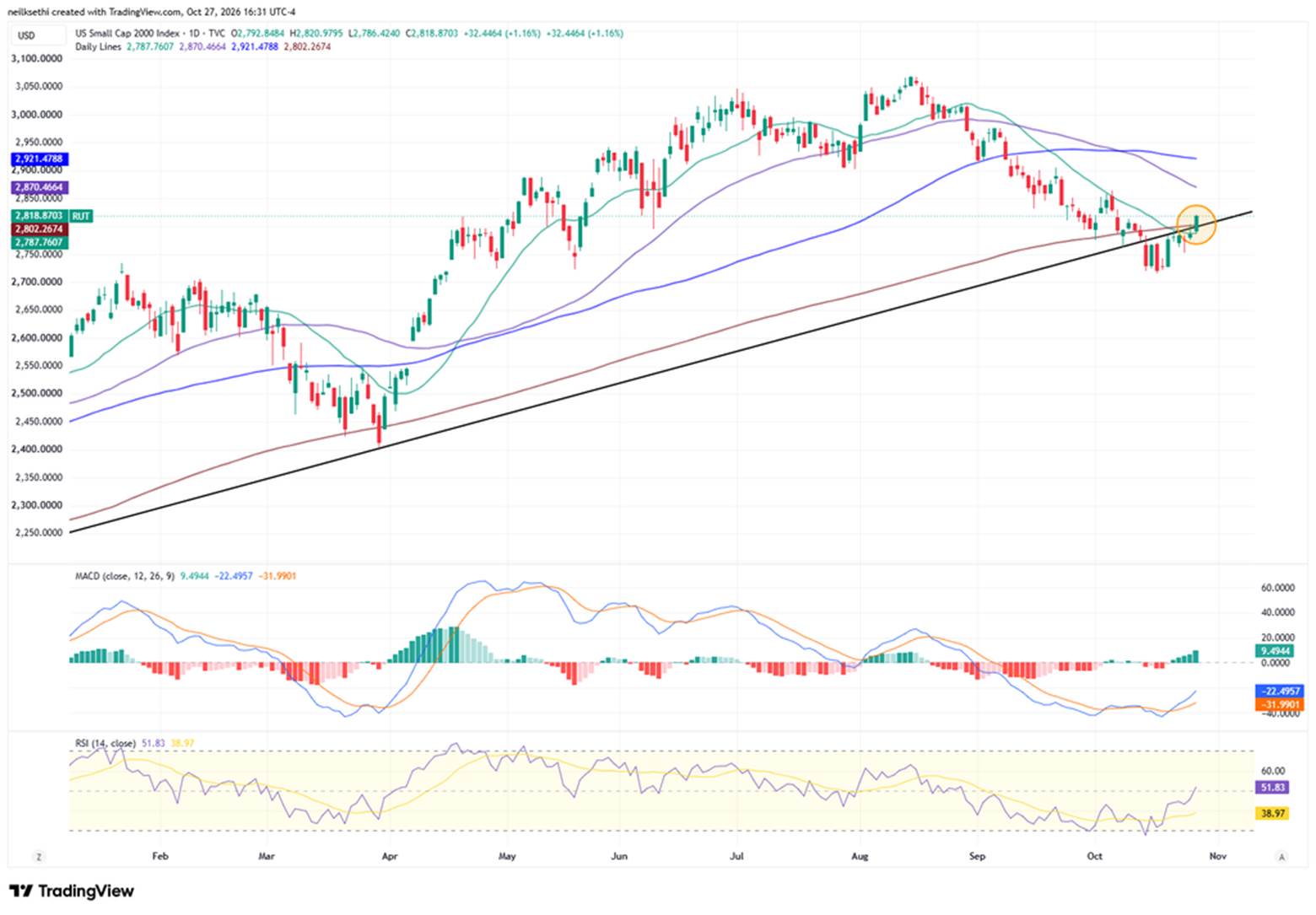
The Russell 2000 rose 1.16% to 2,818.87, closing above its 200-DMA (2,802) and 20-DMA (2,788) and back above the uptrend line from last year’s low (circled). That was my trigger, and I did get back in. The MACD has been in “cover shorts” positioning since October 21, and the RSI is at 52. Helene Meisler says the Russell 2000 is the chart to watch (The Russell 2000 Is the Chart to Watch. Here’s Why.).
The Equal-Weighted SPX (RSP)
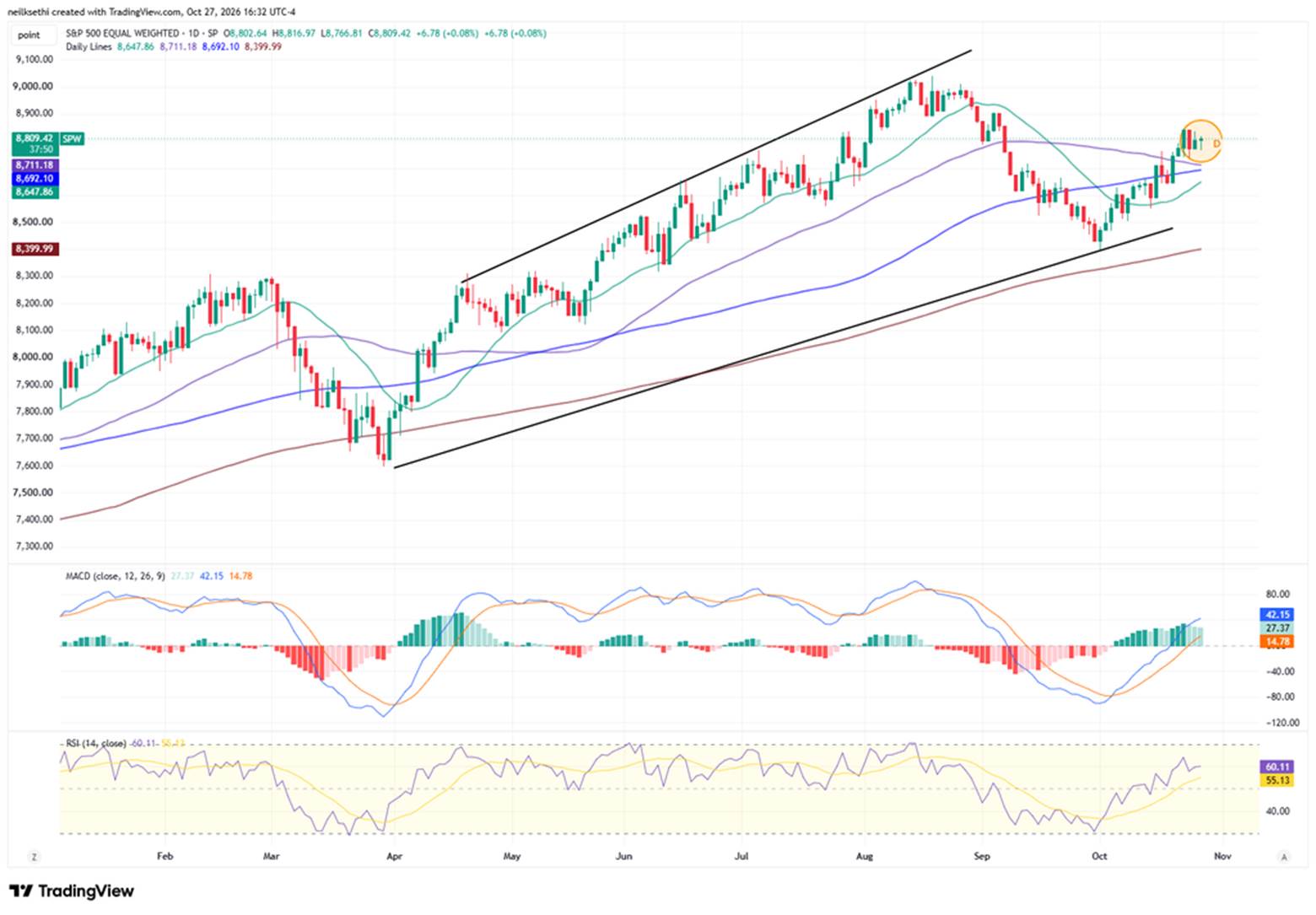
The equal-weighted SPX rose just 0.08% to 8,809.42, lagging the cap-weighted index again as mega-cap growth led, but it remains above all its moving averages that I track, with the MACD in “buy longs” positioning and the RSI at 60. It’s still the best technical setup of the major indices.
The 2-year Treasury
The 2-year yield rose 1.9 basis points (including post-market) to 4.739%, holding above the top of its old channel, which is now acting as support. That leaves it about 86bp above the EFFR (3.88%). Today’s $70 billion 5-year auction tailed but was a big improvement from September’s (5-Year Auction Tails but Big Improvement from September’s Rout).
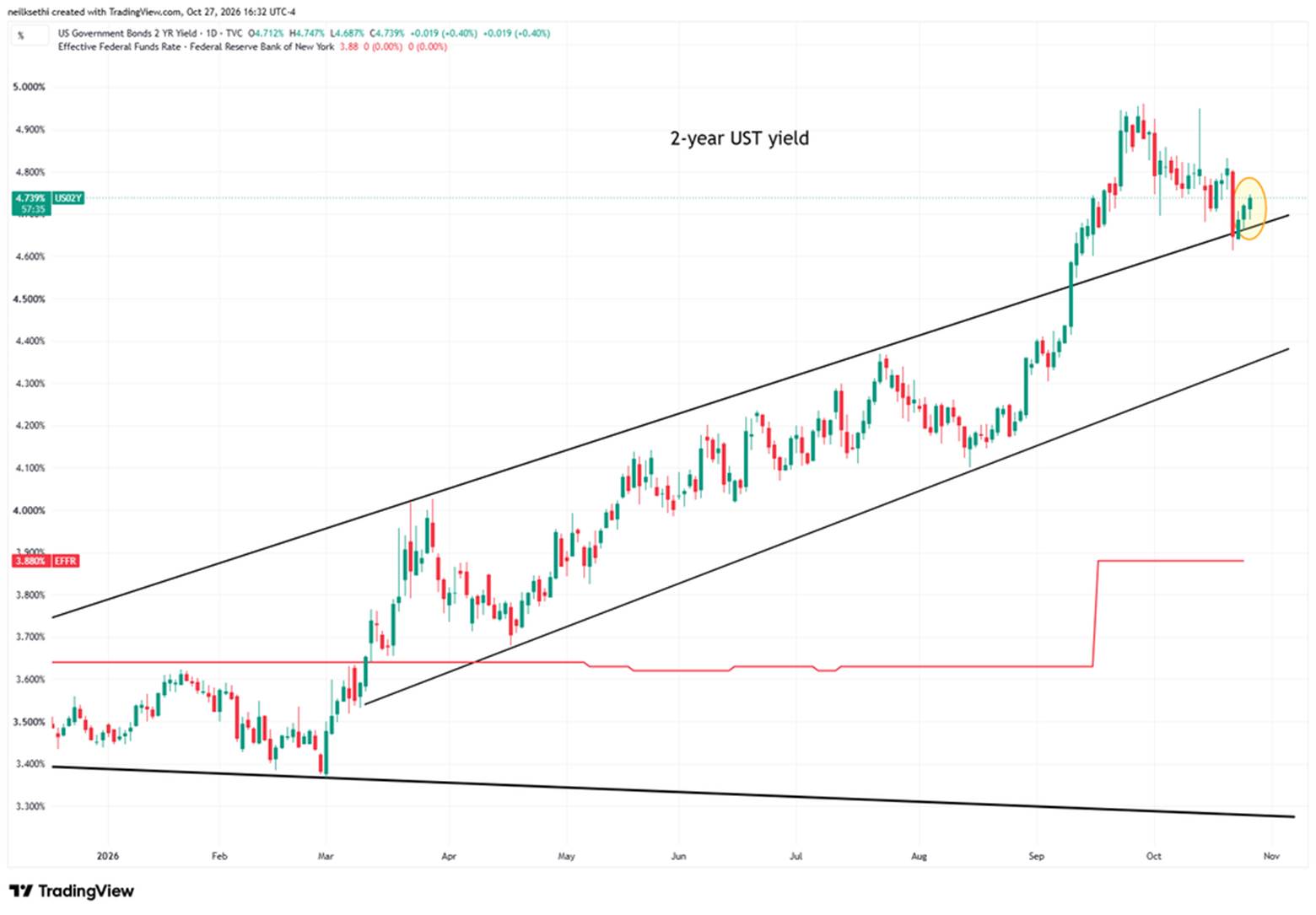
Fed rate hike expectations also firmed beyond October. October is an ~93% chance of a hold, but December is an 83% chance of a hike (from 81% Monday), per CME FedWatch. 2027 expectations see 75 basis points of total hikes priced through December next year (from 69bp).
10-year yields
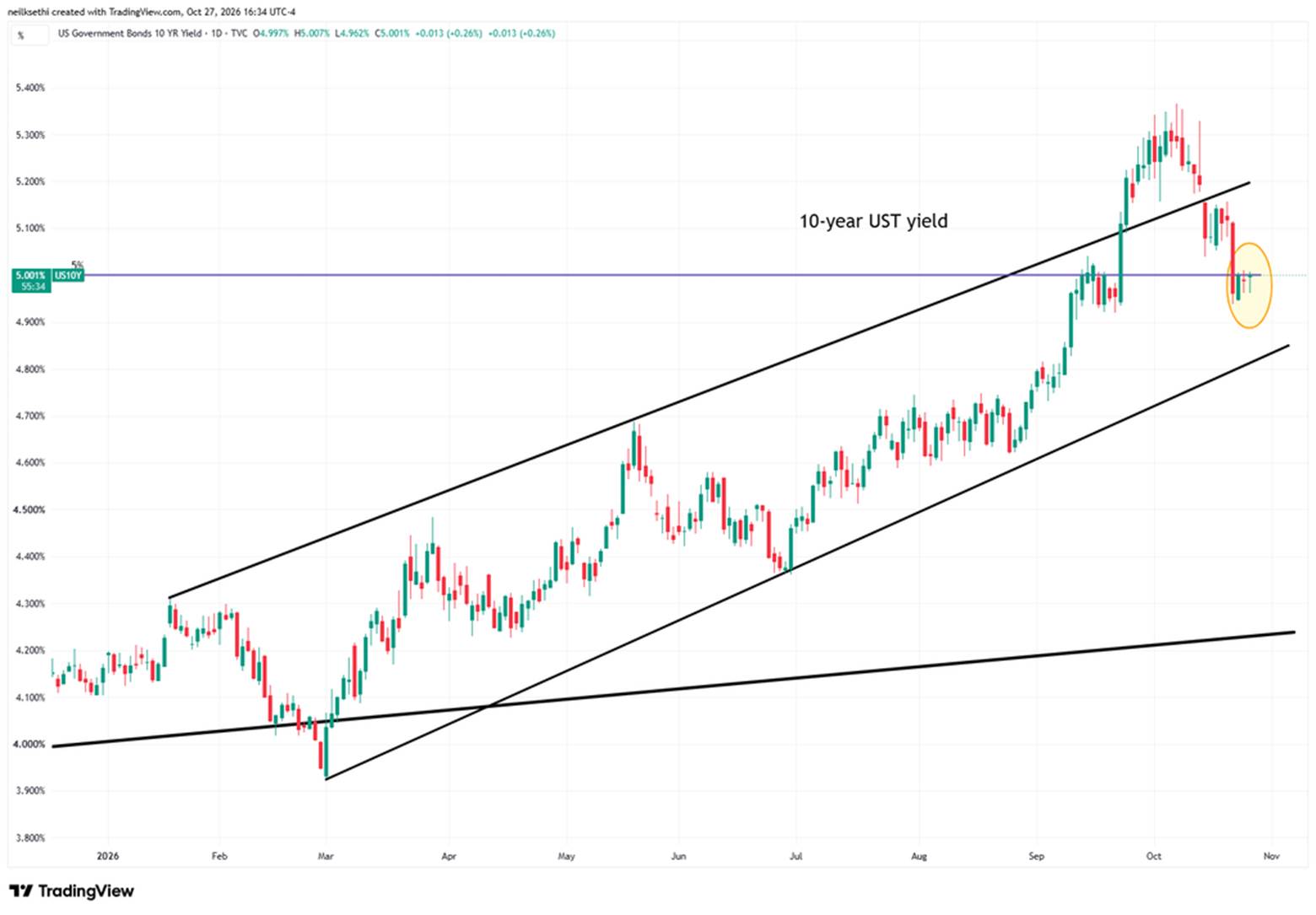
The 10-year yield rose 1.3 basis points (including post-market) to 5.001%, closing juuuust above 5% after two sessions just under it (but remained below in the cash session).
30-year yields
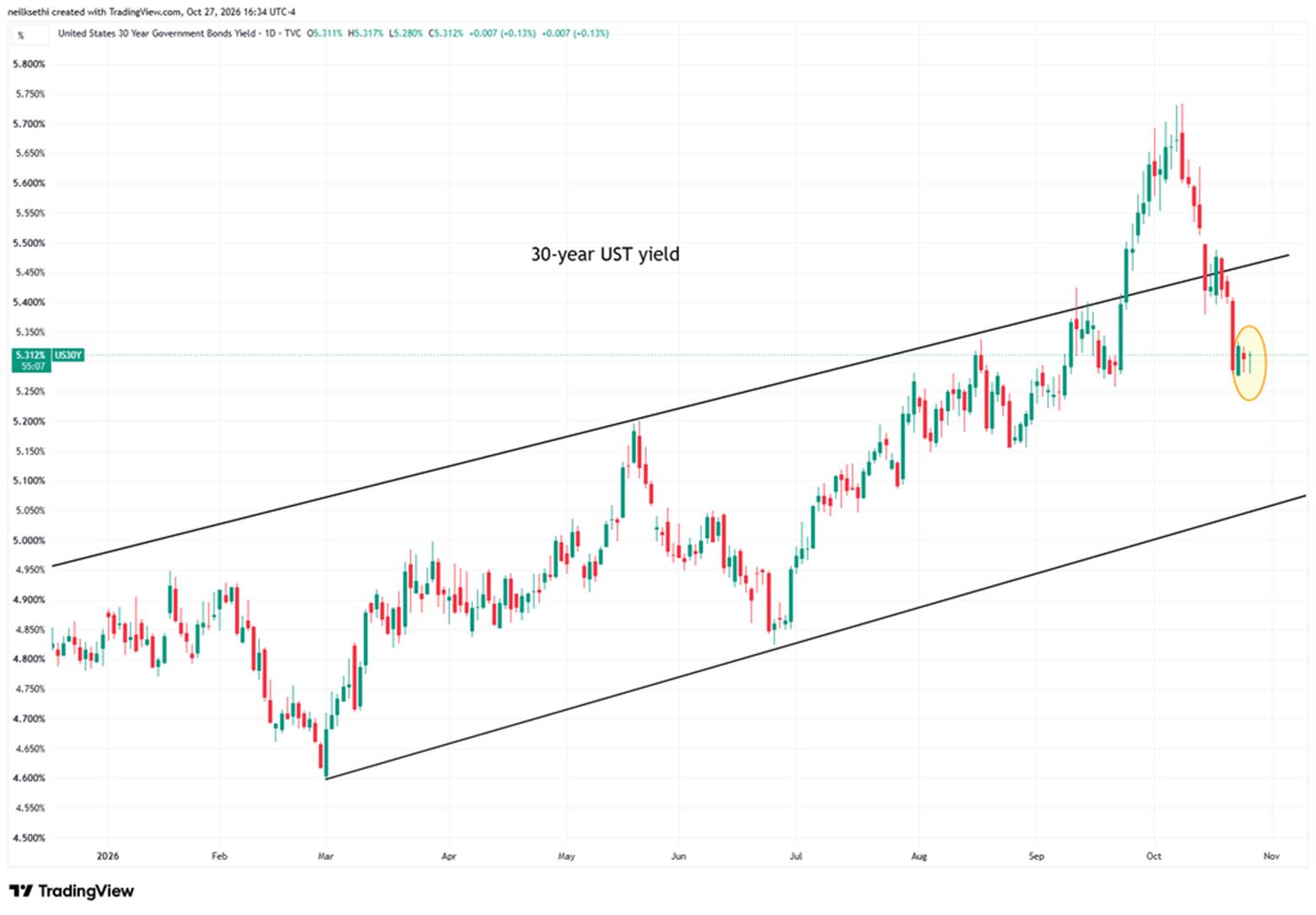
The 30-year yield edged up 0.7 basis points (including post-market) to 5.312%, holding just above Monday’s close, which was its lowest since September 22.
VIX
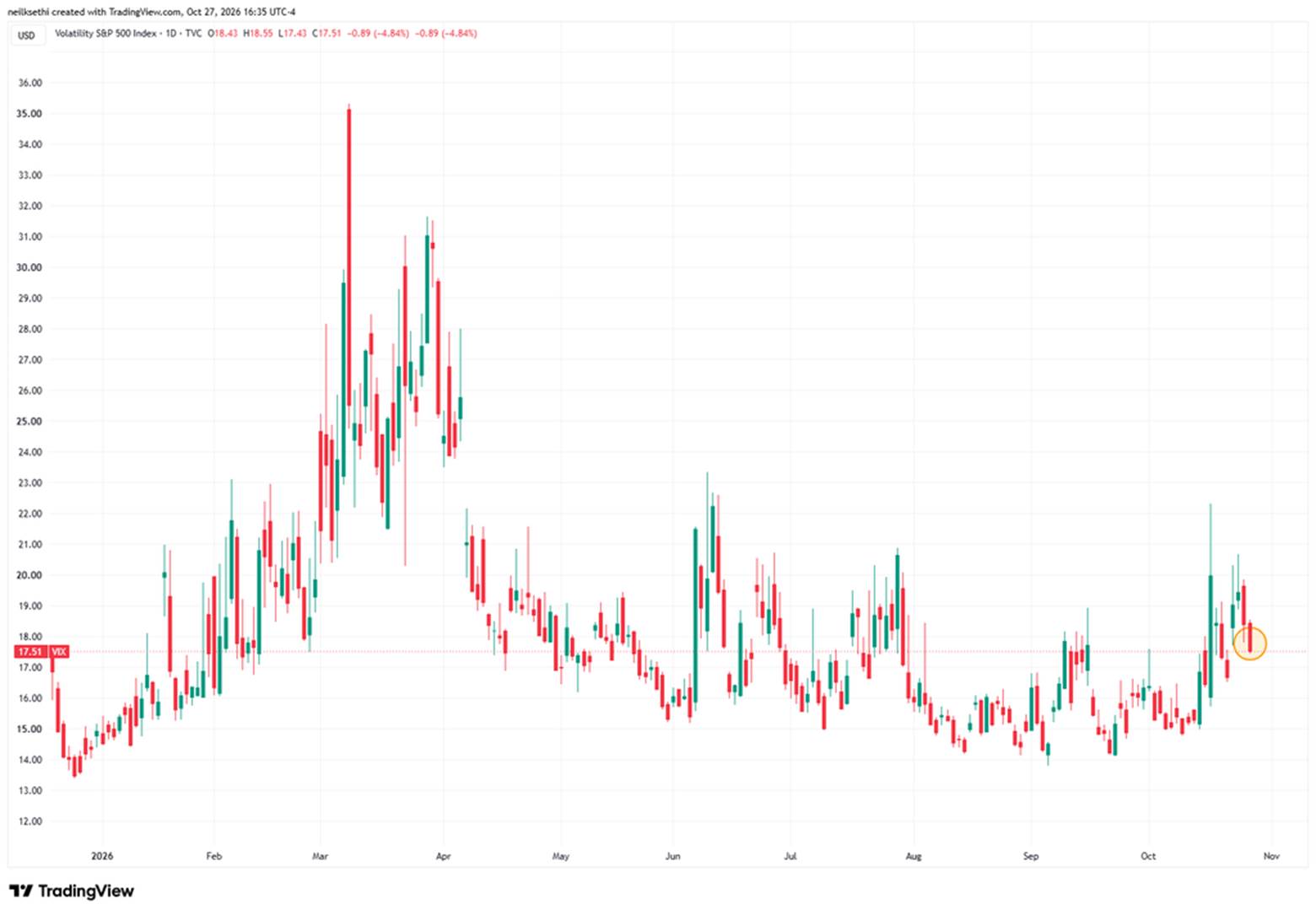
The VIX fell 4.84% to 17.51, implying a daily move of about 1.10% over the next 30 days.
The VVIX
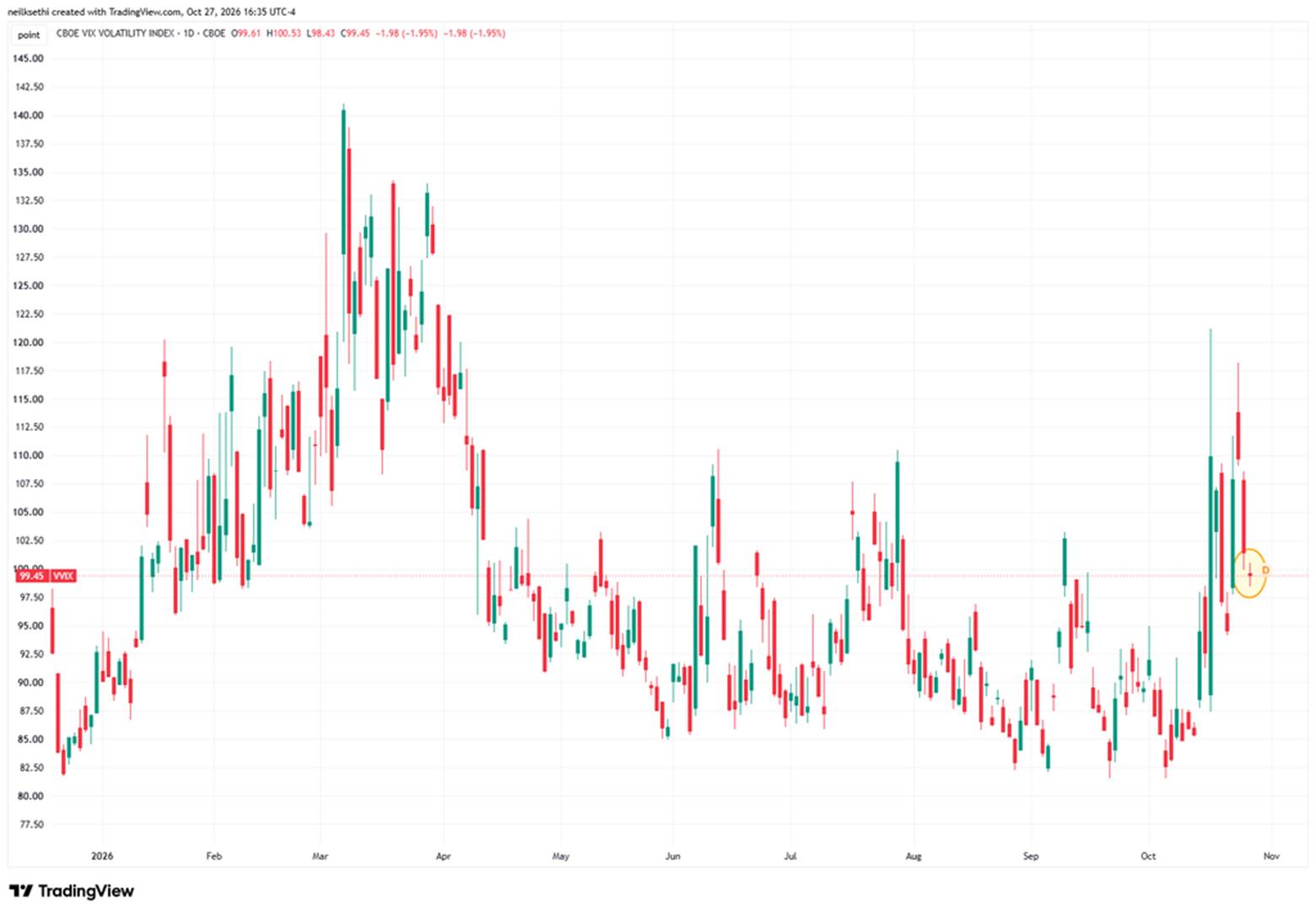
The VVIX (the VIX of the VIX) fell 1.95% to 99.45, back below 100 after poking above it intraday (100.53). The current level is consistent with “moderate” daily moves in the VIX over the next 30 days (historically, normal is 80-100, although we haven’t been below 80 since July 2024), and it’s now just under the 100 level flagged by Charlie McElligott as indicating higher stress.
1-day VIX
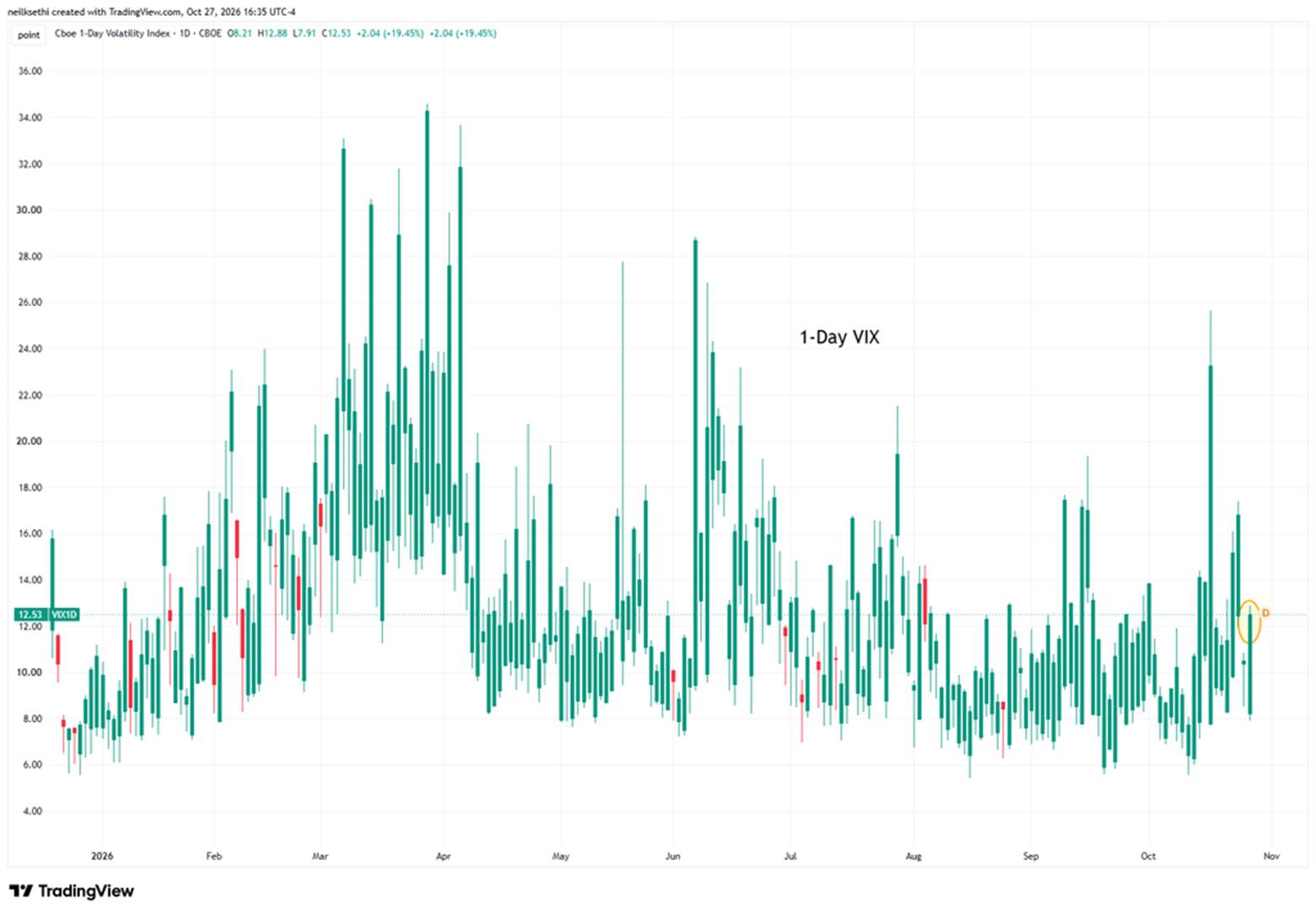
The 1-day VIX rose 19.45% to 12.53 from 10.49 Monday. Monday’s level implied a move of about 0.66% for Tuesday, and the SPX came in just under that at 0.60%. Tonight’s reading implies a move of about 0.79% for Fed day, pretty subdued.
WTI futures (/CL)
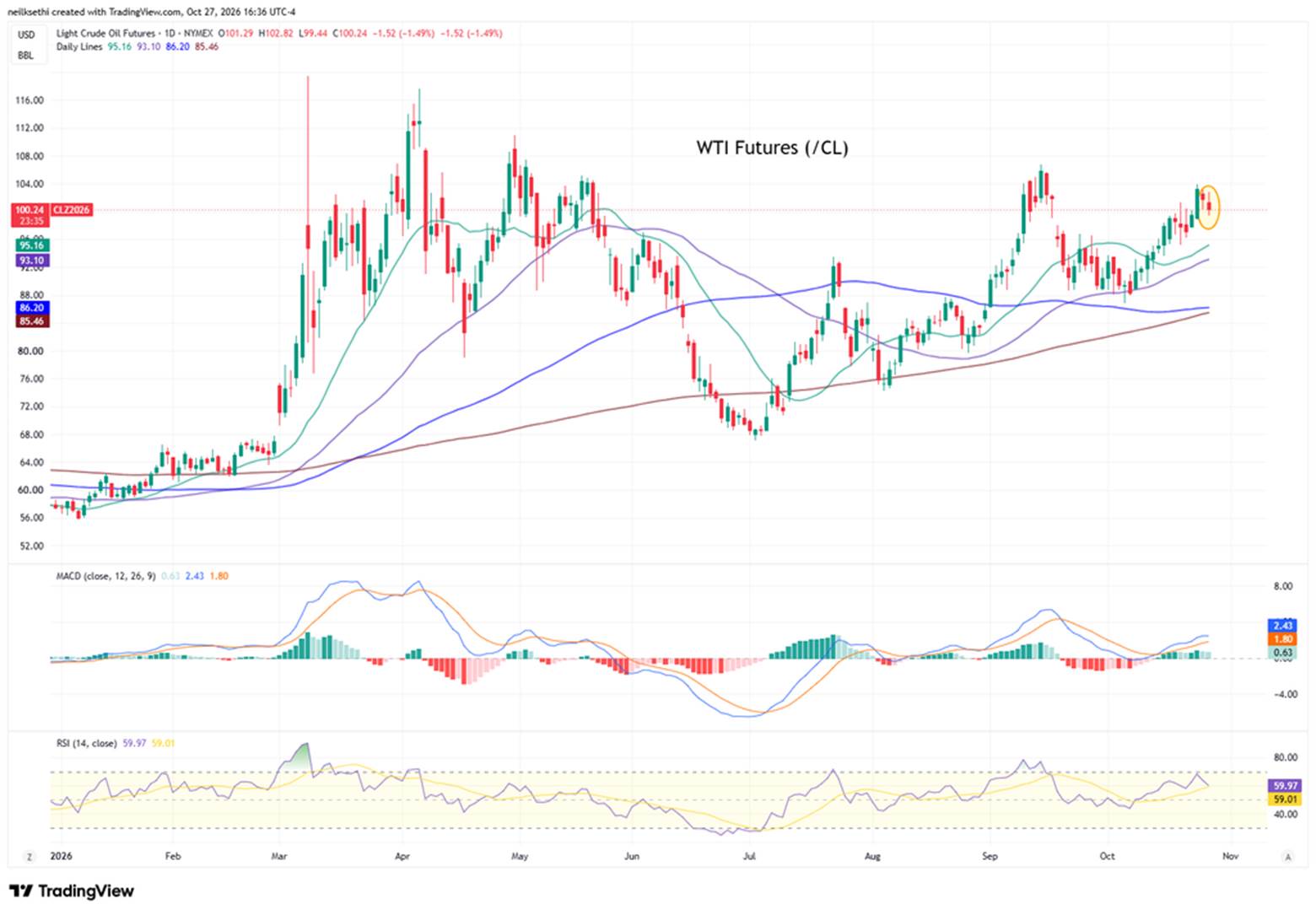
WTI futures, which TradingView has at December currently, fell 1.49% (including post-market) to $100.24 after settling at $99.87. They remain above all their moving averages, with the MACD in “buy longs” positioning, though that’s narrowing, and the RSI at 60.
The DXY
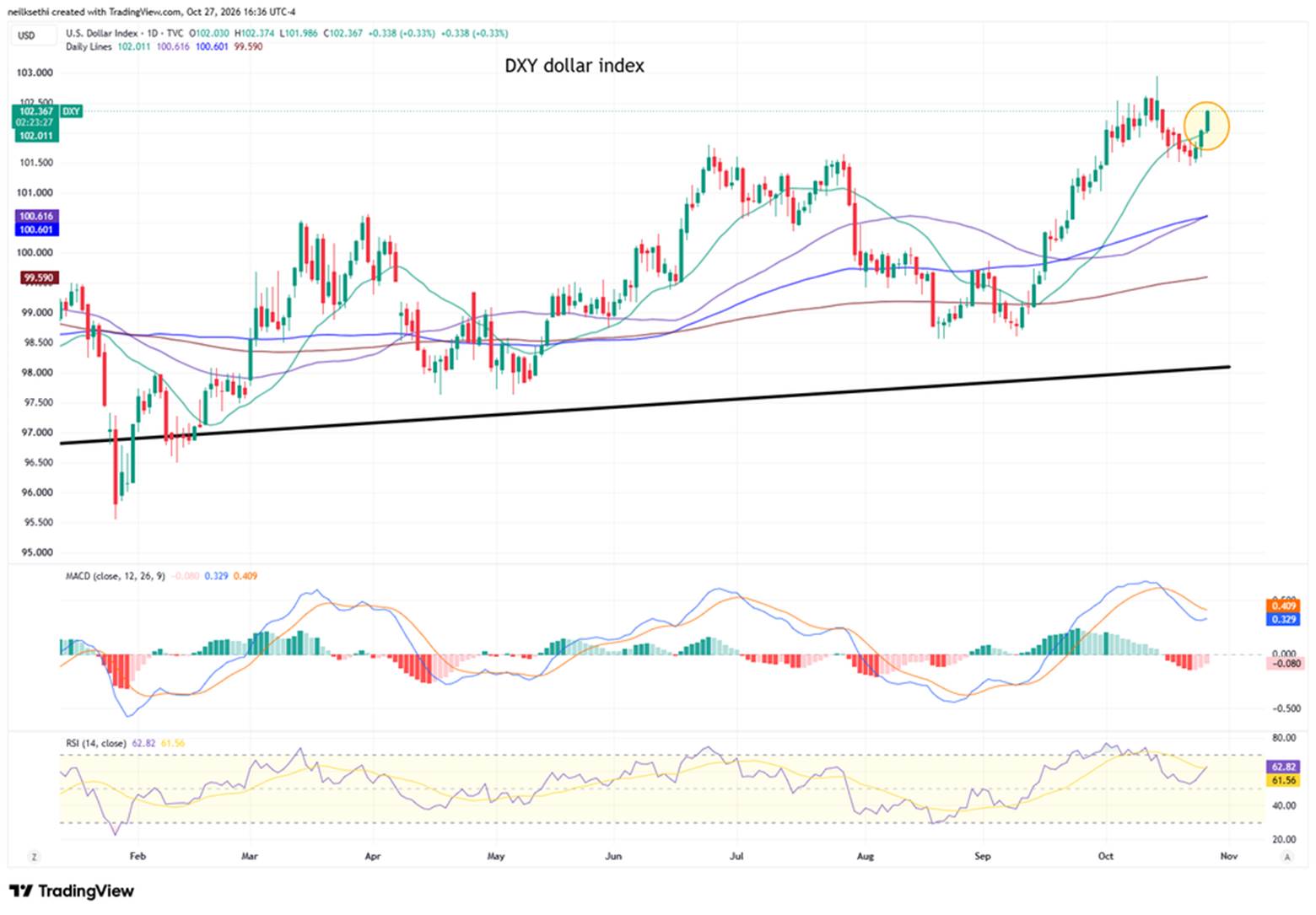
The DXY dollar index (which is fixed weighted with heavy – 57% – allocation to the euro) rose 0.33% to 102.367, its third straight gain, and is holding above its 20-DMA (102.011). The daily MACD remains in the “sell longs” positioning it flipped to on October 16 but is close to crossing back, and the RSI is at 63.
Gold futures (/GC)
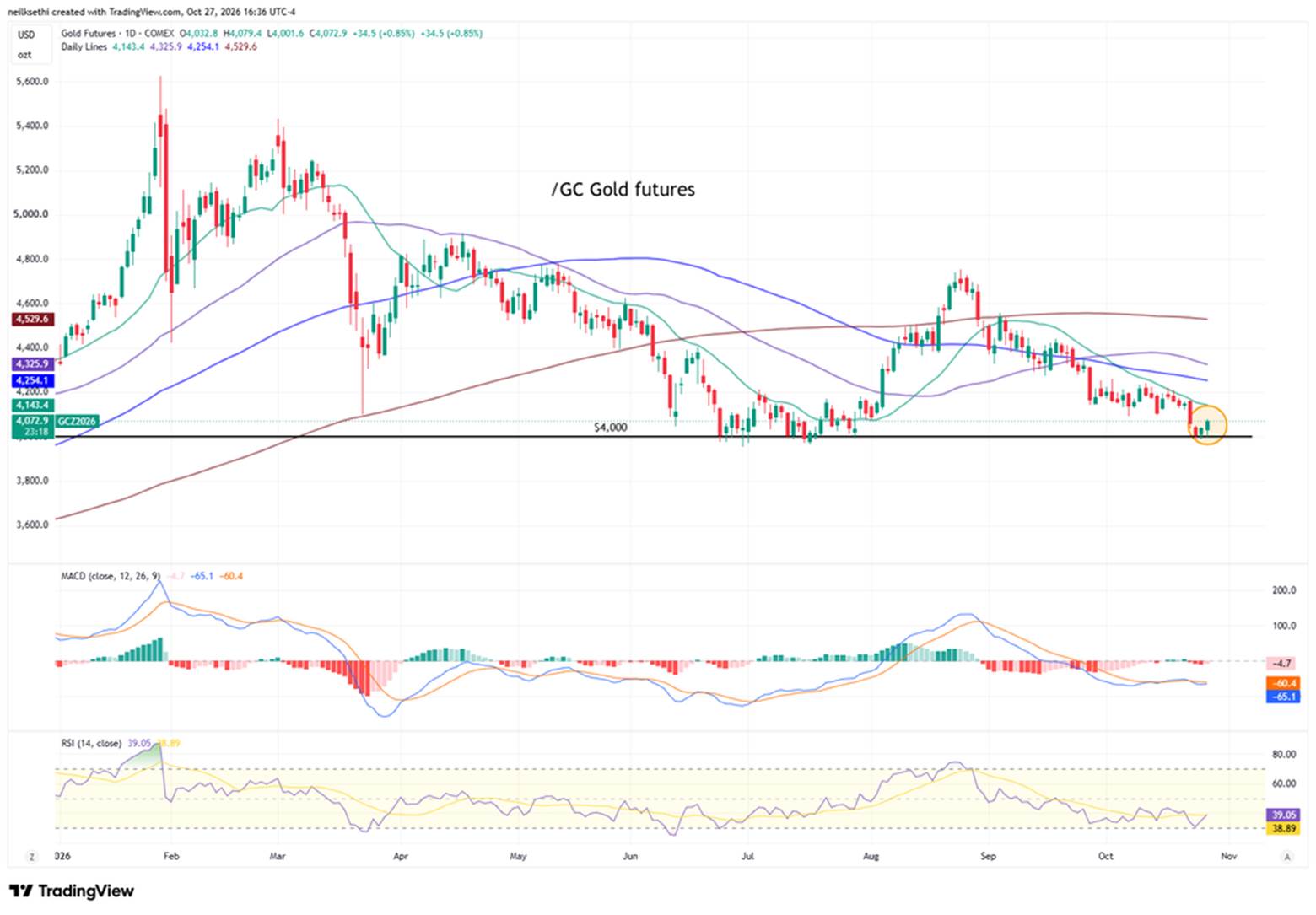
Gold futures rose 0.85% (including post-market) to $4,072.90 after holding $4,000 intraday again ($4,001.60). They’re still below all their moving averages, with the MACD in “sell longs” positioning and the RSI at 39.
US copper futures (/HG)
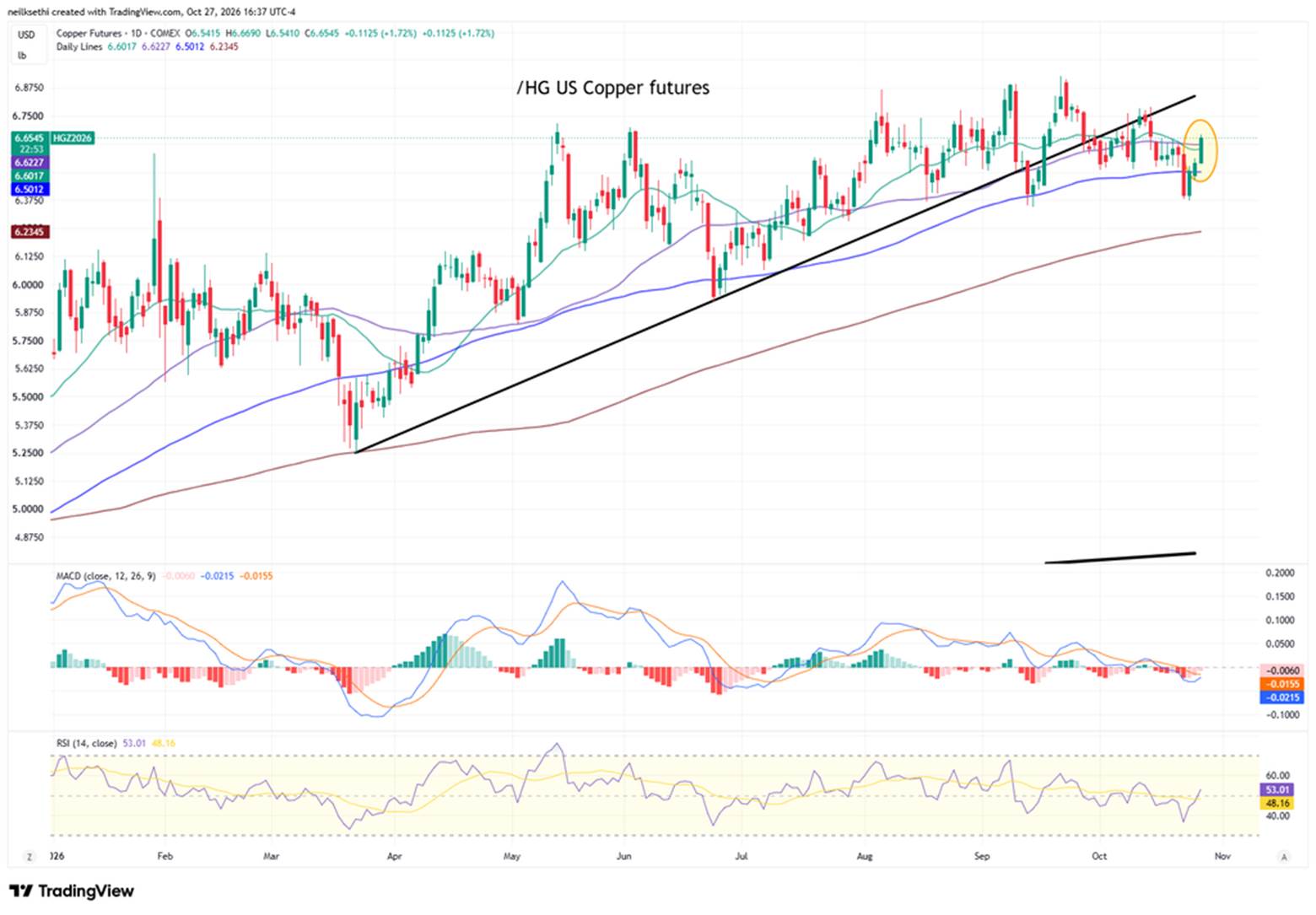
Copper futures rose 1.72% (including post-market) to $6.6545, closing back above all their moving averages, including the 20-DMA ($6.6017) and 50-DMA ($6.6227). The MACD is still in “sell longs” positioning, and the RSI is at 53.
US natural gas futures (/NG)
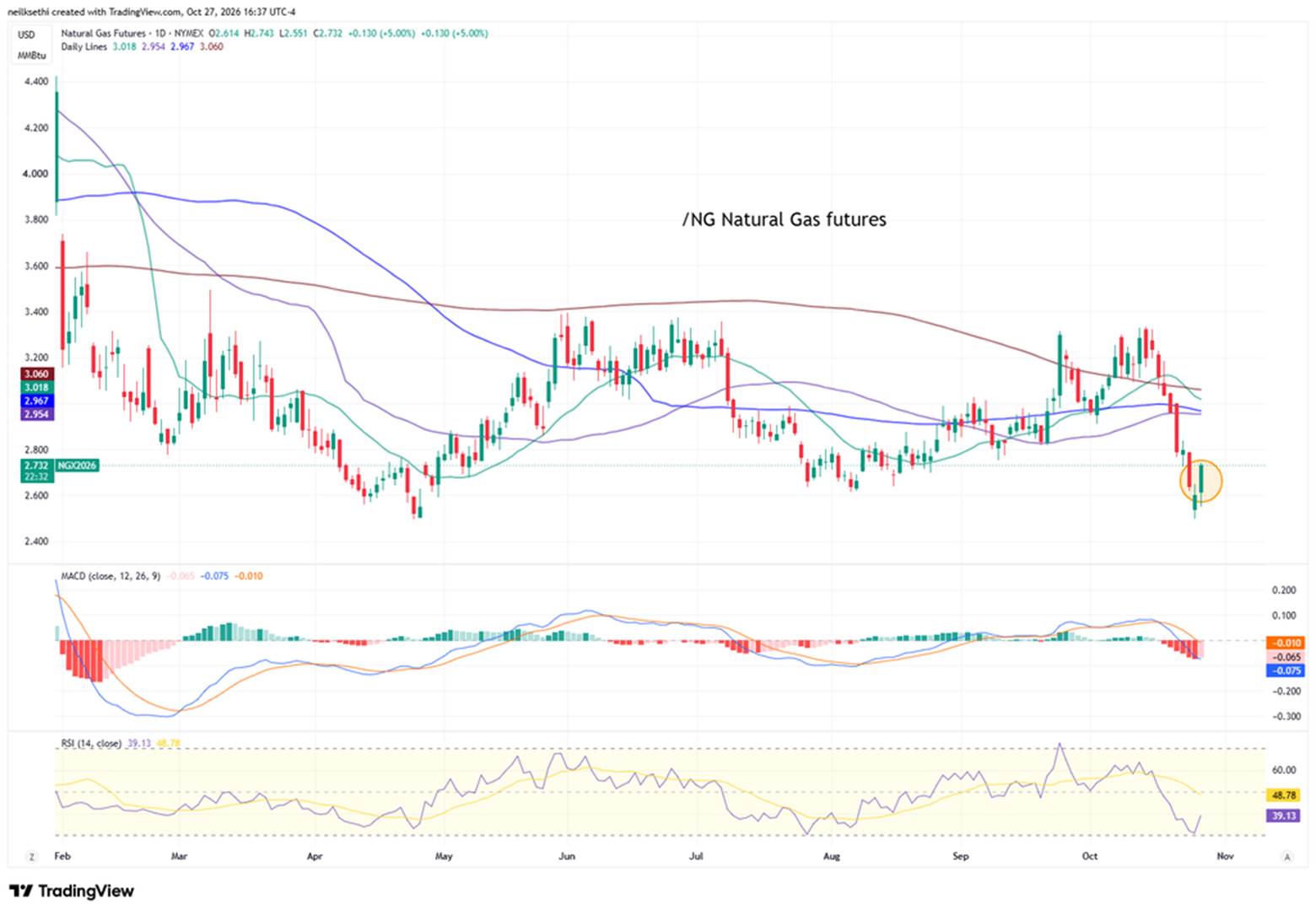
Natural gas futures bounced 5.00% (including post-market) to $2.732 after Monday’s dip to the lowest level since November 2024, though they remain below all their moving averages. The MACD is in “sell longs” positioning, and the RSI is at 39.
Bitcoin futures
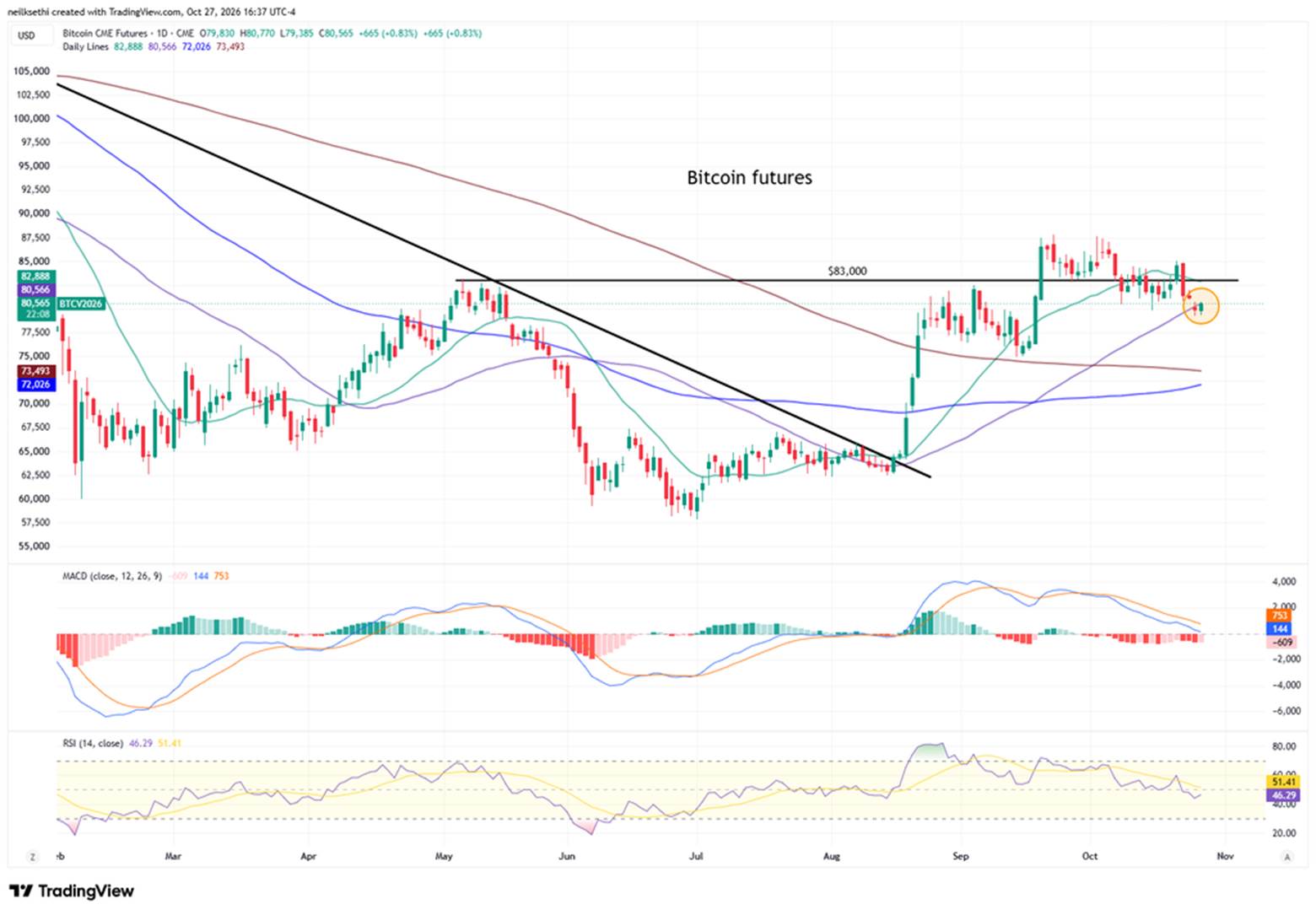
Bitcoin futures rose 0.83% to $80,565, right at their 50-DMA ($80,566) but still below their 20-DMA ($82,888) and the $83,000 level that had been support. The MACD remains in “sell longs” positioning, and the RSI is at 46.
More From TheStreet Pro
James “Rev Shark” DePorre — AI Funding Worries Ease and Buyers Show Up, Big Tech Is About to Report. My Plan: Do Nothing and The Story of the Market Is Access to Capital, Not Its Cost
Helene Meisler — The Russell 2000 Is the Chart to Watch. Here’s Why.
Stephen Guilfoyle — Anthropic Rocks Wall Street and Old-Timers Called It Glass Works. What Call Should Today’s Traders Make?
Chris Versace — Meta and Broadcom-Anthropic Financing Deals: 8 Key Items Shaping the Stock Market Tuesday and VIDEO: Host Digital on Speed to Power and the AI Infrastructure Buildout
Ed Ponsi — Is the Brazilian 20% Stock Market Rout an Opportunity?
Doug Kass — Rising Home Inventories, Lower Prices and Boockvar on Earnings, Econ Data
And From Me If You Missed It
- Tuesday’s Busy Calendar
- HSBC’s Kettner Steps Back From Stocks
- ADP Hiring Growth Slows for Second Week
- Israel Votes Today in Its Most Consequential Election in Decades, but It May Take Months to Settle
- Business Investment Gauge Sees Fastest Quarterly Growth Since 2020
- Consumer Confidence Rebounds to Highest Since June
- New Home Sales Hold Near Year’s High Even as Prices Rebound
- 5-Year Auction Tails but Big Improvement from September’s Rout
Miscellaneous
Wrap-Up — Will the Bounce in Tech Continue?
I said yesterday:
Today was a nice bounce in some beaten down names on the back of what is apparently going to be another huge round of AI spending but for now it’s just that. As I mentioned several times last week, it takes more than a day or two to establish a trend. Or as Rev Shark put it, today looked more like short covering in the most beaten-down AI names ahead of the big reports than investors deciding it’s time to own them again.
But otherwise we continue to see relative strength in many sectors, even if they trailed the AI beneficiaries today. Tomorrow brings a lot of data, but none likely to move any needles. The broad swath of earnings though will see those stocks move.
And today that bounce continued. Still not a trend, but we haven’t put together three positive sessions on the SOX Semiconductor index in a month, so this is definitely a change from what we’ve been seeing. As a side note, the SOX bounced off its 200-DMA. I wish I had noticed that, as that’s a nice place to play a bounce. It’s got some room before running into more resistance, so technically this can go further even if it is a bounce to sell (which I’m not sure of yet).
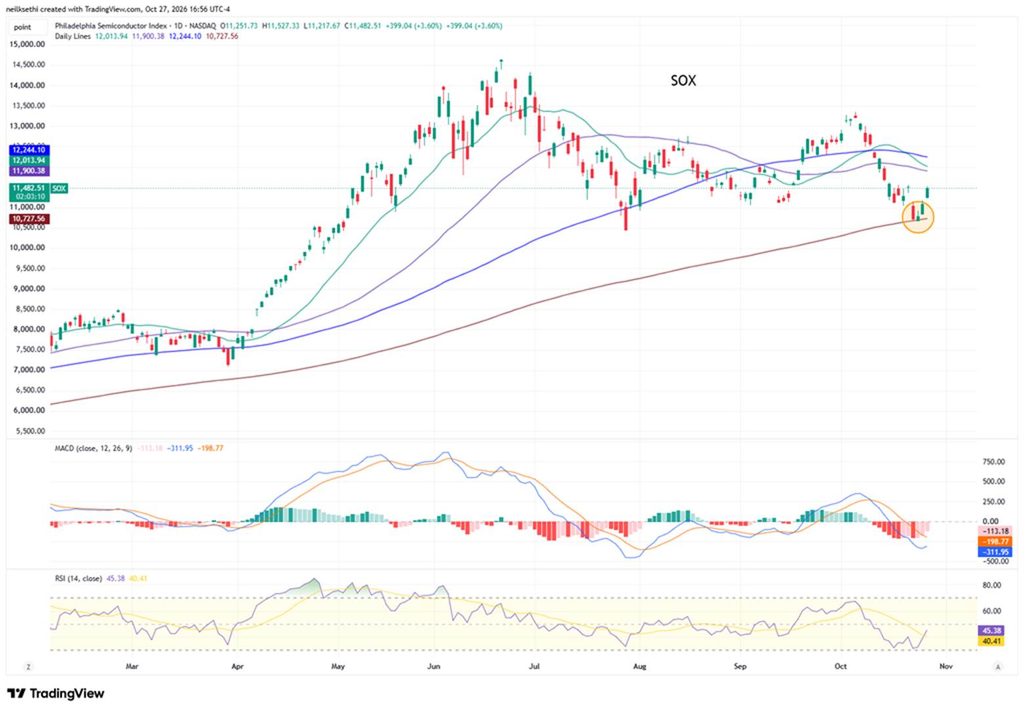
Tomorrow though we get another dose of hyperscalers. I have a hard time believing they won’t provide more evidence that the buildout remains full on, further supporting the rally in AI beneficiaries, but I guess you never know.
But along with the AI bounce has come an end to the drop in Treasury yields (although interestingly they haven’t moved much higher either). But for whatever the reason we’ve seen the steam come out of some of those “rotation” plays with Staples down for a third day.
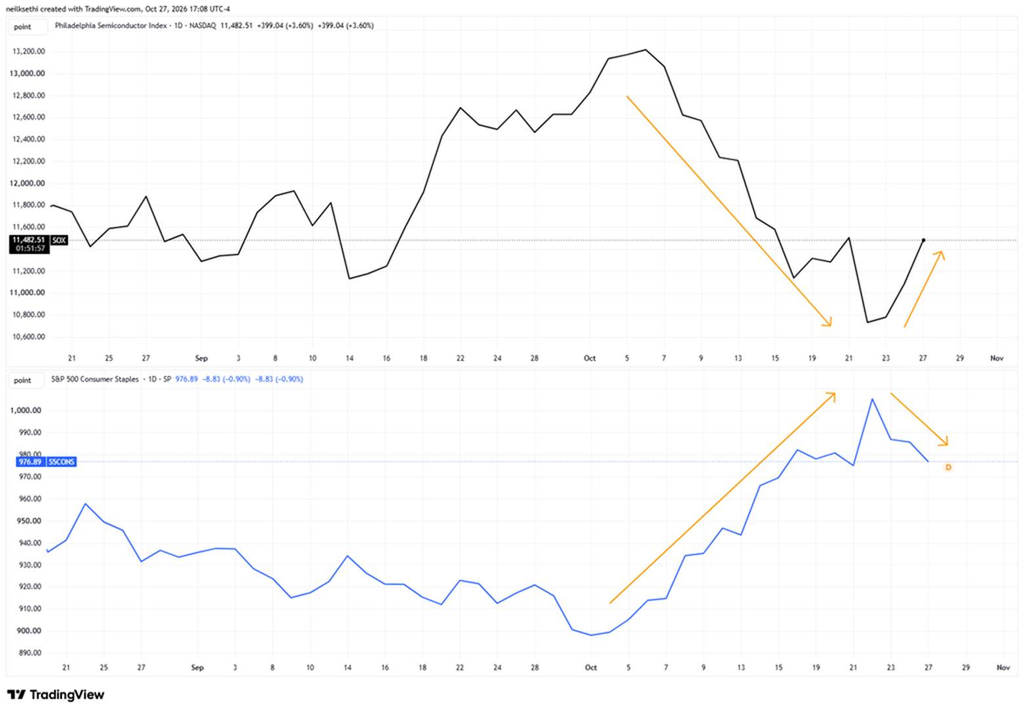
Other sectors though have held in better, so we’re not completely in an “either/or” market quite yet as Helene likes to call it, but it’s definitely a lot less broad than it was until last Friday. We’ll see how this all progresses after we get tomorrow’s earnings.
The other wild card which we will at least get before the close tomorrow is the Fed. But as I mentioned on Sunday:
The Fed has never hiked with less than a 10% chance priced into markets, so we’re either going to get the biggest surprise to markets the Fed has ever delivered (on par with the surprise 75 basis point hike in 2022) or a relative snoozer that is already priced. It would be quite something though if they did hike (which is what BofA still calls for by the way) as it would not only be a huge hawkish surprise – a handful of days before the election – but it would also mean the long-standing “troika” at the top of the Fed in Chair-Vice Chair-NY Fed President (Warsh-Jefferson-Williams) had been busted wide open.
In terms of the rest of the meeting it is expected to also follow the “snoozer” pathway, particularly as there is no new Summary of Economic Projections and Chair Warsh has consistently been cutting back the length of the press conference and providing little information. Again, a change to that would be a big surprise. But the one thing that won’t surprise is dissents. The other regional Fed Presidents (Hammack in particular) have expressed a preference for continued rate hikes.
As always, let’s see what we get and go from there.
The Day Ahead — We Hit Our Peak
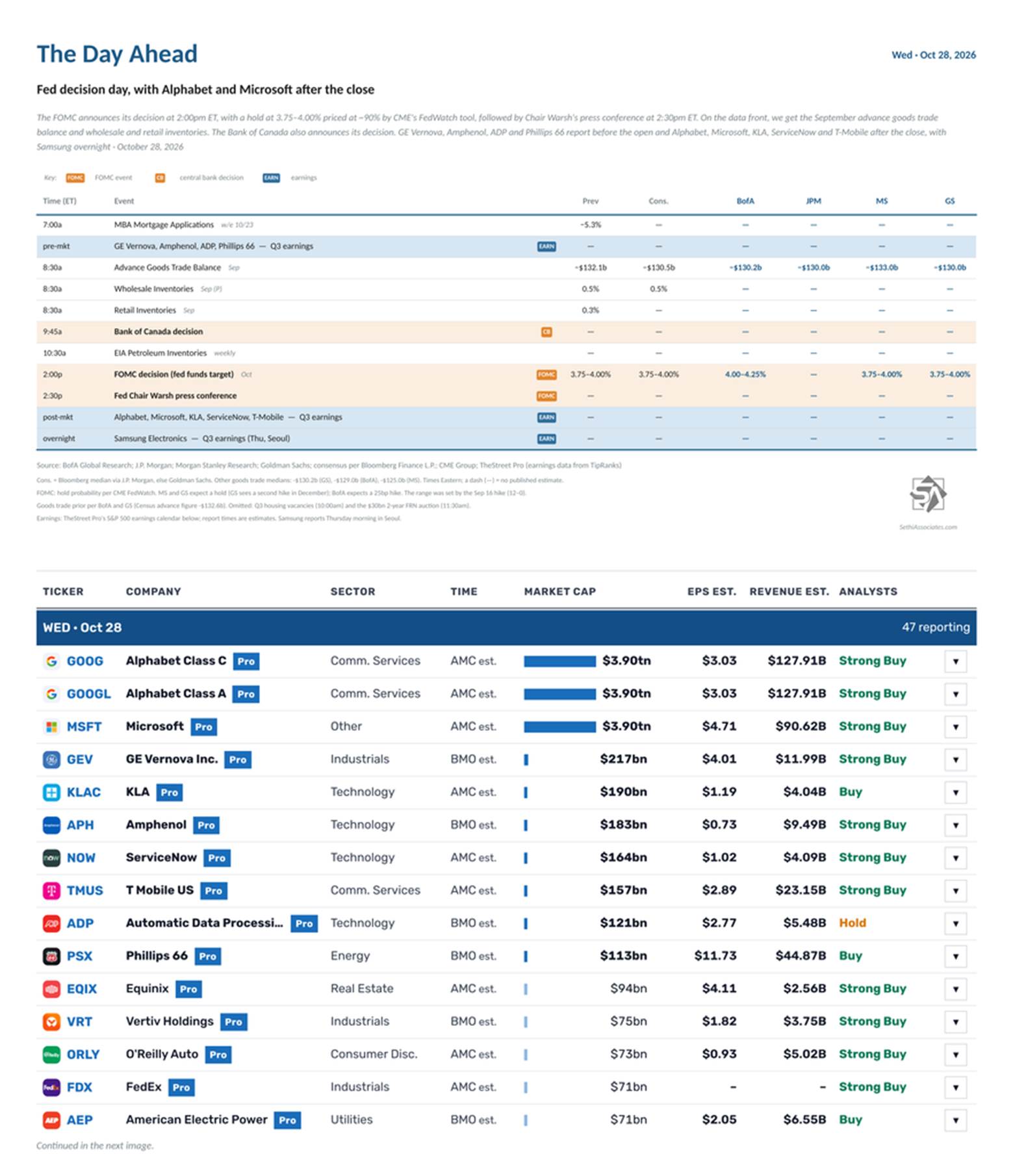
US economic data are light, with just the September advance goods trade balance and wholesale and retail inventories. We’ll also get the weekly MBA mortgage applications and EIA petroleum inventories.
The FOMC announces its decision at 2pm ET, with a hold priced at ~93% by CME’s FedWatch tool, followed by Chair Warsh’s press conference at 2:30pm ET. The Bank of Canada announces its decision at 9:45am ET.
The only Non-Bill (>1yr in maturity) US Treasury auction is a $30bn 2-year floating-rate note (not followed due to its floating nature).
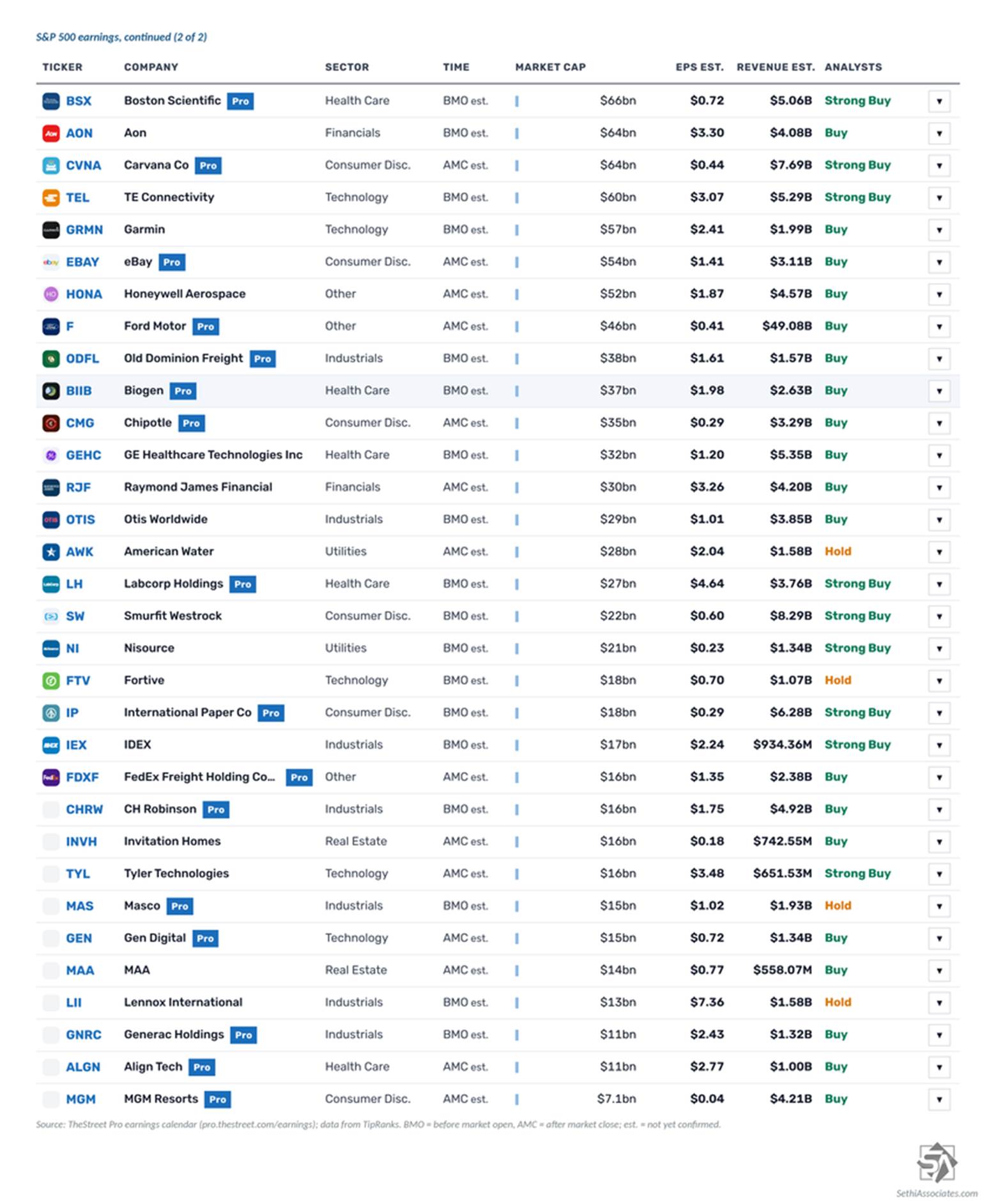
Alphabet and Microsoft lead 46 S&P 500 components reporting, nine of them with market caps over $100bn:
Before the open: GE Vernova (GEV), Amphenol (APH), ADP (ADP), Phillips 66 (PSX), Vertiv (VRT), American Electric Power (AEP), Boston Scientific (BSX), Aon (AON), TE Connectivity (TEL), Garmin (GRMN), Old Dominion Freight Line (ODFL), Biogen (BIIB), GE HealthCare (GEHC), Otis Worldwide (OTIS), Labcorp (LH), Smurfit Westrock (SW), NiSource (NI), Fortive (FTV), International Paper (IP), IDEX (IEX), C.H. Robinson (CHRW), Masco (MAS), Lennox International (LII) and Generac (GNRC)
After the close: Alphabet (GOOGL), Microsoft (MSFT), KLA (KLAC), ServiceNow (NOW), T-Mobile (TMUS), Equinix (EQIX), O’Reilly Automotive (ORLY), FedEx (FDX), Carvana (CVNA), eBay (EBAY), Honeywell Aerospace (HONA), Ford (F), Chipotle (CMG), Raymond James (RJF), American Water Works (AWK), FedEx Freight (FDXF), Invitation Homes (INVH), Tyler Technologies (TYL), Gen Digital (GEN), MAA (MAA), Align Technology (ALGN) and MGM Resorts (MGM)
Outside the US, Samsung Electronics (SSNLF) reports overnight.
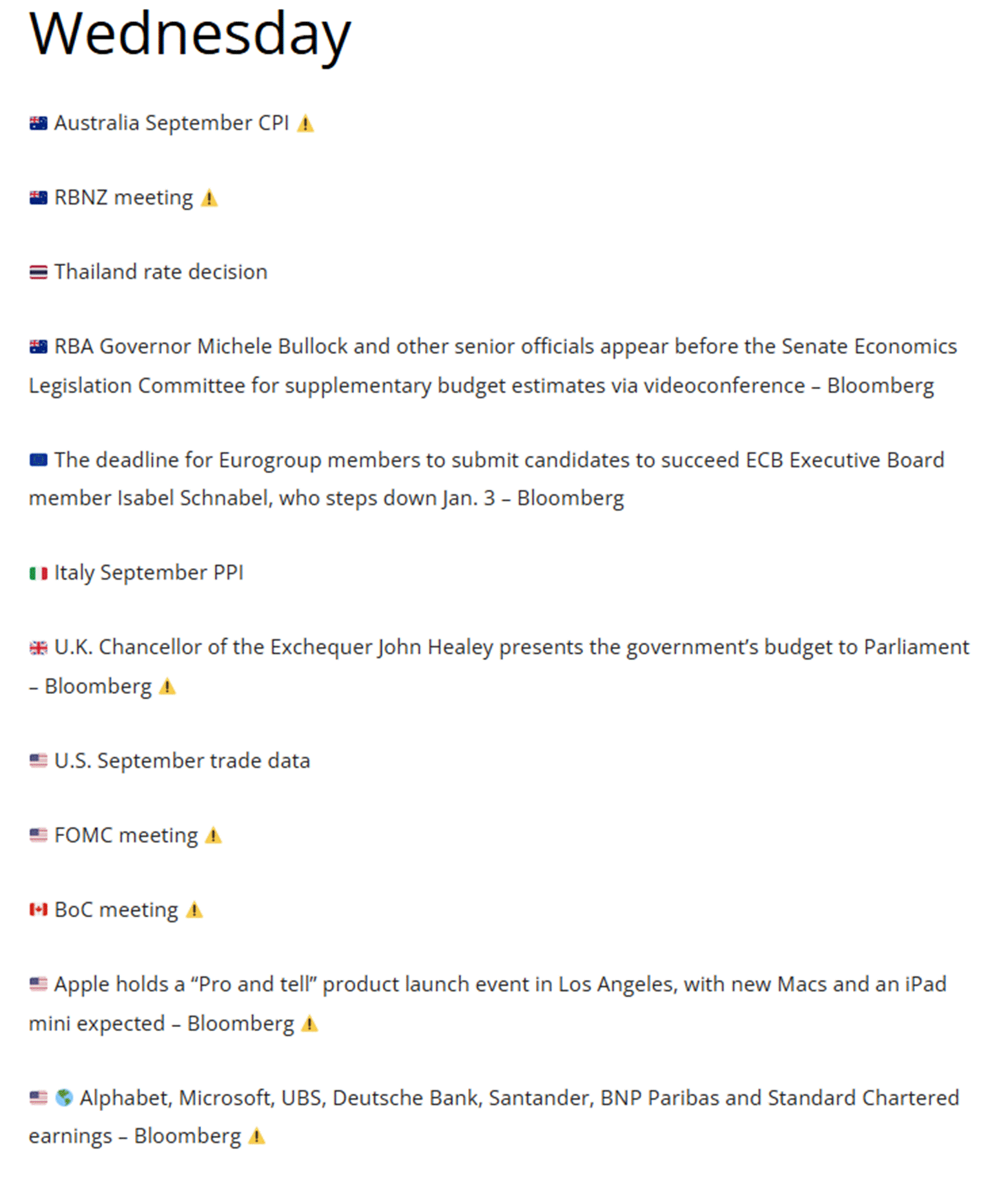
Ex-US highlights include decisions from central banks in Canada and New Zealand, Germany November GfK consumer confidence, France Q3 total jobseekers, Italy August industrial sales and September PPI, and Australia September CPI.
From Christophe Barraud’s international Week Ahead rundown:
At the time of publication, in terms of securities mentioned, Sethi was long AAPL, BA, BIIB, DELL, GOOGL, META, MSFT, NOW, ORCL, SPCX, WM, SPY, IWM, RSP, CPER and numerous Treasury ETFs and short WDC.