A Concerning Nvidia Reversal Pulls the S&P 500 to a Fifth Down Day
Nvidia gave back a solid early gain despite an earnings report that seemed to check all the necessary boxes, while health insurers plunged on a proposed Medicare Advantage audit rule, and the DJIA completed its worst three-day drop since April 2025.
You've reached your free article limit
You've read 0 of 1 free Pro articles.
Executive Summary
Nvidia’s better-than-expected earnings report and call discussed last night weren’t enough to sustain a positive early reaction, and the stock’s nearly 3% loss, along with drops of more than 1% in Energy, Health Care, Materials and Financials, saw the S&P 500 close lower for a fifth session, the longest streak since June.
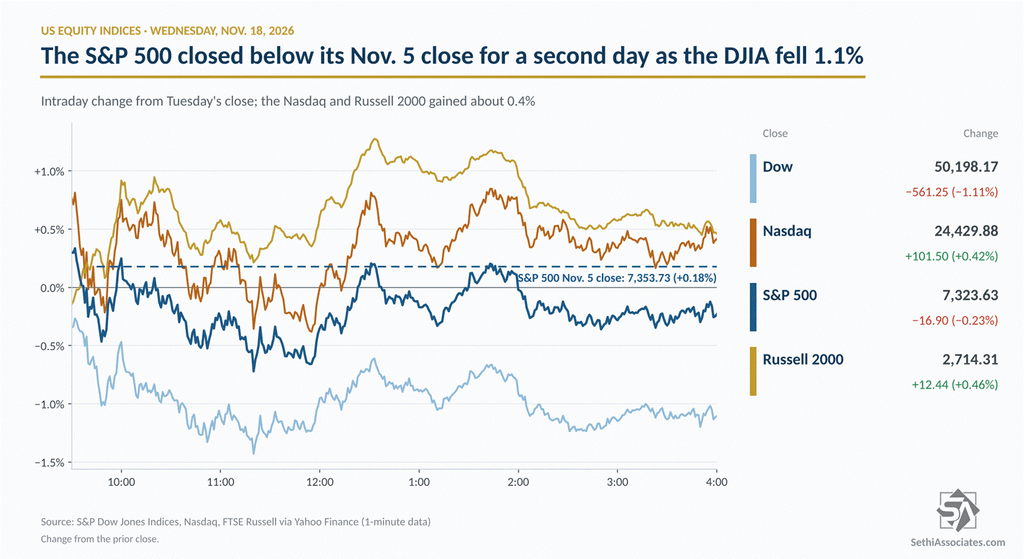
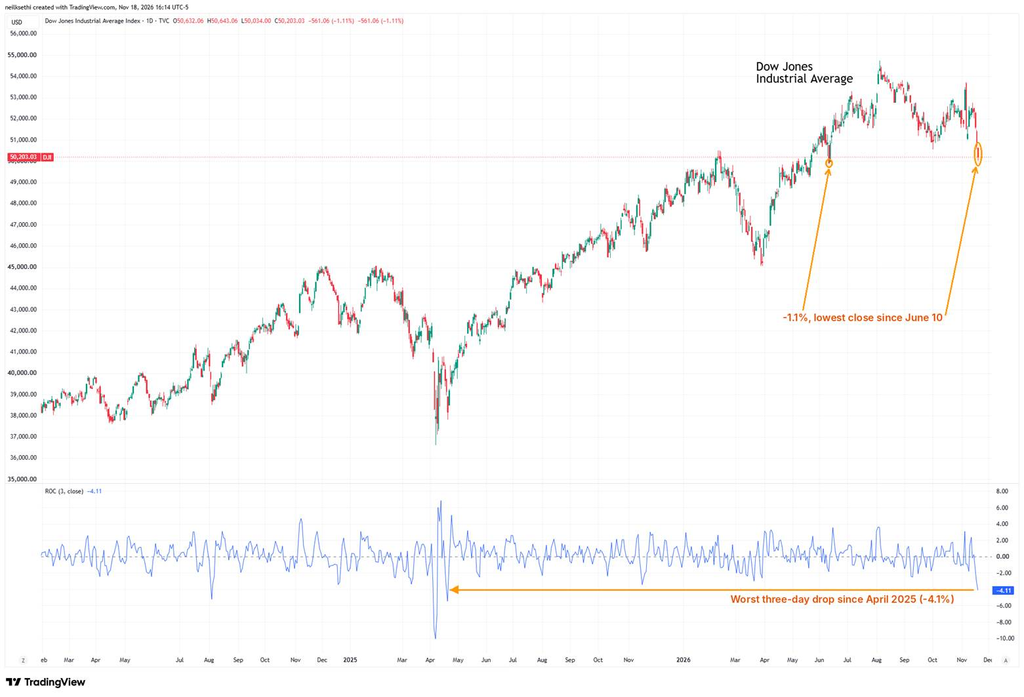
US equity indices opened higher after Nvidia’s results, with the S&P 500 up as much as 0.4%, but the gains faded as Nvidia turned lower. The S&P 500 dropped as much as 0.75% before finishing down 0.2% at 7,324, 0.4% below its November 5th close after several attempts to get back above it failed. It was the index’s fifth straight loss, its longest losing streak. The Nasdaq (+0.4%) and Russell 2000 (+0.5%) managed gains, while the Dow Jones Industrial Average fell 1.1%, weighed down by UnitedHealth, Chevron and Caterpillar, for its third straight loss of more than 1%, its worst three-day drop since April 2025 and its lowest close since June.
Nvidia (NVDA) was up nearly 3% early but finished down 2.9% at $151, not far from its $148.80 intra-day low from last Thursday, despite exceeding expectations (see Nvidia Clears the Bar in Its First Report Without Huang and Nvidia Shares Rise as Kress Raises Growth Outlook). Nvidia has now lost more than a third of its value since its October 6 record close. Other AI names were mixed. CoreWeave (CRWV) and Qualcomm (QCOM) also reversed early gains to fall about 4% and Cerebras Systems (CBRS) nearly 10%, but Nvidia competitors AMD (AMD) (+5.3%) and Broadcom (AVGO) (+3.6%) helped offset those losses, and the Philadelphia Semiconductor Index (SOX) eked out a 0.1% gain.
Health insurers sank after CMS proposed a rule that would apply Medicare Advantage audit findings from a sample of charts to a whole contract and claw back overpayments going back to 2018, with Humana (HUM) down 13% and UnitedHealth (UNH) down 10%.
The VIX fell 3.5% to 24.6. Treasury yields slipped, with the 2-year little changed at 4.81% and the 10-year down 4 basis points to 5.07%, even as the FOMC minutes showed almost all officials saw more hikes as likely and a couple floated a bigger move in December. That came after Fed Governor Waller called for a half-point hike in December unless the Fed clearly signals another hike will follow in January. Governor Barr and San Francisco Fed President Daly also backed further hikes.
The dollar edged up 0.2% to another highest close since April 2025, while commodities were hit again. WTI fell about 3% to $82 as growing US inventories overshadowed Iranian strikes on Kuwait and Bahrain, and gold dropped 3.5% to about $3,730, its lowest close since September 2025. Copper sank 5.3% to its lowest settle since April and its biggest one-day drop since July 2025 in a broad rout as bulls bailed on bets tied to the AI boom and potential tariffs. Bitcoin futures fell 2.4% to about 62,400, while natural gas jumped 6% to $3.41.
In economic data, October housing starts jumped, driven by multifamily, but permits fell to the lowest since May 2020. Pending home sales sank to a second straight record low.
After the close, Bloomberg reported Anthropic has priced its IPO at $83 per share, according to people familiar with the matter, above the $70 to $78 marketed range, making it the biggest first-time share sale on record. The size of the offering has also been increased, the people said.
Anthropic will have its Nasdaq debut Thursday, a day that also brings Walmart’s earnings, jobless claims and five Fed speakers.
My look at today’s charts follows in a separate post later this evening.
Market Commentary
Equities:
- “There are echoes from April, which was the last time the index saw consecutive 1% declines and the last time it slipped below the 200-day moving average,” Mark Hackett, chief market strategist at Nationwide, wrote in emailed comments.
- “Right now, for institutional investors, the mindset is to sell into strength rather than buy dips,” said Steve Sosnick, chief strategist at Interactive Brokers. “It tells me there are basically people who are looking to sell rallies, which is not something we’ve seen.”
- “There’s plenty of uncertainty about how the market trades into year-end,” Louis LaValle, founder, CEO and CIO of Frontier Investments, said in an email to MarketWatch. Recent moves above 25 in the VIX show how unsettled expectations remain, LaValle said. “I’m watching for profit-taking and changes in positioning as hedge funds and institutions close out the year.”
Nvidia/AI:
- “Nvidia earnings and guidance confirmed what we have heard from all other technology companies: AI capex is strong and shows little sign of a slowdown,” said Marija Veitmane at State Street Global Markets. “Strong earnings coupled with lower valuation and positioning make the sector an attractive opportunity.”
- “The fact that [Nvidia] gave guidance is huge,” said Gene Munster, managing partner at Deepwater Asset Management, in an interview. “That is a very bullish sign. I expect the stock to move higher based just on that alone.”
- Tech stocks turned higher Wednesday afternoon, and InvestorPlace analyst and Navellier Market Buzz host Louis Navellier believes a “nice AI rebound” is on tap. It’s “shocking” how cheap valuations in AI stocks are right now, Navellier said.
- Kathleen Brooks, research director at trading platform XTB, told The Wall Street Journal’s What’s News podcast that the chipmaker’s new leadership sent the right message to investors Tuesday by making it clear there are new sheriffs in town. “They didn’t allow distractions, and there are a lot of distractions,” she said, including a statement from co-founder Jensen Huang saying he’d be “honored” to return to his job. Brooks said interim CEO Colette Kress has emerged as a stabilizing force for investors, and an “assertive” rejection of Huang’s potential reinstatement by Nvidia’s first-ever board chair signaled the company is not at a loss for direction. “It really showed that it’s not just the CEO now. They’ve got someone on oversight strengthening their corporate governance.”
- “US AI leadership remains powerful, but we heard that the market may be underestimating Chinese competition and the potential fragmentation of corporate demand,” said UBS strategist Reinout De Bock in a Tuesday note. “The question is not just how quickly AI capex grows, but who will own the infrastructure, control the data and capture the monetization,” he added.
- “It doesn’t take much of a slowdown in earnings growth in the environment that we’re in with the AI buildout and the AI spend to take these types of stocks down pretty quickly,” said Eric Parnell, chief market strategist at Great Valley Advisor Group. “It’s this type of volatility that I suspect we’re not only going to continue to see but it’s likely to increase as we go through 2027 and into 2028.”
- “None of those things answer the fundamental, existential question facing the business right now: What does this company look like in a year?” said Luke Lango, editor of the Innovation Investor newsletter, of Nvidia’s outlook and buyback. “That answer will come down to what happens over the next few weeks and months.”
Anthropic:
- “The 800-pound gorilla in the room is Anthropic and how well, or not, its shares end up trading will be a significant factor for the mood in the days ahead. Meanwhile, SpaceX is also going to test AI sentiment with reports of a big debt raising of its own,” said Mark Cranfield, a Markets Live strategist at Bloomberg.
- “Anthropic’s IPO does look to be on solid footing, which would be a positive structural sign for the AI ecosystem, given the company’s key role as a consumer of AI infrastructure,” said Jay Peters at NewEdge Wealth.
Stock and Sector Breakdown
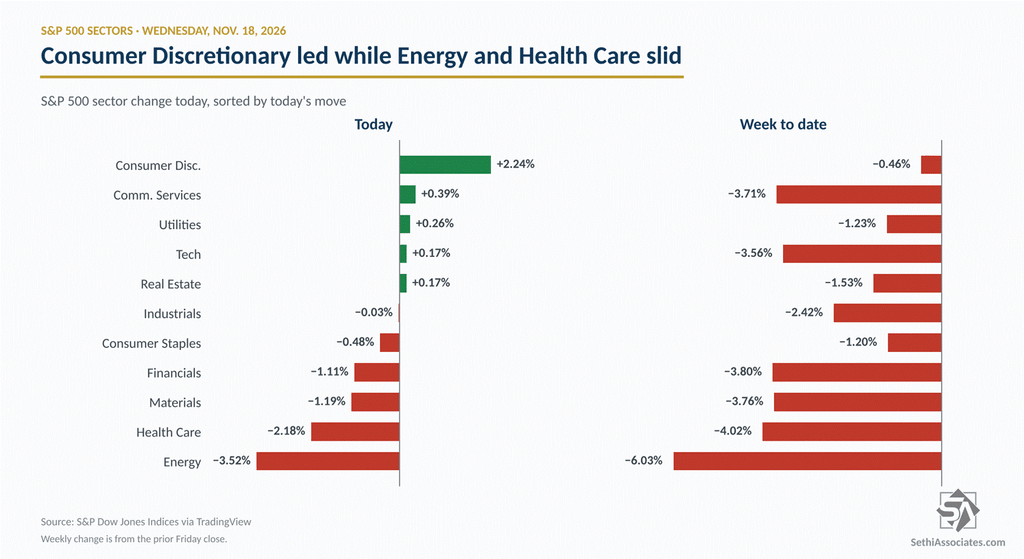
After Tuesday’s across-the-board selling, sectors split, with a spread of nearly six points between the best and worst. Consumer Discretionary led (+2.2%) on Amazon, TJX and Target, followed by Communication Services (+0.4%), Utilities (+0.3%), and Tech and Real Estate (+0.2%).
To the downside, Energy (-3.5%) fell the most as oil slid, followed by Health Care (-2.2%) on the insurers, Materials (-1.2%) and Financials (-1.1%). All 11 remain down week-to-date, with Energy (-6.0%) the worst.
237 S&P 500 stocks rose and 265 fell. 31 rose more than 3% and 37 fell more than 3%.
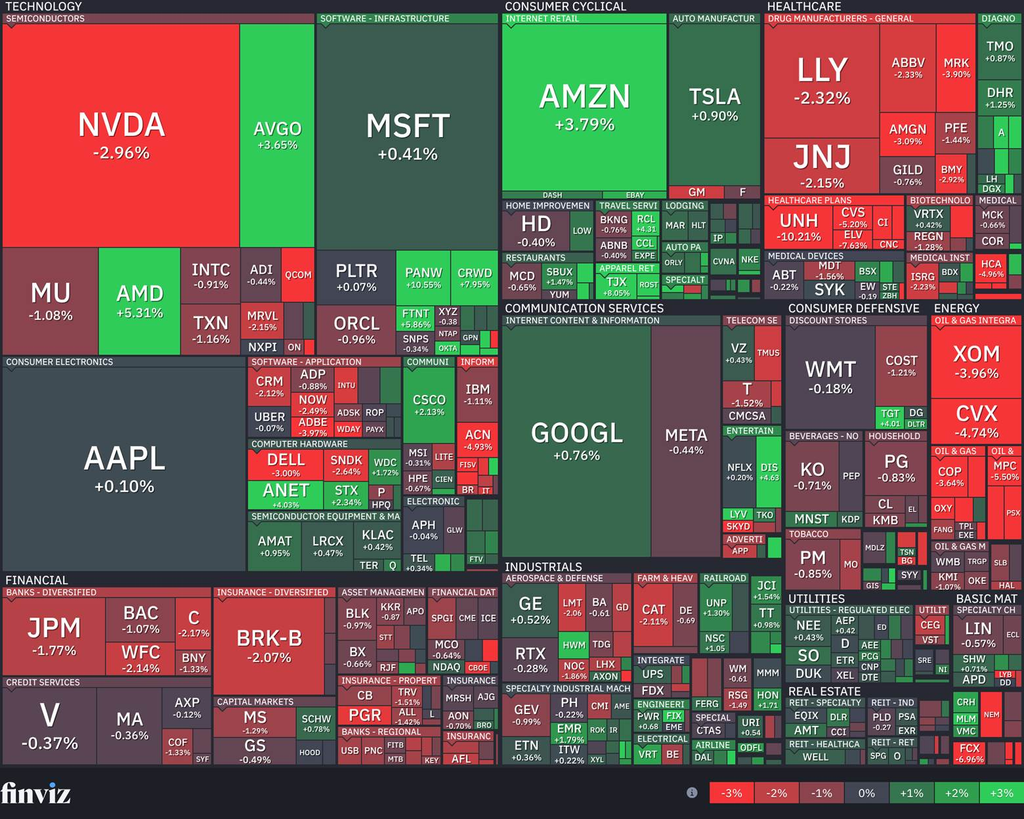
Okta (OKTA) led the S&P 500, up 12%, as cybersecurity stocks rallied ahead of Palo Alto Networks’ results. Recent widespread tech outages, though not tied to cyberattacks, have raised concerns about system resilience, and the spread of autonomous AI agents is adding to demand for more advanced security. Palo Alto Networks (PANW) (+9.9%), CrowdStrike (CRWD) (+8%), Akamai (AKAM) (+8%) and Fortinet (FTNT) (+6%) were also sharply higher, helping the iShares Expanded Tech-Software Sector ETF (IGV) gain 1.3%.
Humana was the S&P 500’s worst performer, as noted, with Elevance Health (ELV) (-7.6%), Centene (CNC) (-7.1%) and CVS Health (CVS) (-5.2%) also hit.
TJX (TJX) rose 8% after its results, which Chris Versace said benefited from customer transaction growth and larger basket sizes, and Target (TGT) gained 4% after beating sales estimates and raising its full-year guidance for a third straight time, while Lowe’s (LOW) edged up 1%. Take-Two Interactive (TTWO) rose 6% on a wave of positive reviews for Grand Theft Auto VI.
Generac (GNRC) jumped 9.9%. Versace noted that recent network outages have consumers stocking up on emergency-preparedness products, with 21 of the 26 high-ticket generators Costco sells online sold out.
Energy names fell with oil, with refiners Valero (VLO) and Marathon Petroleum (MPC) down 5.5% and Chevron (CVX) and Exxon Mobil (XOM) down about 4%. Miners fell with metals, led by Freeport-McMoRan (FCX) (-7%) and Newmont (NEM) (-6%).
Among the megacaps, Amazon (AMZN) rose 3.8% and Alphabet (GOOGL) 0.8%, both lifted by their stakes in Anthropic ahead of its debut, while the rest besides Nvidia, AMD and Broadcom were within about 1%.
After the close, Palo Alto Networks rose another 7% after revenue grew 39% to $3.44 billion and it raised its full-year guidance. It also announced plans to acquire Applied Compute, a platform for running open-weight AI models.
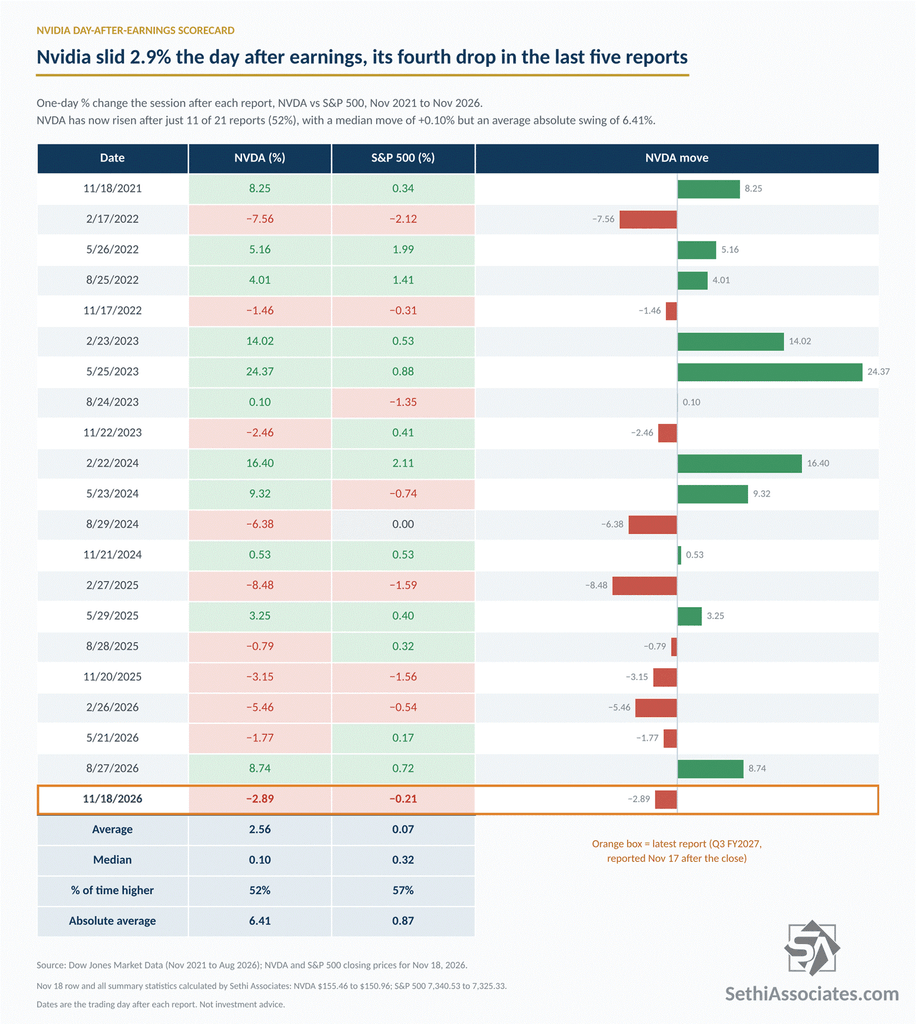
Wednesday’s 2.9% drop was Nvidia’s fourth decline the day after its last five reports. It has now risen after just 11 of its last 21 reports, with a median move of 0.1% but an average swing of 6.4% in either direction. The S&P 500 also fell on six of the 10 days Nvidia declined, and rose on nine of the 11 days it gained.
On Nvidia, Rev Shark said it’s acting like a value trap, with minor strength used to reduce risk, and after the close that Anthropic will have to boost the market where Nvidia faded. Bob Lang sees too much turmoil and potential liability, with big money slowly exiting. Doug Kass concluded Nvidia is “not currently investable (not even for a trade)” and flagged a post noting it didn’t file its 10-Q with the release, as had been its custom.
Steve “Sarge” Guilfoyle gave his pick to replace Jensen Huang and a new pivot for the stock after the SEC investigation update, and Ed Ponsi laid out how Huang could return. Chris Versace added to four Portfolio holdings, including Nvidia, and is sticking with his Nvidia price target.
More broadly, Helene Meisler said the S&P 500’s Daily Sentiment Index fell to 18, low enough to have her attention, though she doesn’t think we’ve had the kind of panic that makes for a durable low. Kass traded the indexes all day and ended net long SPY and QQQ, adding to tech and financials, as his Gnome heard several hedge funds had been liquidated. He also put in for the Anthropic IPO, guessing it prices around $82 and opens around $95.
FedWatch
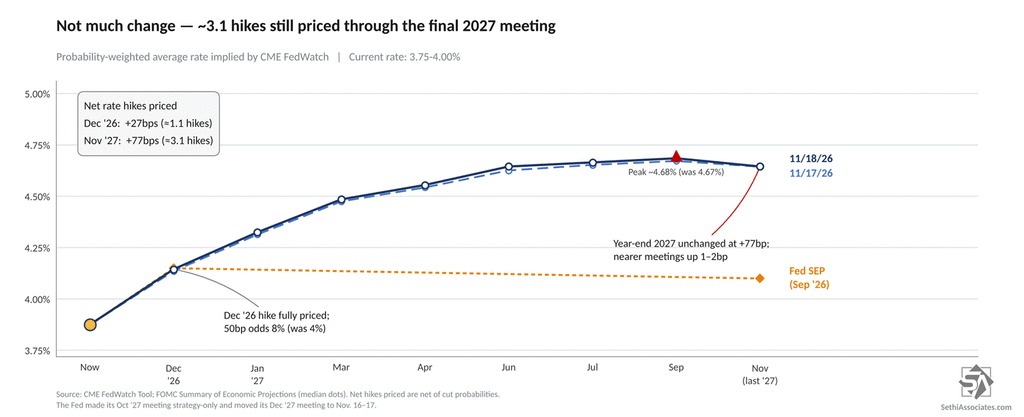
Fed speakers and the October minutes did little to change rate expectations. A December hike remains fully priced, with the odds of a half-point move edging up to 8% from 4%, and 77 basis points of hikes are still priced through the Fed’s final 2027 meeting in November (about three hikes), unchanged from Tuesday, per CME FedWatch.
More From TheStreet Pro
Rev Shark — Nvidia Delivers, but the Response Is Muted. Here’s How I’m Playing It.
Chris Versace — A Portfolio Holding Changes the Structure of Its Pending Offer
Bret Jensen — I’m Also Hungry for This Newly Promoted Portfolio Stock
Stephen Guilfoyle — Our Small-Cap Biopharma Firm Presents
Doug Kass — Ed Zitron on Nvidia
Doug Kass’s Diary:
- You Made Me Love You (But I Sold); Didn’t Want To Do It
- Problem With Rally from Lows
- Boockvar on Waller’s Hawkishness, Housing Data
- Boockvar on Nvidia Comments
- Gold Sentiment
- FOMC Minutes for October
Note: Doug posted 32 Diary entries today; these are the market ones not linked above. You can see all of them here.
And From Me If You Missed It
- Fed’s Musalem Wants ‘Several’ Hikes Before Spring, but Note His Record
- Fund Managers Cool on the Economy, but Don’t See a Recession
- What to Watch as Housing Starts Jump, but Total Permits Sink
- Pending Home Sales Sink to Second Straight Record Low
Miscellaneous
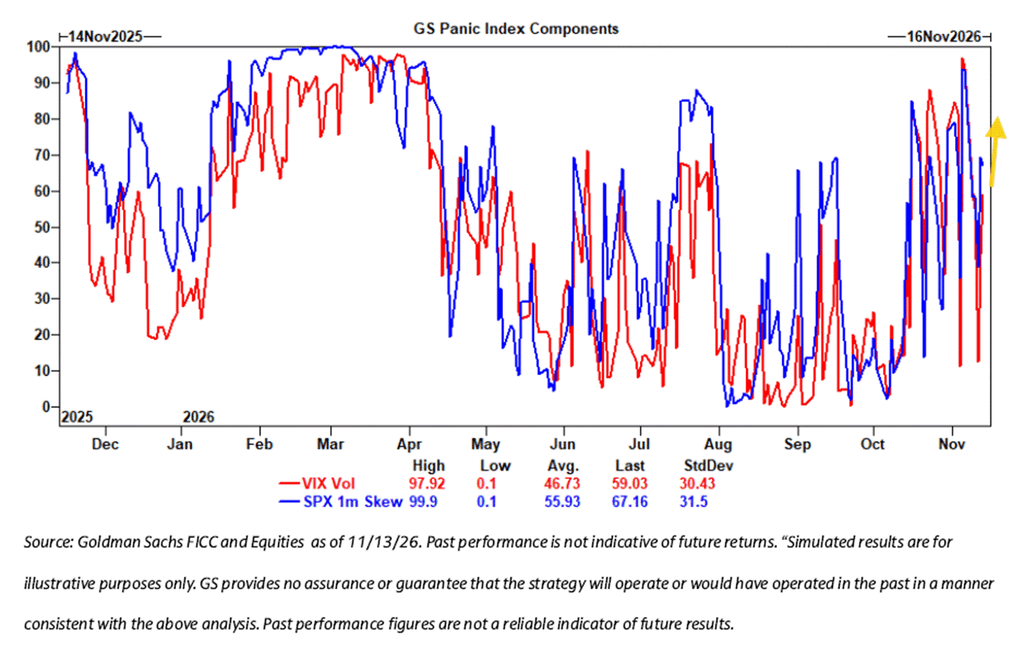
Goldman’s note from Monday afternoon said the vol market “has yet to turn off the ‘seatbelt sign,'” and it only went in the direction of more “panic” Tuesday. Its GS Panic Index, which combines the two-year weighted percentiles of one-month S&P 500 implied volatility, VIX volatility, one-month put-call skew and the term structure slope (one month vs. three months), stood at 6.3/10, the 67th percentile on a one-year lookback. VIX volatility and S&P 500 skew had jumped from the 12th and 38th percentiles on November 11 to the 59th and 67th, and Goldman’s vol forecast “suggests elevated volatility and more choppy conditions in the near-term.”
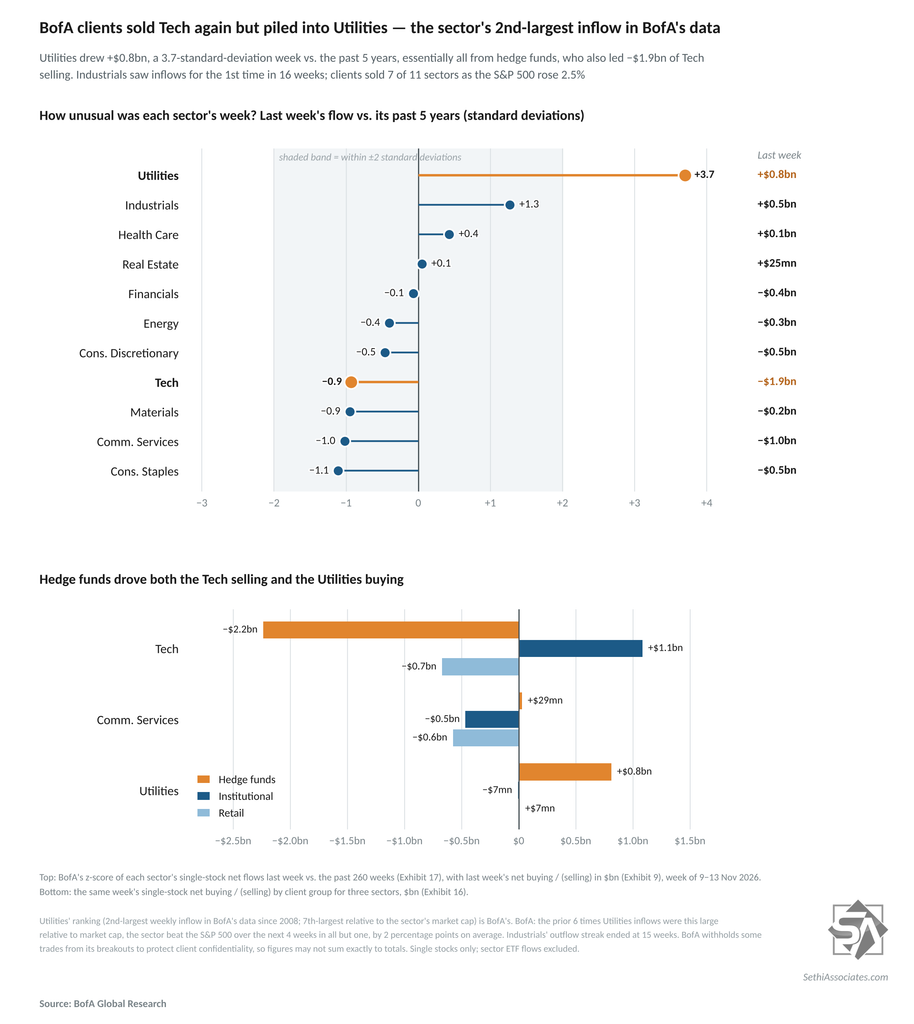
BofA clients poured $811 million into Utilities stocks last week, the sector’s second-largest weekly inflow in BofA’s data back to 2008, essentially all of it from hedge funds. BofA notes that the prior six times inflows were this large relative to the sector’s market cap, Utilities beat the S&P 500 over the next four weeks in all but one, by 2 percentage points on average. Clients also sold $1.9 billion of Tech, led by hedge funds (-$2.2 billion; institutions bought $1.1 billion), and sold Communication Services for a fifth straight week. Industrials saw inflows for the first time in 16 weeks, ending the sector’s longest outflow streak since January 2024.
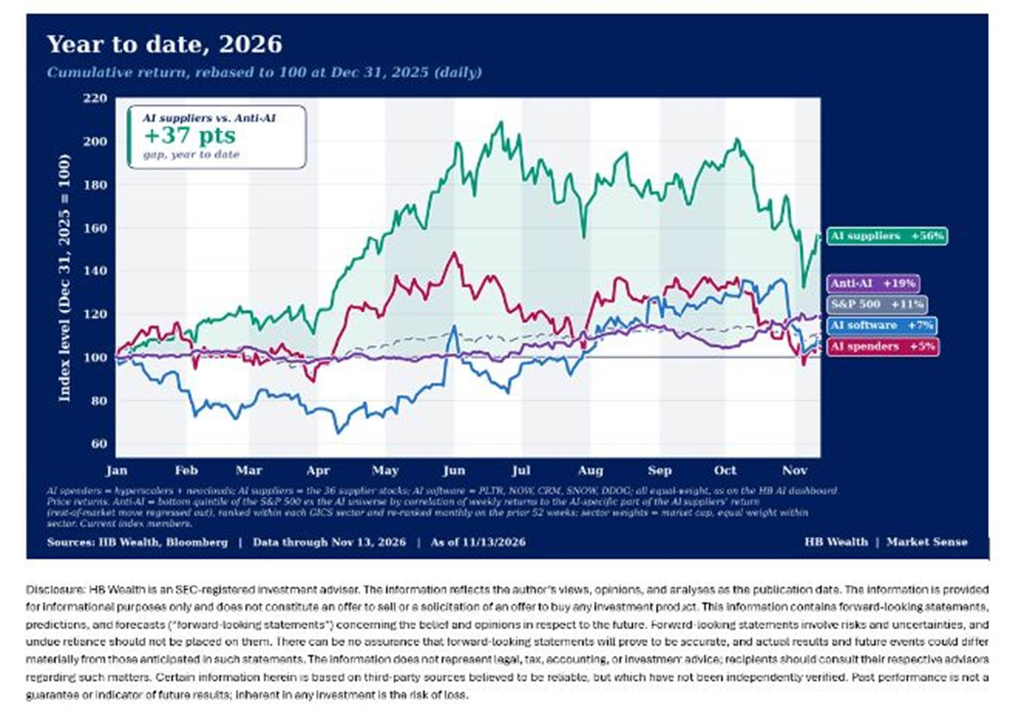
Bloomberg Intelligence’s Gina Martin Adams says “anti-AI” stocks are all the rage in the S&P 500 as the AI trade reprices to reflect peak earnings growth and rising regulatory pressure. A basket of these stocks (neutralized by sector and AI beta) is up 19% this year, and 18% since the most recent peak in AI suppliers and spenders in October, reflecting its use as a portfolio diversifier. The group is heavy in financials, health care and industrials, with sizable staples, tech and utilities exposure, and has correlations of -0.34 and -0.22 to the AI suppliers and overall AI baskets.
Wrap-Up — Not Much of a Bounce
We did get a bounce Wednesday, but not much of one. Nvidia gave up a nearly 3% gain to finish solidly lower, and the “bounce” in the Nasdaq-100 was all of four tenths of a percent, which raises the same concerns about Tech I had last Friday (Chips Slide Again, but the S&P 500 Still Ends the Week Up 2.5%).
Also concerning, the S&P 500 couldn’t get back above its November 5th close despite several tries. It poked above it four separate times, at the open and through the early afternoon, but never for more than a few minutes, and closed below it for a second straight day. Recovering that level is an important step.
That said, I noted Monday that it might take getting past the Anthropic IPO before we can put a rally back on the table (AI Stocks Drag the S&P 500 Back Toward the November 5th Lows), so we likely won’t get a better read until Friday and into next week. The seasonals line up with that too. Hirsch shows Thursday (day 14), the day Anthropic starts trading, as the low point of November’s mid-month dip, with the indices historically rallying from there through Thanksgiving week. Friday also brings monthly options expiration, which Tier1Alpha thinks could be another clearing event allowing gamma to reset closer to neutral from its current fairly negative posture.
There were also some positives under the surface. The selling wasn’t indiscriminate, with the Russell 2000 (+0.5%) and S&P MidCap 400 (+0.3%) higher, software and cybersecurity rallying, and the enthusiasm around Anthropic’s IPO lifting Amazon. The 10-year Treasury yield also fell for a third straight day.
For now, the longer-term reasons to stay bullish I laid out Sunday remain: positioning is still light, sentiment has tipped into territory historically followed by gains, the buyback window is wide open, the economy is strong and earnings growth is expected to stay robust through 2027 (The Week Ahead – Have We Seen the Q4 Bottom?). The question, as it has been all week, is when the market will be ready to embrace them.
As always, let’s see what we get and go from there.
The Day Ahead — Anthropic Debuts and Walmart Reports
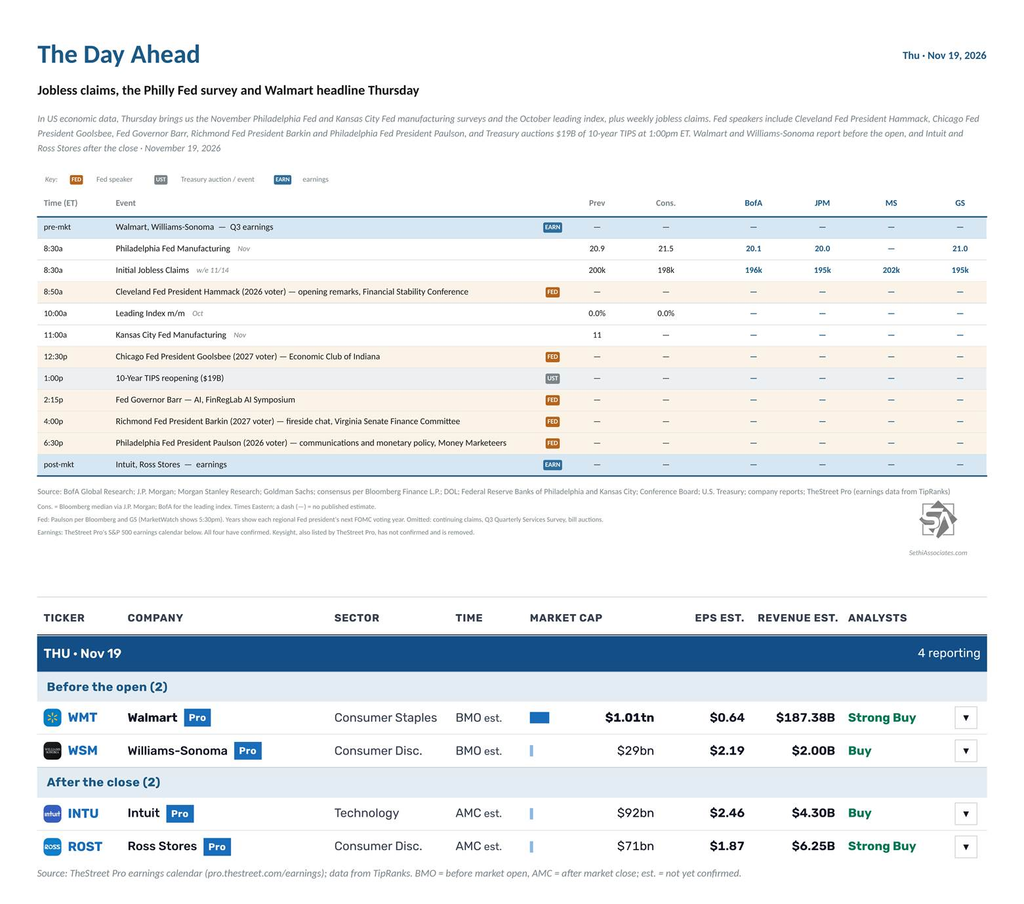
In US economic data, Thursday brings us the November Philadelphia Fed and Kansas City Fed manufacturing surveys and the October leading index, plus the usual weekly jobless claims.
Fed speakers include Cleveland Fed President Hammack (2026 voter), Chicago Fed President Goolsbee (2027 voter), Fed Governor Barr, Richmond Fed President Barkin (2027 voter) and Philadelphia Fed President Paulson (2026 voter).
Non-Bill (>1yr in maturity) US Treasury auctions bring us a $19B 10-year TIPS reopening at 1:00pm ET.
Four S&P 500 components report, one of them with a market cap over $100B:
Before the open: Walmart (WMT) and Williams-Sonoma (WSM).
After the close: Intuit (INTU) and Ross Stores (ROST).
Outside the S&P 500 we’ll hear from Chinese heavyweights Alibaba (BABA), PDD Holdings (PDD) and NetEase (NTES).
Anthropic (ANT) is also set to begin trading on the Nasdaq after pricing its IPO tonight.
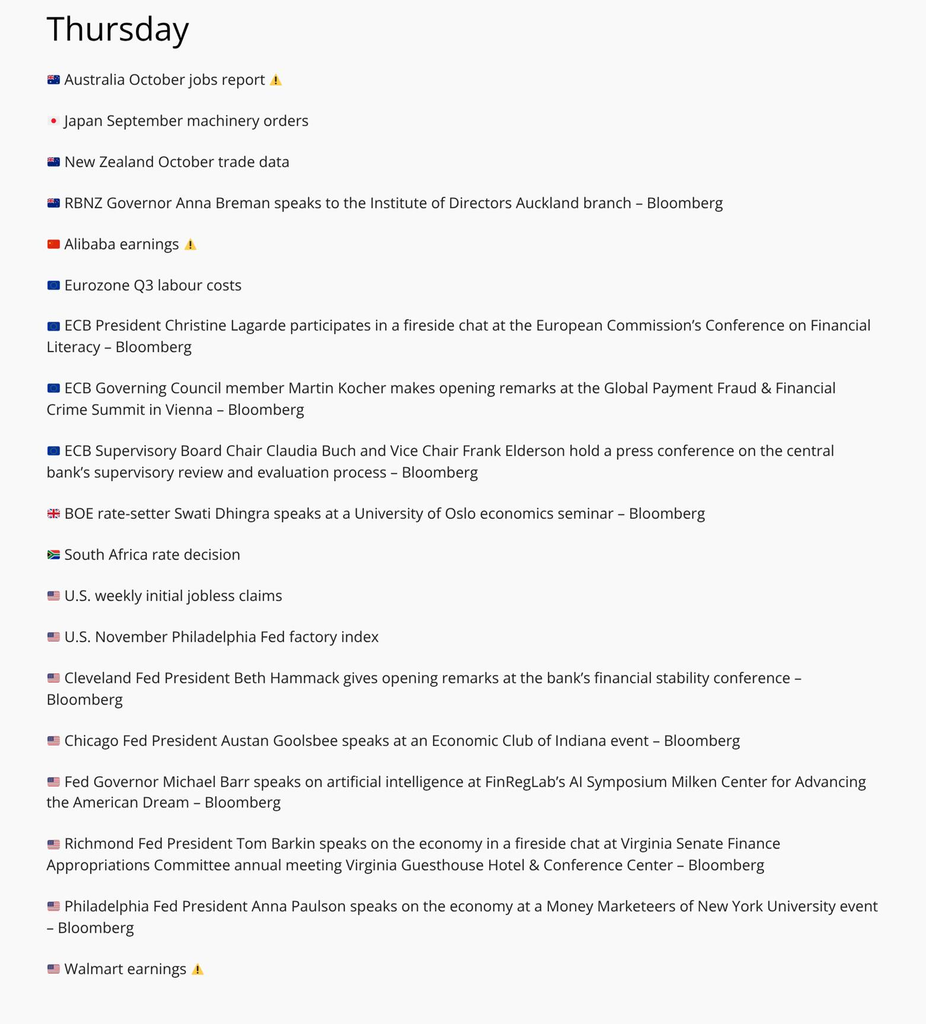
Ex-US highlights include New Zealand’s October trade data (4:45pm ET Wednesday) and Australia’s October jobs report (7:30pm ET Wednesday), Japan’s September core machinery orders, the UK’s November CBI industrial trends, eurozone Q3 labor costs, South Africa’s rate decision (8am ET) and Banxico’s minutes (10am ET), plus the ECB’s supervisory press conference with Buch and Elderson and remarks from ECB President Lagarde and the BoE’s Dhingra. APEC’s leaders’ meeting in Shenzhen wraps up, with President Trump, Xi Jinping and Vladimir Putin expected to meet Thursday.
From Christophe Barraud’s international Week Ahead rundown:
At the time of publication, in terms of securities mentioned, Sethi was long AMZN, GOOGL, IWM, NVDA, QQQ, SOXL, SPY, XOM and numerous Treasury ETFs, and short CPER and IBIT. In the last 24 hours Sethi sold his position in UNH, bought XOM, added to SPY and covered part of his IBIT short.