New Nvidia Stock Price Pivot After SEC Investigation Update
The beleaguered AI firm is developing a stock chart pattern.
You've reached your free article limit
You've read 0 of 1 free Pro articles.

On Tuesday evening, beleaguered tech giant Nvidia (NVDA) published the firm’s fiscal third quarter financial results.
For the period ended October 25, Nvidia posted an adjusted EPS of $2.68 (GAAP EPS: $2.70) on revenue of $115.844 billion. These results all easily exceeded Wall Street’s expectations. That top-line print was good enough for year-over-year growth of 103.2%. Data enter driven revenue printed at $107.6 billion, up 110% from the year-ago period. The firm also announced that Vera Rubin NVL72, the most versatile and advanced computing platform ever built, has now shipped.
Interim CEO Colette Kress commented in the press release:
“Our momentum is real. NVIDIA is an exceptional technology leader, powered by the relentless innovation of our people. Vera Rubin is off to an explosive start, our roadmap is on track and our ambition has never been greater.”
Short. Less than sweet. Kress told us close to nothing here.
The press release then did try to sweeten things for recently burned shareholders with this little reminder:
“In September 2026, NVIDIA’s Board of Directors approved an increase of $150 billion to the company’s share repurchase authorization, without expiration. During the third quarter of fiscal 2027, NVIDIA returned $28.1 billion to shareholders in the form of shares repurchased and cash dividends. As of the end of the third quarter, the company had approximately $227.3 billion remaining under its share repurchase authorization.”
I don’t know if that was supposed to knock my socks off. At the time, it did. Now? Not so much.
As revenue generation grew 103.2% to $115.844 billion, the cost of those sales increased 92.4% to $29.168 billion. This left a gross profit of $86.676 billion (+107.1%) as gross margin improved from 73.4% to 74.8%. GAAP operating expenses printed at $9.156 billion (+56.8%), leaving GAAP operating income of $77.52 billion (+115.3%). That took the firm’s GAAP operating margin from 63.2% to 66.9%.
After accounting for interest, other income and expenses and taxes, GAAP net income attributable to shareholders landed at $65.287 billion (+104.6%). This works out to $2.70 per fully diluted share, up from the year-ago comparison of $1.30. After adjusting primarily for changes in the value of equities held and the pre-tax impact of those adjustments, that EPS print becomes $2.68, up from $2.22.
Segment Sales Performance
Data Center generated sales of $107.61 billion (+110%)
Hyperscale generated sales of $60.136 billion (+71%)
AI Clouds, Industrial & Enterprise generated sales of $47.474 billion (+195%)
Edge Computing generated sales of $8.234 billion (+42%)
Guidance
I must say that I am impressed that with all of the uncertainties now facing this firm that guidance was even issued. For the current quarter, Nvidia is projecting revenue of $130 billion, give or take 3%. Nvidia is not including any revenue from China in that outlook. That has always been the case though. That’s a bit better than the $125 billion that Wall Street was looking for.
Gross margin for the quarter is seen at 71% to 72%, which was disappointing. Wall Street was looking for 71.7%, above the midpoint of the range issued. During the call, Kress added:
“We expect Q4 to mark the bottom of gross margins before improving to the 72% to 73% range in fiscal year ’28.”
She also said, “We are raising our fiscal year 2028 outlook. We expect revenue to grow approximately 75% year-over-year, up from 70% and off what is now a higher fiscal 2027 base.”
Fundamentals
For the quarter reported, Nvidia generated operating cash flow of $48.253 billion. Out of that number came capex spending of $4.422 billion, and principal payments on property and equipment of $54 million. That left free cash flow of $43.777 billion (+98.2%). While those numbers are incredible, free cash flow fell considerably short of the almost $56 billion that Wall Street was looking for. Out of that free cash number, Nvidia repurchased $22.122 billion worth of common stock for the corporate treasury and paid out $6.026 billion in cash dividends to shareholders.
Turning to the balance sheet, Nvidia ended the quarter with a cash position of $97.731 billion and inventories of $39.724 billion. That left current assets at $221.994 billion. Current liabilities add up to $54.361 billion, including no short-term debt. Nvidia’s current and quick ratios now stand at 4.08 and 3.35, respectively. That is simply outstanding.
Total assets amount to $372.188 billion, of which only about 8% is labeled as either goodwill or other intangibles. Obviously, that’s not a problem. Total liabilities less equity comes to $105.522 billion. There is long-term debt on the books of $32.371 billion, which is something that the firm can handle three times over out of pocket. This is a fortress-like balance sheet.
Opinion
There’s a lot to take in here. The quarter reported was fantastic. Growth was wild. Cash flows, though disappointing relative to expectations, were still incredible. The guidance was strong, but a little mixed with the miss on expected gross margin. The balance sheet is Herculean.
That said, there are issues. The Wall Street Journal reported just ahead of this release the news that the Securities and Exchange Commission is now investigating Nvidia. On the national security side and concerning sales through third parties that wound up in places that they were not supposed to be, there will almost certainly be other inquiries. Disgraced former CEO Jensen Huang will now have to appear before congress. Clearly, Huang’s resignation was not a clearing event for investors.
Then comes the search for a new CEO. Kress is a contender for the position, but we know that the former CEO himself did not see her as a strategic leader. We also know that she was in the C-suite as the firm’s culture at the top ran amok. I have no doubt that some of the biggest names in tech would be willing to run Nvidia with the kinds of numbers the firm is putting up. That said, under intense scrutiny, those numbers may be more difficult to come by. The new CEO won’t be running his own little kingdom where everyone is afraid to speak up. I told readers who I think the firm should reach out to, but as an investor in that firm, I hope they don’t.
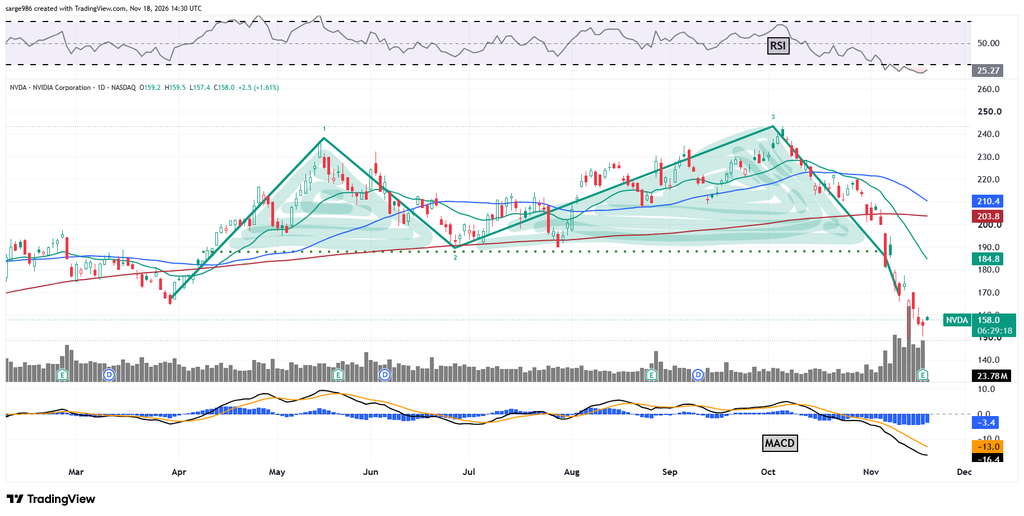
Readers will see the huge double-top pattern of bearish reversal that covers the March through early November period. The pattern bears a $189 pivot. That would put the downside target for short sellers around $142. The stock bottomed close to $148 late last week. I spent the overnight bidding $140 without getting hit. Will the stock test last week’s lows? It could. That depends on how badly the federal government wants to dig on the national security issue.
Moving on to my indicators, relative strength is in awful shape, but does an “oversold” technical reading matter when investigations and inquiries are or could be involved? I just do not know. President Trump is still championing the firm. The daily MACD is sending perhaps the most bearish signals I have ever seen for any stock in that indicator.
How am I approaching NVDA right now? Trade it. Don’t own it.
At the time of publication, Guilfoyle was long NVDA calls, short NVDA calls.