Chips Slide Again, but the S&P 500 Still Ends the Week Up 2.5%
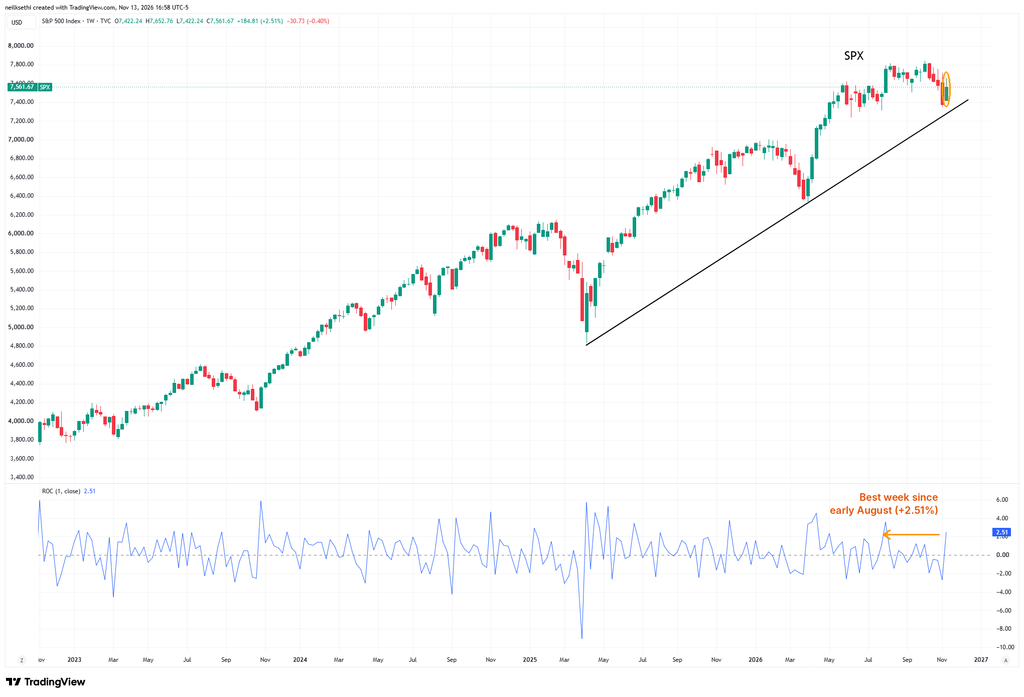
Tech fell back for a second day, pulling down the Nasdaq and S&P 500, but both still finished the week up more than 2%, their best week since early August.
You've reached your free article limit
You've read 0 of 1 free Pro articles.
Executive Summary
Last night I said the market was showing remarkable resilience (The Bounce Stalls as Nvidia Ousts Huang and Yields Jump). And while the Tech pullback deepened Friday, the major indices again finished well off their lows and held onto solid weekly gains.
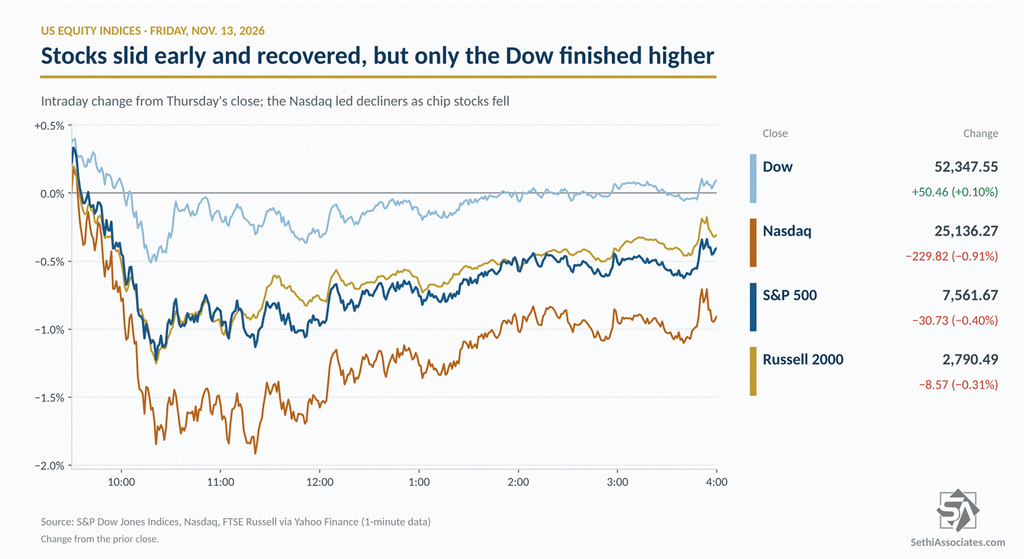
US equity indices started higher after a cooler-than-expected headline PPI reading but quickly fell into the red. They bumped around their lows in the morning before rising in the afternoon, though only the Dow made it (barely) back to the green, up 0.1%. The Nasdaq led decliners, down 0.9% on Tech weakness, while the S&P 500 fell 0.4% and the Russell 2000 0.3%. Most stocks rose, though, with 315 S&P 500 members higher and the equal-weighted index up 0.2%.
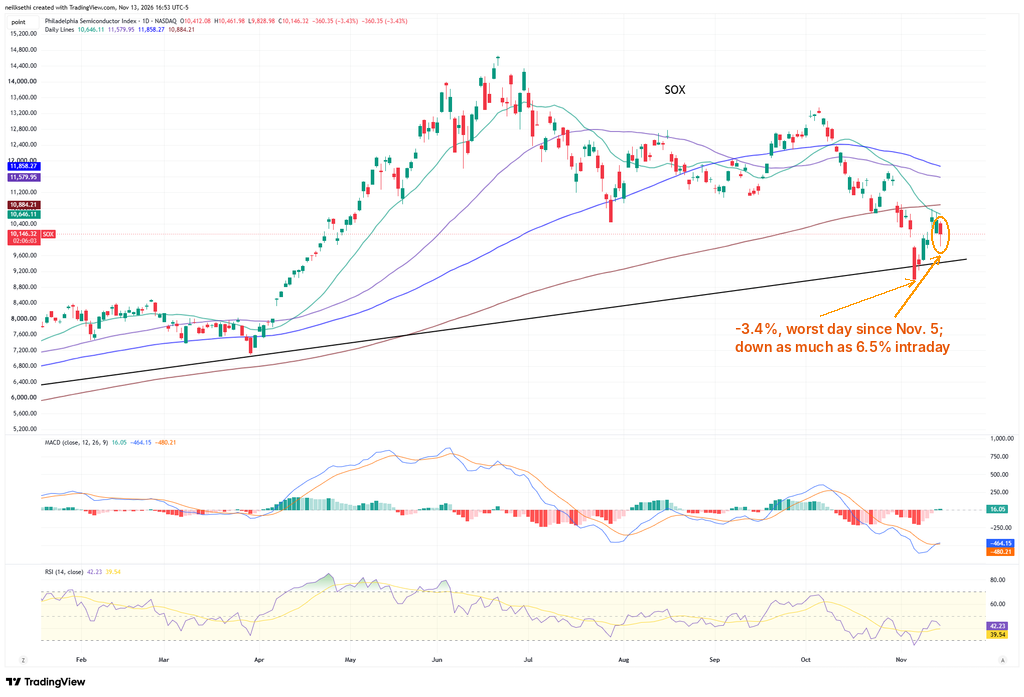
The Philadelphia Semiconductor Index (SOX) fell 3.4%, its worst day since November 5, as AMD (AMD) and Broadcom (AVGO), the S&P 500’s two best performers Thursday, fell 9% and 5% while Nvidia (NVDA) slipped 2%. Through Thursday, the market value leaving Nvidia this week had been showing up, dollar for dollar or better, in its rivals, but that broke down Friday. The SOX was down as much as 6.5% before paring its loss.
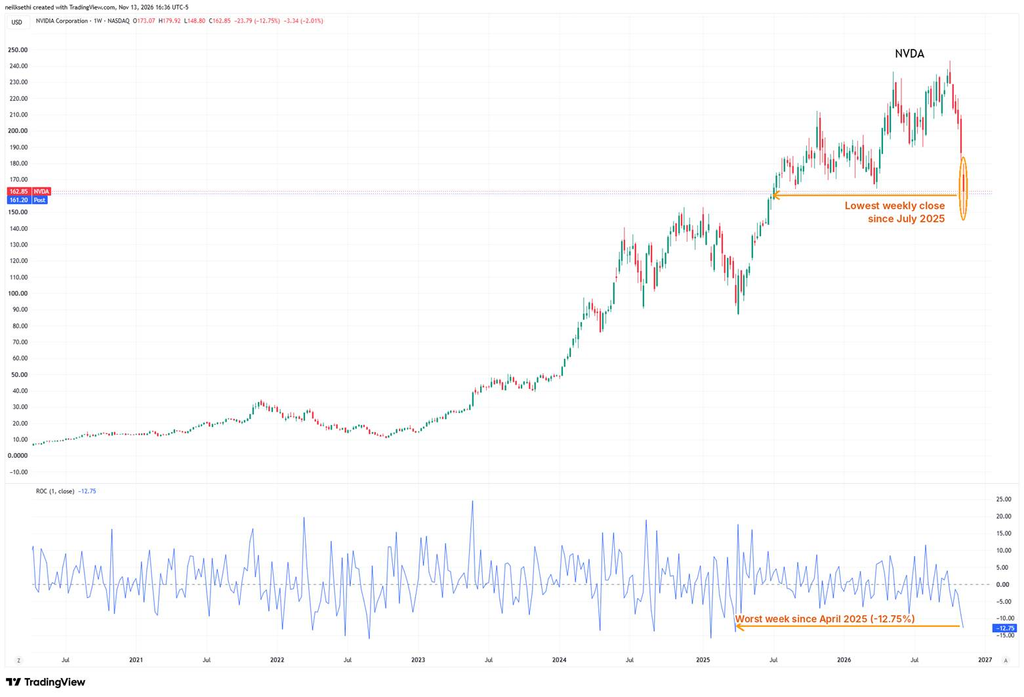
Nvidia fell 13% for the week, its worst since April 2025, and closed at its lowest weekly level since July 2025. HSBC downgraded it to hold Friday, saying the stock will struggle until a permanent CEO is named, and the company said it’s still choosing a search firm after the Financial Times reported its board had approached Arm CEO Rene Haas. The WSJ estimated that nearly $2 trillion has been wiped off Nvidia’s market cap from its highs.
On the Nvidia drama, Rev Shark thinks it’s covering up deeper market issues, Stephen Guilfoyle says we’ll soon need an advanced AI chip just to understand it, and Ed Ponsi asks whether Nvidia has bottomed. Helene says sentiment is getting spooky.
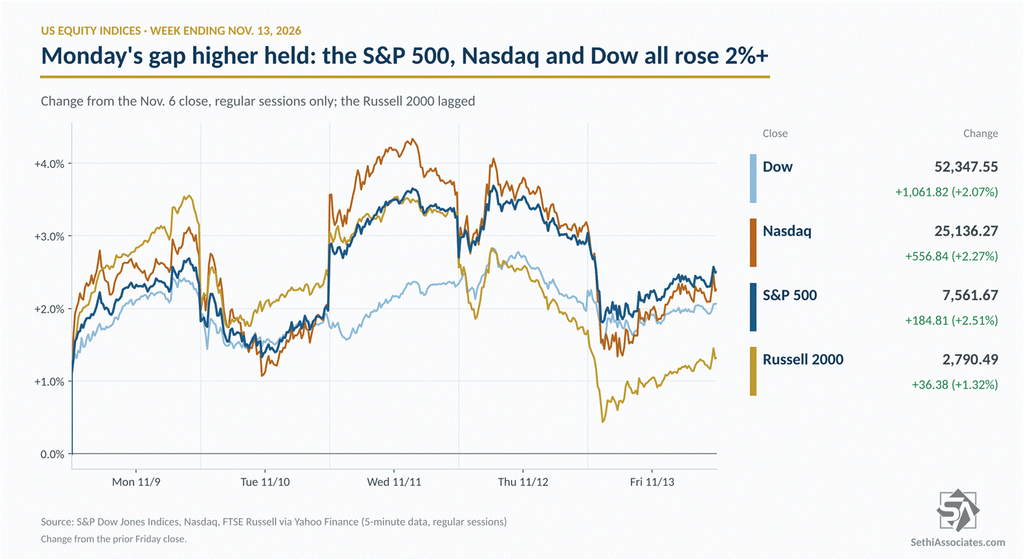
The indices didn’t make much progress after Monday’s gap higher, but they held in the green all week, with the S&P 500, Nasdaq and Dow gaining 2.5%, 2.3% and 2.1% respectively. The Russell 2000 lagged but still ended up a solid 1.3%. That got back most of the prior week’s losses (the Dow more than all of them), and for the S&P 500, Nasdaq and Dow it was the best week since early August. The SOX jumped 8% for the week, also its best since August, despite Friday’s drop.
October producer prices rose 0.3%, less than the 0.4% expected and the smallest increase since July, but they were up 6.5% from a year earlier, the highest since November 2022, and core’s 5.0% annual rate was the highest since December 2022 (more here: Headline Producer Prices Cool, but Core Hits Highest Annual Rate Since 2022).
Boston Fed President Collins became the latest to say “soon some additional firming” is appropriate, after New York Fed President John Williams, the FOMC vice chair, and San Francisco Fed President Mary Daly signaled more hikes late Thursday (see Fed’s Daly and Williams Also See More Hikes, but ‘Over Time’). BofA added a third hike to its call, now expecting increases at each of the next three meetings.
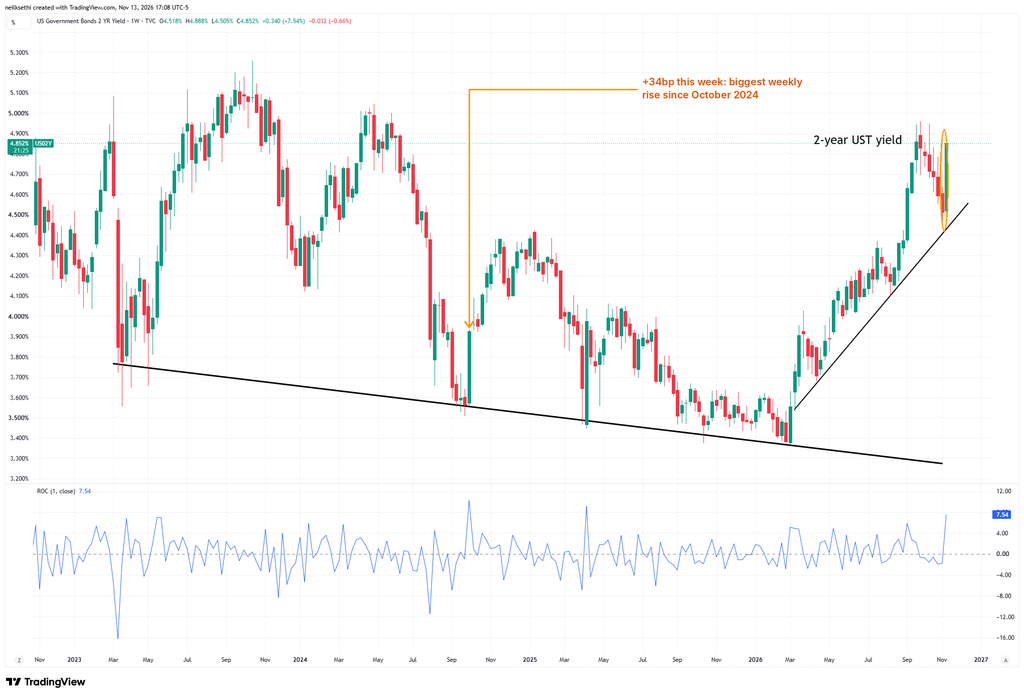
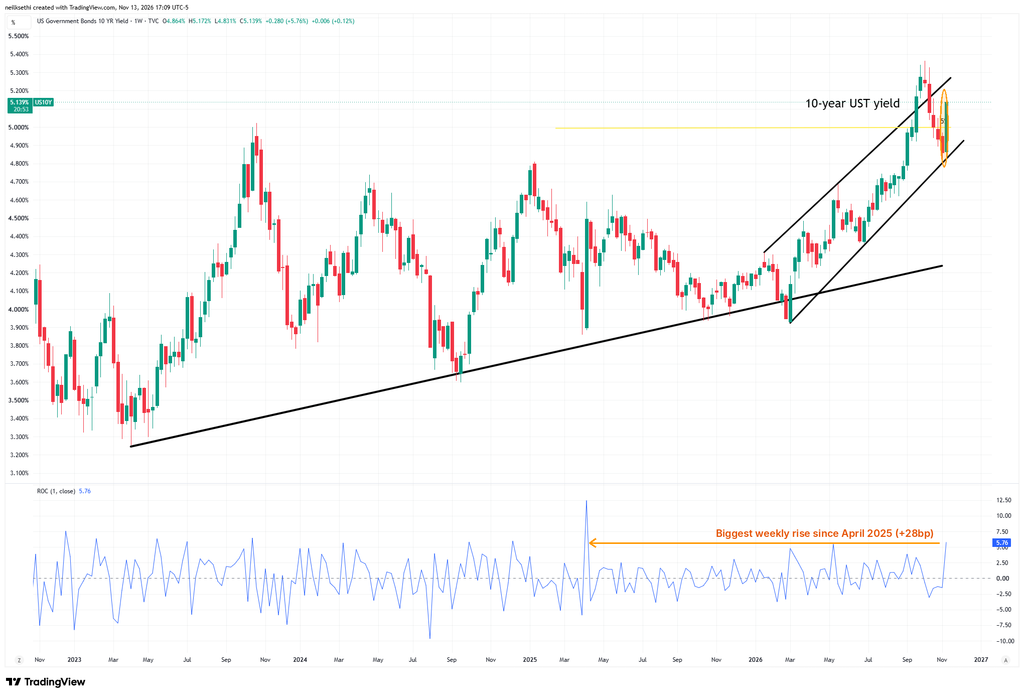
The 10-year Treasury yield edged up to 5.14%, its highest close since mid-October, while the 2-year slipped 3 basis points to 4.85%. For the week, though, the 2-year rose 34bp, its biggest weekly gain since October 2024, and the 10-year 28bp, the most since April 2025.
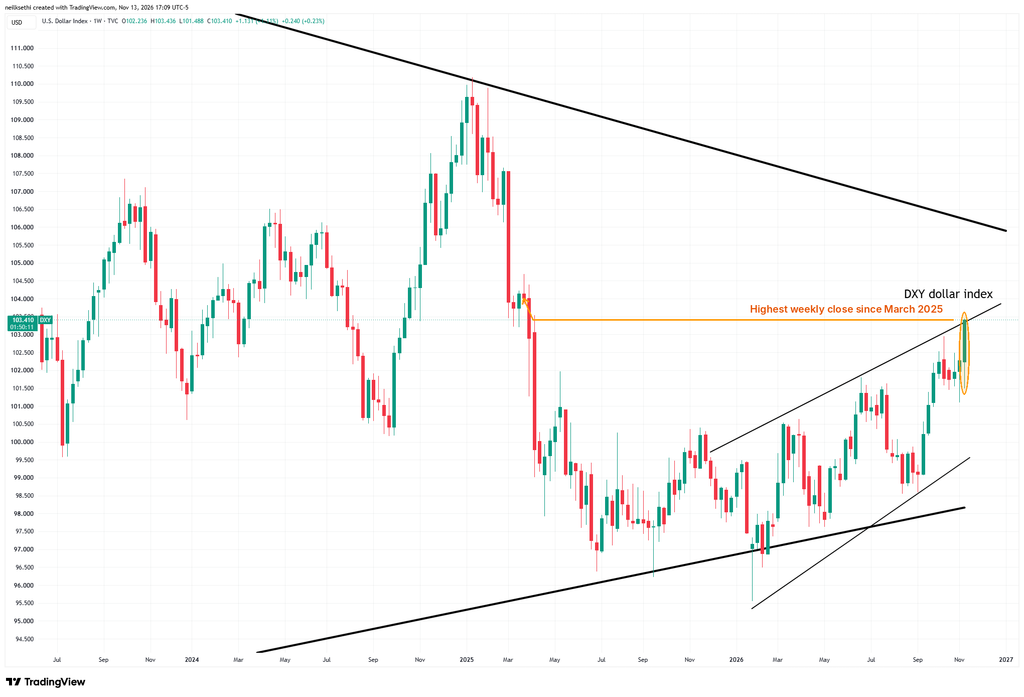
The dollar rose to another highest close since April 2025 and its highest weekly close since March 2025, and bitcoin fell 5% to below $69,000, its lowest close since August 18 and its sixth straight weekly loss. Gold was flat but fell 5% for the week, its worst since June. The VIX rose 3% to 19.3, but it fell 25% for the week.
Next week brings Nvidia’s earnings, October retail sales and industrial production, several housing reports, the FOMC minutes and a slew of Fed speakers, and Anthropic’s IPO is expected Thursday (more in the Week Ahead below).
A more detailed look at the charts from today and this week follows in a separate post later this evening.
Market Commentary
Equities:
- “The market mentality is not about assessing risks, it’s about seeking opportunities,” Steve Sosnick, chief strategist at Interactive Brokers, said in a text message. “The mindset is ‘if NVDA is out of the way, who wins?'”
- “Over the short- and mid-term, I don’t think this changes the AI trade at all,” said Patrick Moorhead, chief executive officer and chief analyst at Moor Insights & Strategy. “When I look at the Broadcoms, the Intels, all the startups, I think they can fill a lot of the cracks that Nvidia could potentially leave open.”
- “We’ve come too far along the way here in terms of AI,” said Angelo Zino, senior vice president and head of technology at CFRA, adding that recent earnings reports from the AI space show a solid demand trajectory. “I don’t think Jensen leaving is going to change any of that.”
- “To the extent Jensen had partnerships or supported smaller firms, or even made investments in smaller firms that got the benefit of having the Jensen seal of approval, that goes away,” said Brian Colello, equity strategist at Morningstar Investment Services.
- “What I’ve learned in my time on this planet is everyone’s replaceable,” said Nancy Tengler, chief investment officer of Laffer Tengler Investments. “I don’t think this has a meaningful impact on the AI trade in general. I think it’s just been an unfortunate blip for Nvidia shareholders.”
- “AI is a transformative technology. That’s not going to change. And, there’s a lot of uncertainty with AI, but one thing that seems very clear is that AI demands a tremendous amount of computing power, which is tremendously expensive,” said Allen Bond, managing director and portfolio manager at Jensen Investment Management Inc. “We think that that infrastructure cycle is going to continue.”
- “The next real test arrives when Nvidia reports on Nov. 17, and the thing to watch is not who is at the podium but whether the order book has changed,” said Brian Jacobsen at Annex Wealth Management.
- Thomas Martin of Globalt Investments expects the process of finding a new CEO to “take a lot of time” and spur even more uncertainty for the name. “What will happen to those types of financing arrangements, and will there be less of them just going forward or will there actually be unwinding of them?” the senior portfolio manager said in an interview. “What are the relationships going to be with their suppliers and with their customers? It’s just early days.”
- “Even before all of this came out, and even before the election, chip stocks had been under pressure. There had already been worries about a blue wave — worries about a Democratic sweep — [and] worries about the [return on investment] on all of this capex,” said Baird investment strategist Ross Mayfield. “It hasn’t really changed the broad tenor of the market.”
Fed:
- “Today’s PPI data — which shows some signs of improving, albeit still too-high — is unlikely to change the Fed’s approach in December because the CPI data was already outside their comfort zone,” said Chris Zaccarelli, chief investment officer at Northlight Asset Management.
- “While some committee members may advocate more aggressive action, we should expect a 25-basis-point rate hike,” said Jeffrey Roach at LPL Financial. “Given the fragility of the broader economy, a larger 50-basis-point increase could pose unnecessary risks.”
Bonds:
- “This is a tougher environment than during the Covid pandemic and the global financial crisis,” said Kellie Wood, a Sydney-based money manager at Schroders Plc who is currently short Treasuries. “Those were big directional moves — today it’s about rolling supply shocks and wild rates volatility. We still have to be on alert for higher yields all the way till year-end.”
- “Barring an abject crash in risk assets like stocks, or a return of oil prices to pre-war levels, the risk is that the [central] banks will have to go further than the market is currently assuming,” Steven Barrow, head of G10 strategy at Standard Bank Group in London, wrote in a note.
Stock and Sector Breakdown
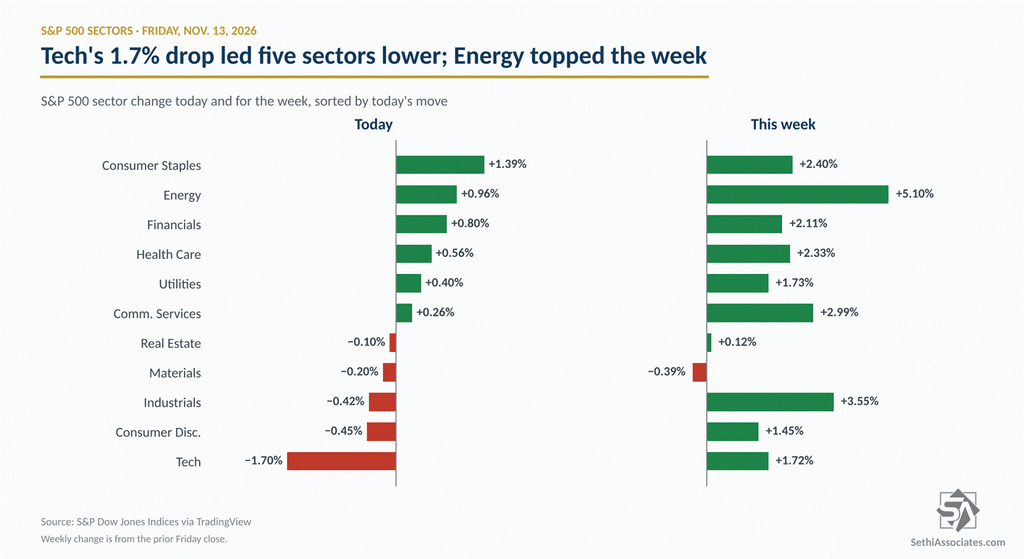
Six of 11 sectors rose, led by Consumer Staples (+1.4%), Energy (+1.0%) and Financials (+0.8%), while Tech (-1.7%) was by far the worst, followed by Consumer Discretionary (-0.5%) and Industrials (-0.4%). For the week, Energy led (+5.1%), followed by Industrials (+3.6%), while Materials (-0.4%) was the only sector to fall.
Some 315 S&P 500 stocks rose and 185 fell, with 12 gaining more than 3% and 28 falling that much (from five and 42 Thursday).
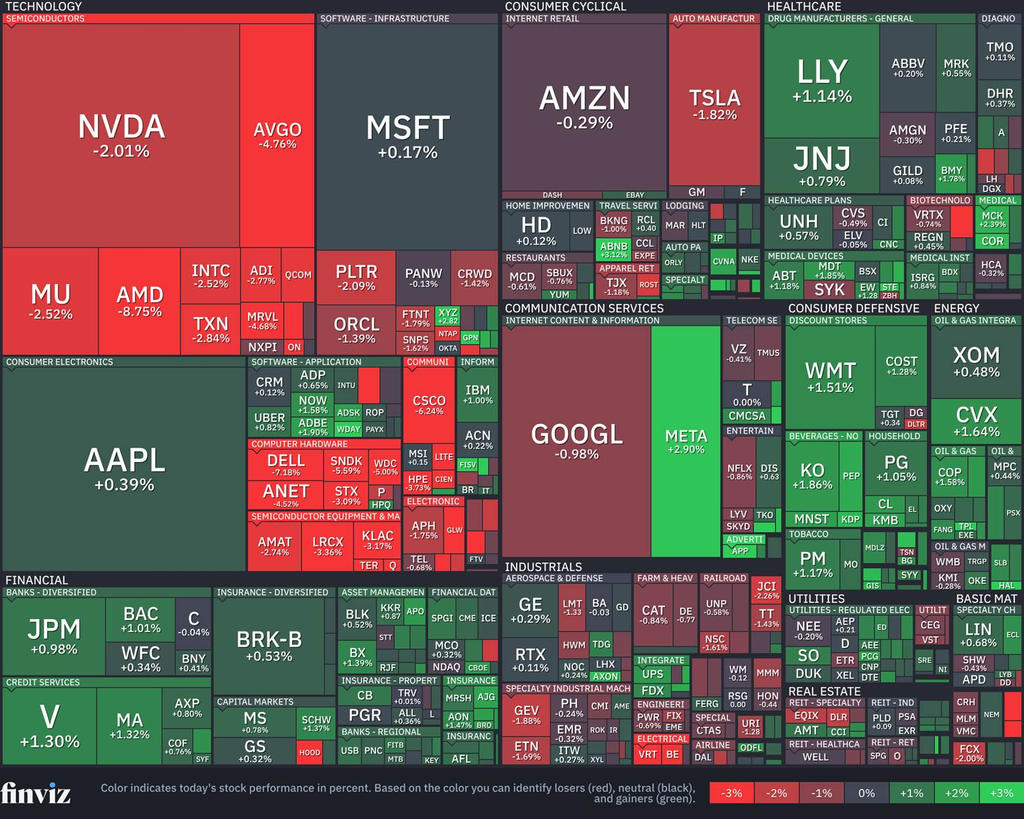
AMD (AMD) was the S&P 500’s worst performer, down 9%, followed by Dell (DELL) (-7%) and Cisco (CSCO) (-6%), which slid after its earnings despite jumping as much as 8% after hours Thursday. Memory names Sandisk (SNDK) (-6%) and Western Digital (WDC) (-5%) fell with them, caught up in the broader chip selloff.
Charter (CHTR) and STERIS (STE) led the S&P 500, up 4%, along with payments names Global Payments (GPN), which bounced after Thursday’s 12% drop, and Fidelity National Information Services (FIS).
The 10 worst performers in the S&P 500 this week:
1. First Solar (FSLR) -14.8%
2. Nvidia (NVDA) -12.8%
3. Moderna (MRNA) -12.1%
4. DaVita (DVA) -8.8%
5. NVR (NVR) -7.1%
6. Super Micro Computer (SMCI) -6.6%
7. Newmont (NEM) -6.4%
8. Skydance (SKYD) -6.1%
9. Lennar (LEN) -5.8%
10. Albemarle (ALB) -5.8%
On the other side, AMD (AMD) (+19%) and Broadcom (AVGO) (+18%) led for the week even after Friday’s drop, followed by Charter (CHTR) and Monolithic Power (MPWR) (both +17%).
The 10 best performers in the S&P 500 this week:
- AMD (AMD) +18.9%
- Broadcom (AVGO) +18.2%
- Charter Communications (CHTR) +17.2%
- Monolithic Power Systems (MPWR) +16.8%
- Arista Networks (ANET) +15.5%
- Ciena (CIEN) +15.3%
- Seagate Technology (STX) +14.6%
- Teradyne (TER) +14.4%
- Coherent (COHR) +13.1%
- Micron (MU) +12.8%
Overall, 399 S&P 500 stocks rose for the week and 104 fell.
FedWatch
Rate-hike bets nearly doubled this week on a string of hawkish comments from Fed officials, led by Governor Waller, and a hot October CPI report. A December hike went from a 77% chance last Friday to fully priced, with an 8% chance of a half-point move, and markets now price 86 basis points of hikes through the Fed’s final 2027 meeting, nearly three and a half, up from 44bp a week ago, per CME FedWatch.
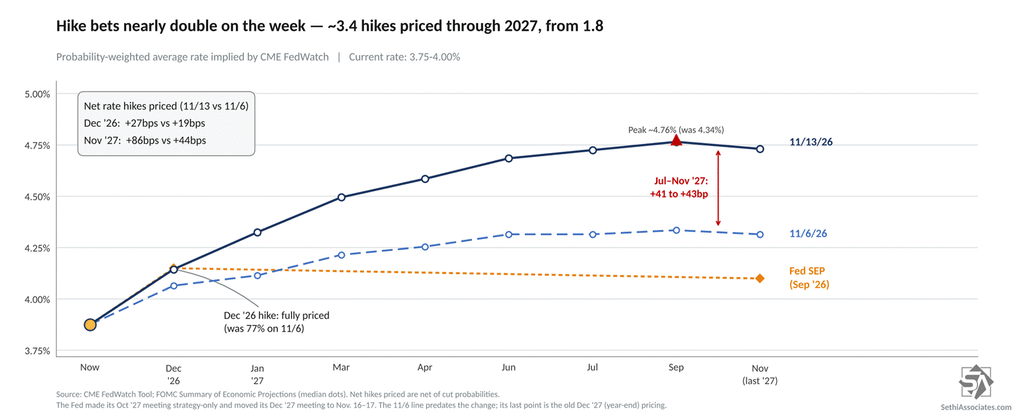
The Fed this week made its October 2027 meeting strategy-only, with no rate decision, and moved its December 2027 meeting up to November 16–17, 2027.
Boston Fed President Collins (2028 voter) said “soon some additional firming, tightening of policy is appropriate,” and “a bit of a tighter policy path than I had penciled in a couple of months ago might be appropriate,” though she didn’t want to “get ahead in terms of how high we should go or how fast.” San Francisco Fed President Daly (2027 voter) said “We’re going to need to, in all likelihood, raise rates,” with services inflation excluding housing “not moving in the correct direction.”
That follows New York Fed President Williams and Daly both saying Thursday they see more hikes, but “over time,” which makes all the Fed officials who’ve spoken on the direction of rates since last Thursday’s selloff lean toward more hikes, split mostly on how fast. BofA now sees hikes at each of the next three meetings, one more than Goldman, with no cuts penciled in for 2027.
More From TheStreet Pro
Chris Versace —
- Cerebras, Cisco and Applied Materials: 8 Key Items Shaping the Stock Market Friday
- Applied Materials Caps Record Year, But We’re Still Trimming Our Price Target
- A SpaceX-Tesla Deal as Soon as December?
Stephen Guilfoyle —
- New Cisco Price Target as New Report Defies Wall Street
- Catching Up on Small-Cap Portfolio Price Targets
Bret Jensen — 2 Healthcare Names to Buy After Recent Acquisitions
Doug Kass’s Diary:
- Oscillator Shifts to Oversold
- More Tales From Nvidia: The National Security Issue (Issue #280!)
- More Tales From Nvidia: There Is Always More Than One Cockroach (Issue #281)
- Are Tech Stocks ‘Cheap’ or ‘Value Traps?’
- A Repeated Refrain of Mine: Buy Financials
- Boockvar on the Producer Price Index
- Late Morning Market Stats
- Boockvar on ‘The Bank of Nvidia’, Tech and the Consumer
- Dan Niles on Nvidia
- Howling About Raging PPI Inflation
- Remember This: We Warned Everyone in ‘More Tales’
Note: Doug posted 28 Diary entries today; these are the market ones.
And From Me If You Missed It
Headline Producer Prices Cool, but Core Hits Highest Annual Rate Since 2022
Miscellaneous
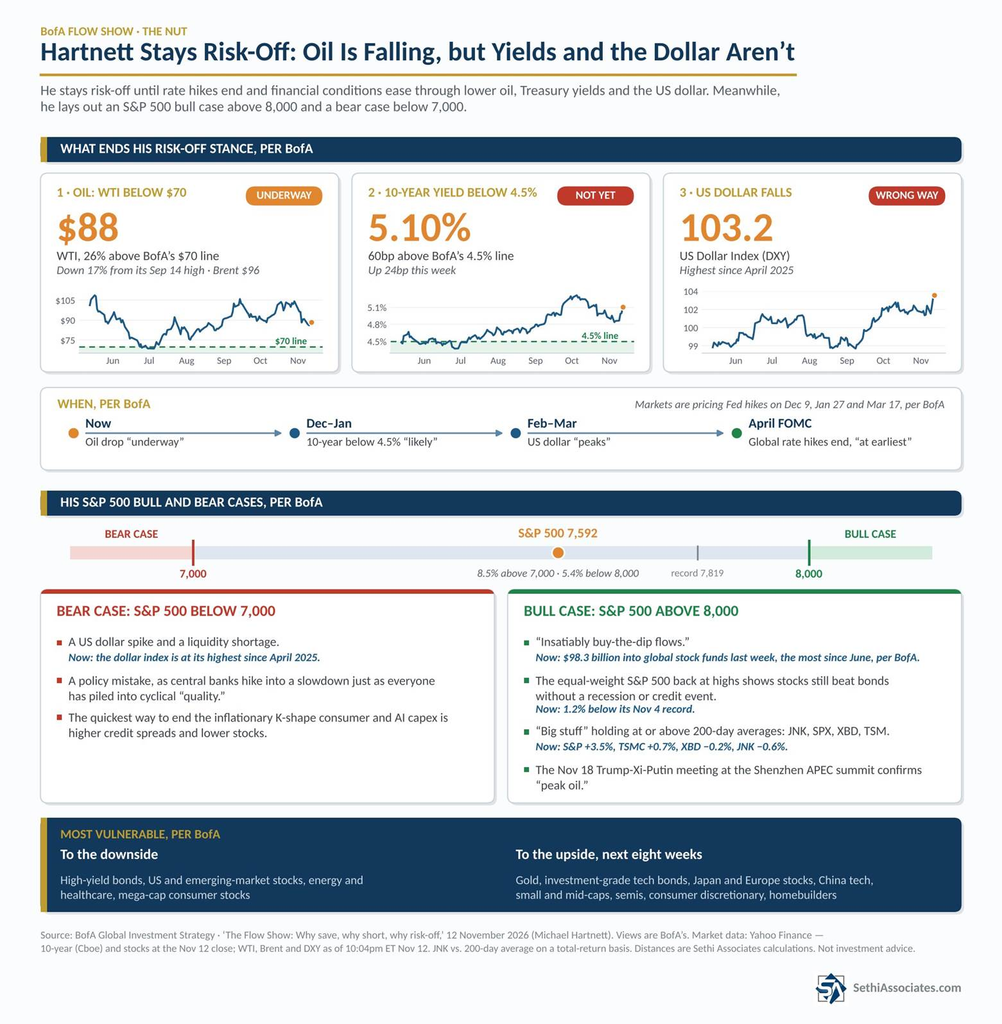
BofA’s Michael Hartnett (Flow Show) says “we stay risk-off until rate hikes end/financial conditions ease” through lower oil, yields and the dollar. Where those stand:
▪ Oil: he wants WTI below $70 and says the drop is “underway.” WTI is at about $89, down about 17% from its September 14 high.
▪ Yields: he wants the 10-year Treasury yield below 4.5%, “likely Dec-Jan.” It closed Friday at 5.14%, up 28bp this week.
▪ Dollar: he says it’s “currently moving decisively the other way” and peaks in February or March. The dollar index is at its highest since April 2025.
He adds that the global tightening cycle (more than 70 rate hikes from June 2026 to May 2027) ends at the April FOMC at the earliest.
His bull case for the S&P 500 is above 8,000. It rests on “insatiably buy-the-dip flows” and the equal-weight S&P 500 getting back to its highs, which would show stocks still beat bonds absent a recession or credit event. It also needs the “big stuff” (JNK, SPX, XBD, TSM) to hold at or above their 200-day averages, and the November 18 Trump-Xi-Putin meeting at the APEC summit to confirm “peak oil.”
His bear case is below 7,000. It comes from a dollar spike and liquidity shortage, or a “policy mistake as central banks hike into slowdown just as everyone has piled into cyclical ‘quality.'” He says the “quickest way to end the inflationary K-shape consumer & AI capex = higher credit spreads/lower stocks.”
Most vulnerable to the downside over the next eight weeks: high-yield bonds, US and emerging-market stocks, energy, healthcare and mega-cap consumer stocks. Most vulnerable to the upside: gold, investment-grade tech bonds, Japan and Europe stocks, China tech, small and mid-caps, semis, consumer discretionary and homebuilders.
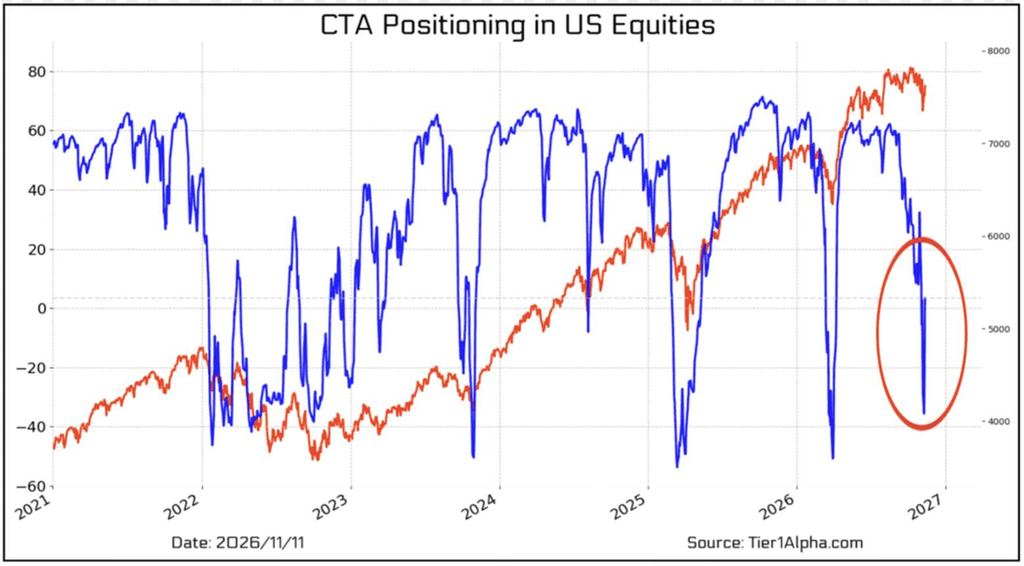
On positioning, Tier1Alpha said Thursday that CTAs were already rebuilding exposure, which may have contributed to that day’s rebound off the lows (and supported markets Friday): “Momentum was strong enough to allow CTAs to begin rebuilding exposure into the positive trend, while volatility remained low enough to avoid triggering any meaningful selling from the volatility-control space…. With systematic equity positioning now at such low levels, the potential for a sharp upside squeeze is beginning to increase as these strategies rebuild exposure into an improving market structure.”
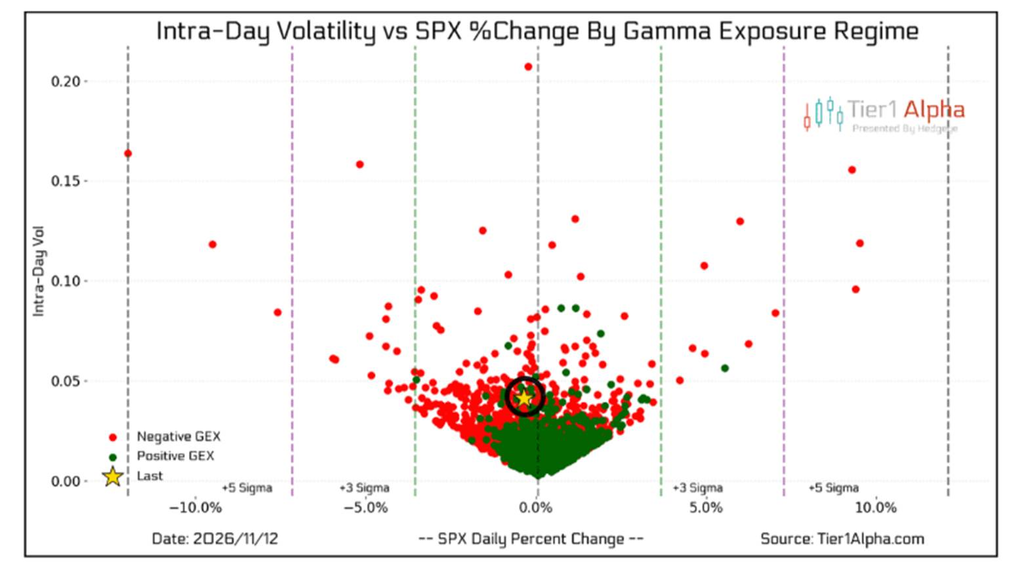
But they also noted we’re back in a negative gamma environment, which is adding to the volatility in equities: “Even as close-to-close volatility remains modest, we are still seeing plenty of structural instability reflected in the intraday price action, as the index aggressively ebbs and flows with the underlying momentum.”
Wrap-Up — Dip Buyers Show Up Again
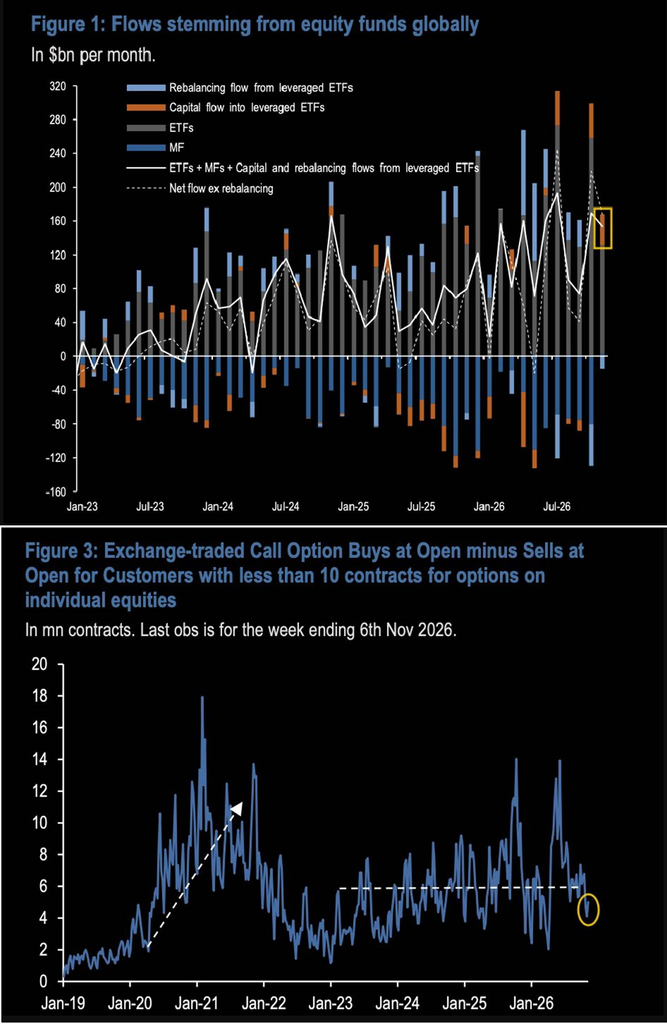
As mentioned above, the negative gamma environment continues to accelerate early moves, but on the positive side markets again battled back to close with minimal losses, a sign that dip buyers are still out there, at least some of them retail. JPMorgan says retail equity ETF purchases accelerated to $30 billion Monday from $20 billion a day last week (via ZeroHedge and Christophe Barraud’s Friday Brief), and retail hasn’t piled back into options yet: “Retail’s share of options trading is now close to its one-year low…. That leaves another potential source of upside demand.”
And since systematic traders key off close-to-close volatility, closes like these should keep supporting their re-risking, as I noted yesterday.
Overall for now I remain constructive for the reasons I laid out earlier this week, but let’s see how everything looks once we’ve had a chance to go through all the indicators.
The Week Ahead — Nvidia, Retail Sales and a Slew of Fed Speakers
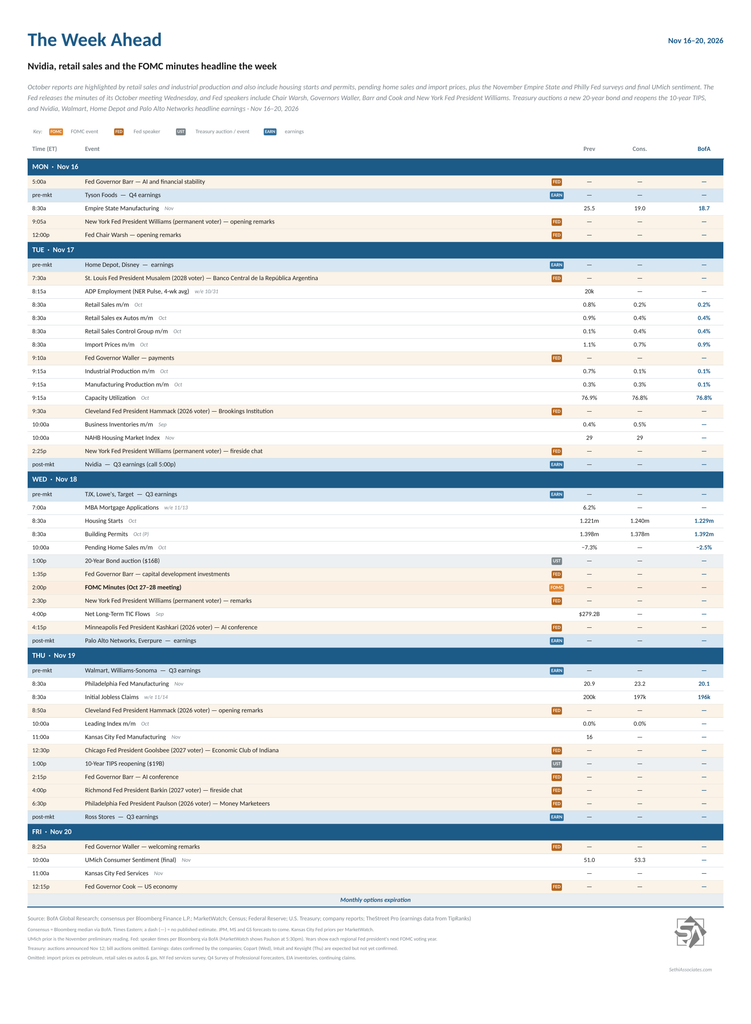
US economic data picks up next week. October reports are highlighted by retail sales and industrial production and also include import prices, housing starts and permits, pending home sales and the leading index. November reports include the Empire State, Philly Fed and Kansas City Fed manufacturing surveys, the Kansas City Fed services survey, the NAHB housing market index and final University of Michigan consumer sentiment. September reports include business inventories and TIC flows. We’ll also get the usual weekly reports (ADP, mortgage applications, unemployment claims, etc.).
The Fed releases the minutes of its October 27–28 meeting Wednesday. Fed speakers continue apace, starting with Fed Chair Warsh’s opening remarks at the Federal Reserve’s Productivity and Jobs Task Force Conference Monday at noon ET. Others include Governors Waller, Barr and Cook, New York Fed President Williams (permanent voter), Cleveland Fed President Hammack (2026 voter), Minneapolis Fed President Kashkari (2026 voter), Philadelphia Fed President Paulson (2026 voter), Chicago Fed President Goolsbee (2027 voter), Richmond Fed President Barkin (2027 voter) and St. Louis Fed President Musalem (2028 voter).
Non-Bill (>1yr in maturity) US Treasury auctions include a new $16B 20-year bond Wednesday and a $19B 10-year TIPS reopening Thursday.
Friday also brings monthly options expiration.
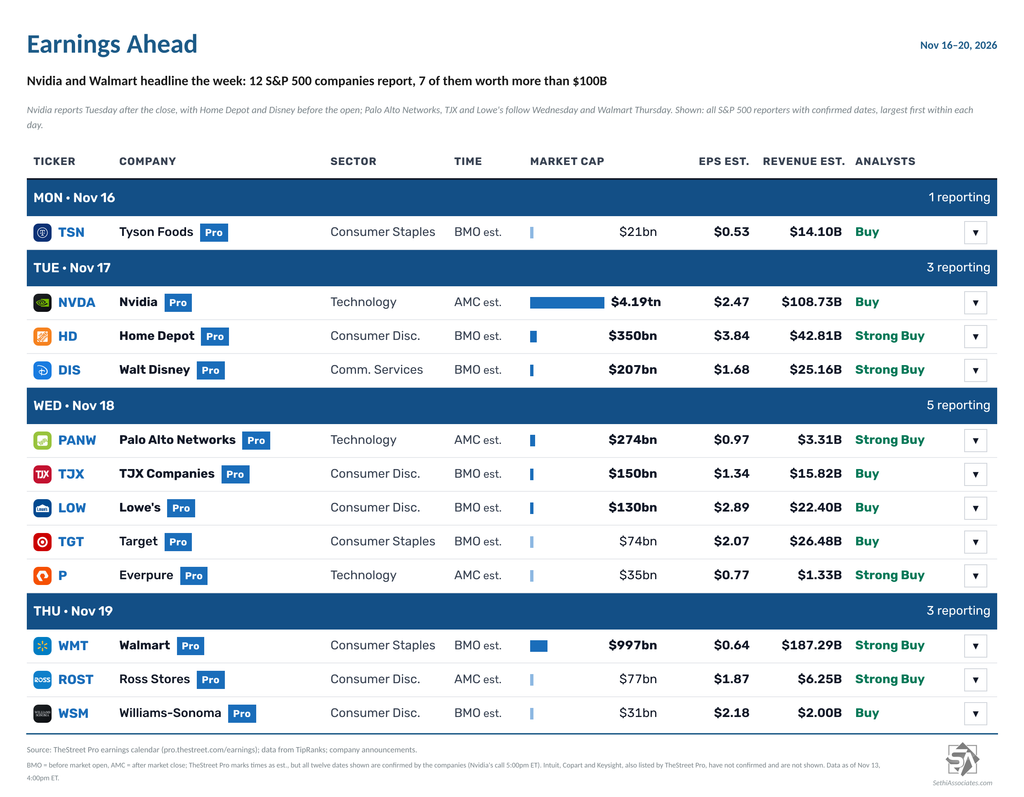
Q3 earnings season continues to wind down with 12 S&P 500 components confirmed to report, but seven of them have market caps over $100B including Nvidia (NVDA) which is likely the highlight of the week:
* Tuesday: Nvidia (NVDA), Home Depot (HD) and Disney (DIS).
* Wednesday: Palo Alto Networks (PANW), TJX (TJX) and Lowe’s (LOW).
* Thursday: Walmart (WMT).
Other S&P 500 reporters include Tyson Foods (TSN) Monday; Target (TGT) and Everpure (P) Wednesday; and Ross Stores (ROST) and Williams-Sonoma (WSM) Thursday. Intuit (INTU), Copart (CPRT) and Keysight (KEYS) are expected but haven’t confirmed dates.
At the time of publication, in terms of securities mentioned, Sethi was long AMD, ANET CEG, DELL, DIS, GPN, IWM, MU, NVDA, QQQ, RSP, SKYD, SPY, TSM and numerous Treasury ETFs, and short HOOD, IBIT and MRVL. In the last 24 hours Sethi sold his positions in AVGO and SOXL, trimmed NVDA, added to CEG and his MRVL short, and covered part of his HOOD short.