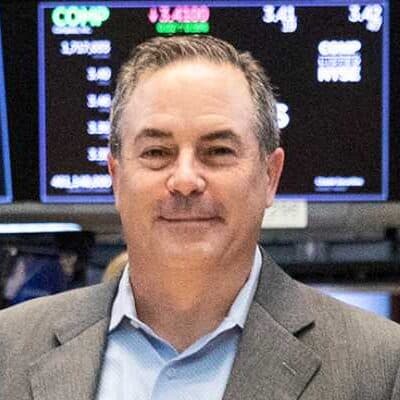
VIDEO: Mining Without Digging: Modern Mining CEO Jeet Basi on Recovering Critical Metals From E-Waste
As the company makes its NYSE debut, the CEO explains how a ton of circuit boards can hold more gold than a ton of ore.
You've reached your free article limit
You've read 0 of 1 free Pro articles.
On the day Modern Mining Technology Corp. (MDRN) begins trading on the New York Stock Exchange, CEO Jeet Basi joins Chris Versace to explain how the company recovers gold, silver, palladium and copper from discarded electronics without burning anything.
He walks through the process, explains why a ton of circuit boards can hold roughly 130 times the gold of a ton of typical ore, and lays out the plan to put its IPO proceeds toward a first commercial plant in North Carolina, with revenue targeted for late 2027 to early 2028.
If you’re looking for more information on Modern Mining, please see the company’s webpage.
Transcript
Chris Versace: Hey everyone, Chris Versace here. From time to time, we get a lot of questions about gold and critical materials here at the Pro Portfolio. That’s not surprising. Gold prices were around $4,300 an ounce when we entered 2026 and ran up near $5,400 in February. They’ve bounced around quite a bit since then, but since August they’ve traded off and are hovering around $3,900 an ounce as I talk with you today.
As part of that conversation about gold, critical materials and critical minerals, we’ve got a really good discussion today with the CEO of Modern Mining, Jeet Basi. Jeet, welcome, and thank you so much. My understanding is it’s a really busy day for you, as you begin trading on the New York Stock Exchange under the symbol MDRN.
Jeet Basi: That’s right, Chris. First and foremost, it’s a pleasure to be here, my friend. I appreciate the opportunity to talk about our company on such a tremendous platform, and I’m looking forward to connecting with you, your team and the broader audience behind you. Today’s an exciting day. It’s been a tremendous journey, all leading up to this milestone. Today we completed our IPO, and we are a publicly listed company on the New York Stock Exchange.
Chris Versace: If I remember correctly from doing my homework, you’re a pre-revenue company. You’ve had a development facility in North Carolina where you’ve been showing people what you can do with your proprietary process. The key here is that there’s a growing mountain of e-waste every year, and I’ll ask you more about that in a second. What you’re looking to do is run a smart, focused recycling process that gets these critical materials out and then repurposes them for other uses, correct?
Jeet Basi: That’s spot on. Our goal at Modern Mining is to produce as much metal as we physically can without digging a single hole, the way the traditional mining industry does. Our focus is electronic waste. We don’t search for gold. We already know where the gold, silver, copper and palladium are. They’re in the devices we throw away every day.
Chris Versace: Right, and that’s everything from smartphones, tablets and PCs to, I imagine, digital cameras, screens or monitors, TVs, that sort of thing.
Jeet Basi: You bet. All of the above and more. Any device that has an electrical plug, a power source or any kind of circuitry contains ample precious, commodity and critical metals, and that’s of interest to us.
Step one, we bring that equipment into our facility. This is all end-of-life material that would otherwise end up in a landfill. Step two, inside the facility, we very specifically extract and recover the key valuable metals. Step three, we bring those metals back into the commodity markets so they can be repurposed into new devices and new goods for everyone to use.
Chris Versace: Okay, a couple of questions. When we talk about key materials, I mentioned gold a little while ago, but are silver, palladium and copper some of the others you’re looking at?
Jeet Basi: Yes, those are the four we’re focusing on at the outset. As you can imagine, within this vast mountain of electronic waste and scrap, a number of other metals exist as well, and we may look to bring them into our workflow in the future. But you’re right, Chris. Right now, our focus is primarily gold, silver, palladium and copper.
Chris Versace: Walk us through the process. When I get rid of my devices, I might recycle them at Best Buy, through Apple or with some other group. You said you bring the e-waste in. Where is it coming from?
Jeet Basi: Exactly the way you mentioned. Many original equipment manufacturers have take-back programs, and they’re always looking for homes for those products, so we can offer them an outlet. There are also primary recyclers, the 1-800-GOT-JUNK? type of companies. These are our colleagues. They work around the clock collecting all kinds of things, and when they find a pocket of electronic scrap and don’t know what to do with it, they call people like us.
So, it’s a wide variety. It could be someone in your family looking to get rid of e-waste, or it could be a major original equipment manufacturer with a big buyback program. There are also government recycling facilities. The whole ecosystem is quite diverse.
Chris Versace: Interesting. Going back to e-waste, as I look at my notes, we talked about the obvious candidates like smartphones and laptops. But I was a little surprised to see refrigerators, washing machines, microwaves, toasters and even vacuum cleaners. It’s all fair game?
Jeet Basi: It’s all fair game, because each of those devices, as you mentioned, has a power source, a power cord and a circuit, and all those components carry value. Our big focus is extracting value from those key components. The overall list of e-waste categories is large and diverse. Some UN publications identify 52 different categories, with several items within each. So, hundreds of devices fit the term e-waste, and we’re just getting started.
Chris Versace: There are a lot of forecasts for e-waste tonnage, and they show the typical up-and-to-the-right curve. But I think there’s another way to look at this. When you see capital being pushed into an area to solve a problem, it tells you that either the problem needs to be addressed or there’s an opportunity there. Getting ready to talk with you, I saw that Mitsubishi and Sumitomo are moving into e-waste processing, and I think Cyclic Materials is as well. From your perspective, it’s a validation point. Where are you compared to these companies, or is everyone in the early days?
Jeet Basi: I think most of us are in the early days. The industry itself is in its infancy, and the upside is so big that there’s room for many players. We welcome more people to the space, because if we want to get serious about recovering metal from all this waste, there’s a lot of room to play. With rising metal prices and long mine development timelines, where putting a mine into production takes 10 to 15 years, recovering metals from discarded electronics is an increasingly important topic. That’s exactly the gap Modern Mining and some of these other companies are aiming to help fill. The more the merrier, as we say.
Chris Versace: Talk to me about your process. I understand you’re trying to minimize waste as you work through the waste, so there’s no incineration, and I believe you have a proprietary process. Tell us about it as best you can.
Jeet Basi: You bet. The key differentiator is that, unlike the status quo in the industry, we don’t burn anything. Our recovery is based on what you could call washing. We focus primarily on waste printed circuit boards, which are our startup feedstock. That material comes into our plant, and we use techniques very similar to conventional mining: crushing, screening and milling. As you can imagine, e-waste comes into our facility in many different shapes and forms.
Chris Versace: Of course. Something out of a refrigerator is very different from something out of a laptop.
Jeet Basi: Exactly. To process it efficiently, we have to homogenize it. We run the material through a cutter or shredder. A circuit board that might be 24 inches by six inches gets chopped into one-inch fragments. We then mill, pulverize and grind those fragments down to a powder that looks like a bucket of flour.
Inside that powder are discrete grains of plastic, fiberglass, epoxies and resins, but also discrete grains of valuable metals like gold, silver, copper, aluminum and others. Once we’ve achieved that sand-like consistency, we apply gravitational force to the mixture and exploit the difference in density between metals and plastics. All the valuable metals separate into one stream, which we call metallic sands concentrate, and the plastics and other barren materials separate into a second, non-metallic stream. In doing so, we pre-concentrate the metals.
That’s the middle step. The last step is where the real fun happens. We use selective chemistry to isolate the individual metals in that metallic mixture, separate and enrich them, and produce enriched metal products on the back end.
Chris Versace: You’re focused on those key metals. I’m curious, what happens to the plastics and other non-metals?
Jeet Basi: That’s a great question, and different companies do different things. We have partnerships with companies that use those plastics as a feedstock for their own downstream processes, mainly because of the energy content in the plastic. So, what you could call waste for us is actually an input for someone else.
Chris Versace: Is that a revenue stream for you, even if a smaller one?
Jeet Basi: Right now, it’s a net-neutral stream. As we grow, we’ll try to make it revenue positive.
Chris Versace: Two more questions on the process. First, is it automated or people intensive? Second, what about hazardous materials like lead and mercury?
Jeet Basi: In our demonstration facility, I must admit we’ve been very lean and disciplined with our capital. We don’t have the bells and whistles. It’s very manual, very step by step. The design we envision for a commercial plant will be fully automated, with automated feedback loops, instrumentation and control systems. The workforce required to operate one of our facilities will be many times smaller than at a traditional mine, and I’m quite proud of that. The reason we can do that is that our feedstock is, in many cases, more than 100 times richer than a traditional mine.
Chris Versace: Why do you say that? That sounds surprising.
Jeet Basi: Think about it this way. Mother Nature is very unpredictable, whereas electronics are very prescriptive, man-made products. Manufacturers know exactly how much copper they need for that machine to do its job.
Compare that to an average gold mine. One ton of ore contains roughly one gram of gold, so you have to process that ton of rock to extract about one gram. If we take the same weight of our feedstock, specifically the printed circuit boards in electronic scrap, one ton contains roughly 130 grams of gold on average, at least in our feedstock. And that’s just the gold, not including the copper, silver and palladium. It’s because it’s an engineered product.
Chris Versace: So, it’s a manufactured product, but from your perspective, it’s a target-rich environment. That helps explain some things I was reading. I believe the IEA has said that the success of what you and others are doing could reduce the number of mines needed in the coming years by something like 25% to 40%.
Jeet Basi: I haven’t seen that stat, but it wouldn’t be surprising if the numbers lined up that way.
Chris Versace: Let’s talk about the IPO. You mentioned your target facility, and my understanding is that, with the proceeds in hand, that’s the focal point for the next year. You’re hoping to be revenue generating by 2028, or maybe a little sooner?
Jeet Basi: That’s exactly what we’re targeting: the back end of 2027 into the early part of 2028 for commercial production and commercial revenue.
Chris Versace: If we look at what you’ve raised, I believe it’s $40 million, less fees, which we’ll see in the final numbers. How far does that carry you on the build-out? Does it take you all the way with some cushion, or will you need to hit certain hurdles and possibly raise more capital?
Jeet Basi: It’s the former. It allows us to fully build out our first facility, which we’re aiming to stand up in North Carolina, and it gives us an 18- to 24-month runway in total. So, if we’re starting revenue at the back end of 2027 or early 2028, we’re fully funded into the middle to back half of 2028.
Chris Versace: I’d imagine you wouldn’t go public if you weren’t confident and comfortable. But for folks who may not know the ins and outs of the business, coming out of the development stage, have any companies said they’d be interested in your materials as you ramp up? Or have you gone further and announced contracts? Any color that might give listeners more comfort that there’s a master plan at work?
Jeet Basi: For sure. One of the things that gets our team most excited is that this isn’t a lab story. We’ve made actual product in our demonstration plant, sent it to third parties for analysis and, on the back of that analysis, made actual sales. So, we already have buyers for product from the demonstration facility.
We have not yet locked in a long-term offtake partner. We don’t necessarily want to put all our eggs in one basket at this point. We want to give our stakeholders maximum exposure to the commodity run. Once we reach critical mass, we may look at longer-term offtakes, but right now we’ve been selling into the spot market. It’s a very liquid market, and it’s been quite fruitful for our efforts.
Chris Versace: Excellent. When do you plan to break ground, and will you be open to visitors?
Jeet Basi: Absolutely, Chris. We hope to break ground in early 2027, and we’d love to host you and your audience, whether at the commercial plant or the demo plant. You’re always welcome. I also want to thank you and your audience. You’ve been some of our strongest supporters to date, and we really appreciate the patience you’ve shown us. These are exciting times, and we’re happy to host you anytime.
Chris Versace: That would be wonderful, but you’re not getting out of here that soon. I have one or two more questions. You said earlier that those are the four metals you’re focused on initially, which suggests there might be others. Do you need to add new capabilities to go beyond the big four?
Jeet Basi: We haven’t publicly disclosed the other metals in our feedstock, but published literature describes some of the other elements in electronic scrap. For example, you see lithium and black mass in some types of scrap, and scrap from permanent magnets contains more rare earths, along with cobalt, nickel and manganese. These are all critical metals found in electronic waste.
While we aren’t focusing on them today, we may in the future, following the necessary R&D and process development. We’ll look to grow the business into those verticals as the opportunities arise. But those things won’t happen in the first commercial plant. We’ll need to add modules and processes to bring those metals to market.
Chris Versace: I won’t say it’s a no-brainer, but as someone peering in, if you’re taking in this waste, you want to maximize what you can pull out of it. The top four might be the largest opportunity, but there’s still something left on the table to monetize.
Jeet Basi: One of our biggest passions is making sure we extract every piece of value we can, and as we grow, we’ll certainly look to do exactly that.
Chris Versace: All right, Jeet, before we wrap up, and again, I know you’re very busy today, is there anything about Modern Mining we didn’t touch on that we should?
Jeet Basi: Chris, you know the space as well as anyone, and the questions kept me on my toes. The one other thing I’d share that’s unique to our business relative to traditional mining is this. I love mining. I spent 20 years in the industry. I love the people, the science, the travel and the role traditional mining plays in supporting society and providing the raw ingredients that move it forward. But one element always frustrated me, and that’s that it’s finite.
Every mine in production today, and every mine in exploration that will eventually be in production, depletes its resource a little bit year after year until it eventually goes to zero. The feedstock we process, electronic scrap, has no expiration and no geology, and its quantity is growing every year.
Chris Versace: As you were describing that, I was thinking that whether you’re drilling for oil or mining gold or some other material, you have to dig so many holes and hope it pays, as they say, even with better technology. But when I replace a screen, a monitor or a refrigerator, I’m most likely replacing it with another one. That says this e-waste cycle could get bigger, and it’s not going away over time.
Jeet Basi: We view our feedstock as growing with every upgrade cycle that comes to market, whether that’s a new set of monitors, the newest phone or the newest AI data centers. At some point, that equipment reaches the end of its useful life and adds to an already large mountain of electronic scrap. That happens every year, so we see our feedstock growing rather than depleting like our traditional mining peers.
Chris Versace: I have to apologize, because I said we were almost done, and now you’ve sparked another question. Compare the iPhone 18 to, say, the iPhone 6. We have a lot more processing power, a lot more memory and a lot more on the printed circuit board. Does that make newer, more advanced devices more target rich for Modern Mining?
Jeet Basi: It depends on the sector and industry, but broadly speaking, newer devices arguably have less gold and a lot more of some of the other metals outside the big four. People are getting smarter. Gold is expensive, so manufacturers try to use less of it. The gold content in devices is falling, but the content of other critical metals is rising, and so are their commodity prices. Gold is also a lot more expensive now. We see that as a net positive for companies like ours that are trying to recover these metals and bring them back into the supply chain.
Chris Versace: Jeet Basi, congratulations again on the IPO, and thank you for joining us. I think we’ll come back to you in six to nine months as you’re building your facility, to see where things stand, and I hope you’ll join us. One last thing: for folks who want to learn more about Modern Mining, where should they go? We’ll link your latest investor presentation in the notes, but is there anywhere else they can go to learn more about e-waste?
Jeet Basi: The key spot is our website, modernmining.com, which has links to the various parts of our business. We have a very strong investor relations team, so give them a call. They’re happy to answer any question in whatever detail you’d like. We always like to connect with our stakeholders, and you’re always welcome. I appreciate the opportunity, Chris.
Chris Versace: Awesome. Thank you so much, Jeet.
Disclosure: TheStreet Pro Portfolio has no position in the shares of Modern Mining (MDRN). This conversation is provided for informational purposes only and shall in no event be construed as an offer to sell or a solicitation of an offer to buy any securities. The information described herein is taken from sources that we believe to be reliable, but the accuracy and completeness of such information are not guaranteed by us. The opinions expressed herein may be given only such weight as opinions warrant. The opinions offered in connection with this content are subject to change without notice. The opinions made known to you in connection with this content are not exclusive to you and may have been previously or subsequently discussed in other media. Comments made known to you in connection with the content: (a) may not be suitable for you; (b) do not take into account your particular investment objectives, financial situation, or needs; and (c) are not intended to provide investment advice or recommendations appropriate for you. TheStreet Pro was compensated by a third party to conduct this interview. Before making any investment or trade, consider whether it is suitable for you and consider seeking advice from your own financial or investment adviser.
At the time of publication, TheStreet Pro Portfolio has no positions in any securities mentioned.