New Cisco Price Target as New Report Defies Wall Street
Wall Street seems to have the earnings report wrong.
You've reached your free article limit
You've read 0 of 1 free Pro articles.

On Thursday, Cisco Systems (CSCO) went to the tape with the firm’s fiscal first quarter financial results. For the three-month period ended October 24, Cisco posted an adjusted EPS of $1.40 (GAAP EPS: $1.17) on revenue of $18.517 billion.
These top- and bottom-line results all beat Wall Street’s expectations while that sales print was good for year-over-year growth of 24.5%. Remaining Performance Obligation (RPO) stands at $46.2 billion, up 8% in total. for the quarter, product RPO was up 7% and services RPO was up 9%.
The firm came away boasting broad-based high demand for Cisco’s technology reflected through double-digit growth across all geographies and customer markets. The strong performance had the firm increasing guidance for both AI infrastructure generated revenue and overall revenue generation for fiscal 2027.
CEO Chuck Robbins who, honestly, I have never been able to make my mind up on, commented in the press release:
“In Q1, we delivered the strongest revenue and non-GAAP earnings per share growth rates for Cisco in over 15 years. Organizations are turning to Cisco for our trusted, market-defining technology and our expertise to help them scale, secure and optimize their environments for the agentic AI era.”
Then he wrote what I wanted to see:
“We are in the very early stages of a multi-year networking supercycle, and we’re confident in our ability to continue capturing the multi-billion-dollar opportunity it represents for Cisco.”
CFO Mark Patterson added:
“The strength of our Q1 performance gives us confidence to raise our revenue and non-GAAP EPS guidance for FY27. As our business continues to scale, we are unlocking significant operating leverage which is enabling us to grow earnings much faster than revenue. Looking ahead, we remain focused on delivering durable growth and driving continued capital returns.”
Operations
As revenue grew 24.5% to $18.517 billion, the cost of that revenue jumped 31% to $6.729 billion. That left a gross profit of $11.788 billion (+21%) as gross margin dropped from 65.5% to 63.7%. GAAP Operating expenses actually contracted 3% to $6.19 billion, leaving a GAAP operating income of $5.598 billion (+66.5%). That put the firm’s GAAP operating margin at 30.2% up from 22.6%.
After accounting for interest and other income and expenses, as well as taxes, GAAP net income landed at $4.552 billion (+59.2%). That works out to a GAAP EPS of $1.14 fully diluted, up from the year-ago comparison of $0.72. Once adjusted, primarily for share-based compensation (which is ridiculous for a non-upstart — back when men were men, if you did it every quarter for multiple decades, that was called an ordinary operating expense) that EPS rises to $1.40 and compares to $1.00.
Geographic Performance
Americas generated sales of $11.506 billion (+28%), producing a gross margin of 64.1%
EMEA (Europe, Middle East & Africa) generated sales of $4.456 billion (+18%), producing a gross margin of 68.9%
APJC (Asia Pacific, Japan & China) generated sales of $2.556 billion (+24%), producing a gross margin of 66.5%.
Guidance
For the current quarter, Cisco is projecting revenue of $18 billion to $18.2 billion. Wall Street was down around $17.9 billion on this number so this was a serious beat. The firm is also projecting adjusted EPS of $1.34 to $1.36, which at the low end is far better than the $1.23 consensus view. The firm also sees an adjusted operating margin of 36% to 37% for the quarter.
For the full fiscal year, Cisco sees sales of $74.8 billion to $75.8 billion, crushing Wall Street’s anticipated $73.2 billion. The firm sees full year adjusted EPS of $5.47 to $5.53. Wall Street was down around $5.15 on that number. Cisco is also expecting AI infrastructure revenue driven by hyperscalers to print at $9 billion in FY27, more than double the total for FY26. This guidance is impressive.
Fundamentals
For the period reported, Cisco generated operating cash flow of $4.357 billion. The firm spent just $502 million on capital expenditures, leaving “free” cash flow of $3.855 billion (+33.4%). Out of that number, Cisco repurchased $1.997 billion worth of common stock for the firm’s corporate treasury and paid out $1.654 billion in cash dividends to shareholders.
Turning to the balance sheet, Cisco ended the quarter with a cash position of $15.845 billion and inventories of $6.384 billion. That puts current assets at $37.921 billion. Current liabilities add up to $39.462 billion. That includes both short-term debt of $10.425 billion and deferred revenue of $16.854 billion (which is not a true financial obligation). At the headline, the firm’s current and quick ratios stand at 0.96 and 0.80. That’s not reflective of the firm’s current position. After adjusting for those deferred revenues, these ratios rise to 1.68 and 1.39, respectively. The firm can easily pay its bills.
Total assets amount to $129.458 billion, of which a rough 51% is labeled as either goodwill or intangible. That’s a bit much to be honest. Total liabilities less equity comes to $77.851 billion. There is long-term debt on the books of $19.374 billion, but also another $13.204 billion in deferred revenue not labeled as current. I give this balance sheet a solid “B.”
Opinion
I like this release. Sales are growing nicely in my opinion. Cash flows are strong. The balance sheet, while not great, is strong enough and no weaker than we expect from Cisco. The guidance is superb. Why is the stock down? Maybe because adjusted gross margin fell 250 basis points year over year to 65.6%. I don’t even respect adjusted gross margins as a datapoint. Operating margin is what counts and operating margin hit a new record.
Product order growth decelerated? I’m hardly panicking based on that. Product sales growth was still good for 32%. The stock trades at 19-times forward-looking earnings. It’s not even undervalued. Based on the fundamentals, Wall Street has Friday morning’s action wrong. Let’s check out the technicals.
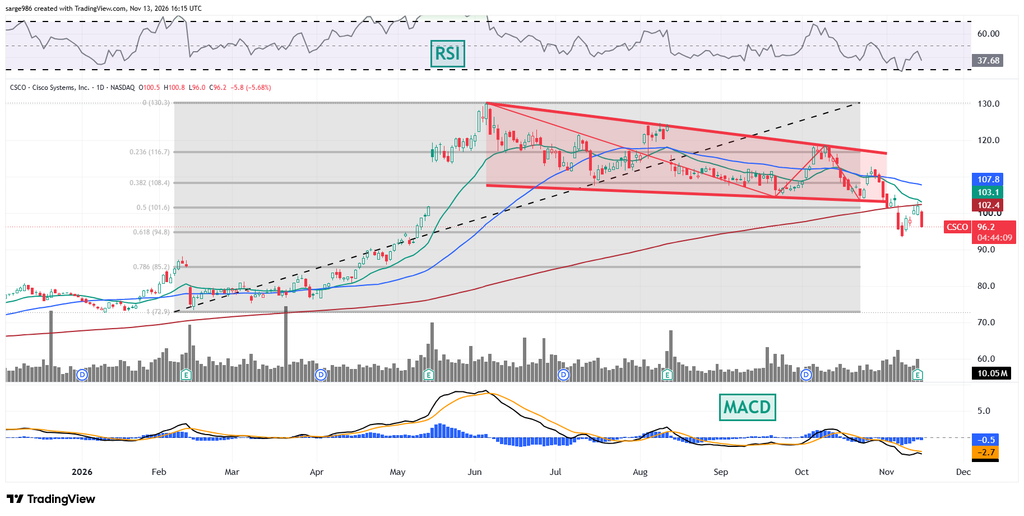
Readers will see that CSCO broke down from a falling wedge of bullish reversal in October. Breaking the wrong way out of a set-up can exacerbate a move and here it has. Now, CSCO has lost its 200-day SMA, which is a line that really matters to professional managers even more so now that these managers think less and pre-program more. Taking that line back is key to the stock’s performance as it would also involve the 21-day EMA, waking up the swing crowd. Now, we know, those guys are still thinking. Support has been found at the 61.8% Fibonacci retracement level of the February into May rally.
Looking at my indicators, relative strength is weakish, but not technically oversold. The daily MACD is still set up rather bearishly as well. My thoughts are this: I intend to start scaling into CSCO based on the strength of the guidance and the valuation. Could it still come in further? Of course. I will begin my quest at the Fib line that I just mentioned. My initial target price is $117 based on the current position of the 200-day SMA.
At the time of publication, Guilfoyle had no positions in any securities mentioned.