The Bounce Stalls as Nvidia Ousts Huang and Yields Jump
Jensen Huang’s resignation and a jump in Treasury yields on higher oil prices and a weak 30-year auction were fresh headwinds, but small caps were hit the hardest.
You've reached your free article limit
You've read 0 of 1 free Pro articles.

Executive Summary
Last night’s update (AI Bounce Gains Momentum on Positive CoreWeave and Anthropic Updates) noted the bounce in Tech was gaining momentum, but Nvidia’s ouster of CEO Jensen Huang and another jump in Treasury yields, as bond traders returned from the holiday to continued hawkish Fed talk, higher oil prices and a weak 30-year auction, stalled it.
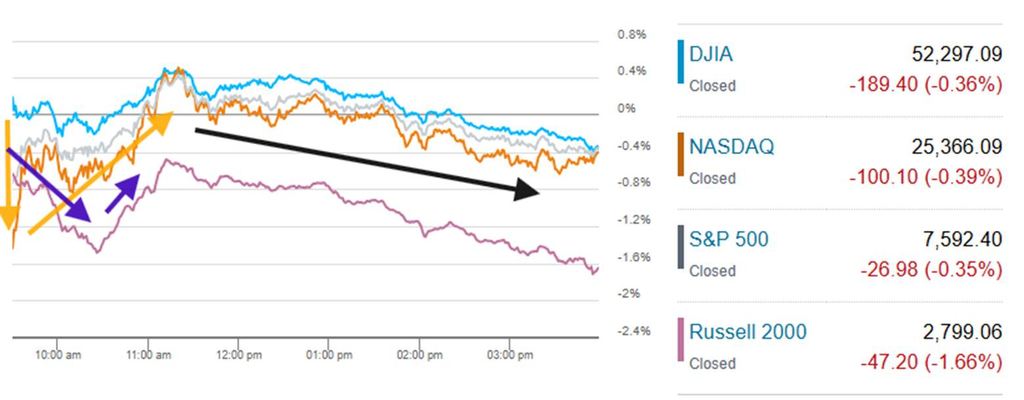
US equity indices started mostly lower as they digested the unfolding situation with Huang, which hit Tech hard early, but dip buyers pounced, sending the Nasdaq into the green by late morning to join the other large-cap indices. That would be the high of the day, though, and the indices softened in the afternoon. Losses were modest given the day’s drama, with all three finishing down 0.4%. The small-cap Russell 2000 had a weaker bounce, though, staying in the red all session and ending down 1.7%.
Schwab
Nvidia‘s (NVDA) Huang tendered his resignation and the company named CFO Colette Kress interim CEO, after a New York Times report on a second extramarital affair, this time within the company. The overnight session and the morning were filled with uncertainty and speculation, since Huang co-founded Nvidia in 1993 and has said he doesn’t believe in succession planning, leaving no clear candidate to replace him (see Huang Out at Nvidia, CFO Kress Named Interim CEO). Shares fell as much as 14% at the open, to their lowest since June 2025, before recovering more than two-thirds of the loss to finish down 4.3%, still the lowest close since March 30. The selloff rippled through the companies Nvidia backs, while rivals AMD (AMD) and Broadcom (AVGO) were the S&P 500’s best performers (see Nvidia’s Selloff Ripples Down the ‘Circular Web’ of Companies It Backs as Board Weighs Huang’s Future). Nvidia reports Tuesday.
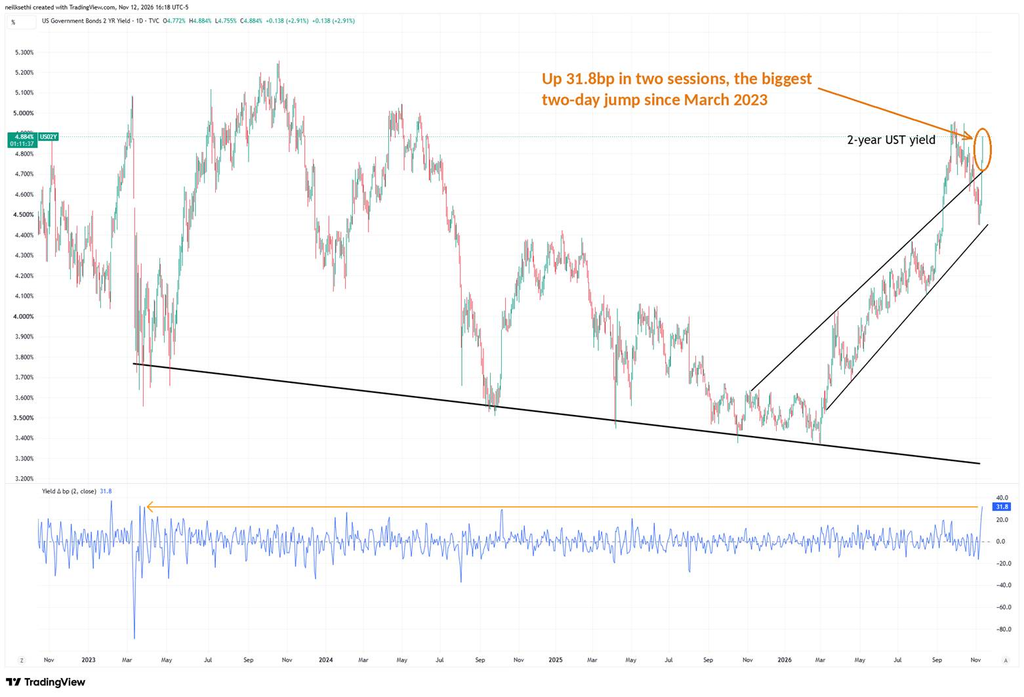
The 2-year Treasury yield rose 14 basis points to 4.88%, completing its biggest two-day move since March 2023, and the 10-year rose 13bp to 5.13%. after President Trump posted “We don’t need a deal with Iran. Those days have long since passed,” which sent WTI crude up 2.6% to settle at $88.74 and Brent up 3.3% (see Uncertainty Is Back and We’re Sticking to the Sidelines for Now). In addition, Fed speakers kept up the pressure, although the committee’s biggest hawk talked down larger hikes. The 30-year auction then tailed, again seeing weaker demand, making it the first time since May that a week’s 3-, 10- and 30-year auctions all tailed.
The dollar rose to its highest close since April 2025, while gold fell 3% to its lowest close since October 2025, bitcoin fell 4.2% to its lowest since August, and the VIX rose 7% to 18.7. Charts for all of them will be in the charts post later this evening.
In data, initial jobless claims rose to 200,000, remaining very subdued historically, but the four-week average held at its lowest since 1969. Existing home sales fell to their lowest pace since August 2010 (Existing Home Sales Fall to Lowest Since 2010 but the Worst May Be Yet to Come). The October budget deficit was $404 billion, more than the $300 billion expected.
After the close, Cisco (CSCO) was little changed after beating estimates and raising its full-year outlook, as was Applied Materials (AMAT) after its own beat.
Friday brings October PPI and four more Fed speakers.
My look at today’s charts follows in a separate post later this evening.
Market Commentary
Equities:
- “We would be a little circumspect about the bounce-back as there are some things changing at the margin [like] stubborn inflation, more Fed rate hikes, higher long-term interest rates, change in configuration in Washington DC [and] AI/data center regulation demands,” said Sameer Samana, head of global equities and real assets at Wells Fargo Investment Institute.
- “A slowdown in AI is the No. 1 risk to the economy and to growth heading into 2027,” said Heather Long, chief economist at Navy Federal Credit Union, in a phone interview Thursday. “It’s been a rough November, between the midterm elections and the overwhelming antagonism towards data centers, and now the resignation of the star player in American AI.” “Now we got somebody coming in who is not as well known,” Long noted.
- “This is a golden opportunity for Amazon, for Google, for AMD, for Broadcom, for OpenAI and Anthropic, who are hiring chip experts to help them design their own chips,” said Jed Ellerbroek, portfolio manager at Argent Capital Management. “Nvidia’s fate as one company is one thing, but this AI revolution is way bigger than that,” he also said. “If Nvidia falls from grace and their chips are no longer the best, and AMDs are better or Google’s are better, then people will switch over and buy them. The demand for the chips is not going down.”
Nvidia:
- “When a star leaves a Wall Street firm, the first question is always the same: Did the clients sign with the banker or with the bank?” said Mark Malek at Siebert Financial. “Nvidia is about to answer that question on the biggest stage in the market.”
- “Despite this uncertainty, the corporate fundamentals around the giant chipmaker are unchanged, and it remains to be seen if a shift at the top of the organization will have a material effect on strategy and execution going forward,” said James McCann at Edward Jones.
- “Nvidia’s earnings already demand close attention, but they will be under an even brighter spotlight next week,” said Bret Kenwell at eToro. “Investors will be looking to Nvidia for a fresh read on demand and a reason to regain confidence. One company’s leadership uncertainty should not be confused with the end of AI investment.”
- “Jensen spent decades building an entire AI ecosystem…. That ecosystem doesn’t disappear with him. The culture of rapid innovation he created is built into Nvidia’s engineers and its roadmap. We see no major impact on Nvidia’s roadmap at least in the next two years,” said Hendi Susanto, portfolio manager at Gabelli Funds.
- “This is an Nvidia problem before it is an AI problem,” said Malek, Siebert’s chief investment officer. “The biggest buyers are funding this buildout out of their own cash flow, and they need the chips no matter whose name is on the door.”
- “Nvidia still makes the most cost-effective chips for doing AI. That doesn’t change with Jensen Huang leaving,” said Gil Luria, head of technology research at D.A. Davidson.
- “We’ve got a lot of investigations, a lot of questions, and a lot of people to talk to to find out how deep this is and what may have been given away,” said Rep. Gregory Meeks (D., N.Y.), who is set to become the next chair of the House Foreign Affairs Committee.
- “The fundamentals are very, very strong at [Nvidia], and I expect the quarter next week to be very good with $300 billion in free cash flow next year,” Stephanie Link, the chief investment strategist at Hightower Advisors, said in an interview. “But, this stock is not going to trade on fundamentals … for a while because you have the overhang of the investigations, of leadership changes, of potential departures.”
Stock and Sector Breakdown
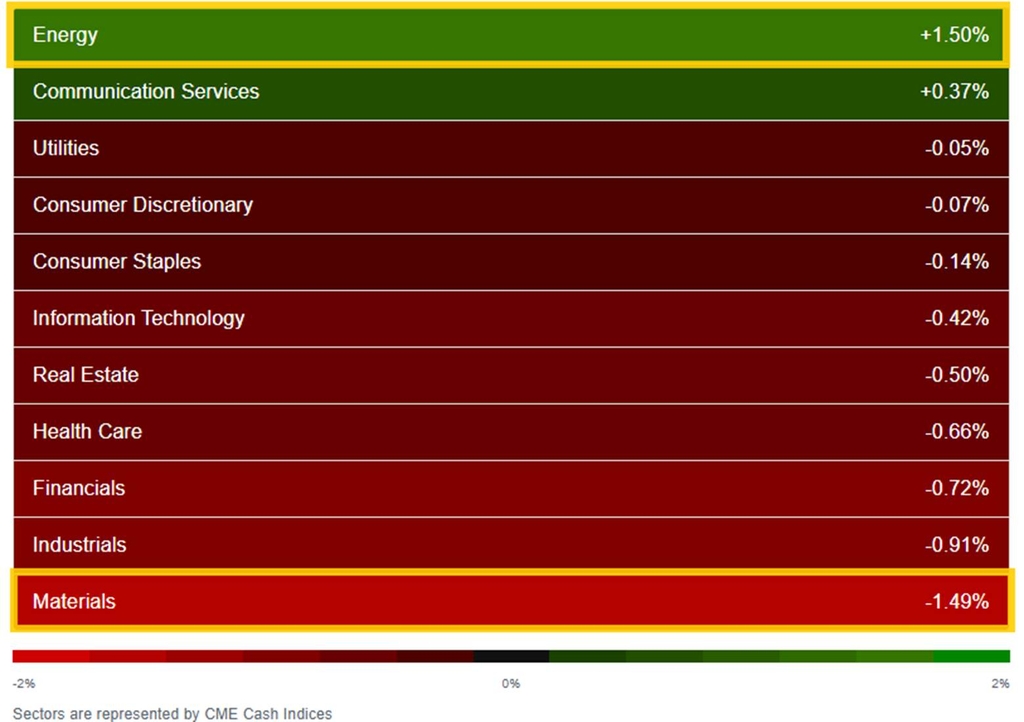
Nine of 11 sectors fell, the reverse of Wednesday. Energy (+1.5%) led on the jump in oil, followed by Communication Services (+0.4%), while Materials (-1.5%), Industrials (-0.9%) and Financials (-0.7%) fell the most. Despite the Nvidia news Tech was down just 0.4%.
Just 124 S&P 500 stocks rose and 377 fell, with five gaining more than 3% and 42 falling that much (from 63 and one Wednesday respectively).
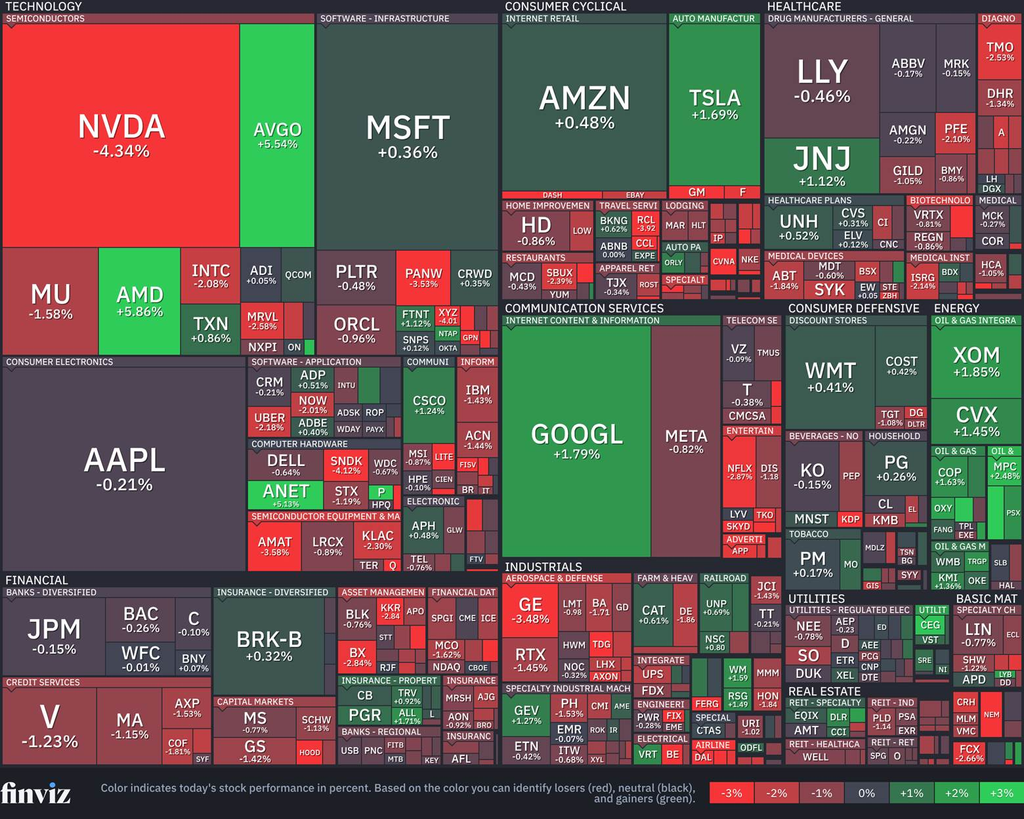
AMD (AMD), Broadcom (AVGO) and Arista Networks (ANET) led the S&P 500, up 5% to 6%, as investors bet Nvidia’s rivals could pick up market share. AMD closed at its highest since October 13 and Broadcom at its highest since October 7. Alphabet (GOOGL), a big Nvidia customer that also designs its own chips, rose 1.8%.
Global Payments (GPN) was the worst performer, down 12%, its worst day since April 2025, after Reuters reported Clayton, Dubilier & Rice walked away from take-private talks. Super Micro (SMCI) fell 11% after Bloomberg reported Manhattan prosecutors are examining whether entities linked to Alice Huang, the former Megaspeed executive at the center of the Nvidia scandal, helped smuggle its servers into China. Keurig Dr Pepper (KDP) fell 7% on a $2 billion share sale to pay down debt ahead of its breakup. Airlines fell with the jump in oil, United down 6% and Delta 5%, and Newmont fell 5% with gold.
Among Nvidia’s investees, CoreWeave fell 7%, giving back part of Wednesday’s 25% gain, and Nebius 17%, its worst day since July, as its full-year revenue outlook disappointed.
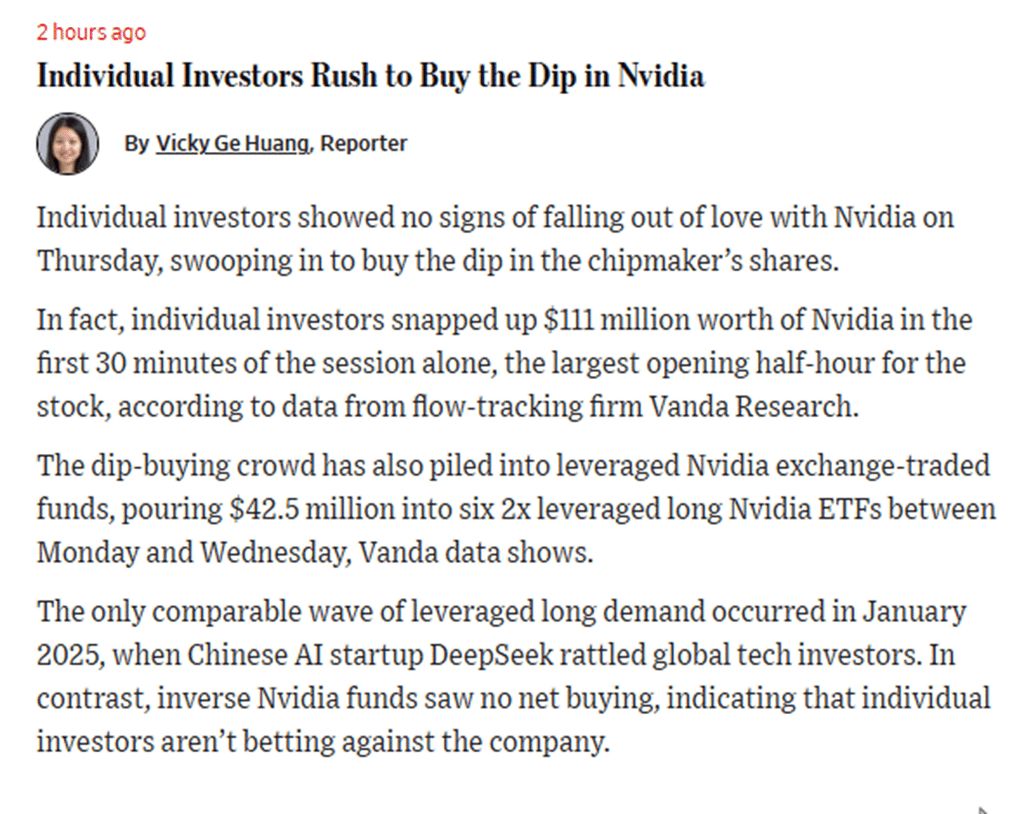
Individual investors bought the dip in Nvidia, snapping up a record $111 million in the first 30 minutes of the session, the largest opening half-hour for the stock, according to Vanda Research data cited by the WSJ. They also poured $42.5 million into six 2x leveraged long Nvidia ETFs between Monday and Wednesday. The only comparable wave of leveraged long demand came in January 2025, when DeepSeek rattled global tech investors, while inverse Nvidia funds saw no net buying.
On the Nvidia news, Rev Shark thinks the larger risk for the market is the financing system Huang built, though he has a game plan for the stock. Stephen Guilfoyle wrote he is breaking up with Nvidia and pivoting to an AI competitor, but note he astutely had already rotated most of his position into AMD last week. Alex Frew McMillan explains how he’s playing it, and Ed Ponsi has three short-circuiting charts.
Despite this week’s chip rally, AAII bears topped 50% for the first time in eight weeks, and Helene says the latest Investors Intelligence bearish shift is good news for the market.
FedWatch
There’s an issue with the data feed for the CME FedWatch tool tonight, so no update on rate-hike pricing. Hopefully it’s fixed for tomorrow’s update.
Ahead of today’s six Fed speakers, I noted that while the Fed’s doves see more hikes, they’re in less of a hurry. Cleveland Fed President Hammack, a 2026 voter and probably the committee’s biggest hawk, sided with them today in terms of preferring “smaller increments,” although she also wants to see “more frequent, smaller rises,” which, along with her dissent at the October meeting, indicates her preferred pace is likely quicker than the doves (each meeting as opposed to quarterly). Chicago Fed President Goolsbee continued to worry about inflation saying it “looks like it’s going the wrong way,” and San Francisco Fed President Daly said her bias is that “further tightening will be needed.”
More From TheStreet Pro
Chris Versace —
- Jensen Huang Debacle Weighs on Nvidia and the Market: 8 Key Items Shaping the Stock Market Thursday
- We’re Adding to Our Robotics Holding
Stephen Guilfoyle — After Ondas Reports Beat, Let’s See If It’s a Buy
Bob Lang — Chart of the Day: This Bullpen Name Still Intrigues From the Sidelines
Doug Kass’s Diary:
- Oscillator Still Overbought
- My Dell Trade
- More Tales From Nvidia: How Jensen Huang Does Anything Is How He Does Everything (Issue #276!)
- Boockvar on Nvidia, Yen, Rally Setup?
- Gold Eye
- More Tales From Nvidia: The Shakeup Edition (Issue #277!)
- Charting the Late Morning Market
- More Tales From Nvidia: Jensen Huang to SpaceX? Not! (Issue #278!)
- The Gnome Knows
Note: Doug posted 22 Diary entries today; these are the market ones.
And From Me If You Missed It
Small Business Price-Hike Plans Jump to the Highest Since 2022
Miscellaneous
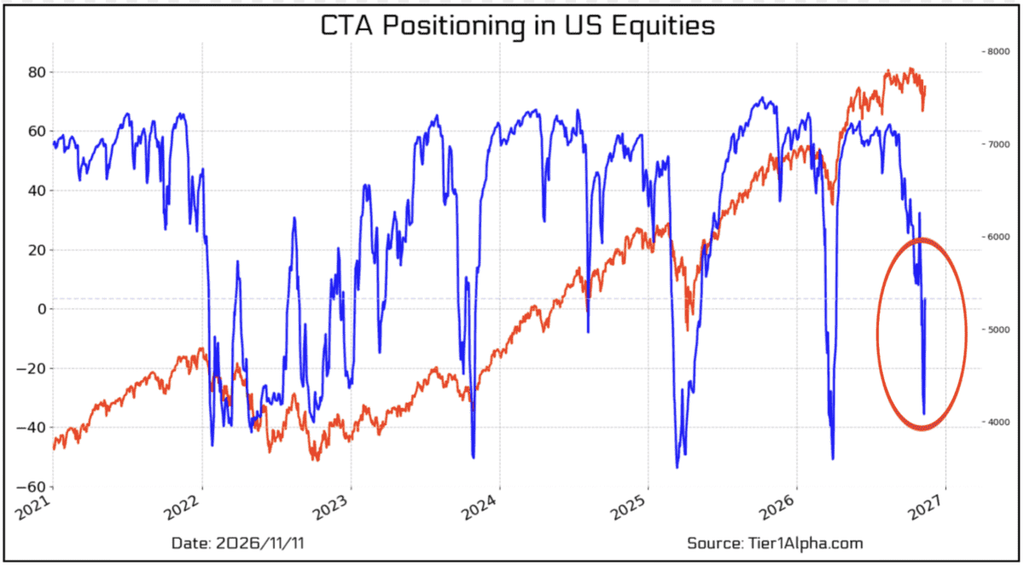
Perhaps helping the rebound off the lows, Tier1Alpha said today that CTA positioning is already rebounding:
“While realized volatility was modestly elevated yesterday, it remained within the sweet spot we were hoping for. Momentum was strong enough to allow CTAs to begin rebuilding exposure into the positive trend, while volatility remained low enough to avoid triggering any meaningful selling from the volatility-control space.
“From here, the setup looks increasingly favorable for mechanical re-leveraging, particularly as we move past some of the larger event catalysts [the Nvidia drama notwithstanding], including Q3 earnings season and the midterm elections, and into a relatively quiet macro calendar. With systematic equity positioning now at such low levels, the potential for a sharp upside squeeze is beginning to increase as these strategies rebuild exposure into an improving market structure.”
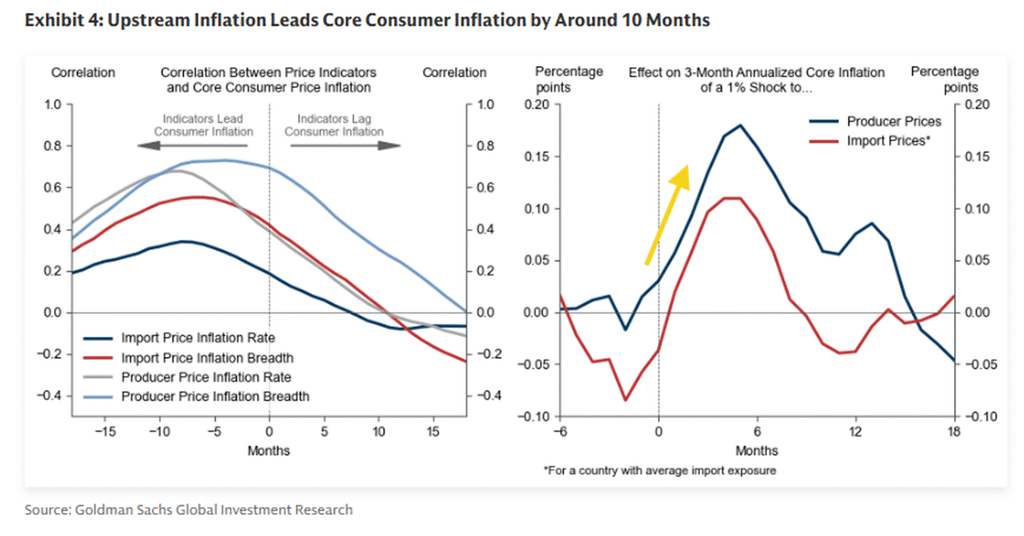
Goldman says that while energy cost pressures on components such as airfares show up quickly, upstream price increases, which partly reflect the indirect effect of energy prices on production, typically take six to 12 months to fully pass through to consumer prices. On average, each 1% increase in producer and import prices raises annualized core inflation by 0.1-0.2 percentage points after six to 12 months.
“Applying the peak cumulative impulse to observed upstream price increases implies an average 0.8pp boost to core inflation relative to the pre-war baseline (although the import price contribution may be somewhat overstated, as higher prices for the types of semiconductors imported for use in data centers have little readthrough to consumer prices). These patterns suggest residual cost pressures will continue to boost inflation into the first half of 2027.”
Wrap-Up — Another Headwind, but Still Resilient
The bounce ran into another headwind (the AI trade really can’t catch a break), this time in the form of the unexpected resignation of the CEO of the second-largest public company in the world and the architect of a web of interrelated investments and financing that has helped power the AI buildout.
Despite that, the markets again showed remarkable resilience, which says to me that for now the more likely path is further upside. Importantly, while it was not a great day for many stocks, the S&P 500 and Nasdaq-100 finished with modest changes, which keeps hopes for further systematic releveraging alive, and there was strong evidence of retail buying the dip, at least as far as Nvidia goes.
More concerning was the weakness in the broader market, but I guess that can be chalked up to the rise in yields and oil. It still puts a dent in my hope we’d continue to see broader participation, but one day is far from a trend.
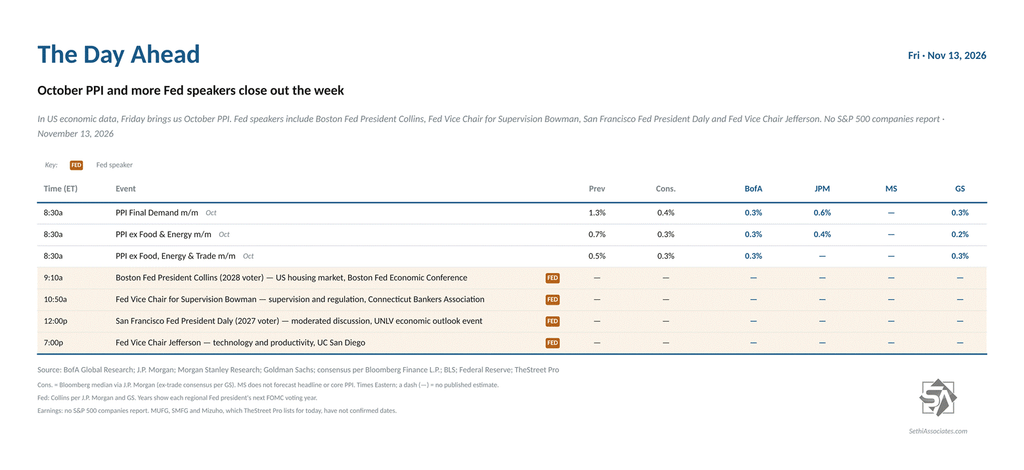
Friday brings a key data point in October PPI, which feeds into core PCE, the Fed’s preferred inflation gauge.
As always, let’s see what we get and go from there.
The Day Ahead — PPI and Four Fed Speakers
In US economic data, Friday brings us October PPI.
Fed speakers include Boston Fed President Collins (2028 voter) at 9:10am ET, Fed Vice Chair for Supervision Bowman at 10:50am, San Francisco Fed President Daly (2027 voter) at noon and Fed Vice Chair Jefferson at 7pm. Collins and Jefferson are the two we haven’t heard from this week, although Collins is less relevant since she isn’t a voter until 2028.
There are no coupon (>1 year in maturity) Treasury auctions.
No S&P 500 components report.
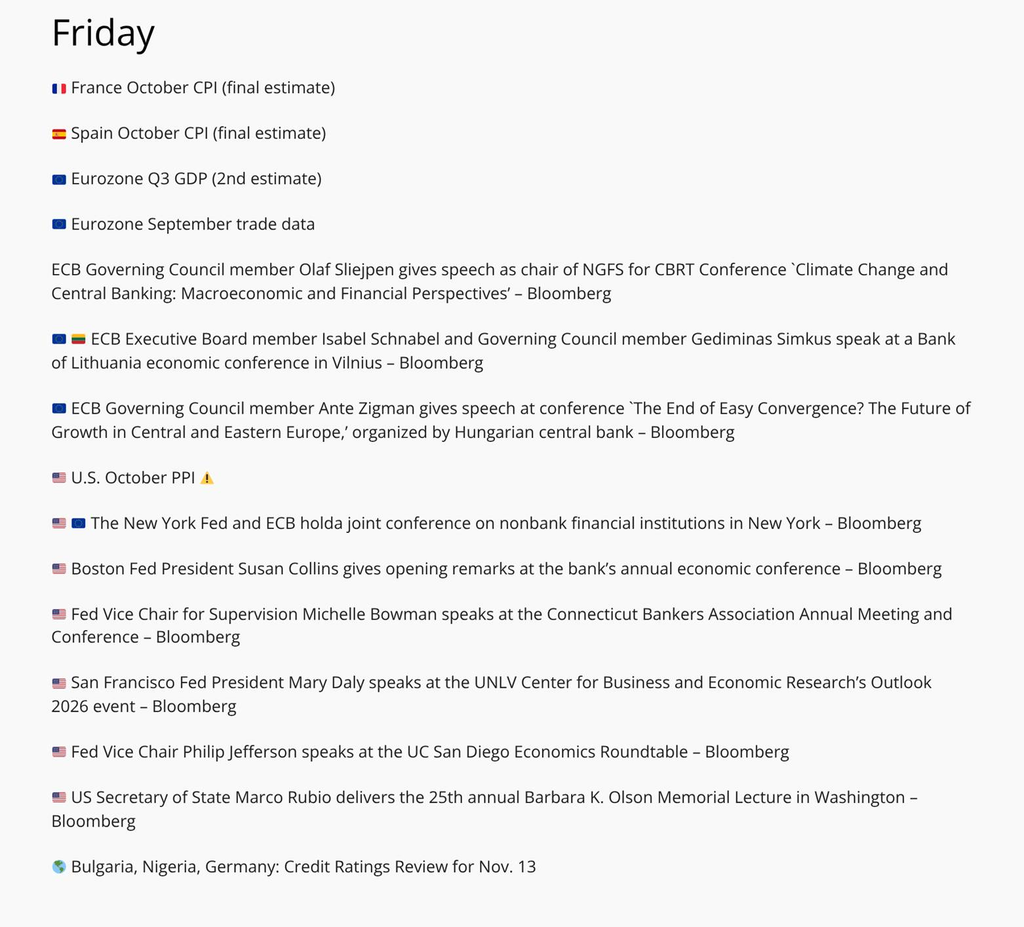
Ex-US highlights include the second estimate of eurozone third-quarter GDP, final October CPI in France and Spain, Poland’s October CPI and third-quarter GDP, and Brazil’s September retail sales. ECB Executive Board member Schnabel speaks, along with Governing Council members Simkus, Zigman and Sleijpen, and EU leaders hold an informal meeting. Germany’s credit rating is also up for review, and Richemont reports.
From Christophe Barraud’s international Week Ahead rundown:
At the time of publication, in terms of securities mentioned, Sethi was long AMD, ANET, AVGO, GOOGL, GPN, IWM, NVDA, SPY and numerous Treasury ETFs, and short AMAT and IBIT. In the last 24 hours Sethi added to his NVDA long, shorted IBIT, and trimmed GOOGL and some of his short duration Treasury ETFs.