AI Bounce Gains Momentum on Positive CoreWeave and Anthropic Updates
CoreWeave’s strong results and funding plan, along with demand for Anthropic’s IPO, gave the AI bounce another boost on a quiet Veterans Day.
You've reached your free article limit
You've read 0 of 1 free Pro articles.
Executive Summary
Last night’s update (The Bounce Runs Into a Hawkish Fed) noted the Nasdaq-100 had turned back at its 200-DMA again, but strong results from CoreWeave, and its plan to fund its growth without more high-cost debt, along with headlines that Anthropic’s IPO was oversubscribed at an indicated valuation above earlier estimates, gave another boost to the AI trade and sent it back above that level.
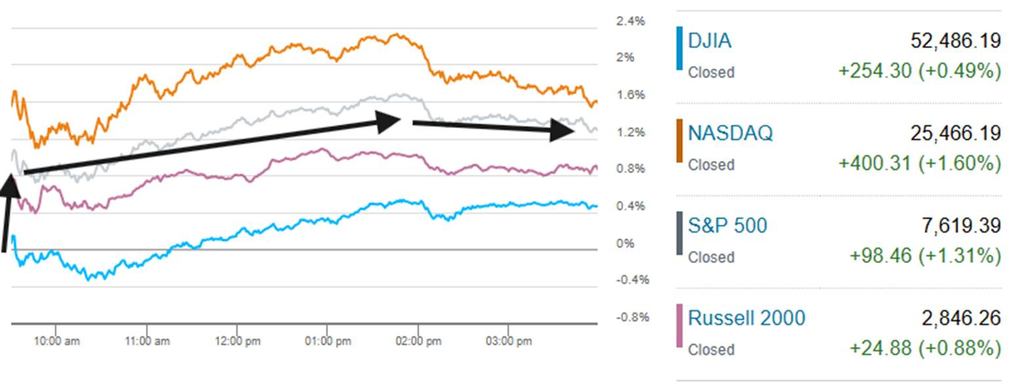
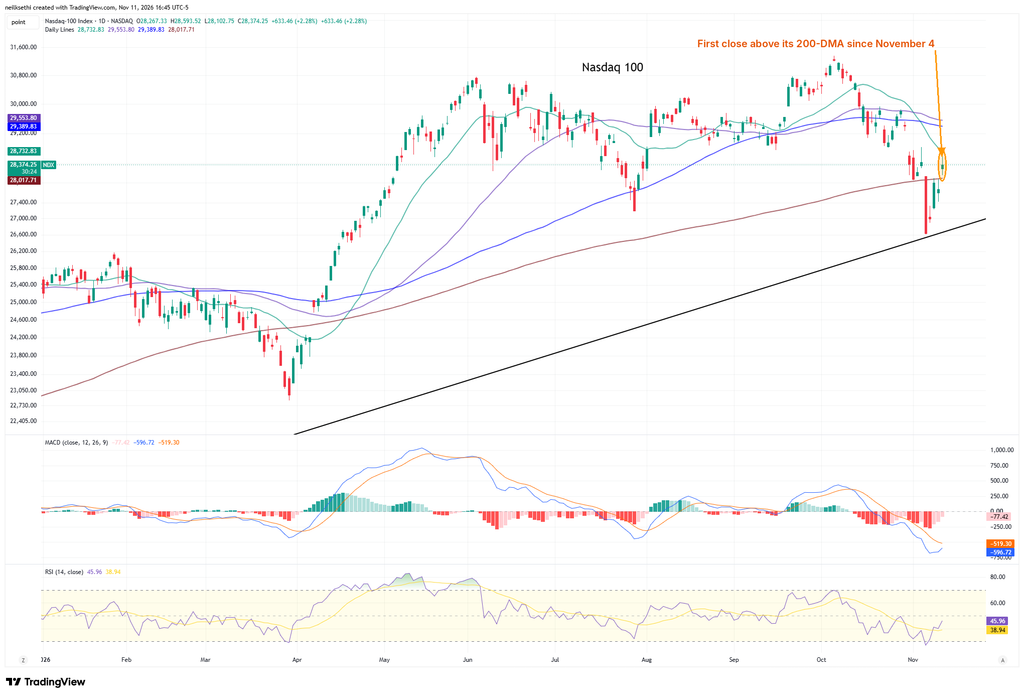
Indices started higher, and an early dip was bought, but some afternoon softening saw them settle back to end about where they started. Tech’s 2.7% gain lifted the Nasdaq Composite 1.6%. The S&P 500 added 1.3%, the Russell 2000 0.9% and the Dow Jones Industrial Average 0.5%. The Nasdaq-100 gained 2.3%, and marked its first close above its 200-DMA in a week.
Schwab
CoreWeave (CRWV) jumped nearly 25%, its best day since June 2025, after third-quarter revenue rose 168% to $3.66 billion, its contracted backlog more than doubled to $132.5 billion and it raised its 2026 revenue and operating income outlook. Its CEO also said it won’t tap the unsecured debt market at current yields, after its 2032 bonds yielded more than 16% last week. Rev Shark noted that funding plan helped the AI bounce (Market Shrugs Off Rates Again as CoreWeave Eases the Capital Crunch).
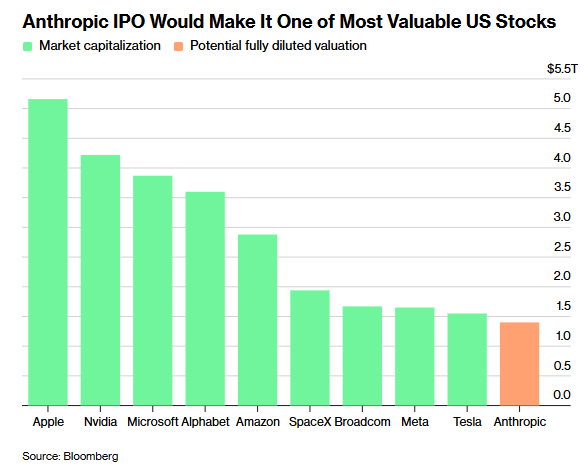
In addition, Bloomberg reported that Anthropic’s IPO was “multiple times” oversubscribed, with its bankers reportedly weighing lifting the initial $70-$78 range set Tuesday which would already give it a fully diluted valuation of $1.4 trillion. Chris Versace also wrote about this today (Anthropic’s IPO Price Talk Is Rising). Meanwhile OpenAI’s quarterly revenue reportedly hit $10 billion.
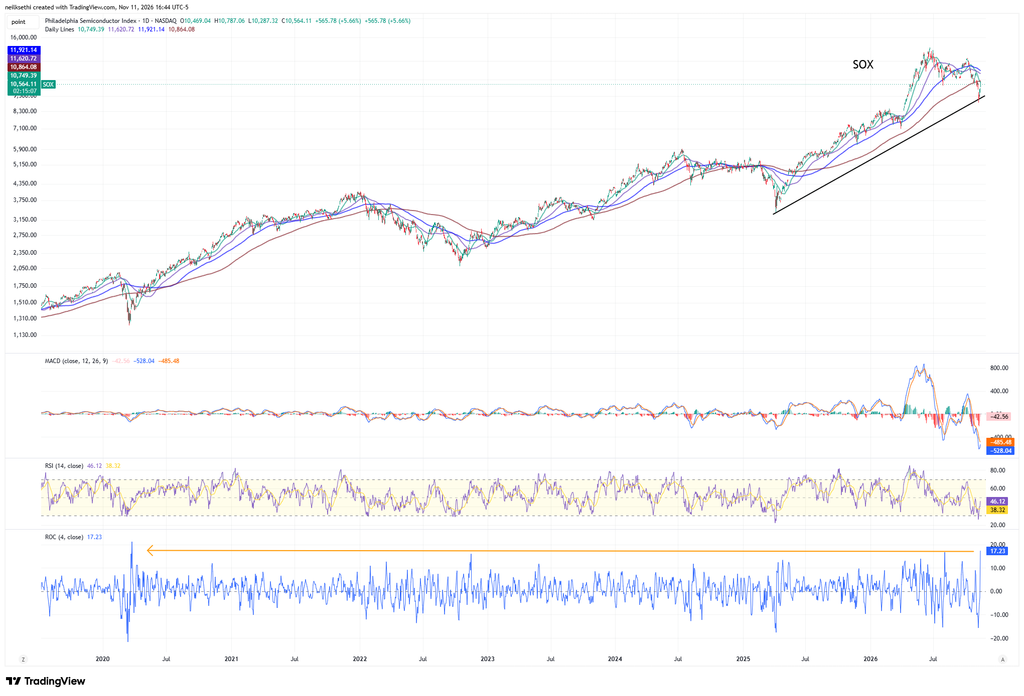
All of that sent the Philadelphia Semiconductor Index (SOX) up 5.7% (it was up as much as 7.9%), bringing its gain over the past four sessions to 17%, the best four-day run since March 2020.
While the bond market was closed for Veterans Day, Treasury futures were open and edged lower (yields higher). The dollar rose 0.7% to its highest close since April 2025, while gold fell back below $4,000, and oil snapped a two-day slide as traders weighed mixed signals on the prospects for an end to the Iran war. The VIX fell another 10% to its lowest close since November 4.
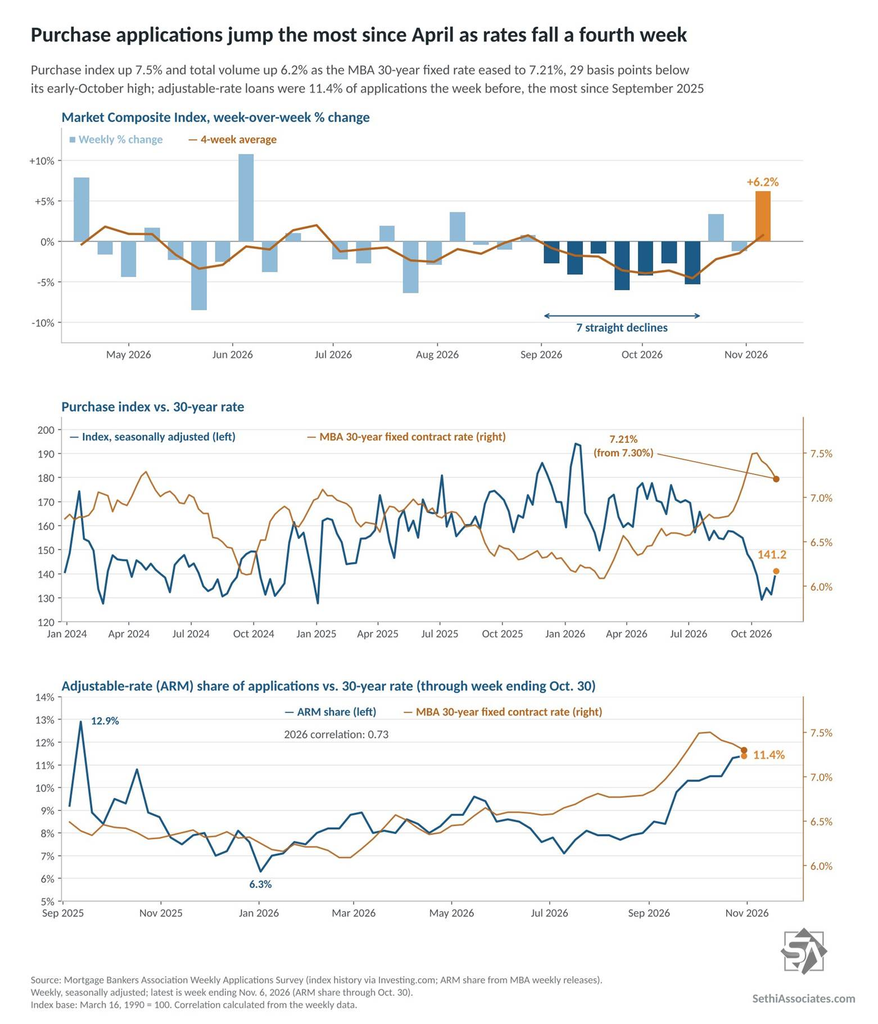
In data, purchase mortgage applications jumped 7.5% last week, the most since mid-April, boosted by the 30-year fixed rate falling for a fourth straight week to 7.21%, and Redbook same-store sales stayed above 10% (Consumers Continue to Consume). Note, though, mortgage rates will be moving back higher after the recent move in the 10-year Treasury.
Thursday brings a busier calendar with jobless claims, existing home sales, a 30-year auction, six Fed speakers and Cisco and Applied Materials after the close.
My look at today’s charts follows in a separate post later this evening.
Market Commentary
CoreWeave:
- “We have 10 times as much qualified demand as available capacity through the end of 2027, and demand for 2028 is already several times larger than our available capacity, even before we have brought it formally to market,” said Michael Intrator, CEO of cloud-computing company CoreWeave.
Equities:
- “The rebound in the tech sector is something that is helping investors to be less concerned about whether the upcoming Anthropic IPO will get done or not,” said Matt Maley at Miller Tabak. “If the Anthropic IPO had been postponed, it would have raised even further questions about whether the AI bubble was bursting.”
- “We continue to favor US large-cap stocks, which we believe offer attractive exposure to the AI theme and trade at a discount to their 10-year average forward price-to-earnings multiple,” said Brock Weimer at Edward Jones. “We also favor US mid-cap stocks, which could continue to benefit from resilient domestic economic activity.”
- “While the recent bloodbath in tech stocks may have scared off nervous investors, American corporations are a machine that aren’t showing any major signs of slowing down,” said Hardika Singh at Fundstrat Global Advisors.
- “One of the questions that has been permeating investor conversations this year is ‘can the market go up if Tech goes down,'” a Goldman Sachs analyst wrote in a recent note to clients. “While it’s tempting to just say ‘no,’ November market price action provides a microcosm of the trade that suggests the answer may be ‘yes.'”
Bonds/Fed:
- Ulrike Hoffmann-Burchardi, CIO of the Americas at UBS, doesn’t think a half-point rate hike will take place. “Before the inflation print, Federal Reserve Governor Christopher Waller said a core CPI reading of around 0.3% or higher could warrant considering a 50-basis-point hike in December,” Hoffmann-Burchardi wrote. “But, we still think FOMC support for a 50bps hike is limited because it could signal a need for more aggressive monetary policy recalibration. For now, our base case remains for 25bps Fed hikes in December and March, with the latest developments bolstering the case for higher rates and raising the risk of more or faster tightening than currently expected.”
Stock and Sector Breakdown
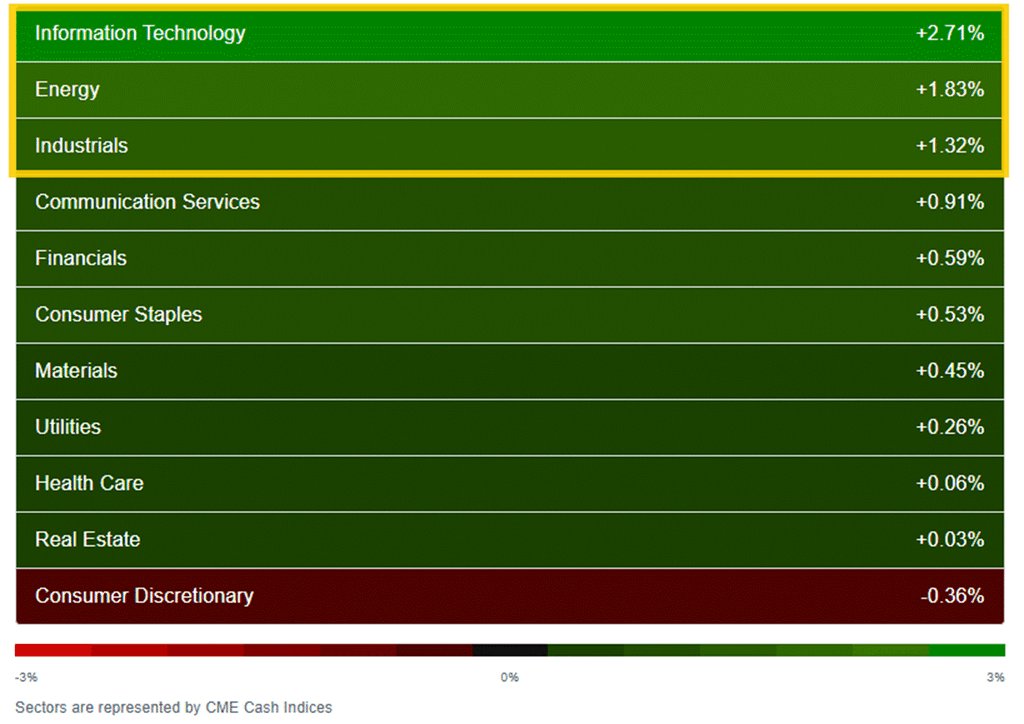
In contrast with Tuesday, when six of 11 sectors fell, 10 rose today, led by Tech (+2.7%), Energy (+1.8%) and Industrials (+1.3%). Consumer Discretionary (-0.4%) was the only decliner, weighed down by Amazon (AMZN) which fell 1.7%.
332 S&P 500 stocks rose and 168 fell, with 63 gaining more than 3% and only one falling that much (from 13 and 26 Tuesday). Note we haven’t seen zero fall more than 3% since November 2025.
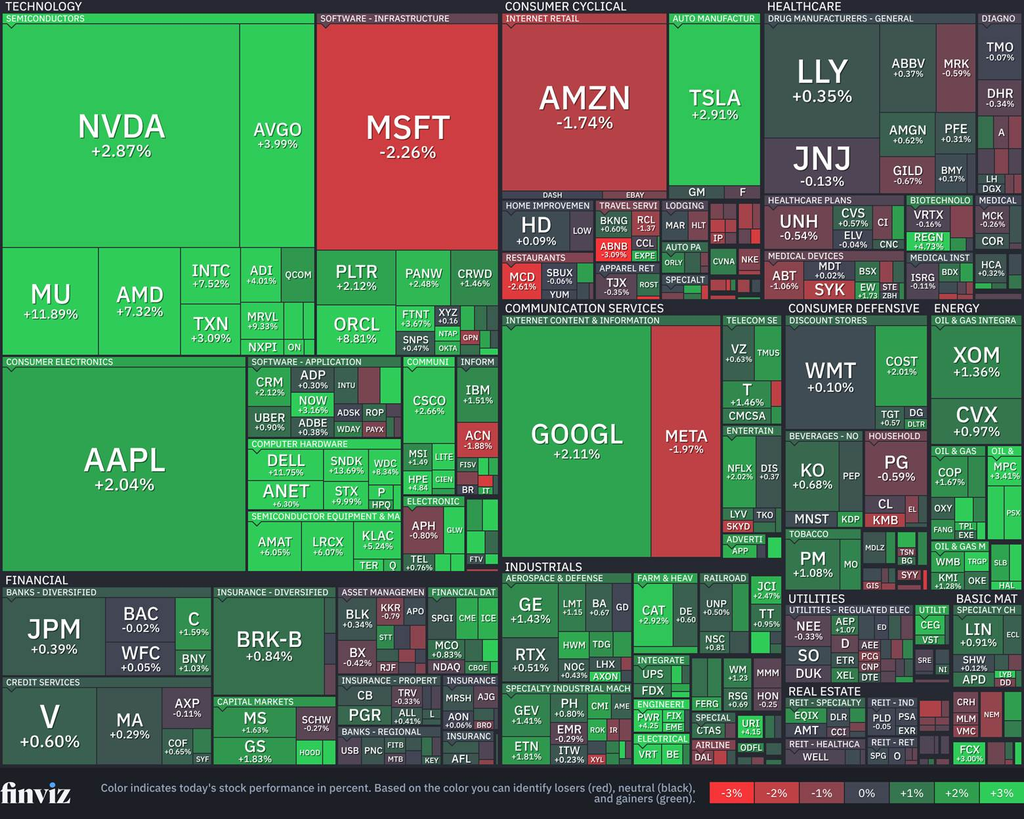
SanDisk (SNDK) led the S&P 500 with a gain of almost 14% on a new product launch and the wider AI rebound, while Airbnb (ABNB) was the worst performer, down 3.1%.
About 20 AI hardware and infrastructure names gained 6% to 14%, from Micron (MU), Seagate and Western Digital to Marvell, Lumentum, Oracle (ORCL) and Bloom Energy. Dell (DELL) rose 12%, which Doug Kass used to sell half his position, then more as it climbed.
Stephen Guilfoyle thinks the beleaguered CoreWeave looks like a trade, while Bret Jensen warns investors not to overlook the fine print in CoreWeave’s report.
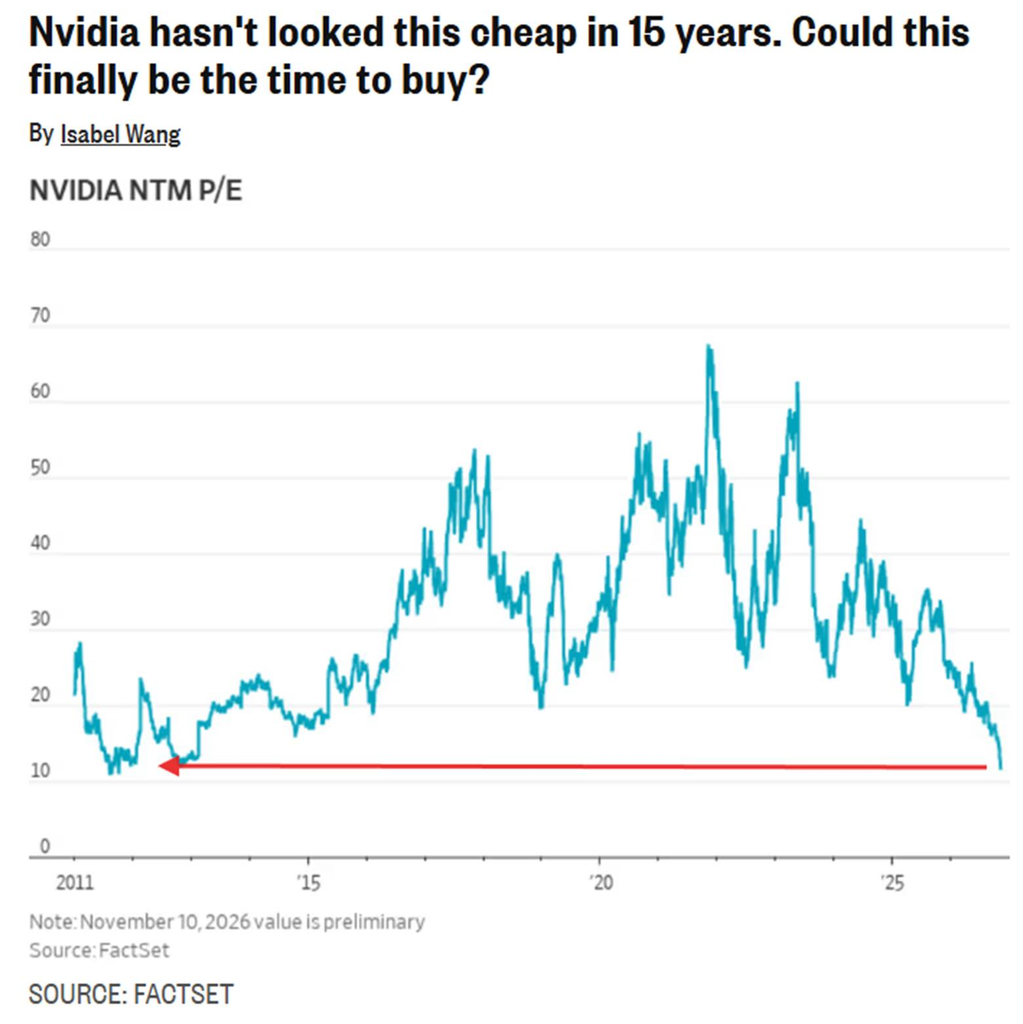
Nvidia (NVDA) bounced 2.9% after falling 22% over the prior two weeks, even as two House Republicans said Congress is prepared to subpoena CEO Jensen Huang over his affair with an alleged Chinese spy. As of Tuesday afternoon it traded at a forward P/E of 11.66, its lowest since October 2011, according to FactSet data cited by MarketWatch.
The hyperscalers that are spending the money lagged the suppliers getting it. Microsoft (MSFT) fell 2.3% and Meta (META) 2%. Meta’s longtime infrastructure chief will reportedly leave in early 2027. Apple (AAPL) rose 2%, though, extending a run Bob Lang highlighted (Chart of the Day: Apple Just Keeps on Rolling), and Alphabet (GOOGL) gained 2.1%.
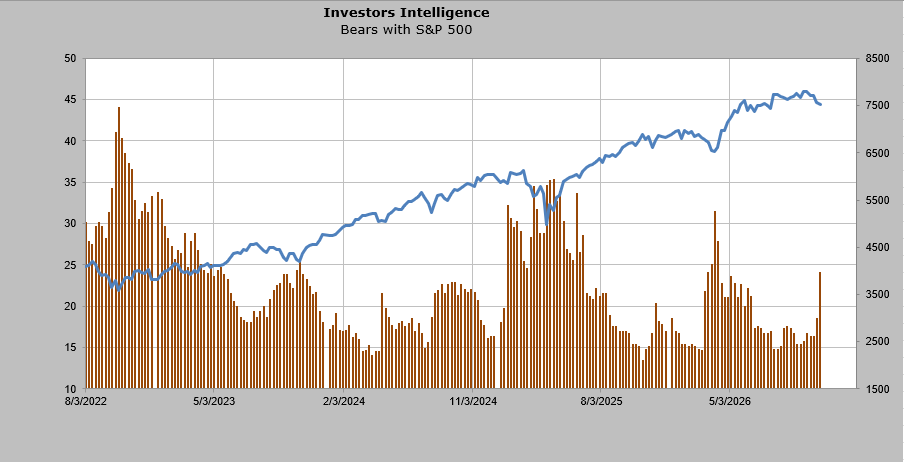
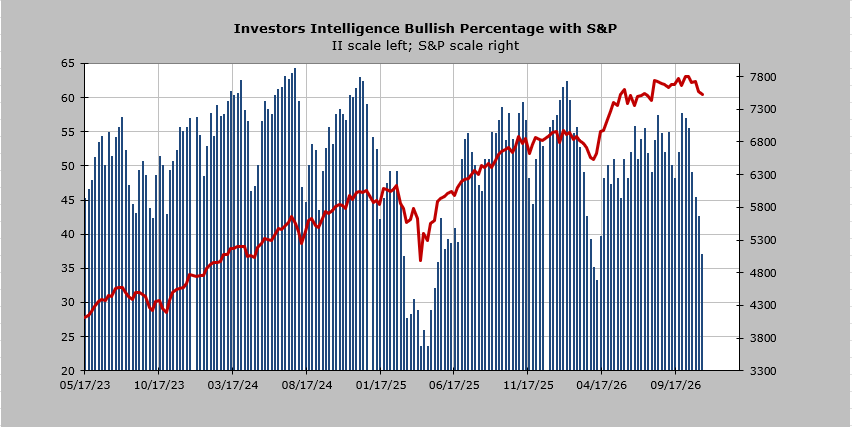
Helene noted a serious change in sentiment, with Investors Intelligence bulls falling to 37% and bears jumping to 24%, the most bears and fewest bulls since April.
FedWatch
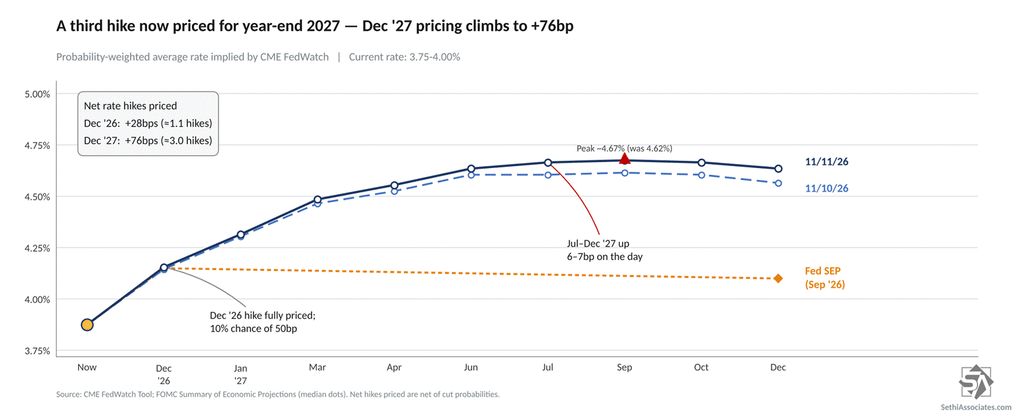
December hike expectations were little changed, but pricing for 2027 kept building. A December hike remains fully priced, with a 10% chance of a half-point move (28 basis points priced), while 76 basis points of hikes are now priced through December 2027, three full hikes, up from 69bp Tuesday, per CME FedWatch.
Chicago Fed President Goolsbee called Tuesday’s CPI report “another distressing report — borderline disturbing” in a PBS NewsHour interview. Vice-Chair for Supervision Bowman and Philadelphia Fed President Paulson, though, probably the two most dovish members of the committee, were more restrained in their remarks (Stock Market Today post on that coming tomorrow morning).
Goldman now sees a third hike in March 2027 and has pushed its first cut to December 2027 (Goldman Now Calls for Two More Hikes, Pushes First Cut to December 2027).
More From TheStreet Pro
Helene Meisler — This Chart Is on an Awesome Run — All Things Being Equal
Rev Shark — I’d Rather Buy Strength Than Guess at Bottoms
Stephen Guilfoyle —
Ed Ponsi — This Unlikely Consumer Stock Is Quietly Beating Apple and ExxonMobil in 2026
Chris Versace —
Doug Kass’s Diary:
- Oscillator Slightly Overbought
- Charting the Late Morning Market
- Jonesy on CoreWeave
- So Far So Very Good
Note: Doug posted 16 Diary entries today; these are the market ones (three more are also linked elsewhere).
And From Me If You Missed It
- Stocks and the VIX Fell Together Tuesday. Here’s What Usually Comes Next.
- Household Debt Jumps the Most Since 2022, Delinquencies Climb to Highest Since 2016
- The NYSE Saw Its First 80% Downside Day Since December Last Week. What Comes Next?
- BofA Says Big Investors Bought the Dip Last Week While Retail Kept Selling
Miscellaneous
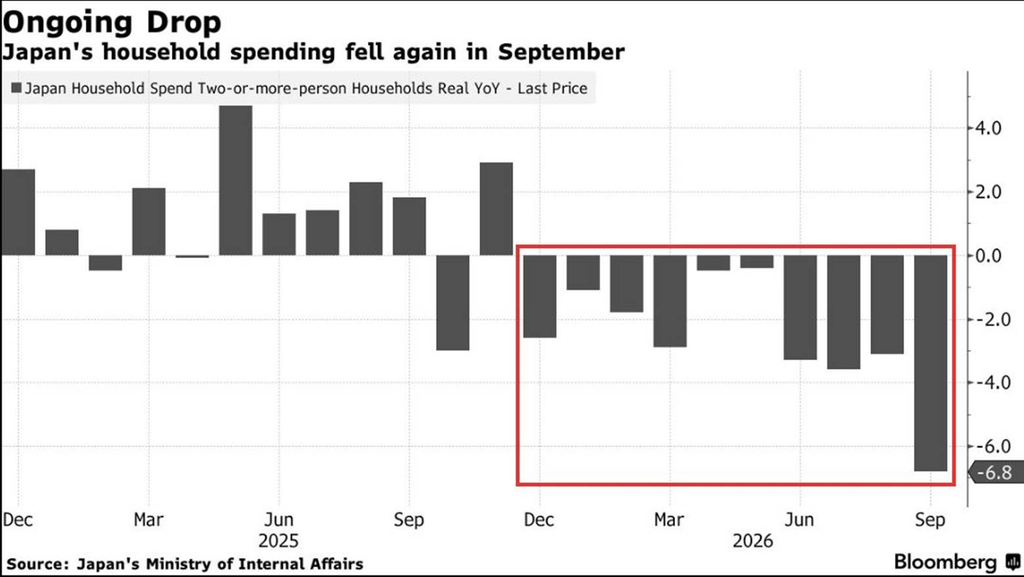
Meanwhile, in Japan, despite nominal cash earnings seeing the largest increase since 1997 in September, household spending unexpectedly fell by the most since 2020, and expected rate hikes from the BoJ will only add to pressure on households.
Outlays by households adjusted for inflation declined 6.8% in September from a year earlier, led by transport, education and entertainment. It was the 10th straight month of falling year-over-year spending.
“Households are still vulnerable to concerns about rising prices,” said Takeshi Minami, chief economist at the Norinchukin Research Institute. “Since wages are rising, it’s hard to explain why consumer spending isn’t picking up.”
“It’s a difficult call whether the BOJ should accelerate the pace of interest rate hikes just focusing on strong AI-related demand, while consumer spending remains weak,” said Minami.
Wrap-Up — The Bounce Gains Momentum
The bounce continues, and it’s gaining momentum as more stocks and indices break through resistance. As mentioned earlier, the Nasdaq-100 (QQQ) was one of them. Other examples were AMD closing back above its 50-DMA (barely though) along with a positive MACD crossover and RSI lifting over 50, and Micron rising above its 200-DMA. In all three cases I reversed from short to long with stops on the QQQ and MU below the 200-DMA.
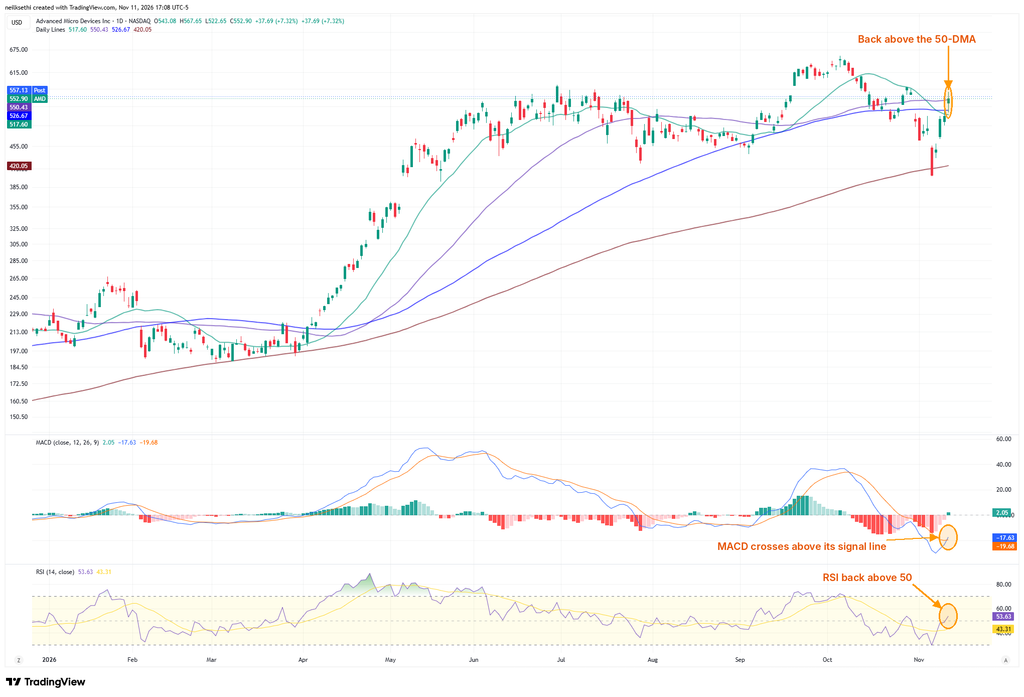
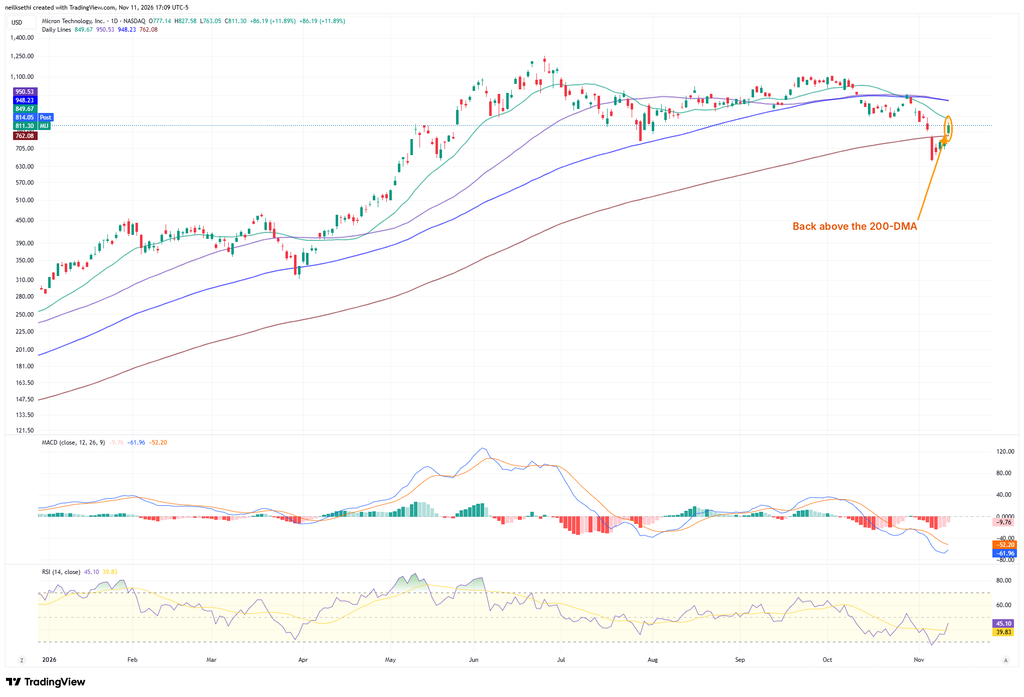
I’m still not convinced we won’t retest last week’s lows, but things are going from bearish to bullish in the AI names, and that has to be respected. It’s also consistent with what we’ve been hearing from our “guru crew” (Deutsche Bank, Rubner, Yardeni and Kettner), as well as Doug Kass, who has been adding to his longs – “second-level thinking is capitalizing on the rally by growing more bullish and buying equities.” That makes me even further inclined to the bullish side.
And the AI rebound is also lifting the indices. Positively, though, today it wasn’t at the expense of the rest of the market, with 10 of 11 sectors and two-thirds of S&P 500 stocks higher, although outside of AI and Energy the gains were more muted.
One thing I’d like to see is things settling down a bit, as big moves are not a hallmark of a stable market (and work against systematic releveraging), although that might be with us until gamma rebuilds. I’d also like some evidence that retail is buying (see BofA Says Big Investors Bought the Dip Last Week While Retail Kept Selling).
Thursday brings some tests I mentioned Sunday for the AI trade, with Cisco and Applied Materials reporting after the close. We also get six Fed speakers, some of whom will likely chime in on their thinking on the path for rate hikes, as well as a 30-year auction.
As always, let’s see what we get and go from there.
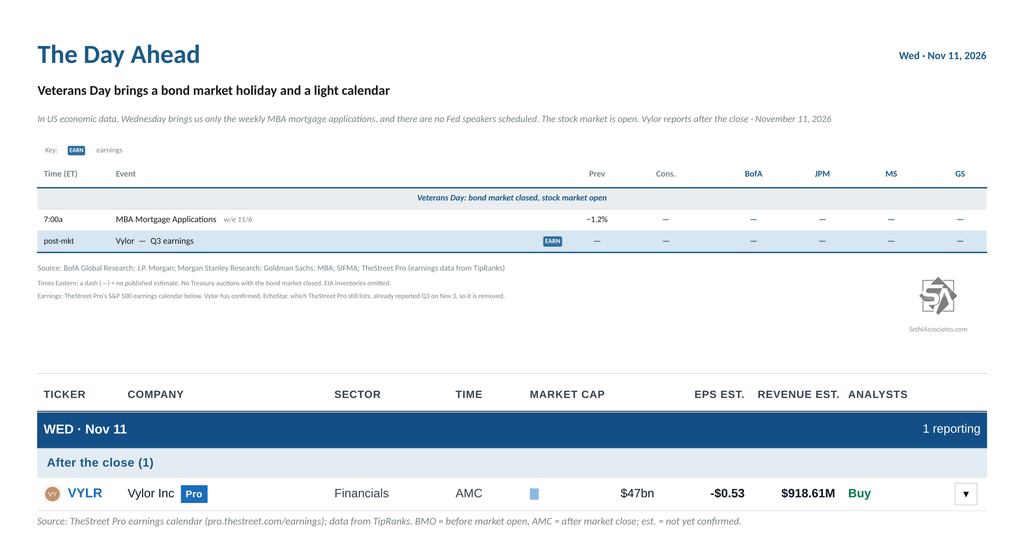
The Day Ahead — Fed Speakers, the 30-Year Auction and Cisco
In US economic data, Thursday brings us weekly jobless claims and October existing home sales, plus the EIA’s weekly crude inventories (pushed back a day by the holiday) and the October Monthly Budget Statement.
We’ll hear from six Fed speakers: Cleveland Fed President Hammack (2026 voter) at 9am, Governor Barr on AI and inequality at 10am, Chicago Fed President Goolsbee (2027 voter) at 11:30am, San Francisco Fed President Daly (2027 voter) at 1:10pm and New York Fed President Williams (permanent voter) at 6:30pm. Kansas City Fed President Schmid (2028 voter) also speaks.
The Treasury will auction $25 billion of 30-year bonds at 1pm ET.
Three S&P 500 components report, two with market caps over $100bn:
Before the open: Williams-Sonoma (WSM).
After the close: Applied Materials (AMAT) and Cisco (CSCO).
Outside the S&P 500, we’ll hear from Brookfield (BN) and Nebius (NBIS) before the open, and Nu Holdings (NU) and Cerebras (CBRS) after the close.
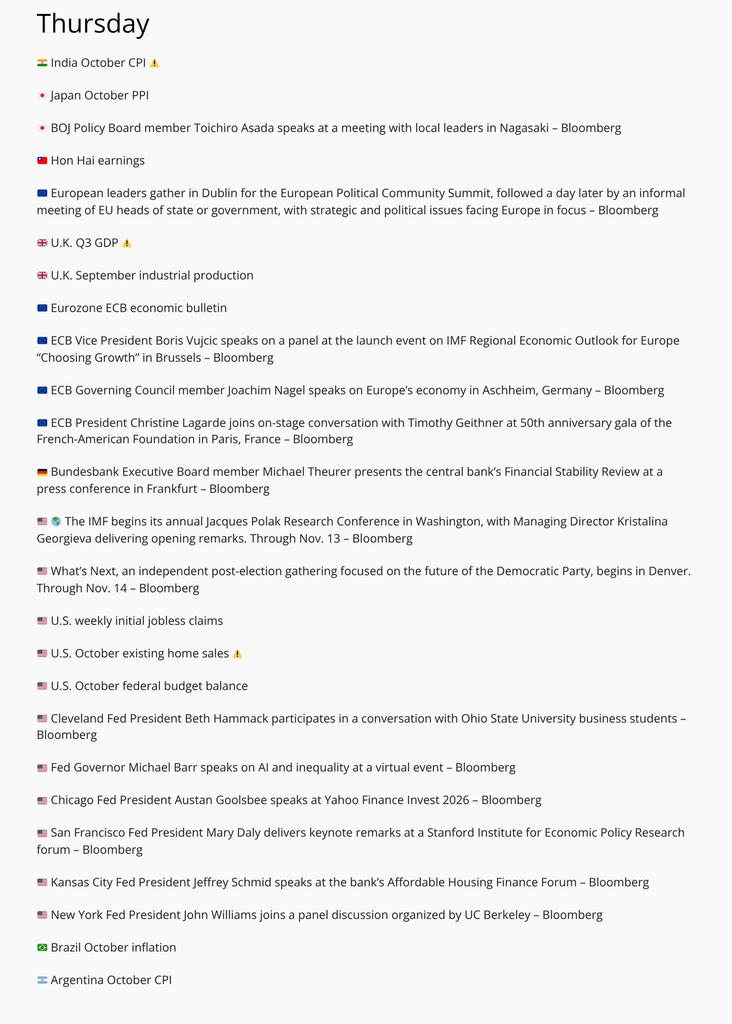
Ex-US highlights include UK third-quarter GDP, India’s October CPI, which Bank of America sees breaching the RBI’s upper band at 6.1%, Brazil’s October inflation and Japan’s October PPI, plus rate decisions in Serbia, Romania and Peru. ECB President Lagarde, Vice President Vujcic and Bundesbank President Nagel speak, along with BoJ board member Asada, and Europe’s leaders gather in Dublin for the European Political Community Summit. Siemens, Allianz, Munich Re and Hon Hai report.
From Christophe Barraud’s international Week Ahead rundown:
At the time of publication, in terms of securities mentioned, Sethi was long AMD, AMZN, DELL, GOOGL, META, MSFT, MU, NVDA, ORCL, QQQ and SOXL, and short AMAT and MRVL. In the last 24 hours Sethi covered his AMD, MU and QQQ shorts, added to his NVDA long and went long DELL and SOXL.