AI Bounce Drives Broad Market Rally
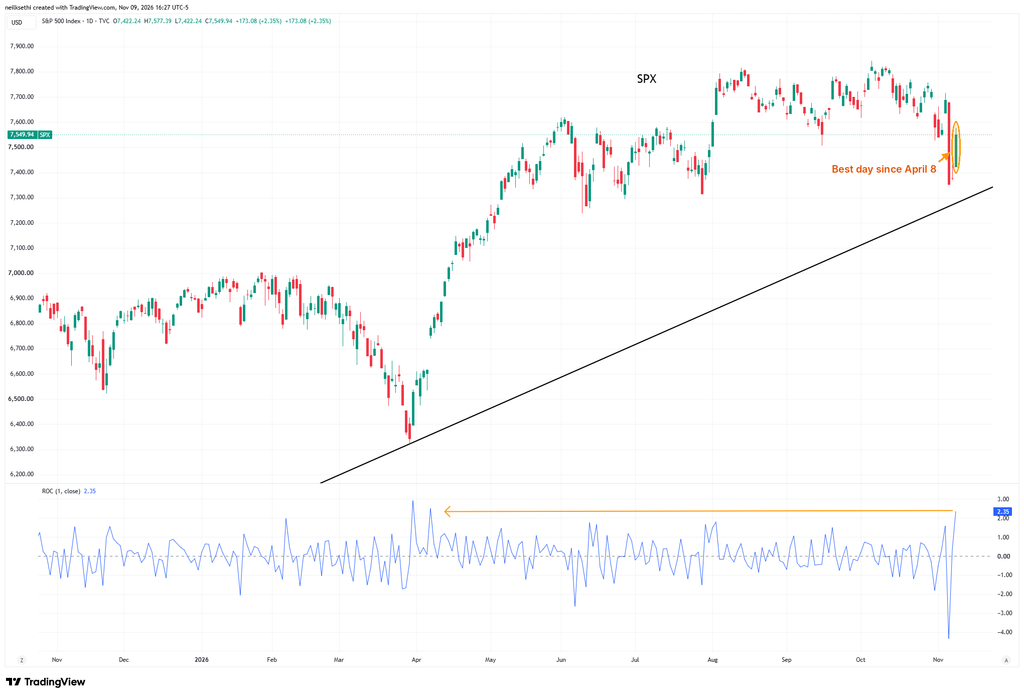
AI beneficiaries continued Friday’s bounce, joined Monday by most of the market, sending the S&P 500 up 2.4%, its best day since April 8.
You've reached your free article limit
You've read 0 of 1 free Pro articles.
Programming note: Starting today, I’m splitting the evening update into two posts. This one covers the day’s market action, the news and commentary behind it, and what’s ahead for tomorrow (or next week on Fridays). My look at the charts (the major indexes, Treasury yields, volatility, the dollar, commodities, bitcoin, market breadth, etc.) will follow in a separate post later this evening. The idea is that the first post gets out sooner and each post is a quicker read, so let me know what you think.
Executive Summary
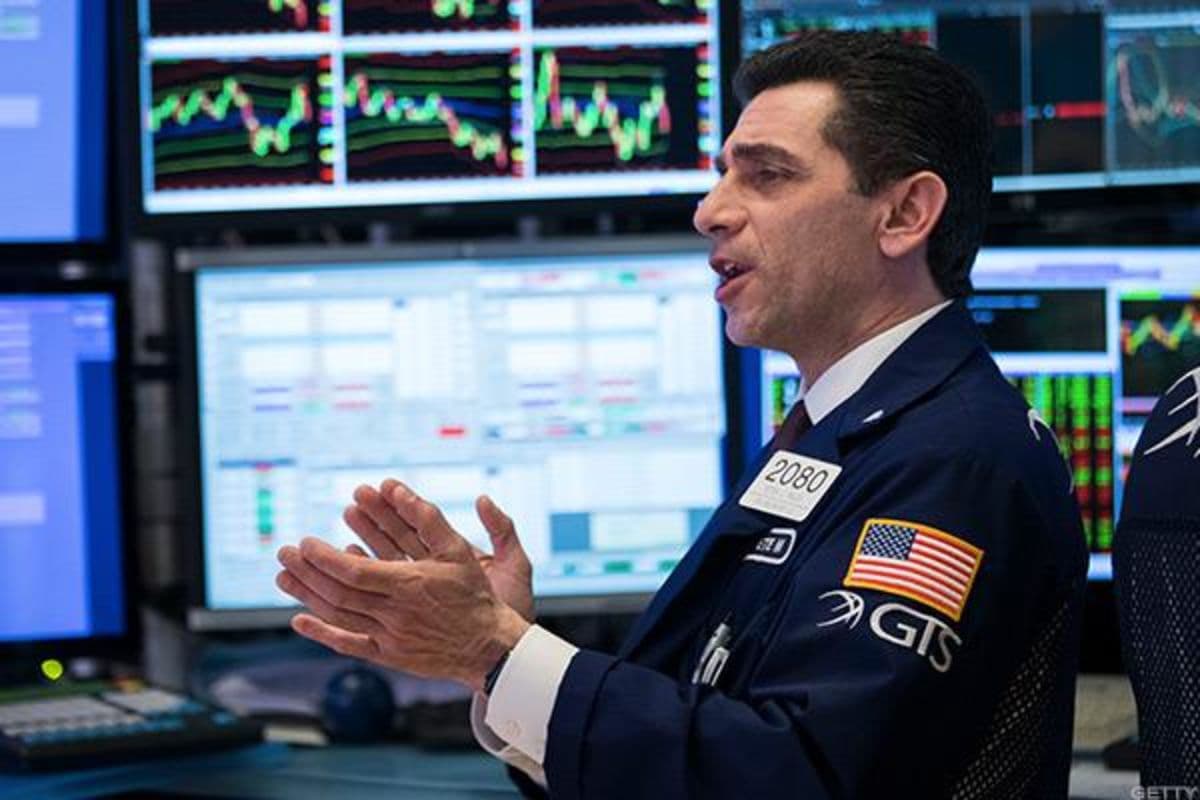
While Friday’s bounce was all AI, with the average stock falling, Monday’s saw more than eight in 10 S&P 500 stocks rise, helped by oil falling on hopes for an Iran deal. Chipmakers ripped higher even as Nvidia slid on headlines about its CEO.
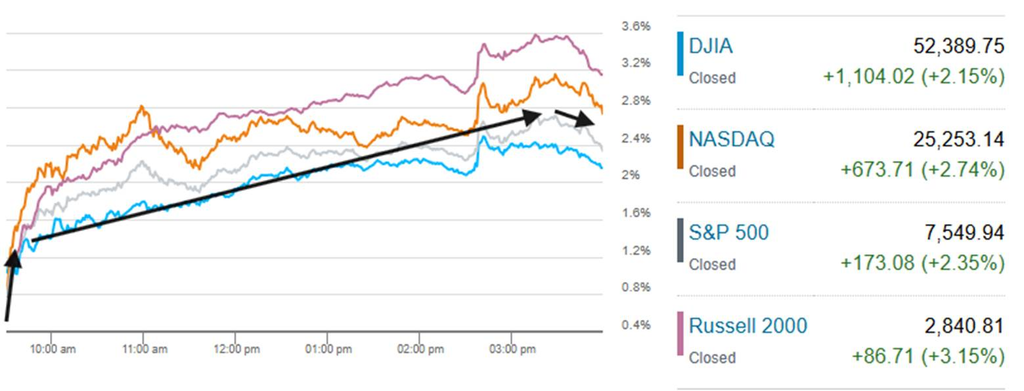
Indexes started higher and climbed throughout the session before slipping a touch in the last half hour. The S&P 500 rose 2.4%, its best day since April 8, and the Nasdaq Composite 2.7%, its best since July 30. The Nasdaq-100 gained 3.4% and the Russell 2000 3.2%, both their best days since March 31, while the Dow rose 2.2% and the equal-weighted S&P 500 2.3%. The Dow is back above its Election Day close, but the S&P 500 and Nasdaq remain slightly below theirs.
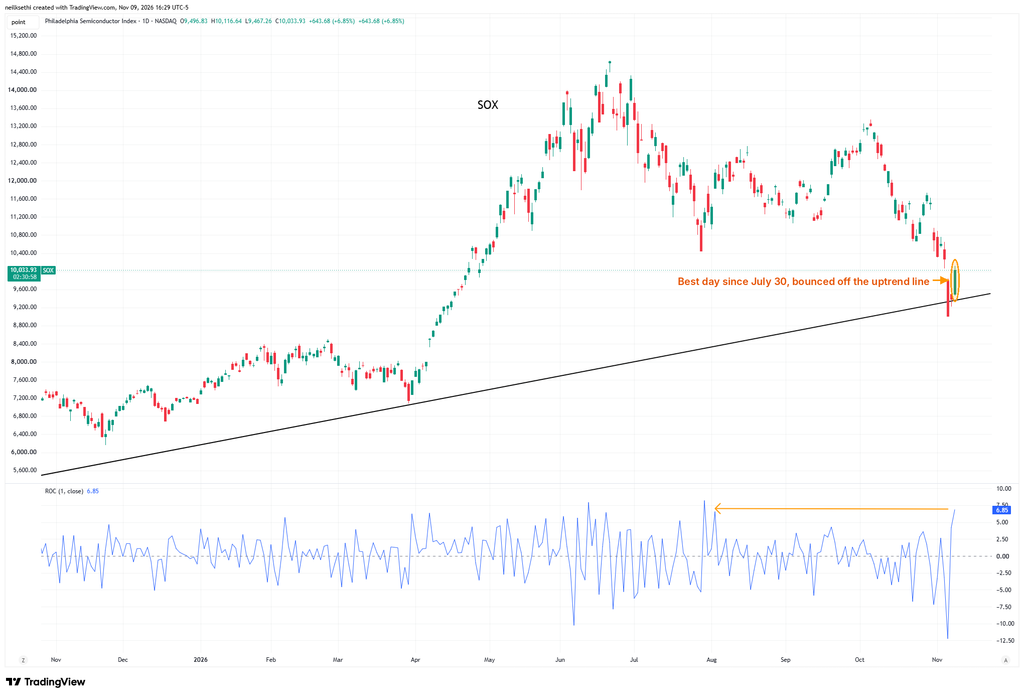
The Philadelphia Semiconductor Index (SOX) jumped 6.9%, its best day since July 30.
That was even as Nvidia (NVDA) fell 4.3% after its board opened an investigation into Jensen Huang’s affair with a woman reported to be a suspected Chinese intelligence operative. Nvidia finished almost 11 percentage points behind the iShares Semiconductor ETF (SOXX), the most since January 2019, and it has now lost about $1.5 trillion in market value since its October 6 peak.
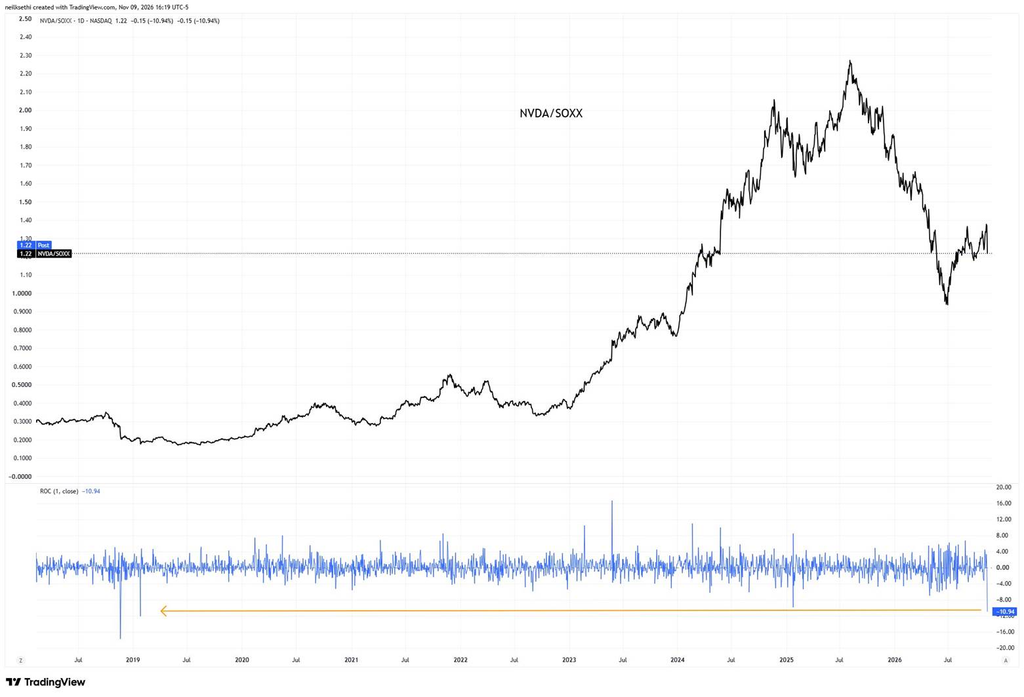
As I noted this morning (Is Tech Ready to Rebound?), today’s market action in the face of the Nvidia headlines is exactly the kind of divergence you’d want to see if positioning has, in fact, been cleaned out.
Oil fell more than 4% to its lowest close since August on growing hopes for a deal with Iran. President Trump said in a CNN interview Sunday that it’s “highly unlikely” he’ll need to order the US back to war with Iran as long as talks progress, and he was set to meet Monday with the prime minister of Qatar, one of the mediators. Al Arabiya later reported that a preliminary agreement to reduce Iran’s uranium enrichment could be reached, with a framework that would reopen the Strait of Hormuz and lift the naval blockade, though US officials haven’t confirmed it.
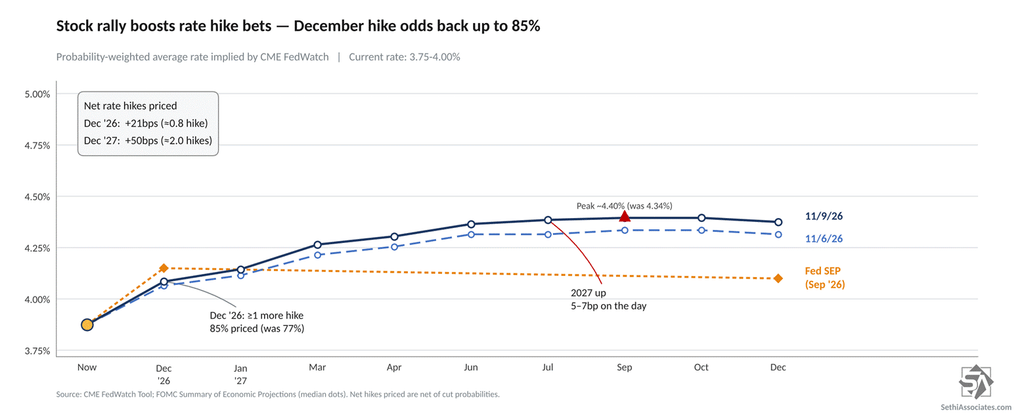
Treasury yields rose, led by the 2-year, which gained 5 basis points to 4.57% (including the after-hours session) ahead of Tuesday’s CPI report, the last before the December FOMC, as Fed rate hike expectations continued to follow the AI trade. Richmond Fed President Barkin said the direction of policy is clear but it needs a careful pace, and Chicago Fed President Goolsbee said officials must address their failure on inflation. The odds of a December hike rose to 85% from 77% Friday, while the dollar fell 0.6%.
The VIX fell back below 20, just edging out last Wednesday as a new largest one-day drop since April 2025 on a percentage basis. That comes after the largest percentage gain since December 2024 Thursday.
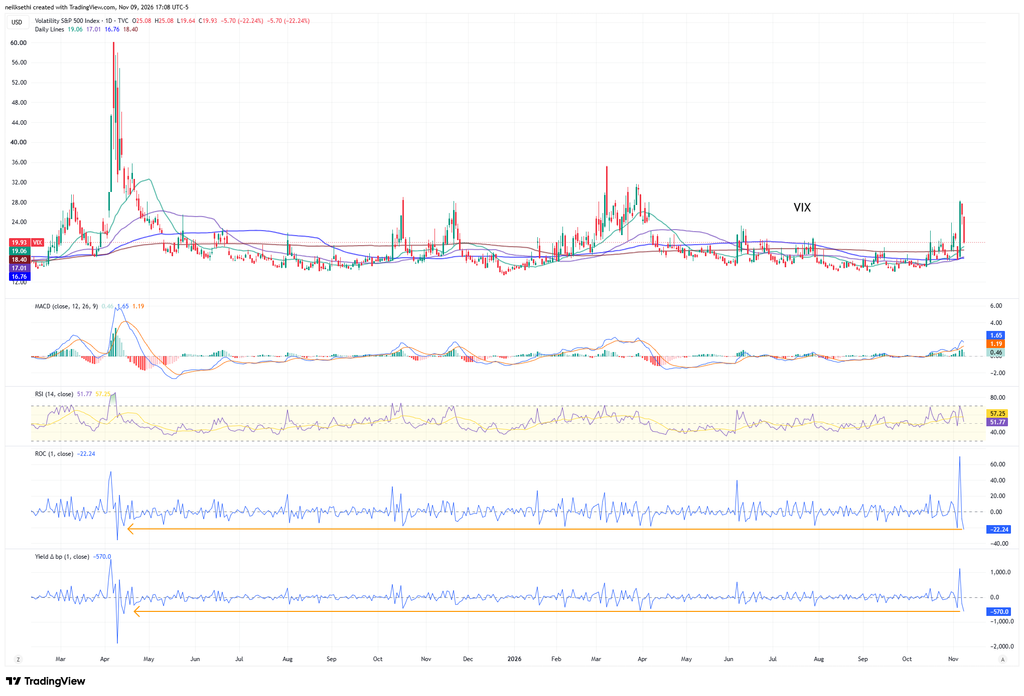
Gold rose 1% and natural gas 7%, while bitcoin slipped.
As mentioned at the top, a more detailed look at today’s charts follows in a separate post later this evening.
Market Commentary
Equities:
- “After the election, there was a knee-jerk reaction,” said Keith Lerner, chief market strategist at Truist Advisory Services. “Now we are moving to the other side. The mood is changing from a fear of downside to the fear of missing out on the upside.”
- “For now, the market is showing the resilience needed to turn last week’s weakness into another buying opportunity,” said Mark Hackett at Nationwide. “That’s an encouraging sign.”
- “Buying on pullbacks makes sense. Volatility is your friend,” said Chris Galipeau, head market strategist at the Franklin Templeton Institute.
- Oppenheimer chief investment strategist John Stoltzfus thinks the market can rebound, as it started to on Monday. “So long as the underlying fundamentals that support economic growth and nurture revenue and profit growth have not dramatically deteriorated… the market can find opportunity to not just regain lost ground but even rise well above where it had been,” he wrote in a Monday note. “It would seem to us that it is much too early to predict the failure of AI to gain traction or achieve profitability.”
- Chris Larkin at E*Trade from Morgan Stanley says last week may have been more about investors repositioning within the AI trade than abandoning it. “There’s good reason to believe the stock market’s long-term rally is intact, especially given that the selloff overshadowed another week of strong economic data.”
- “If we were heading into end-cycle dynamics, with significant downward revisions to 2027 earnings, the capitulation process would certainly have further room to run. However, we see this more as an intra-cycle reset and another deleveraging event in the AI supercycle,” said JPMorgan’s Dubravko Lakos-Bujas. He noted the QQQ’s 14-day RSI fell below 30 last week, and “in each of the nine prior instances that this occurred over the past three years, QQQs rallied around 4% on average over the next five trading days.”
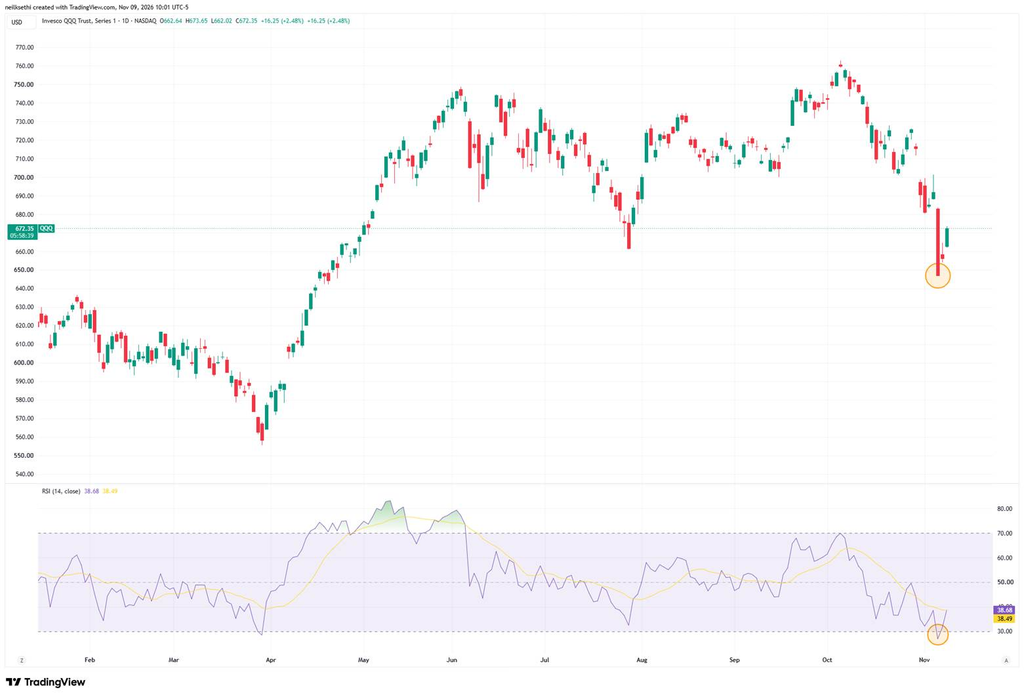
Others are more cautious.
- “With many investors unwilling to stick their neck out right before year-end, we struggle to find many positive catalysts for stocks over the near-term,” said Wolfe Research chief investment strategist Chris Senyek in a Monday note. “We believe markets are likely to remain very news flow driven and need to hold critical technical support levels.”
- Jay Hatfield, CEO at Infrastructure Capital Advisors, said the chip selloff was “overdone” but still “partially correct,” given that there “definitely is a policy overhang from the Democrats in both the short run, but, more importantly, in the long run from ’28.” He believes data centers are ultimately “going to get built” in the US, but “it’s not like the coast is clear,” and he sees the S&P 500 rangebound through year-end. “There are still a lot of overhangs on the market,” he said, pointing to elevated oil prices and the Fed’s rate outlook.
- “The aggressive speed of the AI spend, you have to assume that will be at a more deliberate pace,” said Rick Rieder, BlackRock’s CIO of global fixed income, on Bloomberg Television. “That changed [last] week and you have to factor that into your calculus.”
- “There are going to be losers, and not everybody who’s investing all of this money in capex is going to be a winner,” said Joe Gubler, a portfolio manager at Causeway Capital Management, which oversees about $76 billion.
- UBS’s Ulrike Hoffmann-Burchardi sees the selloff as a reset rather than the start of a structural downturn in the AI investment cycle, but says the rebound doesn’t remove the risks from concentrated positioning and elevated expectations. “Investors whose technology exposure has grown beyond its intended portfolio weight may therefore wish to use periods of market strength to rebalance, lock in some gains, and diversify across sectors and regions.”
Nvidia:
- “Jensen is the core DNA of Nvidia and its AI success and ambitions are heavily tied to him staying on as CEO. Jensen is not replaceable,” wrote Dan Ives, a partner at Yorkville Ives and a well-known tech superbull.
- “In many ways Jensen is Nvidia’s Steve Jobs. That does not mean they cannot find a Tim Cook in the future, but it would be a massive changing of the guard, and the company has not been set up for that,” said Daniel Newman, CEO of tech research and advisory firm Futurum Group.
Chips:
- BTIG’s Jonathan Krinsky says the SOX most likely needs to fall back to the April breakout level of 8,000 to 8,300 before it can start a lasting advance. Since 1995, the 19 times the SOX fell below its 200-day moving average after being above it for at least three months, as it did last week, it was higher 10 days later just 47.4% of the time.
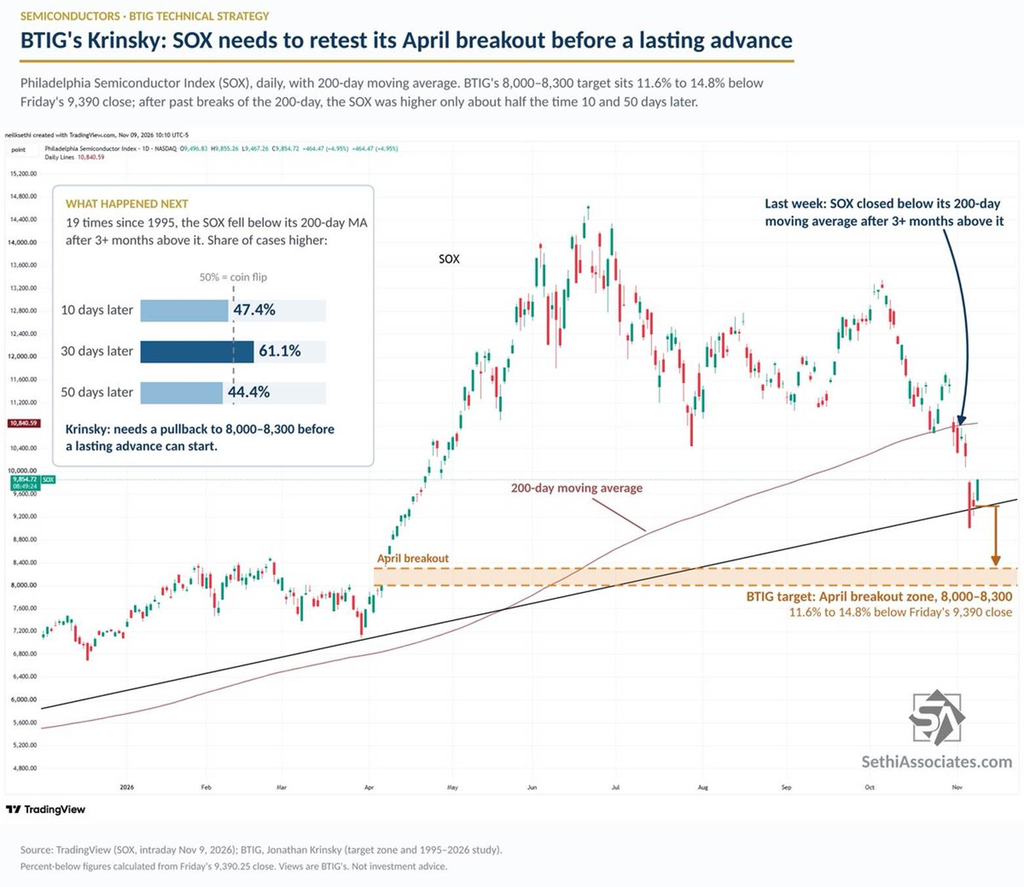
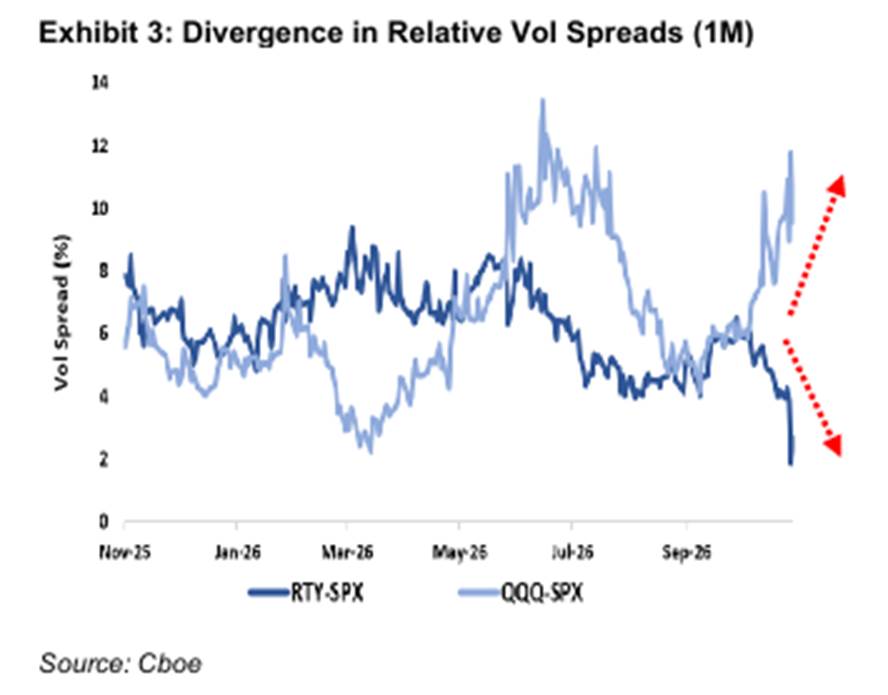
Cboe’s Mandy Xu notes that so far “the pain has been largely concentrated in the Tech sector,” with implied correlation (COR1M) rising only to 22% Thursday, versus an average closer to 70% after a 4% S&P 500 drop over the past 20 years. “Right now, the options market is still pricing for a rotation trade (AI vs. everything else), with very little fear of contagion.”
Stock and Sector Breakdown
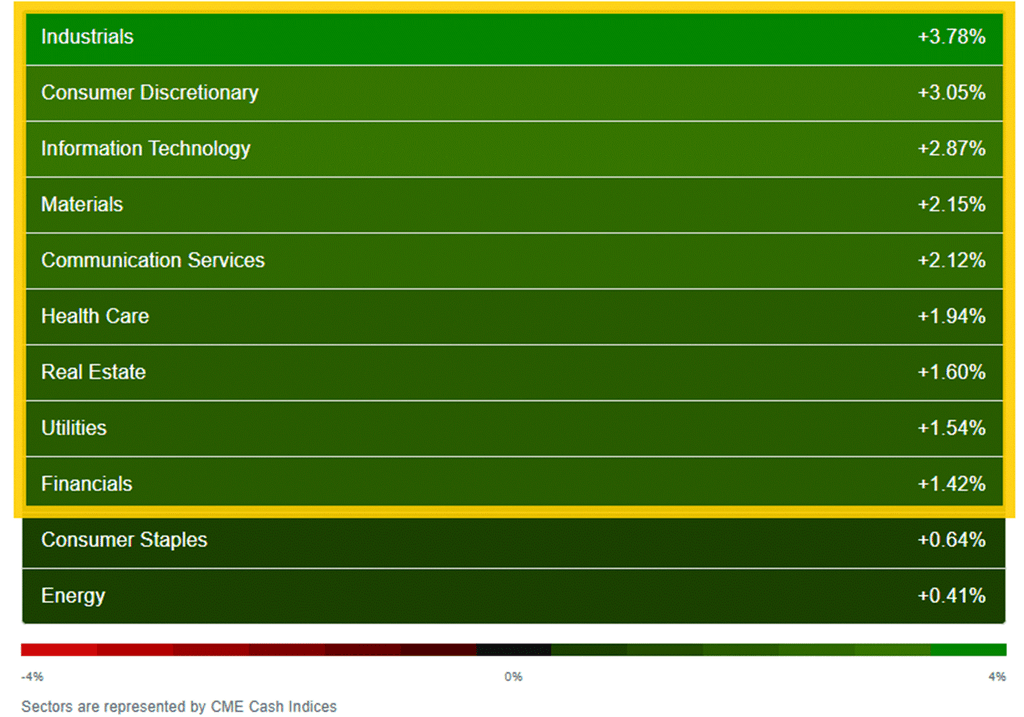
All 11 sectors rose, nine of them more than 1%, led by Industrials (+3.8%), Consumer Discretionary (+3.1%) and Tech (+2.9%). Staples (+0.6%) and Energy (+0.4%) lagged, the latter as oil fell.
423 S&P 500 stocks rose and 78 fell, with 158 gaining more than 3%, the most since August, and just six falling that much.
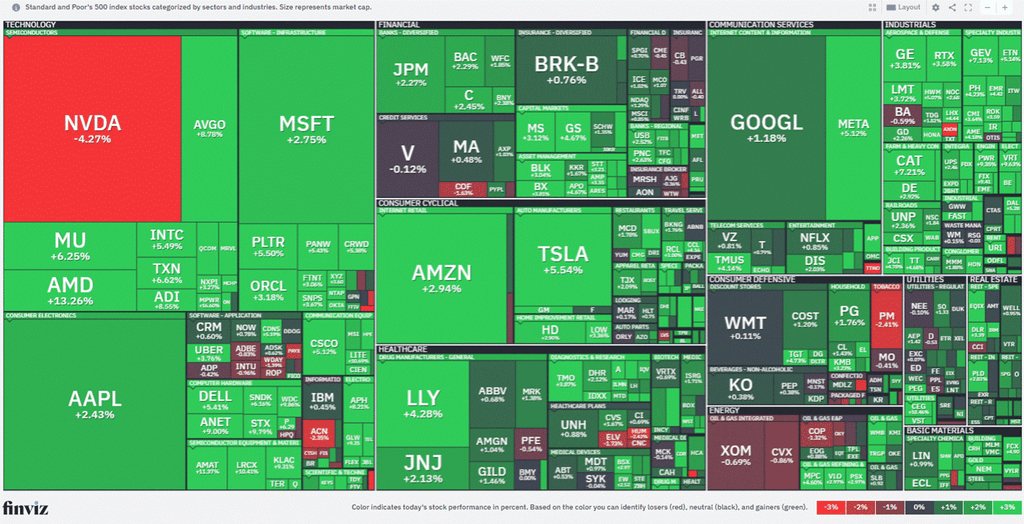
Coherent (COHR) and Monolithic Power (MPWR) led the S&P 500 with gains of about 17%, while First Solar (FSLR, -4.7%) was the worst performer, followed by Nvidia and Take-Two (TTWO, -3.5%).
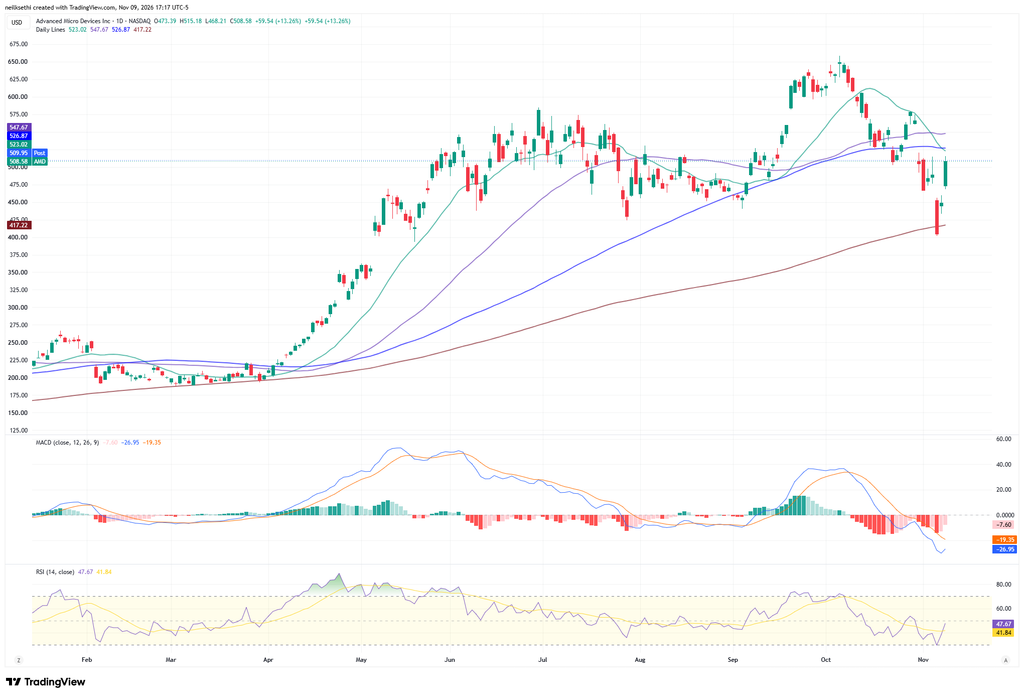
Chips did the heavy lifting. AMD (AMD) jumped 13% after an upgrade to outperform at Oppenheimer, and Stephen Guilfoyle is adding AMD and raising his price target. I re-shorted, as it has run 25% in two sessions and is running into resistance, but I have a stop at $531.
Teradyne (TER) also rose about 13%, Applied Materials (AMAT) 11% and Lam Research (LRCX) 10%, while Micron (MU) gained 6%. Optical and storage names that led last week’s selloff bounced hard, with Lumentum (LITE), Ciena (CIEN), Seagate (STX) and Western Digital (WDC) up 10% to 11%.
AI power names rallied too. Bloom Energy (BE) rose 12%, Constellation Energy (CEG) and NRG Energy (NRG) about 10% after their reports, and Vistra (VST) 7%. NRG CEO Robert Gaudet said his conviction in the company’s Texas data center project “has only strengthened,” easing worries that Democrats’ gains in the state would slow the buildout there.
Among other reporters, Ferguson (FERG) jumped 11% and KKR (KKR) 1.7%. Skydance (SKYD) rose 8.6% after James Gunn and Peter Safran stepped down as co-heads of DC Studios, then slipped about 4% after hours following its first earnings report since the merger. Take-Two (TTWO) rose about 3% after hours following its report,
Among the megacaps, Broadcom (AVGO) gained 9%, Tesla (TSLA) and Meta Platforms (META) more than 5%, Amazon (AMZN) and Microsoft (MSFT) about 3%, and Apple (AAPL) 2.4%, while Alphabet (GOOGL) rose 1.2% after Google unveiled two new versions of its eighth-generation TPU chips. Caterpillar (CAT, +7.2%) and Goldman Sachs (GS, +4.7%) led the Dow.
Elsewhere, Anthropic unveiled new versions of its Mythos and Fable models ahead of its IPO, which it can begin marketing as soon as Tuesday, and Boeing (BA) slipped 0.6% after saying it will cut 5% of its commercial airplane workforce.
For more on the AI backlash, Bob Byrne says Wall Street Just Torched $2.5 Trillion Over a Word It Doesn’t Understand, and Bret Jensen thinks the windows for AI debt, IPOs and data center permits appear to be closing.
FedWatch
Fed rate-hike expectations rose with the stock rally. The odds of a December hike are now 85%, up from 77% Friday and back to where they were a week ago, with 50 basis points of hikes priced through December 2027 (about two hikes), up from 44bp, per CME FedWatch.
More From TheStreet Pro
Rev Shark — Political Trades Seem Obvious After Elections. That’s What Makes Them Dangerous.
Stephen Guilfoyle — Wall Street’s Painful Lesson: All Politics Is Local
Chris Versace — Why CoreWeave’s Earnings Call Will Be Important to Watch
Bob Lang — Charting the Markets: S&P 500 Is Nearly at a Corrective Phase
Doug Kass’s Diary:
- Sleepless in Palm Beach
- Market Observation
- More Tales From Nvidia: Sex, Lies and Nvidia (Issue #272!)
- Sold Balance of My Index Longs
- AMD Up, NVDA Down: Upside, Downside Movers in the Morning
- More Tales From Nvidia: More Funny Business (Issue #273!)
- More Tales From Nvidia: Questions I Ask Myself (Issue #274!)
Note: Doug posted 19 Diary entries today; these are the market ones.
And From Me If You Missed It
- The Week Ahead — CPI and Equity Flows Test a Shaken Market
- The Day Ahead: A Quiet Start to the Week
- Equity Positioning Got Cleaned Out in a Hurry Last Week
- Consumer Credit Surges the Most Since 2022 as Credit Card Balances Jump
- Consumers’ Inflation Expectations Remain at Multi-Year Highs, Straining Household Finances
- CPI Preview: Cooler, but Probably Not Enough to Stop a December Hike
Miscellaneous
Strategists and positioning:
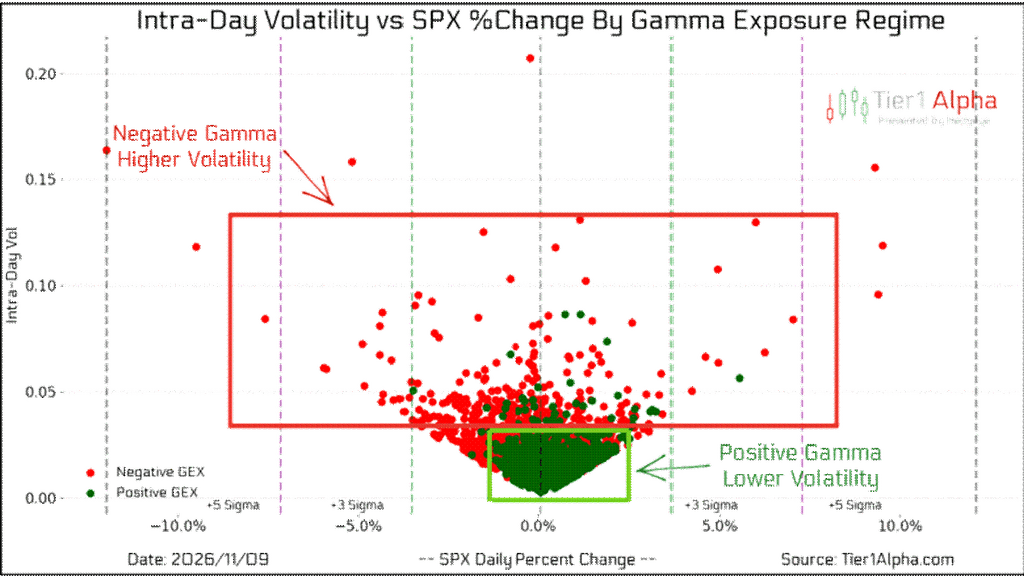
Tier1Alpha said this morning, consistent with BofA in the Week Ahead, that the S&P 500 started the week in negative gamma but they astutely said “we want to emphasize again that negative gamma is primarily about volatility, and not inherently direction. When market makers are short gamma, they are forced to hedge their delta exposure in the same direction as the underlying momentum, selling futures into declines and buying futures into rallies, which can exacerbate price swings in both directions.
“This is particularly important given the current setup, where a reversal in momentum could easily trigger a sharp, convex rally, potentially amplified by other directionally sensitive strategies such as leveraged ETFs and CTAs.”
And that’s exactly what we saw. They caution though: “Given these dynamics, we’d caution against reading too much into short-term price action unless it’s accompanied by a meaningful change in the underlying positioning. As we’ve been highlighting, it’s easy to get fooled by the flows when, in reality, very little has structurally changed.”
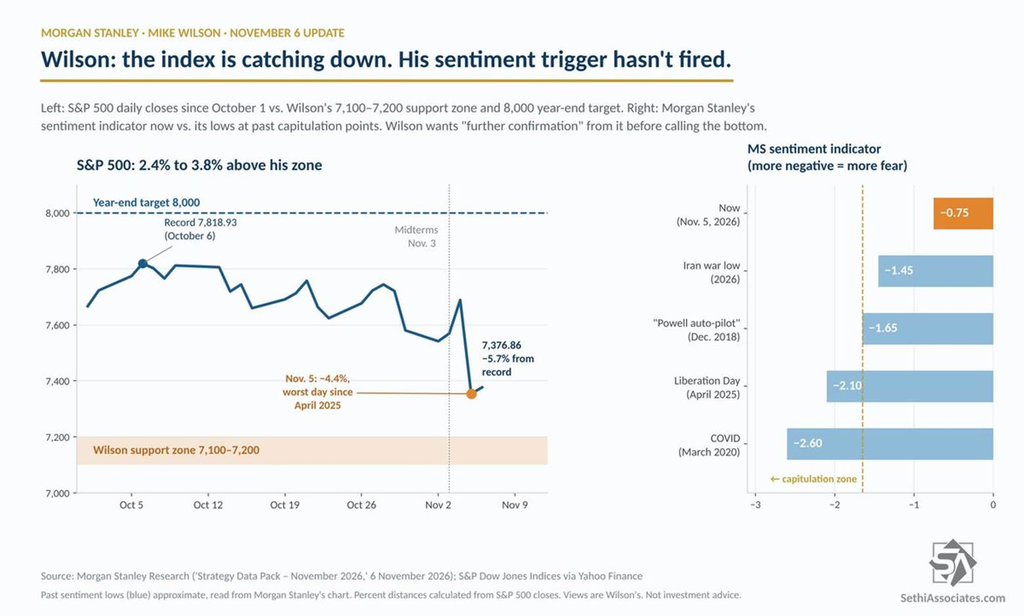
Morgan Stanley’s Mike Wilson says the S&P 500 “catching down” to weaker breadth “is likely the final stage of this correction,” after he rightly called for more weakness in semis on a big Democratic win. But he isn’t calling the bottom yet (“We are getting close, but would like to see… further confirmation from our sentiment indicator”), and liquidity, the clearing event he ranks most important, hasn’t cleared, with Friday’s payrolls pushing December hike odds higher. He still sees 7,100 to 7,200 (2.4% to 3.8% below Friday’s close) before his 8,000 year-end target, and notes the average stock is holding up better than the index, with equal-weight beating cap-weight by 5.9 points in October, the second-widest monthly gap since 2003.
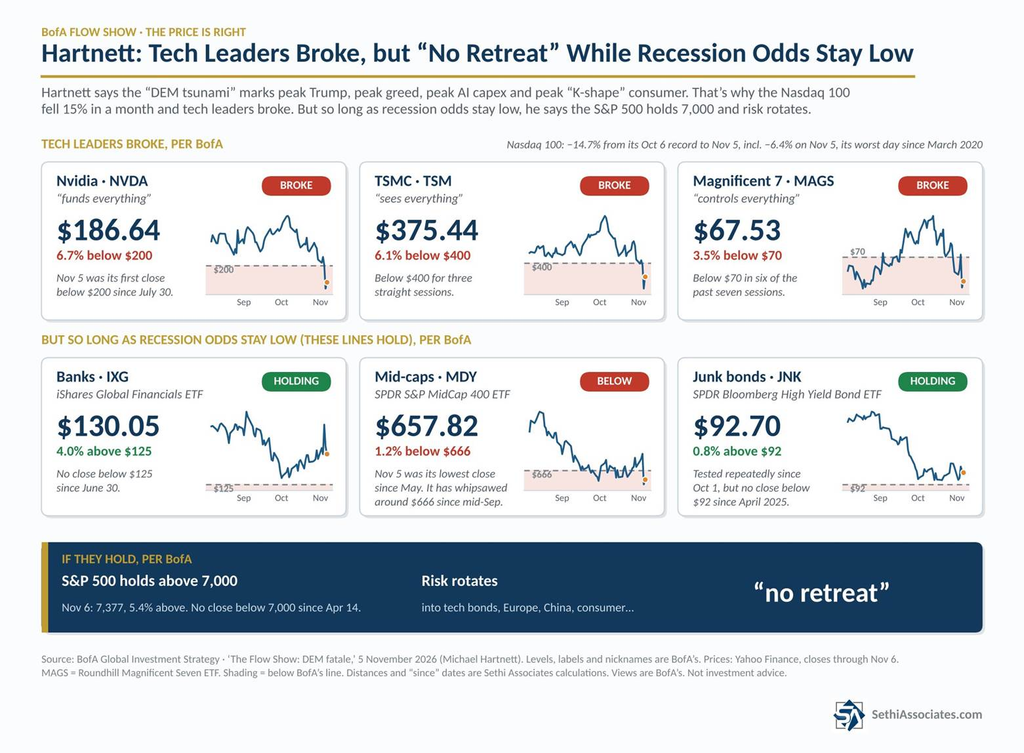
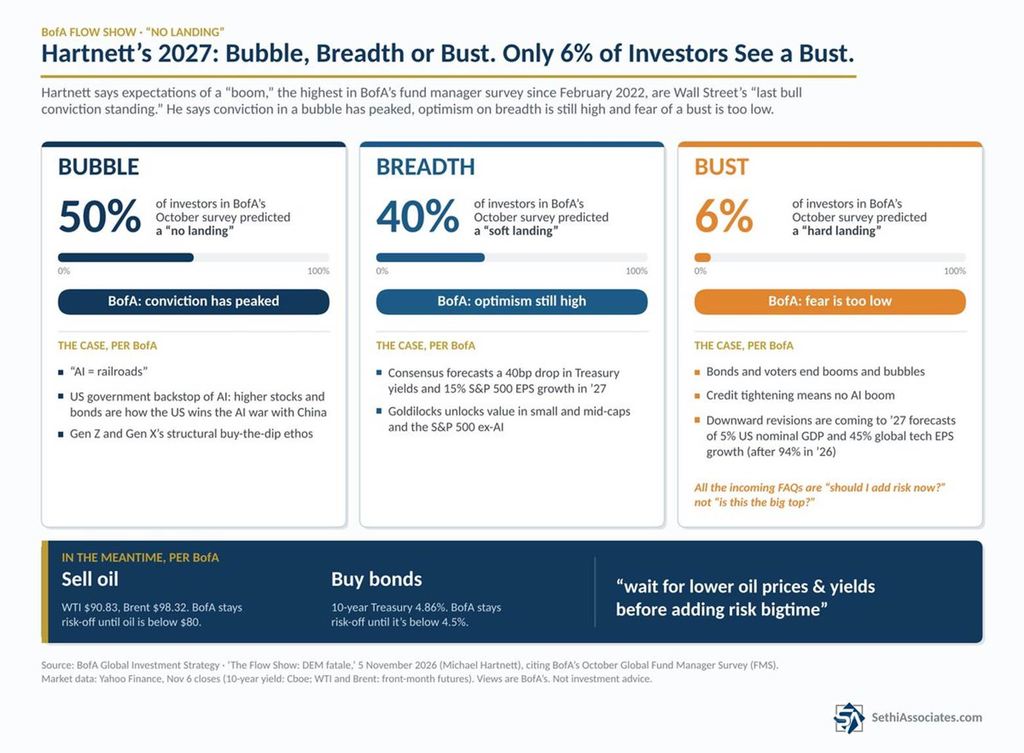
BofA’s Michael Hartnett (Flow Show) says the “DEM tsunami” marks peak Trump, peak greed, peak AI capex and peak “K-shape” consumer, which is why “tech leaders broke”: Nvidia below $200, TSMC below $400 and the Magnificent 7 ETF (MAGS) below $70. But “so long as recession odds stay low,” meaning banks (IXG) hold $125, mid-caps (MDY) $666 and junk bonds (JNK) $92, he says the S&P 500 holds 7,000 and “risk rotates… no retreat.” As of Friday, only mid-caps had broken their line, closing 1.2% below it for a second day.
Hartnett also says Wall Street’s “last bull conviction standing” is expectations of a “boom,” the highest in BofA’s fund manager survey since February 2022. Of his three 2027 scenarios, “bubble, breadth, bust,” he says conviction in a bubble “has peaked” and fear of a bust is “too low,” with just 6% predicting a hard landing. His call: “sell oil, buy bonds, wait for lower oil prices & yields before adding risk bigtime,” with $80 WTI and a 4.5% 10-year yield the levels that would end his risk-off stance (vs. $90.83 and 4.86% Friday).
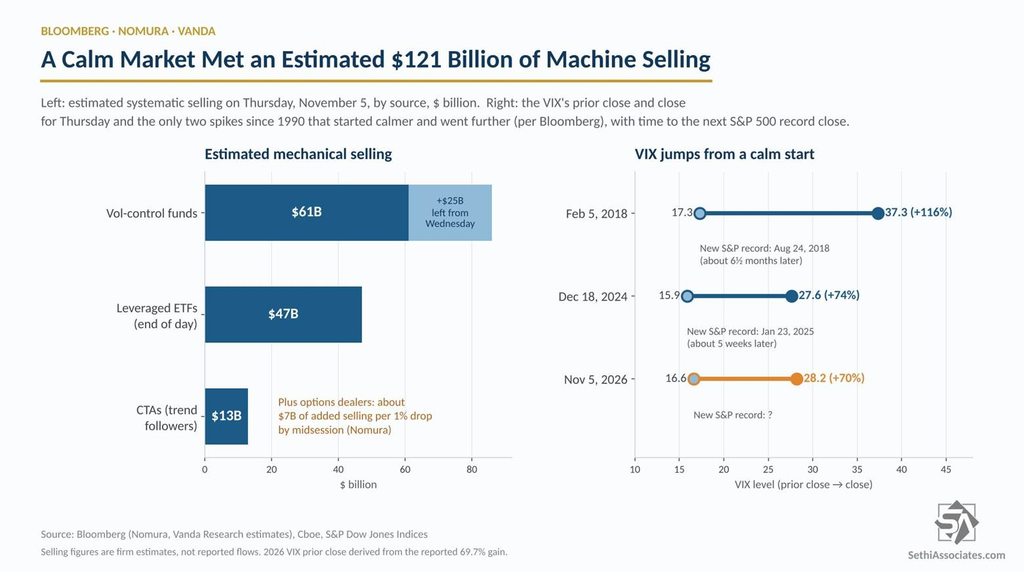
Bloomberg’s reconstruction of Thursday’s rout: retail sold first, hedge funds and long-only managers piled on, no buyers emerged, and then the machines took over. Nomura’s Charlie McElligott estimated options dealers added about $7 billion of selling for every 1% drop, with vol-control funds needing to sell about $61 billion and leveraged ETFs $47 billion. The VIX started the day at 16.6 and jumped 70%, and only two spikes since 1990 started lower and went further (February 2018 and December 2024). Both ended with new S&P 500 highs, five weeks and six and a half months later. With CTAs and vol-control funds having cut exposure, Bloomberg says the forced sellers look mostly spent, the usual setup for a bounce.
AI:
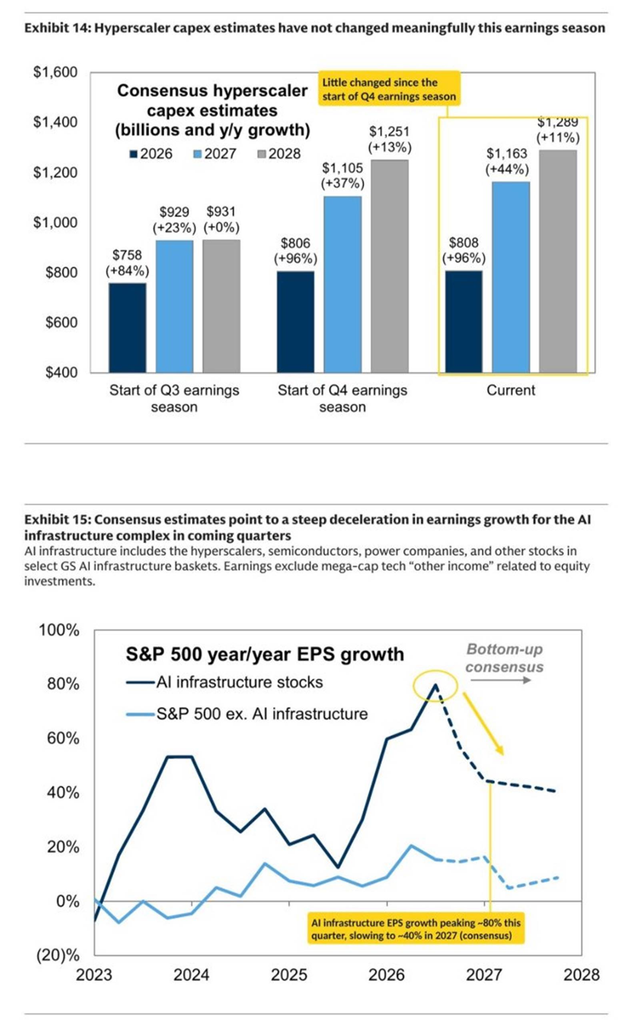
Even before the elections, Goldman saw the growth rate of AI capex peaking. Hyperscalers are on track to spend about $800 billion this year (+96%), and analysts see $1.2 trillion in 2027 (+44%), with earnings growth for S&P 500 AI infrastructure stocks peaking at 80% this quarter and slowing to about 40% in 2027.
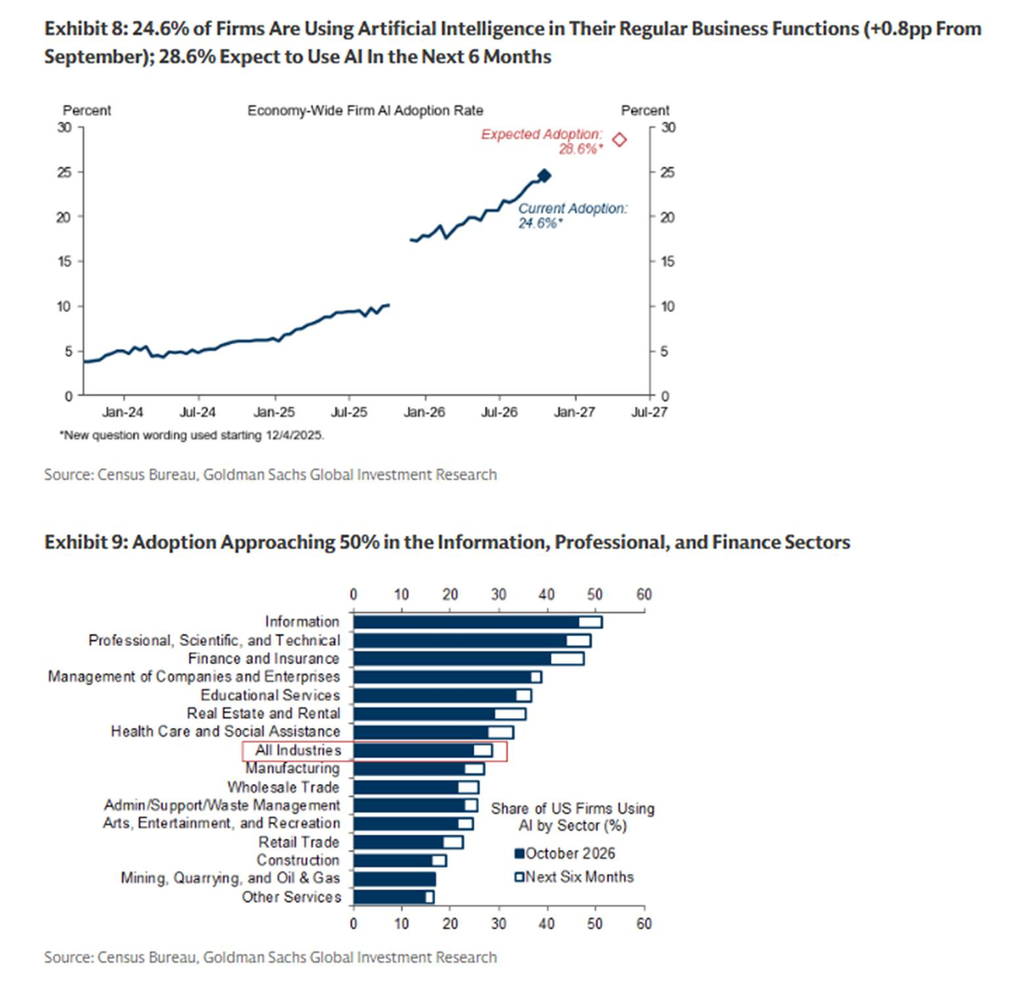
What isn’t slowing, Goldman notes, is AI adoption, which rose to 24.6% of US firms in the Census Bureau’s latest survey and is expected to reach 28.6% in six months, with adoption approaching 50% in the information, professional and finance sectors.
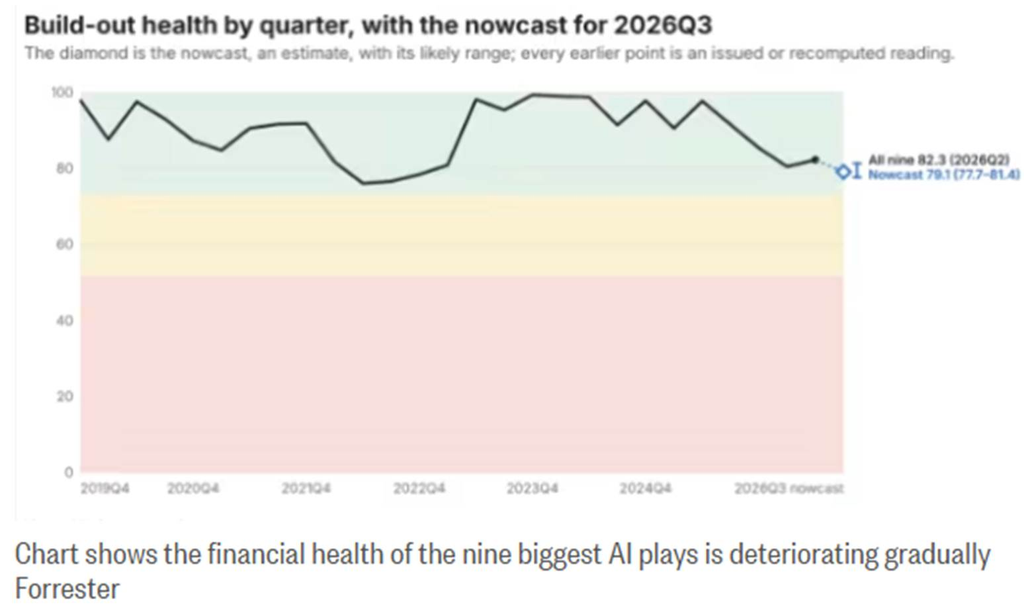
Forrester Research says a bursting of the AI bubble isn’t imminent, but signs of strain are showing, as capex has outrun operating cash since September. Amazon spent $77 billion vs. $42 billion of cash, Alphabet and Meta also overspent, and Oracle spent $1.61 per operating dollar. Forrester estimates US GDP needs to rise 5% by 2035 to justify the current buildout.
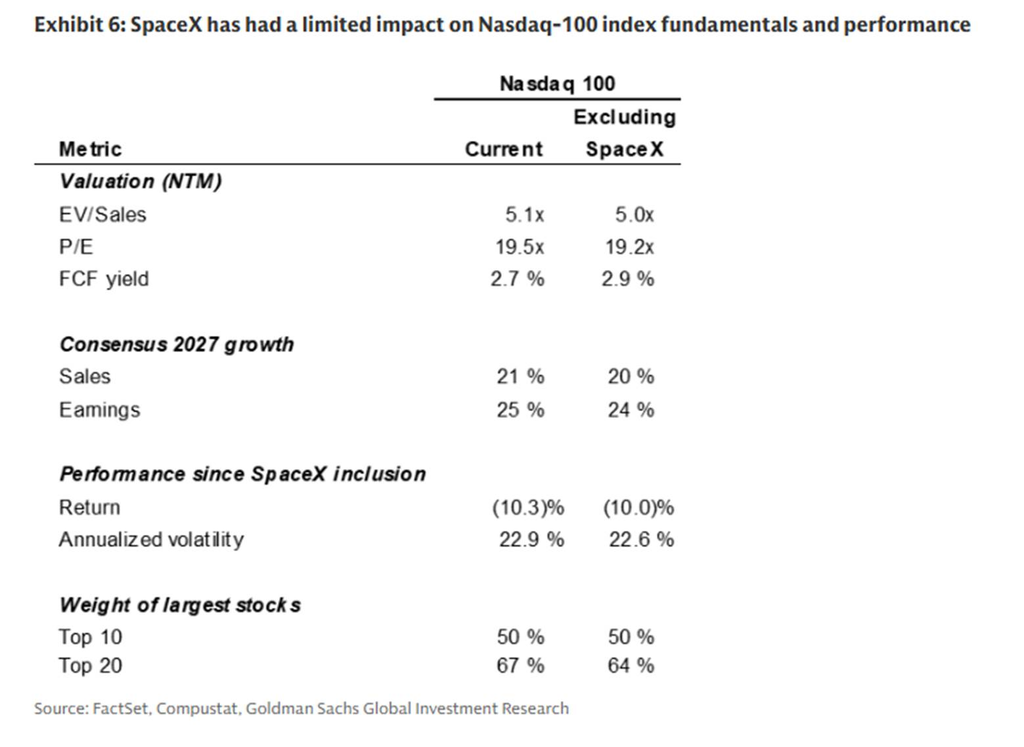
Goldman says that outside the trading around its IPO, SpaceX (SPCX) has had much less impact on the indexes than many expected. Excluding it would lower the Nasdaq-100’s P/E by less than half a turn, much like Tesla’s 2020 inclusion in the S&P 500.
Economy:
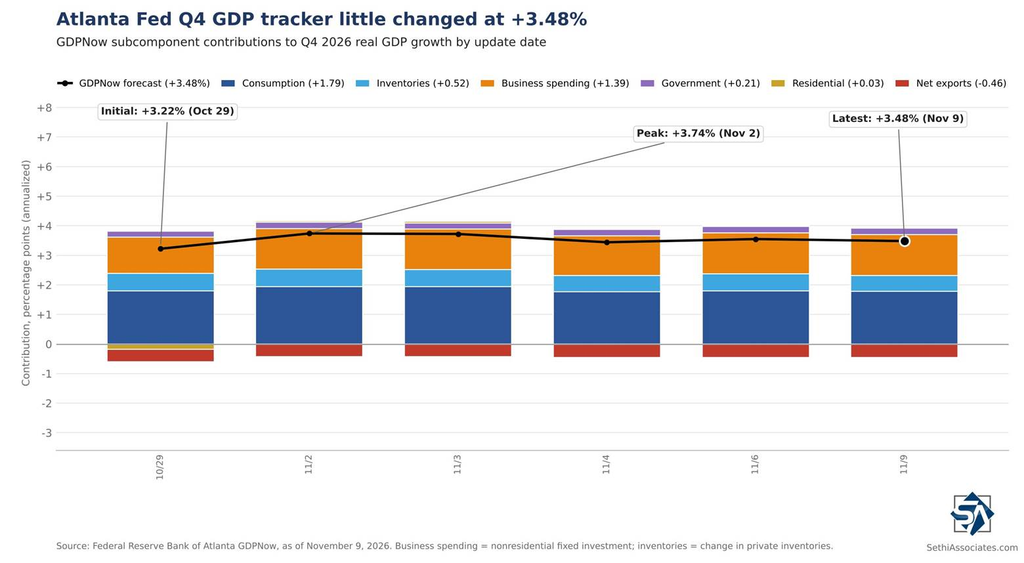
The Atlanta Fed’s GDPNow barely moved after Friday’s blowout jobs report, rising just 0.11 point to 3.55% before giving back 0.07 point after this morning’s wholesale trade report. That leaves it at 3.48%, still well above the roughly 2.1% Blue Chip consensus.
International:
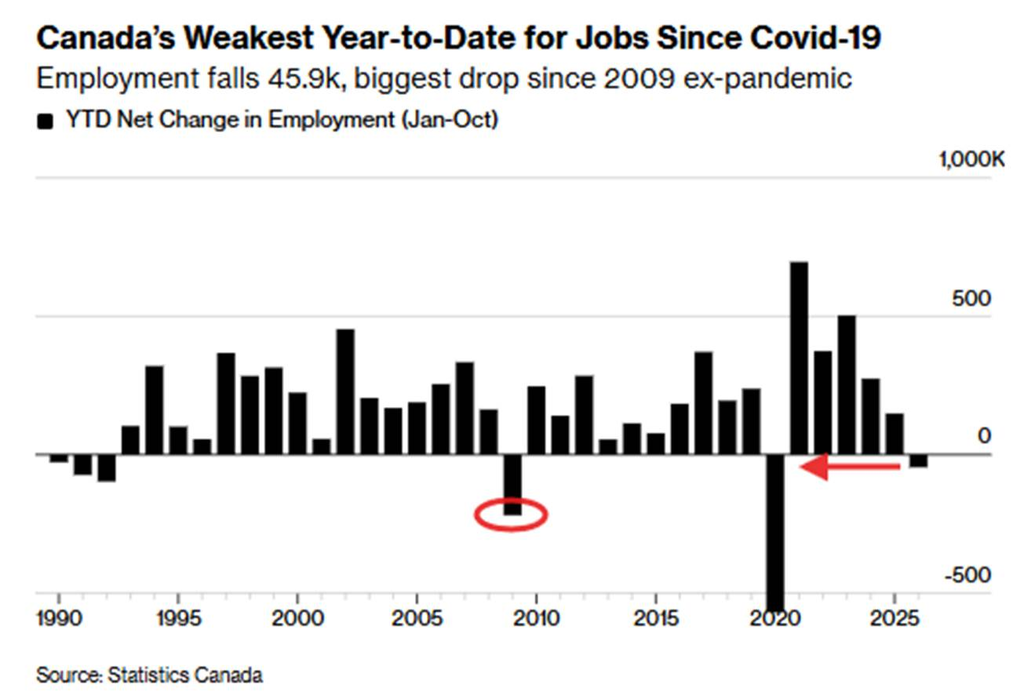
Canada has gone the other way from the US, with a third straight month of job losses, putting it on track for its weakest year since 2009 outside of 2020 as tariffs hit trade employment. That hasn’t stopped the Bank of Canada from raising rates, which it did last week.
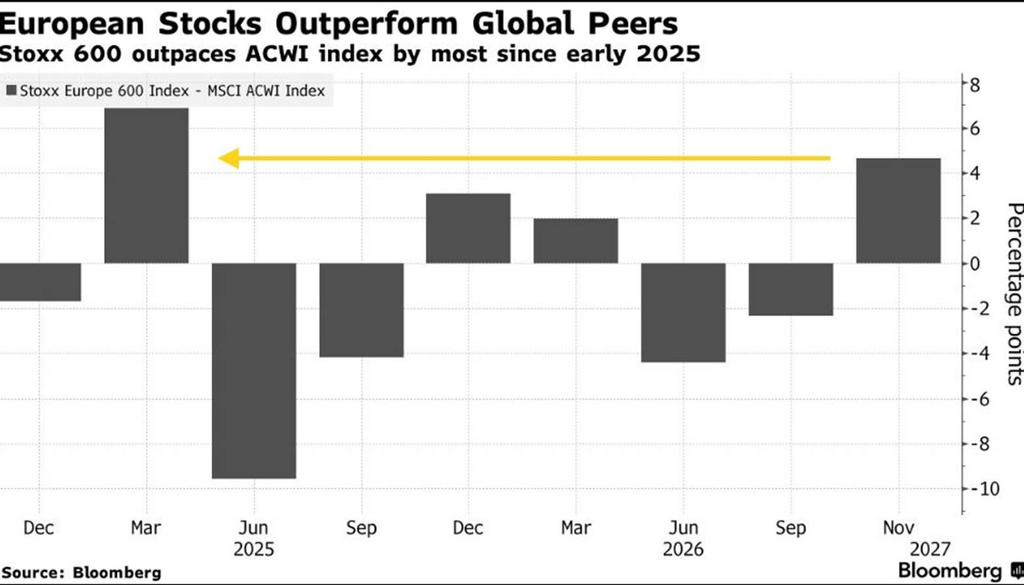
Coming into Friday, Europe’s Stoxx 600 was on track for its largest quarterly outperformance over the MSCI All-Country World Index since the start of 2025, per Bloomberg.
Wrap-Up — A Broader Bounce
I said Sunday I was taking it one day at a time and that “Friday’s weak bounce doesn’t make me super optimistic,” so I have to admit I was surprised by today’s rally given that. But as Tier1Alpha noted, that’s exactly what can happen with markets in negative gamma, as moves gain momentum from dealer flows in the direction of the move.
For now, as Helene mentioned this morning, it remains just a bounce. But I can’t ignore Max Kettner joining Deutsche Bank and Scott Rubner in the outright bullish camp, with Ed Yardeni leaning in that direction as well. Even Doug Kass says he’s no longer a Cassandra, having begun to accumulate selected equities Thursday.
And as my charts post will show, other than the Nasdaq-100 (NDX), which ran right up to its 200-DMA, there’s room for this rally to extend before it hits resistance. The NDX will be the one to watch tomorrow to see how it deals with that resistance.
Of course we get a new catalyst tomorrow in CPI, the last before the December FOMC. A hot print could put a damper on things, while a cool print likely fuels the rally.
As always, let’s see what we get and go from there.
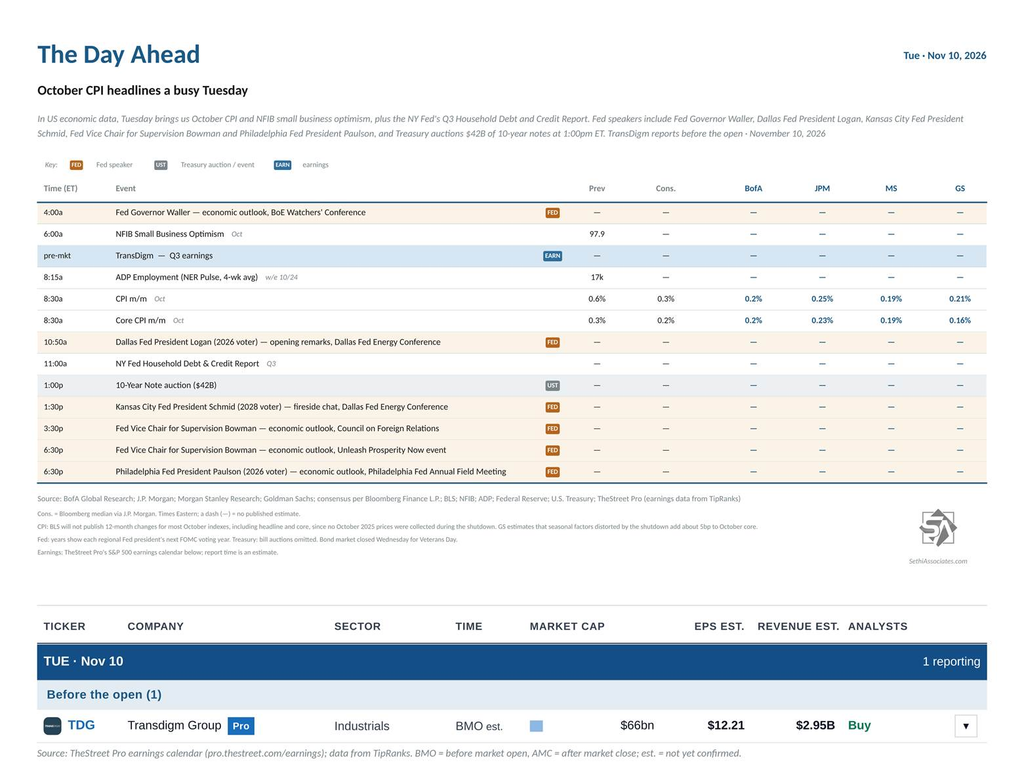
The Day Ahead — October CPI Headlines a Busy Tuesday
In US economic data, Tuesday brings us October CPI and NFIB small business optimism, plus the NY Fed’s Q3 Household Debt and Credit Report. Note that BLS won’t publish 12-month changes for most CPI indexes, including headline and core, since no October 2025 prices were collected during the shutdown. For a CPI preview, see CPI Preview: Cooler, but Probably Not Enough to Stop a December Hike.
Fed speakers include Fed Governor Waller, Dallas Fed President Logan (2026 voter), Kansas City Fed President Schmid (2028 voter), Fed Vice Chair for Supervision Bowman and Philadelphia Fed President Paulson (2026 voter).
Non-Bill (>1yr in maturity) US Treasury auctions bring us a $42B 10-year note sale at 1:00pm ET.
One S&P 500 component reports:
Before the open: TransDigm (TDG).
Outside the S&P 500, we’ll hear from Petrobras (PBR), Sea (SE), Vodafone (VOD), Venture Global (VG), CoreWeave (CRWV) and On Holding (ONON).
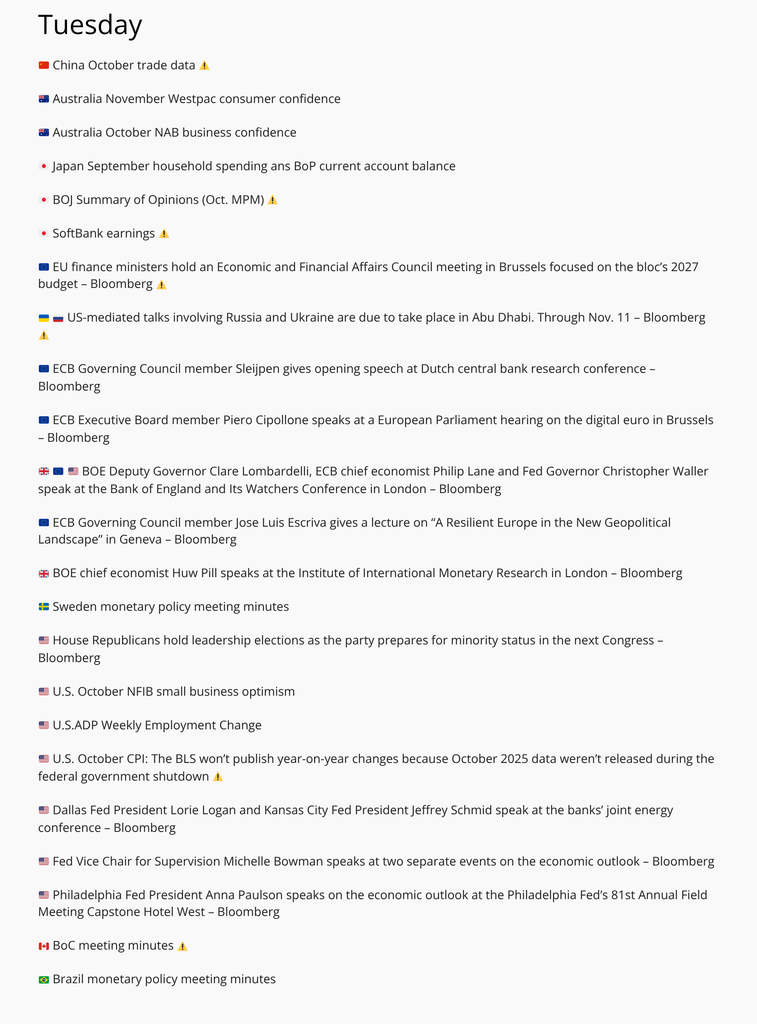
Ex-US highlights include China’s October trade balance, Japan’s October Economy Watchers survey and September household spending, and October CPI in Norway and Denmark. The Bank of Canada releases the Summary of Deliberations from its last meeting (1:30pm ET) and Brazil’s central bank its Copom minutes, while the ECB’s Cipollone, Lane and Escriva and the BoE’s Lombardelli and Pill speak. US-mediated talks between Russia and Ukraine are expected Tuesday and Wednesday.
From Christophe Barraud’s international Week Ahead rundown:
At the time of publication, in terms of securities mentioned, Sethi was long AMZN, ASML, AVGO, BA, CEG, CPER, GOOGL, GS, META, MSFT, PLTR, SKYD, SPY, IWM, RSP and numerous Treasury ETFs, and short AMAT, AMD, LRCX, MU and QQQ. Since Friday’s close Sethi sold his position in APP and OXY, covered DELL, covered CPER and META and went long, bought ASML, added to PLTR, shorted AMD and QQQ, and added to his MU short.