Consumer Credit Surges the Most Since 2022 as Credit Card Balances Jump
Credit card balances jumped the most since November 2023 in September, pushing those and total consumer credit to record highs, but after inflation still smaller than a year ago.
You've reached your free article limit
You've read 0 of 1 free Pro articles.

As a reminder, this report captures balances outstanding at a point in time and is not necessarily a reflection of interest-bearing debt — a meaningful share of revolving (credit card) balances gets paid off within the grace period each cycle before any interest accrues, so the outstanding figure should be taken in that context. It also does not include mortgage debt.
U.S. Consumer Credit (USD) Sep: $27.84 billion (est $13.80 billion; prev $8.28 billion; prevR $8.19 billion)
Executive Summary
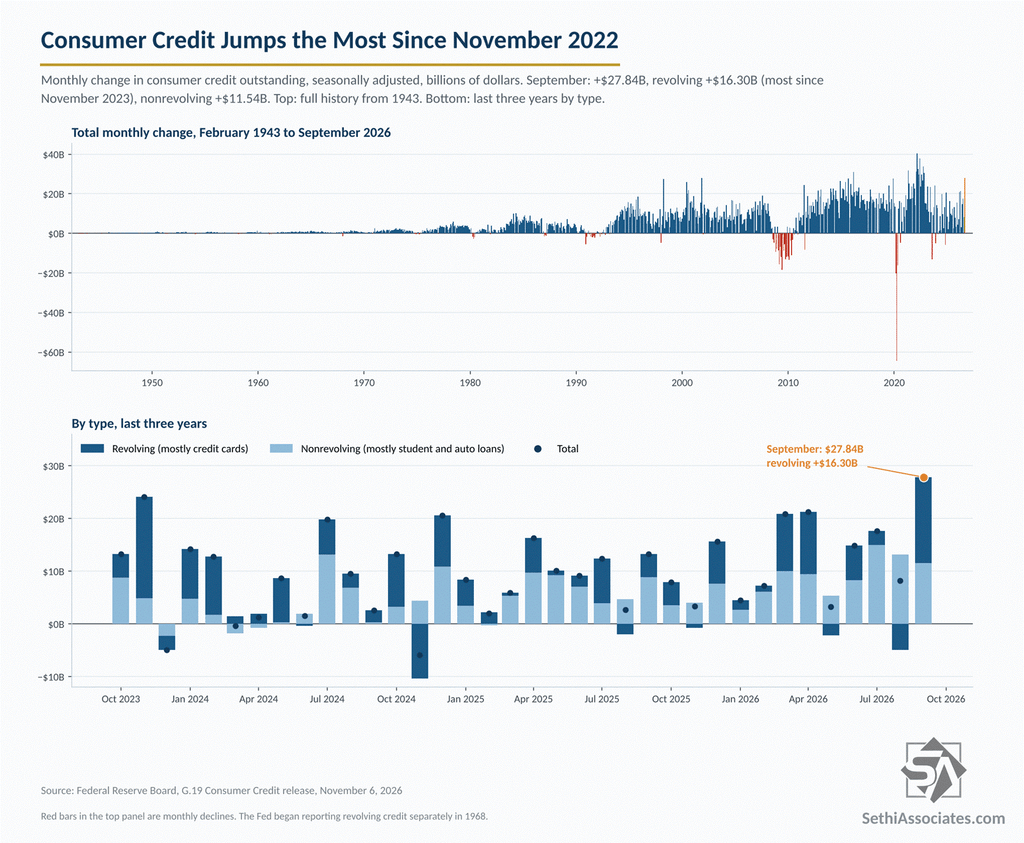
- Consumer credit rose $27.84 billion in September, the most since November 2022 and about double the $13.80 billion consensus.
- Revolving credit (mostly credit cards) jumped $16.30 billion, the most since November 2023, a month after its biggest drop since November 2024. Nonrevolving credit (mostly student and auto loans) rose $11.54 billion, capping its biggest three-month gain since December 2022.
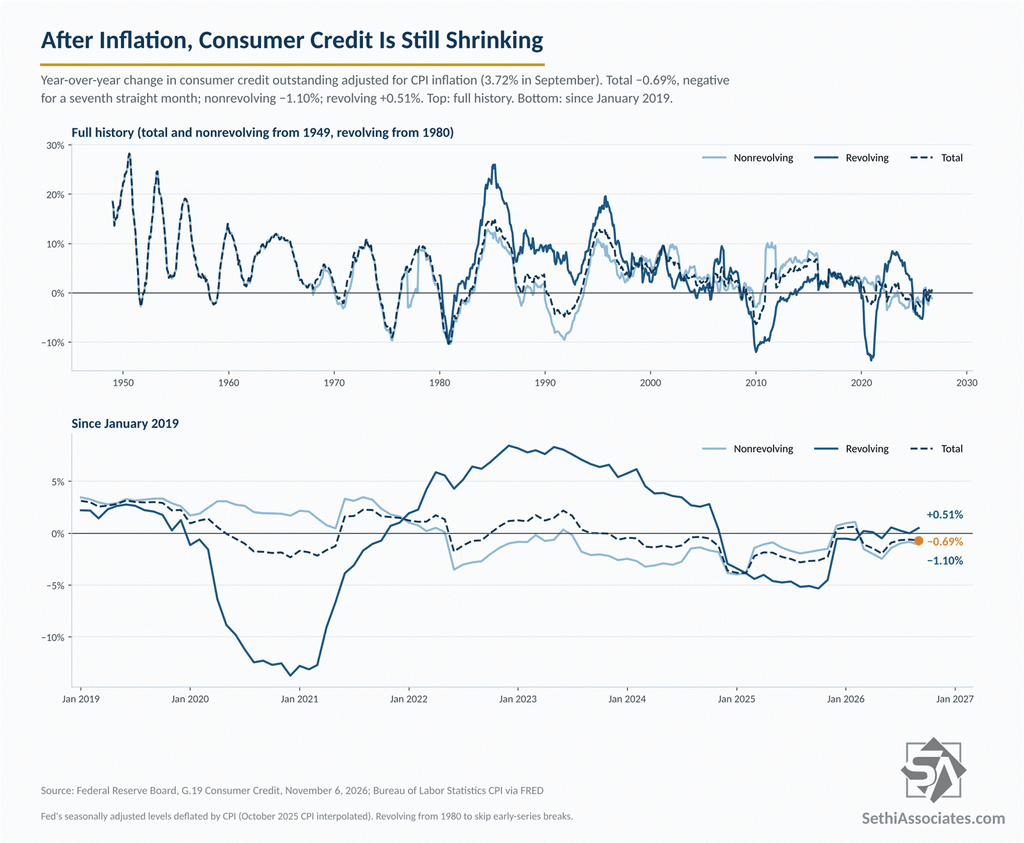
- All three measures hit record highs, but after 3.7% CPI inflation, total consumer credit is down 0.69% from a year ago, the seventh straight month below zero.
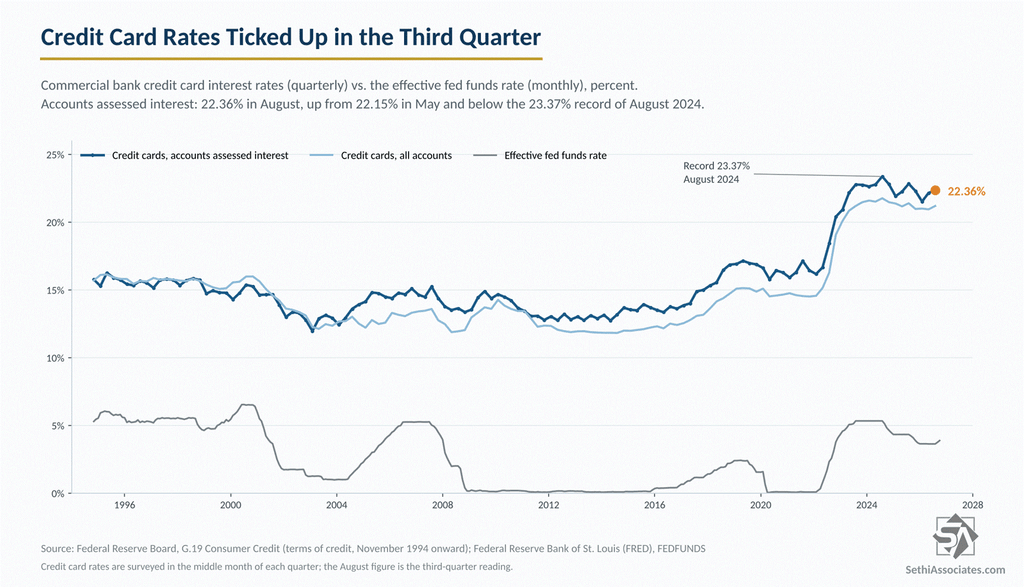
- The average card rate on accounts assessed interest rose to 22.36% in the third quarter, a record 18.73 percentage points above the fed funds rate.
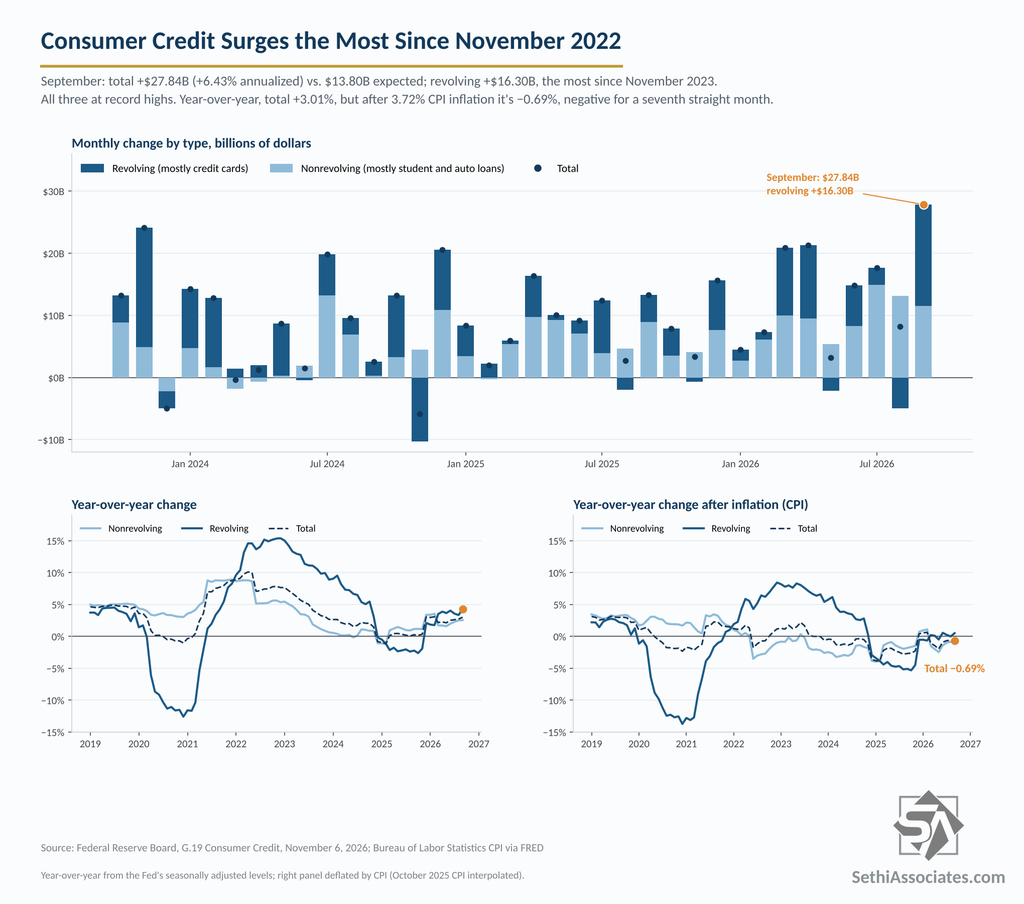
Late Friday the Fed reported that total consumer credit rose $27.84 billion in September, the most since November 2022, about double the $13.80 billion consensus in my Day Ahead and above every estimate in Bloomberg’s survey.
Revolving credit (mostly credit cards) rose $16.30 billion (+14.46% at a seasonally adjusted annual rate, or SAAR), the most since November 2023, after a downwardly revised $4.97 billion drop in August (from $4.79 billion) that I covered last month. That puts revolving balances at a record $1.368 trillion.
Stepping back though, August and September added $11.33 billion, or about $5.67 billion a month. That’s only a bit above the $4.64 billion monthly average of the past year, so September looks more like a catch-up than a break in the trend.
Nonrevolving credit (mostly student and auto loans, roughly three times the size of revolving) rose $11.54 billion (+3.60% SAAR), after $13.16 billion in August and $14.93 billion in July. That’s $39.63 billion over three months, the most for any three-month stretch since December 2022, and it took nonrevolving balances to a record $3.856 trillion.
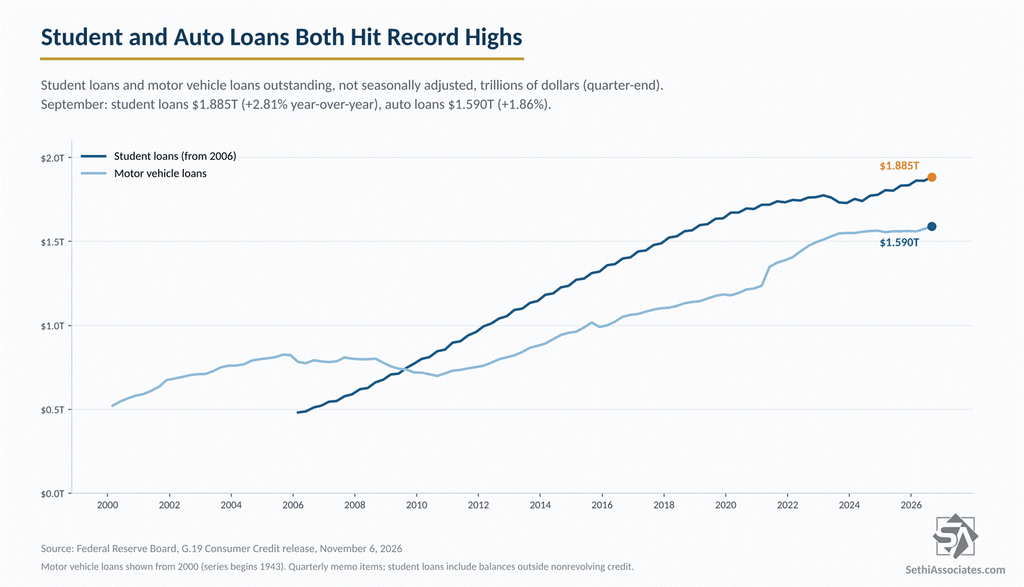
The Fed’s quarterly detail shows student loans at a record $1.885 trillion at the end of September, up $22.70 billion in the third quarter, and auto loans at a record $1.590 trillion, up $15.14 billion.
Faster Growth, but Not After Inflation
From a year ago, revolving credit is up 4.25%, the fastest since October 2024, from 3.35% in August. Total consumer credit is up 3.01%, the most since February, from 2.73%, to a record $5.224 trillion, and nonrevolving is up 2.57% from 2.51%.
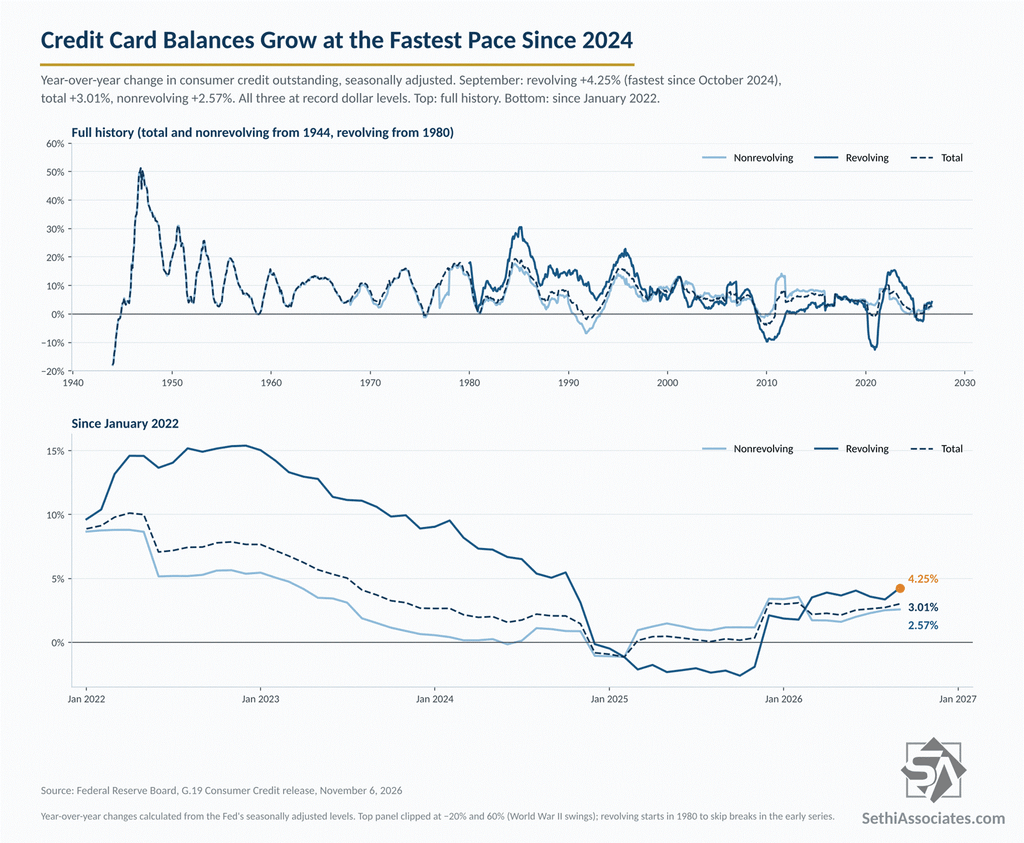
Adjust for inflation, though, and the picture flips. With September CPI at 3.7% year-over-year (see Hot CPI Puts October Rate Hike Back in Play), total consumer credit is down 0.69% from a year ago in real terms, the seventh straight month below zero. Nonrevolving is down 1.10%, and card balances are up just 0.51%.
For comparison, real consumer credit grew an average of 2.91% a year from 2010 through 2019, and real card balances grew as fast as 8.45% in December 2022.
Card Rates Edge Higher
The Fed’s quarterly survey showed the average rate on credit card accounts assessed interest rose to 22.36% in the third quarter, the highest since August 2025, from 22.15% in the second quarter. That’s still below the 23.37% record of August 2024, but the gap over the fed funds rate widened to 18.73 percentage points, the widest in the Fed’s data back to 1994, as card rates have come down only about 1 point from their peak while fed funds is down 1.70 points. Bloomberg noted that high card rates have become a rare bipartisan issue in the midterms.
What to Watch
Bloomberg reads the data as consumers leaning on credit to keep spending while pay struggles to keep pace with prices. The numbers back that up: average hourly earnings rose 3.12% from a year ago in the jobs report, below that 3.7% inflation rate; real take-home pay for private workers was up just 0.66% as of September; and real consumer spending stalled in September.
The question is whether borrowing can hold up as rates move higher. Card rates generally float with the prime rate, so a December Fed hike, now about 78% priced, would just add to the cost for anyone carrying a balance.