Why CoreWeave’s Earnings Call Will Be Important to Watch
Here’s what to keep an eye on as the Nasdaq Composite battles its 200-day moving average.
You've reached your free article limit
You've read 0 of 1 free Pro articles.
The Nasdaq Composite Battles Its 200-Day Moving Average
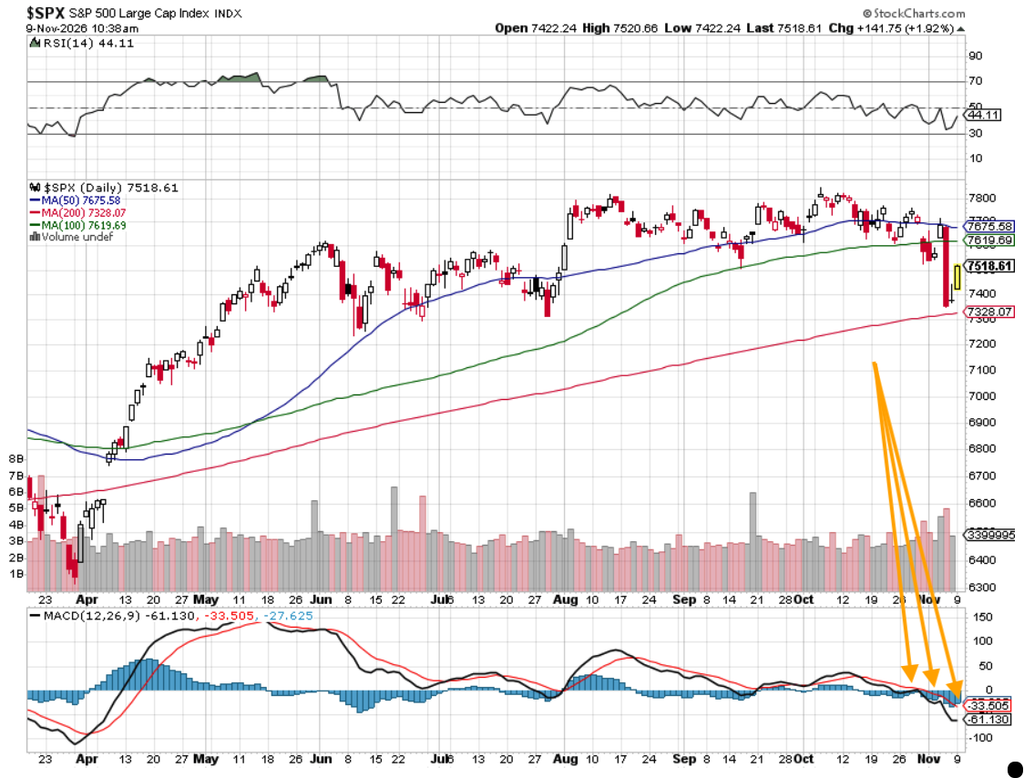
As oil moves lower and the market recovers more of last week’s selloff, we are starting to see a bend in the MACD indicators for the S&P 500 and the Nasdaq Composite in their respective charts below.
As you look at the MACD data, you’ll notice that we saw similar bends in the last few weeks, and they did not lead to a positive upturn. What this tells us is we will need to see more to determine if the market’s rebound has legs or if this is a head fake that we want to avoid falling prey to.
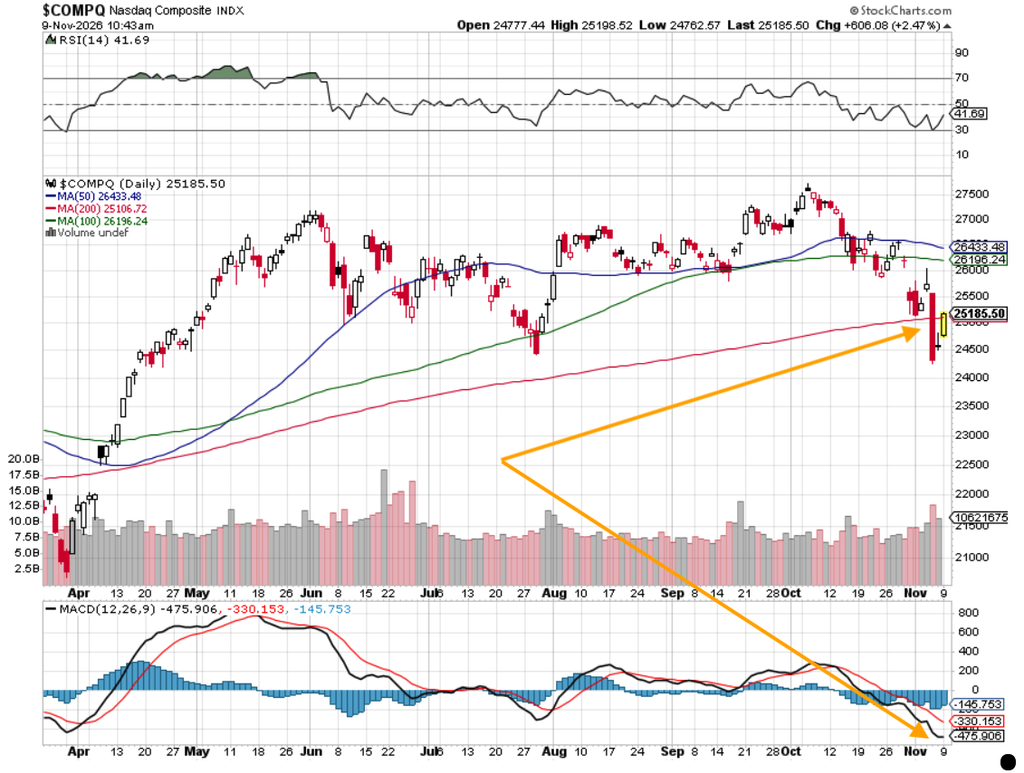
Looking a bit closer at the Nasdaq chart, you’ll see that index is grappling with its 200-day moving day average. As we watch the MACD indicator, we’ll want to see if the Nasdaq closes above that level and delivers a positive re-test. That would be a nice step indicating the market is finding its footing.
In terms of items to watch, tomorrow afternoon brings quarterly results from CoreWeave (CRWV). It’s a pretty safe bet that following the various developments over the last week, the market will be very interested in management’s comments. The thing is, the team has a spotty track record when it comes to CoreWeave’s earnings call presentation, which, at times, has led to sharp pullbacks in the shares despite the steady rise in its backlog.
At the end of June, that figure stood at $104.2 billion up from $66.8 billion at the end of 2025 and $25.9 billion earlier in 2025. Because of reports that Microsoft (MSFT) is winding down its arrangement to rent AI capacity from Oracle (ORCL) as it reassesses its cloud partnerships, there’s a good chance the market will not only be interested in CoreWeave’s backlog figures, but what management says about its pipeline.
Those comments could either help AI infrastructure names find their footing, something that would help the overall market do the same, or raise more questions, potentially resulting in an aforementioned market head fake.
Let’s also remember that CoreWeave exclusively uses Nvidia (NVDA) chips.
One way or another, tomorrow will provide more pieces to the puzzle.
In the back of our mind, we’re also thinking about the continued rise in AI adoption and expanding usage, and what potential zoning impediments and slowdowns could mean. Arguably, similar issues have resulted in solutions for electric and water capacity as well as oil drilling. That, in our view, suggests something similar will happen with data centers given their growing importance to how the economy increasingly works.
But as that gets sorted and hyperscalers and others bring zoned capacity online, what does it mean as they look to channel more of those multi-year backlogs into booked revenue and cashflow?
One possible solution is a wave of M&A activity in which the hyperscalers and neoclouds pick off smaller private data-center companies like Vantage Data Centers, CloudHQ, CyrusOne, Stack Infrastructure, DataBank, PowerHouse Data, Raging Wire, Cologix and others. While not household names, I’ve seen many of them when I’ve driven down data center ally in Ashburn, Virginia. To the extent that they have locations ready with power and water, that would make for some easy pickings.
More Pro Portfolio:
- Taking a Healthcare Winner Off the Board
- Tracking 40 Portfolio Signals Across 10 of Our Strategies
- Weekly Roundup: Riding Out the Blue Wave Whiplash With Cash and a Shopping List
At the time of publication, TheStreet Pro Portfolio was long MSFT and NVDA.