Windows for AI Debt, IPOs & Data Center Permits Appear to Be Closing
Here are three areas that could spell trouble for 2027,
You've reached your free article limit
You've read 0 of 1 free Pro articles.

The market was more than jittery following mid-term election results last week. The Nasdaq ended the week down 3.4% and the S&P 500 fell 2.7%. For the first time this year, my portfolio return for 2026 is above that of both indexes, despite having my heavy allocation to short-term Treasuries in recent quarters. I put some of that “dry powder” to work by executing some covered call trades during Thursday’s big selloff. One new target was Axsome Therapeutics (AXSM), which I highlighted over the weekend.
That said, my allocation to cash and short-term treasuries is still in the high 30s. I plan to incrementally push some more chips into the pot on further declines in equities. The overall market feels there are some important windows that are in the process of closing. That will be the topic for this column:
AI Debt Issuance Window
The credit markets are starting to get indigestion due to the huge surge of AI-related debt issuance. Roughly 35% of hyperscalers’ burgeoning capital expenditure budgets are being financed by debt. Both the interest rates being demanded for further debt issuance and the prices for credit default swaps against that debt are increasing. Meta Platform (META) recently decided to use equity issuance with its recent $95 billion capital raise.
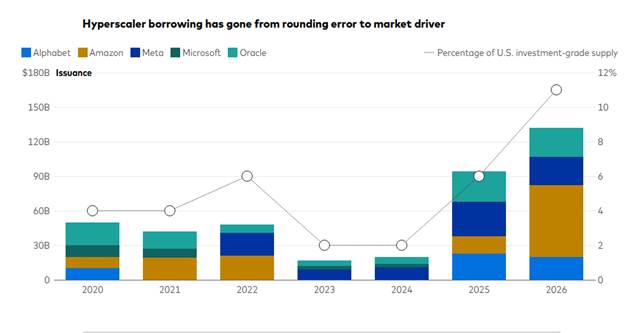
The situation for the neocloud providers is much worse. Debt issued by CoreWeave (CRWV) for example, is trading with north of a 15% yield. The credit default swap prices against its debt imply a better than 50/50 probability of a default within five years.
Data Center Permitting Window
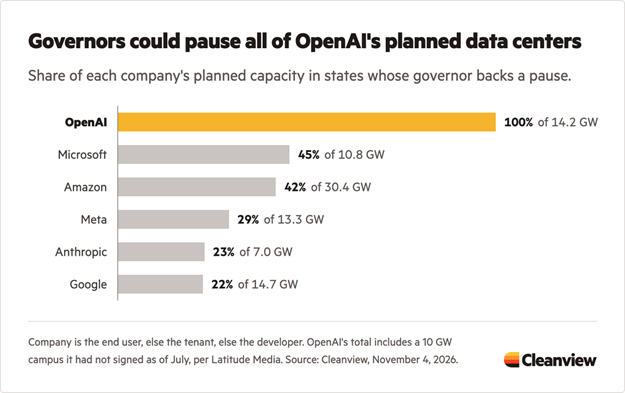
One of the results of the mid-term election landslide is that getting through the process for garnering permits for new AI data centers in states like Ohio and Texas might be elongated or not possible in some cases. State legislation establishing “guardrails” will be a trending headline as 2027 commences. The chart above might be giving executives at OpenAI and Oracle (ORCL) some angina around the challenges ahead.
IPO Window
The most important window that might be closing is the IPO Window. OpenAI pushed off its planned IPO until 2027 and recently had to slash its desired valuation at its most recent funding round. The company also had to cut the amount of new capital it wanted to raise. A month ago, it seems like a good possibility that Anthropic would be able to secure a $2 trillion valuation or close to it with its upcoming IPO. Now $1.5 trillion is the topline of those expectations with $1.2 trillion or even $1.1 trillion a possibility. Much will depend on further data provided by the company like October’s revenue figures and the success of its road show.
One can not blame prospective investors in Anthropic for their potential reticence. CoreWeave was the biggest tech IPO in years when it came public in March 2025. The stock has been pummeled recently and trades for roughly 30% of its post IPO highs. Space Exploration Technologies Corp. (SPCX) is the biggest IPO in U.S. history. The stock is now down to just under its June IPO levels. Elon Musk will also be in the crosshairs of incoming legislatures at both the federal and state level. This could generate negative headlines for the company in the coming months.
Wall Street will enjoy record bonuses this year on the back of massive AI-related debt issuance in 2026 along with record equity issuance. It feels that 2027 will usher in a much more difficult environment to navigate. Both for the investment banks and retail equity investors.
At the time of publication, Jensen was long AXSM.