Stock Market Today

Market updates and conversation from TheStreet Pro team. Follow the latest and join the conversation below.

Stock Market Today: November 9, 2026

Newest first · All times Eastern · 5 updates

DATE:
By Neil Sethi

HSBC’s Kettner Says It’s Time to Buy the Pullback

A follow-up to this morning’s post on whether Tech is ready to rebound: another one of the holdouts I have had my eye on has flipped. HSBC’s Max Kettner, who said on Bloomberg Friday he wasn’t ready to step in yet, after working through his research over the weekend, now says the market’s correction should be used to increase exposure to equities again, and he recommends Tech, especially in the U.S. and Asia, according to MarketWatch.

It’s a quick turn. On October 26 (HSBC’s Kettner Steps Back From Stocks), Kettner cut global equities to tactically neutral from maximum overweight and moved developed-market government bonds to overweight from maximum underweight, positions he had held since March. And as recently as last Tuesday, he said “there’s more pain to come first,” with eurozone and U.S. tech stocks his biggest underweights, according to Investing.com.

His calls have been well timed this year. The S&P 500 rose about 13% from his March 10 move to maximum overweight to his October 26 downgrade (after a 6.5% drop into the March 30 low), then fell 4.2% through Thursday’s close, with the Technology Select Sector SPDR ETF (XLK) down 12.9%.

His bond calls worked too, with the 10-year Treasury yield rising from about 4.1% to a 5.31% peak on October 5 while he was maximum underweight, then slipping to 4.84% from 4.99% after he moved to overweight. The one miss was leaning into U.S. and Asian tech on September 23, two weeks before Tech peaked.
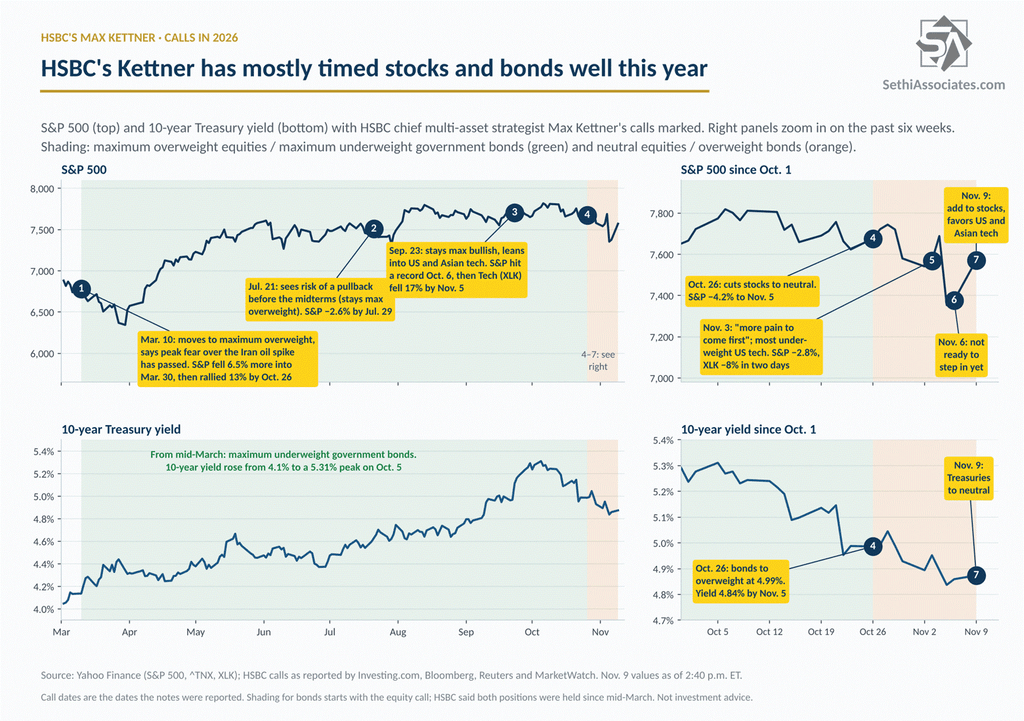
He notes an upcoming catalyst in Anthropic’s IPO, which is drawing closer, along with Nvidia’s (NVDA) earnings next week. “Only a few weeks ago, delaying it [Anthropic’s IPO] again wouldn’t have been as consequential as it is now,” Kettner wrote. “But given the jittery sentiment on AI, we think the IPO is probably the most important catalyst and the real clearing event in the coming weeks.” HSBC also moved its overweight in U.S. Treasuries to neutral, citing an increasingly hawkish Fed and saying the rally has extended too far.

So far, the call has worked out, with the S&P 500 up 2.6% and XLK up 4.0% as of 2:40 p.m. ET.
By Neil Sethi

CPI Preview: Cooler, but Probably Not Enough to Stop a December Hike

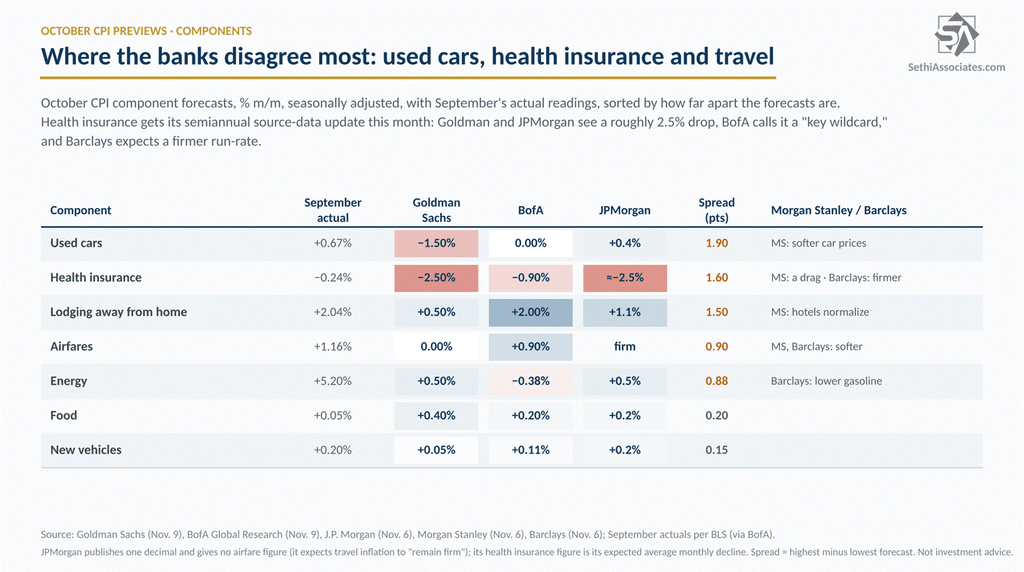
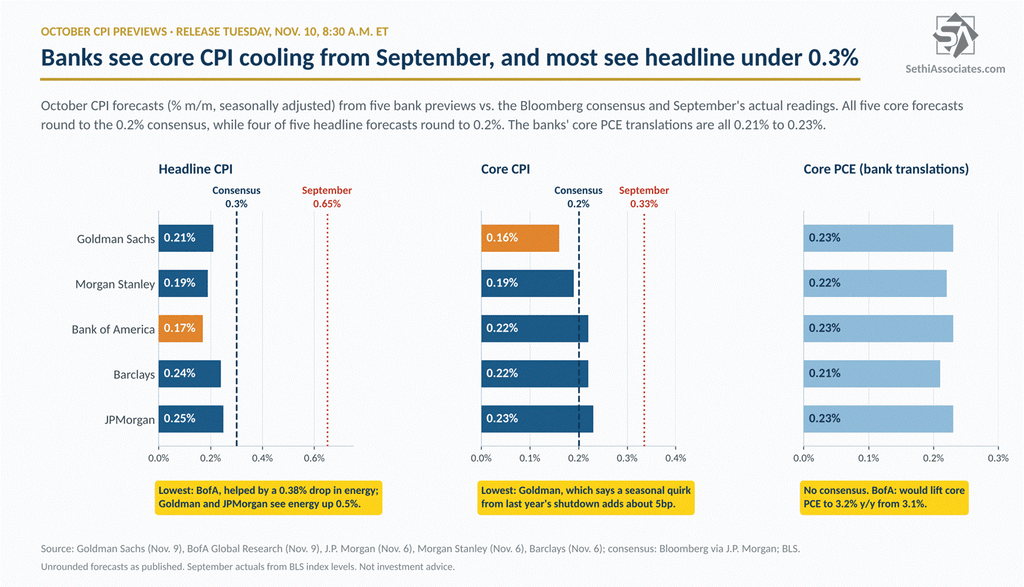
Tuesday’s October CPI is the last before the Fed’s December 8–9 meeting, and the previews from Goldman Sachs, BofA, JPMorgan, Morgan Stanley, and Barclays all expect core inflation to cool after it firmed to 0.29% in August and 0.33% in September (the most since April).

Their core forecasts range from 0.16% (Goldman Sachs) to 0.23% (JPMorgan), all of which would round to the 0.2% Bloomberg consensus. On headline, four of the five are below the 0.3% consensus, at 0.17% to 0.24%, with JPMorgan at 0.25%, after September’s 0.65%.

Note there is no year-over-year figure due to the missing data from the government shutdown a year ago.

Shelter is a key. Owners’ equivalent rent rose 0.35% in September, the most since April, but Morgan Stanley thinks the jump was “largely noise, amplified by unusual volatility in the Midwest,” and Goldman, Bank of America and JPMorgan all see it slowing to 0.26% to 0.3%.

The forecasts are furthest apart on used cars and health insurance, which gets its semiannual source-data update this month. Goldman sees used car prices falling 1.5% and JPMorgan sees them rising 0.4%, while Goldman and JPMorgan see health insurance dropping about 2.5% and Barclays expects “a firmer health-insurance run-rate.”

There’s also an AI angle. BofA says core goods prices have risen at a 2.4% annualized rate over the last three months, with “IT commodities contributing roughly 90bp to the increase,” and JPMorgan points to October price increases for phones from Samsung and Google and reports that Intel planned to raise some CPU prices 10%.

The readthrough to the Fed’s preferred inflation gauge is a bit firmer. BofA and JPMorgan both see their forecasts translating to a 0.23% rise in core PCE, which BofA says would lift the year-over-year rate to 3.2% from 3.1% and JPMorgan says would push it “back up to 3.2%.” Goldman (0.23%), Morgan Stanley (0.22%) and Barclays (0.21%) are in the same range, with Goldman’s and Morgan Stanley’s above their core CPI calls, which Goldman puts partly down to the lower weight of used cars in PCE and different source data for airfares, auto insurance and health insurance.

For the Fed, BofA says its forecast “would effectively lock in another 25bp hike, all else equal,” and that “absent an indisputably soft 0.1% m/m print, we doubt the inflation data will dissuade the Fed from hiking in December.” All four banks currently forecast a December hike.

More in Sunday’s The Week Ahead – CPI and Equity Flows Test a Shaken Market.

By Neil Sethi

Is Tech Ready to Rebound?

The question coming out of last week is whether the AI selloff has run its course, and those I follow the most are split. This morning’s Nvidia headline though provides a real-time test.

Over the weekend, Jensen Huang acknowledged an affair with a woman reported to be a suspected Chinese intelligence operative, and Nvidia’s board opened an independent investigation. Nvidia (NVDA), already down 22% from its October high, is down another 6% in the premarket.

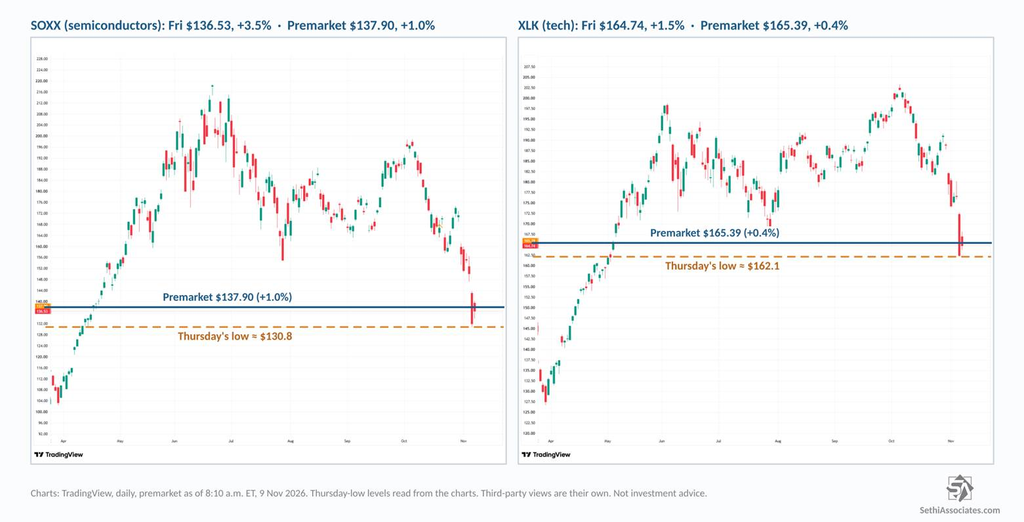
But the groups that took the brunt of last week’s selling aren’t following it lower. The iShares Semiconductor ETF (SOXX) is up over 1.0% premarket and the Technology Select Sector SPDR ETF (XLK) 0.5%, building on Friday’s bounce (SOXX +3.5%, XLK +1.5%). Semis rising while the sector’s bellwether drops 7% is the kind of divergence you’d want to see if positioning has truly been cleaned out. The line in the sand is Thursday’s low: about $131 on SOXX and $162 on XLK.

Among the strategists I covered in Sunday’s Week Ahead (The Week Ahead – CPI and Equity Flows Test a Shaken Market), Deutsche Bank doubled down on its Tech overweight on Friday, saying “with the plunge this week, the risk-reward is now even more favorable,” and that the selloff was “largely driven by a forced positioning unwind” rather than the election.

Citadel’s Scott Rubner has also turned more positive, seeing “a compelling setup for US equities into year-end,” while Ed Yardeni says Thursday’s selloff delivered the post-midterm buying opportunities he expected, though he isn’t calling a bottom yet.

Not all are on board, though. Helene Meisler thinks “we should get a short-term rally” (Nasdaq and the Sentiment Cycle: Where Are We Right Now?), but notes, “I think we’re only talking about an oversold rally at this point. But it ought to be tradable” (A Market Washout May Be Setting Up the Next Tradable Rally). And on Friday, HSBC’s Max Kettner said he wasn’t ready to step in yet.

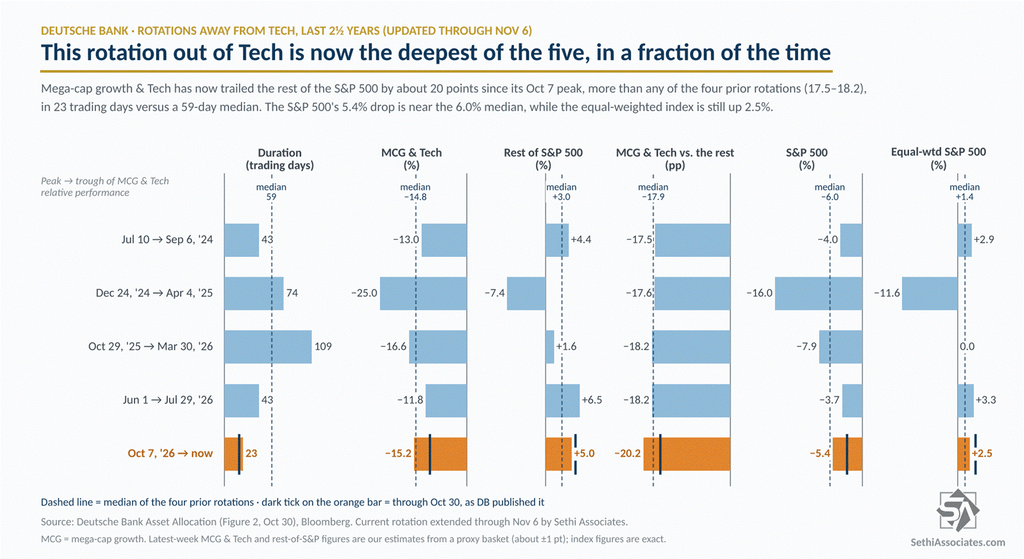
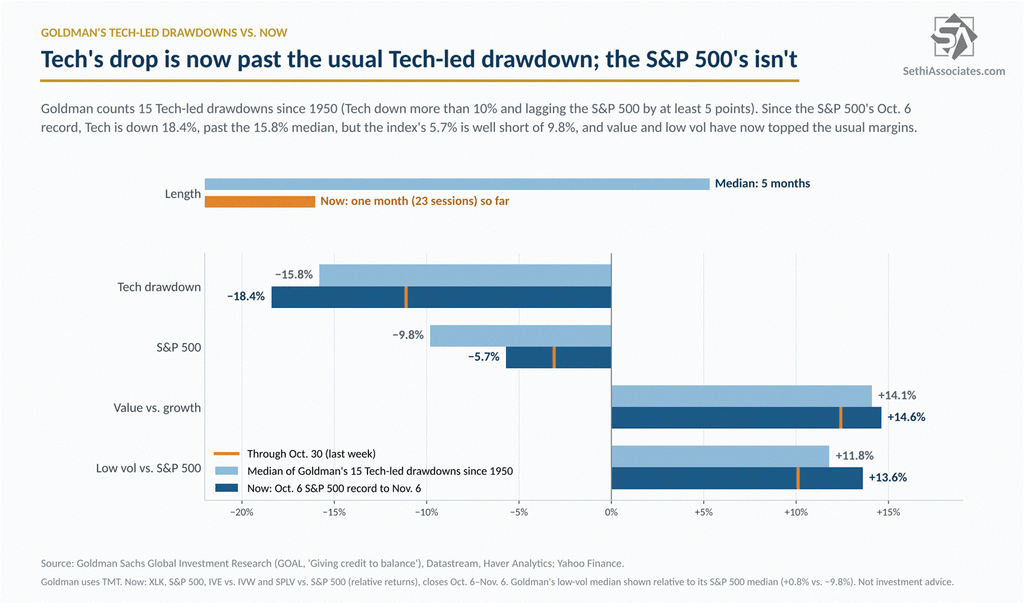
One thing keeping some on the fence is the duration of the selloff. In depth, this rotation out of Tech is already in line with, or past, prior ones. On my update of DB’s table from two Sundays ago, mega-cap growth and Tech have trailed the rest of the S&P 500 by about 20 points since October 7th, more than any of the four prior rotations in the past 2½ years. And on Goldman’s framework, Tech’s 18.4% drop from the S&P 500’s October 6 record is past the 15.8% median for Tech-led drawdowns since 1950.

But it’s taken just 23 trading days, versus a 59-day median in DB’s table, and Goldman’s median Tech-led drawdown lasted about five months, with the S&P 500 falling 9.8% versus 5.7% so far this time.

As Goldman noted after its panic indicator spiked, “the immediate path has been much less reliable, particularly while still in price discovery mode.”

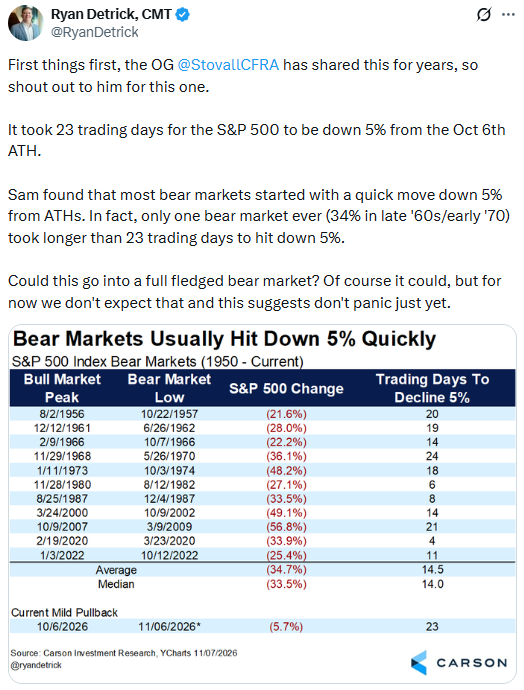
And the bears will point out that sharp down moves are characteristic of bear markets. Carson Group’s Ryan Detrick, crediting CFRA’s Sam Stovall, notes in the post below that “only one bear market ever (34% in late ’60s/early ‘70) took longer than 23 trading days to hit down 5%,” and this one took exactly 23. Detrick himself doesn’t expect a bear market, saying “this suggests don’t panic just yet,” and 23 days is at the slow end of that range (the median is 14), but it isn’t outside it.

So while today’s early action is encouraging, I’m a long way from declaring the coast is clear.

There’s a lot more on this subject in Sunday’s The Week Ahead – CPI and Equity Flows Test a Shaken Market.

By Neil Sethi

Equity Positioning Got Cleaned Out in a Hurry Last Week

As the Week Ahead is a rather long read (The Week Ahead – CPI and Equity Flows Test a Shaken Market), I thought I’d take some time this week to highlight some of the bigger takeaways it contained. One of those is how quickly positioning got cleaned out in last week’s AI rout.

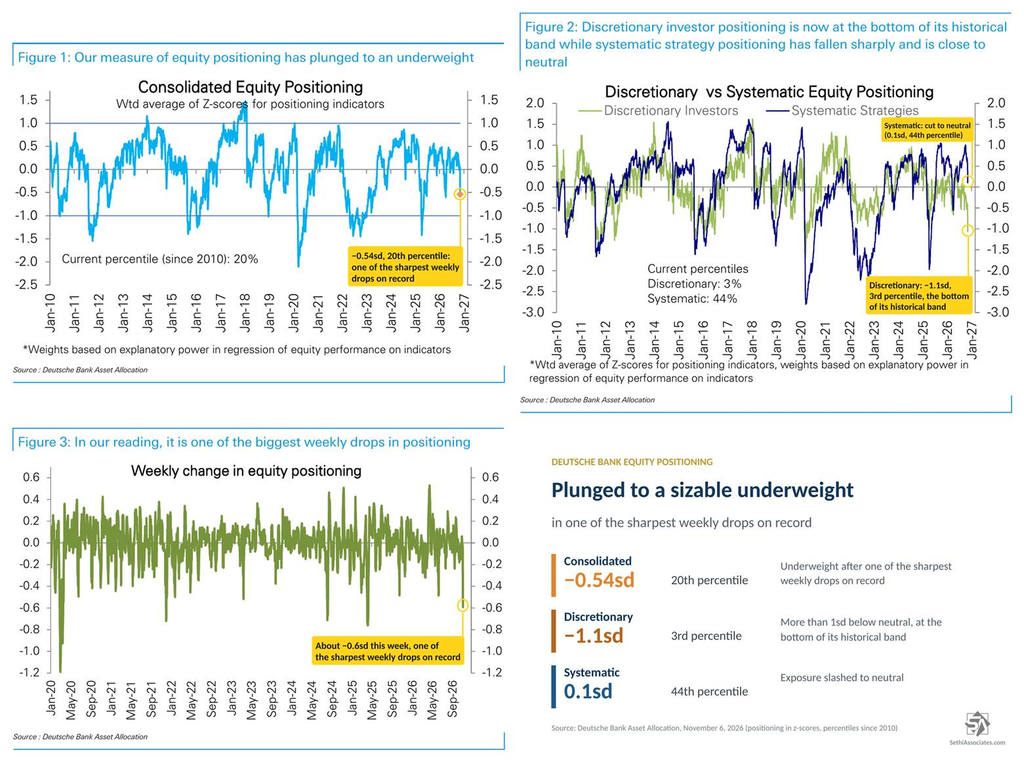
Deutsche Bank’s consolidated equity positioning fell to the 20th percentile from the 44th, one of the sharpest weekly drops on record, with discretionary investors ending the week at the 3rd percentile to 2010, systematic at the 44th and Tech positioning at the 7th, below its liberation day lows.

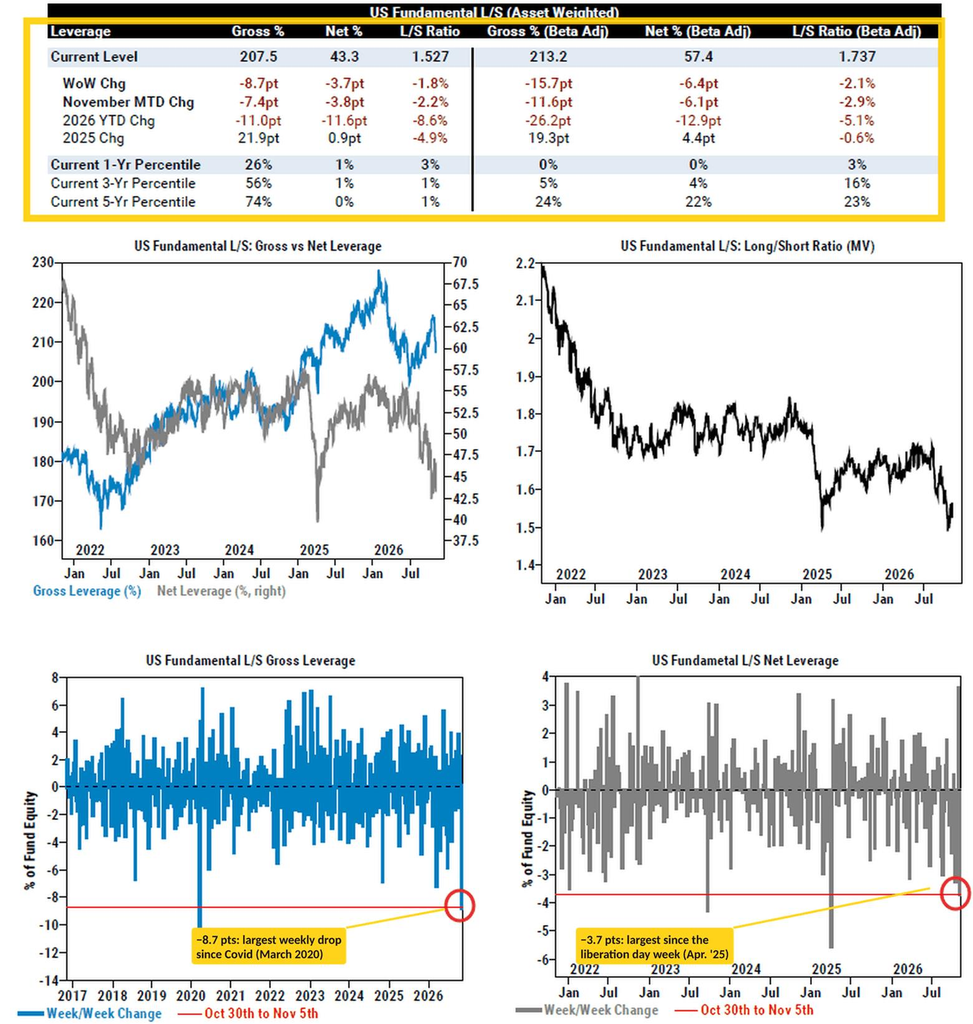
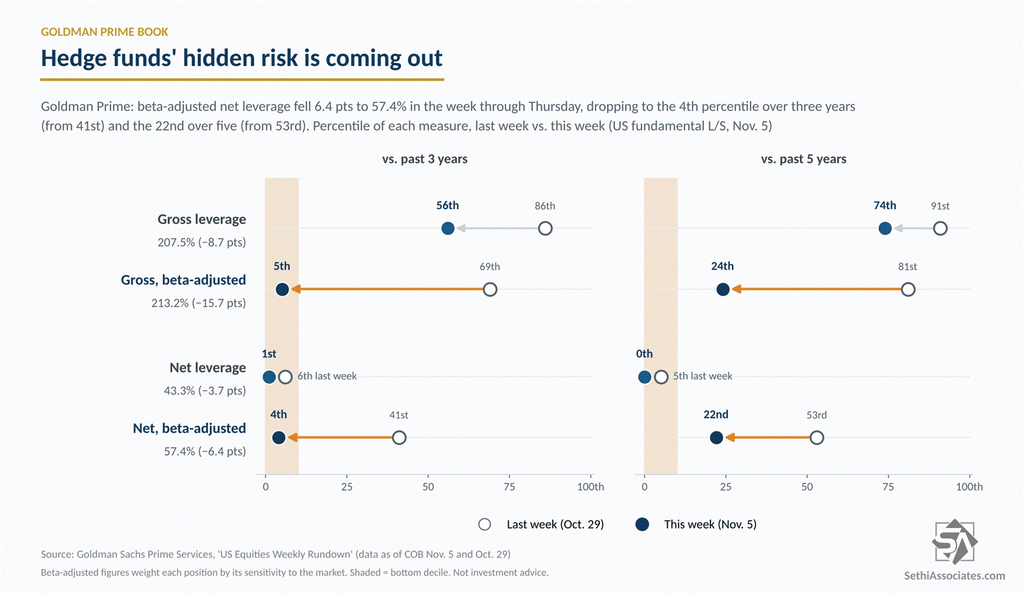
Hedge funds pulled back too. Goldman’s U.S. fundamental long/short gross leverage had its biggest weekly drop since Covid, net leverage is back at the 0th percentile over five years, and this time the beta-adjusted figures came down with it (meaning there was a real cutting of risk profiles).

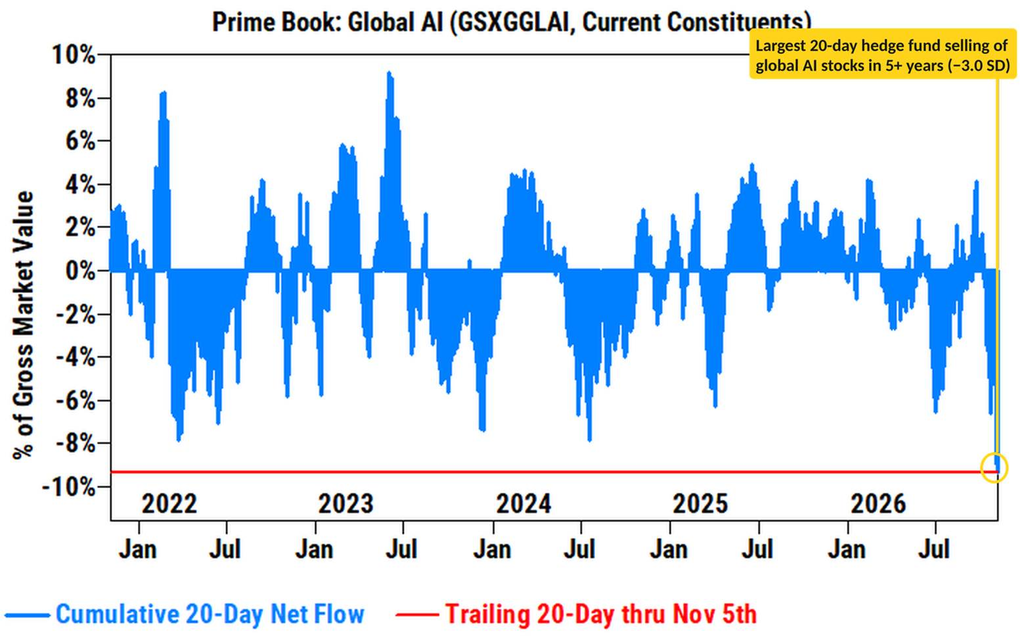
Goldman’s desk adds that on a trailing 20-day basis, hedge fund selling of global AI stocks is the largest in more than five years.

Cleaner positioning doesn’t call a bottom on its own, but it does mean there’s a lot less left to sell, and plenty of room to add back once things stabilize.

Check out more like this on positioning in Sunday’s The Week Ahead – CPI and Equity Flows Test a Shaken Market.

By Neil Sethi

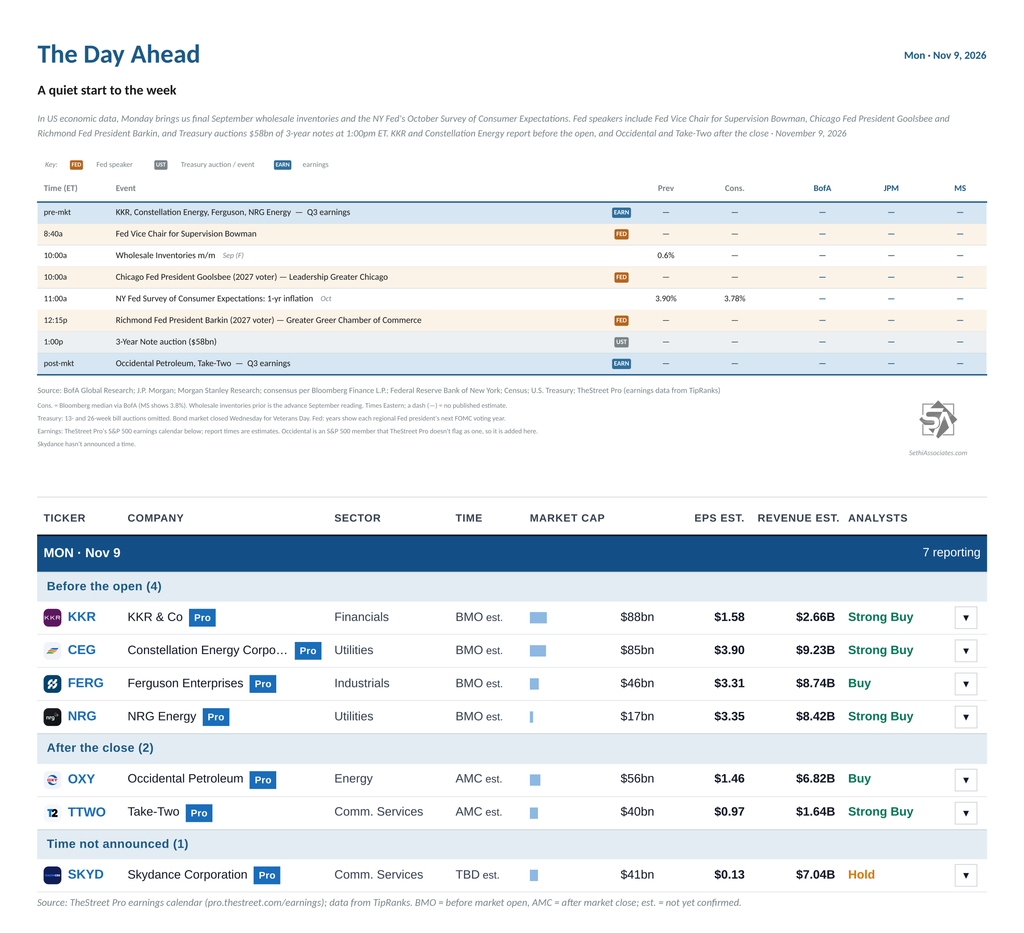
The Day Ahead: A Quiet Start to the Week

In US economic data, Monday brings us final September wholesale inventories and the NY Fed’s October Survey of Consumer Expectations.

Fed speakers include Fed Vice Chair for Supervision Bowman, Chicago Fed President Goolsbee (2027 voter) and Richmond Fed President Barkin (2027 voter).

Non-Bill (>1yr in maturity) US Treasury auctions bring us a $58B 3-year note sale at 1:00pm ET.

Seven S&P 500 components report, none of them with market caps over $100B:

  • Before the open: KKR (KKR), Constellation Energy (CEG), Ferguson (FERG) and NRG Energy (NRG).
  • After the close: Occidental Petroleum (OXY) and Take-Two (TTWO).
  • Time not announced: Skydance (SKYD).
  • Outside the S&P 500 we’ll hear from Orix (IX), Credicorp (BAP), Rocket Lab (RKLB) and AST SpaceMobile (ASTS).

Ex-US highlights China’s October CPI and PPI and the BoJ’s Summary of Opinions from its October meeting (both Sunday evening ET), followed Monday morning by Japan’s September leading index, Germany’s September trade balance, Taiwan’s October exports and Mexico’s October CPI.

The Eurogroup and ECOFIN meetings in Brussels could bring a recommendation on successors to ECB President Lagarde and board member Schnabel. G7 foreign ministers meet in France through Tuesday, and the BoE’s Bailey and the ECB’s Cipollone speak.

Conversation 0 Comments

One ongoing discussion across all days. Everyone can read; sign in to take part.

Your voice matters. Discussions are moderated for civility. Read our guidelines .

Log in to join the conversation

Loading comments...