Here’s How I’m Playing the Shocking Nvidia Scandal
The AI industry has lost its rock-star CEO and chief champion. How should investors respond to Jensen Huang’s departure?
You've reached your free article limit
You've read 0 of 1 free Pro articles.
It’s funny, but as I read it, Jensen Huang has come undone not because he was sleeping with a Chinese spy, but because of prosaic human-resources rules against relationships between the boss and employees reporting to them.
Initially, it looked like the Nvidia (NVDA) president and CEO would ride out the China-spy scandal. Despite the whiff of national-security risk and an investigation into alleged smuggling of restricted Nvidia chips into China, Huang was in the office taking meetings like normal. Even the president had his back.
It was only after a report that the Nvidia co-founder had also been in an extramarital relationship with Kimberly Powell, the company’s vice president of health care, that his position became untenable. The New York Times reported this second affair shortly after the bell on Wednesday, quickly followed by alerts from The Wall Street Journal that Huang was being ousted.
Good Reasons for Direct-Report Rules
There are obviously good reasons to bar relationships between the boss and the people that the boss can order around. Some companies bar relations between any employees at all, even if they work in unrelated departments.
The second stance is going a bit far, if you ask me, to bar any intra-company pairing up at all. But there’s good reason for the first rule. There’s definitely an unpleasant power dynamic at work when there’s a chain of command, and the boss can compel someone to do something. That’s not to mention the potential for playing favorites on pay or projects – or being perceived by jealous rival workers to be doing so.
How Far Will the Fallout Spread?
Why does this matter? Well, I’m trying to get a read on whether problems at Nvidia indicate broader problems in the semiconductor sector, and across the broader Artificial Intelligence (AI) buildout.
How far will this fallout spread? Is the edifice of the “central bank of Nvidia,” the company that has pumped so much circular funding into AI companies that turn around and buy Nvidia-designed chips, starting to crumble?
As an Asian equities specialist, I’m first and foremost concerned about the impact on companies like Taiwan Semiconductor Manufacturing Co. (TSM), which physically makes the vast majority of the chips that Nvidia designs.
My last story looks at the tumultuous year for SoftBank Group (SFTBY) (T:9984), one of the most influential tech venture-capital investors, and a company that is now “all in” on AI. Its U.S. shares are down 4.0% Thursday in sympathy. Are its holdings, principally the $64.6 billion stake that represents 13% of OpenAI, under threat?
I’m also concerned about the spillover to memory makers like NAND flash-memory maker Kioxia Holdings KXIAY (T:285A) in Japan, and the Korean chip giants SK Hynix (KR:000660) (SKHY) and Samsung Electronics (KR:005930). That applies to their U.S. counterpart Micron Technology (MU), too.
My largest position is in the Roundhill Memory ETF (DRAM). It has been buffeted by the semiconductor selloffs over the summer and in October. But I retain that position, confident that those memory makers have already sold their 2027 production, and predict extremely tight supply through 2030.
That gives the memory makers strong pricing power. That said, I would consider selling DRAM if I see the price of NAND, DRAM and particularly High-Bandwidth Memory (HBM) chips start to slip.
Bad Nvidia Timing
But I am also an Nvidia investor. And I have not had the best timing with Nvidia shares!
I mean, my initial timing was great – I first bought the shares at $59, and saw them skyrocket as it built itself into the central pillar of the AI industry.
But I then sold 75% of my Nvidia shares in the chaos surrounding the “Liberation Day” tariffs in April 2025. I was convinced that would do lasting damage to the U.S. economy and U.S. stock market, so I exited the majority of my position around $94.
That netted a very healthy profit, certainly. But I watched with that dread sense of Fear of Missing Out as Nvidia shares, which had lost one-third of their value as the tariffs were announced, shot straight back up again, and then some. By October 2025, they had rallied around 115%.
I could of course console myself that I had switched some of the Nvidia proceeds into the likes of TSMC, shares that have been supremely consistent by the very inconsistent standards of the chip sector. But I had misread the tariffs impact, which Nvidia quickly shook off.
To top off my bad timing, I then I opted to buy back into Nvidia after last week’s semiconductor selloff. Given an almost 10% discounting last Thursday, it seemed like an opportune time to add back to my position. I bought those shares at $187.
Now my entire holding is showing a slight profit. I’m averaging a cost basis of $159. I was very happy with that a few days ago. Thursday, with the shares down as low as $151, less so.
In Nvidia for the Long Run?
Would selling now risk missing another Nvidia upwards move? If you sold at Thursday’s open, you certainly missed a quick-fire rebound. The shares are at $166 and climbing as I file.
Short term, we will clearly see volatility surrounding Thursday’s announcement. Nvidia was down as much as 14.3% at today’s low. Now it’s down “just” 4.6% and continues to trim losses. Dip buyers have stepped in. That’s the only way to read it.
Nvidia is due to report earnings on Tuesday, Nov. 17. The Huang scandal should have very little if no effect on those numbers. It is due to pay a dividend on Dec. 3. Again, no effect there.
Long-Term Questions Remain
The broader questions are long-term. How much impact will Huang’s departure rock the foundation of Nvidia? He helped transform it from a 1993 startup making graphics-processing units for video gaming into what was, for half of 2025 and most of 2026, the most-valuable company in the world.
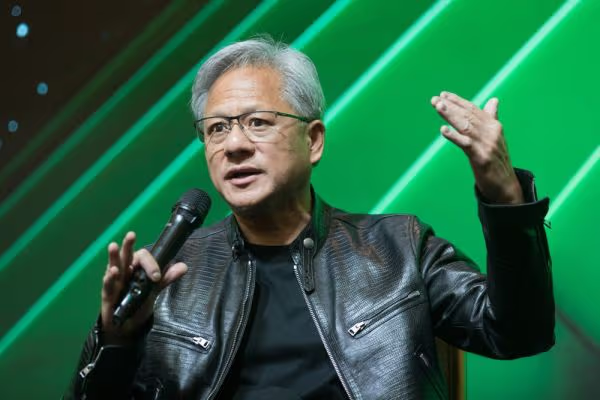
Jensen Huang, the rock star CEO, the tech sector Ghost Rider, striding the stage armored in his leather jacket, is synonymous with the company. If you said “Nvidia,” it’s his face that springs to mind. Semiconductors have never been so sexy.
So it is appropriate that a sex scandal should bring the rock star CEO down. His cult of personality, building a corporate infrastructure in which he had 60 direct reports and no clear successor or rival for his job, now seems like supreme folly.
How will Nvidia fare without its figurehead? Well, I don’t know, if I’m very honest. I’m concerned. It could spell the start of the slipping of Nvidia’s competitive edge.
CEOs Overrated, Overpaid?
Still, I have also long believed that CEOs are extremely overpaid for what they do. The average CEO was paid 99.0 times the average employee when Nvidia was founded, according to data from the Economic Policy Institute. That had already risen from 32.7 times in the prior decade. But it has now shot up to 246.9 times the typical worker.
Compliant boards have bought into the idea that it’s an incredibly competitive market to hire and retain top corporate talent. But I’m not sure any one person can do the work of more than 250 rank and file people working at the company. And I don’t buy that you have to overpay these top executives to quite that degree to retain them.
We have seen companies like Apple (AAPL) move on, successfully, from an era when they had a charismatic founder and no clear successor. Tim Cook did a terrific job, stepping into shoes that were hard to fill, and Cook has been only partly in jest thrown around as a name to take on the Nvidia role.
It is possible that Nvidia and its 41,999 other employees will fare just fine without Jensen Huang. His daughter, Madison, remains at the company in a marketing role. Madison’s husband, Nico Caprez, works at Nvidia, too. And Jensen’s son, Spencer, works in product management for Nvidia’s robotics business. Whether they stay on remains to be seen.
No Role in the Future
One thing’s for sure: the company has made it clear that Jensen Huang will have no role whatsoever with Nvidia as it moves forward. That step likely became necessary because of the violations of corporate policy that have come to light. While it would undoubtedly have been helpful in terms of continuity to have Huang hang around in some capacity, an elder statesman and rainmaker, a board that must maintain standards of corporate governance and behavior didn’t have much choice.
There will of course be investigations into Huang’s affair with Huang Le, the former Megaspeed International executive that U.S. officials now say is a Chinese spy. Her ascent is sketchy, and surprisingly quick. Bloomberg is today reporting that she is in Beijing.
I doubt, if she has indeed been spying for China, that she is a sleeper agent who has been deployed years ago, in the style of TV show The Americans. It’s far more likely – again, if the allegations are true – that she found herself well-positioned when the man she identified as her husband, Kang Wei, was buying up video-game companies during the 2010s, and introduced her to Jensen Huang. It wouldn’t then be a stretch to see Chinese officials, who have their fingers in every corporate pie in the country, cozy up to say, “We would be deeply grateful if you pass along anything interesting you find out …”
That relationship will be under intense regulatory scrutiny, with Jensen Huang now agreeing to testify before Congress by Thanksgiving, according to House Foreign Affairs Committee Chairman Brian Mast. It will surely be part of shareholder lawsuits.
It stands to reason that China, which is rapidly building up a state-sponsored semiconductor sector, wants to know as many of Nvidia’s corporate secrets as it can possibly uncover. Whether Taiwan-born Jensen, who must surely have been under constant pressure to divulge just how his company does what it does so well, was so unwise as to spill useful information to a romantic partner (and client) remains to be seen.
What we can say is that he exercised very bad judgment, not just to become involved in a relationship with a corporate partner, but also with one of his own employees. He could not stay on, once that came to light. The Nvidia board has made the right, the necessary move.
It is telling that Nvidia’s competitors are seeing their shares rise Thursday. Advanced Micro Devices (AMD), up 5.4%, and Broadcom (AVGO), up 5.9%, stand to gain should Nvidia’s crown slip.
That tells me the semiconductor sector will continue to boom. In terms of AI, the market must absorb the Anthropic initial public offering, an event that will have prompted selling in other AI-linked plays if institutional investors are buying into that listing via funds that have specific allocation parameters to the tech sector.
Does It Pay to Catch a Falling Knife?
I mentioned before that there’s some fascinating research from Adam Parker and the team at Trivariate Research looking into whether it pays to catch the knife when a stock experiences a dramatic selloff. They study thousands of sharp drawdowns over the last 25 years to see if the selling sticks.
Their conclusion? If the stock losses were prompted by disappointing earnings (the case in 36% of the cases they examined), the losses tend to stick. Stocks that underperform their rivals in terms of share-price decline also continue to underperform to the tune of 9% in the next year. If there are company-specific reasons for the selling, beware.
Companies that see selling because of a broad-market sector or market selloff tend to recover completely. That was true this February during the “SaaSpocalypse,” when AI coding threatened to kill off the software sector. Indiscriminate selldowns don’t stick.
The Very Definition of a Company-Specific Issue
Nvidia’s problems are the very definition of a company-specific issue. We have the benefit of getting earnings from the company next week, a set of numbers that will draw extra scrutiny, while the earnings call will have analysts hanging on every word.
I would watch for how the investigation into Nvidia proceeds. There’s too much company-specific risk to say with any certainty that Nvidia will ride this out – it likely will, but we don’t know for sure. If I were an analyst, I’d rate Nvidia a “Hold” rather than an outright “Sell” but wouldn’t be bold enough to say it’s screaming “Buy.”
I remain confident in the semiconductor sector, however. Its selloff in October didn’t appear to have a clear driver, other than repositioning. Certain companies – here’s looking at you, Intel (INTC) – were punished for earnings disappointments, but the sector shed some 25% while most companies continue to post record and impressive earnings.
I believe semiconductor stocks should power ahead into the end of the year, and through 2027. We must watch for cheap Chinese chips coming onto the market. But the supply/demand equation is very much in the favor of memory makers.
The AI industry is under pressure to prove its profitability. Despite CoreWeave (CRWV) notching strong earnings Wednesday night, it strikes me as a tough business model, spending heavily on data-center computing equipment in the hopes of uncertain profits. Some neocloud operators may ultimately fail. There will be bumps along that road.
Now Nvidia has delivered a very surprising, highly personal issue to handle. Few saw that coming. It’s a shock and a scandal.
AI has lost its figurehead and champion. Nvidia’s future is uncertain, and a previously untouchable company has lost some of its luster. Of course, the company will ride this out for the time being. It remains to be seen how much damage Nvidia suffers as a result of this executive departure, and the pending inquiries to come.
At the time of publication, McMillan was long NVDA and DRAM.