How SoftBank Is Taking a Hit While AI Ambitions Have Yet to Pay Off
Booking a quarterly loss, the venture-capital investor is taking on expenses for power equipment its data centers no longer need, while waiting to reap the reward of its $64.6 billion OpenAI stake.
You've reached your free article limit
You've read 0 of 1 free Pro articles.
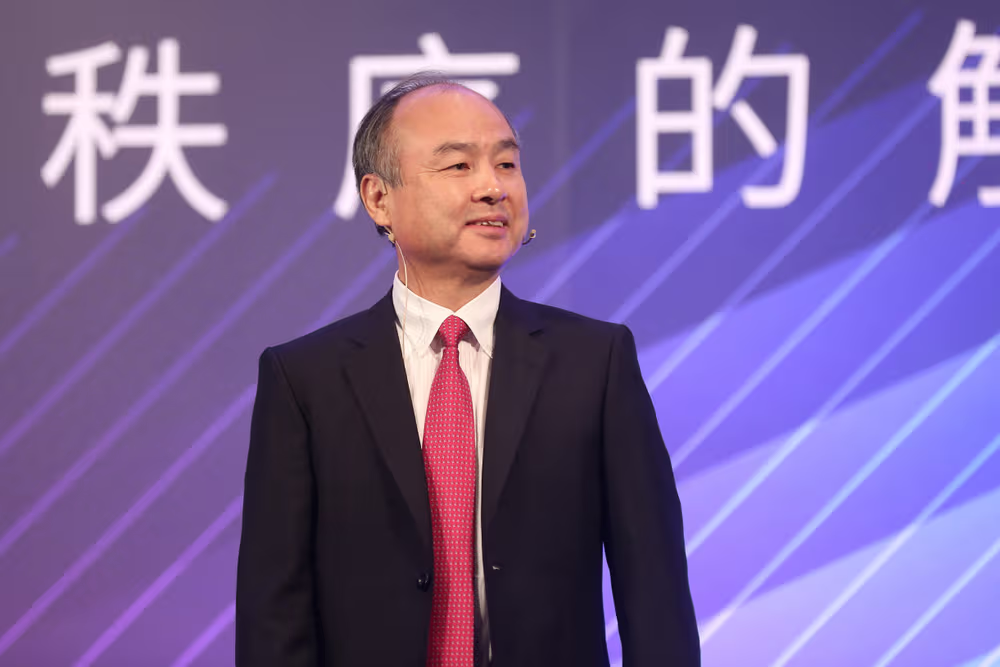
With a boss who says he is “all in” on Artificial Intelligence (AI), SoftBank Group (SFTBY) (T:9984) has had a tumultuous year. And that continues today.
SoftBank shares surged 13.9% in Tokyo trade on Tuesday, follow-through from Monday’s strong showing for AI plays and chip stocks on Wall Street.
Investment Decline in Testing Year
Then, after the bell, the company reported a ¥1.1 trillion ($7.1 billion) loss for the three months through September. That leads to a ¥768.0 billion ($4.8 billion) loss for the first half of its fiscal year, with the company hit hard both by the cost of building out data centers and the cost of financing its investment.
The September quarter marks the company’s first quarterly loss in almost two years. SoftBank’s U.S.-listed ADRs are down 5.8% at the open. The company’s investment returns are impacted by investment losses in the likes of Korean e-commerce platform Coupang (CPNG), which has seen its shares sink 30.0% so far this year.
It’s a microcosm of how 2026 is playing out for SoftBank, one of the biggest venture-capital backers of technology companies, and AI plays in particular. After its shares shot up 91.4% last year, it is looking at a 12.0% year-to-date decline for 2026.
Largest Company in Japan Didn’t Last Long
At the start of June, SoftBank shares hit an all-time high of ¥9,074, up more than double (106.2% to be exact) since the start of the year. The company even briefly replaced Toyota Motor (TM) (T:7203) as the most-valuable company in Japan, as I explain in my June 2 column.
But that didn’t last long. By the end of the month, SoftBank had already been eclipsed in market value by Japanese NAND flash-memory maker Kioxia Holdings KXIAY (T:285A). Now SoftBank shares sit down double digits on the year, and at one-third of their peak value, with a loss of 57.3% from the top.
Toyota (TM) (T:7203) is back in the top spot today, with a market capitalization of $251.8 billion.
And after selloffs for chip stocks in both June and October. Toyota’s shares last week enjoyed their best day in 40 years, surging 16.7%. That’s as the company notched a strong quarter, raised its operating-profit forecast for the fiscal year through March by 14.7%, and unveiled a plan to return as much as ¥14 trillion ($89 billion) to investors by 2031.
I’ve described SoftBank as the most-exciting company in Japan. It certainly says something to see Toyota reclaim its crown even in the face of tariff disruption and slightly slowing overall vehicle sales. It anticipates shifting 2.6% fewer vehicles for the year through March, but is seeing strong demand for its lineup of hybrid models, in an era of elevated fuel costs.
SoftBank’s AI IPO Pipeline Pushed to 2027
SoftBank has committed $64.6 billion to investment into OpenAI, a 13% stake. That explains SoftBank’s torrid summer, after OpenAI filed paperwork to go public, then pushed any initial public offering into 2027 at the earliest. SoftBank believes it is sitting on a $45.0 billion investment gain in OpenAI, but that’s on paper, and will only really be realized once the company goes public.
SoftBank also has an 86.4% stake in British chip designer Arm Holdings (ARM). If anything, that’s currently propping SoftBank stock up, with Arm still notching a 65.8% advance in 2026. In fact, Arm’s $195.1 billion stock-market value is higher than SoftBank’s $139.6 billion valuation.
Largest Quarterly Fundraising on Record
And there’s the rub behind SoftBank’s valuation. It has taken on massive levels of debt to fund its AI ambitions. SoftBank spent ¥790.7 billion ($5.0 billion) on financing in the first half of its fiscal year, the vast majority of it interest on its borrowings.
The group raised ¥8.9 trillion ($56.5 billion) in financing during its Q2, the most it has ever raised in one quarter, issuing corporate bonds and taking out loans to finance its investments. It has borrowed against its investments in Arm and OpenAI, and used forward-contract derivatives to generate $7.4 billion in cash from its holdings of Intel (INTC) shares, a position it spent $2 billion to build.
Booking Expenses on Power Equipment It No Longer Needs
SoftBank is also paying the price of its ambitions to build and operate data centers. Its took a ¥597.2 billion ($3.7 billion) loss on power-generation equipment it had pledged to buy, much of it from commitments to equipment that is no longer in its current buildout plans.
SoftBank’s SB Energy subsidiary, backed by OpenAI, Nvidia (NVDA) and Ares Management (ARES), would like to list separately. But despite filing for an initial public offering, targeting a $50 billion valuation, its IPO plans have been disrupted by the market turmoil in AI investments and data-center stocks. Like OpenAI, it has pushed an intended listing this year into 2027.
Those wasted expenses on power equipment that’s no longer necessary indicate how easy it is to burn through cash quickly while chasing the AI dream. On the plus side, SoftBank notes that data centers are still in drastic undersupply, so its projects should pay off once up and running.
SB Energy’s major PORTS-Pike data center campus in Ohio should start operations in 2028, and be fully on stream with 10 gigawatts of capacity by 2032. The company is also building several large centers in Texas, the largest of them due to start operations next year.
It will take signs that those data-center operations are turning a profit before we see stabilization in SoftBank’s earnings. It is a real-world blotch on its earnings statement to be booking writedowns for power-generation equipment that it no longer needs. Meanwhile its share price will continue to fluctuate dramatically depending on the shifting winds of sentiment on AI.
At the time of publication, McMillan was long NVDA.