Market updates and conversation from TheStreet Pro team. Follow the latest and join the conversation below.
Stock Market Today: November 12, 2026
Newest first · All times Eastern · 3 updates
DATE:
By Neil Sethi
Initial Jobless Claims Four-Week Average Holds at Lowest Since 1969
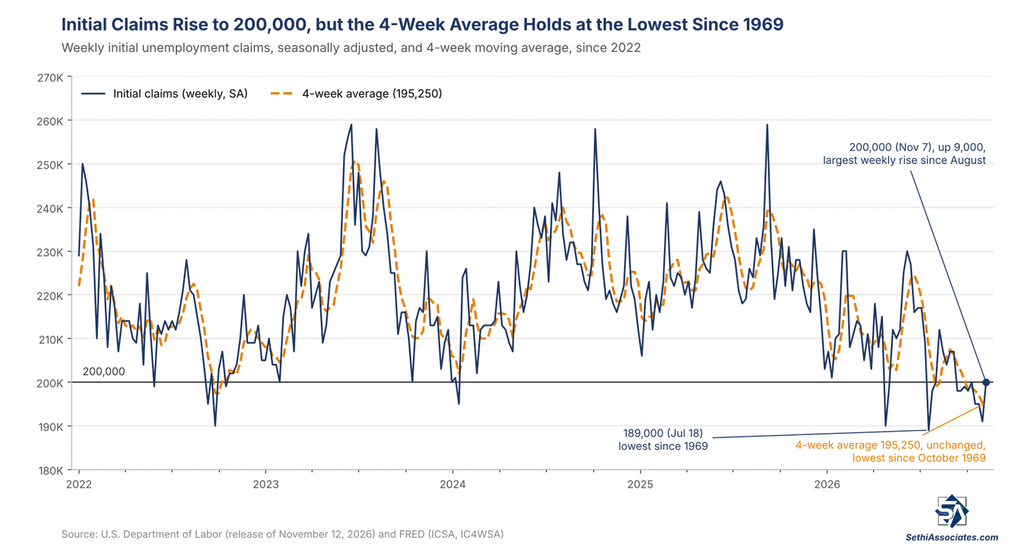
Initial jobless claims for the week ending November 7: 200,000 (estimate 195,000; previous 189,000; revised previous 191,000)
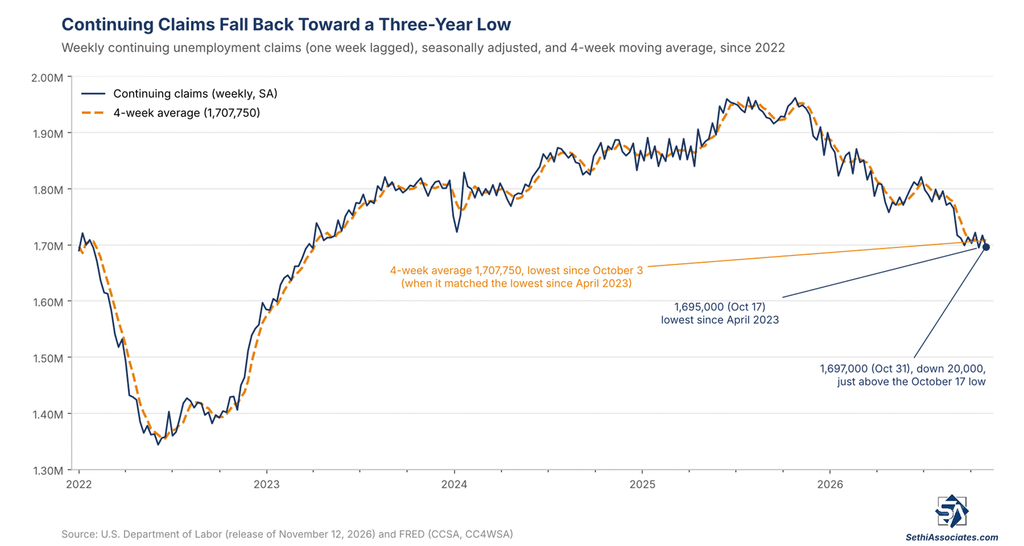
Continuing claims for the week ending October 31: 1,697,000 (previous 1,718,000; revised previous 1,717,000).
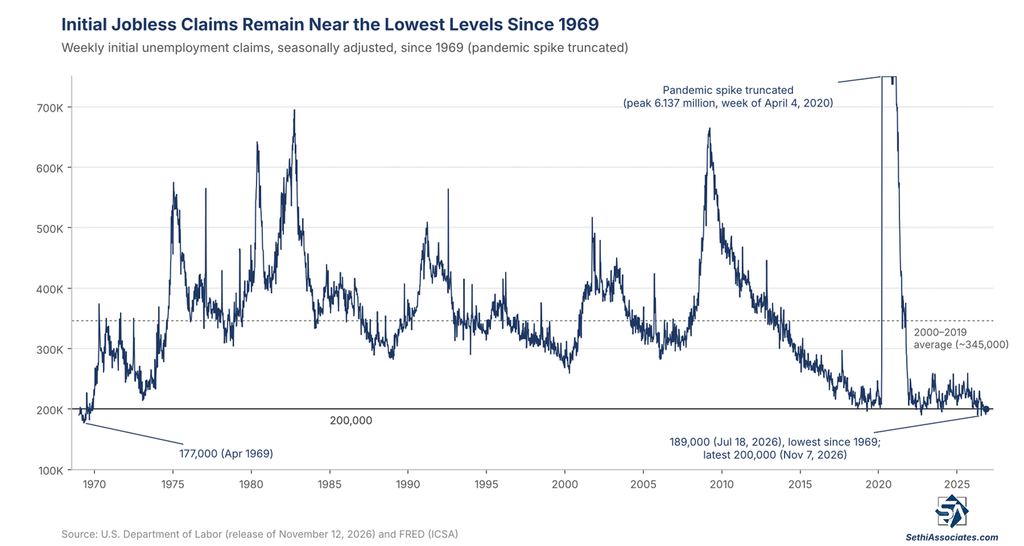
After bottoming at 189,000 in mid-July — the lowest reading since 1969 — initial jobless claims have barely budged. In the week through November 7 they rose 9,000, the most since August 8, but very subdued historically, to 200,000, the highest in four weeks. That ends a three-week run below 200,000, leaving the count at 18 weeks below that mark since 1969 (the four-week run from September 12 through October 3 was the longest since 1969), with claims still near cycle lows at the bottom of the relatively narrow range that has held since November 2021.
The four-week average was unchanged at 195,250, matching the prior week’s upwardly revised level as the lowest since October 1969 (31,750 lower year-over-year).
Continuing claims (seasonally adjusted) in the week through October 31 (one week lagged) fell 20,000 to 1,697,000 (after a 1,000 downward revision to the prior week), just above the 1,695,000 two weeks earlier that was the lowest since April 2023. That leaves them towards the bottom of the roughly 1.70 million to 2.0 million range that has held since mid-2023 — historically low, though not as low as initial claims.
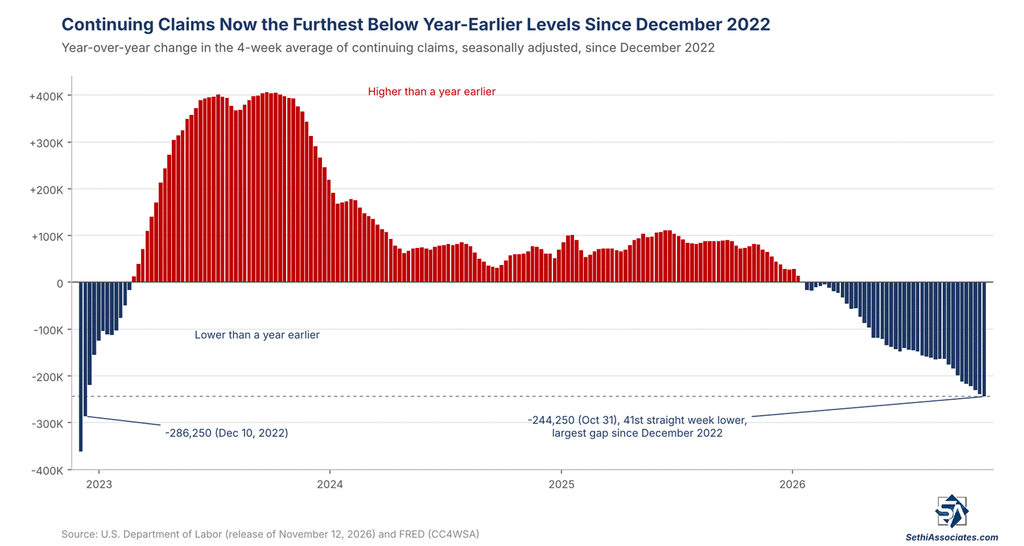
The four-week average of continuing claims fell 1,500 to 1,707,750, the lowest since October 3 when it matched the lowest since April 2023 (after a 250 downward revision to the prior week), and remains lower year-over-year for a 41st straight week (down 244,250) — the largest such gap since December 2022.
The 20-year pre-pandemic average for initial claims is 345,000 and continuing claims roughly 2.9 million.
While the Fed’s Doves See More Hikes, They’re in Less of a Hurry
As things with the Fed are moving at a blurring pace (for the Fed), I thought I’d lay the groundwork ahead of the six Fed speakers to come today, including a couple of the more “core” members in Governor Barr and New York Fed President Williams.
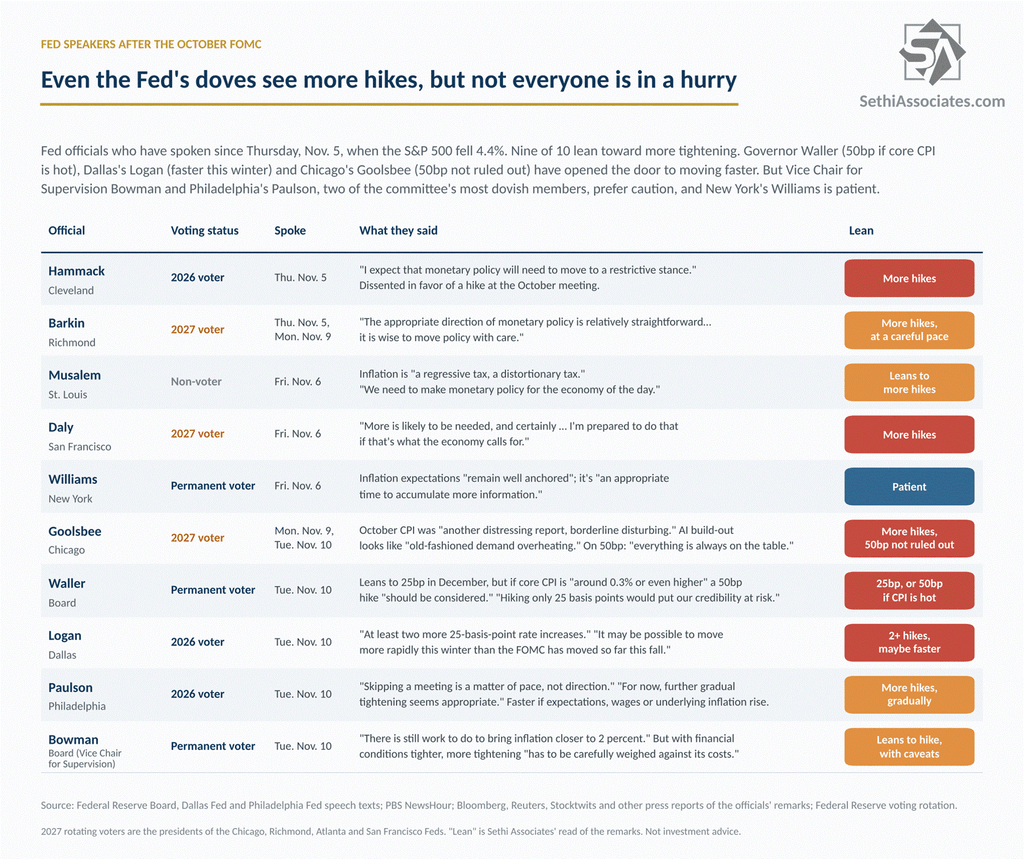
After Governor Waller (Fed’s Waller Floats a Half-Point Hike if CPI Runs Hot) and Dallas Fed President Logan (Dallas’ Logan Adds to 50 Basis Point Speculation) opened the door to faster rate hikes Tuesday, Chicago Fed President Goolsbee (a 2027 voter) called October’s CPI “another distressing report, borderline disturbing” in an interview with PBS NewsHour, adding that “services inflation is not coming down” and “we have got a real inflation issue on our hands.” Asked about a half-point hike, he said “everything is always on the table, and we must get inflation back down to target, and it’s going the wrong way at this point.”
So momentum toward a quicker hiking pace is building, but it’s important to note there’s another side to this argument. Two of the committee’s most dovish members, Vice Chair for Supervision Michelle Bowman and Philadelphia Fed President Anna Paulson, made clear Tuesday that while they’re on board with more hikes, they’re in less of a hurry.
Bowman said in a speech that “there is still work to do to bring inflation closer to 2 percent,” that Tuesday’s CPI suggests core PCE “likely moved up further to 3.3 percent in October,” that pressures “may be broadening,” and that she’s “more attentive to the inflation side of our mandate,” she added more caveats than the hawks. Financial conditions “have tightened a bit recently because of lower equity prices, higher private interest rates, and a stronger dollar,” so “the benefit of additional policy tightening has to be carefully weighed against its costs for interest-rate-sensitive sectors.” She also sees tariffs, energy and AI-related pressures each driving “roughly one-fourth” of above-target core PCE inflation, which she says are mostly “relative price shocks in specific sectors,” and expects core PCE “to move closer to 2 percent next year.”
That’s a very different read than Goolsbee, who worries AI-driven demand is starting to “drift out into just overall overheating prices of a whole bunch of things, including services.” Bowman also added a dose of caution about the AI trade, saying the risks “seem to be concentrated in only a few large firms that provide AI services,” with “the appearance of circular financing,” and that a shortfall in AI revenues could bring “a sharp correction in equity prices for AI firms, higher financing costs, and reduced access to credit.” That takes on added importance given the issues with Nvidia (NVDA).
Paulson, who votes in December before Philadelphia rotates off the committee, said in her speech that “skipping a meeting is a matter of pace, not direction. There is likely more work to do,” but “for now, further gradual tightening seems appropriate.” For a dove, like Bowman, she is still relatively hawkish: “Underlying inflation is above target, and it hasn’t come down. That tells me that elevated inflation isn’t just about factors that will go away on their own.”
Still she argues that going gradually “gives households, businesses, and the financial sector time to adjust.” In addition it “lets me learn as we go,” she said, noting “big swings in the stock market and in oil prices” and that “some of the strength in consumer spending is tied to the stock market, and that may prove less durable than we expect.” She would “act more quickly if inflation expectations drift up, if wage pressures build, or if underlying inflation moves higher. Right now, that’s not what I’m seeing.”
So nine of the 10 officials who have spoken since last Thursday’s selloff lean toward more tightening, but with Bowman and Paulson preferring caution, Richmond Fed President Barkin saying “it is wise to move policy with care” and New York Fed President Williams calling it “an appropriate time to accumulate more information,” a half-point move in December looks like a tougher sell. We’ll hear more today from Goolsbee, Williams, Cleveland Fed President Hammack, San Francisco Fed President Daly, Kansas City Fed President Schmid and Governor Barr. Of those Williams, Hammack and Barr will vote in December.
Nvidia’s Selloff Ripples Down the ‘Circular Web’ of Companies It Backs as Board Weighs Huang’s Future
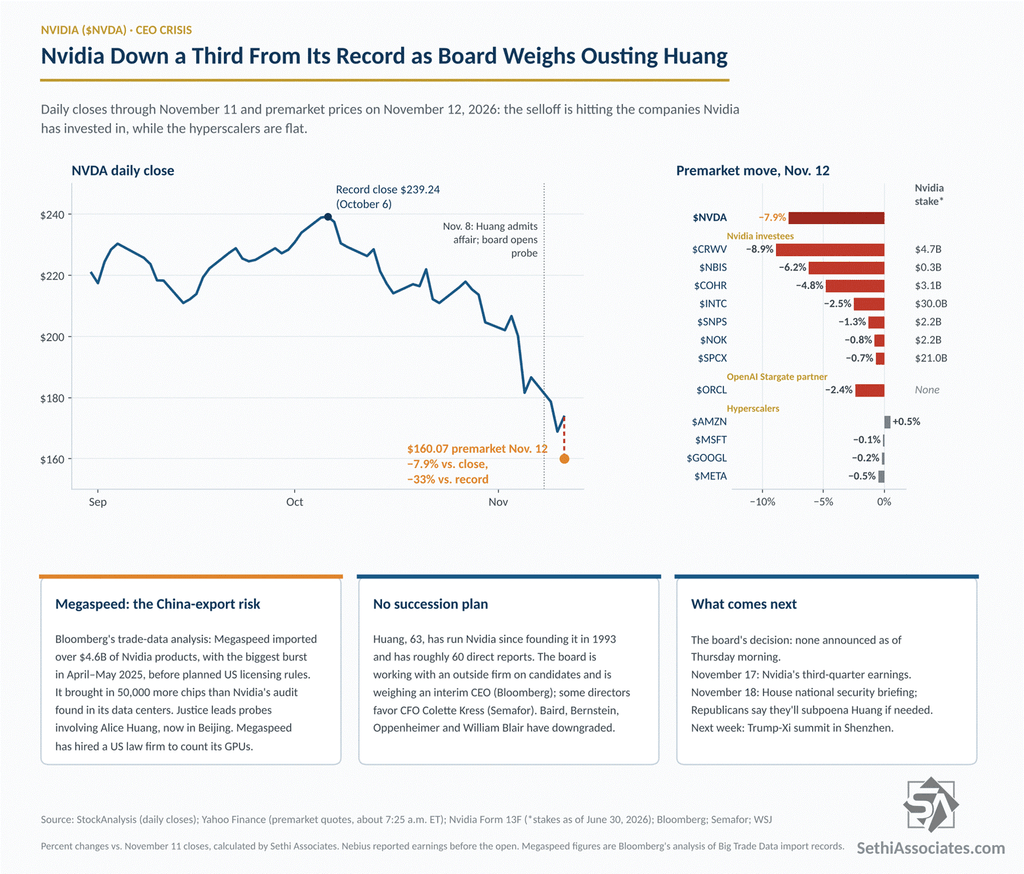
Nvidia (NVDA) is down about 8% premarket to around $160 after The Wall Street Journal reported Wednesday evening that the board is preparing to oust CEO Jensen Huang. The board met late Wednesday, but as of this morning it hasn’t announced a decision, per Bloomberg’s live blog. At $160, the stock is down a third from its October 6 record close of $239.24, erasing Wednesday’s 2.9% bounce and then some.
Bloomberg reports the board is working with an outside firm on candidates and weighing an interim CEO, and, citing Semafor, that some directors favor CFO Colette Kress. Wall Street is stepping back: Baird, Bernstein, Oppenheimer and William Blair have all downgraded the stock this week, and Morgan Stanley dropped it as a top pick (Bloomberg).
The Selloff Is Hitting Nvidia’s Investees, Not Its Biggest Customers
A telling signal is who’s falling with Nvidia: the circular web of companies it funds that in turn buy its chips. All seven of Nvidia’s major public stakes, per its latest 13F filing, are lower premarket: CoreWeave (CRWV) down 9.7%, Nebius (NBIS) 9.2%, Coherent (COHR) 4.9%, Intel (INTC) 3.0%, Synopsys (SNPS) 1.3%, Nokia (NOK) 1.3% and SpaceX (SPCX) 0.6%. Oracle (ORCL), tied in through OpenAI’s Stargate project rather than an Nvidia stake, is off 2.8%.
Meanwhile, the hyperscalers that buy the bulk of Nvidia’s chips are flat: Amazon (AMZN) +0.2%, Microsoft (MSFT) −0.1%, Alphabet (GOOGL) −0.2% and Meta (META) −0.6%. Rivals Advanced Micro Devices (AMD) and Broadcom (AVGO) are higher, as investors bet they could pick up business (Bloomberg).
Two caveats: CoreWeave jumped nearly 25% Wednesday on strong results (more on that here), so it’s only giving back part of that gain, and Nebius reported third-quarter results this morning.
Washington and Megaspeed
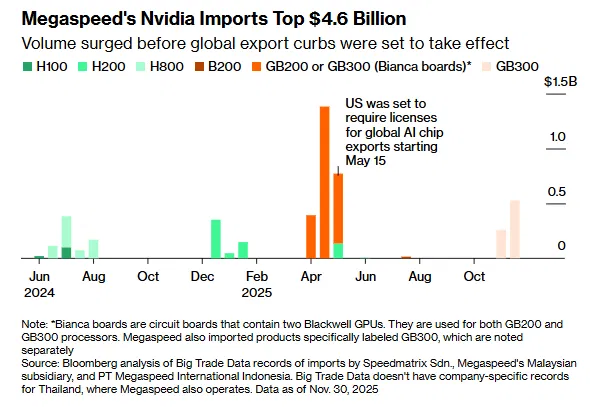
The bigger long-term issue is national security. Huang has admitted an affair with Alice Huang (no relation), a former executive at Megaspeed, a Singapore-based Nvidia cloud partner, whom U.S. officials reportedly suspect of working for Chinese intelligence. Bloomberg’s analysis of trade records shows Megaspeed imported more than $4.6 billion of Nvidia products and brought in 50,000 more chips than Nvidia’s own audit found in its data centers. Overnight, Megaspeed said it had hired a U.S. law firm to count its GPUs and review its export compliance, and Bloomberg reports Alice Huang has resurfaced in Beijing.
Bloomberg
On Capitol Hill, House China committee chair John Moolenaar and House Foreign Affairs chair Brian Mast say they’ll likely subpoena Huang if he doesn’t agree to a closed-door briefing. Sen. Kevin Cramer said Huang should resign, and Sens. Elizabeth Warren and Chris Coons have asked the administration to preserve all records on Nvidia chip exports. Bloomberg notes the scandal also complicates next week’s Trump-Xi summit in Shenzhen.
Strong Demand
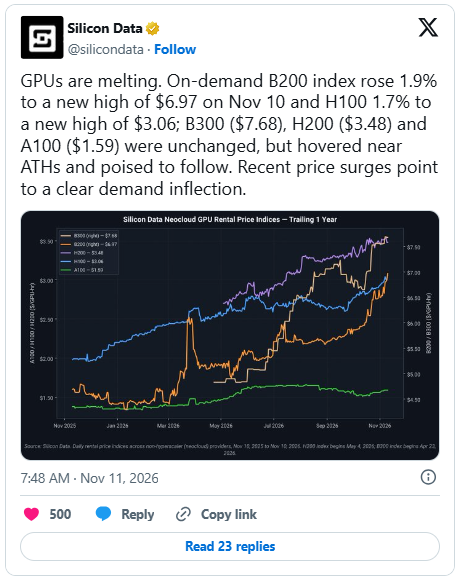
Whatever happens with Huang, though, there remains fierce demand for Nvidia’s products. November 10, at $6.97 and $3.06 an hour. The B300 and H200 are hovering just below theirs, and the H100 is up roughly 50% from a year ago. That comes on top of CoreWeave saying this week it has 10x as much qualified demand as capacity through 2027, showing the market for Nvidia’s chips going into this was as tight as it’s been.
It also matters for the circular-financing worry: rental rates are what back the GPU-collateralized loans to the neoclouds, so firm prices mean that collateral is holding up for now at least.
What to Watch
A quick decision that names an insider such as Kress would signal continuity, but either way the stock is likely to stay under pressure without a successor who was groomed for the job.. ClearBridge’s Michael Feldman warned of a shift from “a Jensen premium to an execution discount” (Bloomberg). Nvidia will report third-quarter results on November 17, the day before Huang is due before House national security committees. For CoreWeave, Nebius and the rest of the companies Nvidia has backed, the question is whether Nvidia keeps writing checks under new leadership.
More on TheStreet Pro
Rev Shark argues the bigger risk is the financing system Huang built, from the OpenAI commitments to the $500 billion customer-financing plan (Nvidia’s Problem Is Bigger Than Its CEO).
Conversation 0 Comments
One ongoing discussion across all days. Everyone can read; sign in to take part.
Your voice matters. Discussions are moderated for civility. Read our guidelines .
Log in to join the conversation