The S&P 500’s Worst Week Since April 2025 Ends in a Correction
The S&P 500 fell for a seventh straight day for the first time since February 2020 to close 11.6% below its record. The Nasdaq erased its nearly 19% gain for the year and the VIX hit its highest since April 2025 as chip stocks had their worst week since 2001.
You've reached your free article limit
You've read 0 of 1 free Pro articles.
Executive Summary
The AI selloff discussed in last night’s update (Anthropic Pops, but the S&P 500 Drops) turned into a rout Friday, with another plunge in chip stocks sending the S&P 500 into a correction.
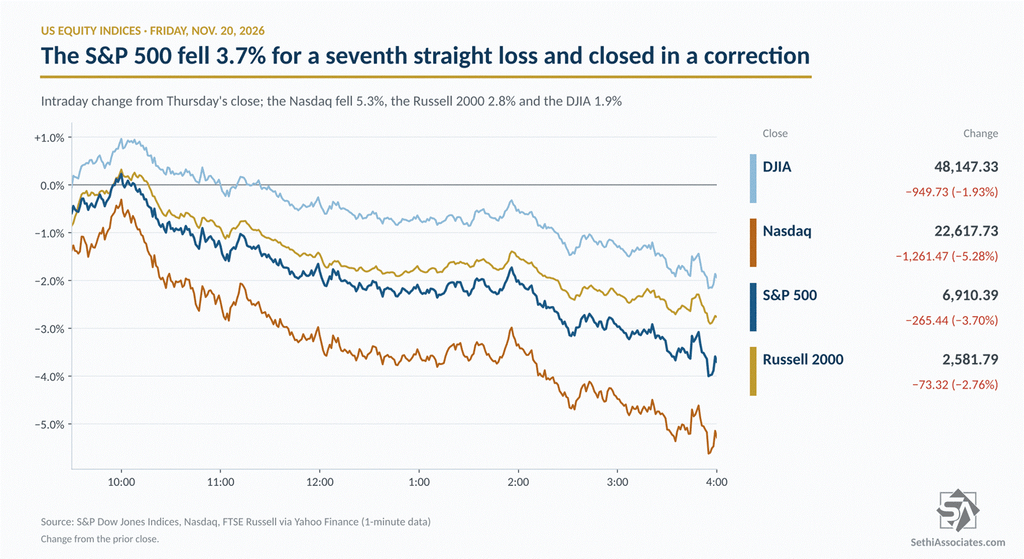
The S&P 500 fell 3.7% to 6,910, its seventh straight decline, the first streak that long since February 2020, leaving it 11.6% below its October 6 record after a brief early bounce faded. The Nasdaq Composite dropped 5.3%, now more than erasing what had been an 18.8% gain for the year, while the Russell 2000 fell 2.8% and the DJIA 1.9%. The Nasdaq-100 (-5.6%) fell as much as 20.2% below its record close intraday before closing 19.8% below it, missing a bear market by just two tenths of a percentage point.
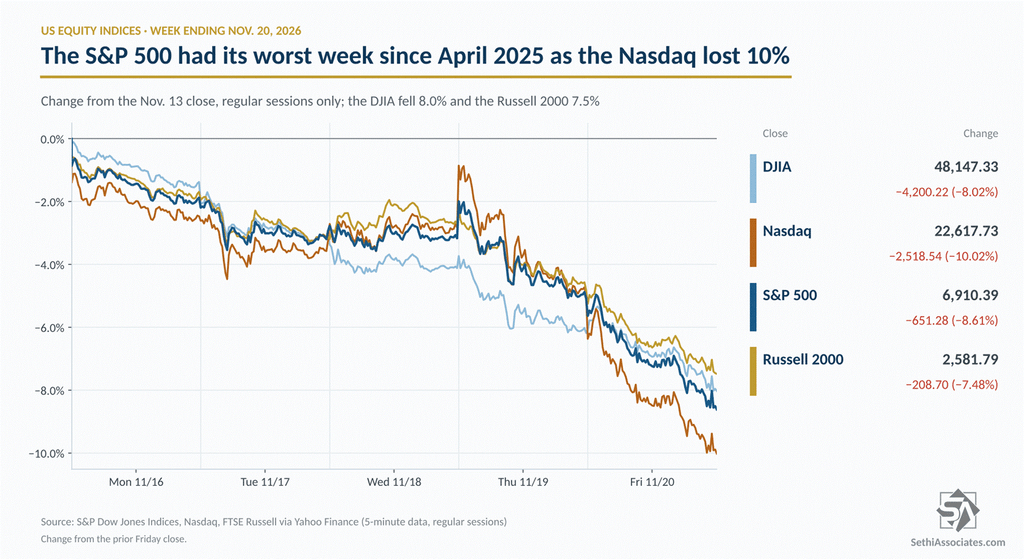
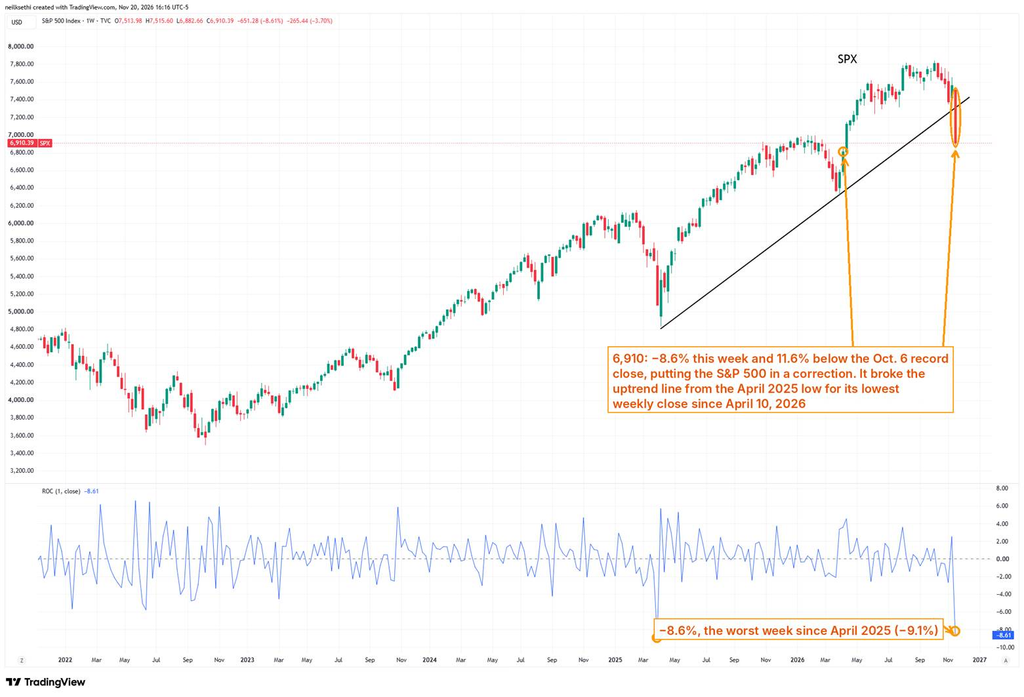
For the week, the S&P 500 fell 8.6%, its worst week since April 2025, and broke below the uptrend line from its April 2025 low. The Nasdaq lost 10%, roughly matching its April 2025 drop as its worst week since March 2020, while the DJIA fell 8.0% and the Russell 2000 7.5%.
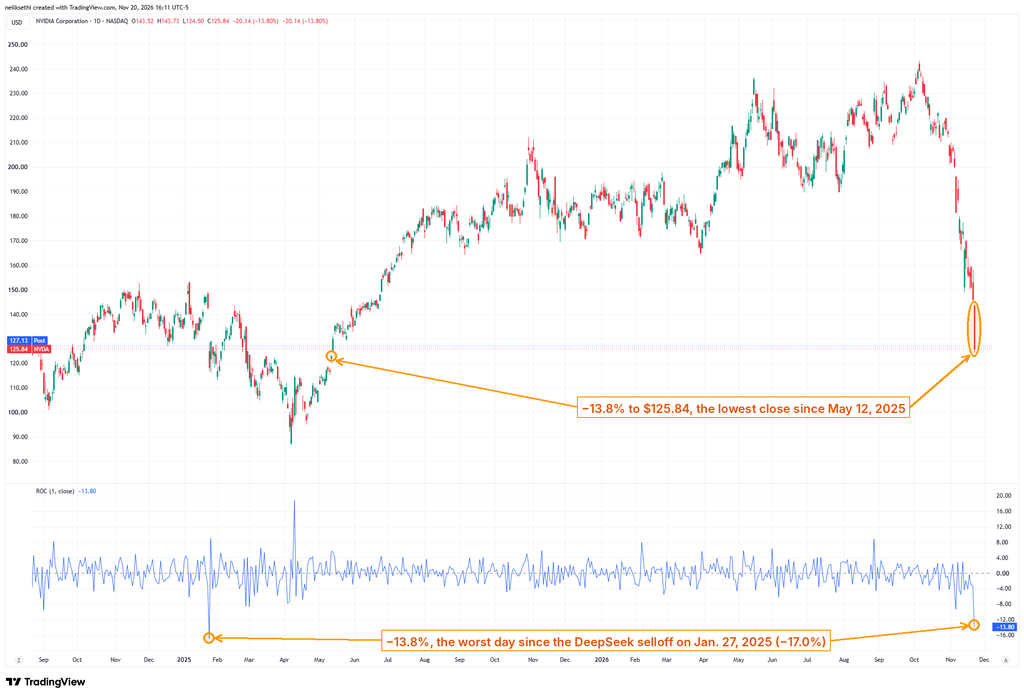
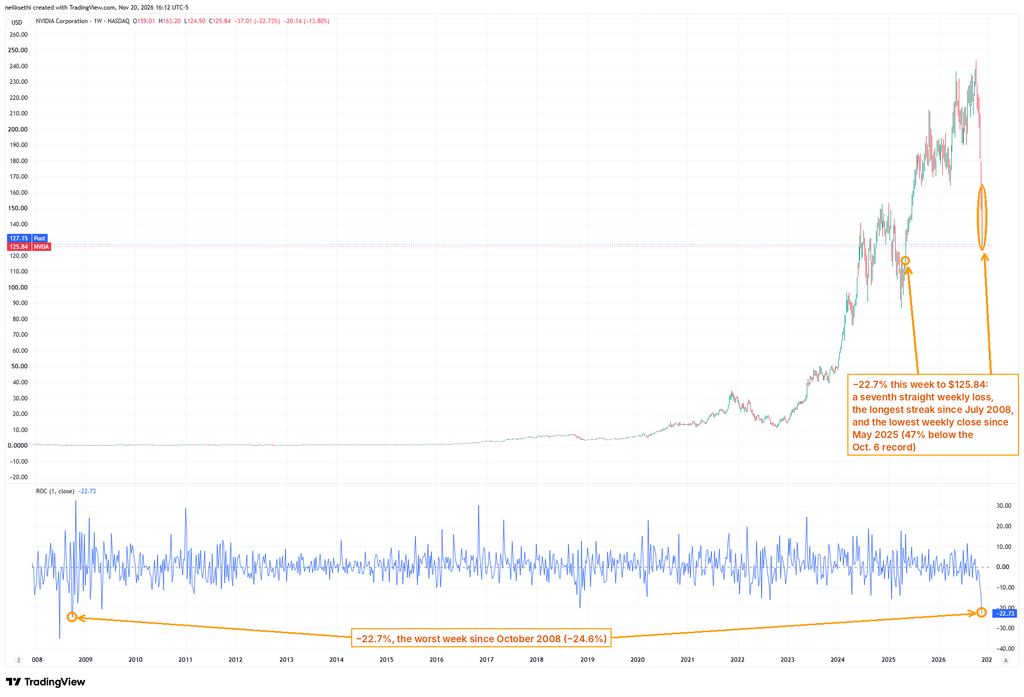
Nvidia (NVDA) fell 14% to $125.53, its worst day since the DeepSeek selloff in January 2025 and its lowest close since May 2025, after Reuters reported US regulators are investigating itsaccounting practices. That capped Nvidia’s worst week since October 2008 (-23%) and made it the fourth-largest US company by market value, behind Alphabet (GOOGL). Bret Jensen noted the company had already pushed off its 10-Q by several weeks for the first time in its history.
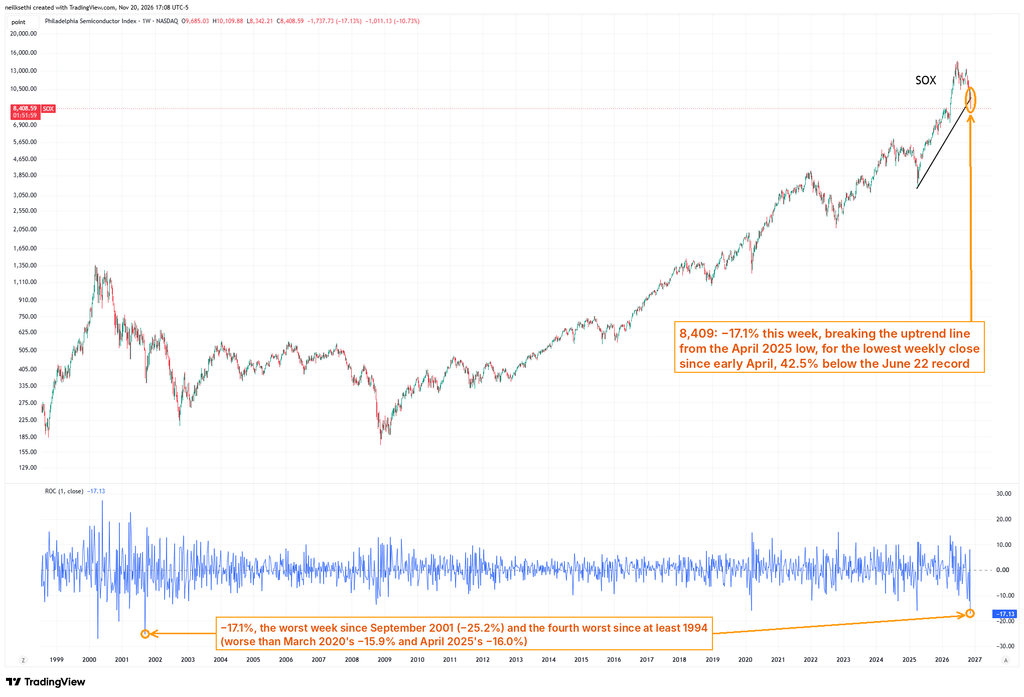
The Philadelphia Semiconductor Index (SOX) in turn plunged 10.7% Friday and 17.1% for the week, its worst week since September 2001, when markets reopened after the 9/11 attacks, and worse than either April 2025 (-16.0%) or March 2020 (-15.9%), leaving it 42.5% below its June 22 record.
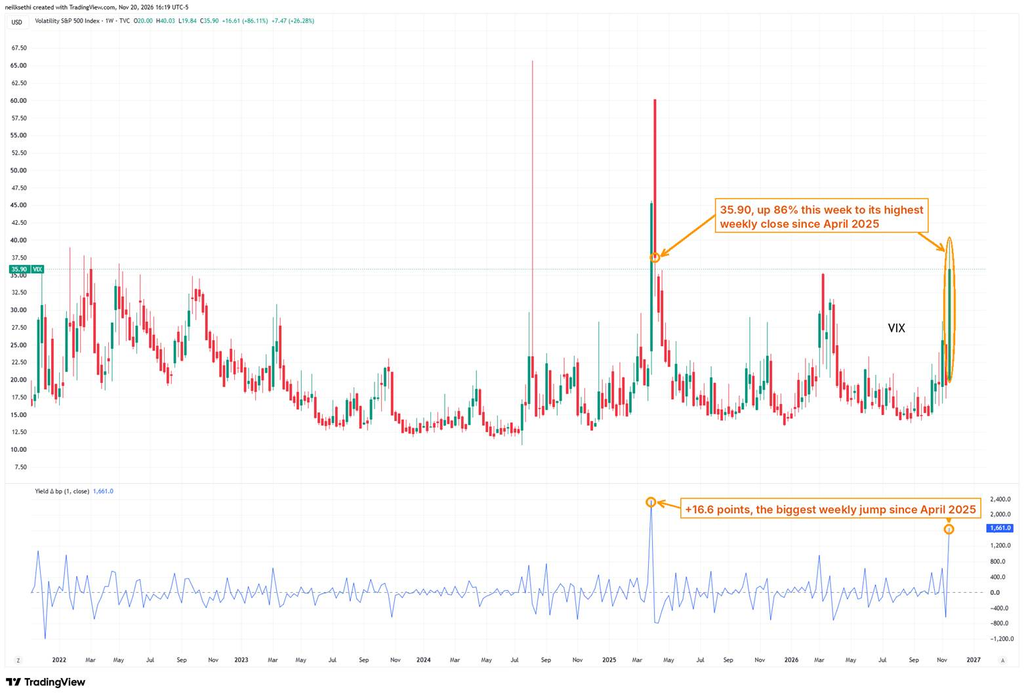
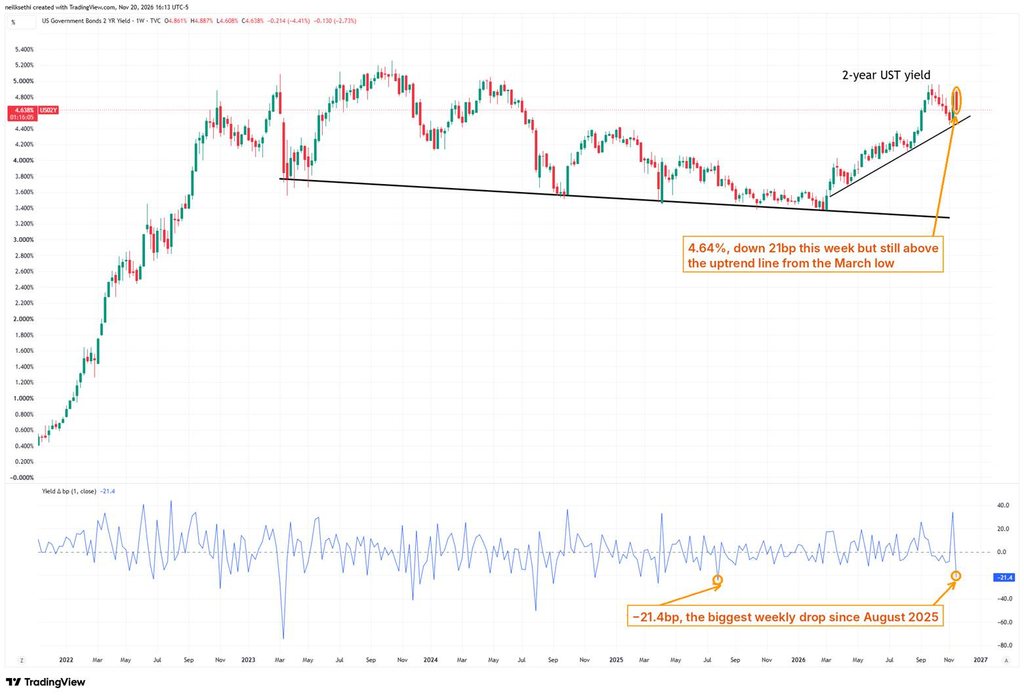
The VIX jumped 26% to 35.9, its highest close since April 2025, and Treasuries rallied as investors sought safety, with the 2-year yield down 12 basis points to 4.65% and the 10-year down 10bp to 4.95% (including post-market), back below 5%. For the week the 2-year yield fell the most since August 2025 (chart in the Fed section). The dollar was little changed, but the selling hit other havens and risk assets alike: gold fell 4.6% to its lowest close since August 2025, its biggest drop since March, copper fell 2.6% to its lowest since late March, completing its worst week since July 2025, and bitcoin futures fell 6% to their lowest since September 2024. WTI rose 1.2%, extending its gains late on a Financial Times report that President Trump is considering restarting strikes against Iran.
After the close, Bloomberg reported that CrowdStrike (CRWD) is in talks to acquire Zscaler (ZS) in what would be one of the largest cybersecurity deals ever, creating a company with a combined market value of about $265 billion. Zscaler jumped about 18% after hours, while CrowdStrike, already down nearly 6% in the regular session, fell about 6% more. The talks are ongoing, and there’s no certainty they’ll produce a deal.
In economic data, final November University of Michigan consumer sentiment rose to 51.5, its highest since August, as inflation expectations plunged (more here: Consumer Sentiment Gets a Post-Election Lift as Inflation Expectations Plunge).
Next week is holiday-shortened (US markets are closed Thursday with a half-day Friday), the last before the Fed’s blackout. US economic data is highlighted by October PCE inflation and the second estimate of Q3 GDP Wednesday ahead of Thursday’s Thanksgiving close (see more in the Week Ahead below).
My look at today’s charts follows in a separate post, which will be either later this evening or on Saturday.
Market Commentary
Equities:
- “One of the fantastic things about the capital markets is how it pivots very quickly. You could be the shining star in a fantastic narrative at one point, and then a couple of data points later, suddenly everyone is saying: ‘Well, we all knew that would happen, didn’t we?'” said Robert Dafforn, chief investment officer of opportunistic credit at Polus Capital Management. In his view, “we’re in the early ‘we all knew that would happen’ phase.” “This looks less like an AI fundamentals crisis than a combination of crowded positioning, scarce liquidity and end-of-year fatigue,” he said. “In the shorter run, simply exhausting the forced selling could be enough for a technical rebound.”
- “Fears that we are in the latter stages of the AI cycle, with peak earnings behind us, are understandably making investors cautious. After a tough couple of months, repeated bouts of selling are eroding confidence in buying dips. And the selling is becoming more indiscriminate. When good news stops working and selling itself keeps investors from reengaging, it’s hard to see what breaks the cycle,” said Skylar Montgomery Koning, Bloomberg macro strategist.
- “The midterm elections, Nvidia’s strong results and Anthropic’s successful IPO have all failed to serve as clearing events,” said Robert Scholtes at Singular Bank. “Technical selling pressures will likely need to run their course, potentially setting the stage for a short squeeze that could mark a bottom.”
- “This is not just a valuation-driven correction. It’s becoming broader,” said Massimo Santicchia, head of US equities at Procyon. “Right now, it’s definitely risk-off.”
- “Anthropic’s strong debut alongside a falling technology sector suggests investors still believe in AI but are becoming more selective about what they will pay for that growth,” said David Miller, CIO at Catalyst Funds. “Nvidia’s leadership uncertainty adds another layer of risk, and the stock’s weakness despite strong earnings shows how much it will take to restore confidence.”
- “The success of Anthropic’s IPO yesterday as other AI-related stocks tumbled highlights how different parts of the AI ecosystem no longer move as one,” James Reilly, senior markets economist at Capital Economics, wrote in a Friday note. “We think the falls in tech stocks and the S&P 500 have further to run — and how this plays out within the stock market will depend on what is driving these falls.”
- The market is skeptical about “all layers of the AI layer cake,” but that can be a “great setup for investors,” said Brett Winton, chief futurist at ARK Investment Management, who has Anthropic in all his portfolios. “The market really thinks that Anthropic’s revenue per gigawatt of compute has essentially peaked and is only going to go down from here. And the history and the returns they’ve got to their training suggest exactly the opposite, where they already have amazing gross margins,” he said.
- “The stock market is going through an AI repricing, reflecting an environment of slowing data center buildouts, reduced funding sources for AI-related projects and a slower trajectory of technology-related earnings growth,” said Richard Saperstein, chief investment officer at Treasury Partners.
- “Smackdown!” said Steve Sosnick at Interactive Brokers. “The problem stems from investors’ rapidly changed perceptions about technology, particularly the pace and cost of the artificial-intelligence buildout.”
- It’s impossible to know when any selloff will run its course, but history shows most moves like this don’t turn into bear markets, according to Chris Larkin at E*Trade from Morgan Stanley. Only five of the past 15 corrections from all-time highs since 1983 have done so, he said.
- “A capitulatory washout could ultimately prove constructive,” said Mark Hackett at Nationwide. “If this evolves into a true flush, it may serve as the reset needed to improve positioning, sentiment, and the odds of a more sustainable rally into year-end.”
- “Dip-buyers may view the current pullback as a long-term opportunity, but they should be prepared to sit through more volatility and uncertainty in the short term,” said Bret Kenwell at eToro.
Anthropic:
- “If this were not a company that simultaneously says it is going to cure cancer and/or wipe out humanity, reporting a similar decline in revenue growth right in front of the IPO would cause major reservations,” said Seaport analyst Jay Goldberg, who advised his clients to stay on the sidelines on the stock, noting that the company’s quarter-over-quarter revenue growth slowed from 144% to 43% in the most recent quarter.
- “We’re probably going to see tech continue to struggle to absorb this giant amount of issuance … I think the market is putting too much pressure on this company as indicative of AI appetite. The reality is it’s a giant IPO and giant IPOs kind of behave the same,” said Gina Martin Adams, strategist at HB Wealth.
- “Remember this isn’t just about the promise of AI, but about making room for it. In a narrow sense, investor financing of the mega-IPO involves making room by selling other holdings. In a broader sense, it mirrors what we have been seeing with yields: with no large borrowers reducing their use of the bond market, financing costs rise for everyone, hitting rate-sensitive sectors particularly hard,” said Mohamed El-Erian, former CEO of PIMCO and Wharton School professor.
- “I think the market seriously underestimated just how much liquidity Anthropic’s IPO would require … The question isn’t whether investors want exposure to AI. It’s whether the market has sufficient liquidity to absorb this much supply without forcing liquidation elsewhere,” said Tracy Shuchart, economist at NinjaTrader.
Gold:
- “Rather than benefiting from increased uncertainty, bullion has become a source of cash for investors facing mounting losses elsewhere, higher funding costs and pressure to reduce overall portfolio risk,” said Ole Hansen, head of commodity strategy at Saxo.
Bonds/Fed:
- Ian Lyngen, head of US rates strategy at BMO, said the fall below 5% in the 10-year yield is not meaningful. “We’re not considering this an especially meaningful technical event and will simply observe that it is consistent with the benchmark Treasury rate being centered at 5.0%. In the event of further downside in global equities, one should expect 10-year yields to move closer to resistance near 4.90%, however once the AI anxiety subsides (assuming it does), then a drift back above 5.0% is likely to prove the path of least resistance,” said Lyngen.
Stock and Sector Breakdown
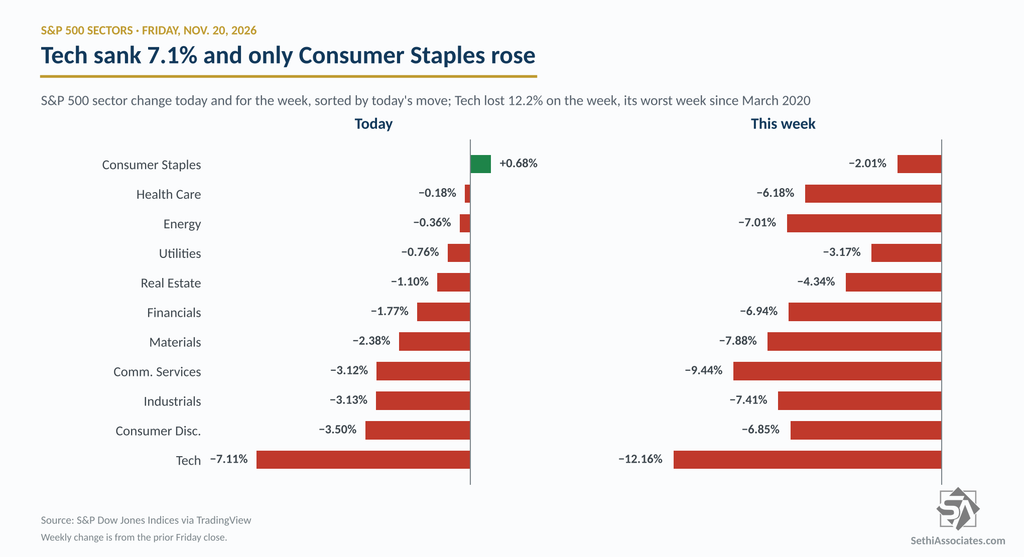
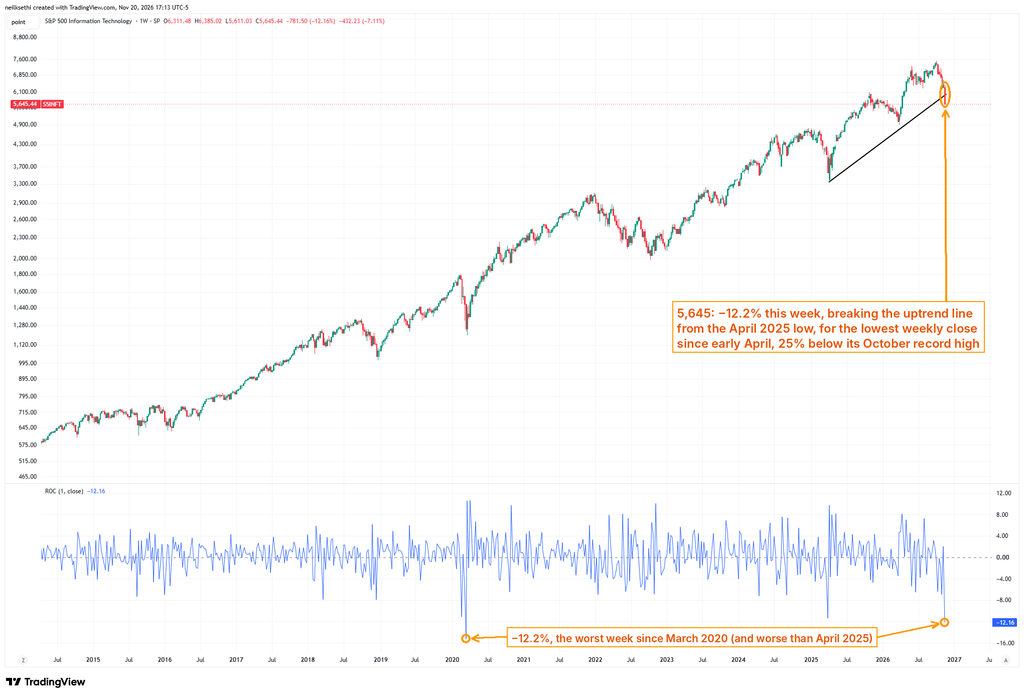
Ten of the 11 S&P 500 sectors fell (after all 11 Thursday), with Tech’s 7.1% plunge by far the worst, leaving it down 12.2% for the week, its worst week since the March 2020 Covid crash. Consumer Discretionary (-3.5%), Industrials (-3.1%) and Communication Services (-3.1%) were the next-worst, while Consumer Staples (+0.7%) was the only sector to rise and Health Care (-0.2%) and Energy (-0.4%) held up best.
124 S&P 500 stocks rose and 376 fell, an improvement from just 38 gainers Thursday, so that’s a positive divergence. Just six rose more than 3% though, while 149 fell more than 3%.
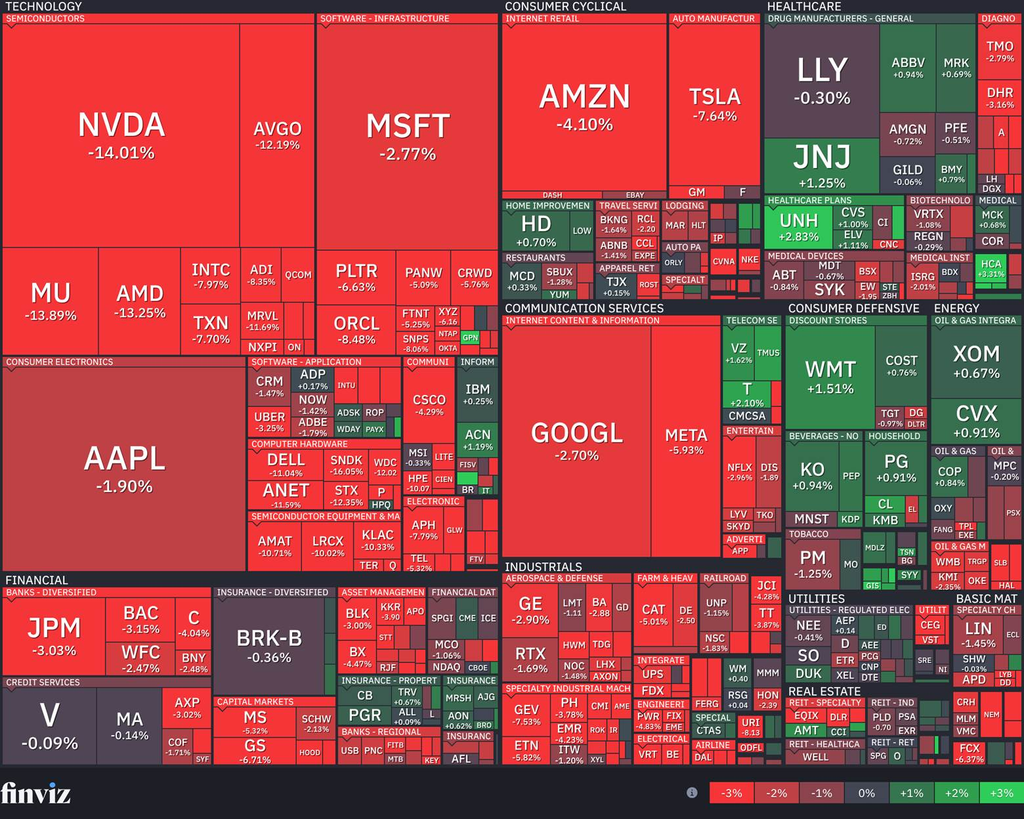
Global Payments (GPN) led the S&P 500, up 10%, after Bloomberg reported that GTCR is exploring a takeover that would be one of the biggest-ever leveraged buyouts. Sandisk (SNDK) was the worst performer, down 16%, as memory stocks were hit especially hard, with Micron (MU) down 14%.
Broadcom (AVGO) fell 12% after analyst Ming-Chi Kuo reported that Google cut its projected 2027 shipments of Broadcom-designed TPU chips by about 20%, and AMD (AMD) fell 13% amid concerns about its China business. Sarge, who is heavily exposed to AMD, said Thursday’s Hunterbrook report on the company might have been what broke the market Thursday, as much as anything related to Anthropic, while Ed Ponsi asked whether AMD is unfairly maligned or right where it belongs. Lumentum (LITE) (-14%) and Marvell (MRVL) (-12%) fell even as Lumentum’s CEO called demand “phenomenal,” per Chris Versace.
Anthropic (ANT) fell 8.5% to $88.91 on its second day of trading after coming within five cents of its $83 IPO price, which Rev Shark said was part of why the two events many investors thought would save the market turned into catalysts for even more selling. AI infrastructure names outside the S&P 500 also sank, with Nebius (NBIS) down 16%, Applied Digital (APLD) 18% and TeraWulf (WULF) 15%, as falling stock prices raised questions about how they’ll fund their data center buildouts.
Among the megacaps, Tesla (TSLA) fell nearly 8%, Meta (META) about 6%, Amazon (AMZN) 4%, Microsoft (MSFT) and Alphabet (GOOGL) nearly 3% each and Apple (AAPL) about 2%. Intuit (INTU) fell nearly 13% after its report Thursday night. Defensive names held up, with General Mills (GIS) up nearly 4% and managed care names such as UnitedHealth (UNH) (+2.9%) recovering some of their recent losses.
For the week, just 31 S&P 500 stocks rose and 472 fell. The top 10 advancers were:
- Tyson Foods (TSN) +10.7%
- Hormel (HRL) +6.6%
- Palo Alto Networks (PANW) +6.5%
- Tractor Supply (TSCO) +5.5%
- Okta (OKTA) +4.7%
- General Mills (GIS) +4.1%
- PG&E (PCG) +4.0%
- TJX (TJX) +3.9%
- Edison International (EIX) +3.4%
- Target (TGT) +2.7%
And the 10 worst:
1. Sandisk (SNDK) -28.4%
2. Bloom Energy (BE) -25.8%
3. Micron (MU) -23.6%
4. Nvidia (NVDA) -22.9%
5. Lumentum (LITE) -22.8%
6. Freeport-McMoRan (FCX) -22.4%
7. Marvell (MRVL) -22.0%
8. Intuit (INTU) -20.9%
9. AMD (AMD) -20.5%
10. Robinhood (HOOD) -20.2%
Doug Kass leaned into the selloff, adding to his index longs as his S&P Short Range Oscillator got more deeply oversold, buying more Microsoft and Meta premarket and by midday moving to a medium-sized long in the indices. His view: it may be time to start growing greedy when others are fearful.
FedWatch
Fed rate hike expectations dropped sharply with the equity selloff. A December hike is no longer fully priced, at 92% (with a 0% chance of a 50 basis point hike), although two hikes are still fully priced by March. Markets now price 61 basis points of hikes through the Fed’s final 2027 meeting in November, nearly two and a half hikes, down from 74bp Thursday and 86bp a week ago, per CME FedWatch.
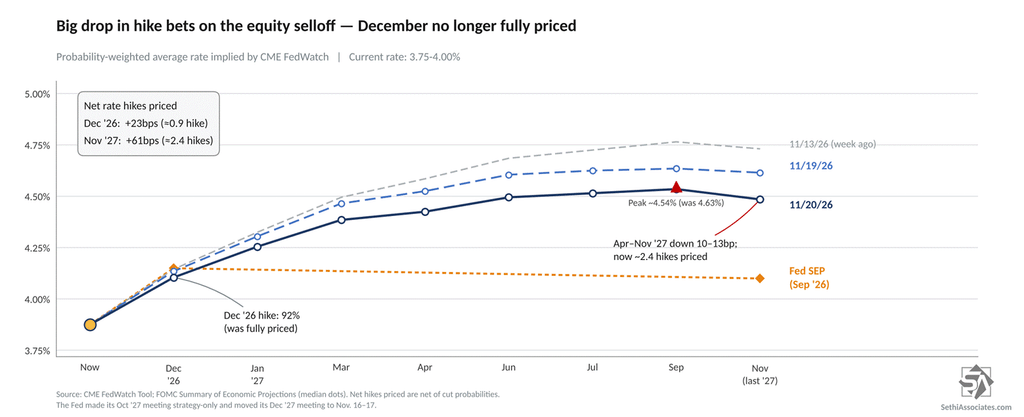
On the back of the repricing in Fed expectations this week the 2-year yield fell 20bp to 4.65%, its biggest weekly drop since August 2025, though it remains above the uptrend line from its March low. On the Fed speaker front, Philadelphia Fed President Paulson again argued for deliberate rate hikes to tame inflation, while Governor Cook said she sees growing urgency to tackle broadening inflation (there will be an SMT on that Monday).
More From TheStreet Pro
Stephen “Sarge” Guilfoyle —
- We Can No Longer Count on the Bull. Here’s What We Can Count On
- I’m Not Buying More SoFi Until He Does
Chris Versace —
- What We’re Watching Ahead of Key Inflation Data
- Volatility Index Moves to Close Out Painful Week: 8 Key Items Shaping the Stock Market Friday
Doug Kass’s Diary:
- My Favorite Three Stocks Over the Next Six Months
- Possible Scenario
- From Bramo
- Out of TLT Long
- Boockvar on Chance of a Rate Hike, Retailers and Consumers
- Boockvar’s Succinct Summation of the Week’s Events
Note: Doug posted 24 Diary entries today; these are the market ones not linked above. You can see all of them here.
And From Me If You Missed It
- History Says the S&P 500 and DJIA Losing Streaks Could Lead to a Bounce
- Stocks Are Suddenly Moving in Lockstep. That’s Been Bullish in the Past
- Active Managers Slashed Stock Exposure but Retail Investor Bearishness Eased
- Fuel and AI Hardware Boost Import Prices to 4-Year High
- Consumer Sentiment Gets a Post-Election Lift as Inflation Expectations Plunge
Miscellaneous
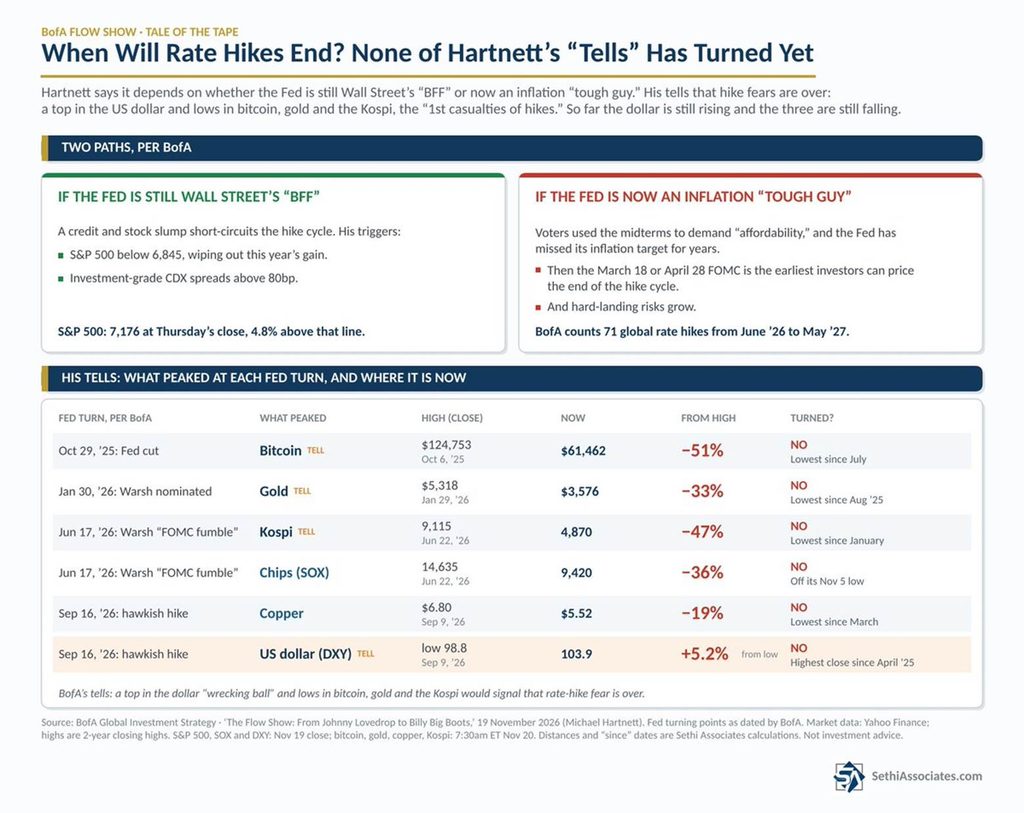
BofA’s Michael Hartnett asks “when will rate hikes end?” He says it depends on the Fed:
If the Fed is still Wall Street’s “BFF,” a credit and stock slump will short-circuit the hike cycle. His triggers are investment-grade CDX spreads above 80bp and the S&P 500 below 6,845, wiping out this year’s gain. The S&P 500 closed Friday at 6,910, just 1% above that line.
If the Fed is now an inflation “tough guy,” the March 18 or April 28 FOMC is the earliest markets can position for “peak rates,” and hard-landing risks grow.
His tells that hike fears are over are a top in the US dollar “wrecking ball” and lows in bitcoin, gold and the Kospi, the “1st casualties of hikes.” None had turned as of Thursday’s close:
Bitcoin: down 51% from its October 2025 high and at its lowest since July.
Gold: down 33% from its January high and at its lowest since August 2025.
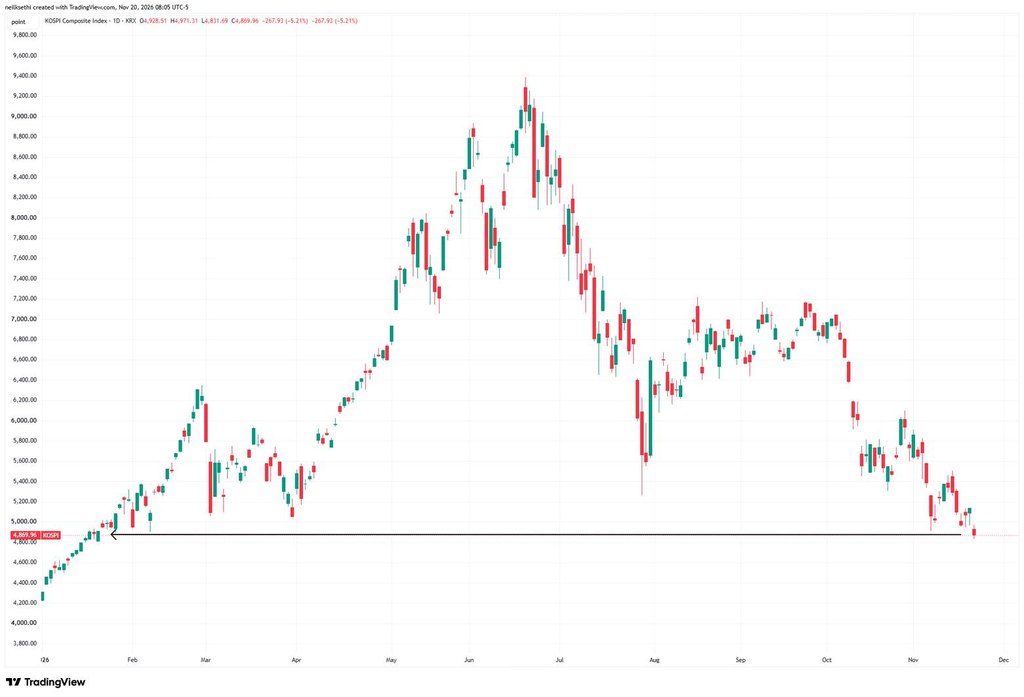
Kospi: down 47% from its June high and at its lowest since January.
Dollar index: 103.9, its highest since April 2025.
A note on the Kospi, South Korea’s equity benchmark. It has now nearly given back the entire 122% gain it had this year at its intraday peak on June 19.
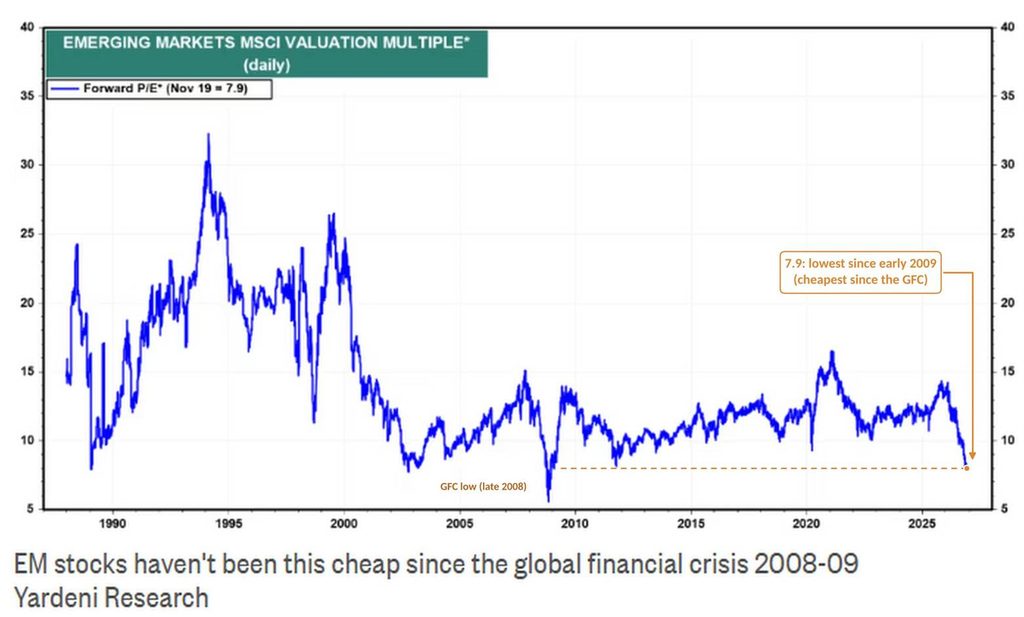
In that regard, if you think US Tech is cheap, emerging market stocks have a P/E ratio under 8 (and still falling with Friday’s selloff), the lowest since the global financial crisis, per MarketWatch.
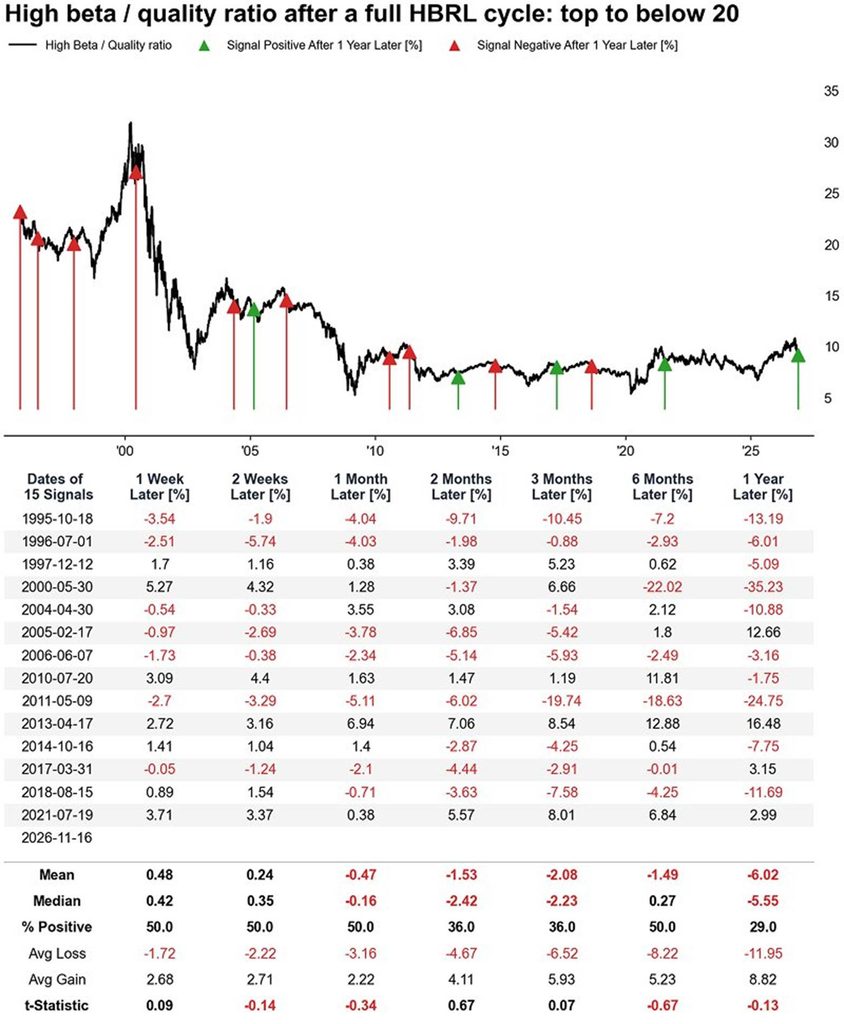
SentimenTrader says the rotation out of high beta has further to go. After past full cycles that took high beta from leading to below 20, the median one-year return for the high beta-to-quality ratio was -5.55%.
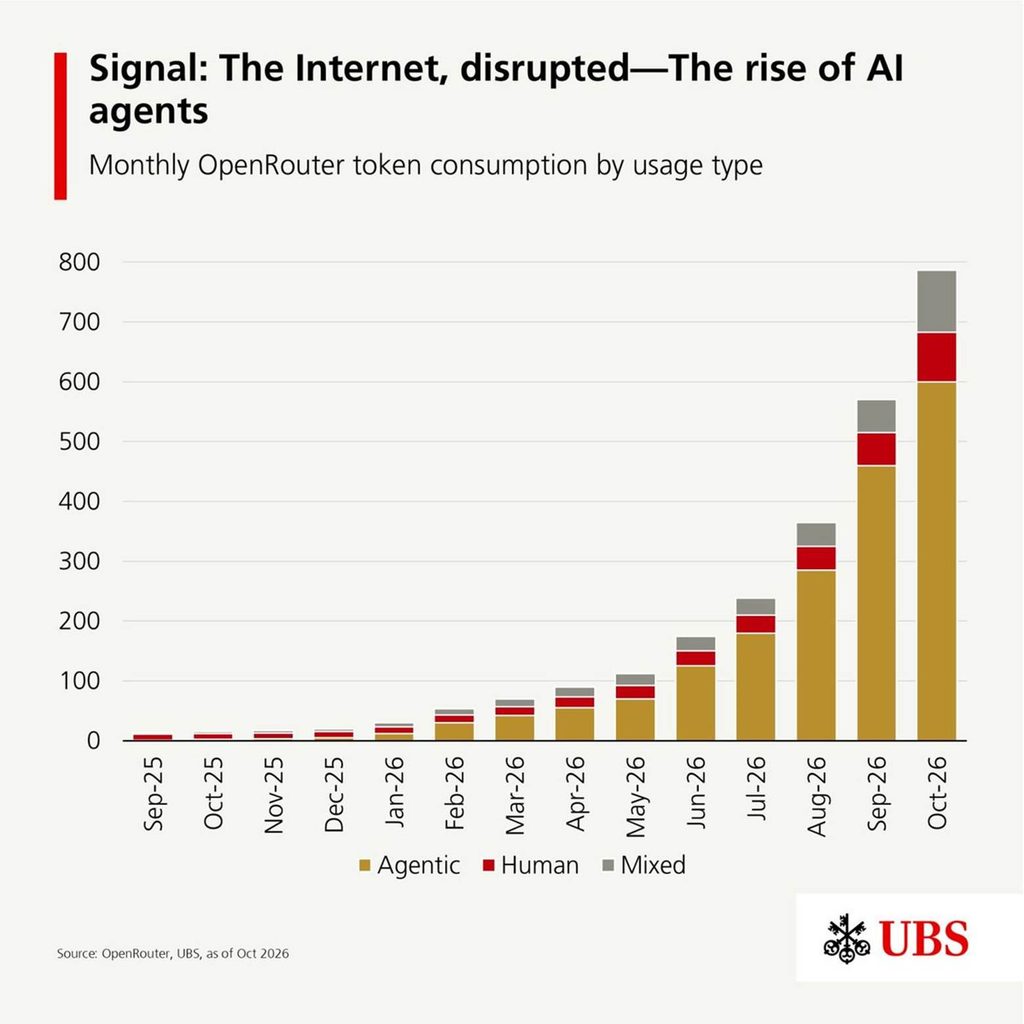
UBS’s Ulrike Hoffmann-Burchardi: “What is not yet fully appreciated, in our view, is how disruptive AI agents will be to internet incumbents. AI agents are rapidly becoming central to the digital economy, with agentic traffic already accounting for the majority of AI API token consumption, as the chart shows. As agents increasingly manage discovery, decisions, and transactions on users’ behalf, they are becoming a critical layer between humans and digital platforms, gradually challenging internet business models built around human attention.”
Wrap-Up — Now It’s a Positioning Story
Ted Mortonson, Baird’s technology desk strategist, one of the more closely followed Tech voices on the Street, said on Bloomberg Surveillance Friday morning that “fundamentals are out the window” and “this is now a positioning story,” one that will “require real panic, not fear.” (That’s from my recollection, so the quotes might not be exact.). That dovetails with the quote above from Robert Dafforn, chief investment officer of opportunistic credit at Polus Capital Management (whom I’m not familiar with, though he was quoted by a major news outlet). “This looks less like an AI fundamentals crisis than a combination of crowded positioning, scarce liquidity and end-of-year fatigue,” he said. “In the shorter run, simply exhausting the forced selling could be enough for a technical rebound.”
I agree with that wholeheartedly, as the selling is completely out of step with the fundamentals, which have shown absolutely no signs of softening. That’s not to say that they won’t, but I’m not sure worries call for a forward P/E ratio (for the Nasdaq) that is now below what we saw at the depths of the Covid crisis. I don’t have much skin in the Tech game at this point, as I have been rigorous about sticking to my stops, which has forced me out of position after position starting almost six weeks ago. So I’m not saying this as an angry bull, more as an interested observer.
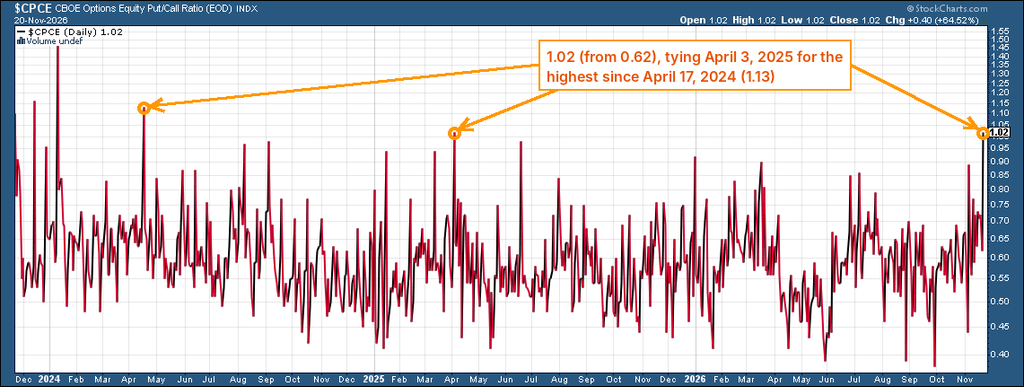
This week though looked like a step in the direction of getting to “panic.” The S&P 500 has fallen for seven straight days for the first time since February 2020, has now entered into correction territory, while the Nasdaq-100 is nearly in a bear market. The VIX is the highest since the liberation day debacle, and Rev Shark noted that nearly 1,100 stocks hit new 12-month lows, up from 725 Thursday. As he’d written in the morning, everything said bear market except the indexes, and that gap is now closing. And today the equity put/call ratio surged to 1.02, tying April 3, 2025 for the highest since May 2024. Since 2006, after readings of 1.0 or more, the S&P 500 was higher a month later 73% of the time (median +3.7%), vs. 66% for all days. I’ll have more on this Sunday.
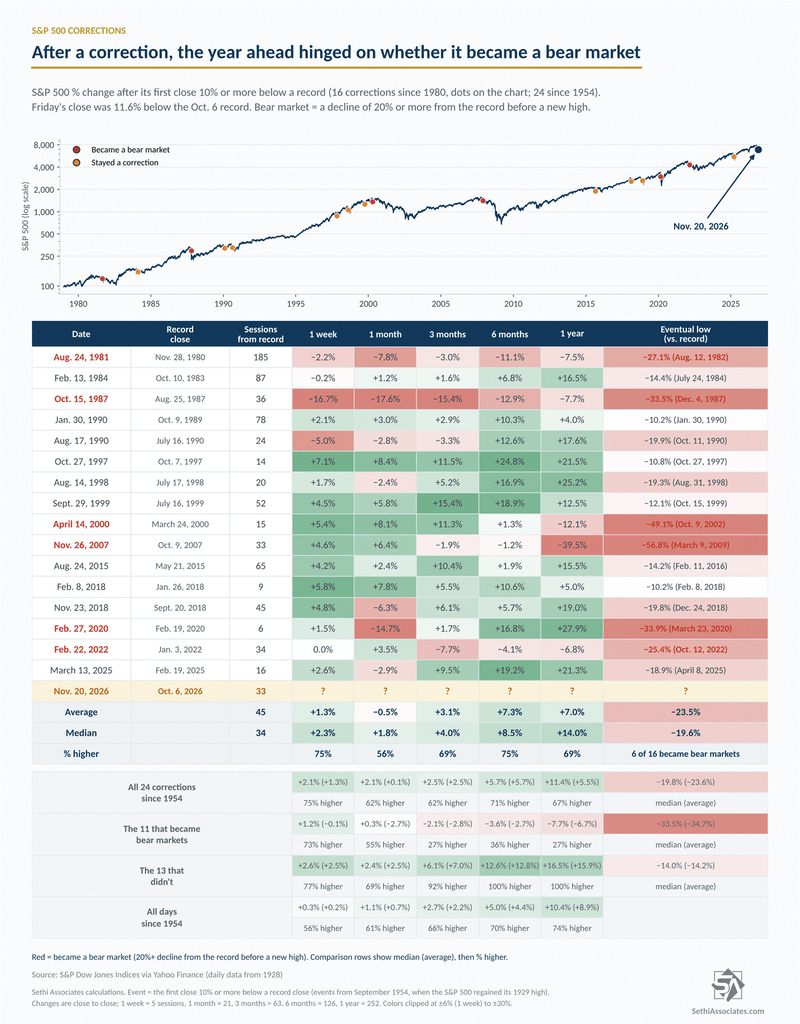
History also offers some near-term comfort: in the 24 prior corrections since 1954, the S&P 500 was higher a week later 75% of the time. The level to watch is a 15% decline, about 6,646, or 3.8% below Friday’s close. The nine corrections that stopped short of it all bottomed by 14.4%, while all 15 that went past it fell at least 18.9%, and 11 of them became bear markets. I’ll dig into this more in Sunday’s Week Ahead.
This weekend I’ll be checking for more signs of “real panic.” Helene, for one, thinks the odds of a relief rally may be rising fast, as sentiment has finally shifted, even if it isn’t extreme.
As always, let’s see what we get and go from there.
The Week Ahead — PCE, GDP and the Beige Book Before Thanksgiving
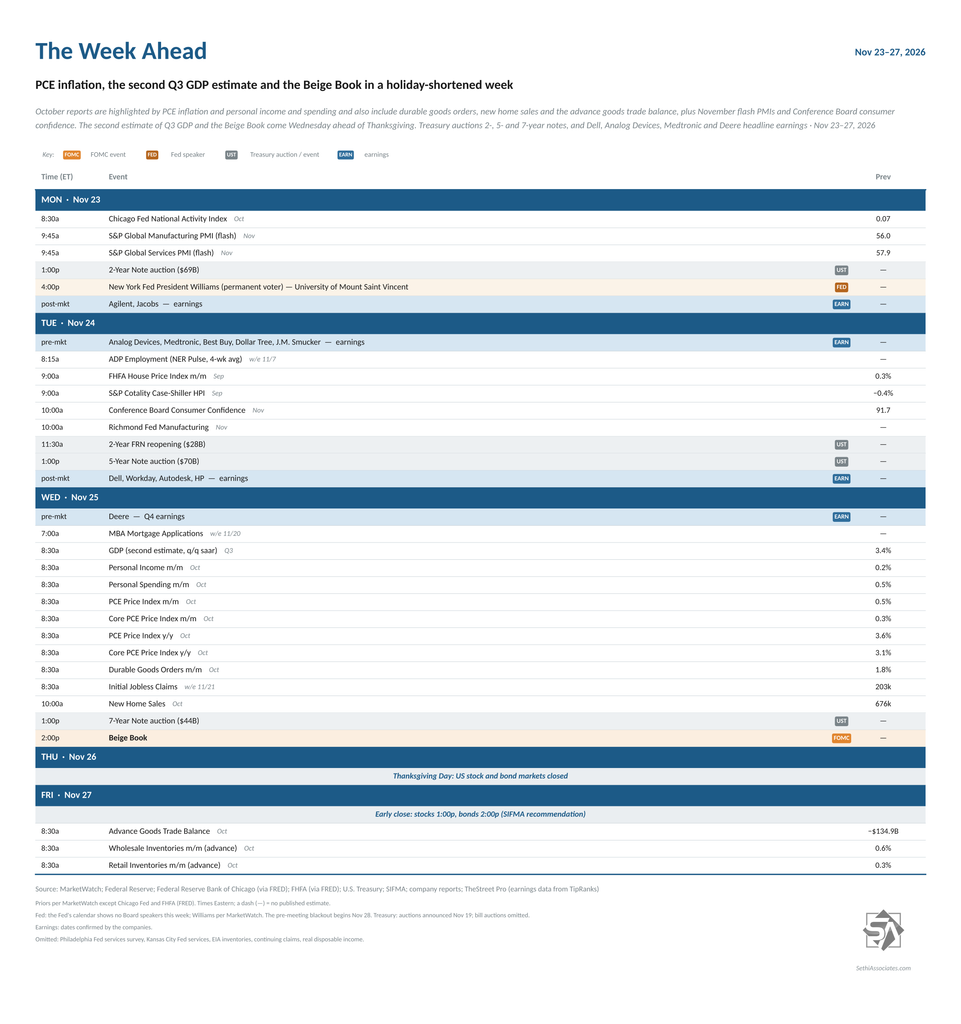
US economic data is front-loaded ahead of Thanksgiving. October reports are highlighted by PCE inflation along with personal income and spending. We’ll also get durable goods orders, new home sales, the Chicago Fed National Activity Index and the advance goods trade balance. November reports include S&P Global’s flash PMIs, Conference Board consumer confidence and the Richmond Fed manufacturing survey. We’ll also get the second estimate of Q3 GDP, September home prices (FHFA and Case-Shiller) and the usual weekly reports (ADP, mortgage applications and jobless claims, which move up to Wednesday for the holiday).
The Fed releases its Beige Book for the December meeting Wednesday, and New York Fed President Williams (permanent voter) speaks Monday. The pre-meeting blackout begins midnight Saturday, November 28, ahead of the December 8–9 FOMC meeting.
Non-Bill (>1yr in maturity) US Treasury auctions are moved up a day due to the holiday and include a $69B 2-year note Monday, a $28B 2-year FRN reopening and a $70B 5-year note Tuesday, and a $44B 7-year note Wednesday.
Markets are closed Thursday for Thanksgiving, with an early close Friday (1:00pm ET for stocks, 2:00pm ET for bonds).
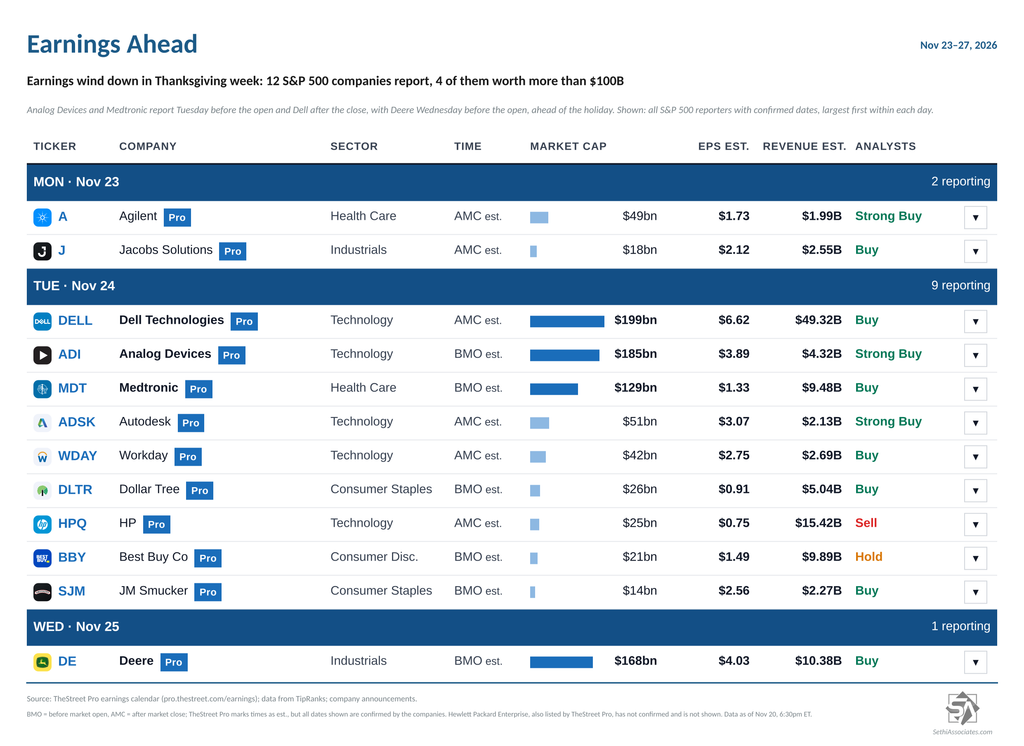
Q3 earnings season winds down with 12 S&P 500 components confirmed to report, 4 of them with market caps over $100B:
- Tuesday: Dell (DELL), Analog Devices (ADI) and Medtronic (MDT).
- Wednesday: Deere (DE).
- Other S&P 500 reporters include Agilent (A) and Jacobs (J) Monday; and Autodesk (ADSK), Workday (WDAY), Dollar Tree (DLTR), HP (HPQ), Best Buy (BBY) and J.M. Smucker (SJM) Tuesday.
At the time of publication, in terms of securities mentioned, Sethi was long AMZN, GOOGL, GPN, NVDA, SOXL, ZS and numerous Treasury ETFs, and short CPER, IWM, MRVL and VOO. In the last 24 hours Sethi sold his positions in META and QQQ, trimmed AMZN, GOOGL and NVDA, added to SOXL, and shifted some of his Treasury ETFs into T-bills.