Consumer Sentiment Gets a Post-Election Lift as Inflation Expectations Plunge
Expectations swung by political party more than in any midterm in data back to 2006.
You've reached your free article limit
You've read 0 of 1 free Pro articles.

November University of Michigan Sentiment: 51.5 (estimate 51.6; preliminary 51.0; October 48.0)
- Current Conditions: 49.4 (preliminary 51.0; October 46.7)
- Expectations: 52.9 (preliminary 50.9; October 48.8)
- 1-Year Inflation: 3.7% (preliminary 4.3%; October 4.7%)
- 5-10 Year Inflation: 3.3% (estimate 3.4%; preliminary 3.4%; October 3.5%)
Executive Summary
- Final November sentiment was revised up to 51.5 from 51.0, the highest since August and just below the 51.6 consensus. The 7.3% gain was the biggest since July and came from a post-election jump in expectations, revised up to 52.9, the highest since July, while current conditions were revised down to 49.4.
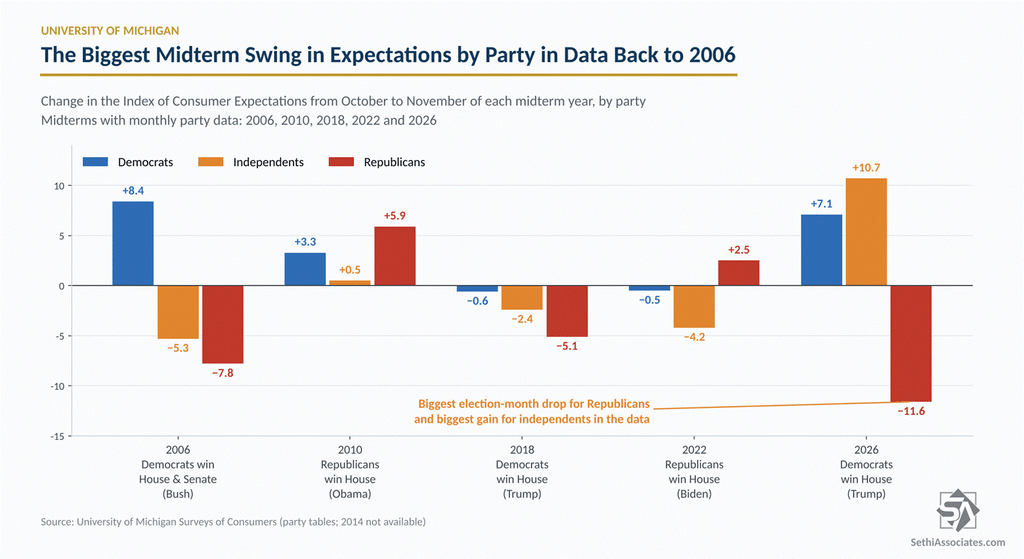
- The midterms reshuffled the party picture. Expectations “surged for independents” (up 10.7 points) and rose for Democrats (up 7.1), but fell 11.6 points for Republicans to the lowest since October 2024, the biggest election-month swing in party data covering midterms back to 2006.
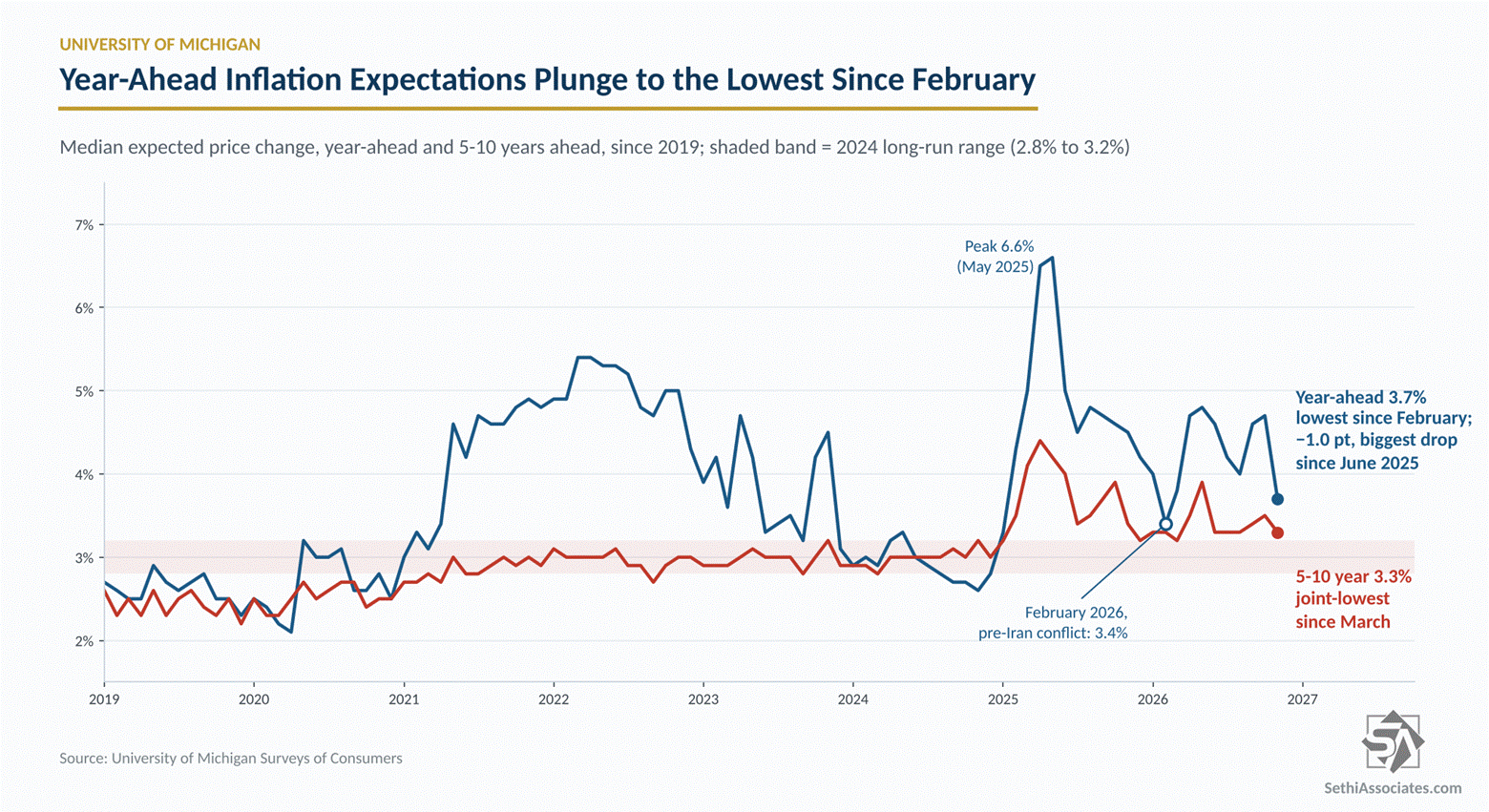
- Year-ahead inflation expectations “plunged” to 3.7% from 4.7%, the lowest since February and the biggest one-month drop since June 2025, as gas prices fell.
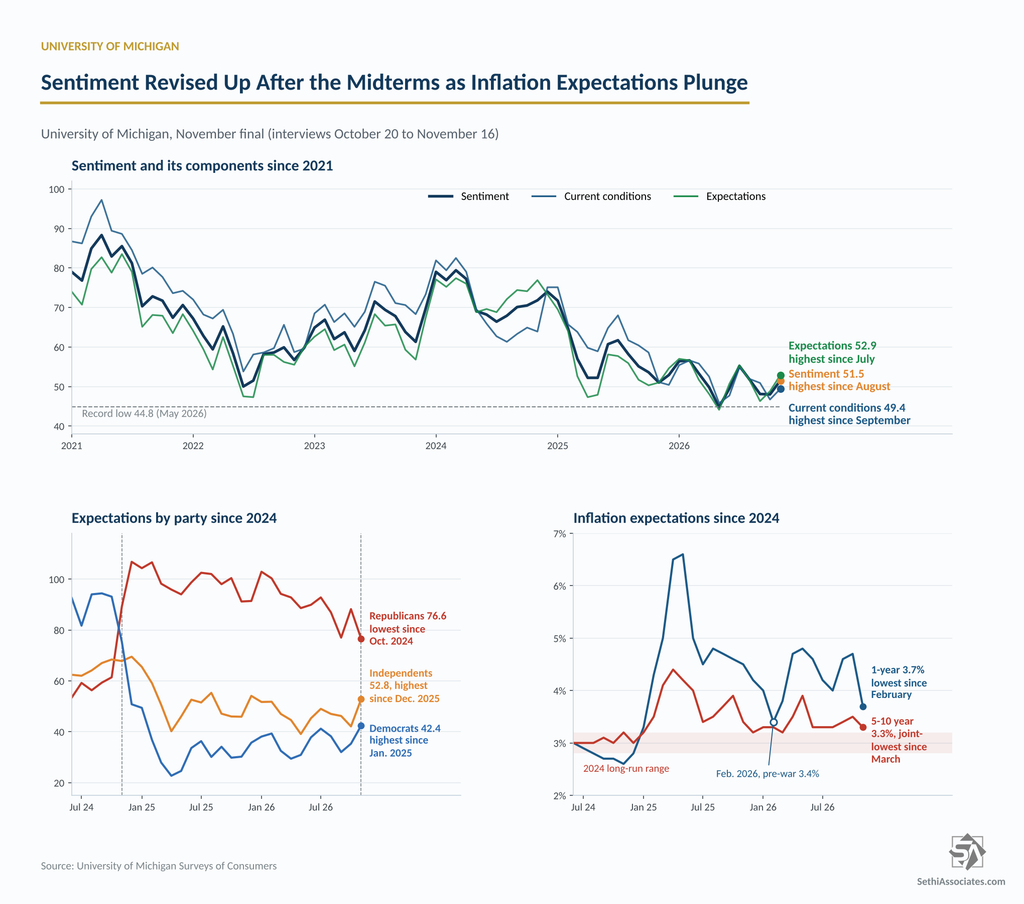
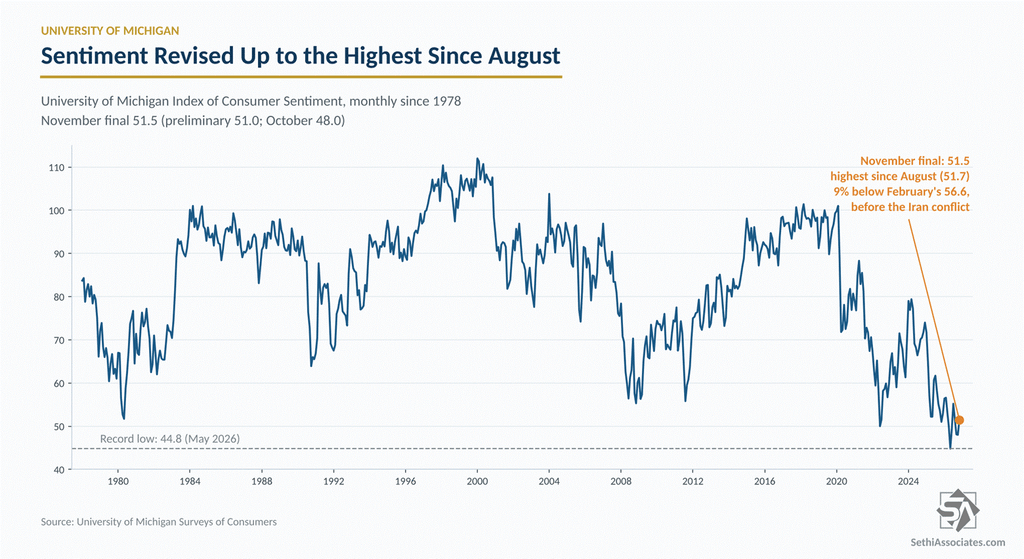
Consumer sentiment got a lift from the midterms. The University of Michigan’s final November index was revised up to 51.5 from 51.0 in the preliminary read, the highest since August, although a touch below the 51.6 median estimate in a Bloomberg survey. That’s up 7.3% from October’s 48.0, the biggest monthly gain since July, and 1% above a year ago.
Still, per Surveys of Consumers Director Joanne Hsu, via the University of Michigan release, sentiment “remains subdued at 9% below February, prior to the start of the Iran conflict, reflecting continued uncertainty regarding the cost-of-living factors that dominate consumers’ perspectives.” It’s also still below every reading before 2022 in data back to 1952. Only seven readings have been lower, all since mid-2022, including May’s record low of 44.8.
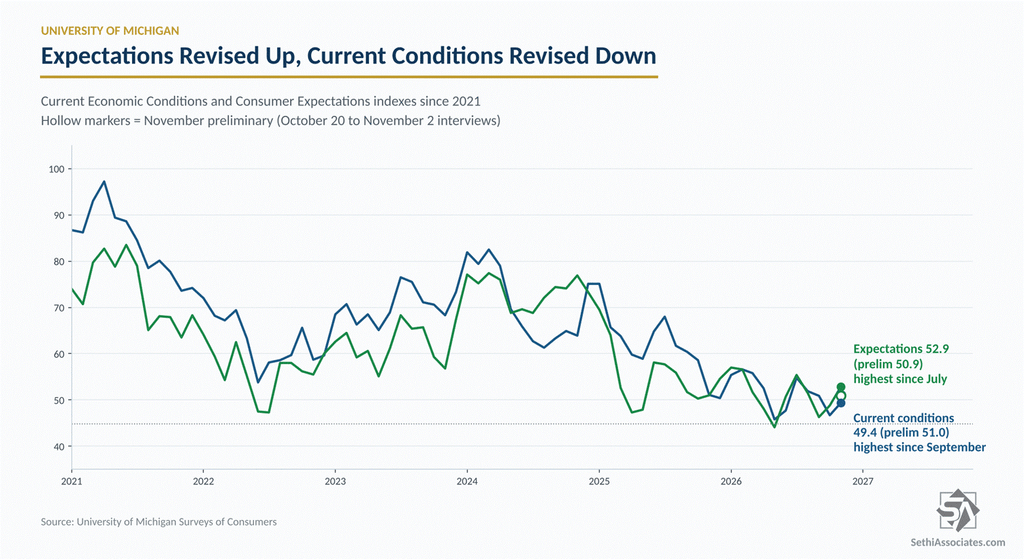
The upward revision came entirely from the outlook. Expectations were revised up to 52.9 from 50.9, up 8.4% from October and the highest since July. Current conditions, though, were revised down to 49.4 from 51.0, still up 5.8% from October but now only the highest since September. With interviews running October 20 to November 16, that means the responses gathered after the preliminary cutoff, a stretch that included the November 3 election, were more upbeat about the future and less so about the present. Per Bloomberg, a gauge of current personal finances did rise to the highest since July.
The Biggest Midterm Swing in Party Data Back to 2006
Hsu tied the gain to the election, in which Democrats took the House and the Senate: “Consumers appear to anticipate potential changes to public policy under a divided government to come. Accordingly, the expectations index surged for independents, who swung to the left in the midterms, and increased more moderately for Democrats. Expectations fell for Republicans, who may not favor a slowdown of the White House policy agenda.”
Per the party tables released with the survey, independents’ expectations jumped 10.7 points to 52.8, the highest since December 2025, and Democrats’ rose 7.1 to 42.4, the highest since January 2025. Meanwhile Republicans’ fell 11.6 points to 76.6, the lowest since October 2024, before the last presidential election.
That cut the gap between Republican and Democratic expectations to 34.2 points from 52.9, the narrowest since November 2024. Independents’ overall sentiment rose to 51.4 from 42.4, the highest since September 2025, and that matters because the national numbers have tracked independents closely, the subject of a May special report.
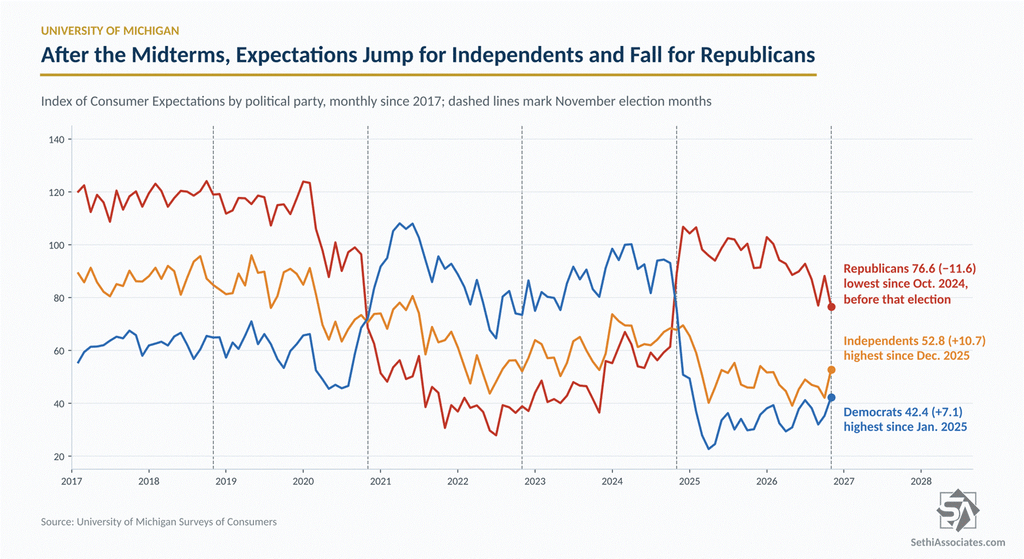
That’s an unusually large swing. The party data has monthly readings for four earlier midterms (2006, 2010, 2018 and 2022), and none came close. Republicans’ 11.6-point drop is the biggest election-month decline, topping 7.8 points in 2006, when Democrats took both chambers under President George W. Bush. In 2018, the last time Democrats flipped the House under President Trump, Republican expectations fell just 5.1 points while Democrats’ dipped 0.6. Independents’ 10.7-point gain compares with a previous best of 0.5 point in 2010. For the overall index, the 4.1-point gain in expectations is the biggest in a midterm November since 2002, and the 3.5-point gain in sentiment the biggest since 2010.
The Biggest Stockholders Still Feel the AI Selloff
Not everyone shared in the improvement. Hsu: “Current personal finances improved for low-wealth consumers and, to a lesser extent, middle-wealth consumers, who experienced some relief with falling gas prices. In contrast, those with the largest stockholdings reported a decline in personal finances, consistent with continued AI-related agitation in stock markets.”
That extends what she flagged in the preliminary read, when the personal finances of the largest stockholders had dropped 12% to the lowest since April, and the final sample now includes the November 5 AI rout. Per the stock ownership tables, the three-month average of current conditions for the top third of stockholders fell to 68.0 from 72.0, the lowest since July, while it edged up for the bottom third (45.2 from 44.7).
That reading would likely be even worse today. Since the survey closed November 16, the S&P 500 is down about 4% and the Nasdaq almost 5% as of midmorning Friday.
Inflation Expectations Plunge
Hsu: “Median year-ahead inflation expectations plunged from 4.7% last month to 3.7% this month.” That’s also down from 4.3% in the preliminary, and the full-point drop is the biggest since June 2025, taking expectations to the lowest since February. The peak was 6.6% in May 2025.
Long-run expectations “ticked down from 3.5% in October to 3.3%, higher than their 2024 range of 2.8% to 3.2%.” That matches June through August for the lowest since March (3.2%), and per ZeroHedge the decline “was entirely driven by independents.” The peak was 4.4% in April 2025.
Gasoline is a big part of the story. Per Bloomberg, the national average was above $4 a gallon at the start of the month according to AAA but had dropped to about $3.75 by the time the survey closed, and Hsu said expectations for gas prices are now “broadly comparable to pre-Iran readings.” Per ZeroHedge, year-ahead decline “reflects a considerable reduction of consumers expecting 5% or higher inflation” and “primarily occurred among independents, whose year-ahead expectations are now at their lowest since February, and Democrats, who are at the lowest in almost two years,” while Republicans’ “inched up a bit.”
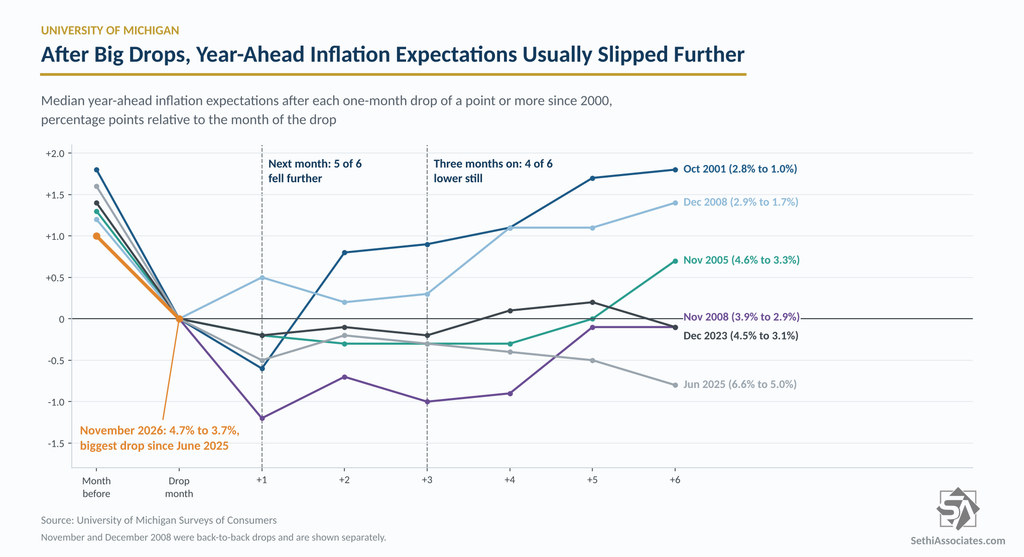
History suggests drops this big tend to carry a bit further in the near term. Of the six previous one-month declines of a point or more since 2000, five were followed by a further decline the next month, and in four expectations were lower still three months later, though by six months the record was split.
The University of Michigan’s featured chart shows the smoothed trend hasn’t turned as sharply. The three-month moving average dipped only to 4.3% from 4.4%, compared with 2.7% at the end of 2024.
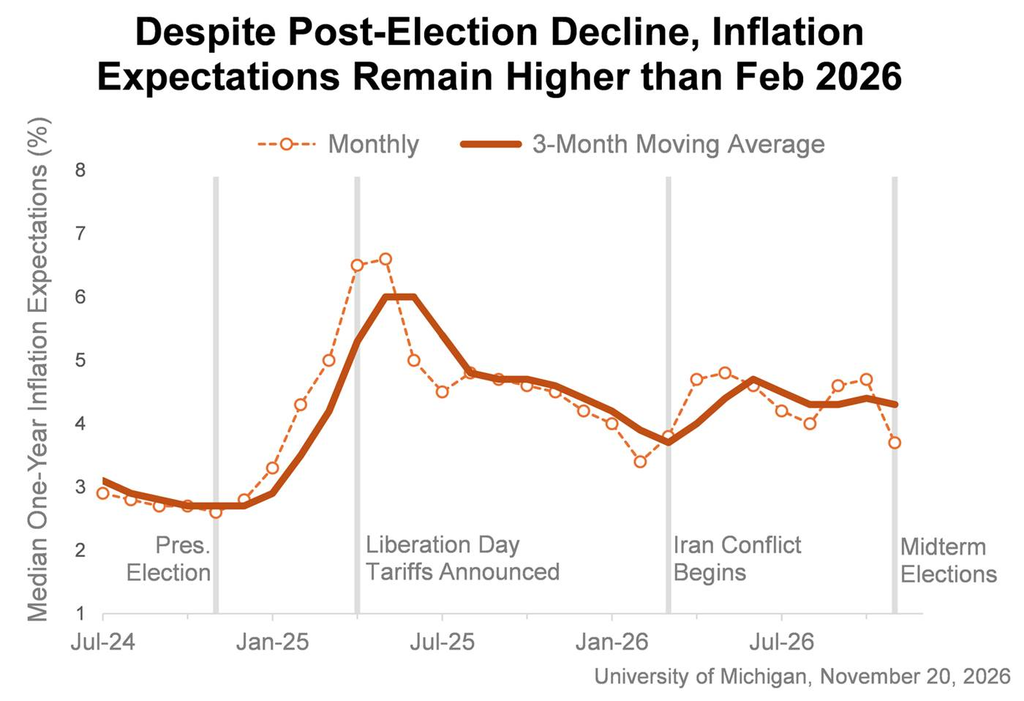
University of Michigan, November 20, 2026
And Hsu noted that the year-ahead expectations reading “remains meaningfully above the 3.4% seen in February before the Iran conflict began, along with all 2024 readings,” and that “despite the softening in inflation expectations, consumers continue to report overwhelmingly that inflation — rather than unemployment — will cause greater hardship for consumers in the next one or two years.”
What to Watch
The preliminary December read is due December 4. The questions are whether the post-election lift in expectations holds, how the AI selloff weighs on the largest stockholders, and whether lower gas prices keep year-ahead inflation expectations moving back toward February’s 3.4% ahead of the Fed’s December decision.