AI Rout Sends the Tech Sector to Its Worst Day Since the Covid Crash
Worries that Democrat political gains will slow the AI buildout morphed into a broader selloff Thursday pulling every sector lower, led by Tech.
You've reached your free article limit
You've read 0 of 1 free Pro articles.

Executive Summary
Wednesday’s post-election rally didn’t make it past Thursday’s open, as a continued drop in AI related shares dragged the broader market lower with the S&P 500 seeing its worst session since April 2025.
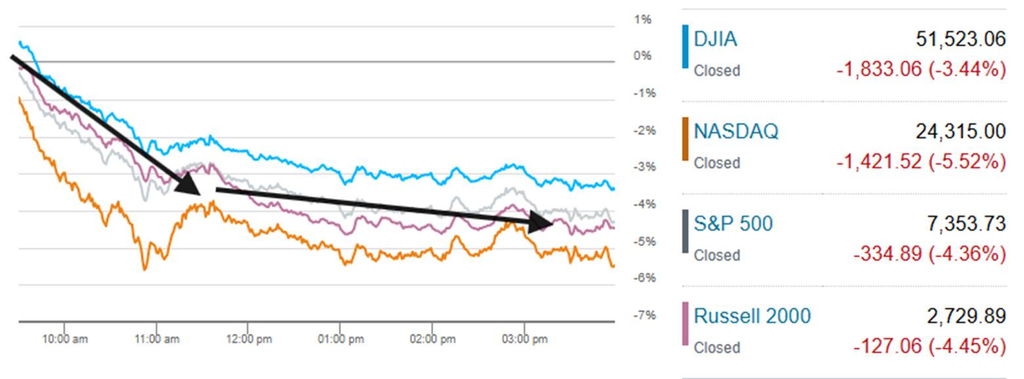
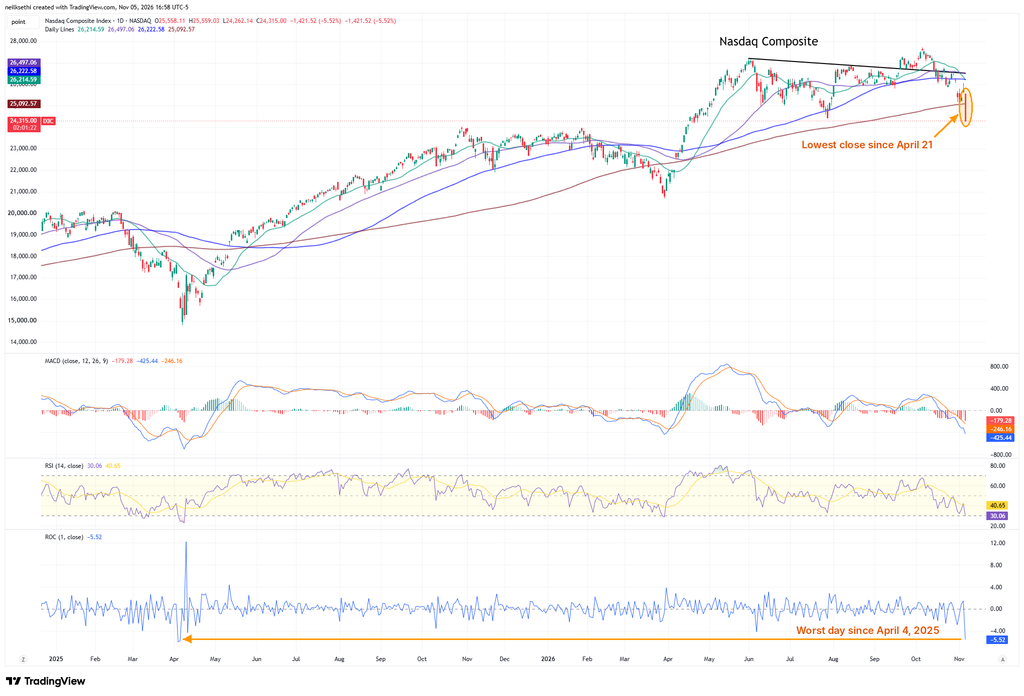
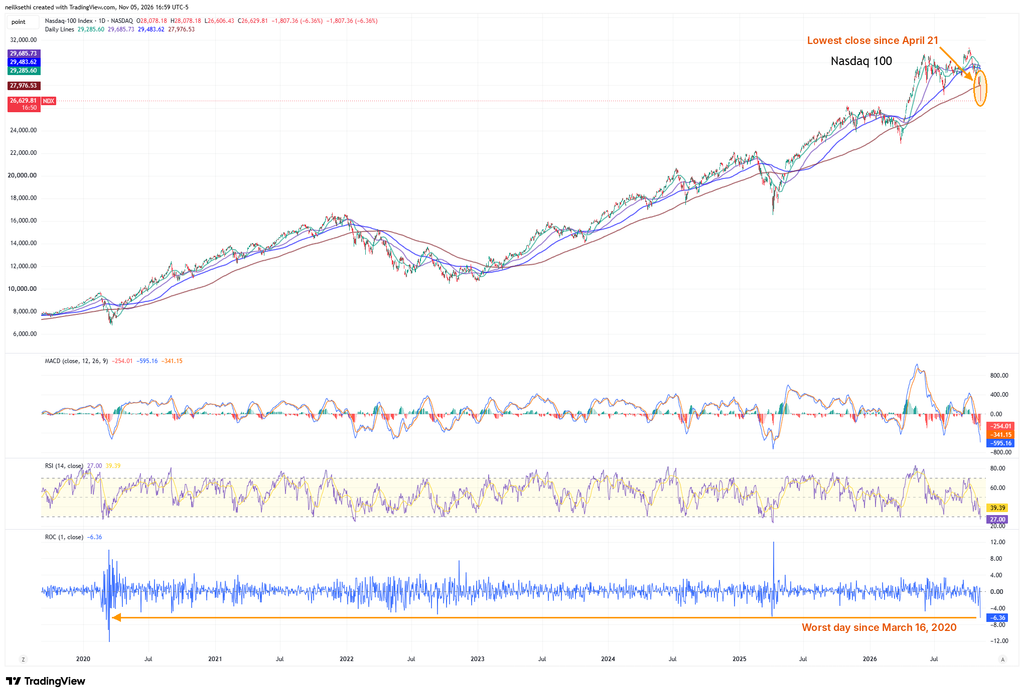
The S&P 500 fell 4.4% to its lowest close since July 29, erasing Wednesday’s gain and then some. The Nasdaq-100 plunged 6.4%, its worst day since March 2020, closing back below its 200-day moving average. The Nasdaq Composite lost 5.5%, falling into correction territory more than 10% below its October 6 record. It also lost a record $2.5 trillion in market value in a single day, per the WSJ.
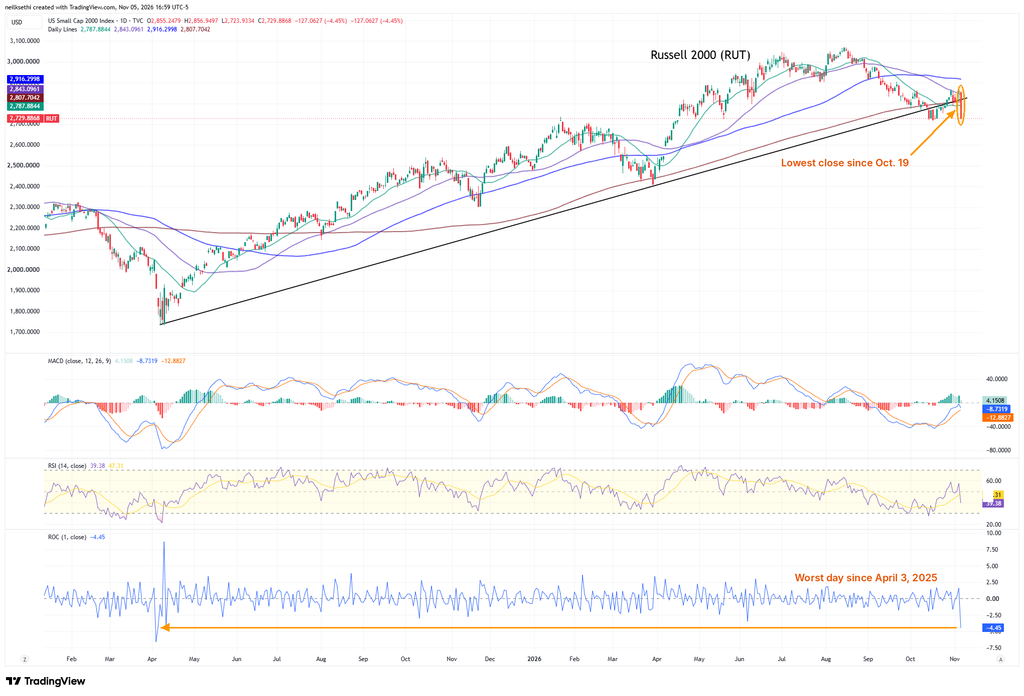
The Dow Jones Industrial Average (DJIA) lost 3.4%, or about 1,830 points, more than wiping out Wednesday’s 1,569-point gain and falling below its 50-day moving average. The Russell 2000 fell 4.5% and also entered a correction. All four major averages had their worst days since April 2025.
Schwab
Stocks started the day mixed as the AI names kept selling off, but the selling broadened after the open, and the major averages spent the rest of the day grinding toward their lows.
The Philadelphia Semiconductor Index (SOX) plunged 12.3%, its worst day since March 16, 2020, the depths of the Covid crash.
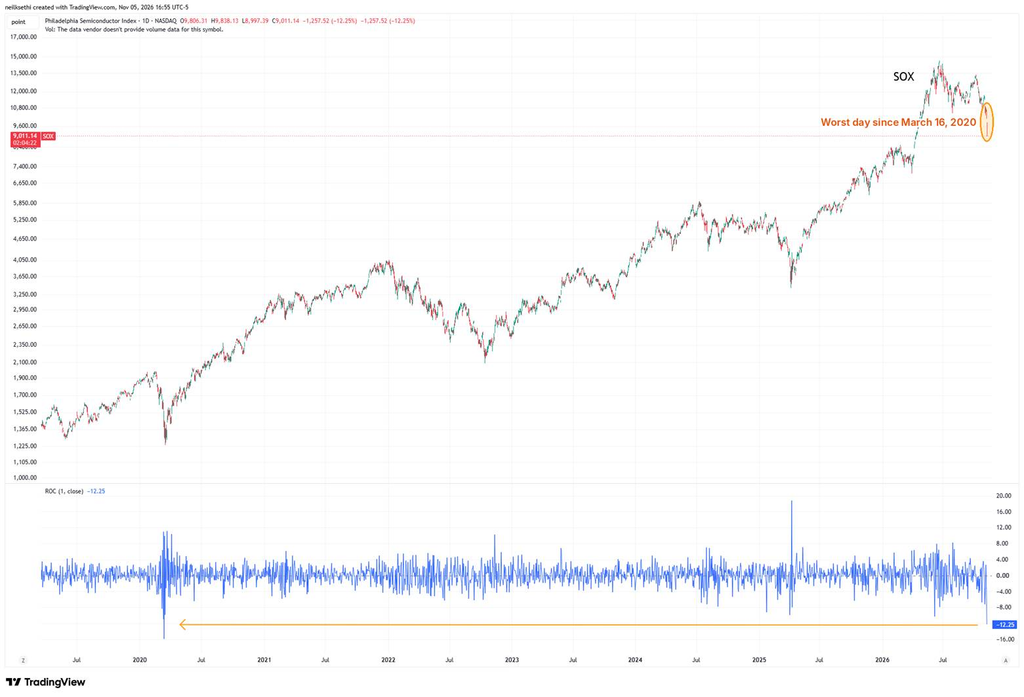
That led the S&P 500 Tech sector to its worst day since then as well.

Investors kept dumping AI hardware on worries that a Democratic Congress, along with a host of new Democratic governors, particularly in heavy data center states Texas and Ohio, who have backed data center moratoriums, will slow the buildout. Sen. Bernie Sanders added to that Wednesday evening by calling for a national data center moratorium (CNBC). Qualcomm’s weak outlook and 26% drop in handset revenue didn’t help, nor did a report that Micron suspended a $4.5 billion Taiwan plant over a labor dispute. After the open, Bloomberg reported that Microsoft won’t extend a Texas data center contract with Nscale, and that Oracle’s planned $165 billion New Mexico complex faces another potential delay.
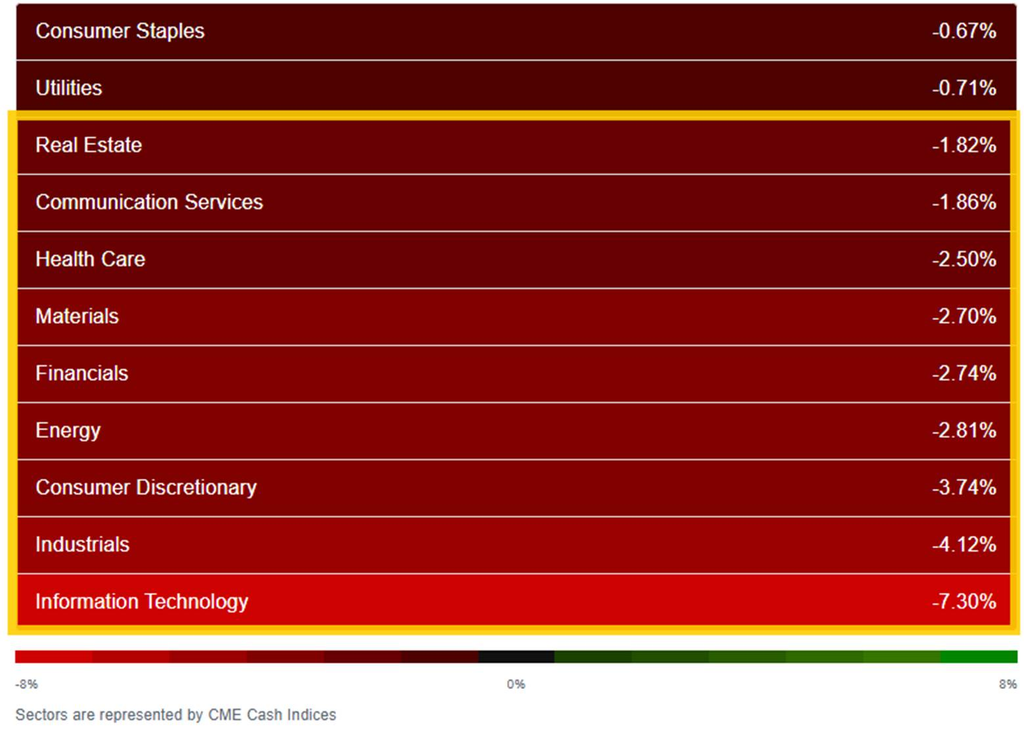
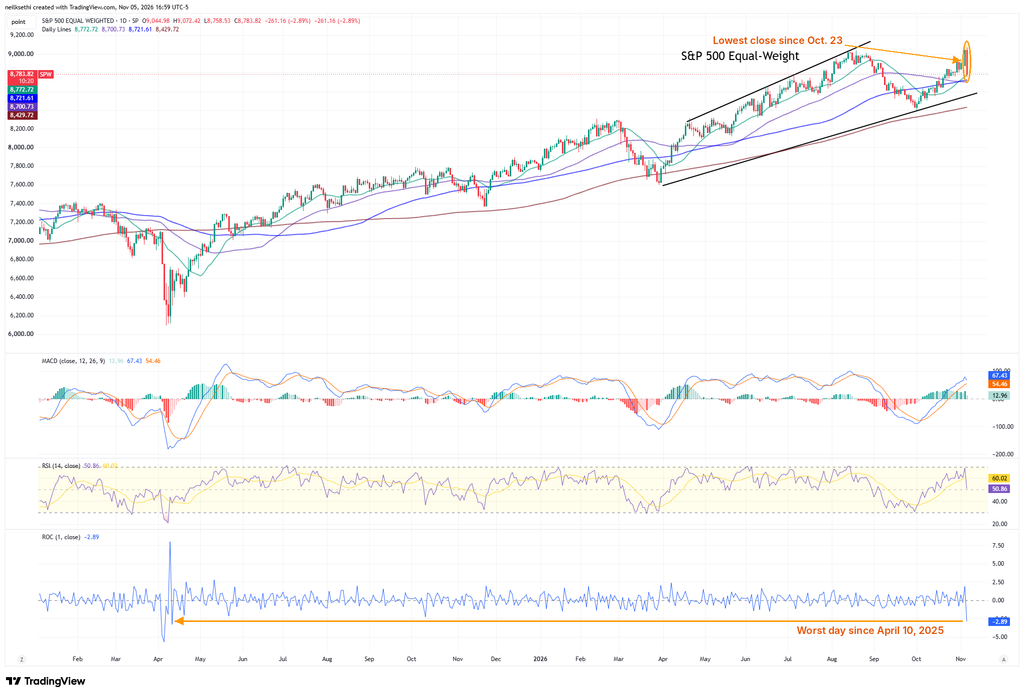
Unlike Wednesday, when only the AI trade sold off, almost nothing was spared. All 11 sectors fell, and 429 S&P 500 stocks declined while just 73 rose. The equal-weighted S&P 500 lost 2.9%, its worst day since April 2025, a day after closing at a record.
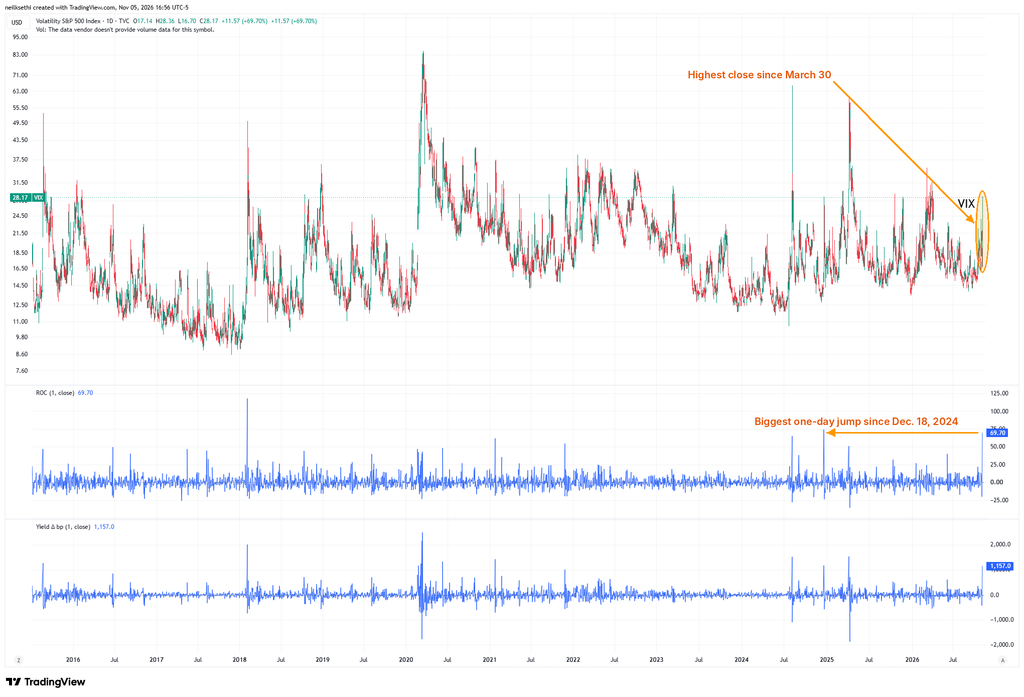
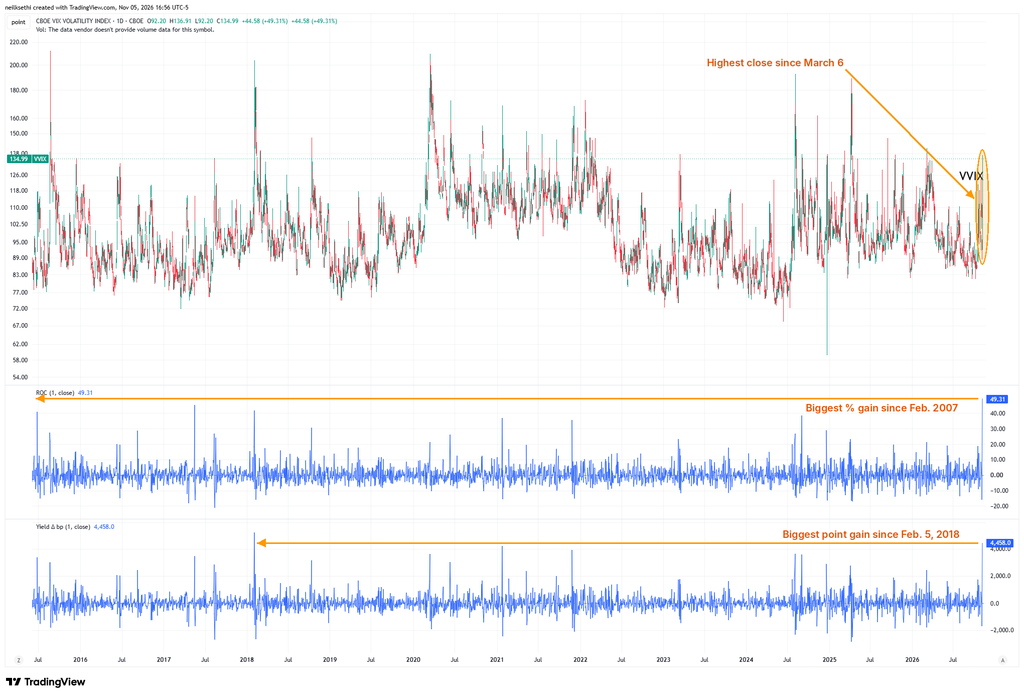
Volatility came roaring back. The VIX index of 30-day expected S&P 500 volatility jumped 70% to 28.17, its biggest one-day gain since December 2024 and second largest since the February 2018 “Volmageddon” event, and its highest close since March 30 (more here: Investor ‘Fear’ Returns). The VVIX, which tracks expected volatility of the VIX itself, rose 49%, its biggest one-day gain since February 2007. Its point gain was the biggest since Volmageddon.
Treasuries rallied as investors sought safety and Fed rate hike bets were pared significantly. The odds of a December hike fell to 67% from 82%, and markets now price about 39 basis points of hikes through December 2027 (about 1.6 hikes), down from 56, per CME FedWatch. The 2-year yield settled the cash session down 10 basis points at 4.49% and the 10-year down 6 basis points at 4.84%, per Briefing.com, leaving the 10-year at its lowest since September 9.
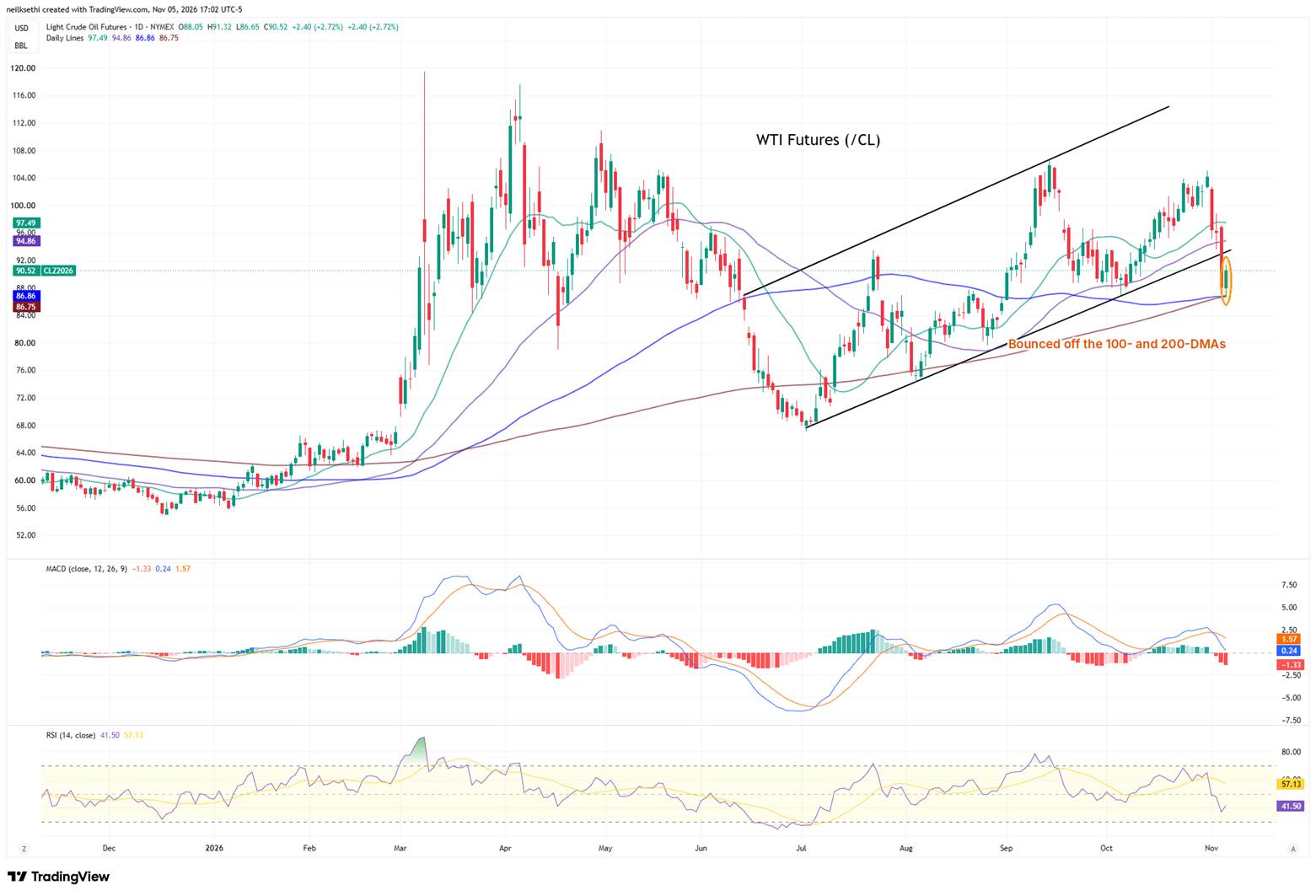
Oil bounced after Wednesday’s 8% plunge, with WTI settling the cash session up 2.6% at $90.55, per Briefing.com, while bitcoin fell 5%, back below $80,000. Copper slid 2.5% to its lowest close since July 17, though it held its 200-day moving average, and gold rose about 1%.
In economic data, initial jobless claims fell to 189,000, matching July’s low as the joint-lowest since 1969 (more here: Initial Jobless Claims Drop Back to Joint-Lowest Since 1969). Q3 productivity rose 3.6%, the strongest in a year and well above the 2.7% estimate, but real wages rose just 1.0% from a year earlier, and labor’s share of output fell to 53.0%, the lowest since records began in 1947 (more here: Q3 Productivity Hands Fed Doves Some Ammo, but Workers’ Share Hits a Record Low).
Challenger’s October job cuts were the fewest for the month since 2023, as AI cuts were the lowest of the year with economic conditions passing AI as the top reason for 2026 (more here: October Job Cuts at 3-Year Low as Focus Turns to Economic Conditions).
After the close, Cloudflare (NET) jumped 16% and Airbnb (ABNB) rose 11% after their reports. DraftKings (DKNG) sank 19% and Axon Enterprise (AXON) 12% after theirs, with Affirm (AFRM) and Monster Beverage (MNST) also lower. Chip stocks bounced a bit, with Lam Research (LRCX) up about 4%.
Friday morning brings a new catalyst in the October Employment Situation report, with economists expecting 62,000 new jobs and a 4.2% unemployment rate. We’ll also get preliminary November Michigan sentiment and September consumer credit. NY Fed President Williams and Governor Bowman highlight Fed speakers. Vistra (VST) and Moderna (MRNA) report before the open.
Market Commentary
Equities:
- Markets will likely go back to trading on macro fundamentals once the election-driven rotation has run its course, said Wolf von Rotberg at Bank J. Safra Sarasin. “If AI capex growth is actually threatened, equities will struggle to perform into the end of the year,” he said.
- Markets are positioned “for a classic Santa rally lasting into December as people try to buy the dip in the AI trade,” said Joachim Klement at Panmure Liberum. “We would use strength into year-end to sell since we think the AI trade will run out of steam in 2027.”
- “The market is starting to discount that there could be more anti-data center regulations coming from the biggest state for data centers,” said Ohsung Kwon, chief equity strategist at Wells Fargo, referring to Texas.
- “Investors have no idea where those estimates will reset,” said Michael O’Rourke at JonesTrading. “As a result, they are de-risking until clarity returns, which won’t be for some time.”
- “If you can’t get data centers built in places like Texas, Ohio, Pennsylvania and Georgia, how are you going to build capacity?” said Sameer Samana at Wells Fargo Investment Institute. A slowdown in the “breakneck pace” of AI spending on potential regulations may cause tech earnings growth to moderate, he said.
- “The rotation out of chipmakers reflects growing concern about the pace and funding of AI spending due to the risk of more regulations after the blue wave, even as earnings remain resilient and valuations have reset sharply,” said Chris Murphy at Susquehanna International Group.
- “I am not seeing customers flipping long or chasing the laggards higher,” Christina Jones at JPMorgan wrote in a note. “To me, the only pocket of the market where there is some true rotation going on is within Technology, Media and Telecommunications.”
- “Certainly we went too far, too fast yesterday,” said Steve Sosnick, chief strategist at Interactive Brokers. “FOMO played a large part in the move. Today, it’s just plain old nasty.”
- “This is a true panic. This is 100% about the chip stocks and the potential slowdown in the AI trade,” said Jay Hatfield, CEO at Infrastructure Capital Advisors.
- “When that momentum starts to go against investors, particularly when there’s leverage involved, it can lead to what might seem like extreme sell-offs,” said Mike Bell, head of market strategy at RBC BlueBay Asset Management. “Sometimes markets go down because people sell, and sometimes people sell because markets are going down.”
- “The all-or-nothing mentality is surprising to us, because we believe the real truth is more nuanced,” said Chris Zaccarelli at Northlight Asset Management. “We do agree that sentiment has shifted and building data centers will become more difficult, but if there is a productive business case for building them, then they will get built.”
- “We’re looking at everyone coming down and saying, okay, let’s dig into the weeds a little bit and see what this really means,” Victoria Fernandez, chief market strategist at Crossmark Global Holdings, said on Bloomberg Radio. “It’s these neo clouds that are getting hit so hard. The hyperscalers continue to do a little bit better, but I think people are starting to read into the element that has been supporting our economy for so long now may have to take a step back.”
- “We are not concerned about what the blue wave means for the buildout of AI, since the president still has the veto pen and data centers bring jobs and tax revenue,” said Bob Edwards at Edwards Asset Management.
- “Whether AI adoption remains constrained by energy scarcity, or enabled by energy abundance, may come down to how these negotiations shape up and whether Congress passes permitting reform,” said Jordan Jackson and Stephanie Aliaga at JPMorgan Asset Management. “We expect that the AI boom will remain on track, but may become costlier, slower and more consolidated in the coming years.”
- “The setup is now positive for risk. Slower AI spending and lower oil are bond market supportive, while lingering concerns over Fed independence have been extinguished. We are also coming from a place where positioning had shifted defensively, ahead of major events, which have now cleared. The result is easier financial conditions and room to add exposure,” said Skylar Montgomery Koning, a macro strategist at Bloomberg.
- Investors are having “a knee-jerk reaction,” selling tech stocks on worries about what the blue wave means for the AI trade, said Stephen Dover, chief market strategist at Franklin Templeton Institute. But “this is not a tipping point for the end of the AI trade,” he told MarketWatch. “The AI trade is not over,” even if it has likely peaked, he said, adding that a slowdown in the AI buildout should be “healthy” for the market after froth developed in areas such as chip stocks.
- “If there truly is a sharp pullback in AI investment, the labor market impacts could be minimal — the capital intensity has meant few jobs added during the surge, so likewise few should be lost through any decline,” said Will Compernolle at FHN Financial. “If an investment pullback eventually ripples into the broader economy through financial contagion, it won’t be revealed tomorrow.”
Stock and Sector Breakdown
Schwab
There was nowhere to hide. All 11 sectors fell, nine of them by at least 1.8%, compared with nine sectors higher on Wednesday. After Tech (-7.30%), Industrials (-4.12%) and Consumer Discretionary (-3.74%) were also down over 3%. Consumer Staples (-0.67%) and Utilities (-0.71%) held up best.
AppLovin (APP) (+31%) was the best performer in the S&P 500 after a third-quarter beat and strong outlook, with Goldman raising its price target (TipRanks), plus a new $3.2 billion buyback (Briefing.com). Sandisk (SNDK) (-22%) was the worst, its biggest drop since it was spun off in February 2025, as the memory selloff deepened.
Memory and storage names led chips lower, with Sandisk, Micron (MU), Western Digital (WDC) and Seagate (STX) down 16% to 22%. Micron’s drop was its worst since March 2020. Advanced Micro Devices (AMD), Marvell (MRVL) and Lam Research (LRCX) lost 16% to 17%. Even NXP Semiconductors, the best performer in the SOX at 10:30am at down about 4%, closed down 8%. Qualcomm (QCOM) (-9%) and Arm Holdings (ARM) (-13%) fell after underwhelming outlooks.
James “Rev Shark” DePorre asks Is the Chip Bubble Bursting?, Stephen Guilfoyle writes that Qualcomm Faces the Semiconductor Abyss, and Chris Versace says the Tech Sector Is Officially Oversold.
Data center suppliers extended Wednesday’s slide, with names from Lumentum (LITE) to Vertiv (VRT) down about 14% to 19%. CoreWeave (CRWV) fell 10% to its lowest since May 2025, and the Roundhill Neocloud ETF (NCLD) sank 12% to a record low (Briefing.com). The selling spilled into credit, too, with SpaceX (SPCX) and CoreWeave among the biggest casualties, per Bloomberg.
Software didn’t escape either, with the iShares Expanded Tech-Software ETF (IGV) down 4%. Palantir (PLTR) fell 10%, extending its slide despite beating estimates earlier in the week, on worries about slower bookings growth and its valuation (Briefing.com), and cybersecurity names like CrowdStrike (CRWD) also lost about 10%.
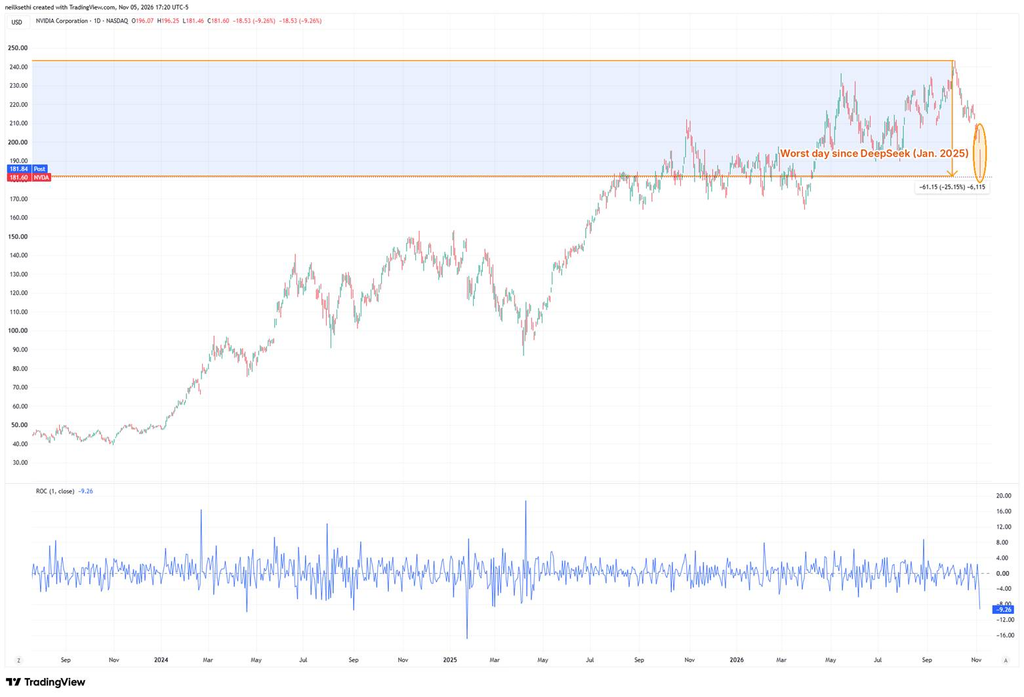
Among the megacaps, Nvidia (NVDA) fell 9%, its worst day since the DeepSeek selloff in January 2025, putting it in a bear market about 25% below its October high, a loss of about $1.5 trillion in market value. House Republicans asked CEO Jensen Huang for a briefing on his dealings with a Megaspeed International executive who, per the New York Times, is under investigation for allegedly spying for China (Bloomberg).
Broadcom (AVGO) fell 10% and Tesla (TSLA) 11%, the latter on worries about more scrutiny of Elon Musk’s businesses, including a potential SpaceX combination (Briefing.com), while Microsoft (MSFT) and Meta Platforms (META) lost about 4%, and Apple (AAPL), Amazon (AMZN) and Alphabet (GOOGL) held losses to about 1.5% to 2%.
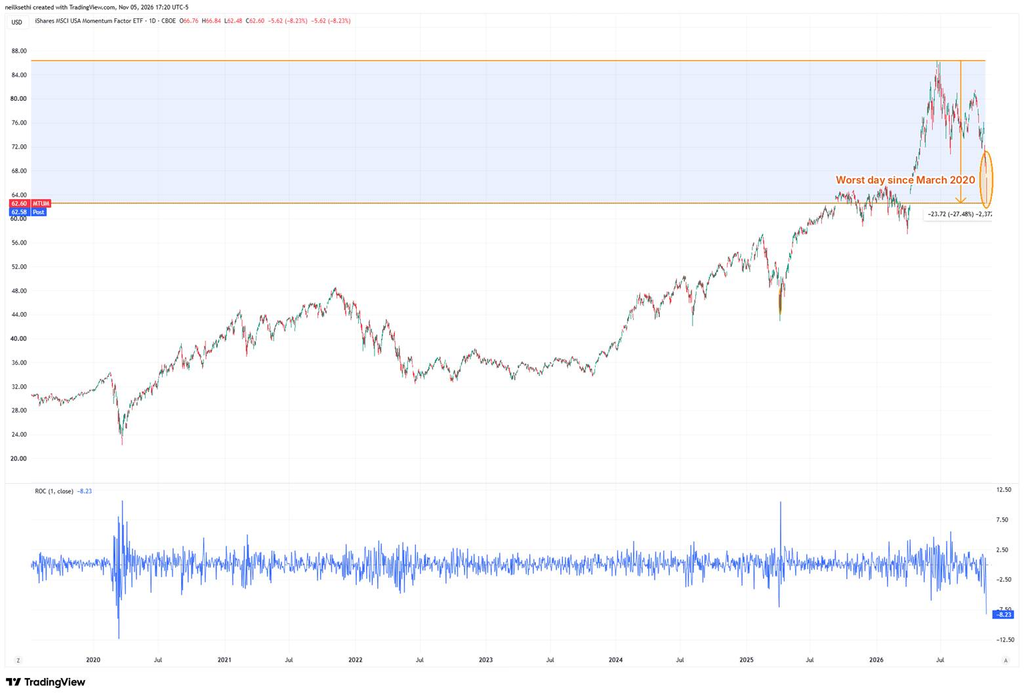
As you might guess momentum was hit hard. The iShares MSCI USA Momentum Factor ETF (MTUM) fell 8%, its worst day since March 2020, leaving it down 27% from its June high.
Crypto stocks fell too, with Robinhood (HOOD) and Coinbase (COIN) down about 10% after an earnings miss from Robinhood (TipRanks).
Expedia (EXPE) fell 14% as its fourth-quarter outlook pointed to slower growth and margin pressure, per Briefing.com, and Rockwell Automation (ROK) lost 14% after its report. DoorDash (DASH) fell 9% after Amazon said it will bring Uber Eats to its shopping platform for Prime members (Briefing.com). Outside the S&P 500, Toyota (TM) rose 9% and Sony (SONY) 6% after their reports.
Stephen Guilfoyle made 4 New Portfolio Moves as Market Sells Off.
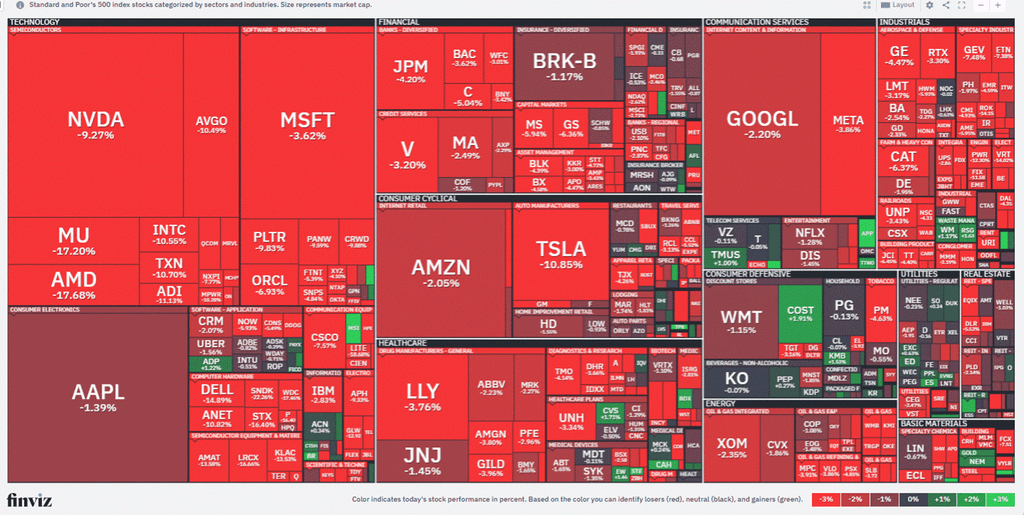
The number of large SPX losers (down over 3%) jumped to 207 from 85 Wednesday, the most since mid-summer, while large winners (up over 3%) fell to 9 from 225.
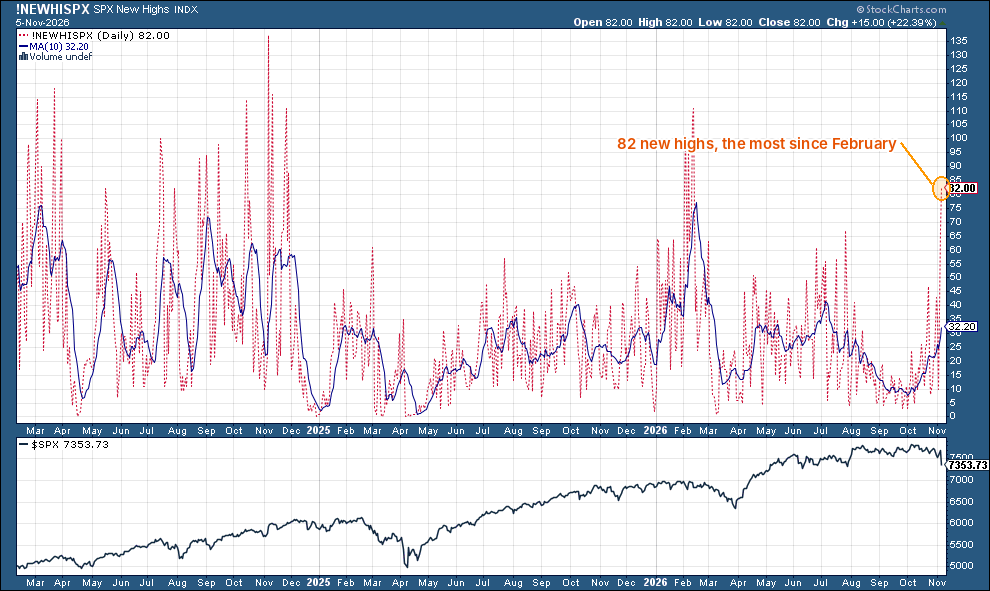
One surprise was a jump in new highs for the session. Even on its worst day since April 2025, the S&P 500 had 82 stocks hit 52-week highs, the most since February. The rotation into financials, health care and consumer staples carried into the open, lifting the equal-weighted S&P 500 to an intraday record before the selling spread. Nearly four out of five of those stocks closed lower.
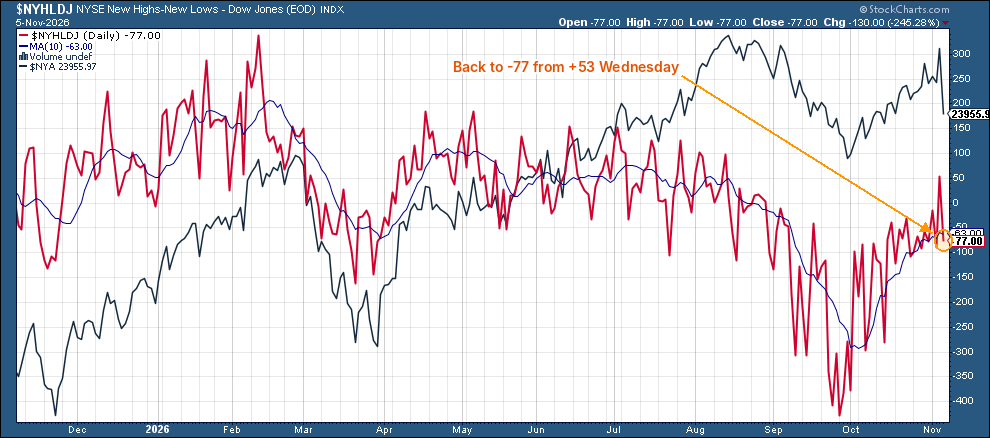
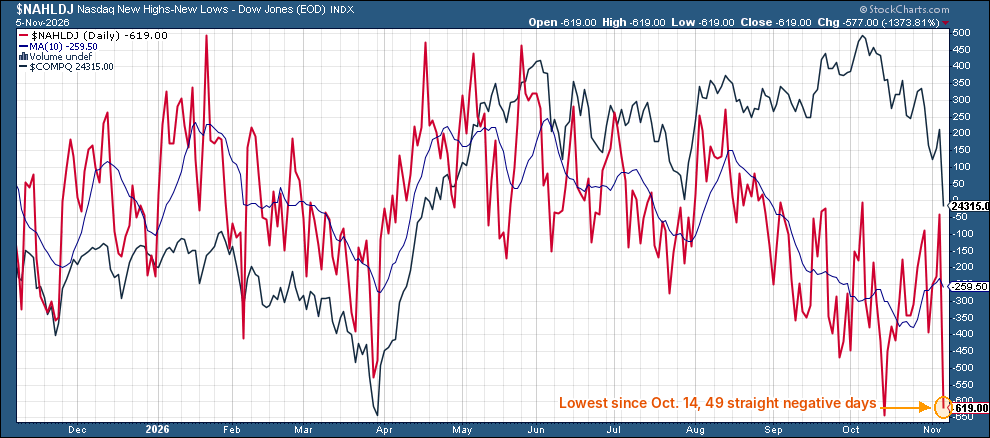
52-week highs minus lows flipped back to negative on the NYSE at -77 from +53 Wednesday. The Nasdaq fell to -619 from -42, its lowest since October 14 and its 49th straight negative session, tying the stretch that ended November 14, 2023.
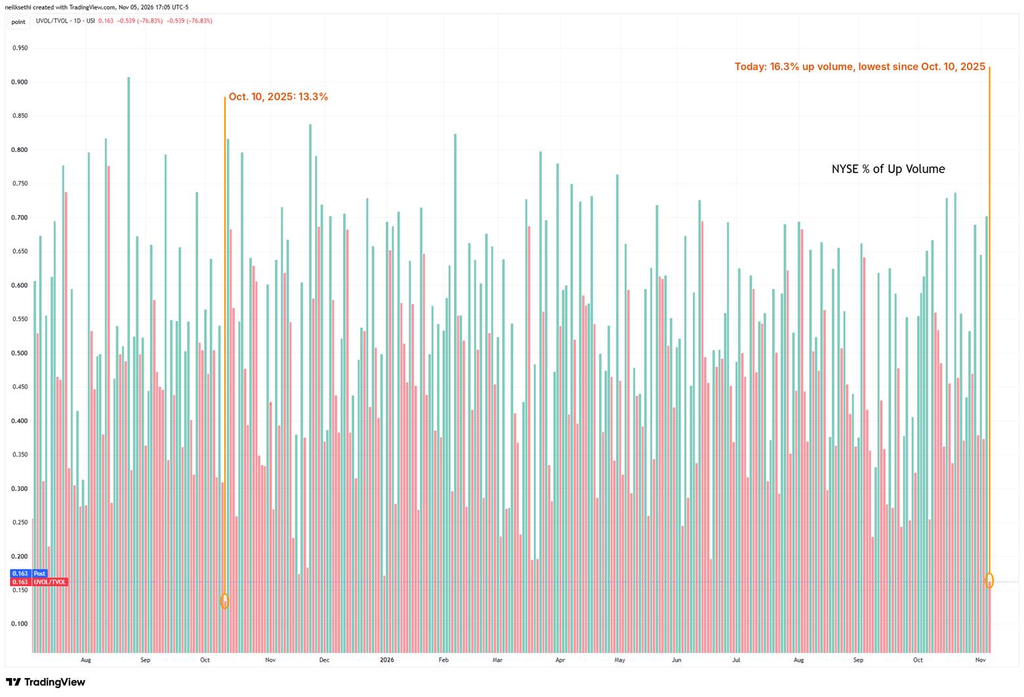
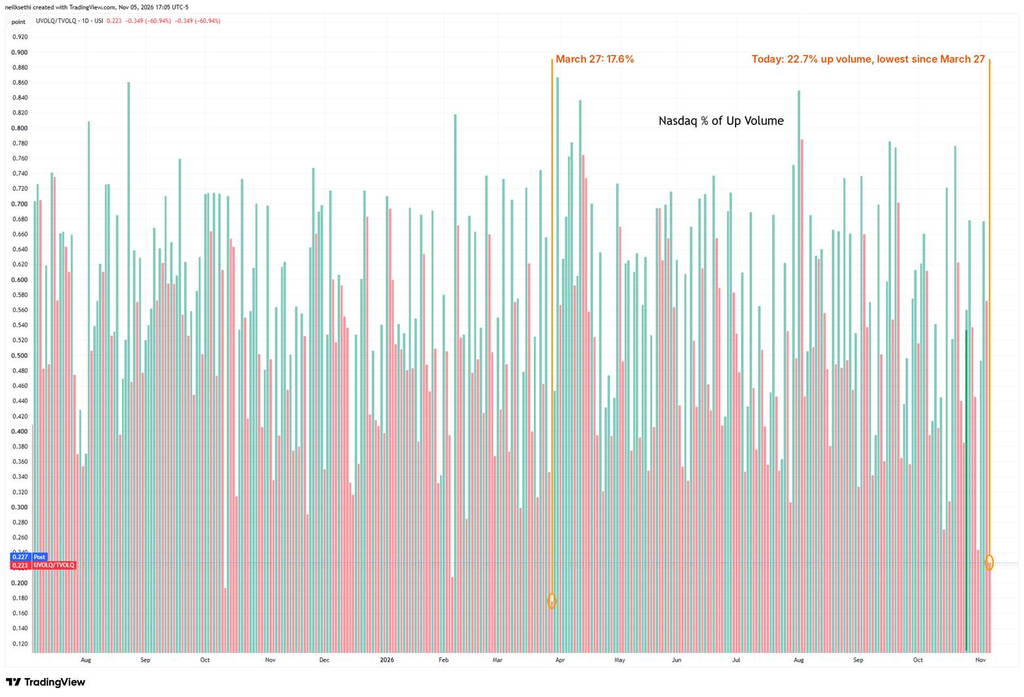
Positive volume collapsed to just 16.3% on the NYSE, its lowest since October 10, 2025, but not quite a “washout” of sub-10%. The Nasdaq’s 22.7% was its lowest since March 27 but even further from a 90% down day.
Some other stock-specific commentary from TheStreet Pro:
Stephen Guilfoyle — Sticking With This Peloton Price Target After Across-the-Board Beat
Chris Versace —
- New Costco Price Target, Selling Shares Amid Monthly Comp Sales Gains
- Taking a Healthcare Winner Off the Board
- We’re Bringing This Stock Back to the Bullpen
- We’re Buying More Shares of 2 Holdings
Bob Lang — Chart of the Day: Bank of America Resets Its Price
Ed Ponsi — 2 Iconic Consumer Stocks Are Lighting Up the Market
A Look At The Charts
Note on all charts the colored lines are moving averages (the average price over the lookback period — days on the daily charts, weeks on the weekly charts):
20 = green
50 = purple
100 = blue
200 = brown
Exception is monthly charts where blue is 10-month moving average and brown is 20-month moving average.
MACD = Moving average convergence/divergence line, a measure of momentum that compares longer term and shorter term momentum to gauge if a move is strengthening or weakening. This is probably my favorite individual indicator.
RSI = Relative Strength Index (basically what it sounds like) = measures the strength of the move comparing gains to losses over the given lookback window (I use the standard 14 periods).
SPX
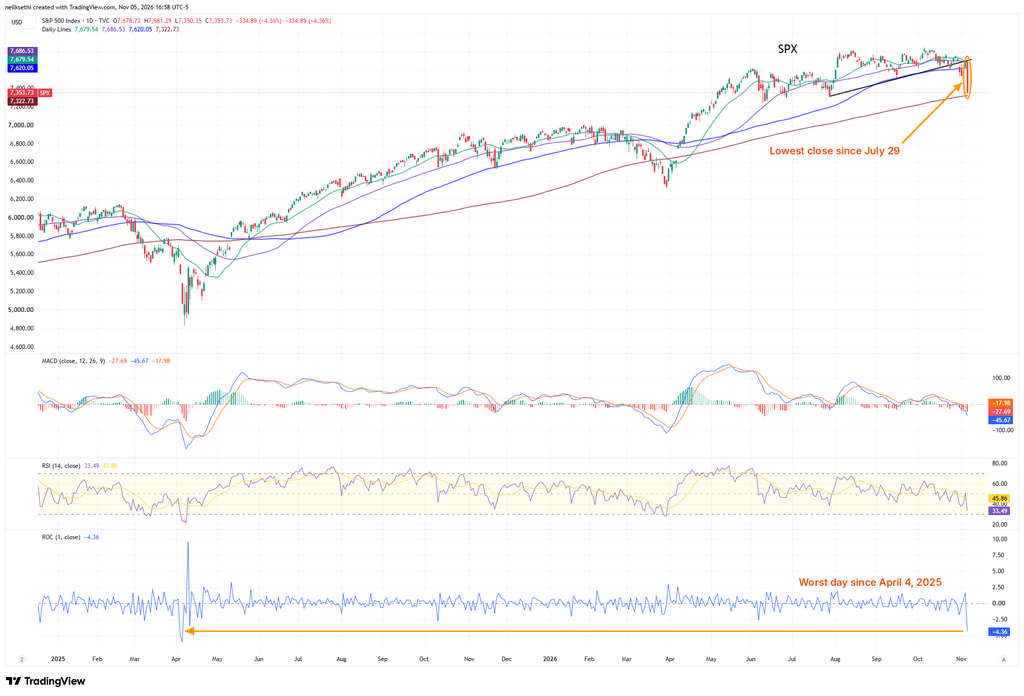
The SPX fell 4.36% to 7,354, its worst day since April 4, 2025, and its lowest close since July 29. It fell back below its 20-, 50- and 100-DMAs and the September intraday low (7,508), and is now just 0.4% above its 200-DMA (7,323). The MACD is in “go short” positioning, and the RSI is at 33.
I had said I’d sell the rest of my SPY position on a break of the September intraday low, but the drop was so sharp that it was quickly at the 200-DMA. I will sell and likely short if that breaks.
Nasdaq Composite
The Nasdaq Composite fell 5.52% to 24,315, its worst day since April 2025 and its lowest close since April 21. It’s now 3.1% below its 200-DMA (25,093) and 11.9% below its October 6 record, with the MACD in “go short” positioning and the RSI at 30.
The Nasdaq-100 (QQQ)
The Nasdaq-100 fell 6.36% to 26,630, its worst day since March 16, 2020, and its lowest close since April 21. It’s now 4.8% below its 200-DMA (27,977) and 14.7% below its October 6 record. The MACD is in “go short” positioning, and the RSI is at 27, oversold.
As I noted, I had a stop on my QQQ trade 1% below the 200-DMA, so I exited, and I’ve gone short.
The Russell 2000 (IWM)
The Russell 2000 fell 4.45% to 2,730, its worst day since April 2025 and its lowest close since October 19. That gave back Wednesday’s first close above the 50-DMA in more than two months and put it back below its 200-DMA (2,808) and the uptrend line from the April 2025 low. The MACD is still in “cover shorts” positioning, and the RSI is at 39.
I sold my IWM position today.
The equal-weighted SPX (RSP)
The equal-weighted SPX fell 2.89% to 8,784, its worst day since April 10, 2025, and its lowest close since October 23, a day after its record close. It held just above its 20-DMA (8,773), and the MACD is still in “buy longs” positioning, with the RSI at 51.
The 2-year Treasury
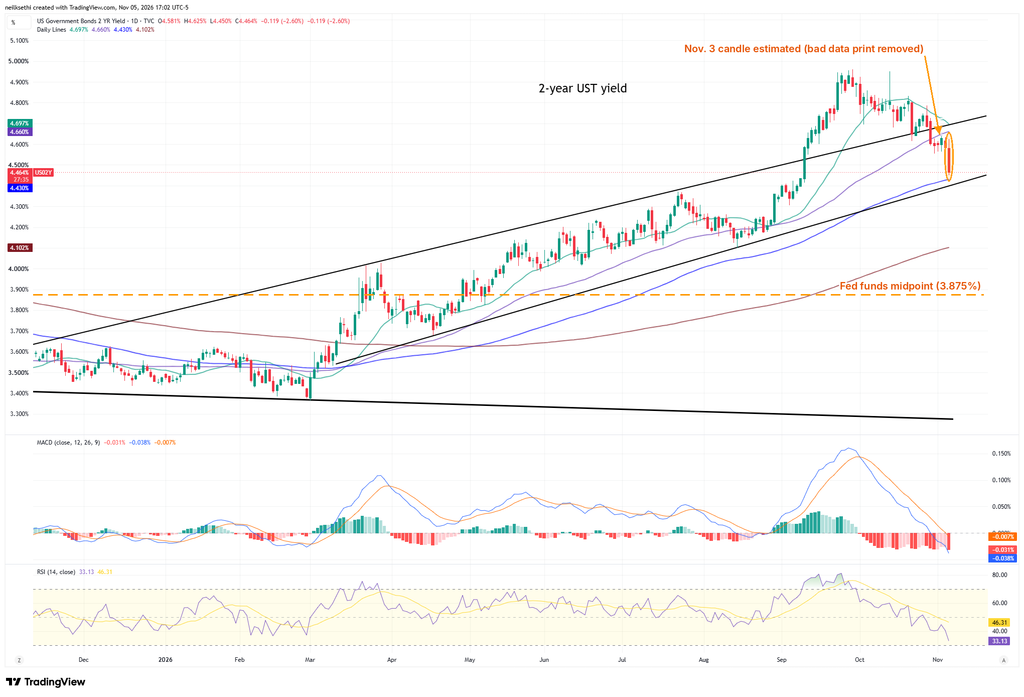
The 2-year yield fell 11.9 basis points to 4.46%. It’s back below its 20- and 50-DMAs but still above its 100-DMA (4.43%). The MACD is in “go short” positioning, and the RSI is at 33.
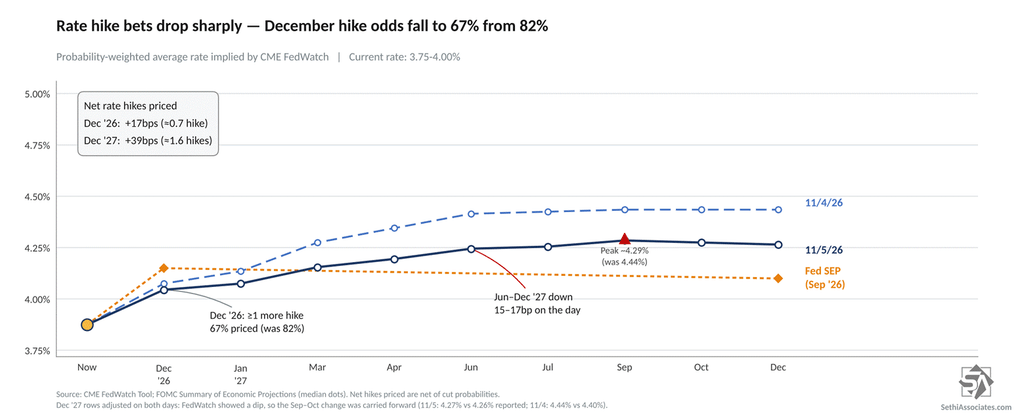
The 2-year yield is about 59bp above the midpoint of the Fed funds target range (3.875%) pricing in less than two hikes. Fed rate hike expectations from CME’s Fedwatch also dropped sharply. The odds of a December hike fell to 67% from 82%, or about 17 basis points priced (from 20). Through December 2027, markets now price 39bp, about 1.6 hikes, down from 56.
10-year yields
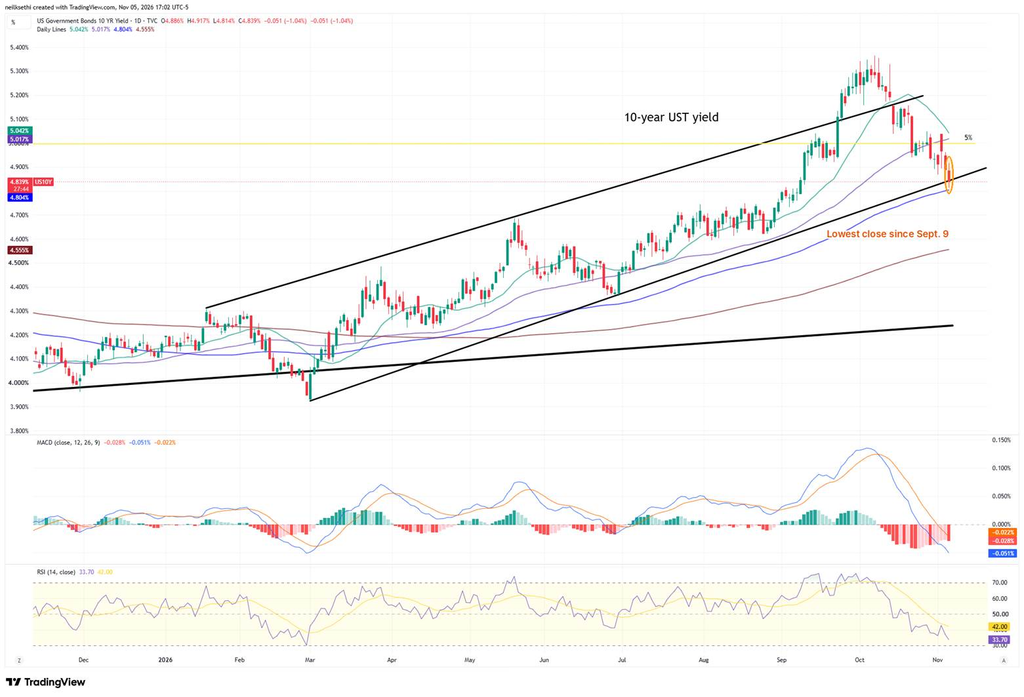
The 10-year yield fell 5.1 basis points to 4.84%, its lowest close since September 9. That left it on the lower trendline of its uptrend channel, just above its 100-DMA (4.80%) and near the 20-week moving average (around 4.81%) that Reuters flagged as the key line. The MACD is in “go short” positioning, and the RSI is at 34.
30-year yields
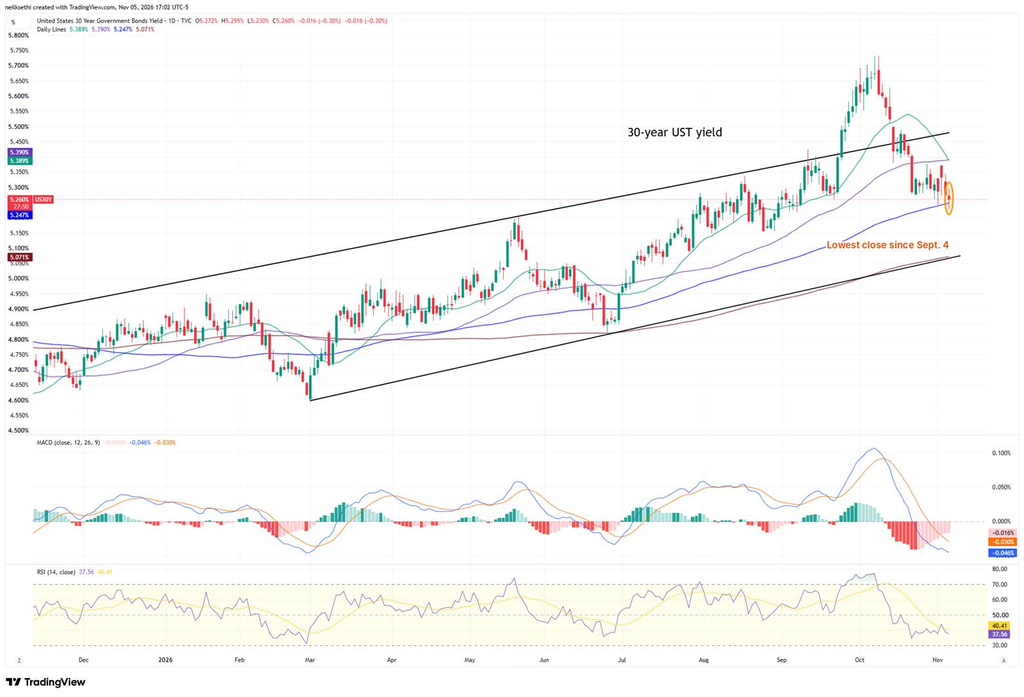
The 30-year yield edged down 1.6 basis points to 5.26%, its lowest close since September 4, holding its 100-DMA (5.25%) after dipping below it intraday. The MACD is in “go short” positioning, and the RSI is at 38.
VIX
The VIX jumped 69.70% to 28.17, its biggest one-day gain since December 18, 2024, and its highest close since March 30. That implies a daily move of about 1.78% over the next 30 days.
The VVIX
The VVIX (the VIX of the VIX) jumped 49.31% to 134.99, its biggest one-day gain since February 2007 and its highest close since March 6. In points, it was the biggest jump since the February 2018 “Volmageddon”. That’s well above the 100 level flagged by Charlie McElligott as indicating higher stress, and consistent with “extreme” daily moves in the VIX over the next 30 days.
1-day VIX
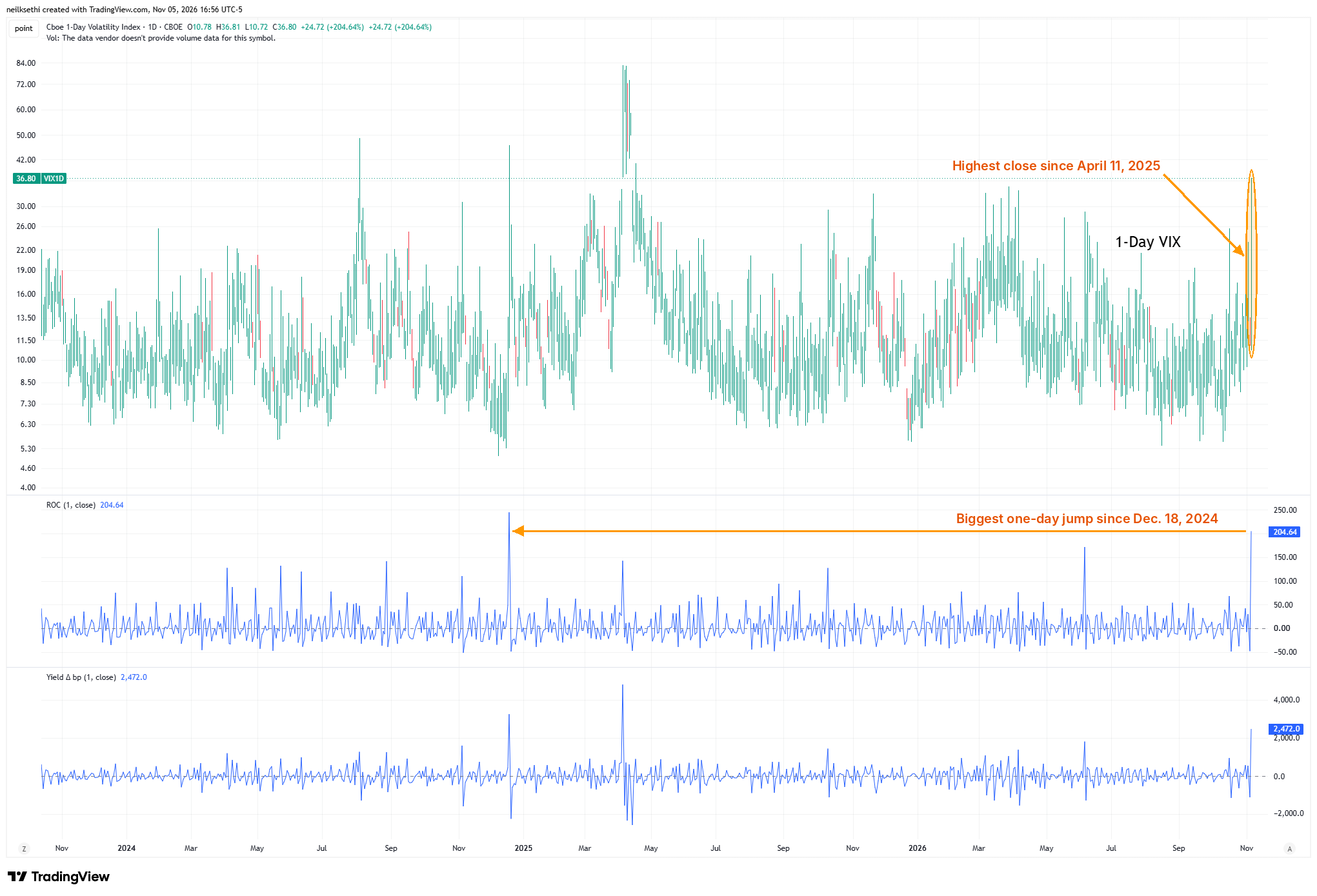
Wednesday’s 1-day VIX reading implied a move of about 0.76% for Thursday, and the SPX moved nearly six times that. The 1-day VIX then tripled (+204.64%) to 36.80, its biggest gain since December 2024 and highest close since April 11, 2025, implying a move of about 2.32% for Friday’s jobs report.
WTI futures (/CL)
WTI futures, which TradingView has at December currently, rose 2.72% to $90.52, the best day since October 28, bouncing off their 100- and 200-DMAs (both around $86.80). The MACD remains in “sell longs” positioning, and the RSI is at 42.
DXY
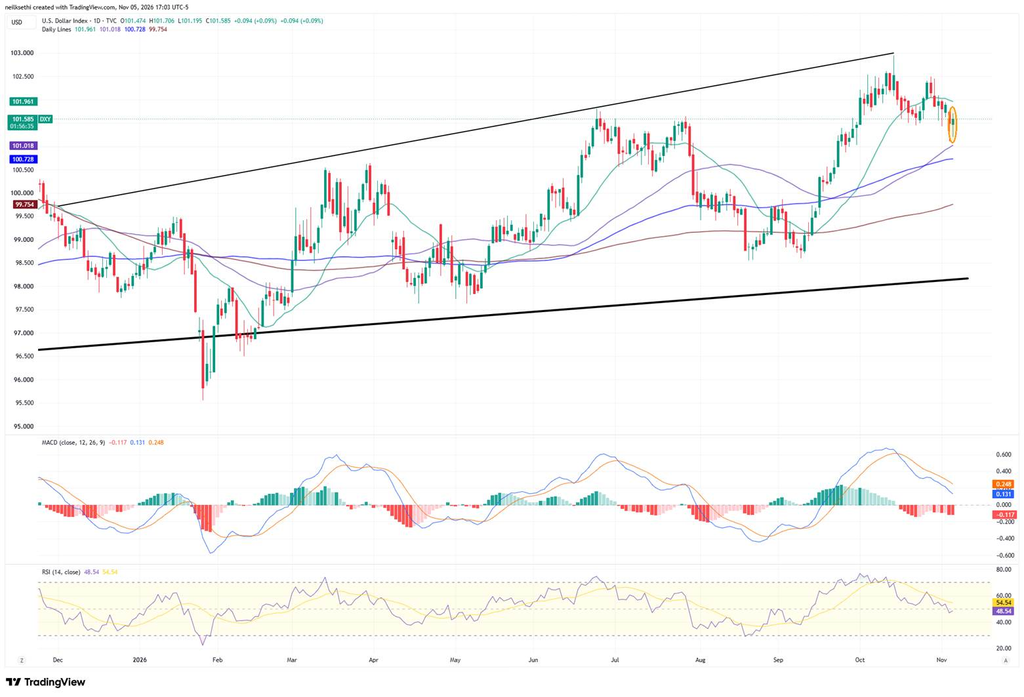
The DXY dollar index (which is fixed weighted with a heavy — 57% — allocation to the euro) edged up 0.09% to 101.59, staying between its 20-DMA (101.96) and 50-DMA (101.02). The MACD remains in “sell longs” positioning, and the RSI is at 49.
Gold futures (/GC)
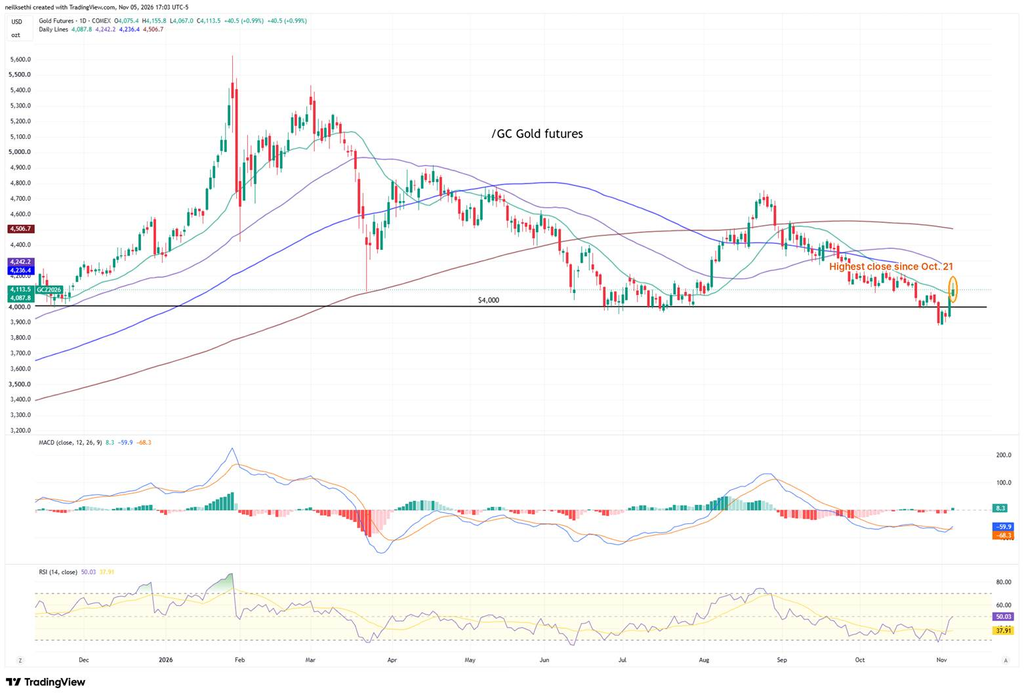
Gold futures rose 0.99% to $4,114, their highest close since October 21, closing above their 20-DMA ($4,088). The MACD crossed above its signal line to “cover shorts” positioning, and the RSI is at 50.
US copper futures (/HG)
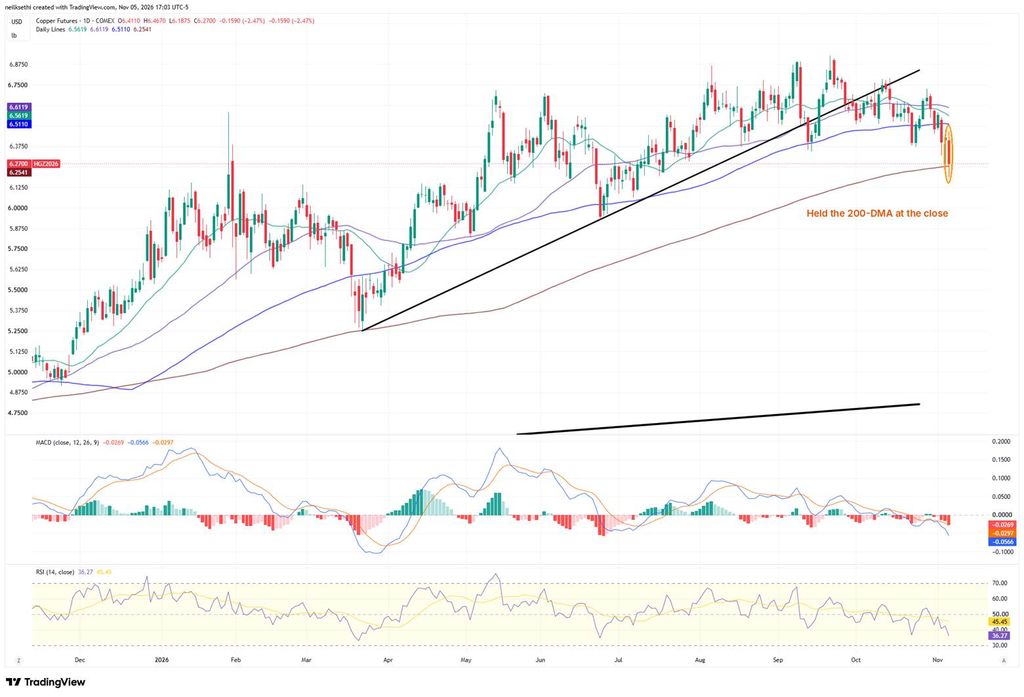
Copper futures fell 2.47% to $6.27, their lowest close since July 17. They dipped below their 200-DMA ($6.25) intraday but closed just above it. The MACD is in “go short” positioning, and the RSI is at 36.
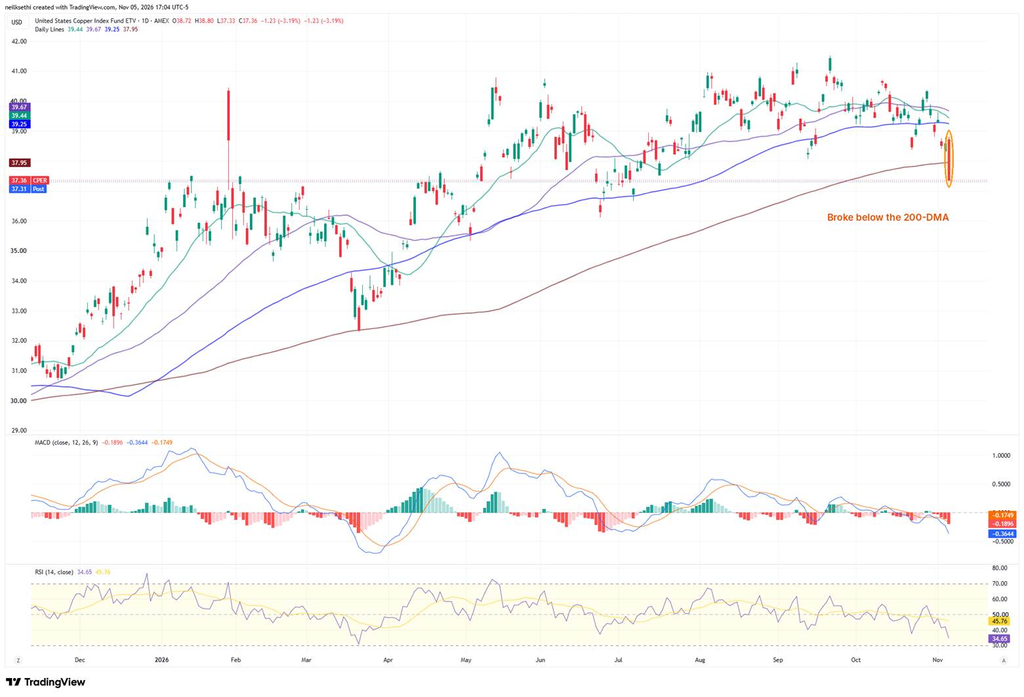
The copper ETF (CPER), which had outperformed copper until today, fell 3.19% to $37.36, its lowest close since July 8, and did break below its 200-DMA ($37.95), the line I said I’d hold it above, so I sold it and went short.
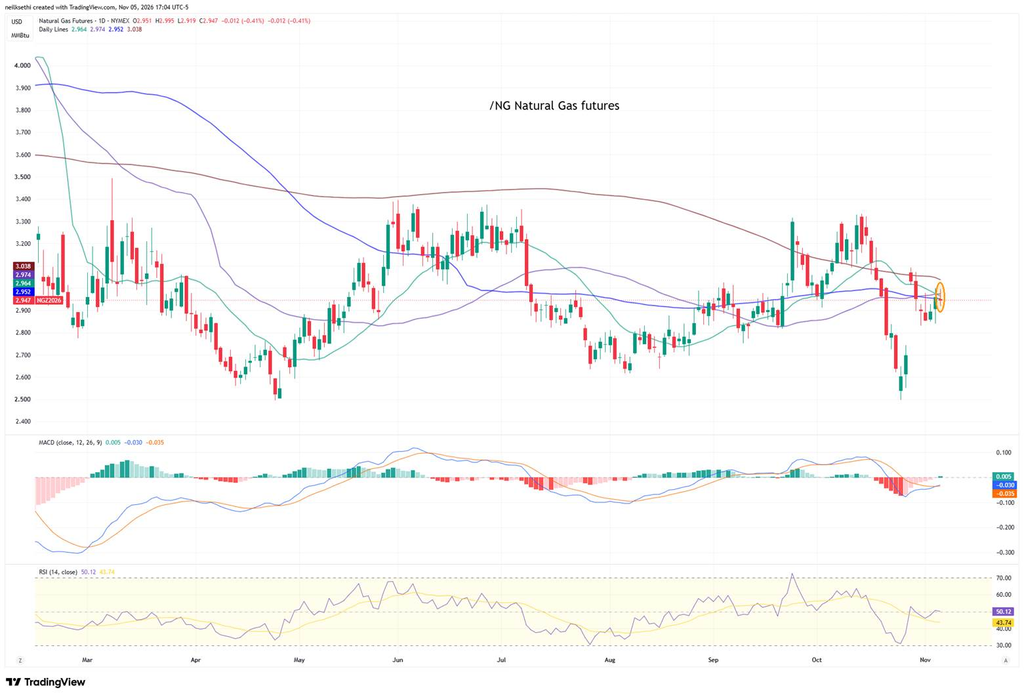
US natural gas futures (/NG)
Natural gas futures slipped 0.41% to $2.95, still right at their 20-, 50- and 100-DMAs, after the EIA reported a 77 bcf storage build. The MACD crossed to “cover shorts” positioning, and the RSI is at 50.
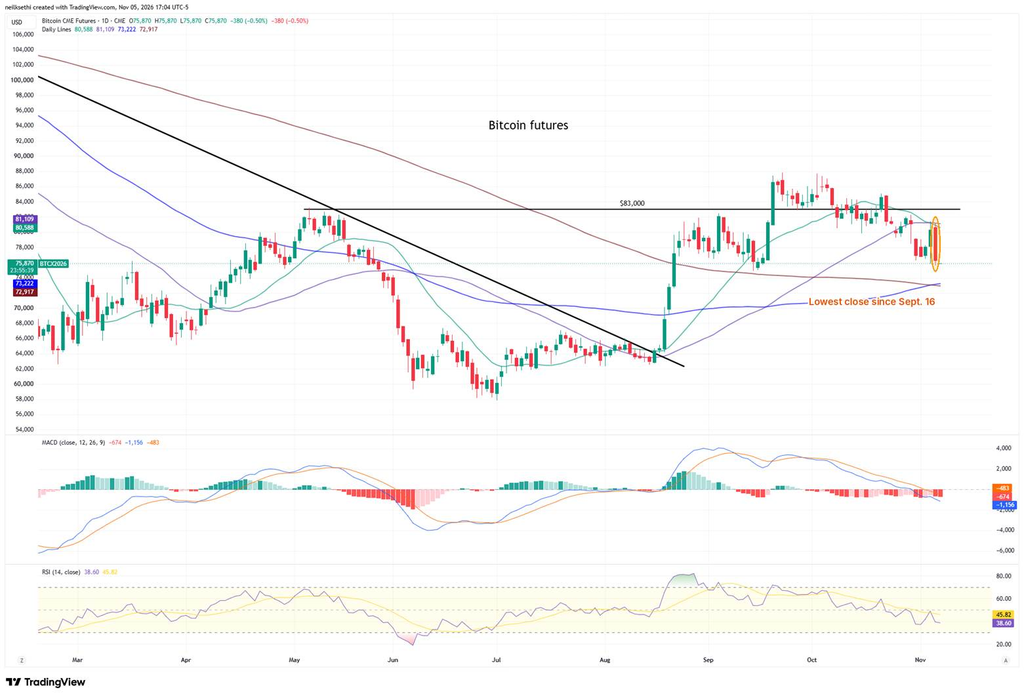
Bitcoin futures
Bitcoin futures fell 5.08% to $76,250, their lowest close since September 16, back below $80,000 and their 20- and 50-DMAs (both around $81,000). The MACD is in “go short” positioning, and the RSI is at 39.
More From TheStreet Pro
Helene Meisler — The Either/Or Market Rages on Despite Blue Wave Rally
James “Rev Shark” DePorre — A New Crop of Winners and Losers Is Emerging After a Major Political Shift
Stephen Guilfoyle — From Blue Wave to Flood of Green
Chris Versace — Cybersecurity Names Won’t Stay Down for Long: 8 Key Items Shaping the Stock Market Thursday
Doug Kass —
- Oscillator More Deeply Overbought
- Added to SPY Short
- Boockvar on the Rational Rally, Consumer Insights
- Warby Parker Up, Qualcomm Down: Upside, Downside Movers in the A.M.
- Bank Buys
- Adding to 5 Longs
- Goldman Long
- Added to QQQ
- New Long
Note: Doug posted 30 Diary entries today so lots more there.
And From Me If You Missed It
- Wednesday Rally Comes Too Late to Boost AAII Survey
- Initial Jobless Claims Drop Back to Joint-Lowest Since 1969
- Democratic Sweep the Answer to China’s Stock Market Malaise?
- Q3 Productivity Hands Fed Doves Some Ammo, but Workers’ Share Hits a Record Low
- October Job Cuts at 3-Year Low as Focus Turns to Economic Conditions
- Investor ‘Fear’ Returns
Miscellaneous
Wrap-Up — A Tech Vortex
I had said yesterday that I thought the move was “extreme.” Little did I know I was soon to be reminded of what extreme really looks like. Tech seeing its worst day since the depths of the Covid pandemic is quite something. But it does fit with my other comment that I thought “may prove to be more than a one-day event” in terms of the Tech selloff.
That said, markets did a lot of work today in flushing out any non-diehards (like myself) or completely passive investors, and I’d have to think if the buy-the-dip crowd still exists this is quite the dip to buy. As I said last week, a selloff like this often sees a bounce, and often a sharp one at that, but as I also said then until proven otherwise it will just be a bounce.
But with markets having given back much of this year’s advance on what for now are just concerns about slower growth and positioning having been cleaned out (we’ll see how much this weekend), things certainly seem relatively favorable for upside once things stabilize.
As always, let’s see what we get and go from there.
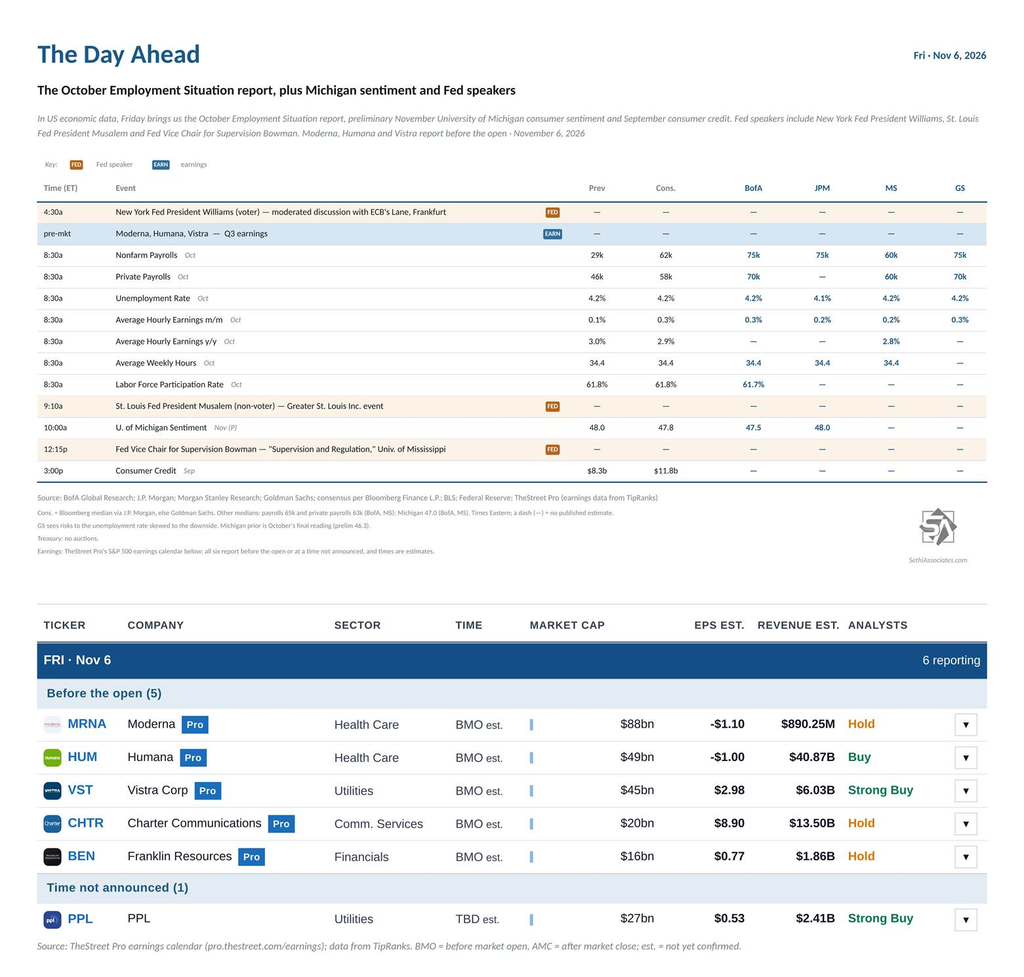
The Day Ahead — Jobs Friday
In US economic data, Friday brings us the October employment report and preliminary November University of Michigan consumer sentiment, plus September consumer credit.
New York Fed President Williams (voter) joins the ECB’s Lane for a moderated discussion in Frankfurt at 4:30am ET, St. Louis Fed President Musalem (non-voter) speaks at a Greater St. Louis Inc. event at 9:10am ET, and Fed Vice Chair for Supervision Bowman discusses supervision and regulation at the University of Mississippi at 12:15pm ET.
There are no non-Bill (>1yr in maturity) US Treasury auctions.
Also, the Justice Department and lawyers for Fed Governor Lisa Cook are due to file a report with a federal judge on how to proceed with her lawsuit challenging President Trump’s attempt to remove her, per Bloomberg (via Barraud).
Six S&P 500 components report, none with market caps over $100bn:
Before the open: Moderna (MRNA), Humana (HUM), Vistra (VST), Charter Communications (CHTR) and Franklin Resources (BEN)
Time not announced: PPL (PPL)
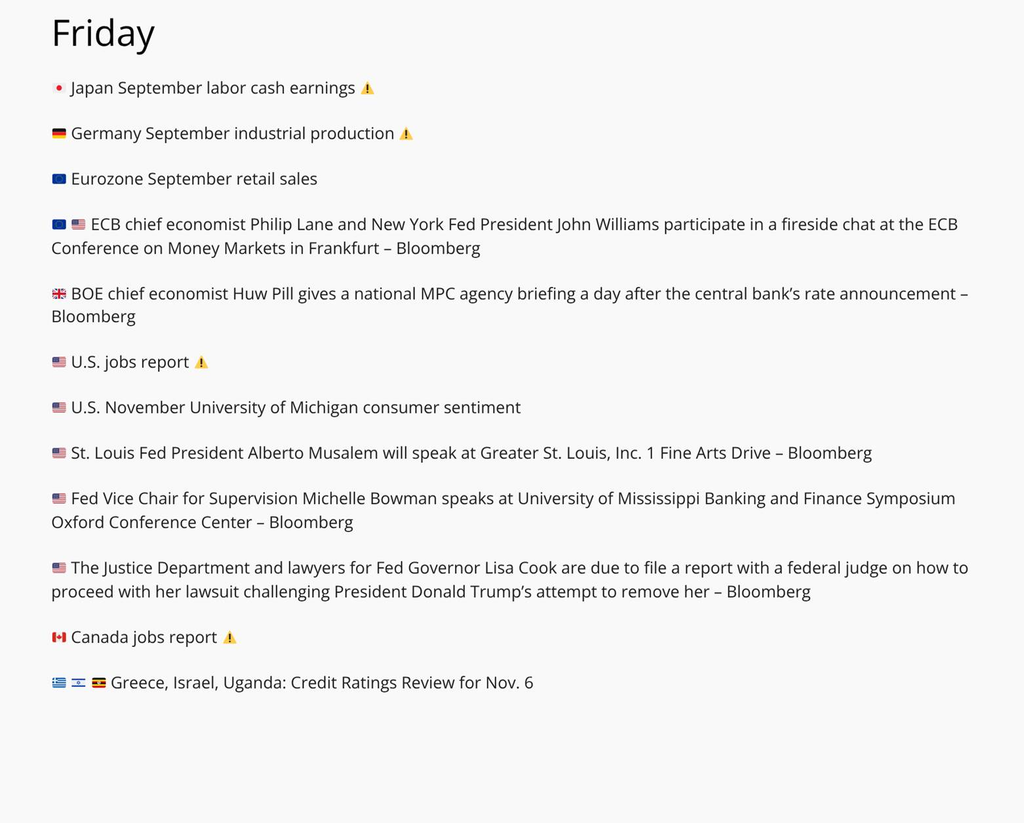
Ex-US highlights include Japan September labor cash earnings, Germany September industrial production, France’s September current account and trade balances and Q3 wages, Eurozone September retail sales and Canada’s October Labour Force Survey. The BoE’s Huw Pill also gives a briefing the day after the bank’s decision, and Greece and Israel face credit rating reviews.
From Christophe Barraud’s international Week Ahead rundown:
At the time of publication, in terms of securities mentioned, Sethi was long APP, GOOGL, MSFT, PLTR, SPY, RSP and numerous Treasury ETFs, and short AMD, CPER, HOOD, META, MRVL, MU and QQQ. In the last 24 hours Sethi sold his positions in IWM, QQQ and TSLA, and moved short CPER, HOOD, META, MU and QQQ.