October Job Cuts at 3-Year Low as Focus Turns to Economic Conditions
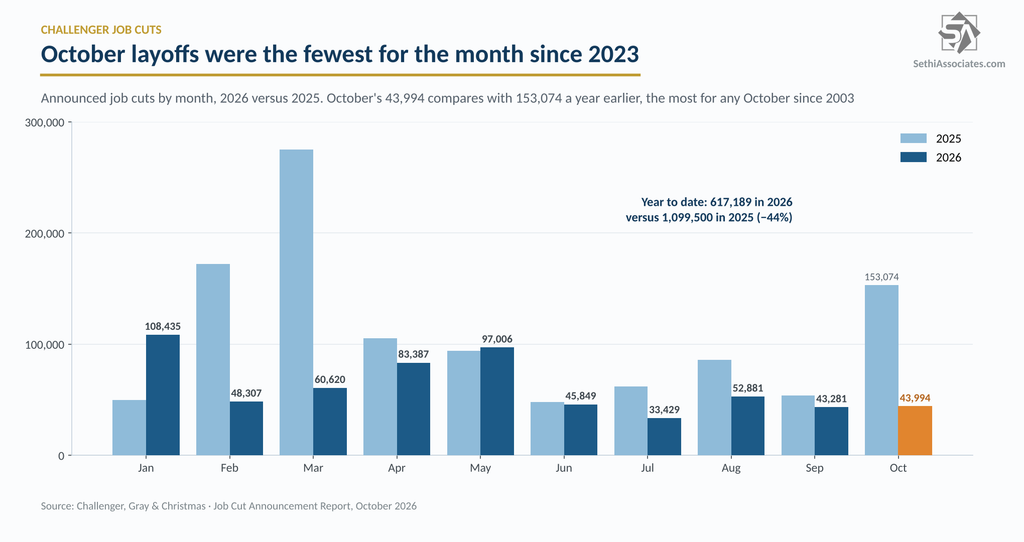
Employers announced 43,994 job cuts in October, the fewest for the month since 2023. AI cuts were the lowest of the year as economic conditions passed AI as the top reason for 2026.
You've reached your free article limit
You've read 0 of 1 free Pro articles.

- U.S. Challenger Job Cuts (Year-over-Year) Oct: -71.3% (prev -19.9%)
- U.S. Challenger Job Cuts Total: 43,994 (prev 43,281)
Executive Summary
- Employers announced 43,994 job cuts in October, up 2% from September and down 71% from a year ago — the lowest October total since 2023 and the eighth month this year below its year-earlier figure. Through October, cuts of 617,189 are down 44%, the lowest January-to-October total since 2022.
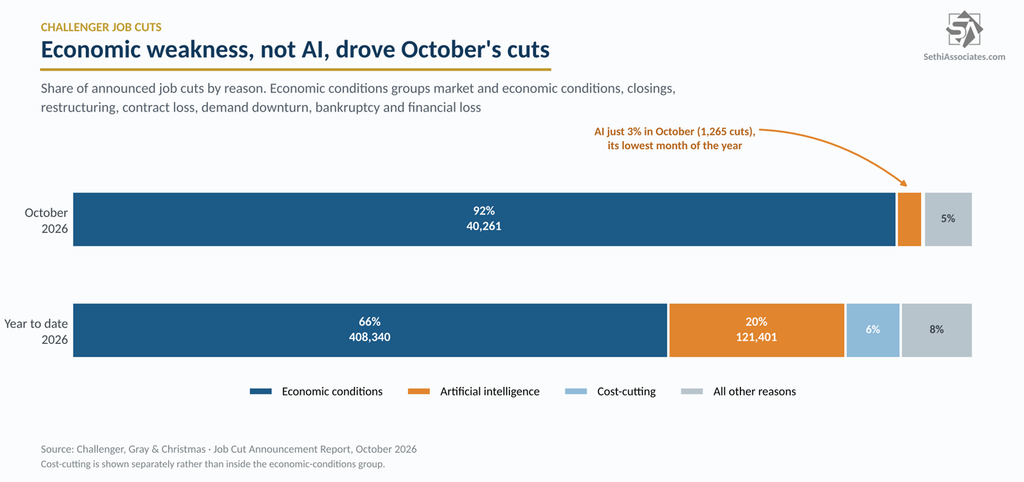
- The top reason employers give for cuts this year has switched. Market and economic conditions led October with 16,407 cuts and at 130,531 year to date have passed artificial intelligence as the top reason of 2026. AI was cited for just 1,265 cuts, its lowest month of the year. Every economic-weakness reason together accounts for 92% of October’s cuts.
- Hiring jumped, but mostly it was seasonal hires at Amazon (AMZN) and UPS (UPS). October’s 444,692 plans are the most for the month since at least 2009, but 300,000 are Amazon seasonal hires and 100,000 are UPS. Seasonal roles are 72% of all 2026 hiring plans.
A Quiet October
U.S.-based employers announced 43,994 job cuts in October, up 2% from September’s 43,281, according to Challenger, Gray & Christmas. That is down 71% from the 153,074 announced in October 2025, which was the most for any October since 2003. This October was the lowest for the month since 2023, when 36,836 cuts were announced, and below the 56,348 average for the month from 2015 to 2025.
Through October, employers have announced 617,189 cuts, down 44% from a year ago and the lowest January-to-October total since 2022.
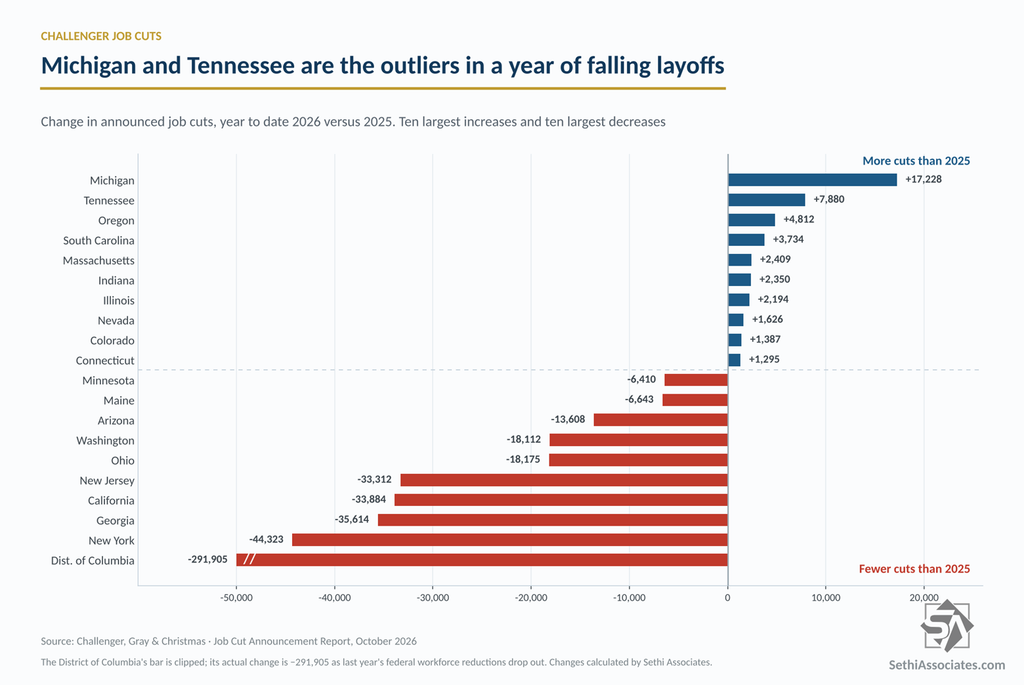
The year-over-year comparisons, though, still include last year’s federal workforce reductions by the Department of Government Efficiency (DOGE). Government cuts are down 93%, and the District of Columbia alone is a 291,905 swing.
“This is a low-fire environment. Employers are holding on to the workers they have heading into the holidays,” said Andy Challenger, the firm’s chief revenue officer. That squares with the September JOLTS report earlier this week, which showed layoffs falling the most since April.
Note: One large number is not in the data at all. Microsoft (MSFT) offered voluntary exit packages to 60,000 employees in October, and Challenger does not count voluntary programs until employees accept or the company states a target. That is an overhang on the next few reports.
Tech Layoffs Slow
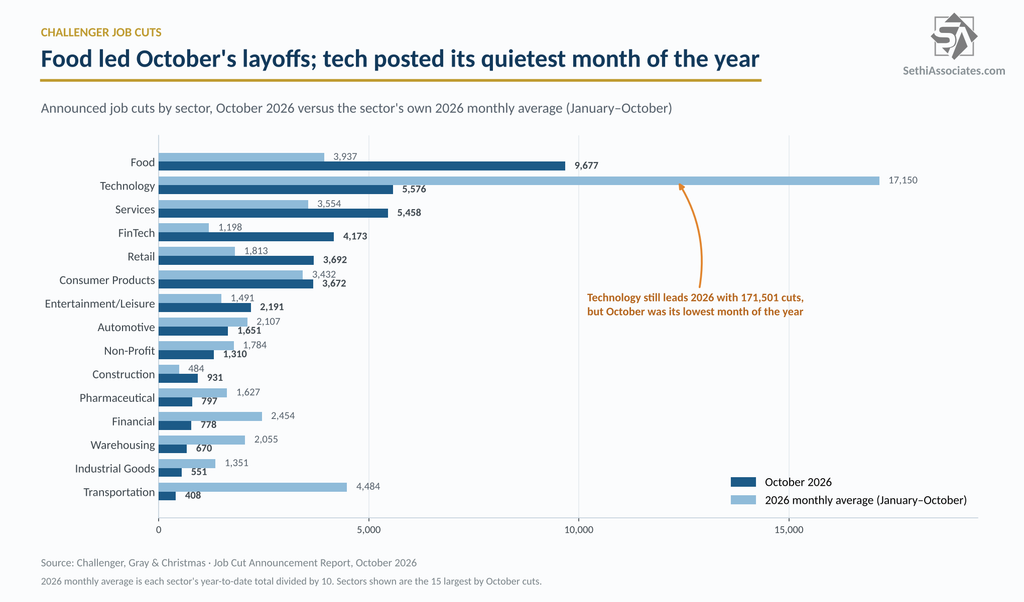
Food companies led all industries with 9,677 cuts, the sector’s highest month this year and enough to put it third for 2026 at 39,370, up 43%. Services followed with 5,458, FinTech with 4,173.
Technology announced 5,576 cuts, its lowest month of the year, though it still leads 2026 at 171,501 — 28% of all cuts and already past the 154,445 it announced in all of 2025. Retail saw 3,692 jobs cut even as it announced 13,300 hires. “Companies are trimming permanent roles and leaning on seasonal workers to cover the busiest weeks of the year,” Challenger said.
The Reason Has Changed
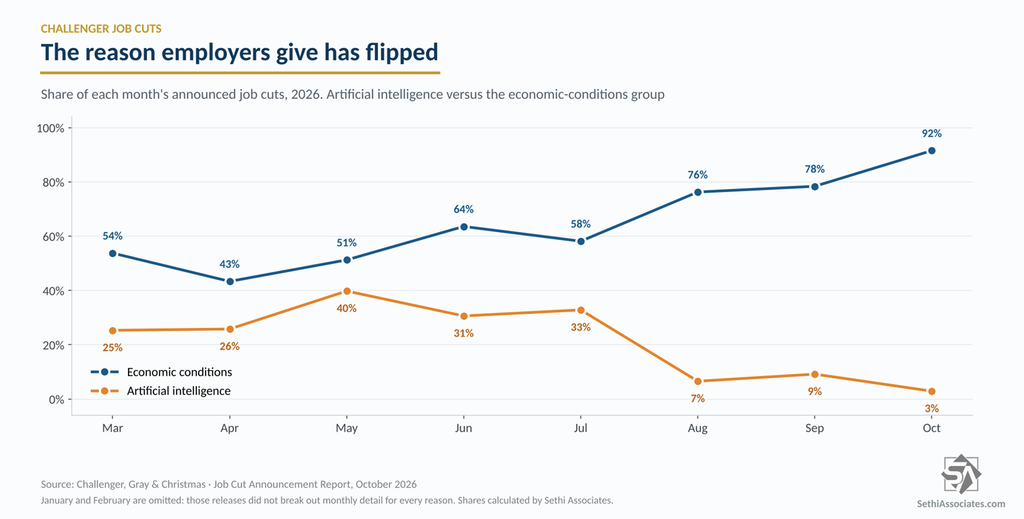
Through the spring and summer, AI was the story. It peaked at 40% of May’s cuts, led the monthly list for five straight months, and raised attribution questions that went well beyond U.S. employers. In October though it was cited for just 1,265 cuts, under 3% of the month and its lowest of the year.
Market and economic conditions in contrast led for the second month running with 16,407 cuts, and at 130,531 year to date have overtaken AI as the leading reason of 2026.
In addition, closings accounted for 10,250 cuts and demand downturn 6,118, taking that category to 21,347 for the year, up 145%. Group every economic-weakness reason together — market and economic conditions, closings, restructuring, contract loss, demand downturn, bankruptcy and financial loss — and you get 40,261 cuts in October, 92% of the month, and 66% of the year. “I leave cost-cutting out, since trimming because you want to is not the same as trimming because you have to.
“The reasons employers give have shifted from technology to the economy,” Challenger said. “That is a more cautious signal, though the overall pace of cutting remains low.”
A Huge Hiring Number, but Mostly Temp Jobs at Two Companies
Employers announced 444,692 hiring plans in October, up 57% from a year ago and the highest October total since at least 2009. Year to date, plans of 655,304 are up 34%.
Almost all of October’s total is temporary hiring at two companies. Amazon announced 300,000 seasonal hires, the largest single seasonal announcement Challenger has tracked, and UPS announced 100,000. Everyone else combined accounted for 44,692.
Note: Challenger counts Amazon in Technology, so Amazon’s fulfillment and distribution hires represented all but 252 of October’s 300,252 technology hiring plans. Seasonal roles from five companies are 470,400 of the 655,304 plans announced this year and nearly 60% of the increase over last year.
The timing has shifted too. September used to carry these announcements — at least 60% of the September-October total every year from 2012 through 2024. That share fell to 29% last year and 17% this year, which is why September’s 90,787 was the weakest for the month since 2011.
Where the Cuts Are
California led October with 10,032 cuts and leads the year at 124,850, a fifth of the national total, though down 21% from 2025. Washington followed with 7,233, then New York at 4,671 and Ohio at 4,592, both sharply higher than a year ago. The West accounted for 46% of October’s cuts.
Cuts are down in all four regions for the year, but the state picture splits almost evenly: 24 states above last year, 26 plus the District of Columbia below. Among states with at least 10,000 cuts, Michigan is up 89% and Tennessee up 68%.
What to Watch
Some things to watch into year end. First, whether Microsoft’s 60,000 voluntary exit offers start showing up in the totals. Challenger only counts them once employees accept or the company sets a target, so they could land in the next report or two. Second, with 72% of this year’s hiring plans seasonal, whether any of the seasonal hiring turns permanent in January. Third, demand downturn up 145% this year. If it keeps climbing, it might start to show up in broader labor market metrics.
The next read on the labor market comes Friday, when the October jobs report is expected to show payrolls up 65,000 with the unemployment rate holding at 4.2%, according to Bloomberg.