From Blue Wave to Flood of Green
Let’s see how and why the midterms gave a boost to Wall Street, and examine why even some tech giants surged — while others dropped.
You've reached your free article limit
You've read 0 of 1 free Pro articles.

It’s Okay
Take off the masque
Take off the gloves
Take off the armor that’s so rough, rough, rough
Might need a blast
Of crazy love
Forget the past
Dig the signs from above
– Reb Beach, Kip Winger (Winger), 2023
We had for weeks, projected that post-election certainty would produce an equity market rally. Not in our wildest dreams did we expect a one-day rally like that. Then again, we did not expect to see the kind of one-way blowout on Election Day that we did, indeed, see. U.S.-based equities screamed higher on Wednesday after the “Blue Wave” of Tuesday’s electoral rout had washed over Wall Street. Readers do not need to be told that Democrats won decisive majorities in both houses of the Legislative Branch of government. Readers do not need to be told that even parts of the country thought to be deeply red in color such as Texas and Kansas, took on a new shade of blue.
Equities opened on strength and found nearly immediate support on several attempted selloffs early in the session. On each attempt, buyers and keyword-reading algorithms stepped in to snap up the shares that were for sale. I mention the keyword-reading algorithms, because they, ironically and quite noticeably, reacted to headlines after reactions by Republican party leaders, in defeat, made headlines.
First up was Vice Pres. JD Vance who blamed the war in Iran for the steep election losses that his party suffered on Tuesday. With crude oil prices already in collapse coming into the election due to a less aggressive stance by Pres. Trump, front month WTI prices dropped another 8% or so, to trade with an $86 (per barrel) handle. At its overnight low, crude oil was down more than 17% just since Friday’s high.
After that, it was the president’s turn. Pres. Trump told the New York Times that he was “absolutely willing” to accept these electoral results. He also told the Wall Street Journal that Republicans would work with Democrats. Guess he has no choice after a drubbing like that. Can’t claim it fraudulent when the election is not close. Can’t choose not to work with the other party when it’s clear that the American public is this angry. Regardless, algorithms don’t reason and they loved it.
Lastly, as we all know, markets typically do well under a divided government. There will be some gridlock. While the legislature will be decisively blue, the wave was not enough to make said legislature veto-proof. The president, as the executive, still has enough power to block any legislation he does not like and as long as the remaining Republican lawmakers stick with him, nothing can pass.
The president will have to play ball with Democrat party leaders, but they will also have to play ball with the president if they want to accomplish anything. That said, at the state level, there will almost certainly be some change due to a lack of gridlock. Hence, the divergence in the performance of tech stock on Wednesday.
Shell Game
Most of Wall Street rallied on Wednesday as energy prices collapsed and the slope of the Treasury yield curve continued to flatten. By the way, when short-term yields rise and longer-term yields drop, that’s typically a warning that economic activity is going to slow in the near to medium-term future. Hopefully, that was an algorithmic blip, but with the future of data centers now in trouble, as AI and that buildout had been a key driver (for now) of middle-class job and wage growth, we shall see.
The tech trade was split in two on Wednesday. As mentioned above, U.S. equities rallied quite robustly in response to the election. What went the other way were energy for good reason and certain parts of the tech trade. For the day, seven of the S&P sector SPDR ETFs gained at least 2.49%, led by the discretionaries (XLY) and the financials (XLF). Energy (XLE) gave up a whopping 4.74% on the session. Technology (XLK)? Flat on the day. Really, the XLK was down 0.01%. That masked what was really going on.
Within tech the Dow Jones U.S. Software Index soared 3.9% as an AI/data center slowdown could boost that threatened industry. Applovin (APP) and Shopify (SHOP) were up 10.7% and 7.3% respectively. The hyperscalers were also strong. Amazon (AMZN) and Microsoft (MSFT) ran more than 6% apiece while Alphabet (GOOGL) popped for a 3% gain. Why? You see, these companies already have large data center-based operations in place. Not only will a slowdown in the development of data centers have even more power to the hyperscalers, the slowdown will allow these companies to slow their “out of control” spending, which will improve their respective cash flows and balance sheet health.
The Dark Side?
Sarge, you said the tech trade was split. It sure was, cowboy. I say cowboy, because states like Texas and Ohio will lose their economic standing as the data center buildout fades in those locales and goes elsewhere. Hey, I don’t love AI. I hate it. I have already lost more than one occupation to technological “progress” and have had to reinvent myself multiple times, so I know better than most of what I speak. We can’t stop progress without becoming non-competitive.
There were two groups of tech-sector victims of the election wave. The first is the neoclouds. These smaller, upstarts that provide data center access and computing power in competition to the hyperscalers do not have generally strong balance sheets. They are debt reliant and now their business plans are going to face intense pressure. I speak of CoreWeave (CRWV), Iren (IREN) and Nebius (NBIS). These stocks were all down more than sharply on Wednesday.
The semiconductors also faced selling pressure on Wednesday as that group provides the infrastructure, the brains and the capacity to the data center buildout. The Philadelphia Semiconductor Index surrendered 3.13% on Wednesday. I did tell you folks that I was selling some Advanced Micro Devices (AMD) yesterday despite loving that company and its leader. The big losers among the semis on Wednesday were SanDisk (SNDK), Marvell Technology (MRVL and Micron (MU). All of those names gave back at least 7% for the day as memory was hit especially hard. Just a heads up, I had already been out of SanDisk. I finished selling Micron yesterday.
Breadth
The rally was broad on Wednesday and trading volume popped. That much is for sure. The S&P 500 gained 1.58% for the regular session. The Nasdaq Composite ran 1.44%, while the Russell 2000 added 1.58%. It was a good day in general as the wealth spread out to the Banks, and the Transports as well.
Winners beat losers at the NYSE by roughly a 10-to-three margin as advancing volume took a 69.9% share of composite NYSE-listed trade. At the Nasdaq, winners beat losers by two-to-one as advancing volume took a less convincing 58.1% share of composite Nasdaq-listed activity thanks to the semiconductor beatdown.
Yes, the trading volume was there. NYSE-listed trade ramped by an incredible 34.8% on a day-over-day basis, while Nasdaq-listed trade increased by 19.2% over the day prior. Perhaps more impressively, aggregate trade across the membership of the S&P 500, if I am correct, was its most for a single (non-triple witch expiration, non-rebalancing) session since May.
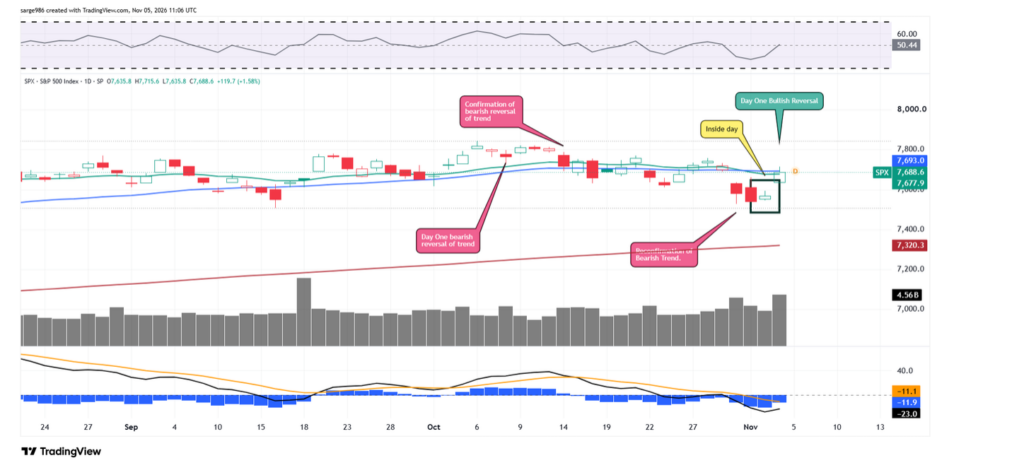
That does indeed make Wednesday a “Day One” bullish reversal of trend session. The “inside day” on Tuesday was not a “Day One.” This is a positive. To confirm, we need a pause in the bullish activity and then a resumption on increased trading activity. We know the drill by now.
Readers will see that the S&P 500 approached but failed to retake its 50-day simple moving average on Wednesday. That’s actually good for the bulls, technically. The potential level of resistance could force the pause that I am talking about and a second attempt. That second attempt, if successful, would cause the increase in trading volume required to confirm the reversal. The “Day One” is also visible on the chart of the Nasdaq Composite, though there we were worried about support at the 200-day SMA and not resistance at the 50-day SMA.
Economics (All Times Eastern)
08:30 – Initial Jobless Claims (Weekly): Expecting 197K, Last 194K.
08:30 – Continuing Claims (Weekly): Last 1.701M.
08:30 – Non-Farm Productivity (Q3-adv): Expecting 3.0% q/q, Last 1.4% q/q, SAAR.
08:30 – Unit Labor Costs (Q3-adv):
Expecting 1.1% q/q, Last 1.5% q/q, SAAR.
The Fed (All Times Eastern)
08:50 – Speaker: Cleveland Fed Pres. Beth Hammack.
09:10 – Speaker: Richmond Fed Pres. Tom Barkin.
7:00 p.m. – Speaker: Dallas Fed Pres. Lorie Logan.
Today’s Earnings Highlights (Consensus EPS Expectations)
Before the Open: BDX (4.07), COP (3.04), KMB (1.65), RL (4.25), WEN (.09)
After the Close: ABNB (2.85), DBX (.73)
At the time of publication, Guifloyle was long WEN, AMZN, MSFT, AMD equity.