Q3 Productivity Hands Fed Doves Some Ammo, but Workers’ Share Hits a Record Low
Third-quarter productivity was the strongest in a year as output jumped while hours worked were little changed.
You've reached your free article limit
You've read 0 of 1 free Pro articles.

Third-quarter productivity was the strongest in a year as output jumped while hours worked were little changed, boosting the Fed’s 1990s-style productivity camp, but the share of output going to workers set another record low.
US Nonfarm Productivity Q3 P: 3.6% (est 2.7%; prev 1.4%; prev R 2.1%)
-Unit Labor Costs: −0.7% (est 0.2%; prev 1.2%; prev R 1.9%)
-Real Hourly Compensation: 1.1% (prev −3.3%; prev R −1.9%); year-over-year 1.0%
-Labor Share: 53.0% (prev R 53.3%), a record low
Executive Summary
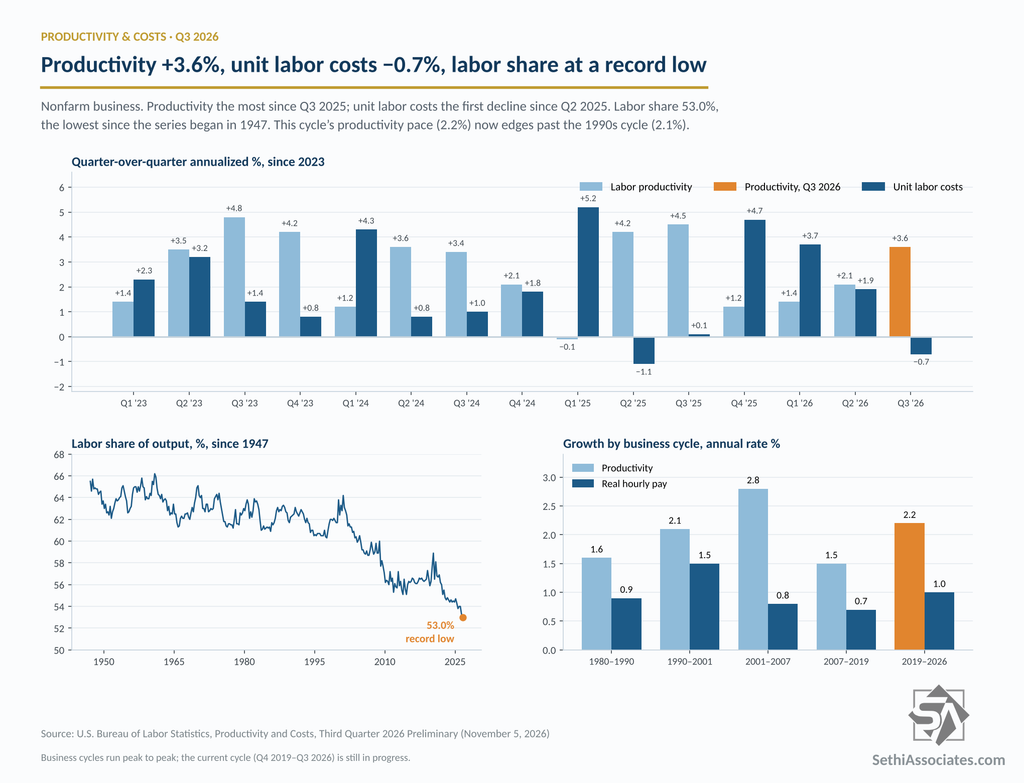
- Nonfarm productivity rose 3.6% annualized in the third quarter, well above the 2.7% consensus and the most since the third quarter of 2025, as output grew 3.7% while hours worked barely moved. It was the sixth straight quarterly gain.
- Unit labor costs fell 0.7% versus a 0.2% increase expected, the first decline since the second quarter of 2025, as hourly pay growth slowed to 2.9%, the least since the fourth quarter of 2022.
- Real hourly pay is up just 1.0% from a year ago and labor’s share of output fell to 53.0%, the lowest since records began in 1947. Annual revisions lifted productivity for 2024 and 2025, and this cycle’s 2.2% pace now edges past the 1990s cycle.
Third-Quarter Productivity
Productivity is a metric closely followed by the Fed, and one with heightened importance given the view from some Fed members, including Fed Chair Kevin Warsh, that, like the 1990s, productivity may be the key to keeping rates stable or lower while maintaining solid growth and a healthy labor market (some economists have called it “fairy dust”). The number of members leaning on that has dwindled, and even they see it as a longer-term story, with AI-related price pressures dominating in the near term. After their October meeting, Fed officials described productivity growth as “strong” even as inflation remained elevated, and Warsh has cautioned that any AI-driven payoff will emerge gradually, per Bloomberg.
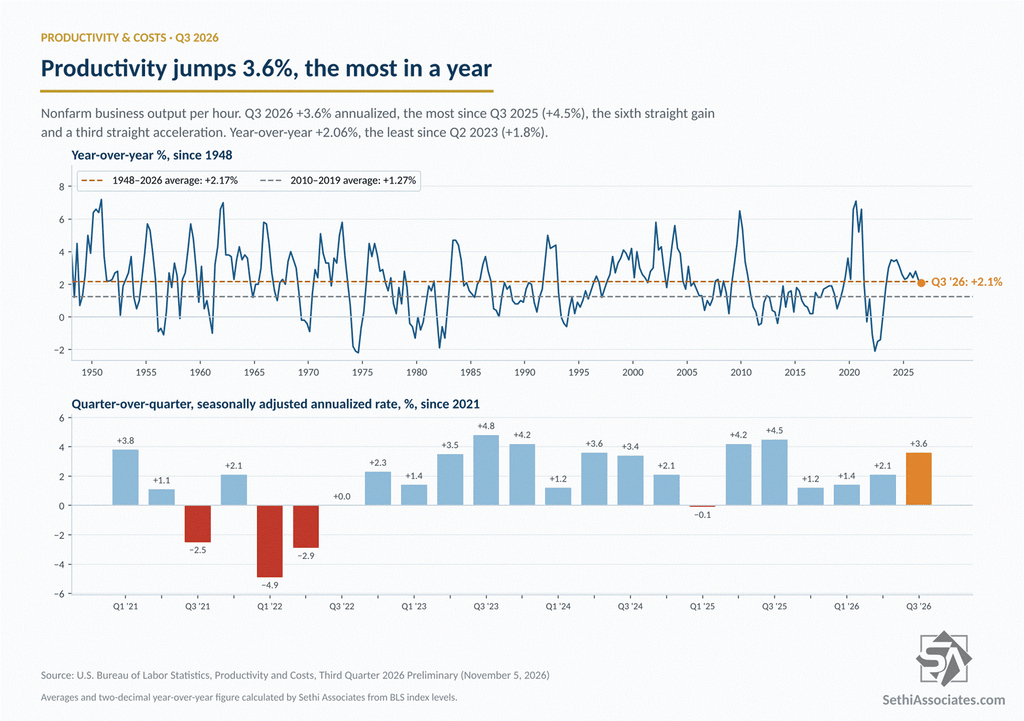
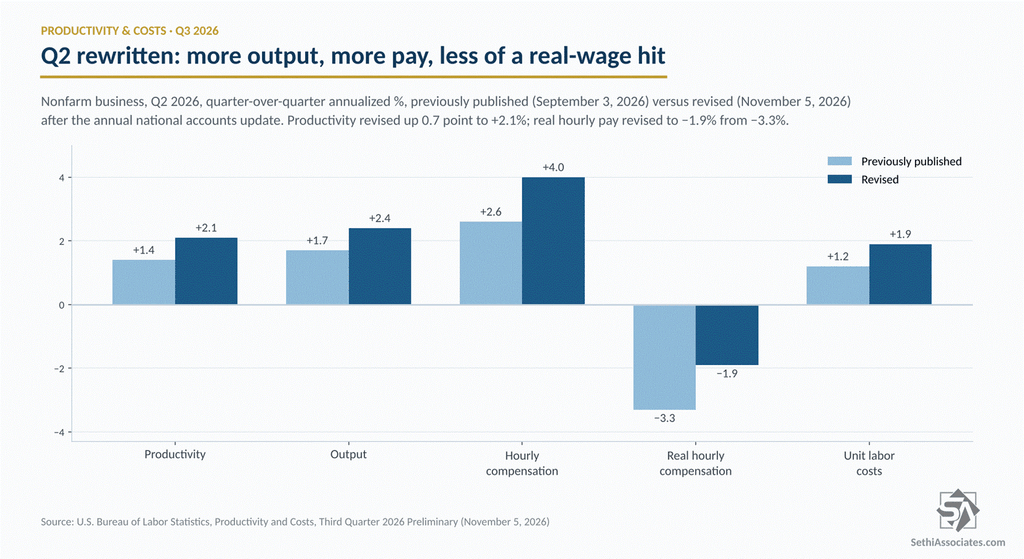
With that lead-in, the third-quarter preliminary number gave that 1990s-style pro-productivity camp some ammunition. Nonfarm productivity rose 3.6% at a seasonally adjusted annualized rate, the most since the third quarter of 2025 (4.5%), and beat the 2.7% consensus. That followed an upwardly revised 2.1% in the second quarter (from 1.4%), making it the sixth straight quarterly gain and the third straight acceleration (BLS).
The mix was also favorable to that argument: output rose 3.7% (see the third-quarter GDP report), the most since the third quarter of 2025 (4.7%), while hours worked rose just 0.1%, the least since the fourth quarter of 2025 (−0.2%). So businesses produced more without adding much labor.
From a year ago, though, productivity slowed to 2.06%, the least since the second quarter of 2023 (1.8%), as a strong third quarter of 2025 rolled into the comparison. That is still well above the 1.27% average from 2010 through 2019.
Unit Labor Costs and Pay
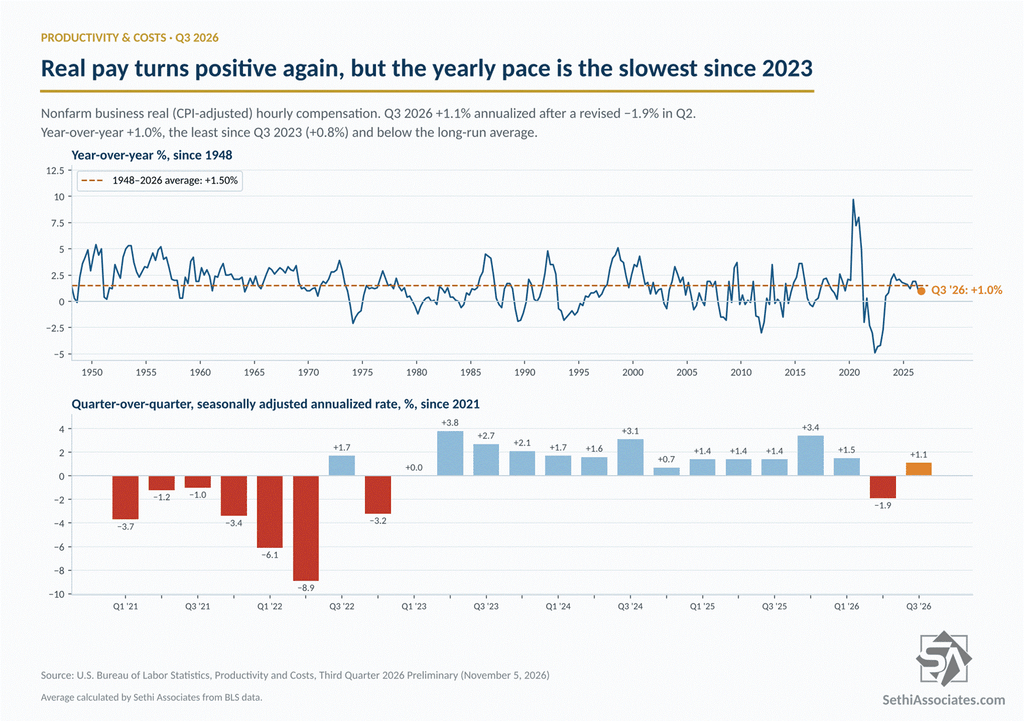
Hourly compensation rose 2.9% annualized, the least since the fourth quarter of 2022 (0.9%), echoing the slowdown in last week’s Employment Cost Index and September’s payrolls report. After inflation, real hourly compensation rose 1.1%, reversing a revised 1.9% decline in the second quarter (previously published as −3.3%).
From a year ago, though, real pay is up just 1.0%, the least since the third quarter of 2023 (0.8%) and below its 1.50% average since 1948.
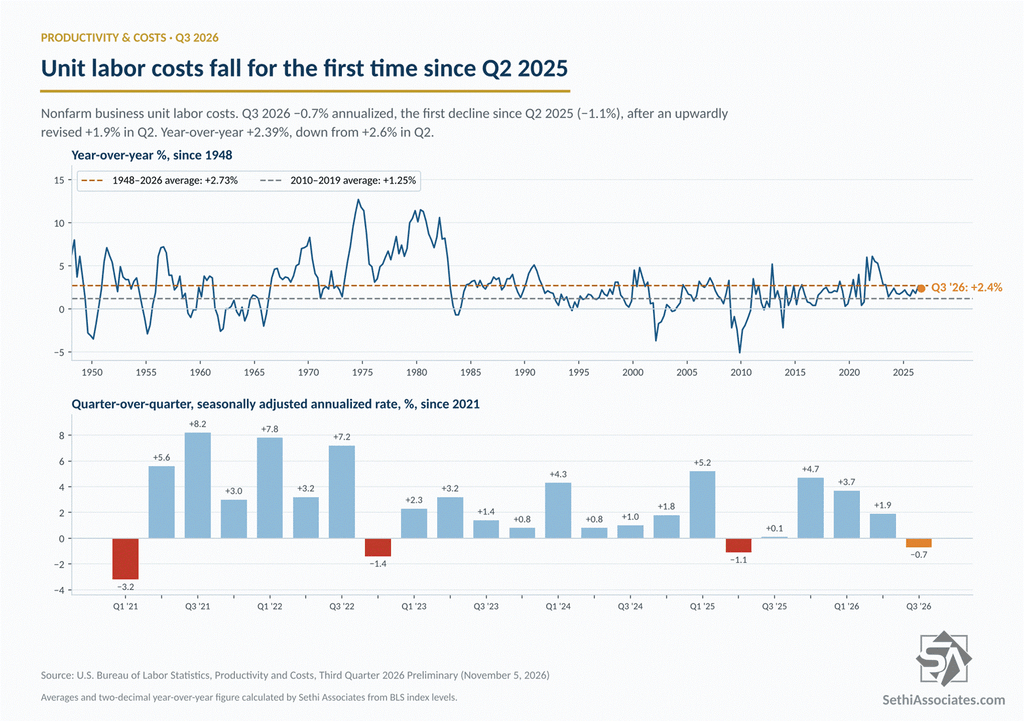
With the strong productivity and softer compensation growth, unit labor costs, a key read on wage-driven inflation, fell 0.7%, the first decline since the second quarter of 2025 (−1.1%), versus a 0.2% increase expected. That followed an upwardly revised 1.9% in the second quarter (from 1.2%). From a year ago, unit labor costs rose 2.39%, down from 2.6% in the second quarter.
The Labor Share
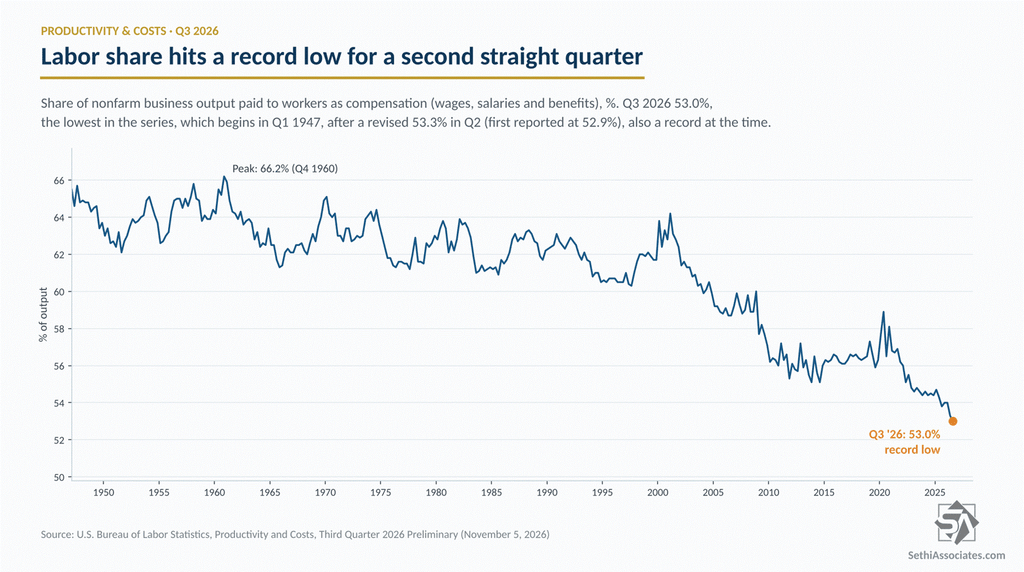
In addition to the slow year-over-year real pay growth, the share of nonfarm business output paid to workers fell to 53.0%, “the lowest level in the series, which begins in the first quarter of 1947,” per the BLS. It is the second straight record low on revised data: the second quarter, first reported at 52.9%, was revised to 53.3%. Unit nonlabor payments, which include profits, rose 5.2% in the quarter.
A note on the measure: it covers the nonfarm business sector only and uses gross value-added output, keeping it consistent with the productivity and unit labor cost figures. It runs lower than economywide measures based on national income, but the direction is consistent.
Revisions and the 1990s Comparison
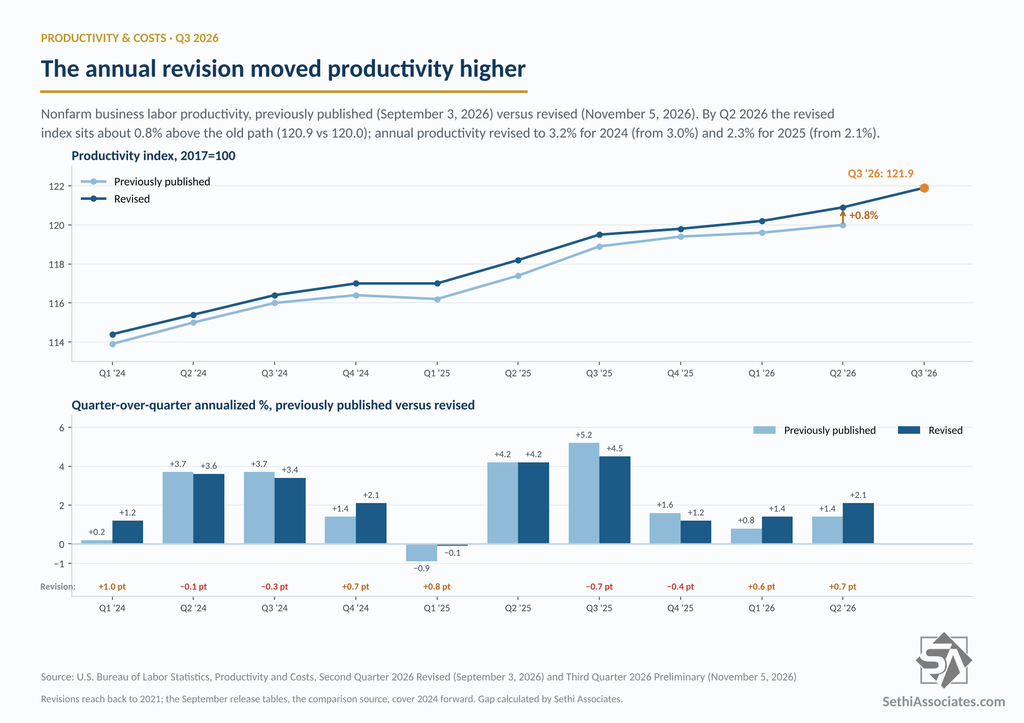
This release folded in the annual national accounts revisions, and per the BLS, “output and productivity were revised up.” Annual productivity is now 2.3% for 2025 (from 2.1%) and 3.2% for 2024 (from 3.0%), the latter the strongest year since 2020 (5.2%).
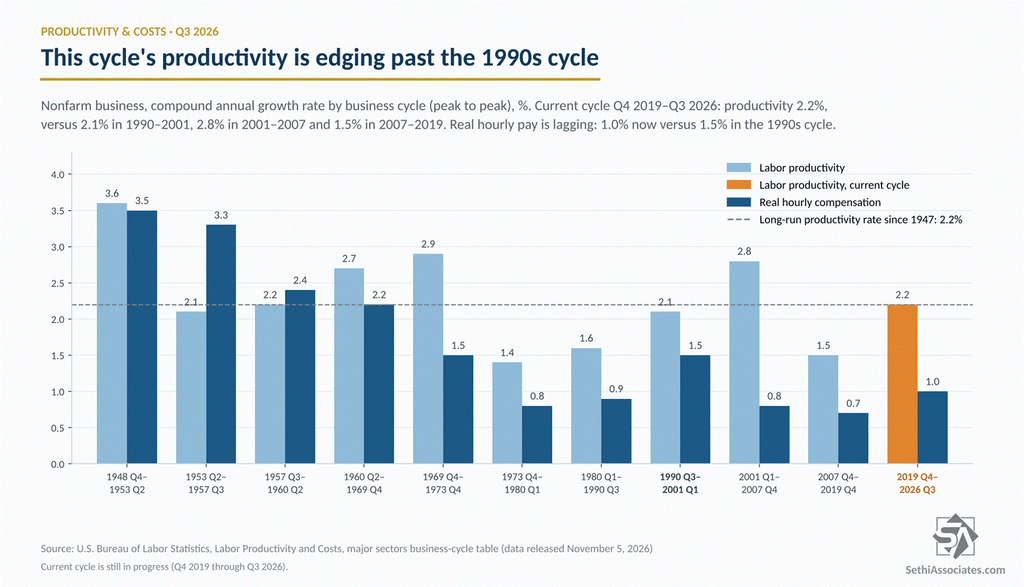
That lifted this business cycle’s productivity pace (BLS measures cycles peak to peak, so this cycle runs from the fourth quarter of 2019) to 2.2% a year, a touch ahead of the 2.1% in the 1990–2001 cycle. It matches the 2.2% long-run rate since 1947 and tops the 1.5% of the 2007–2019 cycle, though it still trails the 2.8% of the 2001–2007 cycle.
Where this cycle lags the 1990s is pay: real hourly compensation has grown 1.0% a year versus 1.5% in the 1990s cycle.
Services and Manufacturing
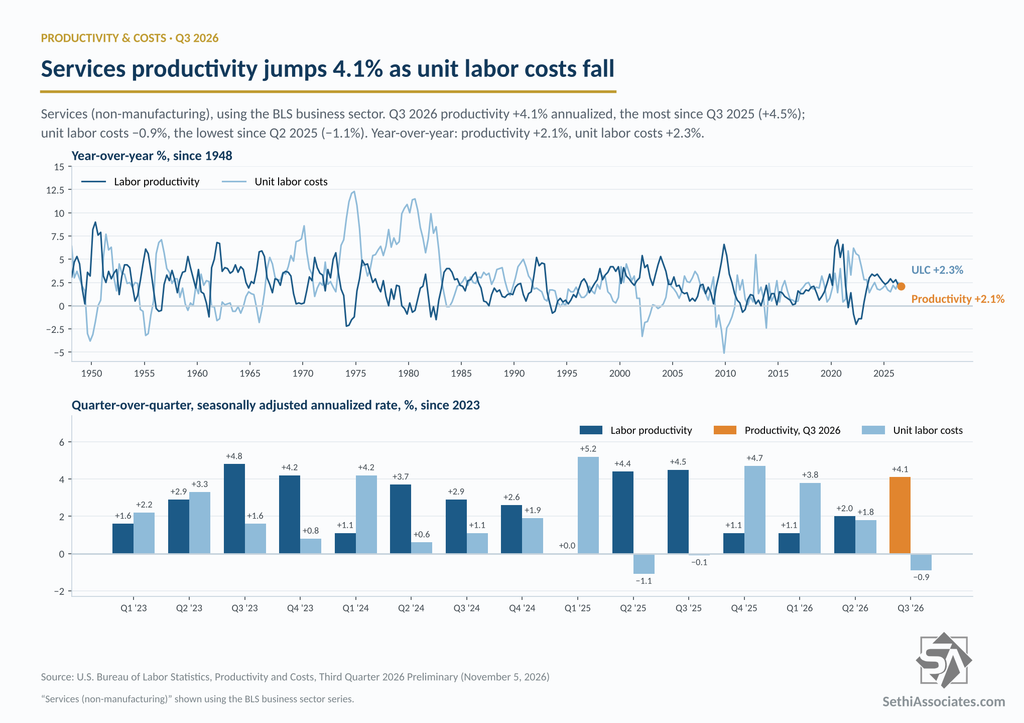
Services (non-manufacturing) did the heavy lifting, with productivity up 4.1%, the most since the third quarter of 2025 (4.5%), and unit labor costs down 0.9%.
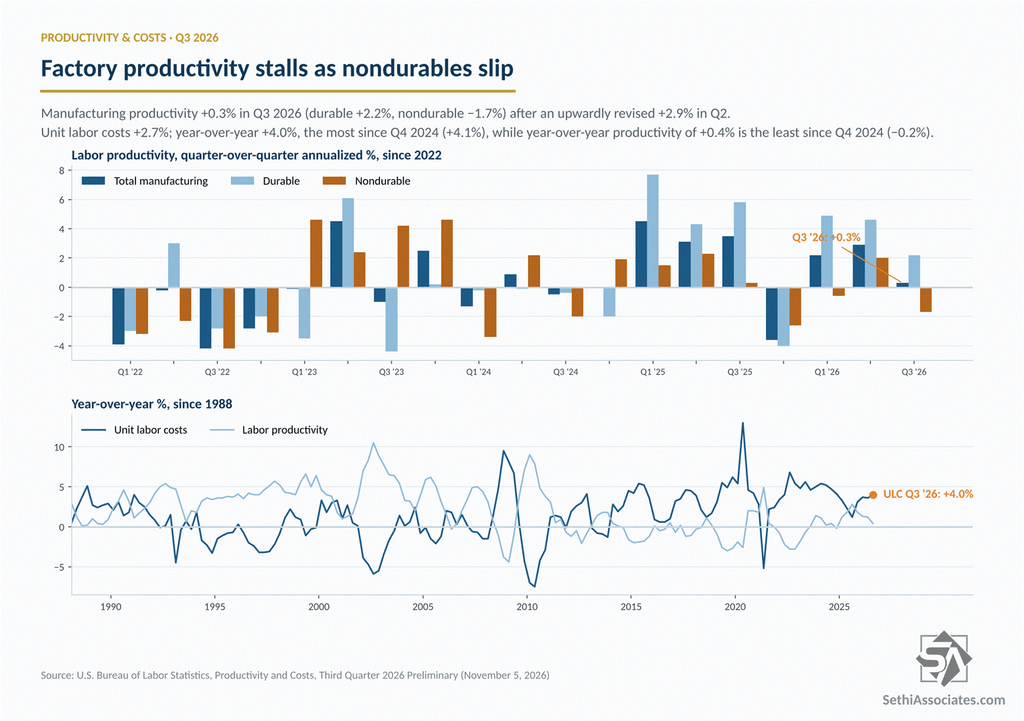
Manufacturing productivity, though, edged up just 0.3% after an upwardly revised 2.9% in the second quarter (from 2.4%), as output rose 1.3% and hours 1.0%. Durable goods productivity rose 2.2%, while nondurables fell 1.7%. Manufacturing unit labor costs rose 2.7%, led by nondurables at 5.0%, the most since the fourth quarter of 2025 (9.4%).
From a year ago, manufacturing unit labor costs are up 4.0%, the most since the fourth quarter of 2024 (4.1%), while productivity of 0.4% is the least since that same quarter (−0.2%).
What to Watch
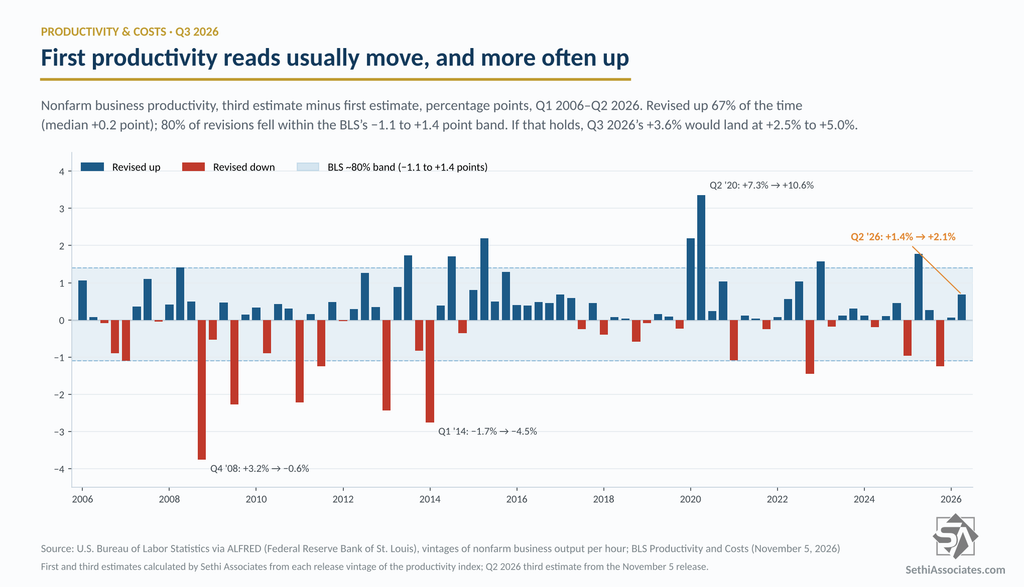
The revised third-quarter report is due Tuesday, December 8. Preliminary readings move: the BLS says the third estimate has differed from the first by −1.1 to +1.4 percentage points about 80% of the time. But note since 2006, the first estimate has been revised up two-thirds of the time, by a median of 0.2 point. Applying the BLS band to today’s 3.6% implies a third estimate between 2.5% and 5.0%.
All data from the BLS Productivity and Costs release.