What We’re Watching Ahead of Key Inflation Data
Why softer inflation findings could help bring a turn in the market.
You've reached your free article limit
You've read 0 of 1 free Pro articles.
The Volatility Index is up, and we can see the same in trading volumes in the Nasdaq Composite and the Dow Jones Industrial Average.
With more than half of Friday’s trading hours to go, we are seeing the same across a few of the Portfolio’s holdings — Alphabet (GOOGL) and Nvidia (NVDA) in particular relative to their respective three-month average daily trading volume levels with Apple (AAPL), Marvell (MRVL), SpaceX (SPCX) and the First Trust Nasdaq Cybersecurity ETF (CIBR) not that far behind.
If we were to speculate as to what that means, one thought would be that short-term traders are lining up for that potential oversold rally that Helene Meisler and others are warming up to. We’ve done some nibbling with the Portfolio earlier this week, and as we pay close attention to the indicators and levels Meisler will be discussing on Sunday and Monday nights, we’re also keeping a watchful eye on the RSI and MACD levels for both the S&P 500 and the Nasdaq Composite.
As we write this alert, the S&P 500’s RSI on the daily chart is now below 30 as is the one for the Nasdaq Composite. Looking at their respective MACD indicators, the slope has yet flattened out or started to turn up for either of the market benchmarks.
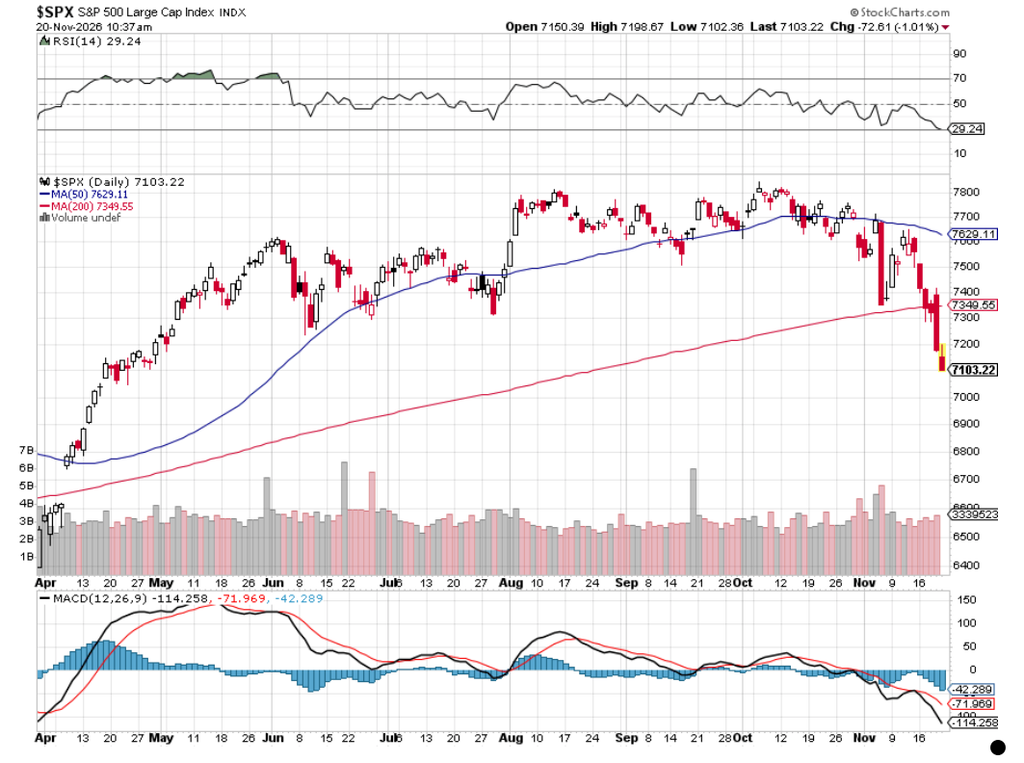
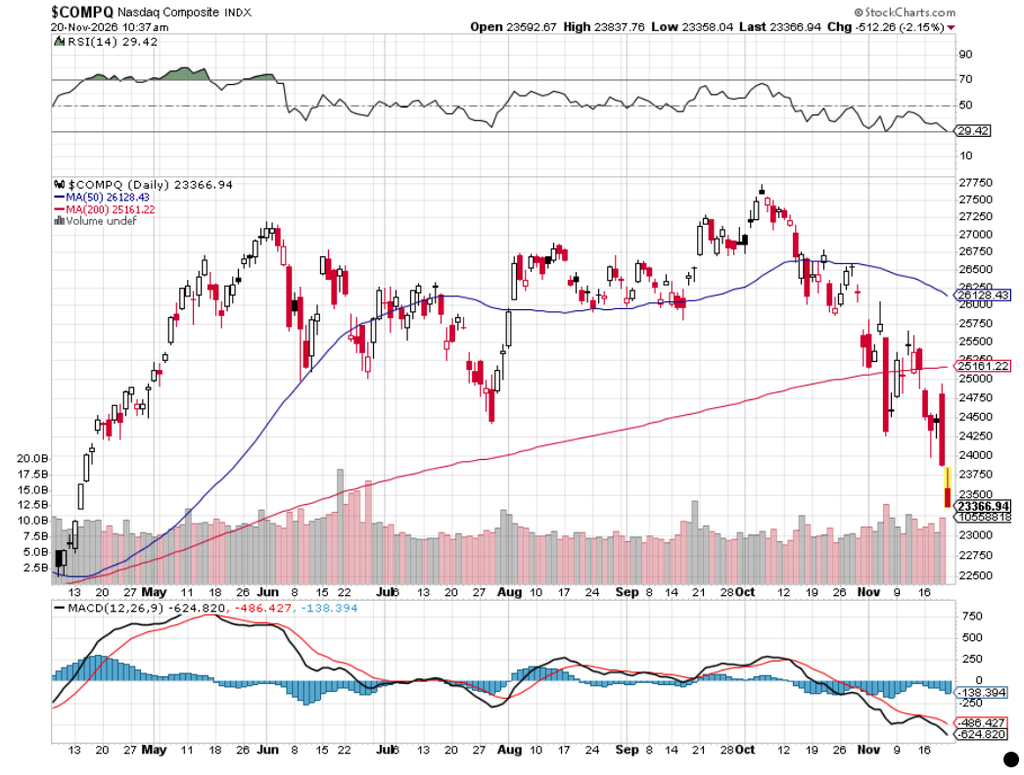
Following the final reading for the Michigan Consumer Sentiment Index that showed a sharp drop in consumer inflation expectations in November to 3.7% from 4.6% to 4.7% in September and October, we’re seeing the market claw back some of its early losses. However, when we look at a trailing three-month average of core PPI figures, we can see why Fed officials have been sounding more hawkish of late despite the fall in oil and gas prices we’ve been talking about. Next week brings the October PCE Price Index data, and if the consensus 3.2% figure is the one that gets printed for core PCE, it means the three-month moving average will step up as well.
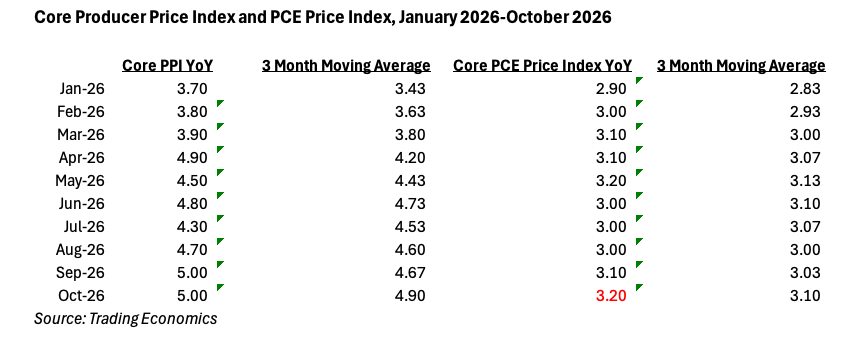
Here’s the thing, in addition to that October PCE Price Index report, early in the holiday shortened week, we’ll get the Flash November PMI report from S&P Global. In that report, we’ll be looking to see the degree to which findings on input and output prices has changed compared to those in August, September and October given the November fall in oil and gas prices.
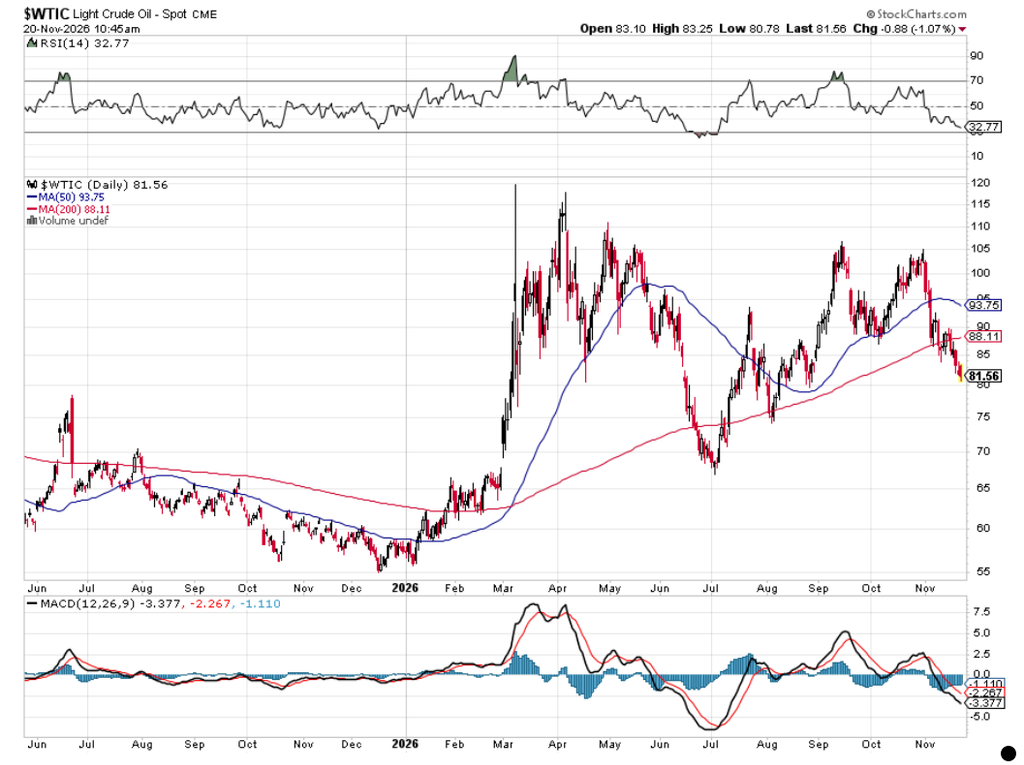
Because the Fed’s blackout dates ahead of the December policy meeting begins on November 28, it means we should be focused on Fed speaker comments next week and Wednesday’s Fed Beige Book. Point being, what next week’s data and comments bring has the potential to reshape what the market expects the Fed to do in just under three weeks.
As this alert is being written, the expectation captured by the CME FedWatch Tool is high for a 25-basis point rate hike on December 9 (97.9% probability), and another on January 27 (65.2% probability). Probabilities are shifting for the March and April policy meetings, and our view is data in the coming months will bring a better indication of what the Fed is likely to do.
If the aggregate inflation data and commentary next week is softer than expected, that would relieve some of the pressure slapped on the market this week following the comment from Fed Governor Christopher Waller this week about a potential 50-basis point rate hike. Remember, this was the same clown Fed speaker that said the Fed didn’t need to raise rates when he was in the running for the Fed chair job.
If that inflation data and commentary is softer than expected and the market enters the oversold condition Meisler has been discussing that would be a nice Thanksgiving recipe for a market rebound.
More Pro Portfolio
- We’re Adding to Our Robotics Holding
- Tracking Over 45 Portfolio Signals That Speak to Our Investment Strategies
- Weekly Roundup: Jensen Huang’s Exit Rattles AI as We Trade Boeing for SpaceX
At the time of publication, TheStreet Pro Portfolio was long AAPL, CIBR, GOOGL, MRVL, NVDA and SPCX shares.