Weekly Roundup: Jensen Huang’s Exit Rattles AI as We Trade Boeing for SpaceX
This week we closed out our Boeing position, initiated one SpaceX and added to five existing holdings.
You've reached your free article limit
You've read 0 of 1 free Pro articles.
Following the prior week’s AI-led rout, and despite the ups and down over the last five trading days, the market rebounded week over week, with the Pro Portfolio doing so at a brisker pace.
The market spent the first part of this week looking for its footing. Oil prices fell to two-month lows early in the week on hopes for progress in U.S.-Iran talks over the Strait of Hormuz, only to rebound on Wednesday following fresh reports of attacks on tankers and energy infrastructure in the region.
Tuesday’s October CPI report came in hotter than expected, with headline CPI up 0.4% month over month vs. the 0.3% consensus and core CPI up 0.3% vs. 0.2%. Because the 2025 government shutdown left no October 2025 base, there were no year-over-year figures, but on a trailing three-month annualized basis headline CPI ran near 5.6% and core near 3.6%, up from 4.4% and 3.2%, respectively, in September. That put the size and number of further Fed rate hikes back in focus, and Goldman Sachs moved to forecast another hike in March on top of one expected in December.
Offsetting that, several data points helped reaffirm demand for AI infrastructure. Taiwan Semiconductor’s (TSM) October revenue rose 59.7% year over year, CoreWeave’s (CRWV) revenue backlog climbed to $132.5 billion with demand running roughly 10 times its available capacity, OpenAI’s quarterly revenue topped $10 billion for the first time, and heavy demand for Anthropic’s IPO had bankers weighing a price above the initial $70-$78 range. On Thursday, Foxconn forecast “high double-digit growth” in AI rack shipments for 2027 and Nebius (NBIS) topped revenue expectations and guided 2027 revenue to $12 billion-$13 billion.
Nvidia (NVDA) shares, however, were under pressure all week following reports of internal and FBI investigations tied to CEO Jensen Huang, culminating in Huang’s resignation Thursday, with CFO Colette Kress stepping in as interim CEO. Thursday also brought a renewed jump in oil prices and Treasury yields after President Trump posted that a deal with Iran is not needed, along with a threat to double tariffs on goods from Mexico.
After Thursday’s close, Cisco (CSCO) topped expectations with its quarterly outlook, raised its annual forecast and now expects $9 billion in AI-related revenue from hyperscalers this fiscal year, while Cerebras (CBRS) lifted its 2026 outlook and Applied Materials (AMAT) delivered record results with guidance ahead of expectations.
Those AI demand signals were overshadowed on Friday, though, as the Nvidia overhang reignited selling in tech, with the Philadelphia Semiconductor Index down 6% midday, and Microsoft (MSFT) weighed down by a lengthy outage of Outlook and Teams. October PPI offered little relief: headline producer prices rose 0.3% month over month but 6.5% year over year, the fastest annual pace since 2022, while core PPI rose 0.3% and 5.0%, respectively.
We used the week to begin rebuilding cash, by exiting Boeing (BA), then put part of that capital to work in positions with better growth prospects following the supportive CoreWeave and Anthropic data points.
With near-term uncertainty back in the market our cash position of roughly 11% helps insulate the Portfolio near term and gives us flexibility to act as greater clarity arrives. Amid swinging oil prices, renewed questions over nuclear negotiating points between the U.S. and Iran, Nvidia’s CEO succession in focus and Anthropic’s IPO expected to price on Wednesday, we’ll stay selective with new additions, and be mindful of technical levels for the market. Also looming in the background is December 11, which is when the latest funding extension expires for the federal government.
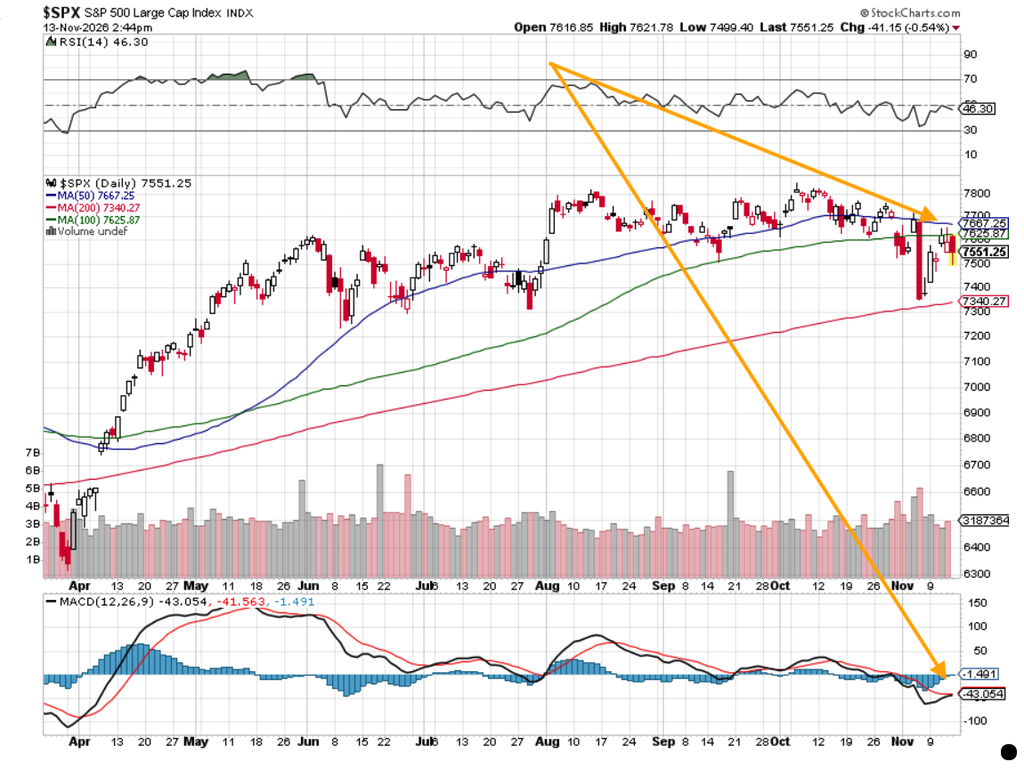
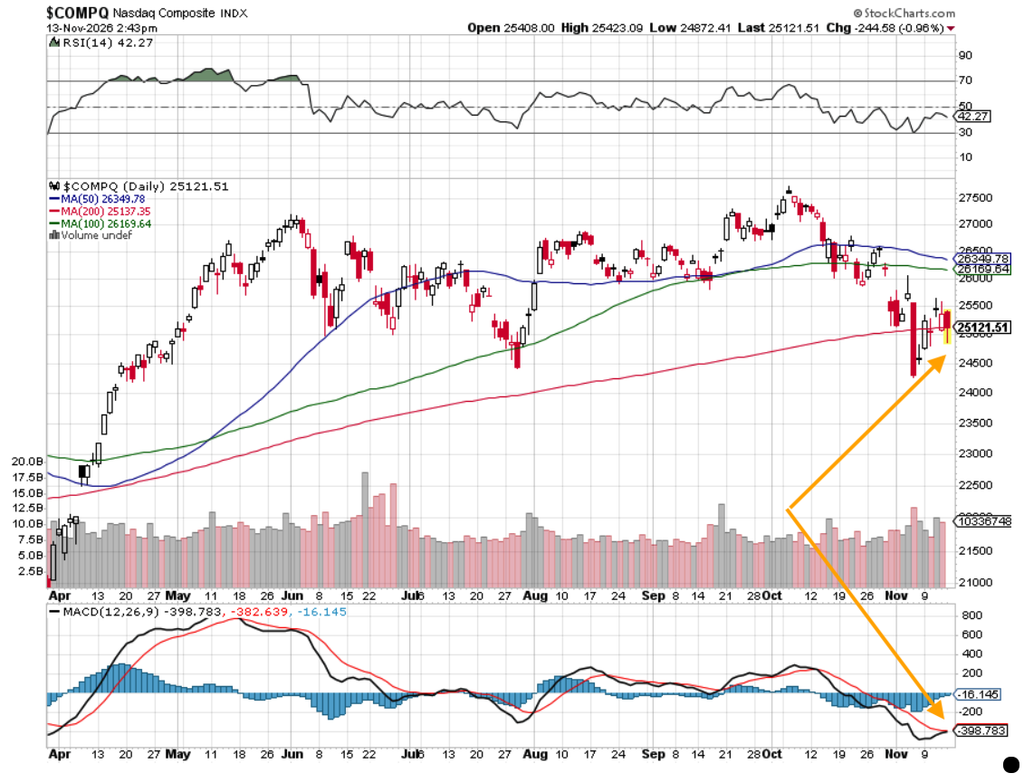
Despite all the volatility, in the chart above you’ll see the Nasdaq Composite held at its 200-day moving average, suggesting the market is finding its footing. Comments this week from Cisco, Cerebras, Nebius, CoreWeave and Foxconn keep the outlook for the Portfolio’s AI infrastructure holdings bright, and we’ll continue to leverage that volatility when and where we can.
Enjoy your weekend, Saturday’s signals alert, and we’ll see you back here, bright and early Monday.
Catching Up on the Portfolio This Week
While the market ended the week on a challenging note, the week-over-week rise in the major market averages helped the Portfolio rebound after last week’s drubbing. We didn’t regain all of that lost ground, but we made up a significant portion. And though it may not have felt like it, the Portfolio outperformed both the S&P 500 and the Nasdaq Composite this week.
We can attribute that outperformance to the moves in Broadcom (AVGO) and Arista Networks (ANET) as well as solid gains in Marvell (MRVL), Costco (COST), Palantir (PLTR), Applied Materials (AMAT) and Paccar (PCAR). Working against us was the double-digit decline in Nvidia (NVDA) stemming from the fallout from the Jensen Huang situation and his resignation. Shares of Microsoft (MSFT), TJX (TJX), Axon (AXON) and American Express (AXP) slipped modestly.
On Tuesday, after Boeing (BA) reported it delivered 49 aircraft in October, below the 53 it averaged in the third quarter and the 57 in the second quarter, we began unwinding our position, selling shares near $173 and downgrading the remaining shares to a Four rating. Lower delivery volumes mean less fixed-cost absorption, and Boeing’s plan to cut roughly 5% of its Commercial Airplanes workforce reaffirmed the extended turnaround timetable behind our earlier downgrade. On Wednesday, we sold our remaining shares near $174, closing out the position with a loss near 15%.
We put part of those proceeds to work Wednesday, adding to our positions in Applied Materials near $389, Axon near $314, Marvell near $166 and Nvidia near $173. We also initiated a position in SpaceX (SPCX), buying shares near $140, with a $200 price target, a One rating and an initial $120 checkpoint. Our SpaceX thesis centers on the coming revenue ramp in SpaceX’s Super Intelligence business, which includes Anthropic’s $120.5 billion of compute commitments with SpaceX through 2029. We’ll be watching upcoming lockup expirations, its push into wireless service and the question of a merger with Tesla (TSLA). With those moves, we reset our checkpoints to $350 for Applied Materials, $275 for Axon, $150 for Marvell and $155 for Nvidia.
On Thursday, we added to our robotics holding, buying shares of the ROBO Global Robotics & Automation ETF (ROBO) near $73 following several supportive data points. We set a new checkpoint of $60 and are reviewing our Two rating as ROBO constituents report in the coming weeks.
Applied Materials capped a record fiscal year, with October-quarter revenue up 53% to $10.41 billion and adjusted EPS up 92% to $4.16, both ahead of consensus. Even as Wall Street lifted its 2027 and 2028 EPS expectations, it applied more restrained valuation multiples, and we did the same, trimming our price target to $600.
Also this week, Costco declared a record $30-per-share special dividend, totaling about $13.3 billion and twice the size of its last special dividend in January 2024. It also approved a new $4 billion share repurchase authorization that runs through November 2030. Next week’s October Retail Sales and quarterly results from retailers will bring some context for Costco’s recent monthly sales figures. We continue to see it picking up share as consumers contend with persistent inflation pressures.
Closing out the week, which also happens to be the halfway mark for the current quarter, the Portfolio’s cash level was around 11%. On Wednesday, we flagged some companies at the top of our potential shopping list, and we’re continuing to watch them closely.
Now let’s see what others on Wall Street had to say about the Portfolio’s holdings during the week:
Tuesday: RBC Capital raised its Welltower (WELL) price target to $266 from $260, and JPMorgan raised its target to $273 from $260. Cantor Fitzgerald initiated coverage of TJX with a Neutral rating, while UBS lowered its TJX price target to $184 from $198. Evercore ISI cut its Eaton (ETN) price target to $445 from $515. Wells Fargo lowered its Nvidia price target to $300 from $315, and Citi lowered its target to $285 from $315.
Wednesday: Baird downgraded Nvidia to Neutral from Outperform, citing a potential slowdown and lack of visibility, and Morgan Stanley removed Nvidia as a Top Pick. Bernstein raised its Costco price target to $1,155 from $1,143, and Mizuho raised its target to $1,100 from $1,065. UBS lifted its Welltower price target to $289 from $269. JPMorgan resumed coverage of Eaton with a Neutral rating.
Thursday: Following Jensen Huang’s resignation, Nvidia was downgraded by Oppenheimer (to Perform), Bernstein, William Blair (to Market Perform), Evercore ISI (to In Line) and Truist (to Hold). Nvidia price targets were cut at Citi ($225 from $285), Stifel ($205 from $315), BofA ($280 from $350), JPMorgan ($215 from $320), Cantor Fitzgerald ($250 from $350), RBC Capital ($230 from $330), Yorkville Ives ($225 from $300), Goldman Sachs ($220 from $300) and DA Davidson ($200 from $300), while BMO Capital lowered its target to $240 and removed Nvidia as a Top Pick.
Friday: Wells Fargo said Huang’s resignation is a step closer to a clearing event for Nvidia shares. Following its quarterly report, Applied Materials saw price target cuts at Jefferies ($580 from $770), Evercore ISI ($430 from $590), JPMorgan ($500 from $660), BofA ($520 from $650), Needham ($470 from $580), Wells Fargo ($500 from $610), Bernstein ($600 from $700), Goldman Sachs ($580 from $670), Mizuho ($510 from $590), Stifel ($600 from $650), UBS ($640 from $695) and Morgan Stanley ($507 from $538), while B. Riley raised its target to $500 from $475. BofA raised its Costco price target to $1,257 from $1,095.
Key Global Economic Readings
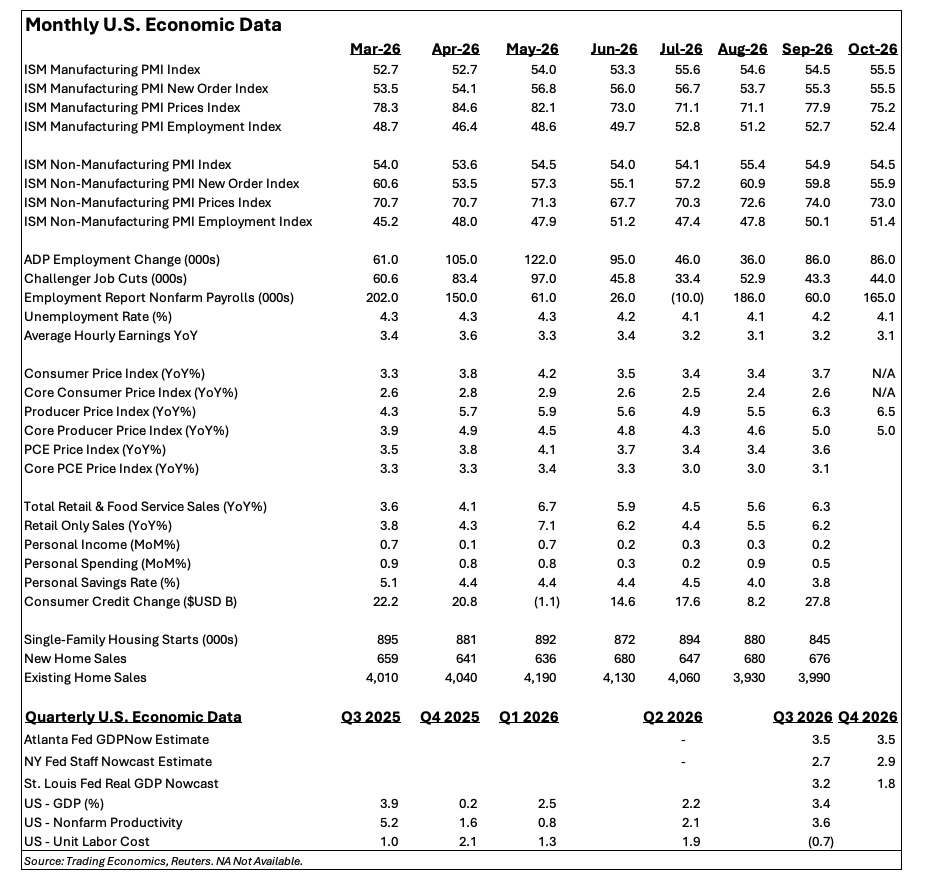
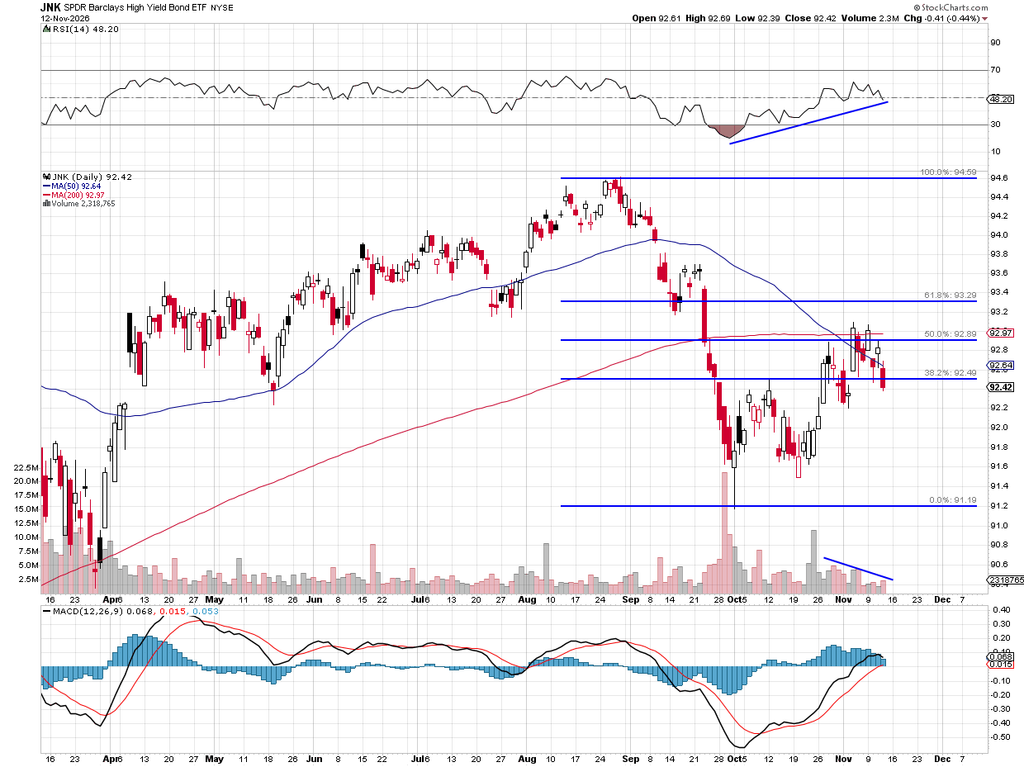
Chart of the Week: State Street SPDR Bloomberg High Yield Bond ETF (JNK)
With the recent wild movements in bond yields, I thought we might look again at the high-yield situation. These bonds are like a hybrid between equities and fixed income.
What does that mean?
Basically, high yield responds better to the stock market than Treasuries or even high-grade corporate bonds. High yield provides a better return but with far more risk. Not many fixed-income managers allocate too much to this asset class, but those with a risk appetite in the right environment are willing to do so.
Why is high yield so attractive these days? Well, we have an economy that is strong, earnings are robust and the risk of recession is extremely low. Now, those conditions can change, and when they do, so will the risk appetite for high yield. For now, though, it seems a safe bet that many companies that have issued high-yield debt are going to repay in full. If that is the case, the risk was worth taking.
Many high-yield instruments have a yield to maturity (YTM) of more than 11%, which more than doubles the return of the risk-free 10-year yield (about 5.1%). Lately, however, we have seen a bit of stress in this market due to some excess issuance and a bit of re-categorizing. What is that? Basically, if the risk is high that a company may not pay back its bonds and interest, the YTM rises as bondholders sell the bonds, prices go down and yields go up.
We can measure the performance of high yield using the iShares iBoxx $ High Yield Corporate Bond ETF (HYG) and the State Street SPDR Bloomberg High Yield Bond ETF (JNK), which share the same chart. The SPDR ETF shows a downtrend forming just below the key 50-day and 200-day moving averages. The recent reaction low in early October made way for a nice bounce, but that appears to be over.
Is the ETF telling us something about the economy down the road? Is it a predictor of recessions? Not necessarily. Weakness in junk debt is more a symptom of trouble brewing, and there are more variables in play to assess a recession on the horizon. But keep your eyes on this asset class; it can tell us plenty about conditions.
Other charts we shared with you this week were:
Monday, November 9: S&P 500: S&P 500 Is Nearly at a Corrective Phase
Monday, November 9: Can’t Be Too Disappointed With Welltower
Tuesday, November 10: Morgan Stanley Fights Its Way Back
Wednesday, November 11: Apple Just Keeps on Rolling
Thursday, November 12: This Bullpen Name Still Intrigues From the Sidelines
The Week Ahead
Next week we enter the back half of the fourth quarter, and normally that means before we know it the year-end holidays will be here and things will start to slow down. Did you notice I said “normally”? As you read the ensuing paragraphs, you’ll see that we’ll have a busy set of days and some key data points to chew through before Thanksgiving arrives.
In addition to several pieces of important economic data, including October Retail Sales and Housing Starts, next week brings the October 27-28 Fed meeting minutes. We’ll want to revisit this week’s October CPI and PPI data with the added context of those meeting minutes. We continue to think the final determinant of the size of a December rate hike will be the October PCE Price Index data that will be published right before the Thanksgiving holiday.
The Empire State, Philadelphia Fed and Kansas City Fed surveys and the final November University of Michigan reading round out the week. We’ll also keep watching oil prices and U.S.-Iran headlines given what they mean for inflation.
Kicking of things Monday, Fed Chair Kevin Warsh will take stock of the AI revolution in San Francisco, opening and closing a three-hour public forum on technology’s implications for the economy and the labor market. So far, that’s the only scheduled public event from the five task forces he set up this year. In addition to what is said about AI and job creation, we’ll be listening to see if Warsh drops any hints about monetary policy following this week’s inflation reports.
Here’s a closer look at the economic data coming at us next week:
U.S.
Monday, November 16
Empire State Manufacturing Survey (Nov) – 8:30 AM ET
Fed Chair Warsh hosts public forum on AI and the economy, San Francisco
Tuesday, November 17
ADP Employment Change Report (Weekly) – 8:15 AM ET
Retail Sales (Oct) – 8:30 AM ET
Import & Export Prices (Oct) – 8:30 AM ET
Industrial Production & Capacity Utilization (Oct) – 9:15 AM ET
Business Inventories (Sep) – 10:00 AM ET
NAHB Housing Market Index (Nov) – 10:00 AM ET
Wednesday, November 18
MBA Mortgage Applications (Weekly) – 7:00 AM ET
Housing Starts & Building Permits (Oct) – 8:30 AM ET
Pending Home Sales (Oct) – 10:00 AM ET
EIA Crude Oil Inventories (Weekly) – 10:30 AM ET
FOMC Meeting Minutes (Oct 27-28 meeting) – 2:00 PM ET
Thursday, November 19
Initial & Continuing Jobless Claims (Weekly) – 8:30 AM ET
Philadelphia Fed Manufacturing Survey (Nov) – 8:30 AM ET
Cleveland Fed President Hammack speaks – 8:50 AM ET
Conference Board Leading Economic Index (Oct) – 10:00 AM ET
Advance Quarterly Services Report (Q3) – 10:00 AM ET
EIA Natural Gas Inventories (Weekly) – 10:30 AM ET
Kansas City Fed Manufacturing Survey (Nov) – 11:00 AM ET
Friday, November 20
University of Michigan Consumer Sentiment – Final (Nov) – 10:00 AM ET
International
Monday, November 16
Japan: GDP – Preliminary (Q3)
Japan: Industrial Production – Final (Sep)
China: Industrial Production (Oct)
China: Retail Sales (Oct)
China: Fixed Asset Investment (Oct)
China: Unemployment Rate (Oct)
China: House Prices (Oct)
Eurozone: Industrial Production (Sep)
Tuesday, November 17
UK: Unemployment Rate & Average Earnings (Sep)
Germany: ZEW Economic Sentiment (Nov)
Eurozone: ZEW Economic Sentiment (Nov)
Wednesday, November 18
Japan: Trade Balance (Oct)
UK: CPI (Oct)
UK: PPI (Oct)
Eurozone: CPI – Final (Oct)
APEC Economic Leaders’ Meeting, Shenzhen (Nov 18-19)
Thursday, November 19
Japan: Machinery Orders (Sep)
Friday, November 20
Japan: CPI (Oct)
UK: GfK Consumer Confidence (Nov)
UK: Retail Sales (Oct)
Germany: PPI (Oct)
Eurozone: Consumer Confidence – Flash (Nov)
On the earnings front, Nvidia (NVDA) reports after the close Tuesday, its first report with CFO Colette Kress serving as interim CEO following Jensen Huang’s resignation. Consensus calls for EPS of $2.47 on revenue of $109 billion for the October quarter, per LSEG data, with $2.76 in EPS and $125 billion in revenue expected for the January quarter. Beyond the figures, margins and the degree to which Nvidia is sold out will be focal points. We’ll also be listening for what the company says about leadership and its CEO search as it looks to move on from its former CEO.
TJX Companies (TJX) also will be reporting alongside several other retail-facing companies, including Home Depot (HD), Lowe’s (LOW), Target (TGT) and Walmart (WMT). We will be parsing their comments about consumer psychographics, which will help set consumer spending expectations heading into the holidays.
Anthropic’s IPO, reportedly about six times oversubscribed, is expected to price Wednesday, November 18, against an initial range of $70-$78 per share, and begin trading on the Nasdaq on Thursday, November 19. We’ll be watching the final price and any upsizing as a potential catalyst for AI infrastructure stocks and the hyperscalers. As we discussed this week, the post-IPO performance will be important in determining what’s next with the IPO market.
We’ll also be monitoring the status of Marvell’s (MRVL) pending acquisition of Lumentum (LITE) and listening to Microsoft (MSFT) CEO Satya Nadella’s November 17 webcast for his take on this week’s outage and any incremental comments on AI and its adoption.
Here’s a closer look at the earnings reports coming at us next week:
Monday, November 16
Open: Aramark (ARMK), Baidu (BIDU), Tyson Foods (TSN)
Close: AECOM (ACM)
Tuesday, November 17
Open: Amer Sports (AS), Home Depot (HD), Klarna (KLAR), Walt Disney (DIS)
Close: Nvidia (NVDA)
Wednesday, November 18
Open: Lowe’s (LOW), Target (TGT), TJX Companies (TJX)
Close: Palo Alto Networks (PANW)
Thursday, November 19
Open: Alibaba (BABA), Bath & Body Works (BBWI), Construction Partners (ROAD), Walmart (WMT), Warner Music Group (WMG)
Close: Elastic (ESTC), Gap (GAP), Intuit (INTU), Keysight Technologies (KEYS), Post (POST), Ross Stores (ROST)
Portfolio Investor Resource Guide
Economic Data: Here’s a List of Links to the Key Economic Data We Closely Watch
Investing Terminology: 16 Key Terms Club Members Should Know
10-Ks: Want to Know About a Stock? Read the Company’s Reports
10-Qs: Unlock the Numbers and Key Information Behind Your Stock With the 10-Q
Income Statement: Our Cheat Sheet to Understanding This Financial Document
Balance Sheet, Cash Flow Statements, and Dividends: How to Know If a Company Is Off-Kilter? Read Its Balance Sheet
Valuation Metrics: Everyone Wants a Value. Here’s How Investors Can Find One
Thematic Investing 101 Webinar
Like the Benefits of ETFs? Let’s Talk About Models
The Portfolio Ratings System
1 – Buy Now (BN): Stocks that look compelling to buy right now.
2 – Stockpile (SP): Positions we would add to on pullbacks or a successful test of technical support levels.
3 – Holding Pattern (HP): Stocks we are holding as we wait for a fresh catalyst to make our next move.
4 – Sell (S): Positions we intend to exit.