Anthropic Pops, but the S&P 500 Drops
Subheader: The S&P 500 swung from a 1.3% gain to a 2% loss and closed at its lowest level since April even as Anthropic finished its debut 17% above its IPO price. The DJIA fell more than 1% for a fourth straight day for the first time since 2018. Executive Summary Anthropic’s record IPO got …
You've reached your free article limit
You've read 0 of 1 free Pro articles.
Subheader:
The S&P 500 swung from a 1.3% gain to a 2% loss and closed at its lowest level since April even as Anthropic finished its debut 17% above its IPO price. The DJIA fell more than 1% for a fourth straight day for the first time since 2018.
Executive Summary
Anthropic’s record IPO got off to a strong start, but it wasn’t the “clearing event” I was hoping for (at least for the bulls). The S&P 500 swung from a 1.3% gain to a 2% loss, for its first six-day losing streak since April 2024.
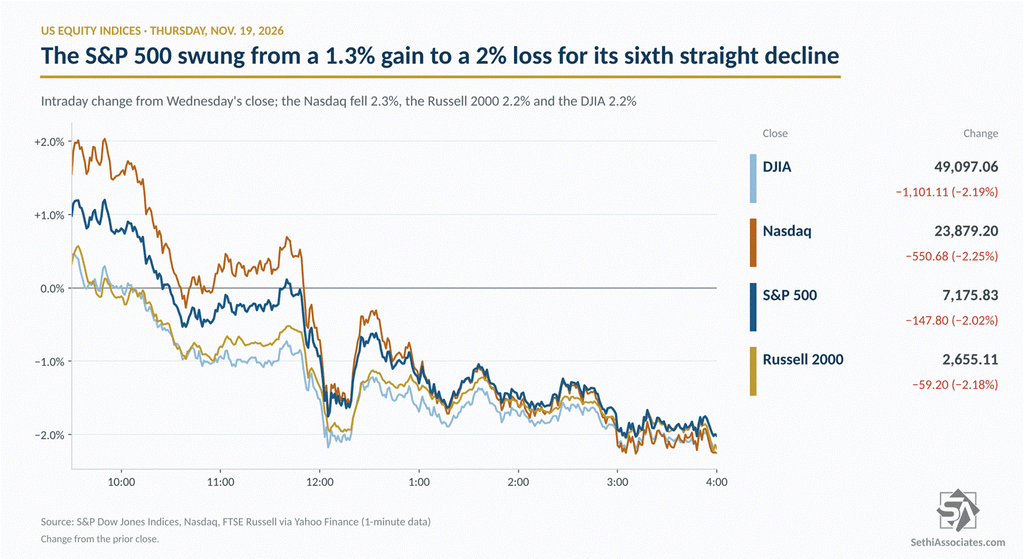
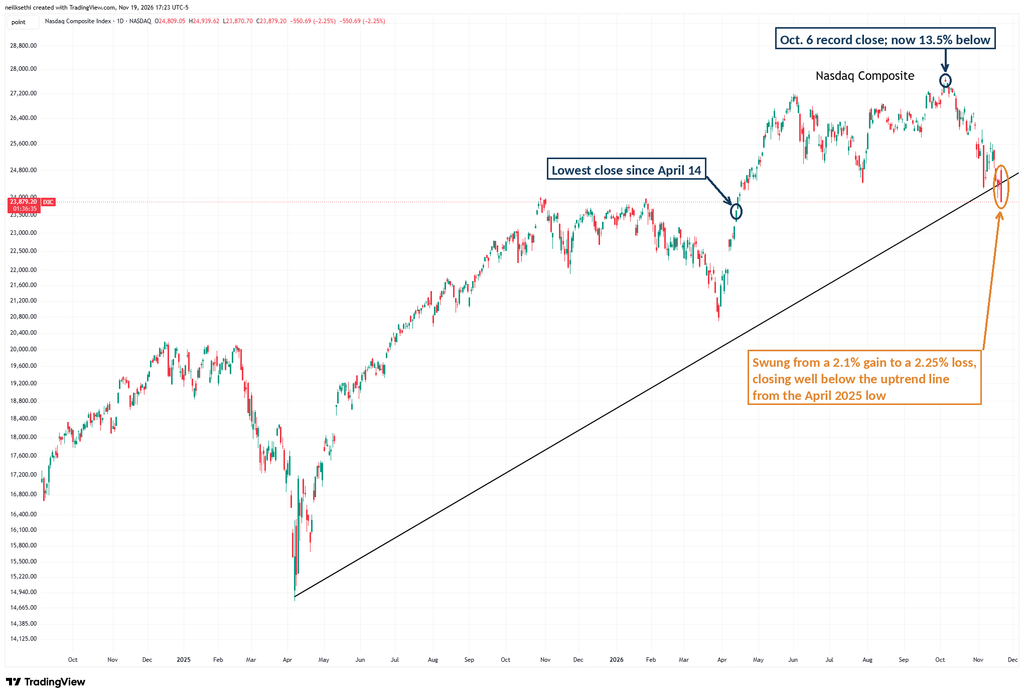
US equity indices opened higher, with the S&P 500 up as much as 1.3% and the Nasdaq 2.1%, lifted by the enthusiasm around Anthropic’s debut and Texas resuming its permit reviews for data center projects. The gains faded through the morning, with the S&P 500 back below its November 5th low (7,350) well before Anthropic began trading, and the selling picked up just before noon, around the time Anthropic’s shares opened. The S&P 500 finished near its low, down 2.0% at 7,176, its lowest close since April 29 and 2.4% below its November 5th close. It was the first time the index went from a gain of more than 1% to a loss of more than 2% since October 2022. The Nasdaq (-2.3%) had its biggest reversal since November 20, 2025, and its lowest close since April 14, while the Russell 2000 (-2.2%) closed at its low, its lowest close since April 10.
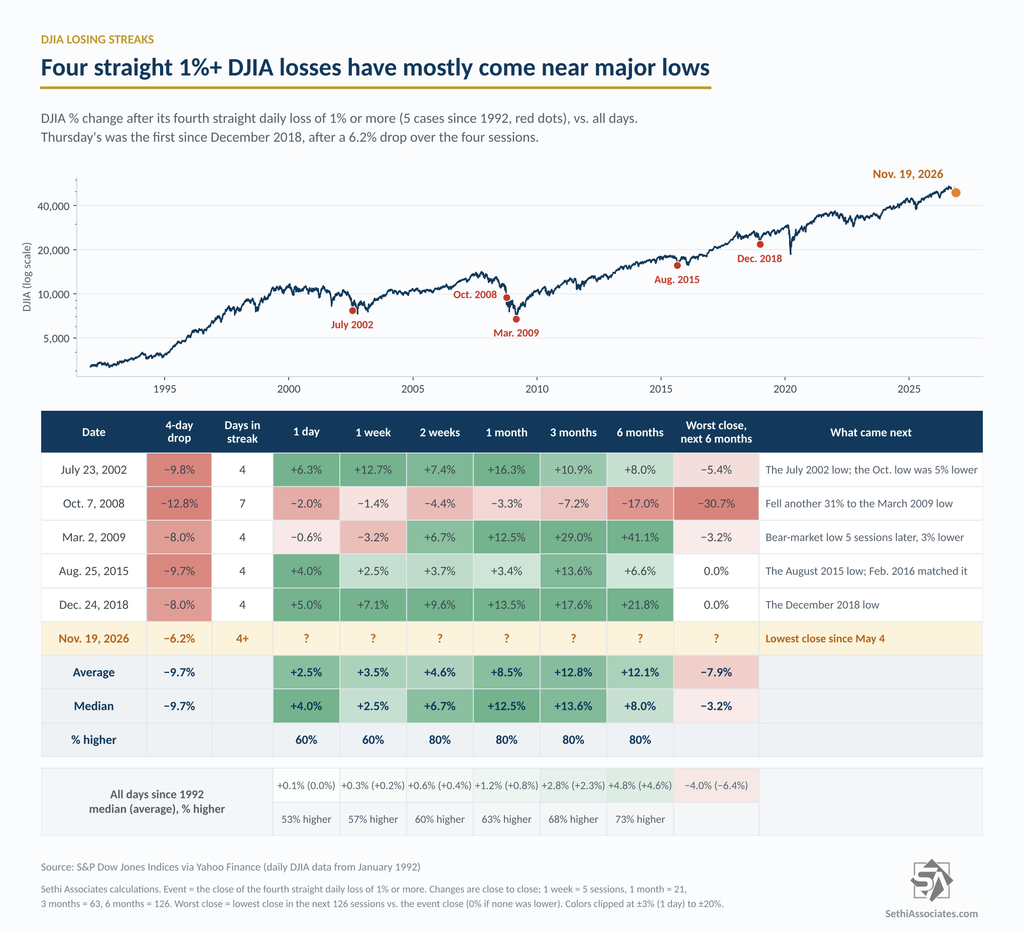
The Dow Jones Industrial Average (-2.2%) fell more than 1% for a fourth straight day for the first time since December 2018, its worst four-day drop since April 2025, leaving it at its lowest close since May 4. Note that four of the five prior times since 1992 that the DJIA fell 1% or more four days in a row came within days of a major low. The exception though was October 2008.
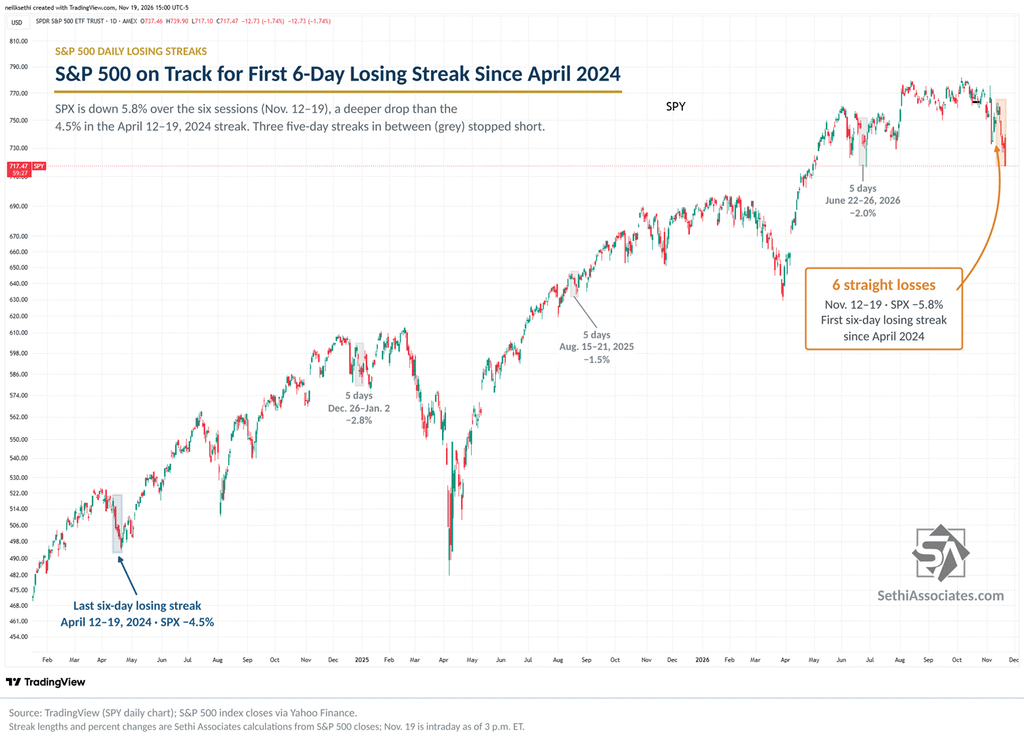
The S&P 500 is down 5.8% over the six sessions, its worst six-day stretch since April 2025 and worse than the 4.5% drop in the April 2024 streak, leaving it 8.2% below its October 6 record close and up just 4.8% for the year. The silver lining is that all four of the five- and six-day losing streaks since then (the April 2024 run and three five-day runs) bounced the next session, and the index was higher a month later each time, by 1.0% to 6.9%. The April 2024 streak ended right at that pullback’s low. But four cases is a tiny sample, and none of those streaks did this much damage.
Anthropic (ANT), which priced its IPO at $83 Wednesday night, above its $70 to $78 range, to raise $81 billion in the biggest IPO on record, opened at $111.50 at 11:48am ET, 34% above its offer price, and touched $115.10 before sliding as low as $92.72. It closed at $97.17, up 17% from the IPO price, on about 840 million shares, giving it a fully diluted market value of about $1.8 trillion and making it one of the 10 biggest public companies in the world by valuation, per Bloomberg. Rev Shark had said that where the stock closes is what he’d watch most: “If Anthropic doesn’t finish substantially over its IPO price, it will have a major impact on sentiment.” A 17% gain clears that bar, but its biggest shareholders sold off anyway, with Amazon (AMZN) down 3.9% and Alphabet (GOOGL) down 3.5% to its lowest close since October 2025, while Zoom (ZM), another investor, fell 9.6%. Doug Kass, who sold his allocation at $110 on the open, said the market “seems to be telling you they do not think Anthropic’s (ANT) stock price is going to be here when their big investors get unlocked” (The ANT Long Squeeze).
The weakness was broad across Tech. Nvidia (NVDA) fell 3.3% to $146 for a sixth straight loss, its lowest close since June 2025 and 39% below its October 6 record close, and AMD (AMD) dropped 7.7% after Hunterbrook Capital disclosed a short position, pointing to alleged US export control breaches involving China, which AMD denied. The Philadelphia Semiconductor Index (SOX) was up as much as 4.7% before closing down 2.4%, and the Nasdaq is now 13.5% below its October 6 record close.
Also weighing on sentiment, JPMorgan Chase (JPM), Visa (V) and Mastercard (MA) said some customer information was accessed in a cyberattack on a vendor, the latest in a string of digital issues that have raised fears about the safety of the technology behind some big companies. They fell 1.2%, 3.1% and 2.6% respectively.
The VIX jumped 15.8% to 28.4, its highest close since March 30. Treasury yields slipped, with the 2-year down 4 basis points to 4.77% and the 10-year down 2 basis points to 5.05%.
The dollar edged up 0.1% to another highest close since early April 2025. WTI crude rose about 1% to roughly $84 even after President Trump, Xi Jinping and Vladimir Putin agreed at APEC to increase the production and supply of petroleum, as renewed attacks on shipping in the Strait of Hormuz and an Axios report that Trump is still considering a joint strike on Iran with Israel kept a bid under prices. Gold fell 2.2% to about $3,660, its lowest close since early September 2025, and copper slipped 1% to another lowest settle since April. Bitcoin futures fell 0.9% to about 61,950, and natural gas dropped 3.9% to $3.24 (commodity prices are from the cash sessions).
In economic data, initial jobless claims edged up 1,000 to 203,000, the highest since September 5, while continuing claims jumped 70,000 to 1.763 million, the biggest increase since January 2024 and the highest since August 29, though Goldman attributes most of the jump to Michigan.
In earnings, Walmart (WMT) recovered most of an early 3% drop to close down 1% after raising its full-year sales and earnings forecasts. Chris Versace highlighted the faster comp growth at Sam’s Club (4.9% vs. 2.9% at Walmart US) and 20% growth in membership income. After the close, Intuit (INTU) fell about 10% and Ross Stores (ROST) about 5% following their reports.
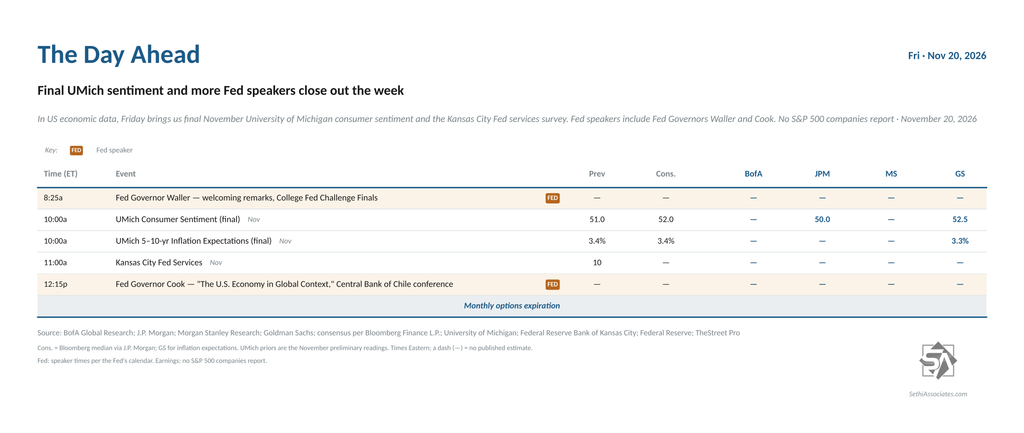
Friday brings final November University of Michigan consumer sentiment, Fed Governors Waller and Cook, and monthly options expiration.
My look at today’s charts follows in a separate post later this evening.
Market Commentary
Equities:
- “Not just the very successful IPO of Anthropic but the news too that the Texas Department of Environmental Quality ‘has gathered information for the community impact review for pending data center projects. The agency has resumed its normal permit review process and will evaluate applications under all applicable state and federal laws and regulations’ has the futures rallying sharply this morning,” wrote Peter Boockvar, chief investment officer at One Point BFG Wealth Partners.
- “That’s a big technical signal,” Thomas Martin, a partner and senior portfolio manager at Globalt Investments. “[The S&P 500] has been above its 200-day moving average for a long time. And, if you’re a trend follower, you say, ‘okay, well, maybe if it breaks through, you have room to the downside.'”
Anthropic:
- “It’ll be an important barometer for investors’ AI appetite,” Callie Cox, director of investment strategy at Plancorp, said of Anthropic’s IPO. “AI stocks desperately need some wind at their backs, too … Wall Street needs a sign that investors still believe in the potential for AI beyond already-elevated expectations.” “The challenge in that thesis is that hot IPOs rarely perform well right out of the gate, especially these days, when every company seems to be vying for a limited pool of capital to fund their AI strategy,” she said. “While I wouldn’t be surprised to see the stock market take cues from Anthropic’s performance, I’d caution investors about trying to read the tea leaves from one event too much.”
- “What is interesting about the IPO of Anthropic today is that it highlights the importance of AI. The growth rate is staggering. We’ve never seen so much value creation in such a short timeframe,” said Jonathan Cohen, chief investment officer and founder of Robocap.
- “The Anthropic IPO doesn’t change my mind. I feel very comfortable being a contrarian. We think the AI bubble is about to burst,” said Joachim Klement, investment strategist at Panmure Liberum.
- “Question marks are still alive regarding the monetization of it; the capacity of players like Anthropic, but also others, to monetize their huge investments,” said Amundi Chief Investment Officer Vincent Mortier. “That’s why we believe it’s a bit excessive, even though this company in particular is, of course, of very good quality.”
- For Alexandre Drabowicz at Indosuez Wealth Management, Anthropic’s IPO should help the AI trade to rally into year-end. “The huge demand for the IPO just shows how much liquidity is available,” he said. “If there were any doubts about the future of AI, there clearly aren’t many now.”
- “This was always going to be a critical test for the tech sector. Anthropic could be the new poster child for AI trade, especially after Nvidia headlines,” said Aleks Spencer, Bogart Wealth CIO. “There’s a lot here too that needs to be processed and digested, which translates to this period of uncertainty and volatility.” “The enthusiasm comes in, and it’s a great moment to sell the rally and take some profits,” Spencer added.
- “The Anthropic IPO has been a major success,” said Matt Maley at Miller Tabak. “However, the IPO does little to address the market’s bigger problems including AI profitability concerns, massive spending, higher interest rates, credit market stress and geopolitical risks.”
- “Today doesn’t matter,” said Baird tech strategist Ted Mortonson, who likened the day’s action in Anthropic to a casino. “It’s a blink of an eye of their journey. It’s an important event, but how they navigate the next three years that will determine valuation.”
- “I think it’s going to be a very unique stock in the marketplace, at least until OpenAI comes public. For that reason, I could see it getting a bit of a scarcity premium,” said John Belton, portfolio manager and managing director for growth portfolios at Gabelli Funds.
- Anthropic’s IPO is a huge win for the AI trade because it proves investors aren’t running away, which was one of the fears driving the spending slowdown thesis, according to Luke Lango, editor of the Innovation Investor newsletter. “But don’t mistake one blockbuster deal for an all-clear signal,” he said. “Wall Street writing a check to the world’s leading frontier lab, a company with explosive revenue growth and customers lining up for more, is very different from Wall Street writing checks to debt-heavy neoclouds and the riskier corners of the AI stack.” The first is a bet on the winner, Lango said, while the second is a bet on the buildout, and that’s where money has gotten a lot pickier.
- “Its next test will be turning the rapid enterprise adoption of Claude into sustained operating profits,” said Antonio Di Giacomo at XS.com. “Anthropic will need to show that it can expand the use of its models while containing the cost of meeting that demand.”
- “It has failed to rekindle enthusiasm for tech stocks,” said Joe Maher, market economist at Capital Economics, who cautioned against reading too much into the initial pop in Anthropic’s share price.
- “It’s difficult to draw conclusions from the first day of trading,” said Andre Bakhos, managing member at Ingenium Analytics.
- “We’ve been calm about it.… Our picture of it is: We think we’re building something great, and so the day-to-day, week-to-week, even month to month, it’s less important,” Anthropic CEO Dario Amodei said on Thursday morning.
- “I actually do know a lot of the people at Anthropic from my OpenAI days, and no one I met at Anthropic set off my evil detector, for what it’s worth,” SpaceX and Tesla CEO Elon Musk said at the New York Times’ DealBook Summit on Wednesday.
Stock and Sector Breakdown
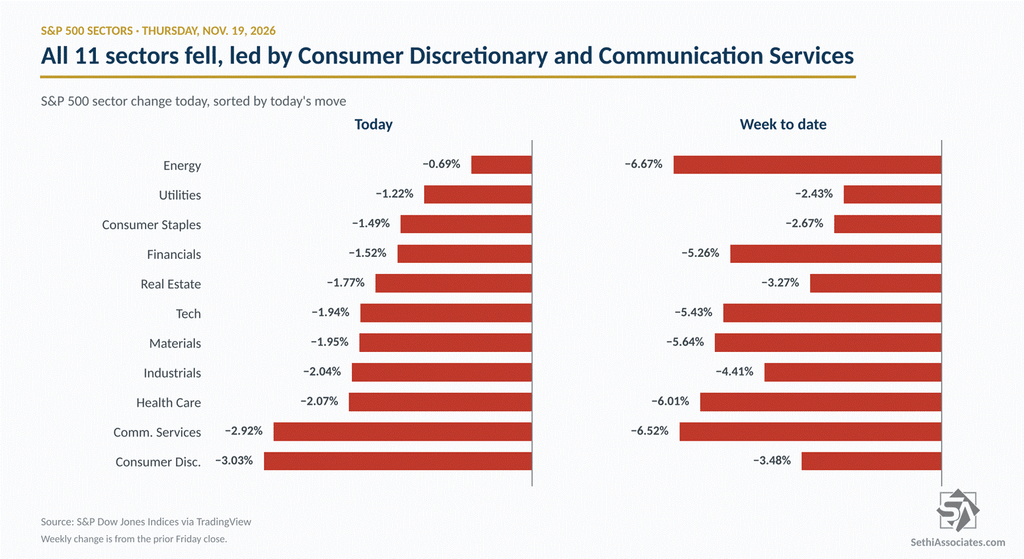
All 11 sectors fell for the second time in three days. Consumer Discretionary (-3.0%) led the way down on Amazon and Williams-Sonoma, followed by Communication Services (-2.9%), which had led the market for much of the morning before Alphabet reversed an early gain of about 4%. Health Care (-2.1%) and Industrials (-2.0%) were next, while Tech (-1.9%) gave up an early gain of nearly 3%.
Energy (-0.7%) held up best as oil edged higher, followed by Utilities (-1.2%) and Consumer Staples (-1.5%). Week to date, Energy (-6.7%) is still the worst, just ahead of Communication Services (-6.5%) and Health Care (-6.0%), while Utilities (-2.4%) and Consumer Staples (-2.7%) have held up best.
Just 38 S&P 500 stocks rose and 464 fell. Four rose more than 3% and 81 fell more than 3%. Decliners outnumbered advancers by more than 5-to-1 on the NYSE and more than 3-to-1 on the Nasdaq.
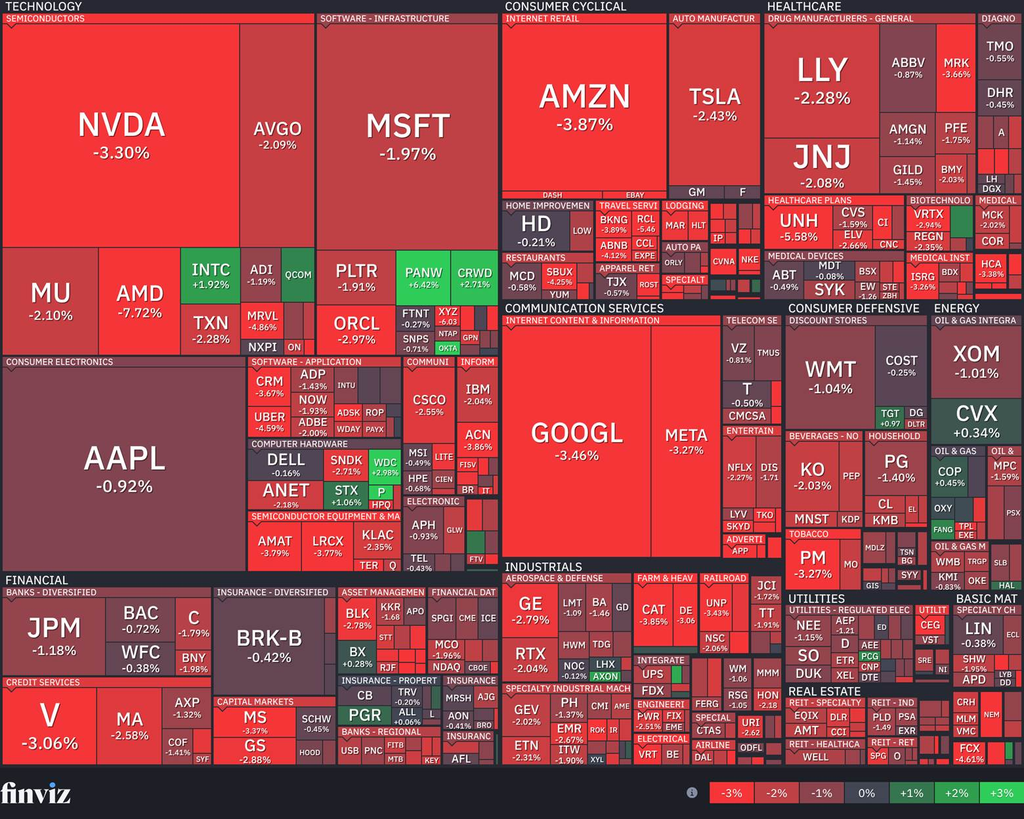
Palo Alto Networks (PANW) led the S&P 500, up 6.4%, after its fiscal first-quarter revenue grew nearly 40% to $3.45 billion, it materially raised its full-year guidance and it agreed to buy AI model platform Applied Compute in an all-stock deal valued at $4.5 billion. Steve “Sarge” Guilfoyle called it a fantastic quarter as cybersecurity surges. Okta (OKTA) (+5.8%) and CrowdStrike (CRWD) (+2.7%) rose with it, and Everpure (P) gained 5.1% after its own results. Memory and storage names also held up comparatively well, with Western Digital (WDC) up 3.0% and Seagate (STX) 1.1%.
Elsewhere in AI, CoreWeave (CRWV) fell 6.1%, Cerebras Systems (CBRS) 7.6%, Vertiv (VRT) 5.0%, Marvell (MRVL) 4.4% and Oracle (ORCL) 3.1%. Among the megacaps, Meta (META) fell 3.1% for a fourth straight loss, Tesla (TSLA) 2.4%, Broadcom (AVGO) 2.1%, Microsoft (MSFT) 1.9% and Apple (AAPL) 1.0%.
Payments names were also hit, with Fiserv (FISV) down 6.3%, Block (XYZ) 6.0% and PayPal (PYPL) 2.6% along with Visa and Mastercard, while Twilio (TWLO) dropped 8.6%. Sarge asked why SoFi keeps falling after seven straight declines through Wednesday. Health care names were weak again, with UnitedHealth (UNH) down 5.4% to its lowest close since April and Universal Health Services (UHS) and Zoetis (ZTS) both down more than 5%. Cruise lines Royal Caribbean (RCL), Carnival (CCL) and Norwegian (NCLH) fell about 5%, and Take-Two Interactive (TTWO) slipped 3.8% on Grand Theft Auto VI’s launch day after running well ahead of its usual pre-launch pattern.
Williams-Sonoma (WSM) was the S&P 500’s worst performer, down 15%, after its fiscal third-quarter earnings came in a penny ahead of estimates and revenue just shy of them. It only reaffirmed its full-year guidance, flagged up to $60 million of extra diesel costs this year and warned that further oil increases or heavier holiday expediting could push results off its outlook.
Chris Versace looked at the implications of Anthropic’s debut for four Portfolio holdings, including Amazon and Alphabet, and added to two names and started a new one, while Bob Lang is looking for a bounce in that new name, International Flavors & Fragrances (IFF), near its 200-day moving average around $80.
On Anthropic, Rev Shark asked where the money comes from, since a deal this size has to pull capital from other AI names, Sarge said the deal would mint a new trillion-dollar company, and Bob Byrne noted Stan Druckenmiller says he has the least clarity on markets in 50 years, is neither long nor short and won’t short AI, in a column on what Anthropic’s $81 billion raise means. Ed Ponsi looked at what we can learn from the Situational Awareness blowup, Leopold Aschenbrenner’s hedge fund that went from 62% short via puts in Q1 to 90% long and heavily concentrated by the end of Q2.
Helene Meisler said midday that “That Felt Panicky,” as down volume reached 86% (she’d love 90%) and NAAIM’s exposure index fell to 52, though fewer stocks were making new lows. In her morning column she said that while narratives are nice, extreme sentiment is investable, and a few more days of selling could get some of her indicators to the kind of extremes she likes.
Kass sold his index trading longs before 4am on the overnight rally, then shorted and covered SPY and QQQ and sold his Anthropic allocation at $110 on the open. As the market slid, he began buying on a scale at -95 handles in the S&P 500 (Citigroup, Bank of America, Morgan Stanley, Microsoft, Meta and Alphabet), took a trading long in the indexes at -108, moved to medium-sized positions in Meta, Alphabet and Microsoft, added to his index longs and, at -135 handles, added across the board to financials and tech.
FedWatch
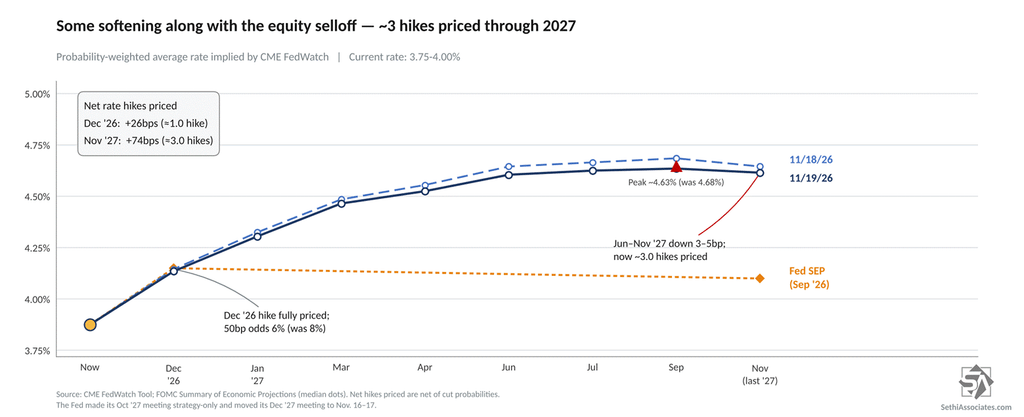
Fed rate hike expectations softened along with the equity selloff. A December hike remains fully priced, with the chance of 50 basis points slipping to 6% from 8%, while 74 basis points of hikes are priced through the Fed’s final 2027 meeting in November, about three hikes, down from 77bp Wednesday, per CME FedWatch.
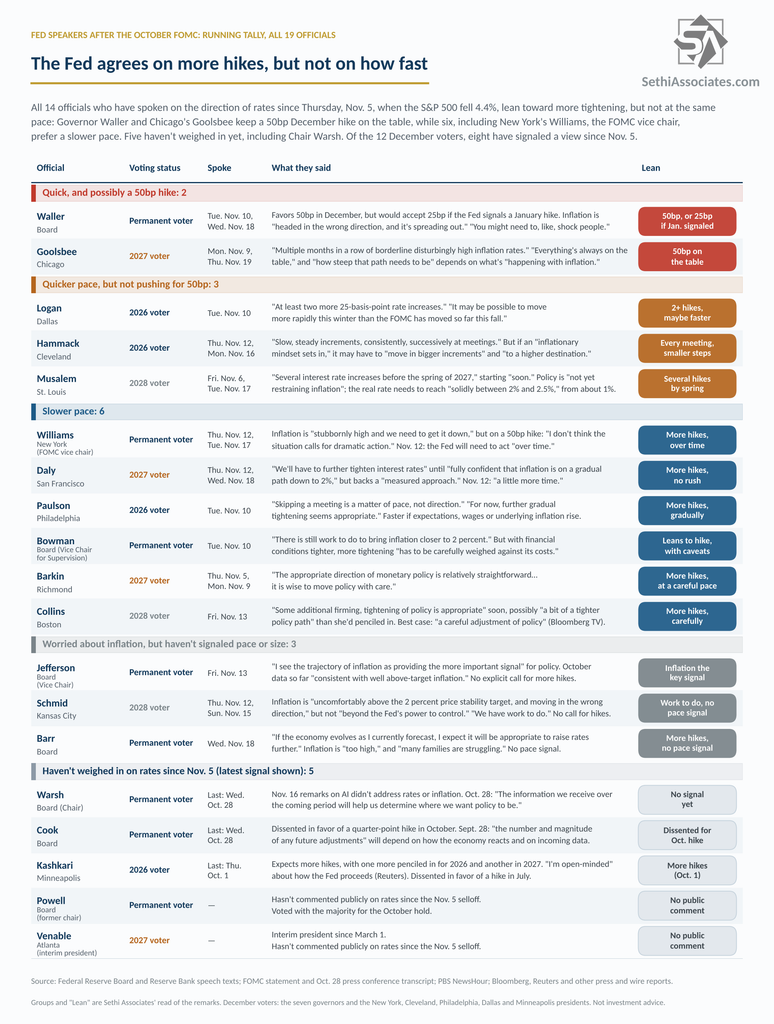
Chicago Fed President Austan Goolsbee, who becomes a voter in January, on Thursday joined Governor Christopher Waller in keeping a 50bp December hike on the table. “We’ve now had multiple months in a row of borderline disturbingly high inflation rates with little progress in the sectors where we would expect to be seeing some progress,” he told reporters, according to Bloomberg. “So everything’s always on the table, in my view, and how steep that path needs to be is determined by what we think is happening with inflation.”
He also flagged seasonality: the hot readings came at a time of year when prices usually cool, and price pressures have tended to be stronger early in the year, which raises the question of whether “the through line is going to be another jump back up in the inflation rate” in 2027. He called the AI infrastructure buildout a “second component, which to me looks like the beginnings of just ordinary demand overheating.”
Goolsbee doesn’t vote in December, but Waller isn’t alone inside the room: the October minutes, released Wednesday, showed another unnamed official also wanted to at least discuss a larger increase, perhaps Goolsbee. Even so, fed funds futures put the odds of a 50bp December hike at only about 6% as noted above.
More From TheStreet Pro
Chris Versace —
- After Another Frustrating Reversal, Let’s Recall a Different Buffett Quote
- JP Morgan Sends Apple Update Ahead of iPhone Upgrade Cycle
James “Rev Shark” DePorre – Anthropic IPO Was a Success and a Nasty Trap for the Rest of the Market
Jason Meshnick — ANT IPO & AI Trade Coverage Video Stream
Doug Kass’s Diary:
- ANT IPO Priced at $83
- From The Goat
- Howling About Auto Debt
- Shades of Enron?
- Neocloud Chatter
- Tech, Financials, Energy vs. Consumer Staples
- Midday Market Stats
Note: Doug posted 31 Diary entries today; these are the market ones not linked above. You can see all of them here.
And From Me If You Missed It
- High-Profile IPOs Have Usually Lagged in Their First Year, but Note the Exceptions
- Caution Sign From the Banks
Miscellaneous
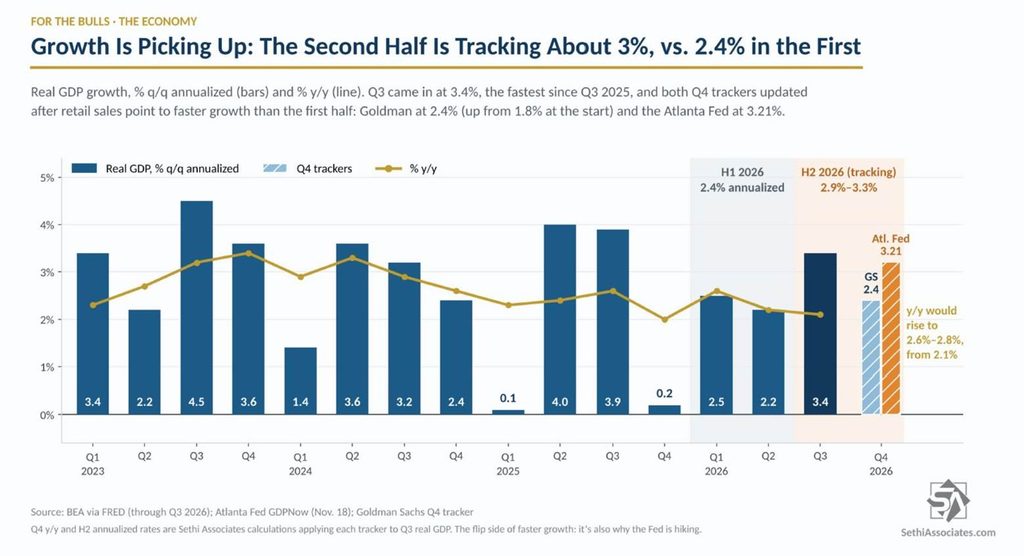
Economic growth is picking up, not slowing. Q3 real GDP grew 3.4%, the fastest since Q3 2025, and both Q4 trackers updated after retail sales point higher than the first half (Goldman at 2.4% and the Atlanta Fed at 3.21%). That would put second-half growth at a 2.9% to 3.3% annualized rate versus 2.4% in the first half, and lift year-over-year growth to 2.6% to 2.8% from 2.1%. The flip side is that it’s also why the Fed is hiking.
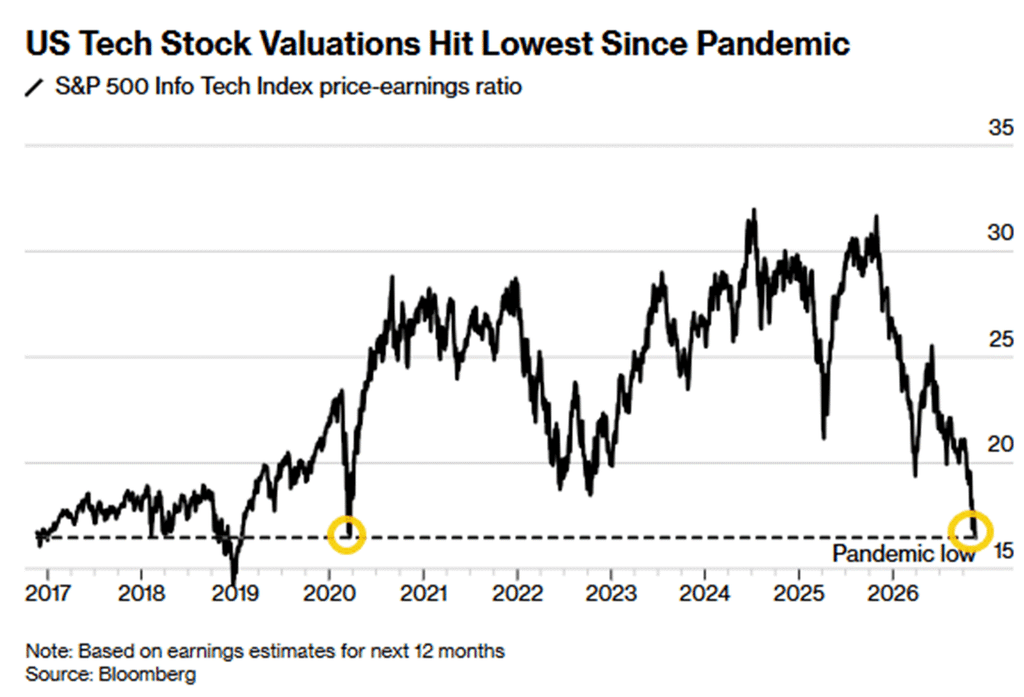
The S&P 500 Tech sector’s forward P/E, which I noted in the Week Ahead had bounced to 18.0 from 17.3 (the lowest since March 2020, per FactSet), is now back at its pandemic low, per Bloomberg.
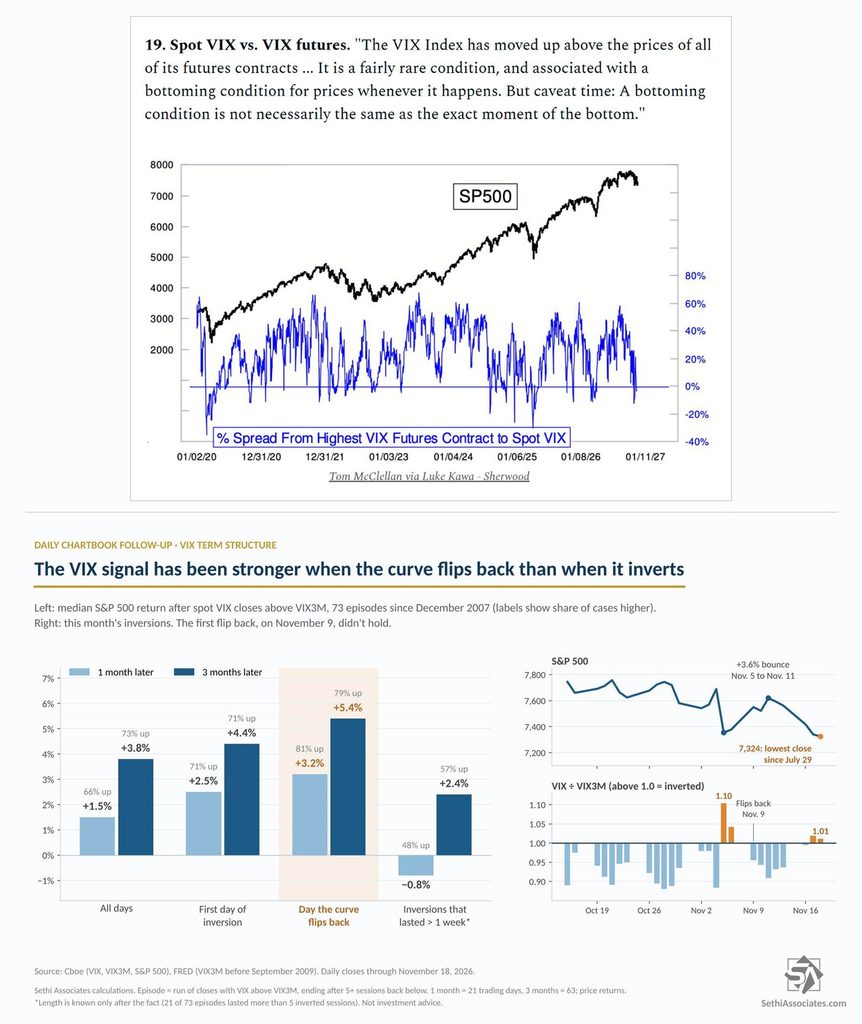
The Daily Chartbook’s nightly email noted Tom McClellan’s observation that spot VIX had moved above all of its futures contracts, a “fairly rare condition” tied to “a bottoming condition for prices,” though not necessarily “the exact moment of the bottom.” Cboe data back to late 2007 show spot VIX closing above 3-month VIX (VIX3M) on about 10% of trading days, in 75 separate episodes. Median S&P 500 returns (share of cases higher in parentheses) one and three months later have been:
▪ All days: +1.5% (66%) and +3.8% (73%).
▪ First day of inversion: +2.5% (71%) and +4.4% (71%).
▪ Day the curve flips back: +3.2% (81%) and +5.4% (79%).
The catch is that the 21 episodes that lasted more than a week (2008, 2011, late 2018 and 2020 among them) saw a median -0.8% the next month, with only 48% higher, and you only know how long one lasts after the fact. The current inversion was only two days old and shallow at Wednesday’s close (a VIX/VIX3M ratio of 1.01), but it deepened Thursday, with the VIX closing at 28.9 against 27.4 for VIX3M, a ratio of 1.06. Nomura’s Charlie McElligott adds that aggregate S&P dealer gamma has fallen to -$7.3 billion, the deepest on Nomura’s chart going back to 2019, meaning “dealers are now selling into every dip and buying into every rip,” so a single flip back is a weak all-clear.
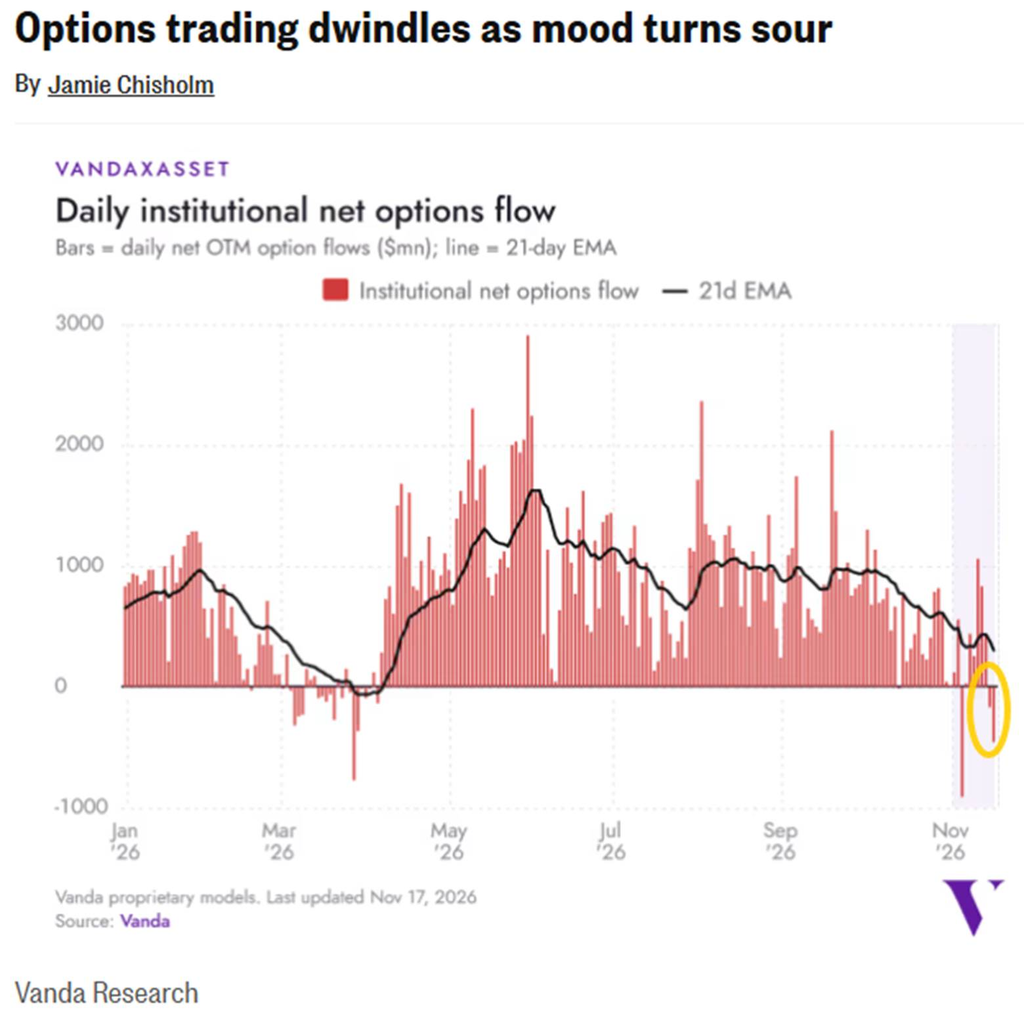
Big investors have been pulling back from options bets. Vanda Research’s analysis of daily net option flows among institutional investors (via MarketWatch) shows a decline since the summer that turned negative on November 16 and 17, the first back-to-back daily decrease since April. “The lack of exuberance outside retail may simply be investors waiting for Anthropic to list — or it could be a sting in the tail for tomorrow [Thursday]. We will be watching closely,” Vanda said.
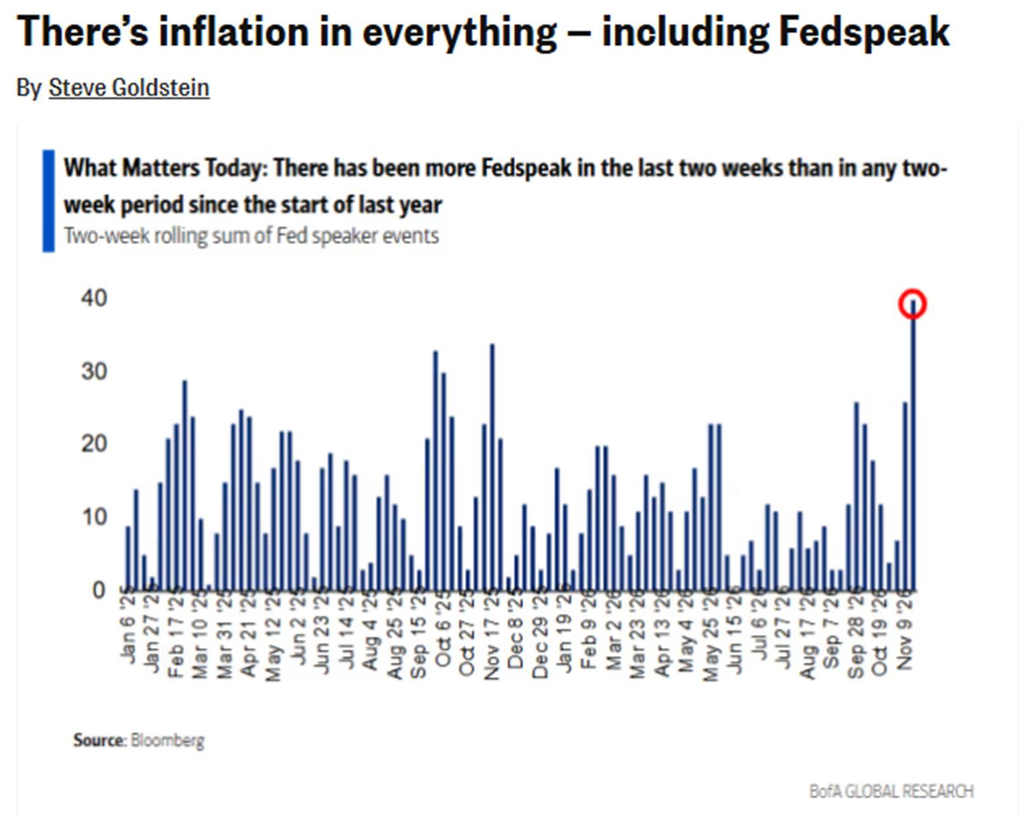
MarketWatch noted today inflation isn’t limited to prices; it’s also showing up in the frequency of Fedspeak. BofA says there’s been more Fed commentary in the last two weeks than in any two-week period since the start of the year. “Typically, the chair would weigh in, indicating to markets whether the hawks or doves are in ascendence. Absent this leadership, however, both sides might feel incentivized to speak more often and more forcefully,” said BofA’s Bhave, adding that the back-and-forth is causing undue rate volatility in already turbulent times.
Wrap-Up — Anthropic Wasn’t the Clearing Event
The selloff continued Thursday, and I don’t like the way it played out. The S&P 500 opened above its November 5th low (7,350), clearing that resistance noted yesterday, and pushed as high as 7,416. But that early push was sold, and the index ran to new lows, closing near the lows of the day at its lowest level since April 29. That is not a good setup for Friday.
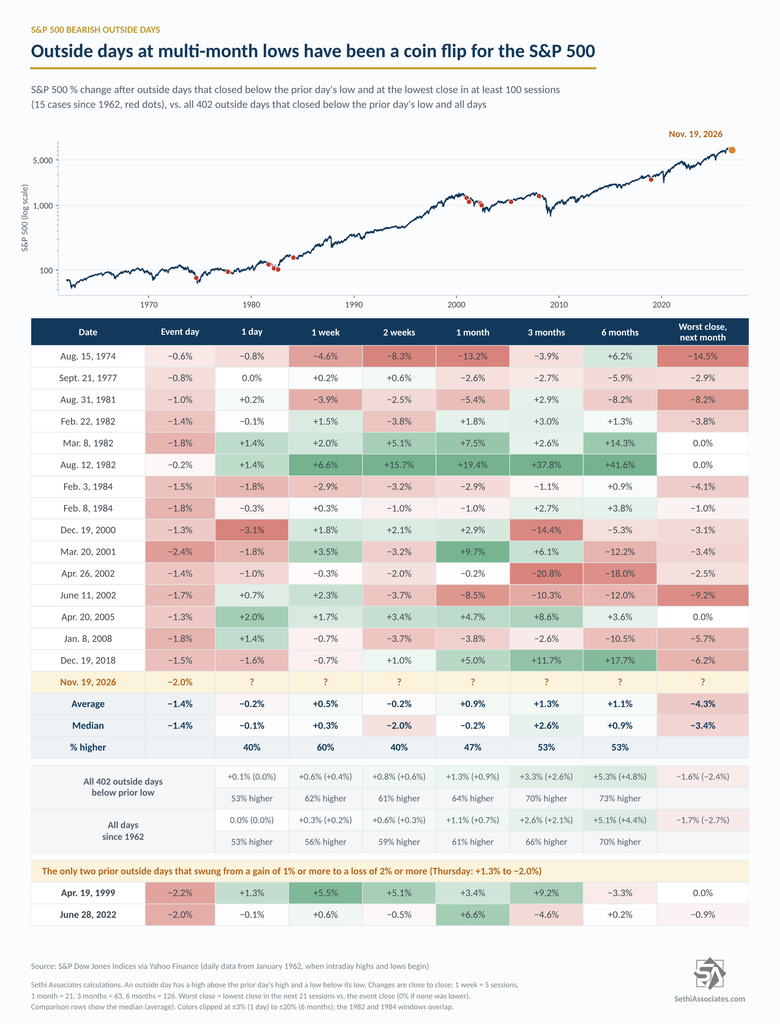
That also made Thursday an outside day, with a high above Wednesday’s high and a low below Wednesday’s low, and a bearish one, closing below Wednesday’s low. On their own, those haven’t been much of a warning. Since 1962, the S&P 500 has had 402 outside days that closed below the prior day’s low, and it was higher a month later 64% of the time, with a median gain of 1.3%, slightly better than the 61% and 1.1% for all days.
Context matters, though. The 15 that also produced the lowest close in at least 100 sessions (Thursday’s was the lowest in 142) were a coin flip a month later, higher just 47% of the time with a median loss of 0.2%. That group includes the 2000–2002 and 2008 bear markets, but also December 19, 2018, three sessions before that selloff’s low, and August 12, 1982, the final low of that bear market. And such an outside day that went from a gain of 1% or more to a loss of 2% or more has happened just twice before since 1962 (April 19, 1999, and June 28, 2022), with the index higher a month later both times (+3.4% and +6.6%).
And Anthropic clearly wasn’t the clearing event I thought it might be (except I guess to put on bearish positions). I said Monday that it might take getting past the IPO before we could put a rally back on the table, and despite the deal itself going well, with the stock closing 17% above its offering price, the market sold right into it, starting with Anthropic’s biggest shareholders, Amazon and Alphabet.
Sentiment isn’t washed out either. AAII bears fell to 42.2% from 51.4% even as the S&P 500 slid 3.5% over the survey week, a surprising sign that retail clearly isn’t panicking, though active managers are pulling back, with NAAIM’s exposure index down to 52 from 72.9 (I’ll an SMT tomorrow on this).
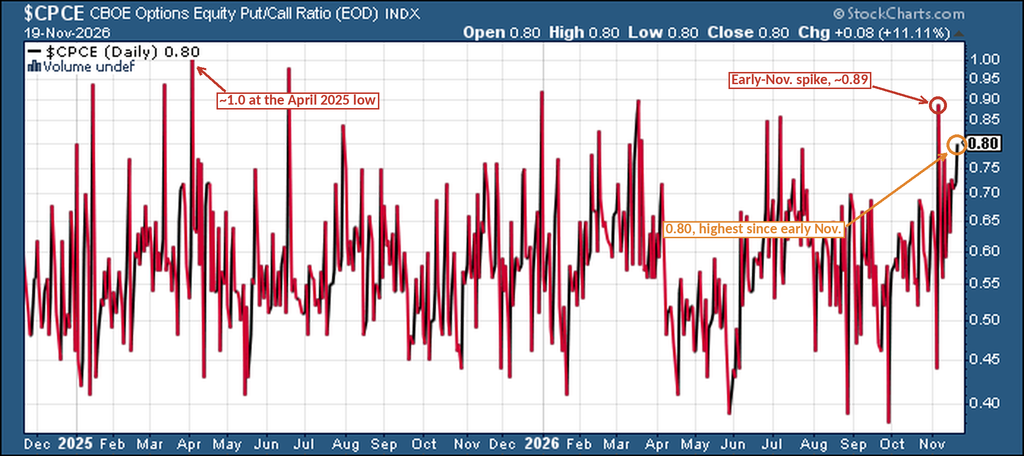
The “good” news is that as the day progressed, we seemed to get a bit more of the panic you’d like to see. NYSE downside volume reached 87.1%, just short of a 90% downside day, and the VIX jumped back toward 30, closing at 28.9, its highest since March 30, with spot VIX further above 3-month VIX (see Miscellaneous). The CBOE equity put/call ratio also rose to 0.80 from 0.72, its highest since early November, but that’s not as high as I would have liked, still short of the roughly 0.89 spike earlier this month and the roughly 1.0 reading at the April 2025 low.
The seasonals also line up with a rebound. Jeff Hirsch (Almanac Trader) has Thursday (day 14) as the low point of November’s mid-month dip, with Friday’s options expiration usually bringing a small bounce and the indices historically rallying from there through Thanksgiving week. Of course seasonality is just a lesson in what markets have done in the past, and we haven’t been following the seasonal playbook much this year to date.
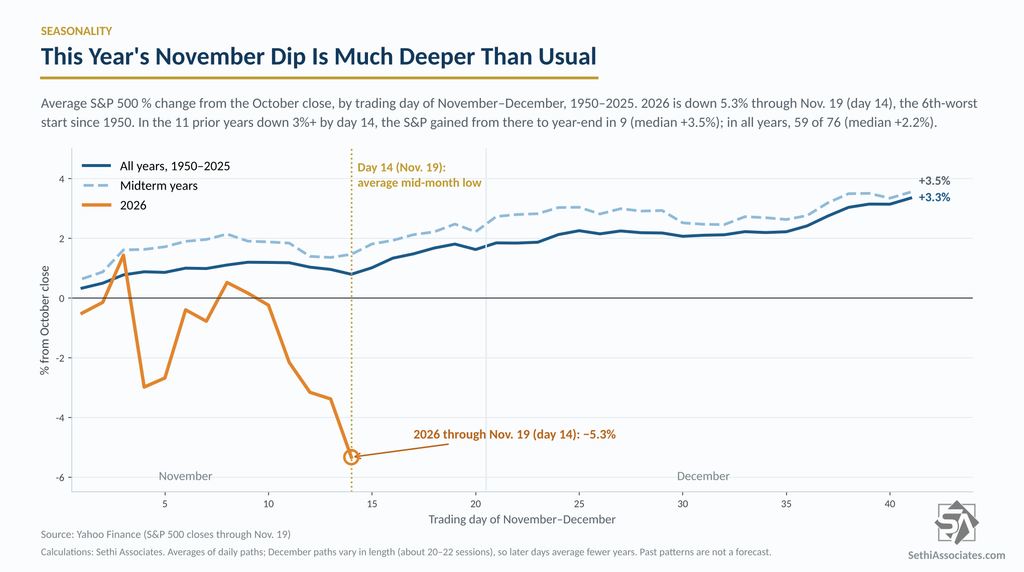
On the other side, the NYSE Composite closed 1.4% below its September 30th low, its lowest close since June 10, the confirmation I’d flagged from the McClellan Summation Index (more in tonight’s charts post), and in the Week Ahead I said I was getting increasingly more bullish “as long as we hold the November 5th lows,” which we now haven’t for three straight days (The Week Ahead – Have We Seen the Q4 Bottom?). Until the S&P 500 can get back above that level and hold it, the burden of proof is on the bulls.
As always, let’s see what we get and go from there.
The Day Ahead — Michigan Sentiment, Waller and Cook, and Opex
In US economic data, Friday is another light day with just final November University of Michigan consumer sentiment.
Fed speakers include Fed Governors Waller (welcoming remarks at the College Fed Challenge finals) and Cook (on the US economy in a global context, at the Central Bank of Chile’s annual conference).
No S&P 500 components are scheduled to report. Outside the S&P 500 we’ll hear from BJ’s Wholesale Club (BJ) before the open.
Friday is also monthly options expiration.
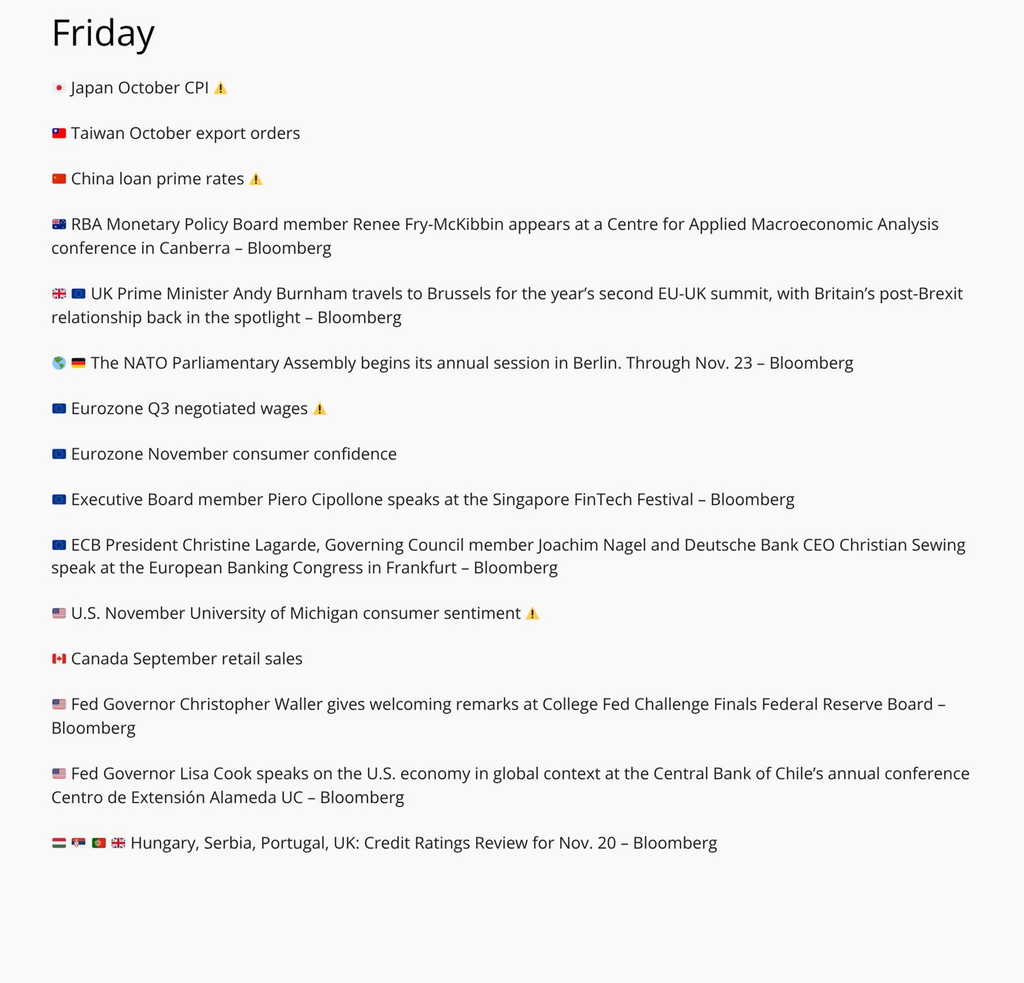
Ex-US highlights include Japan’s October CPI (6:30pm ET Thursday), China’s loan prime rates, eurozone Q3 negotiated wages and November consumer confidence, the UK’s October retail sales and November GfK consumer confidence, Germany’s October PPI and Canada’s September retail sales. ECB President Lagarde and the Bundesbank’s Nagel speak at the European Banking Congress, and UK Prime Minister Andy Burnham travels to Brussels for the year’s second EU-UK summit.
From Christophe Barraud’s international Week Ahead rundown:
At the time of publication, in terms of securities mentioned, Sethi was long AMZN, GOOGL, META, NVDA, QQQ, SOXL and numerous Treasury ETFs, and short IBIT, CPER and JPM. In the last 24 hours Sethi added to AMZN, sold his SPY position, covered part of his IBIT short, and went from long to short JPM.