Palo Alto Posts Fantastic Quarter as Cybersecurity Surges
The need for cybersecurity in the AI age is clear to investors.
You've reached your free article limit
You've read 0 of 1 free Pro articles.

On Wednesday evening, cybersecurity giant Palo Alto Networks (PANW) released the firm’s fiscal first quarter financial results.
For the period ended October 31, Palo Alto posted an adjusted EPS of $1.05 (GAAP EPS: $0.57) on revenue of $3.445 billion. These results all handily beat Wall Street’s consensus view. The revenue line was good enough for annual growth of 39.7%. For Palo Alto, Next-Generation Security annual recurring revenue (ARR) for the fiscal first quarter grew 66% year over year to $9.7 billion. In addition, remaining performance obligations grew 35% from the year-ago period to $21 billion. the stock is reacting very well to these numbers.
Nikesh Arora, chairman and CEO of Palo Alto Networks commented in the press release:
“We had a strong start to the year with a record (fiscal) Q1 and delivered one of our highest NGS (Next Generation Security) ARR beats ever as our customers turn to us to protect them against an unprecedented threat environment. As AI reshapes the threat landscape, we must continually evolve to protect our customers and enable them to adopt AI securely. To that end, we are pleased to announce our intent to acquire Applied Compute, which will allow us to deliver secure open weight models to our customers and accelerate the adoption of enterprise AI.”
CFO Dipak Golechha added, “Given the current threat environment and demand we see ahead of us, we are materially raising our full year guidance.”
That’s just it. The need for broad, AI-infused, rapid-response cybersecurity platforms has never been greater than it is right now. That need may never ebb. Readers know that I am long Palo Alto competitor CrowdStrike (CRWD) for this reason. That firm, along with Palo Alto, are considered by many (including your author) to be “best in class” in this industry.
Operations
As revenue generation grew 39.7% to $3.445 billion, the cost of those sales increased 72.8% to $1.103 billion. This left a gross profit of $2.342 billion (+27.6%) as GAAP gross margin dropped from 74.2% to 68%. On an adjusted basis, gross margin dropped from 80.2% to 72.3%, which was a miss.
GAAP operating expenses printed at $2.246 billion (+47.1%), leaving GAAP operating income of $96 million (down from $309 million). After adjustments, operating income grew 42% to $1.059 billion as adjusted operating margin actually improved from 30.2% to 30.7%.
After accounting for interest, other income and expenses and taxes, GAAP net income landed at $482 million (+44.3%). This works out to a fully diluted GAAP EPS of $0.57, up from the year-ago comparison of $0.47. Once adjusted, primarily for share-based compensation and the amortization of acquired intangibles, that EPS rises to $1.05 (fully diluted), up from $0.93.
Guidance
For the current quarter, Palo Alto sees revenue generation of $3.53 billion to $3.55 billion. This is a serious beat as Wall Street was looking for something close to $3.42 billion. The firm also sees adjusted EPS at $1.01 to $1.03. Wall Street was looking for about $1.01, so this is also a beat. NGS ARR is projected at $10.2 billion to $10.22 billion, while RPO is projected to grow 34% to 35%.
For the full fiscal year, Palo Alto is predicting revenue generation of $14.52 billion to $14.57 billion. Again, this is a major beat as consensus had been for less than 14.2 billion. Full year adjusted EPS is projected at $4.26 to $4.30, also well above the $4.18 or so that Wall Street had in mind. NGS ARR is projected at $11.475 billion to $11.525 billion (+26% to 27%), while RPO is projected to grow 19% to 20%. Wall Street sees this as very strong guidance overall.
Fundamentals
For the quarter reported, Palo Alto generated operating cash flow of $1.929 billion. Out of that number came capex spending of $87 million, leaving free cash flow of $1.842 billion (+9.2%). The firm does not pay shareholders a dividend and did not repurchase any common stock for its treasury during the quarter reported, However with this release, the board authorized a $1 billion share repurchase program set to run through December 31, 2027.
Turning to the balance sheet, Palo Alto ended the quarter with a cash position of $3.055 billion and current assets of $7.45 billion. Current liabilities add up to $11.356 billion, including no short-term debt, but deferred revenue (not a true financial obligation) of $7.73 billion. Palo Alto’s current ratio now stands at 0.65, but once correctly adjusted for those deferred revenues, rises to a very muscular 2.05.
Total assets amount to $49.11 billion, of which about 60% is labeled as either goodwill or other intangibles. Obviously, I don’t love that. Total liabilities less equity comes to $20.445 billion. There is no long-term debt on the books, or no debt of any kind. We do love that. There is also another $6.859 billion in deferred revenue not labeled as current. This is a very strong balance sheet.
Opinion
There’s an awful lot to like here. The quarter was fantastic. Growth is strong. Cash flows continue to be robust. The guidance was very solid. The balance sheet is golden. The only thing that didn’t thrill me was the declining gross margin, but adjusted operating margin improved. Oh, and there’s the new share repurchase authorization. Let’s go to the chart:
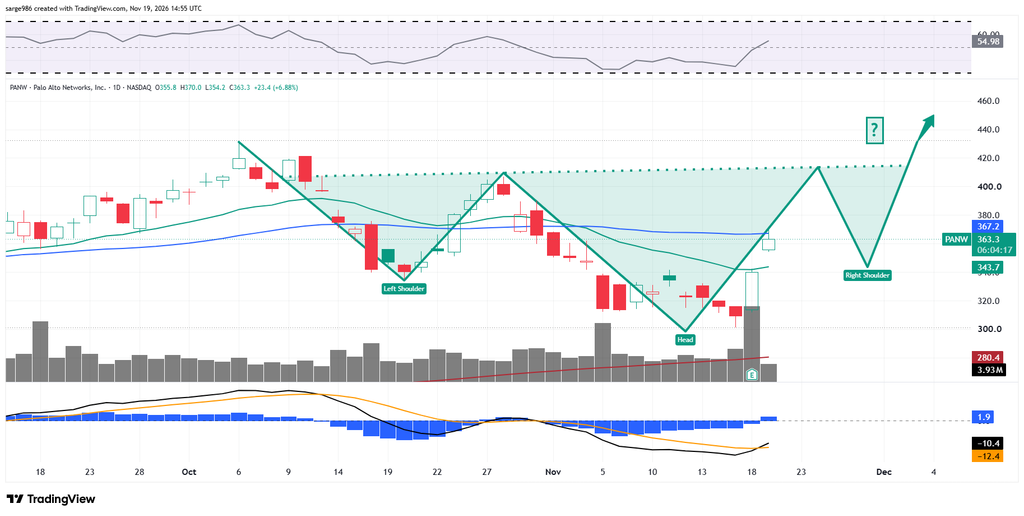
I see a couple of not truly defined (as of yet) technical patterns in the making. They are both bullish. I have drawn up a potential inverse head-and-shoulder pattern for you, which is about two-third of the way towards completion. The pivot created there, I project to be around $407, should the pattern fully develop. Within that pattern we have what could be a much smaller double-bottom pattern of bullish reversal with a $342 pivot. The double bottom would provide a target price of close to $410. The inverse head and shoulders, which is no sure thing, would provide a much higher target. Probably around $485.
Moving on to my indicators, relative strength is on the rise and is now posting a better than neutral reading. The daily MACD is suddenly stronger as well. The histogram of the nine-day EMA has just crossed above the zero-bound. That’s short-term bullish. In addition, the 12-day EMA has just crossed above the 26-day EMA, which is medium-term bullish. If those two lines can cross above the zero-bound with the nine-day EMA? That would amplify the bullish signal here.
At the time of publication, Guilfoyle was long CRWD equity.