Can Nvidia Save the Indices?
A spreading Tech selloff and a report of an NSA network outage sent the S&P 500 to its lowest close since late July, undercutting its November 5th close, with all 11 sectors lower ahead of Nvidia’s results.
You've reached your free article limit
You've read 0 of 1 free Pro articles.

Executive Summary
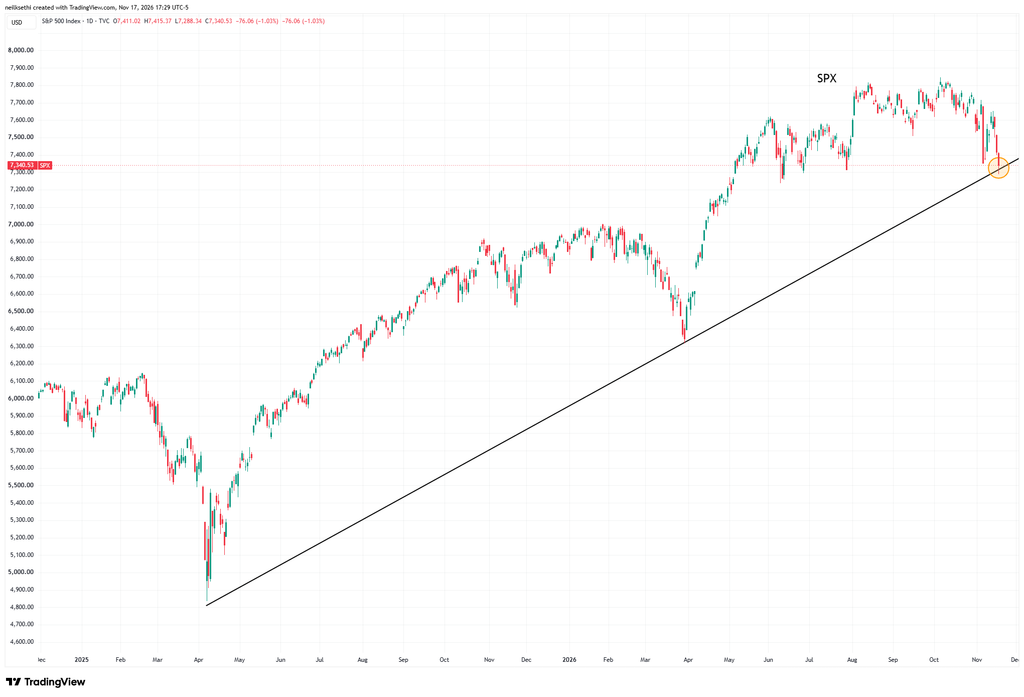
The retest of the November 5th lows I flagged Sunday is here, and the S&P 500 closed just below as software stocks sank and a report of an NSA network outage added to a risk-off move that saw every sector close lower.
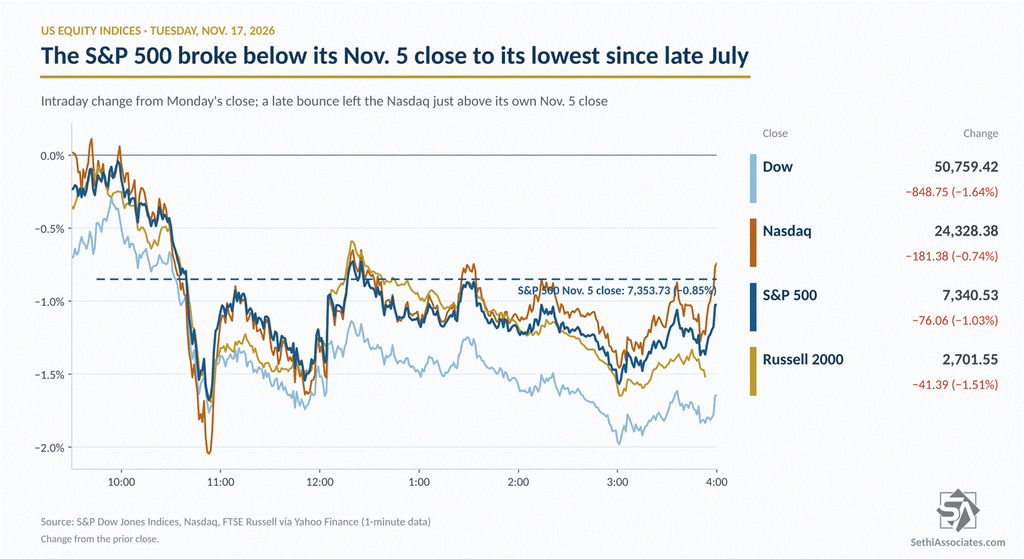
US equity indices opened lower and then dropped sharply when a CNN report that a classified NSA network had gone down sent the S&P 500 as much as 1.7% lower and the Nasdaq down 2.1% to its lowest since April. They bounced after reports said there was no evidence of a cyberattack, but never made it back to their initial levels. The Dow Jones Industrial Average led decliners, down 1.6%, followed by the Russell 2000 (-1.5%), the S&P 500 (-1.0%) and the Nasdaq (-0.7%). The S&P 500 closed 0.2% below its November 5th close at its lowest since late July, while the Nasdaq held just above its own.
The Tech selloff spread to software on worries that more capable AI agents will undercut subscription pricing, with Salesforce down 9.4% and the software ETF (IGV) down 3.3% ahead of Anthropic’s IPO, which is expected to price Wednesday and start trading Thursday.
Nvidia (NVDA) slipped 0.4% ahead of its results after the close. Jensen Huang said he’d be open to returning as CEO if the board thought it was in shareholders’ best interest, though Nvidia has reportedly hired Heidrick & Struggles to find his successor, and the WSJ reported late in the session that the SEC is investigating the company following his departure.
After the close, Nvidia appears to have cleared the bar in its first report without Huang, beating both Wall Street’s estimates and the higher buy-side “whisper” numbers on revenue, earnings and guidance. It also added $150 billion to its buyback authorization, though inventory, receivables and supply commitments all rose. The stock softened from an initial 3% pop to around 1% but rallied during the call to nearly 4% after hours (as of 6 p.m. ET) as interim CEO Colette Kress raised next year’s revenue growth outlook to 75% from 70% with demand “far exceeding supply.”
The VIX rose 11% to 25.5, its highest close since November 6. Treasury yields eased along with equities, with the 2-year yield down 2 basis points to 4.82% and the 10-year down 1bp to 5.12%, even as St. Louis Fed President Musalem called for “several interest rate increases before the spring of 2027” (more on why markets shrugged off his comments in the FedWatch section below, and in an SMT post in the morning). New York Fed President Williams, who carries more weight, struck a softer tone, saying further hikes may be needed, though not an outsized one. The dollar was little changed near its highest since April 2025, WTI crude futures settled up 0.3% at $86.02 after a volatile session on US-Iran headlines, and gold was flat near its lowest since September 2025. Bitcoin futures fell another 1.4% to about 64,200, their lowest close since August 14.
In economic data, October retail sales beat across the board despite a drop at auto dealers, industrial production fell 0.4% as utilities and energy output dropped even as manufacturing rose for a second month, and builder sentiment sank to its lowest since April 2012.
Wednesday brings the FOMC minutes, October housing starts and pending home sales, Fed speakers Williams, Barr and Kashkari, and earnings from Lowe’s, TJX and Target before the open and Palo Alto Networks after the close, with Anthropic expected to price its IPO.
My look at today’s charts follows in a separate post later this evening.
Market Commentary
AI:
- “For the sell-off to indicate a lasting deterioration in the AI investment cycle, we would need to see weakening compute demand, slowing AI-related revenue growth, poor capacity utilization, or tighter financial conditions constraining spending by the largest technology platforms,” Ulrike Hoffmann-Burchardi, chief investment officer for Americas at UBS Global Wealth Management, said in a note Tuesday. Breadth of selling will also matter, and there is no evidence of that yet. Underlying demand for computing capacity also remains robust, she noted. “We therefore continue to see potential for gains in broad equity markets over the next six to 12 months, supported by resilient economic growth and corporate earnings,” Hoffmann-Burchardi wrote. “Near-term volatility reinforces the importance of selectivity and disciplined portfolio construction rather than a broadly defensive stance.”
- “Decelerating AI capex growth suggests the ‘AI trade’ will continue to transition from AI infrastructure stocks to the beneficiaries of monetization and adoption, including the hyperscalers,” Goldman strategists wrote.
- “Fundamentally, I think the [Anthropic] IPO will be a success, but what matters for the markets longer term is, once they start reporting earnings and once investors get more visibility into a pure-play AI name for the first time, what does the spending versus revenue continue to look like and what are the expectations around it?” said Anthony Saglimbene, chief market strategist at Ameriprise. “I’m more interested in how does the market respond over time to having a pure-play AI large language model player now helping set the tone around the AI space,” Saglimbene told MarketWatch via phone on Tuesday. “That is something we’ll be monitoring for months and quarters ahead.”
Equities:
- “Any one of the stories that have broken over the course of the last week or so would be enough to cause the market jitters. But when you compound that by having multiple stories — whether it’s today’s NSA report or the FAA ground halt or Microsoft Outlook being down for two days or Chase Bank ATMs not working — aggregate all of those, and it’s easy for the human mind to get to a place where there must be something larger at play here,” said Art Hogan, chief market strategist at B. Riley Wealth.
Economy:
- “The strength of today’s [retail sales] report continues to reflect the resilience of the US consumer this year, as boosts from tax refunds and positive wealth effects from equity market gains have more than offset the drag from higher energy prices,” Goldman chief economist Jan Hatzius said in a note.
Stock and Sector Breakdown
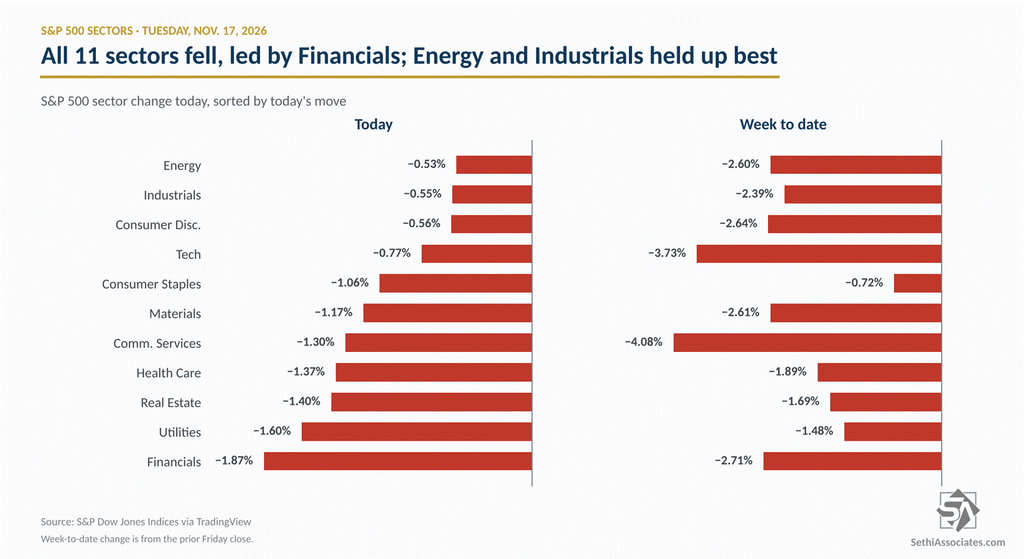
All 11 sectors fell, led by Financials (-1.9%), Utilities (-1.6%), Real Estate (-1.4%) and Health Care (-1.4%), while Energy (-0.5%), Industrials (-0.6%), Consumer Discretionary (-0.6%) and Tech (-0.8%) held up best. All are also down week-to-date, led by Communication Services (-4.1%) and Tech (-3.7%).
Helene Meisler said this morning that there was no panic Monday because there were still places to hide, but that breadth was starting to roll over, with the McClellan Summation Index turning down for the first time since early October. Today the hiding places gave way too, with Utilities (-1.6%) and Staples (-1.1%) among the laggards, and Doug Kass said staples stocks were “in shambles.”
Just 74 S&P 500 stocks rose and 427 fell, with two gaining more than 3% and 57 falling that much.
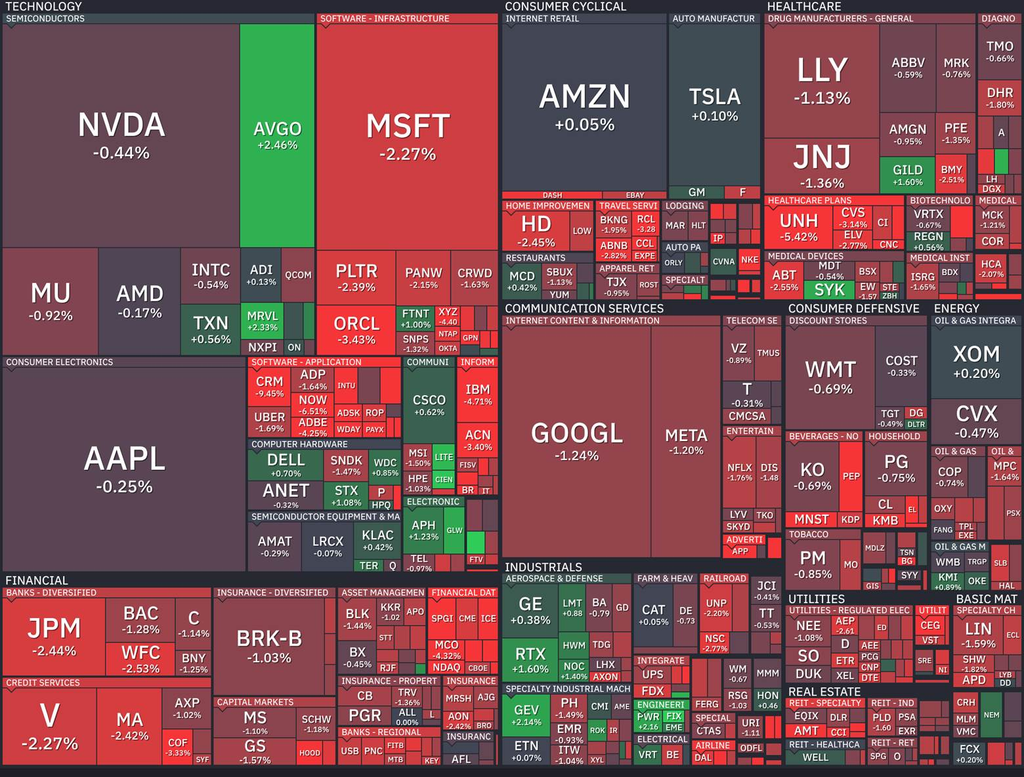
Salesforce (CRM) was the S&P 500’s worst performer, down 9.4%, leading the software selloff noted above, with, with Intuit (INTU) down 7.2%, ServiceNow (NOW) 6.5%, Workday (WDAY) 5.8%, Fair Isaac (FICO) 5.7% and Adobe (ADBE) 4.3%, while Oracle (ORCL) fell 3.4% and Microsoft (MSFT) 2.3%.
Nike (NKE) fell 6.3% after laying out its “Full Stride Ahead” strategy, with new CFO Dave Denton saying next fiscal year will be challenging. UnitedHealth (UNH) fell 5.4% as managed care gave back some of Monday’s gains, and tower REITs SBA Communications (SBAC) (-6.5%) and Crown Castle (CCI) (-5.8%) also slid.
Home Depot (HD) fell 2.4% after trimming its comparable-sales outlook to about 1.4% growth (from as much as 2%) and flagging continued weakness in larger projects, while Disney (DIS) slipped 1.5% despite better-than-expected results and above-consensus FY27 guidance.
In Financials, Robinhood (HOOD) and Coinbase (COIN) fell 4.0% as bitcoin slid again, JPMorgan (JPM) fell 2.4% even as its banking services returned to normal after Monday’s outages, and Visa (V) and Mastercard (MA) fell 2.3% and 2.4%. Among the other megacaps, Alphabet (GOOGL) and Meta (META) fell 1.2%, Apple (AAPL) slipped 0.3% after an outage hit its services, and Amazon (AMZN) and Tesla (TSLA) edged up 0.1%.
On the upside, Comfort Systems (FIX) led the S&P 500, up 3.9% on an upgrade from Morgan Stanley to Overweight. The company also boosted its buyback authorization. AI infrastructure names bounced back from Monday’s rout, with Coherent (COHR) up 3.7%, Ciena (CIEN) 2.8%, Lumentum (LITE) 2.6%, Broadcom (AVGO) 2.5%, Marvell (MRVL) 2.3% and Corning (GLW) 2.2%, along with power plays Quanta Services (PWR) (+2.2%) and GE Vernova (GEV) (+2.1%). That helped the SOX finish up 0.3% after falling more than 3% at its low.
Ahead of Nvidia’s report, Rev Shark noted options were pricing in a move of roughly 9% either way, the biggest for an Nvidia report since 2024, and Alex Frew McMillan exited his Nvidia position, with Monday’s new chip rules showing the administration’s hawks have won out. I noted this morning that Nvidia is one down week from tying its longest weekly losing streak on record, and that the new chip rules goes after the China loophole J.P. Morgan’s Michael Cembalest flagged.
More broadly, Rev Shark thinks the indexes are hiding how weak this market really is, with most stocks already in a bear market, and Stephen Guilfoyle says the worry is spreading beyond Wall Street. Doug Kass, meanwhile, added to SPY and QQQ and kept adding to his net long exposure through the session, wanting to “be more greedy when others are growing fearful.”
FedWatch
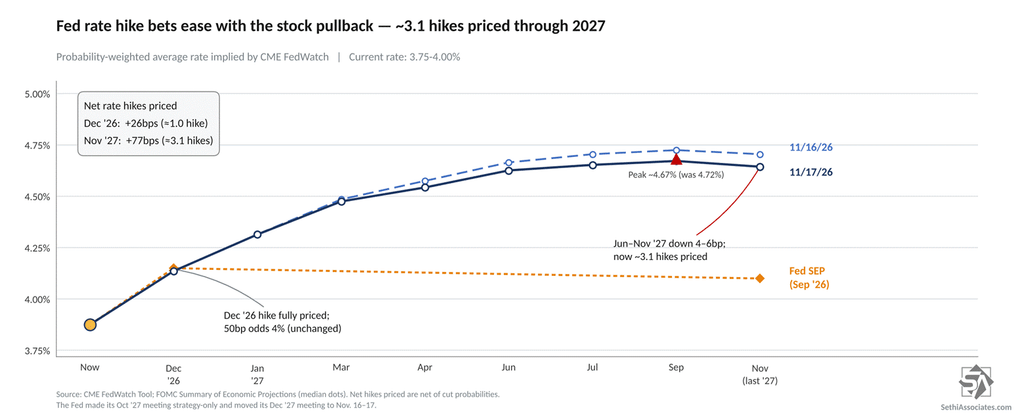
Fed rate-hike expectations eased with the stock pullback. A December hike remains fully priced, with a 4% chance of a half-point move, but pricing further out slipped to 77 basis points of hikes through the Fed’s final 2027 meeting in November (about three hikes), down from 83bp Monday, per CME FedWatch.
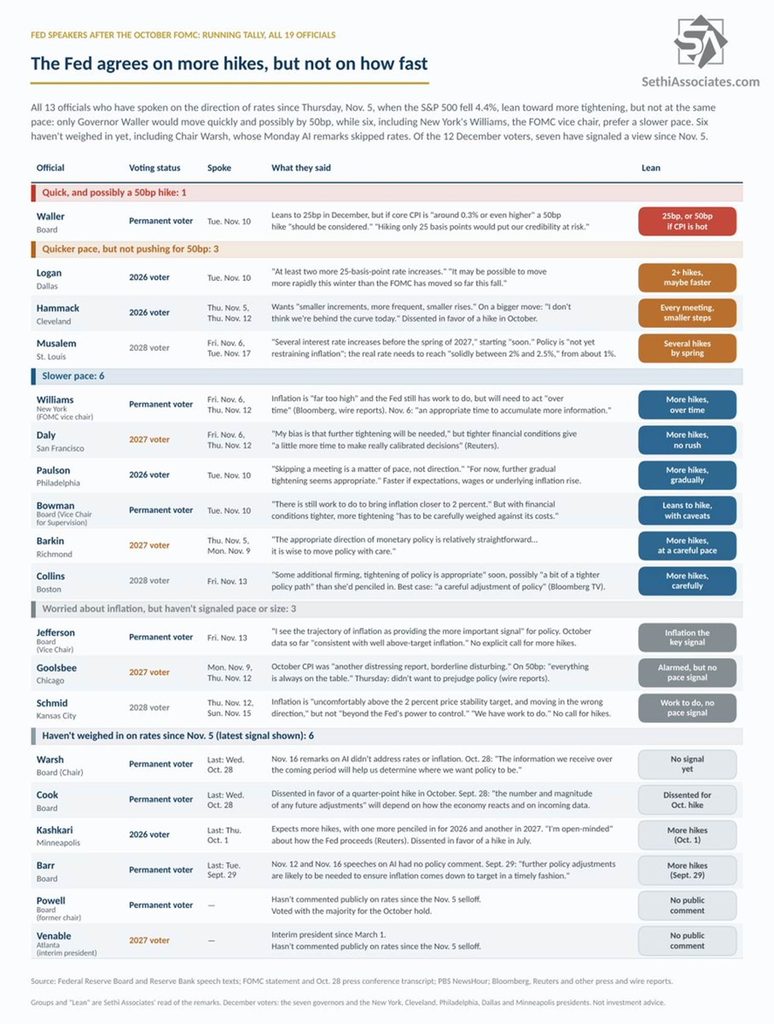
St. Louis Fed’s Musalem (2028 voter) gives the most aggressive guidance from a Fed official yet on how far and fast he sees the Fed needing to go: “several interest rate increases before the spring of 2027,” starting “soon.”
▪ The math: he puts today’s real policy rate “at the lower end of the 1% to 1.5% range” and wants it “solidly between 2% and 2.5%” by spring. That’s a rise of 1 to 1.5 percentage points, and “the nominal policy rate may need to do most of the work.”
▪ The calendar: only three FOMC meetings come before spring (Dec. 8–9, Jan. 26–27 and March 16–17), so “several” hikes means at least one per meeting.
▪ “In my view, current policy is not yet restraining inflation.” He agrees with Chair Warsh’s description of the September hike as “removing a dose of accommodation.”
▪ He’s “not overly concerned” by the recent tightening of financial conditions, which he says was smaller than after Liberation Day or the start of the Middle East conflict. That’s a direct counter to Daly and Bowman, who see tighter conditions as a reason to go slower.
▪ Inflation: October CPI and PPI suggest October PCE inflation “could be 3.8% and 3.2%” for headline and core, with “three-month rates running above six-month rates for every major category.”
▪ Expectations are anchored “because markets expect that the FOMC will raise its policy rate within the next few months.” “Moving sooner, while inflation expectations are anchored, has a better chance of succeeding.”
▪ Like Warsh on Monday, he doesn’t see an AI productivity boom yet: “the economy does not yet appear to be in a high-productivity growth regime.”
That said, it’s worth remembering that this isn’t the first time Musalem has staked out a very hawkish position. In June 2024 he said rate cuts could take “months, and more likely quarters.” Eight weeks later, he said “the time may be nearing” for one, and the Fed cut by half a point in September.
In that respect, in a statement that seems hard to square with the rest, he said he somehow also sees “an unlikely but still plausible scenario in which additional policy firming will not be required.” That could happen if energy and shipping costs fall, productivity picks up, or AI spending or wealth-driven consumer spending slows.
He joins Logan, Hammack and Waller in calling for a faster pace but importantly doesn’t have a vote until 2028. All 13 officials who’ve spoken on rates since the Nov. 5 selloff lean toward more hikes.
More From TheStreet Pro
Disney and Home Depot Report, Nvidia on Deck: 8 Key Items Shaping the Stock Market Tuesday — Chris Versace
We’re Making a Call to the Bullpen, Initiating a New Position — Chris Versace
Why We Added Our Latest Holding and Why Cyber Still Matters — Chris Versace
Chart of the Day: Nuclear Is Melting Down, but We’re in This ETF for the Long Haul — Bob Lang
Following Bullish Data From General Motors, Here’s What We’re Watching for This ETF — Chris Versace
Doug Kass’s Diary:
- Oscillator Becomes Further Oversold
- Early Morning Trading
- Give ‘Em the Old Double Whammy — Daze and Dizzy ‘Em
- GLAS Up, BABA Down: Upside, Downside Movers in the Morning
- Boockvar on Retail Sales, Import Prices
- Boockvar on Nvidia, Uranium Stocks, American’s ‘Beefing’ Up
- Back … Sorta
- Getting Magnificent
- Tech (XLK) Vs. Financials (XLF) Vs. Energy (XLE)
- Adding to Index Longs
- Charting the Late Morning Market
- Added to My Index Longs
- On the Market Rally Off of the Lows
- Boockvar on Builder Sentiment
- Things I Did Today
- Jensen Huang Tweets
- Fed Speak
- A Heads Up
Note: Doug posted 28 Diary entries today; these are the market ones.
And From Me If You Missed It
- Nvidia Clears the Bar in Its First Report Without Huang
- October Retail Sales Beat Across the Board Despite Falling Auto Sales
- What to Watch as Utilities and Energy Mask Solid Factory Output
- 3 Things to Watch as Homebuilder Sentiment Sinks to Lowest Since April 2012
- ADP Weekly Hiring Jumps to Most Since September
Miscellaneous
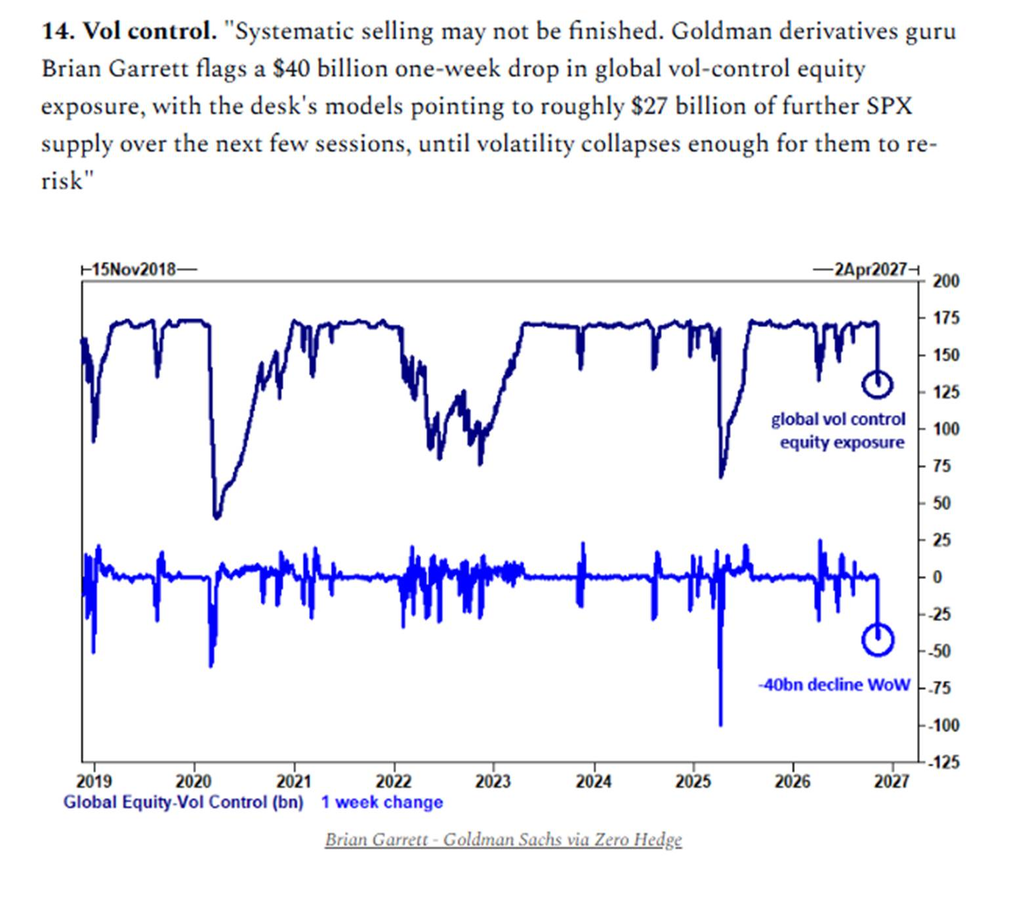
Goldman’s Brian Garrett (via ZeroHedge from @dailychartbook’s nightly email) flagged coming into Monday that global vol-control funds were modeled to sell roughly $27B more of S&P 500 stocks over the next few sessions. Then came Monday’s nearly 2% drop, which will almost certainly boost that number.
Coming into the week, Tier1Alpha had noted the biggest day rolling out of the 1-month window this week was only a 1.2% decline. Monday’s drop should lift 1-month realized vol to about 22.5–23% and 3-month to around 15%. That’s roughly where Tier1Alpha projected 1-month vol for Friday if the S&P swung ±1% every day, and we got there in one session.
BofA’s flat-market base case had vol control buying about $11B this week, but its down-market case had it selling about $10B. Monday put us in the down column. Goldman’s chart has exposure still around $130B, against a ceiling near $175B. Past deleveragings bottomed near $40B (2020), $80B (2022) and $65B (2025).
The calendar works against a quick reset. The Nov. 5 drop of 4.4% doesn’t roll out of the 1-month window until Dec. 4, and Monday’s drop stays in it until mid-December. And that’s with Nvidia’s results on deck for Tuesday.
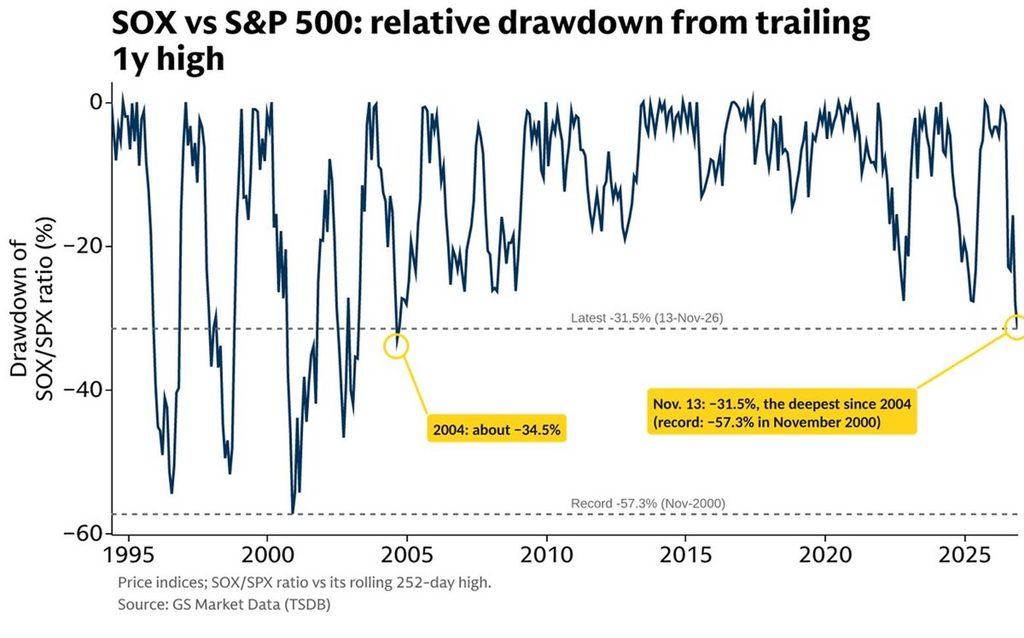
Goldman’s Callahan: “Zooming out, semis have underperformed the S&P by >30 percentage points since June (sharpest relative drawdown since 2002).” That leaves the SOX/S&P 500 ratio 31.5% below its one-year high, the deepest drawdown since 2004, though well short of the 57.3% record in November 2000.
Goldman’s AI Semis basket trades at just 11x 2028 earnings versus nearly 16x for the S&P 500, despite consensus expecting 31% earnings growth in 2028.
Current prices would imply 2028 earnings declining about 6%, so “either the selloff has gone too far, or investors are already pricing in cuts to earnings estimates.”
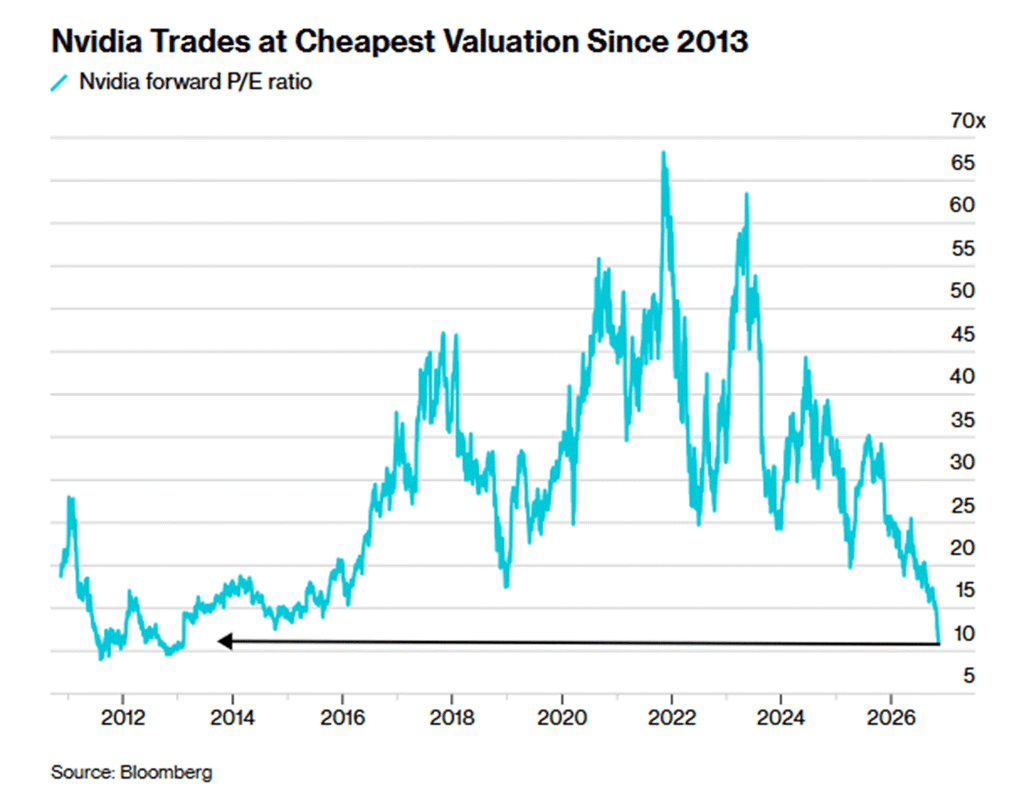
Nvidia at its cheapest now since 2013.
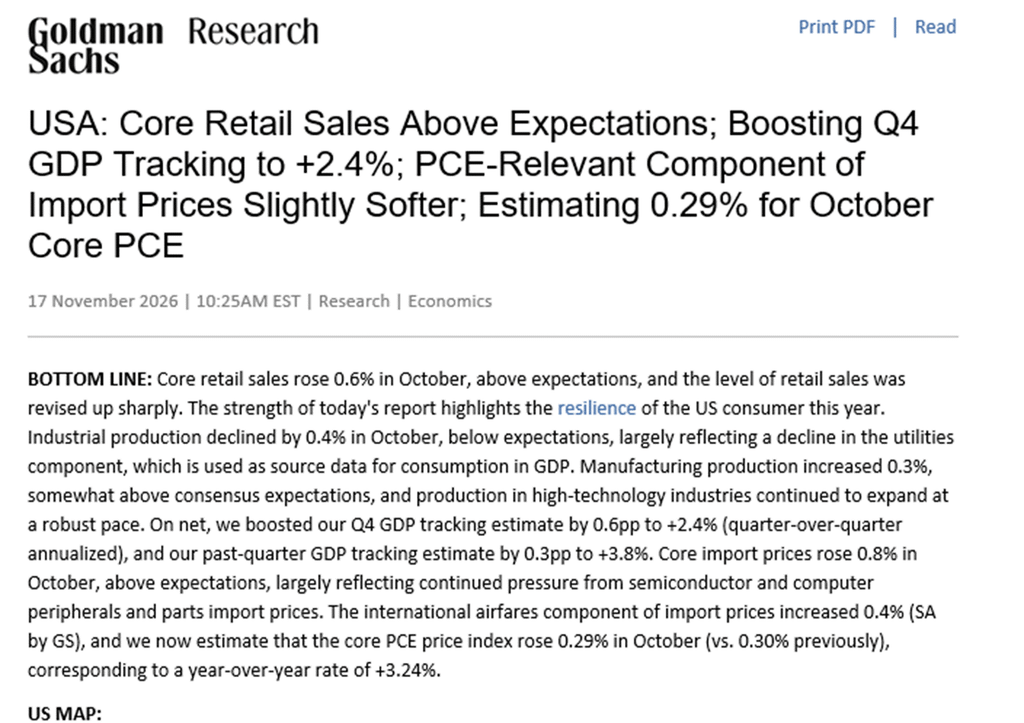
Goldman boosts Q4 GDP tracking to +2.4% from +1.8%.
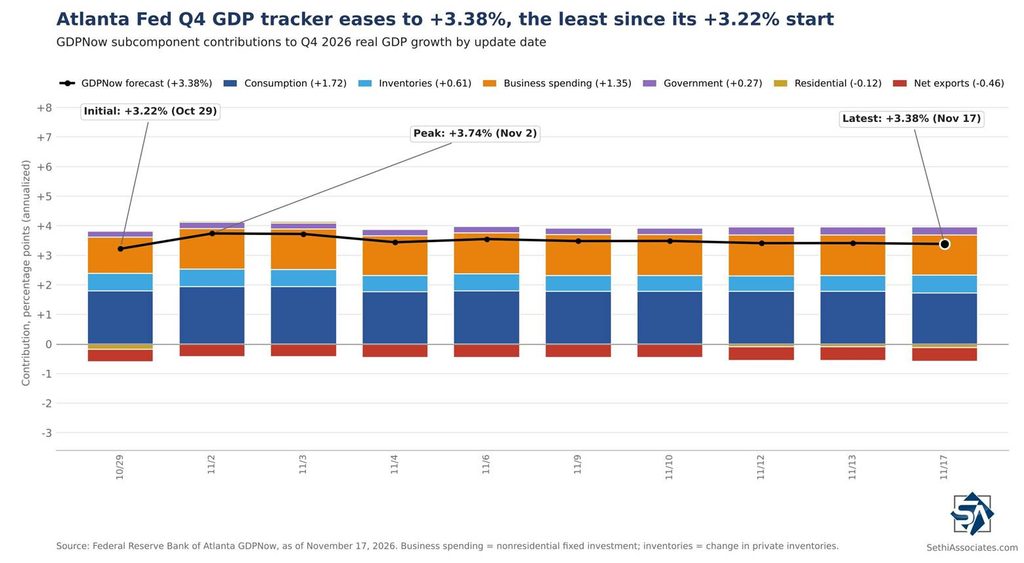
The Atlanta Fed’s Q4 real GDP tracker though eased to +3.38%, the least since its +3.22% initiation on October 29th, down from +3.48% on November 9th.
The biggest move since the last update was a -0.15% drop in the contribution from residential investment (to -0.12% from +0.03%), mostly after last Wednesday’s existing home sales report.
Consumption’s contribution also fell -0.07% (to +1.72% from +1.79%), mostly after today’s reports (which looks strange given the strength of the control group, but the model actually raised its goods spending estimate; the drag came from services, led by a plunge in October utility spending in today’s industrial production data and a drop in restaurant sales; also September retail spending was revised up giving a higher compare). Those were partly offset by gains in inventories (+0.09%) and government spending (+0.06%).
As a reminder, the Atlanta Fed’s tracker started very strong in each of Q1, Q2 and Q3 before falling sharply as we approached the actual GDP reads: Q1 went from 3.13% to 1.99%, Q2 from 3.70% to 1.50%, and Q3 from 4.95% to 3.37%. We’re far from that point, though, as we won’t get the Q4 report until late January.
The reading for now remains well above the blue chip consensus of ~+2.1%.
Here’s the breakdown of the components as of November 17th and changes from my last update November 9th:
- Consumption = +1.72% (-0.07%)
- Nonresidential fixed investment (biz spending) = +1.35% (-0.04%)
- Inventories = +0.61% (+0.09%)
- Gov’t = +0.27% (+0.06%)
- Residential investment = -0.12% (-0.15%)
- Net exports = -0.46% (0.00%)
- GDPNow Forecast: +3.38% (-0.10%)
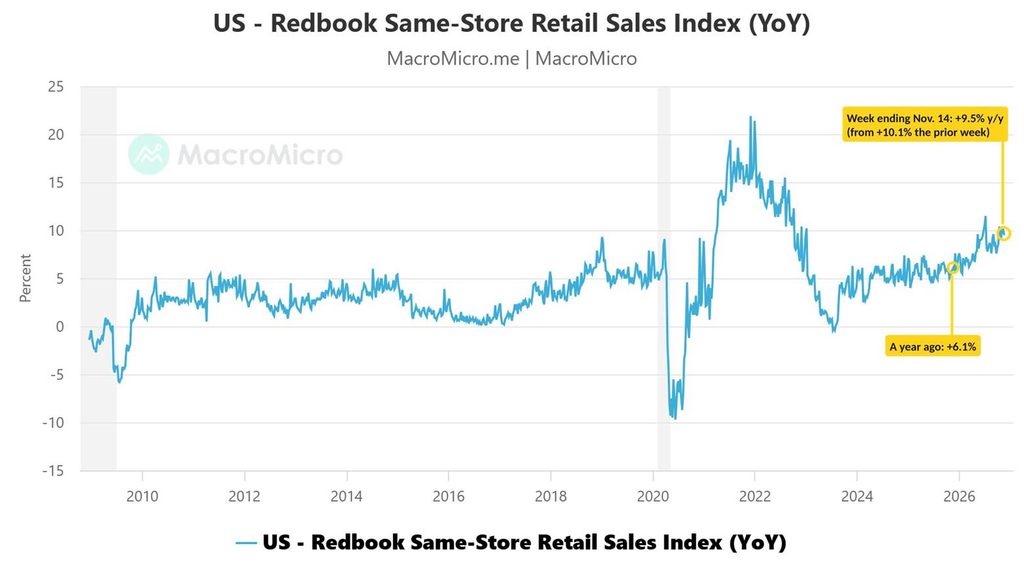
Redbook sales* rose 9.5% y/y in the week ending November 14th, down from 10.1% the prior week and back below 10% after two straight weeks above it, but still well above the 6.1% of a year earlier.
*Redbook sales are same-store sales across a panel of large general-merchandise retailers, such as department stores, discount chains, apparel retailers, drugstores, and warehouse clubs.
Wrap-Up — The Undercut
The retest I said was still on the table Sunday has arrived, and Tuesday the S&P 500 undercut that low and ended below it (by 0.2%). The Russell 2000 (1.0% below) and the DJIA (1.5% below) also closed under their November 5th closes, while the Nasdaq held just 0.06% above its own after a late bounce.
As mentioned in earlier posts, a break below isn’t unusual on a retest. Lows often get undercut before they hold, shaking out the last of the weak hands. The important thing now is that the S&P 500 doesn’t continue to close below it, which would make me much more bearish.
We also had some indicators of mild capitulation with all 11 sectors falling, over 80% down volume on the NYSE, the VIX hitting 27.7 intraday before closing at 25.5, etc. But none of these individually were at “washout” levels (in fact, all were more mild than that Nov. 5th day), making me hesitant to call a bottom.
Helene’s quick take after the late-morning drop was that “that whoosh felt a bit panicky,” the VIX got jumpy (she likes a secondary push up) and the SOX didn’t make a lower low. And BofA’s November Fund Manager Survey showed the biggest one-month cut to tech allocations since 2006, with the net share overweight falling to 12% from 37%.
As a side note, the seasonals had called for it. As noted in the Week Ahead, Hirsch had today (day 12) as the sharpest drop of the month in midterm years, with the mid-month low on Thursday (day 14), the day Anthropic starts trading. In that regard, as I also noted in the Week Ahead, Anthropic’s debut, along with Nvidia’s earnings, which so far seem to have been received positively, may serve as clearing events.
I did cut back a lot of risk today, but held onto more than I normally would, wanting to see the reaction to Nvidia. So far so good.
As always, let’s see what we get and go from there.
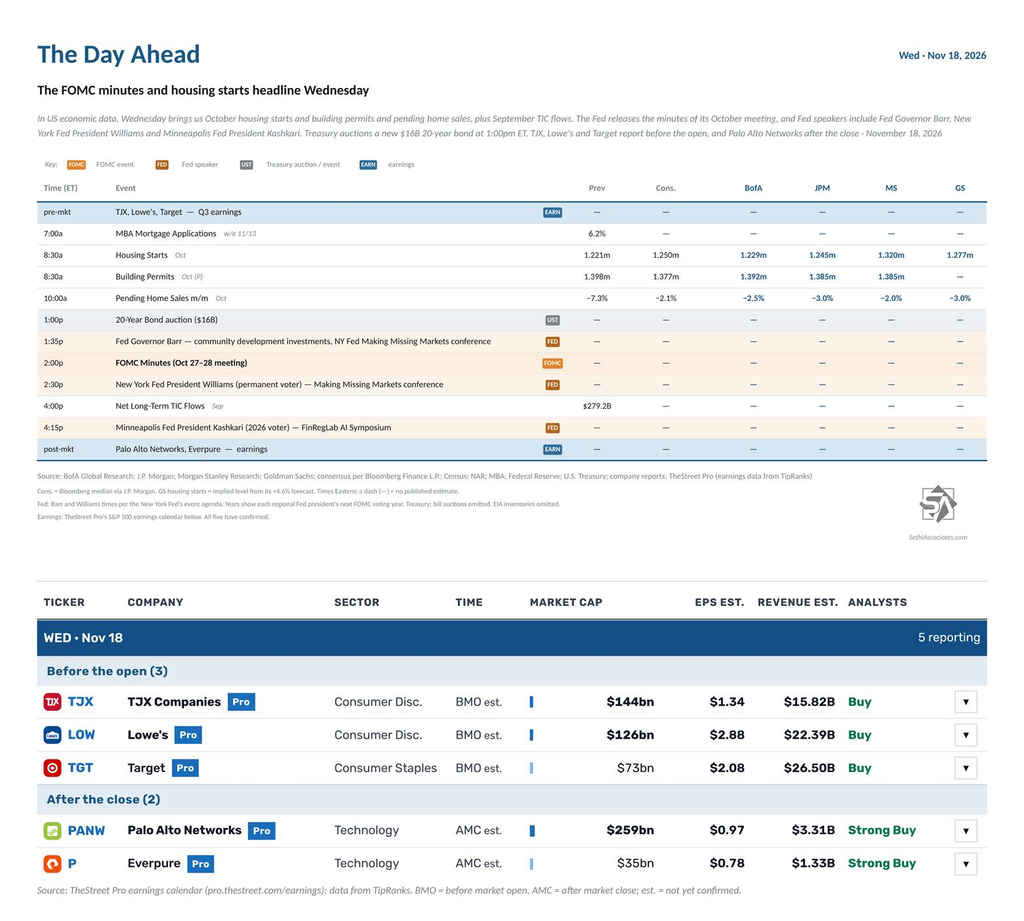
The Day Ahead — The FOMC Minutes and Housing Starts Headline Wednesday
In US economic data, Wednesday brings us October housing starts, building permits and pending home sales, plus September TIC flows and the weekly MBA mortgage applications.
The Fed releases the minutes of its October 27–28 meeting at 2:00pm ET, and Fed speakers include Fed Governor Barr, New York Fed President Williams (permanent voter) and Minneapolis Fed President Kashkari (2026 voter).
Non-Bill (>1yr in maturity) US Treasury auctions bring us a new $16B 20-year bond at 1:00pm ET.
Anthropic is also expected to price its IPO ahead of its Nasdaq debut Thursday.
Five S&P 500 components report, three of them with market caps over $100B:
Before the open: TJX (TJX), Lowe’s (LOW) and Target (TGT).
After the close: Palo Alto Networks (PANW) and Everpure (P).
Outside the S&P 500 we’ll hear from Tencent (TCEHY).
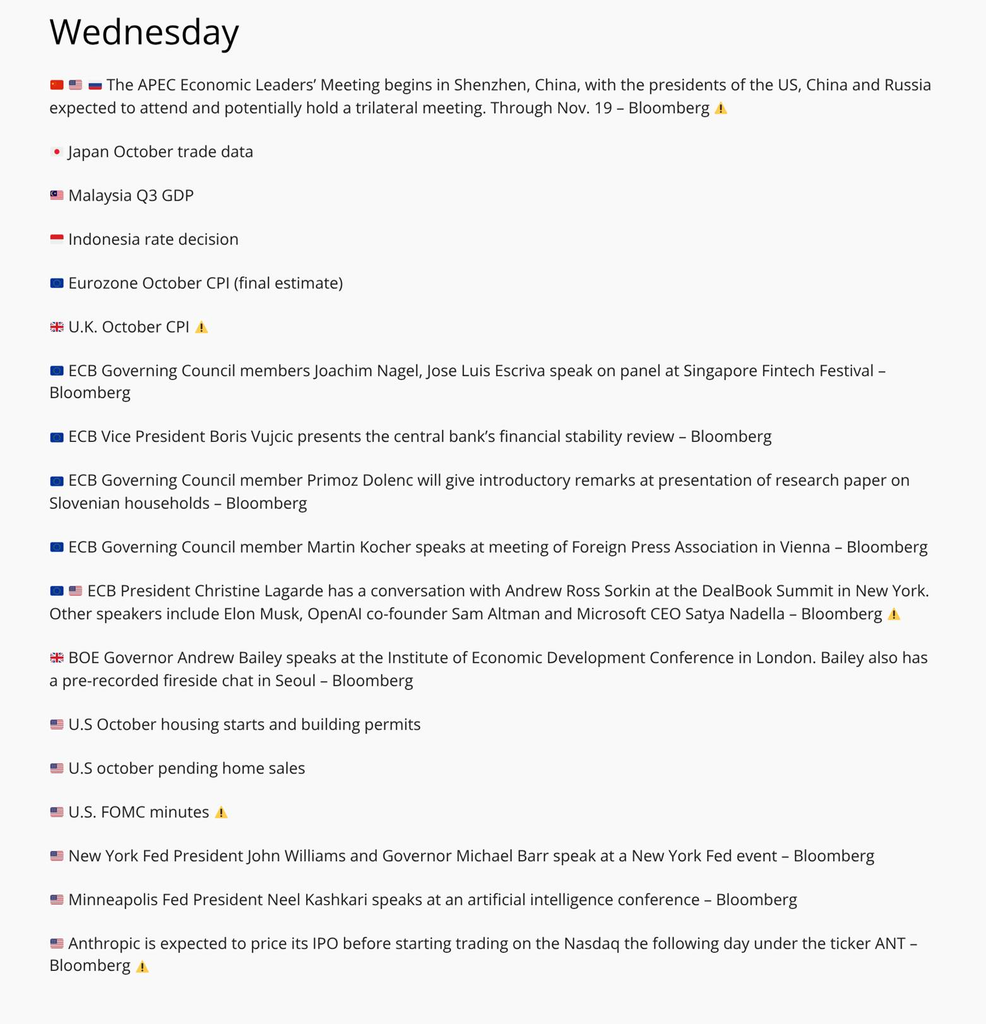
Ex-US highlights include the UK’s October CPI, RPI and PPI, the eurozone’s final October CPI, Japan’s October trade data (6:50pm ET Tuesday), Australia’s Q3 wage price index (7:30pm ET Tuesday) and Malaysia’s Q3 GDP, plus a Bank Indonesia rate decision and the ECB’s Financial Stability Review. BoE Governor Bailey speaks in London, and ECB President Lagarde joins Andrew Ross Sorkin at the DealBook Summit in New York (9:25am ET).
The APEC Economic Leaders’ Meeting opens in Shenzhen, where Presidents Trump, Xi and Putin are expected and could hold a trilateral meeting.
From Christophe Barraud’s international Week Ahead rundown:
At the time of publication, in terms of securities mentioned, Sethi was long AMZN, DIS, FICO, GOOGL, IWM, META, NKE, NVDA, ORCL, QQQ, SPY, UNH, WDAY and numerous Treasury ETFs, and short HOOD, IBIT and MRVL. In the last 24 hours Sethi sold his positions in CRM and MSFT, added to GOOGL, NKE and QQQ, trimmed SPY and covered part of his MRVL short.