Market updates and conversation from TheStreet Pro team. Follow the latest and join the conversation below.
Stock Market Today: November 17, 2026
Newest first · All times Eastern · 4 updates
DATE:
By Neil Sethi
ADP Weekly Hiring Jumps to Most Since September
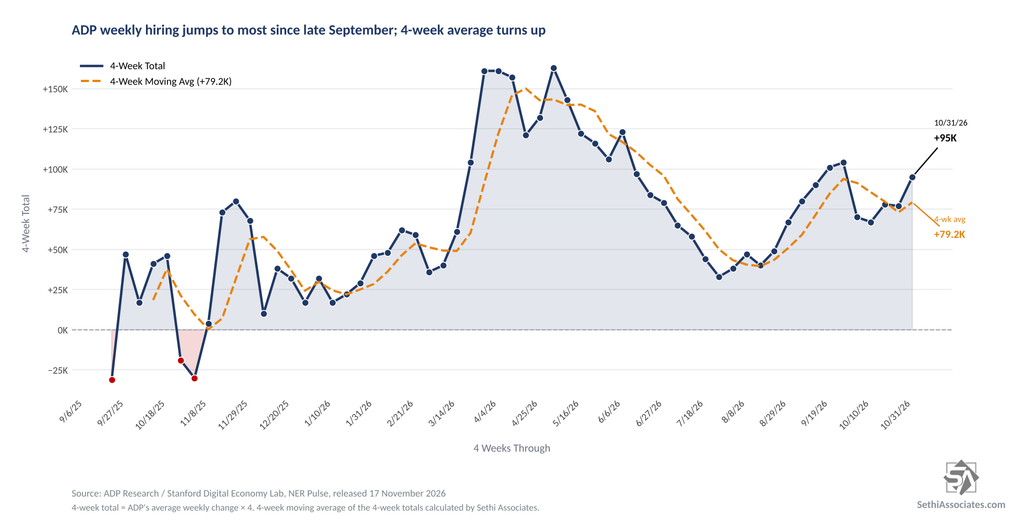
Private employers added95,000 jobs, or 23,750 a week, in the four weeks ending October 31, the most since the period ending September 26 according to the NER Pulse, ADP’s weekly update of its monthly National Employment Report. ADP said “hiring strengthened this week.” The prior period, ending October 24, was revised down slightly to 77,000 from 79,000.
The four-week moving average of those totals rose for the first time in five weeks, to79,250, the highest since the period ending October 17.
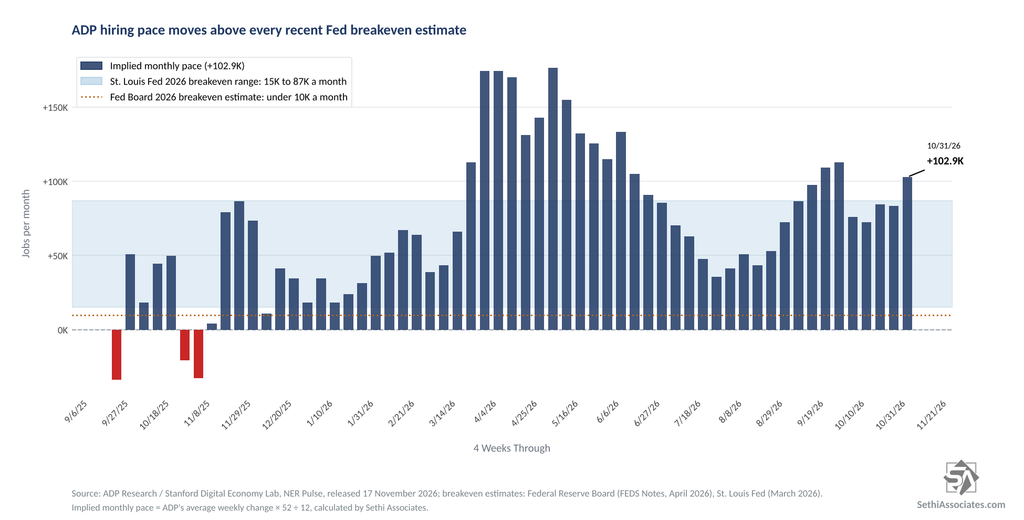
At roughly 102,900 a month, the implied monthly pace is now above every recent Federal Reserve estimate of breakeven job growth, the pace needed to hold the unemployment rate steady. The Federal Reserve Board puts that at “less than 10,000 new jobs per month in 2026,” and the pace is above the top of the St. Louis Fed’s range of 15,000 to 87,000.
Nvidia on Track to Tie Its Longest Losing Streak on Record
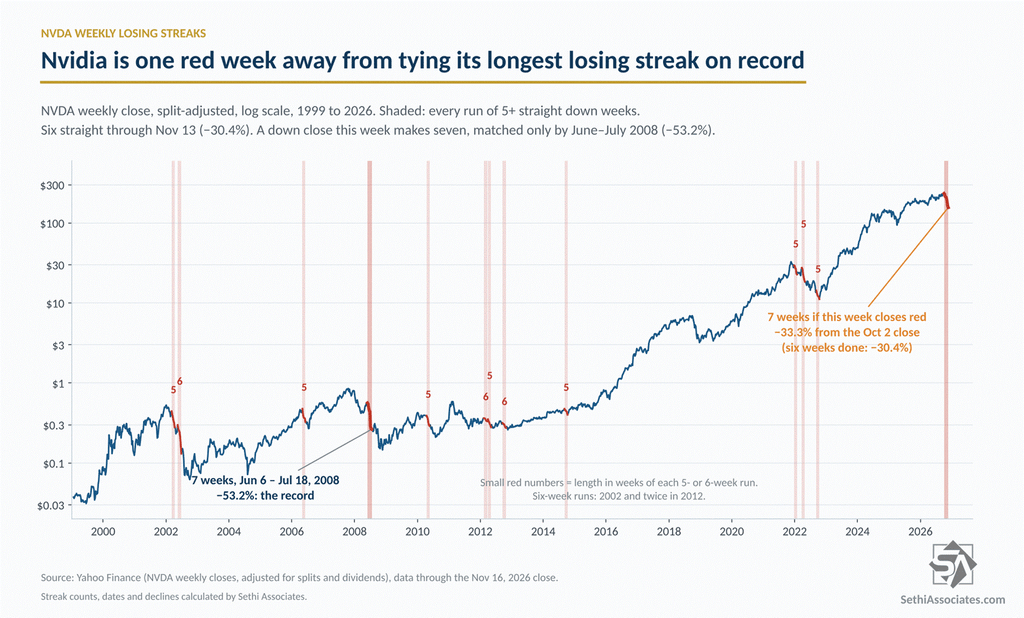
Nvidia (NVDA) fell 4.1% Monday to $156.14, putting it on track for a seventh straight weekly loss. That would tie the longest weekly losing streak in its history, matched only by the seven weeks from June 6 to July 18, 2008, when the stock fell 53%, according to our calculations from Yahoo Finance data going back to the 1999 IPO. It has never fallen eight weeks in a row.
The stock lost 30.4% over the six weeks through Friday, and Monday’s drop brings the run to 33.3% from its October 2 close. Six-week streaks are slightly less rare (one in 2002 and two in 2012), but a seventh down week would be the first in 18 years. At 33%, this is already the fourth-deepest of Nvidia’s 13 runs of five or more down weeks, behind the two in 2002 and the one in 2008.
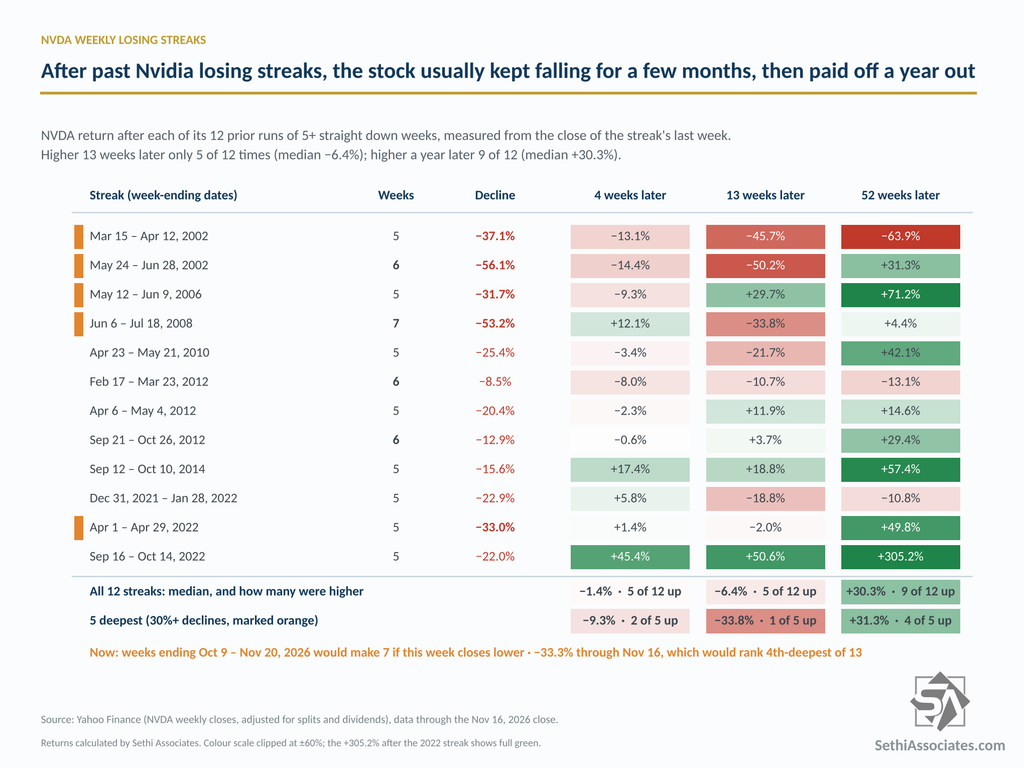
Note, though, history says the end of a streak like this hasn’t been a reliable near-term buy signal. After the 12 prior runs of five or more down weeks, Nvidia was higher four weeks later only five times, with a median decline of 1.4%, and higher 13 weeks later just five times, with a median decline of 6.3%. The deepest streaks were the worst: four of the five runs of 30% or more were followed by further losses over the next 13 weeks, including a 34% drop after the 2008 streak and drops of 46% and 50% after the two in 2002.
The longer view has been kinder. A year later, the stock was higher nine of 12 times, with a median gain of 30%. The most recent streak, which ended in October 2022 about six weeks before ChatGPT’s launch, was followed by a 305% gain over the next 12 months.
Whether this week ends up at seven likely rides in no small part on Tuesday. Nvidia reports fiscal third-quarter results at about 4:20 p.m. ET, with written commentary from interim CEO Colette Kress ahead of a 5 p.m. ET call (Nvidia). It will be her first call in the top job.
At the time of publication, in terms of securities mentioned, Sethi was long NVDA.
Most of the attention on Nvidia (NVDA) heading into Tuesday’s report is either on who will run it or what will happen with its investments in the AI ecosystem (Is Nvidia’s Open Checkbook Closing?). But Monday’s new chip curbs target a risk J.P. Morgan’s Michael Cembalest flagged in his Eye on the Market note on Friday, “The Icarus Files.” He argues that Nvidia’s China exposure and competition risks are the risks that will outlast the leadership decision.
Nvidia fell 4.1% Monday, slipping to the third-largest U.S. company for the first time in 18 months, as Treasury Secretary Scott Bessent’s call for an outside CEO and the new rule weighed on chip stocks (see AI Stocks Drag the S&P 500 Back Toward the November 5th Lows).
The Loophole Washington Just Closed
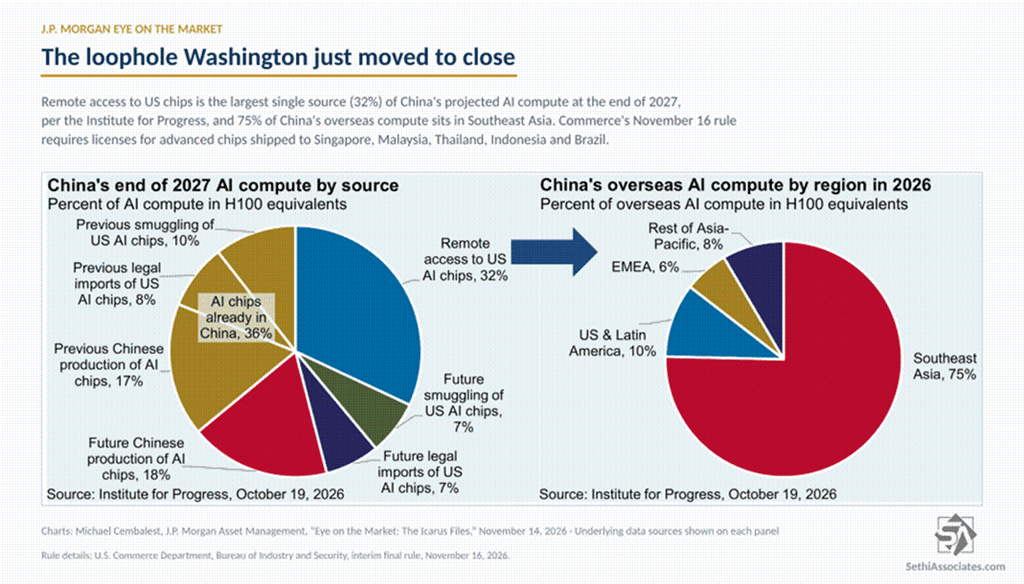
The Commerce Department’s Bureau of Industry and Security issued an interim final rule Monday, effective in 90 days, requiring a license for chips headed to overseas data centers that provide significant computing power to companies based in restricted countries such as China. It also requires a license for advanced chip exports to Singapore, Malaysia, Thailand, Indonesia and Brazil, which it described as higher-than-normal diversion risks.
That goes straight at the slice of China’s computing power Cembalest called the most interesting. Citing the Institute for Progress, he notes that remote access to U.S. chips is the largest single source of China’s projected AI compute at the end of 2027, at 32%, and that 75% of China’s overseas compute sits in Southeast Asia. Cembalest noted that the House passed the Remote Access Security Act 369–22 and the Senate never took it up, but he wrote that China hawks “appear to have the upper hand right now in DC.” Three days later, Commerce acted on its own.
For Nvidia, the share of revenue billed to customers with Singapore addresses rose from 8% to 22% after the Biden-era export controls took effect, according to Cembalest, and Nvidia stopped breaking out the figure in July 2025. Its guidance already excludes data center revenue from China itself. The open question is how much of its Southeast Asian demand came from Chinese companies renting compute there.
Cembalest Says the Bigger Risk Is Competition
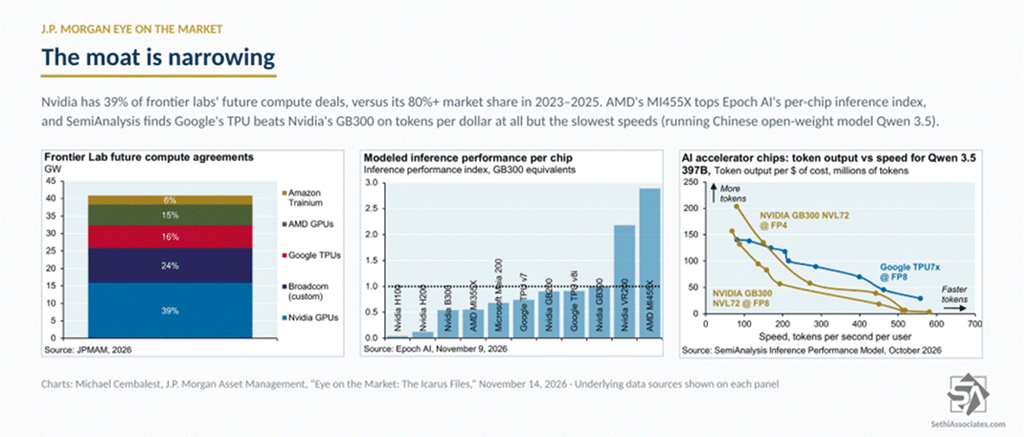
Cembalest calls competition the most important part of the note, and it’s already having an impact. Nvidia holds 39% of frontier labs’ future computing agreements, compared with its 80%-plus market share from 2023 to 2025. Some of that may reflect demand outrunning Nvidia’s supply, but Cembalest says frontier labs are moving to their own chips or other providers. The MI455X from Advanced Micro Devices (AMD) ranks first on Epoch AI’s per-chip inference index, and SemiAnalysis found that TPUs from Alphabet’s (GOOGL) Google beat Nvidia’s GB300 on cost per token at all but the slowest speeds. One frontier lab told him that getting its models running on AMD chips used to take six to 12 months, and now, with its own AI model doing the engineering, it takes three days.
The export restrictions fuel the same worry. Cembalest notes that if the remote access curbs work, Chinese companies have even more reason to build their own chips, and Z.AI, DeepSeek and Meituan have already cited training and running models on Huawei’s Ascend chips.
The Icarus Moment?
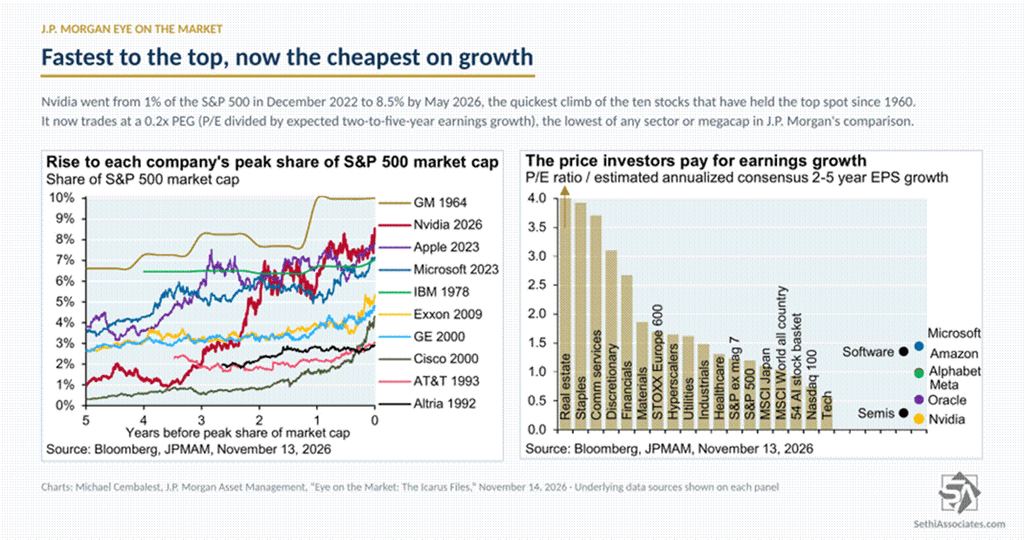
Nvidia went from 1% of the S&P 500 in December 2022 to 8.5% by May 2026, the fastest climb of the ten companies that have held the top spot since 1960, and most of the others later shrank to a fraction of their peak weight. After the selloff, Nvidia trades at a PEG ratio (its P/E divided by expected earnings growth) of just 0.2, far below any other large AI stock in his comparison.
Cembalest still sees the long-term case, but it rests on the business, not the CEO. Citing Nvidia’s free cash flow and a balance sheet with more cash than debt, he agrees the stock looks interesting for long-term holders at 32% below its high. The risks he lays out, China and competition, will be there no matter who runs the company.
For Tuesday, options are pricing a one-day move of about 8%, per Cboe’s Mandy Xu (more in Monday’s close). While not much is expected on the key issues, with a CEO search underway and interim CEO Colette Kress on the job for less than a week, watch for any commentary on the new rule’s potential impact, how Nvidia describes demand outside the U.S. (particularly Singapore), and any update on frontier-lab deals. For the financing side, including the commitments to watch in the quarterly filing, see Is Nvidia’s Open Checkbook Closing?.
The Day Ahead — Retail Sales and Nvidia Headline a Busy Tuesday
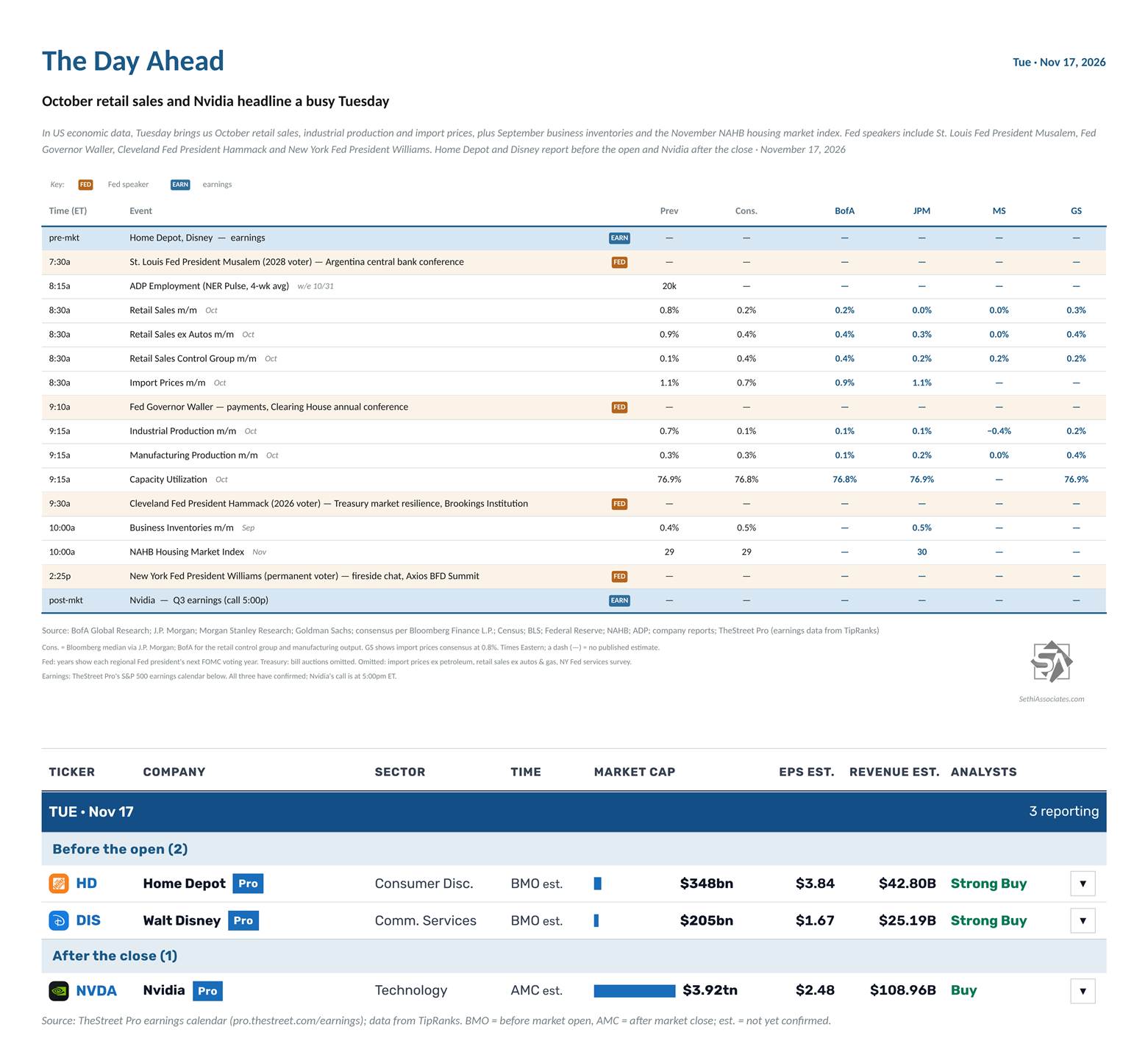
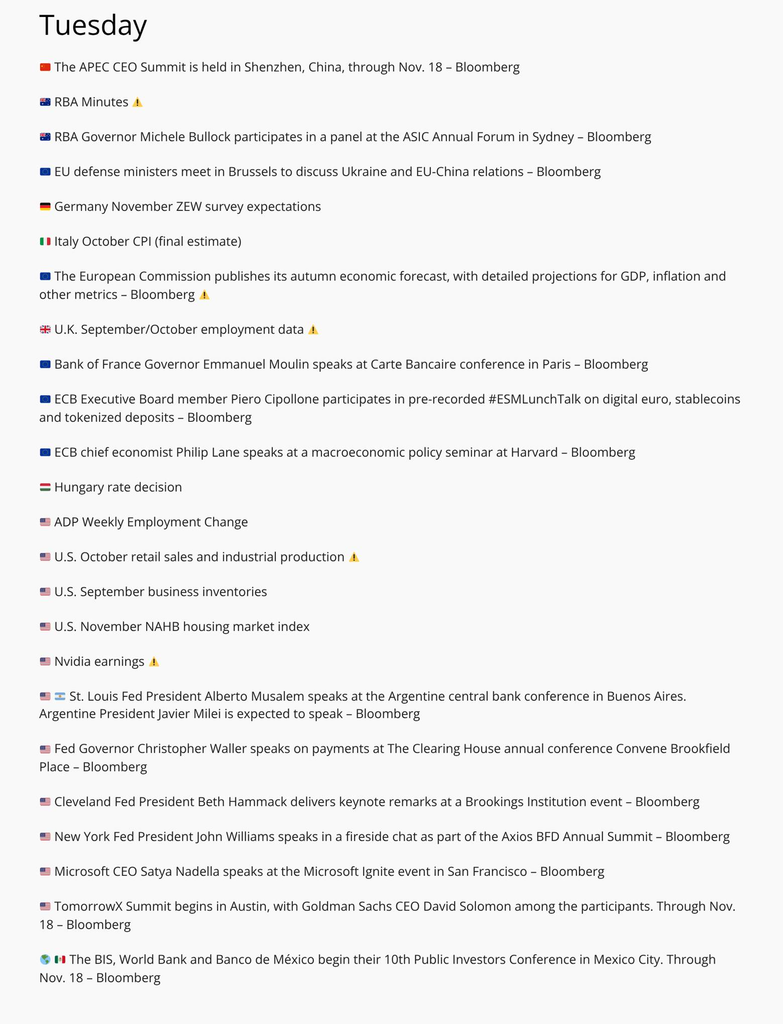
In US economic data, Tuesday brings us October retail sales, industrial production and import prices, plus September business inventories and the November NAHB housing market index. We’ll also get the weekly ADP report.
Fed speakers include St. Louis Fed President Musalem (2028 voter), Fed Governor Waller, Cleveland Fed President Hammack (2026 voter) and New York Fed President Williams (permanent voter).
Three S&P 500 components report, all with market caps over $100Bheadlined by Nvidia:
Before the open: Home Depot (HD) and Disney (DIS).
Outside the S&P 500 we’ll hear from JD.com (JD) and Viking (VIK).
Ex-US highlights include the minutes of the RBA’s November meeting, the UK’s September labor market report, Germany’s November ZEW survey, Italy’s final October CPI and the European Commission’s autumn economic forecast. Hungary’s central bank announces a rate decision, ECB chief economist Lane speaks at Harvard along with Cipollone and Moulin, and RBA Governor Bullock joins a panel.
The APEC CEO Summit gets underway in Shenzhen, and EU defense ministers meet on Ukraine and EU-China relations.
Conversation 0 Comments
One ongoing discussion across all days. Everyone can read; sign in to take part.
Your voice matters. Discussions are moderated for civility. Read our guidelines .
Log in to join the conversation