Weekly Roundup: The AI Trade Got Smacked. We’re Following the Data, Not the Fear
We put capital to work in two holdings, exited another and bumped up our price target for a long-time position.
You've reached your free article limit
You've read 0 of 1 free Pro articles.
We’ve wrapped up another October week, one that started with a sleepy Columbus Day holiday and quickly turned into anything but. Back-to-back hotter-than-expected inflation reports, the kickoff of big bank earnings, a string of upbeat multi-year outlooks from the AI supply chain, and renewed concerns over AI infrastructure funding pulled the market in opposite directions. While the market attempted to find its footing on Thursday, the S&P 500 shed more than 2% for the week. The tech-heavy Nasdaq Composite fell more than 4% and given the Pro Portfolio’s exposure in that area, it was a challenging week for us.
The largest issues weighing on the market this week were the September CPI and PPI reports, which confirmed that inflation pressures accelerated further during the month. You’ll recall we expected that to be the case and a rebound in oil prices over the last 10 days points leaves the commodity flat to up compared to September. On Friday, both the average price for a gallon of gas and for diesel were unchanged with levels seen roughly 30 days ago per findings from AAA.
Those reports shifted probabilities expected by the market for an October rate hike, but the odds reversed on Friday when a tight-lipped Fed Chair Kevin Warsh didn’t tip his hand about future monetary policy moves. Again, no surprise to us given Warsh’s mantra about no forward guidance. On Friday, we voiced the possibility of a potentially larger rate hike at the Fed’s early December policy meeting if inflation pressures continue to accelerate in the October and early November data.
Even though the 10-year Treasury yield traded off this week to around 5.1% compared to the recent high near 5.3% very early this month, we saw renewed questions about funding for the build-out of AI infrastructure cut across sectors poised to benefit from that activity. Front and center in that discussion was Nvidia (NVDA) customer CoreWeave (CRWV). CRWV shares fell more than 30% in the last 10 days, but attesting to it being more than CoreWeave specific, other neoclouds, such as Nebius (NBIS) and IREN (IREN), came under pressure as well this week.
Those concerns rippled through to hardware companies from Nvidia and Marvell (MRVL) to Advanced Micro Devices (AMD), Micron (MU) and others in the Portfolio and the current EPS All-Stars line-up.
However, those worries overlooked bullish comments and outlooks from ASML (ASML), Applied Materials (AMAT), Taiwan Semiconductor (TSM) and others this week. ASML said AI demand is driving orders for its chipmaking tools into 2030 and that it won’t be able to fully meet demand in 2027 and 2028. Applied Materials raised the bar at SEMICON West sharing that it sees wafer fab equipment spending growing faster through 2030 than over the past decade. Also, this week, Alphabet (GOOGL) President Ruth Porat said the company remains “capacity constrained” and that capital spending, roughly $200 billion this year, will “increase significantly” in 2027. During the week, Bloomberg reported that Microsoft (MSFT) plans to more than triple its data center capacity to over 38 gigawatts by 2032, up from around 12 gigawatts today.
Meanwhile, we continue to see AI adoption rising and usage expanding. This week, Bank of America (BAC) CEO Brian Moynihan said the company is seeing operating leverage from its AI investments, targeting a 10% increase in work accomplished for the same cost. Moynihan also noted BofA’s AI project spend would increase to $700 million next year, up from $250 million-$300 million this year, as it targets further productivity improvements. Information Services Group (III) announced that AI‑driven infrastructure demand pushed its third‑quarter 2026 as‑a‑service ACV to $41 billion, a 95% year‑over‑year rise.
Gravitee’s State of AI Agent Security 2026 published this week showed that modal enterprise agent deployment jumped from a range of 26 to 50 agents to a range of 76 to 100 in a single quarter. The report also found that more than 80% of organizations surveyed plan to deploy significantly more agents in the next 12 months, with 28% saying “significantly more.” Travel and transport companies show the strongest intent to expand, at 90%.
On the consumer side, BNP Paribas finds that downloads for Meta’s (META) agentic AI Muse do not seem to be slowing down. We see this as encouraging as is Apple’s (AAPL) bringing Apple Intelligence to China later this year. Data from NIQ tracking finds 51% of U.S. consumers are now utilizing AI when shopping, and Similarweb data indicates that 11.4% of path-to-purchase volume now involves AI-driven transactions.
Those aggregate data points and the corresponding increase in data creation and consumption across networks and data centers backstops those multi-year forecasts. And as we’ve pointed out more than a few times, there are other drivers for data center and networking demand besides AI, even though it is a force multiplier. Agentic AI consumes orders of magnitude more data and tokens than standard, single-pass inference AI because it runs in continuous, multi-step reasoning loops rather than a single prompt-response cycle.
Because we are ones that follow the data, we’ll look to mine earnings calls in the coming weeks for other comments on AI adoption and usage. We’ll balance those findings against revenues, bookings and backlog levels when the hyperscalers report soon.
Based on Friday’s market close, and after rebuilding our cash position on Friday, the technical levels we will be watching for the S&P 500 as we enter next week are the 50-day moving average near 7706 and the 100-day moving average near 7598. With the Nasdaq Composite pushing below its 100-day moving average near 26,285 on Friday, we’ll be looking to see if a positive test of that level emerges early next week.
Being mindful of those levels, we’ll not be in a rush to deploy large chunks of our cash. Rather, any moves we make are likely to be smaller ones, like the bites we made this week with Applied Materials and Axon (AXON).
Here’s the thing, we’ve been in similar situations when investor anxiety has dragged the market down despite the data and related signals. What we must not do is succumb to emotion for when we do that it becomes far easier to make mistakes in judgement that we may later regret. Calm, disciplined heads that follow the data and logical reasoning win the long game, and that’s what we aim to do as we look for opportunities to pick up shares of well-positioned companies that have been overly punished.
Enjoy your weekend and Saturday’s Signals alert. We’ll see you back here, bright and early on Monday.
Catching Up on the Portfolio This Week
As much of a challenging week as it was for the market, it was an even bigger one for the Portfolio. Double-digit falls in several tech-related holdings weighed heavily on the Portfolio’s performance, taking us from leading the S&P 500 to falling behind it on a year-to-date basis. We view those reactions as overdone, and depending on the position, that has us inclined to stay the course to pick up some additional shares when the market finds it footing or slips into an oversold condition.
While the Portfolio’s year-to-date gain fell this week, we fared far better than the more than 7% drop in the State Street Technology Select Sector SPDR ETF (XLK). The reason for that was the positive week-over-week performance in our other holdings. Waste Management (WM), in particular, was a strong performer while shares of TJX (TJX), Welltower (WELL), Paccar (PCAR), Costco (COST), American Express (AXP) and the Healthcare Select Sector SPDR Fund (XLV) were all outperformers.
As market pressure increased during the week, on Thursday, we picked up additional shares of Applied Materials (AMAT) near $426. We made that move based on the combination of ASML’s (ASML) comments about multi-year order strength for its chip equipment, reports of favorable pricing that support that outlook, and the 2030 targets Applied shared at SEMICON West the day before. Applied’s update, which included a path to 54% gross margins, rising prices and a supply-constrained up-cycle, reinforces our view that it is one of the key enablers of the AI build-out with pricing power and margin expansion still ahead. Early that morning, Taiwan Semiconductor (TSM) reaffirmed its 50% year-over-year increase in capex, and Global Foundries (GFS) announced two new chip plants in upstate New York.
Also on Thursday, we rounded out the position size in our public safety play, buying more shares of Axon Enterprise (AXON) near $412. That move came on the back of several newly announced federal wins. We see those and other recent wins adding to Axon’s future contracted bookings and paving the way for its higher-margin, recurring software and services revenue.
We also cleaned up the Portfolio’s Bullpen Thursday. Three names came into the Bullpen: Dell Technologies (DELL), the VanEck Uranium and Nuclear ETF (NLR), and SpaceX (SPCX). On the other side of the ledger, we removed Labcorp (LH), Builders FirstSource (BLDR), Hershey (HSY), and Starfighters Space (FJET) from the Bullpen.
On Friday, following what we view as a questionable hire for its new Chief Content Officer, we opted to pull the plug on the Portfolio’s position in Netflix (NFLX). We took some lumps with this position, but as we discussed in that trade alert, the company’s headcount reduction paired with the background of new content chief Peter Rice do not inspire confidence in Netflix re-arming its content slate and recapturing streaming share near-term. The same day, BMO Capital Markets said that in its view “Sensor Tower’s app data and a shift in Chief Content Officer implies muted engagement growth in 3Q26E, suggesting near-term results could remain challenged.” The bottom-line is there are better opportunities to recover the ground we’ve lost with NFLX shares in companies with stronger competitive positions and better growth prospects.
Also on Friday, following Apple’s (AAPL) iPhone Duo pre-orders selling out, we lifted our AAPL price target to $375 from $350 given the prospects for a more favorable product mix as Apple adjusts production to favor this higher priced product.
Following this week’s moves, the Portfolio’s cash position sits at around 11% of its assets, up from roughly 8.3% last week.
Now let’s see what others on Wall Street had to say about the Portfolio’s holdings during the week:
Monday: Citi raised its Eaton (ETN) price target to $498. Bernstein trimmed its Boeing (BA) target to $278 from $298. Wells Fargo lowered its Amazon (AMZN) target to $329 from $338, and Cantor Fitzgerald followed with a cut to $310 from $320. Phillip Securities downgraded Microsoft (MSFT) to Neutral from Accumulate and Palantir (PLTR) to Neutral from Buy. JPMorgan lowered its American Express (AXP) target to $360 from $400, while Morgan Stanley nudged its AmEx target to $380 from $382. Cantor Fitzgerald lowered its Meta (META) target to $840 from $860. Baird raised its Palantir target to $250 from $200. JPMorgan lifted its Apple target to $360 from $340, and Deutsche Bank raised its Microsoft target to $600 from $550.
Tuesday: Pivotal Research raised its Meta target to $930 from $790, and Truist went further, resetting its target at $1,000 from $763. Barclays lowered its Welltower (WELL) target to $246 from $259 but raised its Microsoft target to (NFLX)$600 from $512. UBS trimmed its Welltower target to $269 from $271. KeyBanc lowered its Netflix target to $85 from $92, and Huber Research downgraded the shares to Underweight from Overweight.
Wednesday: UBS edged its Alphabet (GOOGL) target up to $380 from $379 and raised its Meta target to $884 from $715. Guggenheim raised its Meta target to $850 from $700, while Goldman Sachs went the other way, cutting its target to $762 from $860. Following Morgan Stanley’s earnings, Keefe Bruyette cut its target on the shares but sees a “very attractive entry point,” and Goldman Sachs lowered its target to $200 from $207. Jefferies raised its Microsoft target to $650 from $575.
Thursday: Following Bank of America’s (BAC) results on Wednesday, Baird upgraded the shares to Outperform from Neutral, even as a long list of firms lowered their targets to $60-$68. Morgan Stanley’s (MS) targets also came down, with Wells Fargo at $217 from $223, Evercore ISI at $205 from $215, and TD Cowen at $205 from $210. Microsoft collected another round of target increases, from UBS to $675 from $525, Citi to $636 from $600, TD Cowen to $625 from $540 and Mizuho to $600 from $510. Mizuho also raised its Palantir target to $245 from $215. Citi lifted its Meta target to $895 from $800, and JPMorgan raised its Alphabet target to $425 from $420. Jefferies assumed coverage of Netflix with a Buy rating. Evercore ISI lowered its Applied Materials target to $590 from $700, RBC Capital cut its Boeing target to $235 from $265 and Raymond James lowered its Axon target to $675 from $800. WM saw target cuts from BMO Capital to $232 from $240 and Scotiabank to $245 from $260. After the close, Tigress Financial raised its Costco (COST) target to $1,250 from $1,065.
Friday: BofA trimmed its Morgan Stanley price target to $220 from $225.
Key Global Economic Readings
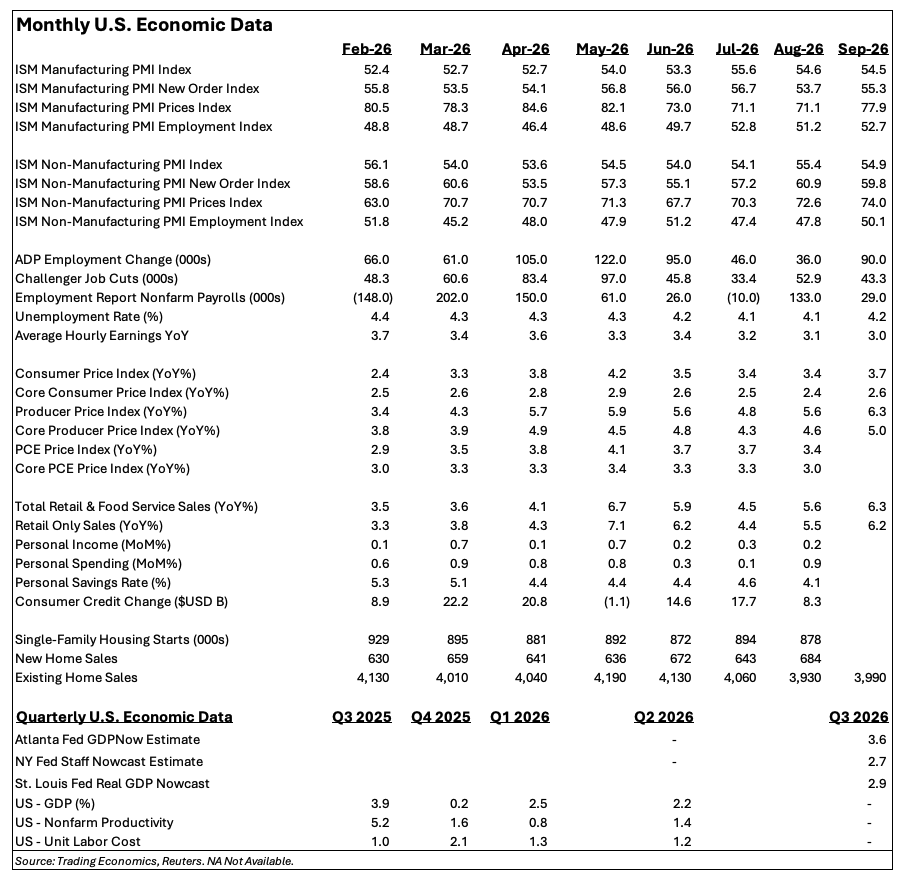
Chart of the Week: VanEck Uranium and Nuclear ETF (NLR)
Nuclear energy has been all the rage in discussions, for it is the cheapest and safest form of energy on the planet. However, it can be considered dangerous if uranium (used in nuclear fission, splitting atoms) gets into the wrong hands. The last nuclear reactor in the U.S. was built in 2024 and then 2023. However, before that you needed to go back to 1970-1990, a 20-year boom of new reactors.
Today, there is an abundance of talk about building more reactors due to the demand for power. Big techs and hyperscalers are partnering with nuclear energy providers to bring 24/7 power to AI data centers. Companies such as Constellation Energy (CEG), Vistra (VST), Oklo (OKLO), Terra Power and others have long-term agreements with companies like Meta (META), Amazon (AMZN), Microsoft (MSFT) and Alphabet (GOOGL) for power as they see the advantages to partnering up. They also see the value over time for buying in early.
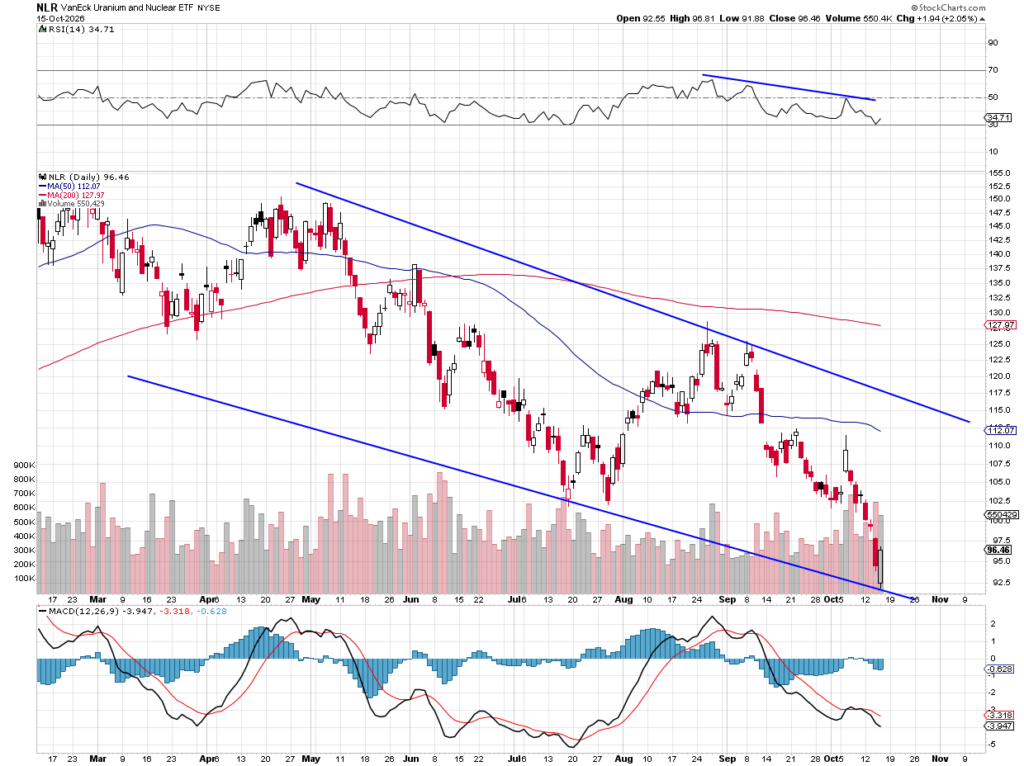
As for the chart of VanEck Uranium and Nuclear ETF (NLR), we are not seeing much bullishness yet. The ETF has fallen sharply over the last six months but may have found a short-term bottom. The RSI at the top shows an oversold condition while recent volume moves point toward exhaustion.
MACD is clearly on a sell signal and the price is well below the 50-day and 200-day moving average. A nice, long sideways basing period is needed before the NLR makes a move. If you’re patient, you’ll likely be rewarded.
Other charts we shared with you this week were:
Monday, October 12: S&P 500 – New Highs, But Was It Convincing Enough?
Monday, October 12: Morgan Stanley (MS) – Will Earnings Change the Game for Morgan Stanley?
Tuesday, October 13: Microsoft (MSFT) – Microsoft Leads the Mag 7 and Most Others
Wednesday, October 14: Robo Global Robotics and Automation Index ETF (ROBO) – Robotics ETF Lands on Strong Support
Thursday, October 15: Applied Materials (AMAT) – Applied Materials Follows the Rest of Semi Stocks
The Week Ahead
Next week is light on U.S. economic data, and with the Fed entering its blackout period on Saturday ahead of the October 27-28 FOMC meeting, there won’t be any Fed speakers to parse. Housing gets the spotlight with the NAHB index on Monday, followed by housing starts and pending home sales on Tuesday. Given what we’ve seen with mortgage rates and builder incentives, we’re not expecting much in the way of good news there.
The Leading Economic Index arrives Thursday, followed by the October Flash PMIs and final University of Michigan consumer sentiment on Friday. Following this week’s CPI and PPI data, we’ll be scrutinizing the U.S. Flash October PMI’s price component and what the data says about job creation during the month.
And as we’ve become accustomed to in recent months, we will continue to track weekend developments when it comes to the U.S. and Iran, what those implications may mean for oil and related prices, and how we’re likely to start next week’s trading.
Here’s a closer look at the economic data coming at us next week:
U.S.
Monday, October 19
NAHB Housing Market Index (Oct) – 10:00 AM ET
Tuesday, October 20
ADP Employment Change Report (Weekly) – 8:15 AM ET
Housing Starts & Building Permits (Sep) – 8:30 AM ET
Philadelphia Fed Nonmanufacturing Business Outlook Survey (Oct) – 8:30 AM ET
NAR Pending Home Sales Index (Sep) – 10:00 AM ET
Wednesday, October 21
MBA Mortgage Applications (Weekly) – 7:00 AM ET
EIA Crude Oil Inventories (Weekly) – 10:30 AM ET
Thursday, October 22
Initial & Continuing Jobless Claims (Weekly) – 8:30 AM ET
Conference Board Leading Economic Index (Sep) – 10:00 AM ET
Chicago Fed Survey of Economic Conditions (Oct) – 10:00 AM ET
EIA Natural Gas Inventories (Weekly) – 10:30 AM ET
Kansas City Fed Manufacturing Survey (Oct) – 11:00 AM ET
Friday, October 23
S&P Global Flash US Manufacturing, Services & Composite PMI (Oct) – 9:45 AM ET
University of Michigan Consumer Sentiment – Final (Oct) – 10:00 AM ET
Kansas City Fed Services Survey (Oct) – 11:00 AM ET
International
Monday, October 19
China: GDP (Q3)
China: Industrial Production (Sep)
China: Retail Sales (Sep)
China: Fixed Asset Investment YTD (Sep)
Tuesday, October 20
Germany: ZEW Economic Sentiment & Current Conditions (Oct)
Eurozone: ZEW Economic Sentiment (Oct)
Germany: PPI (Sep)
Wednesday, October 21
Japan: Trade Balance, Exports & Imports (Sep)
UK: CPI, Core CPI & RPI (Sep)
UK: PPI Input & Output (Sep)
Thursday, October 22
Eurozone: Flash Consumer Confidence (Oct)
UK: CBI Industrial Trends Orders (Oct)
Friday, October 23
Japan: National CPI (Sep)
Japan: au Jibun Bank Flash Manufacturing & Services PMI (Oct)
UK: GfK Consumer Confidence (Oct)
UK: Retail Sales (Sep)
UK: S&P Global Flash Manufacturing & Services PMI (Oct)
Eurozone: HCOB Flash Manufacturing & Services PMI (Oct)
The Q3 2026 earnings season shifts into high gear next week with more than 60 notable reports, including Portfolio holding American Express (AXP) on Friday before the open.
Lam Research (LRCX) and Texas Instruments (TXN) will be key read-throughs for semi-cap and semiconductor demand and our positions in Applied Materials (AMAT), Marvell (MRVL), Broadcom (AVGO) and Nvidia (NVDA).
GE Aerospace (GE), RTX (RTX), Northrop Grumman (NOC) and Lockheed Martin (LMT) will speak to aerospace and defense and our positions in Boeing (BA) and Eaton (ETN), while Union Pacific (UNP), CSX (CSX) and the airlines will shed light on transports, fuel costs and freight for Paccar (PCAR).
IBM (IBM), SAP (SAP) and Tesla (TSLA) will speak to AI, software and enterprise spending for Microsoft (MSFT) and Palantir (PLTR). Capital One (COF), Ally (ALLY) and the regional banks will shed light on consumer credit while Procter & Gamble (PG), Comcast (CMCSA) and AT&T (T) will offer a read on consumer health and pricing power. We’ll also be interested in what Comcast and AT&T have to say about Bullpen resident SpaceX’s (SPCX) move to compete with their respective wireless businesses.
When Alaska Air (ALK), American Airlines (AAL), and United Airlines (UAL) report, comments about jet fuel prices, travel bookings and new aircraft expectations will be top of mind for us. Inside quarterly results and guidance from Next Era Energy (NEE) our focus will be on its multi-year capex plans and how it sees capacity coming on stream over the coming years.
As we navigate those reports and others, we’ll be mindful of what is said about input costs and potential pricing action to shore up margins. We’ll also continue to collect comments about AI adoption and usage across various enterprise sectors as well as what is said about productivity and other benefits.
Outside of earnings, orders for Apple’s (AAPL) first foldable smartphone, the iPhone Duo, opened Friday, October 16, with devices expected on shelves October 23. We suspect an upbeat press release in the coming days indicating initial in-store supply has sold out. We’ll also be watching for early product reviews ahead of Apple’s Mac-focused announcements reportedly slated for later this month and its September-quarter earnings report on November 2.
Here’s a closer look at the earnings reports coming at us next week:
Monday, October 19
Open: Fifth Third Bancorp (FITB)
Close: Steel Dynamics (STLD), W. R. Berkley (WRB), Zions Bancorporation (ZION)
Tuesday, October 20
Open: 3M (MMM), Ally Financial (ALLY), Equifax (EFX), GE Aerospace (GE), General Motors (GM), Genuine Parts (GPC), Halliburton (HAL), Hasbro (HAS), KeyCorp (KEY), Northrop Grumman (NOC), RTX (RTX)
Close: Alaska Air Group (ALK), Capital One (COF), Chubb (CB), Intuitive Surgical (ISRG), Netflix (NFLX), United Airlines (UAL)
Wednesday, October 21
Open: Abbott Laboratories (ABT), AT&T (T), CME Group (CME), Danaher (DHR), Elevance Health (ELV), Moody’s (MCO), NextEra Energy (NEE), Northern Trust (NTRS), Philip Morris International (PM), Thermo Fisher Scientific (TMO)
Close: CSX (CSX), IBM (IBM), Lam Research (LRCX), Molina Healthcare (MOH), SAP (SAP), Southwest Airlines (LUV), Tesla (TSLA), Texas Instruments (TXN), United Rentals (URI)
Thursday, October 22
Open: American Airlines (AAL), Blackstone (BX), Comcast (CMCSA), Dover (DOV), Dow (DOW), Honeywell (HON), Huntington Bancshares (HBAN), Lockheed Martin (LMT), Nasdaq (NDAQ), Nokia (NOK), Procter & Gamble (PG), PulteGroup (PHM), Quest Diagnostics (DGX), Snap-on (SNA), Tractor Supply (TSCO), Union Pacific (UNP), Valero Energy (VLO)
Close: Newmont (NEM), VeriSign (VRSN), Western Digital (WDC)
Friday, October 23
Open: American Express (AXP), SLB (SLB)
Portfolio Investor Resource Guide
Economic Data: Here’s a List of Links to the Key Economic Data We Closely Watch
Investing Terminology: 16 Key Terms Club Members Should Know
10-Ks: Want to Know About a Stock? Read the Company’s Reports
10-Qs: Unlock the Numbers and Key Information Behind Your Stock With the 10-Q
Income Statement: Our Cheat Sheet to Understanding This Financial Document
Balance Sheet, Cash Flow Statements, and Dividends: How to Know If a Company Is Off-Kilter? Read Its Balance Sheet
Valuation Metrics: Everyone Wants a Value. Here’s How Investors Can Find
Thematic Investing 101 Webinar
Like the Benefits of ETFs? Let’s Talk About Models
The Portfolio Ratings System
1 – Buy Now (BN): Stocks that look compelling to buy right now.
2 – Stockpile (SP): Positions we would add to on pullbacks or a successful test of technical support levels.
3 – Holding Pattern (HP): Stocks we are holding as we wait for a fresh catalyst to make our next move.
4 – Sell (S): Positions we intend to exit.