The Fed Holds, Oracle Jumps, Chips Rise for Fourth Session but Alphabet Sinks After Hours
The Fed held rates steady with two hawkish dissents, Oracle’s aggressive long-term targets lifted AI names, but Alphabet fell about 9% after missing expectations.
You've reached your free article limit
You've read 0 of 1 free Pro articles.
Quick Summary
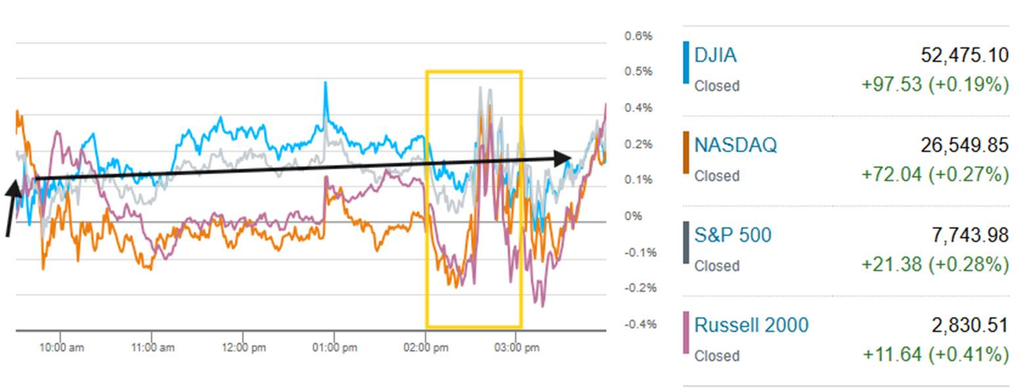
- US equity indices started the session modestly higher and ended that way after a lot of volatility, particularly during the FOMC decision and press conference (yellow box), although the range was well under 1%. The Russell 2000 (+0.4%) led, followed by the S&P 500 (+0.3%), Nasdaq (+0.3%) and Dow Jones Industrial Average (+0.2%), all up for a third straight session.
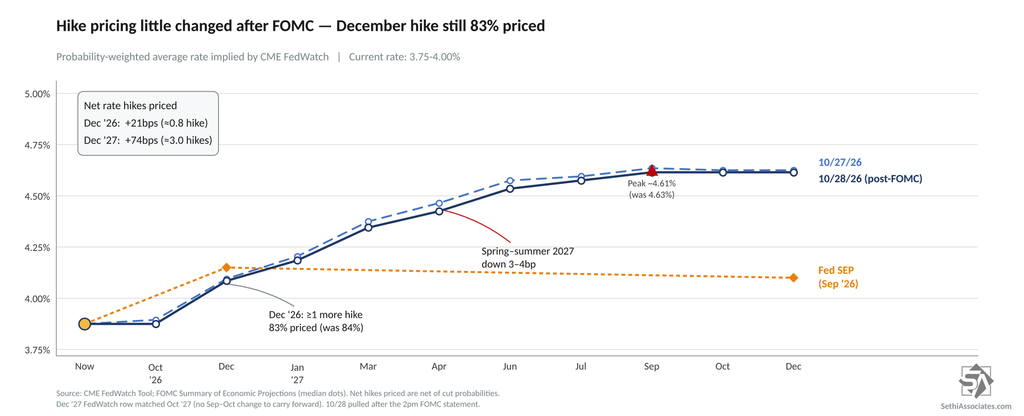
- The Fed held rates at 3.75% to 4% in a 10-2 vote, with Governor Lisa Cook and Cleveland Fed President Beth Hammack dissenting in favor of a hike, but offered no clear signal on December (more here: FOMC Holds Rates Steady; Governor Cook Dissents) with the statement saying the “accumulation of more information will help the committee determine the policy stance appropriate to ensure a timely return of inflation to the committee’s 2% goal.” Chair Warsh also announced the committee would be moving to six interest rate decisions from eight by 2028. Hike expectations were little changed following the decision and Chair Warsh’s press conference, with December at an 83% chance of a hike and 74 basis points of hikes priced through December 2027.
- Oracle (ORCL) jumped 10.7% after providing at its investor day “an aggressive financial and growth strategy, projecting more than 35% compound annual revenue growth from fiscal 2026 to fiscal 2030 and total revenue of at least $225 billion by fiscal 2030” per TipRanks. That lifted AI infrastructure names such as CoreWeave (CRWV) (+7.3%) and Nebius Group (NBIS) (+7.0%). Chips also extended their rebound after SK Hynix’s (SKHY) record results (more here: SK Hynix Gives Another Boost to Chip Stocks), with the Philadelphia Semiconductor Index (SOX) up for a fourth straight session gaining 1.8%.
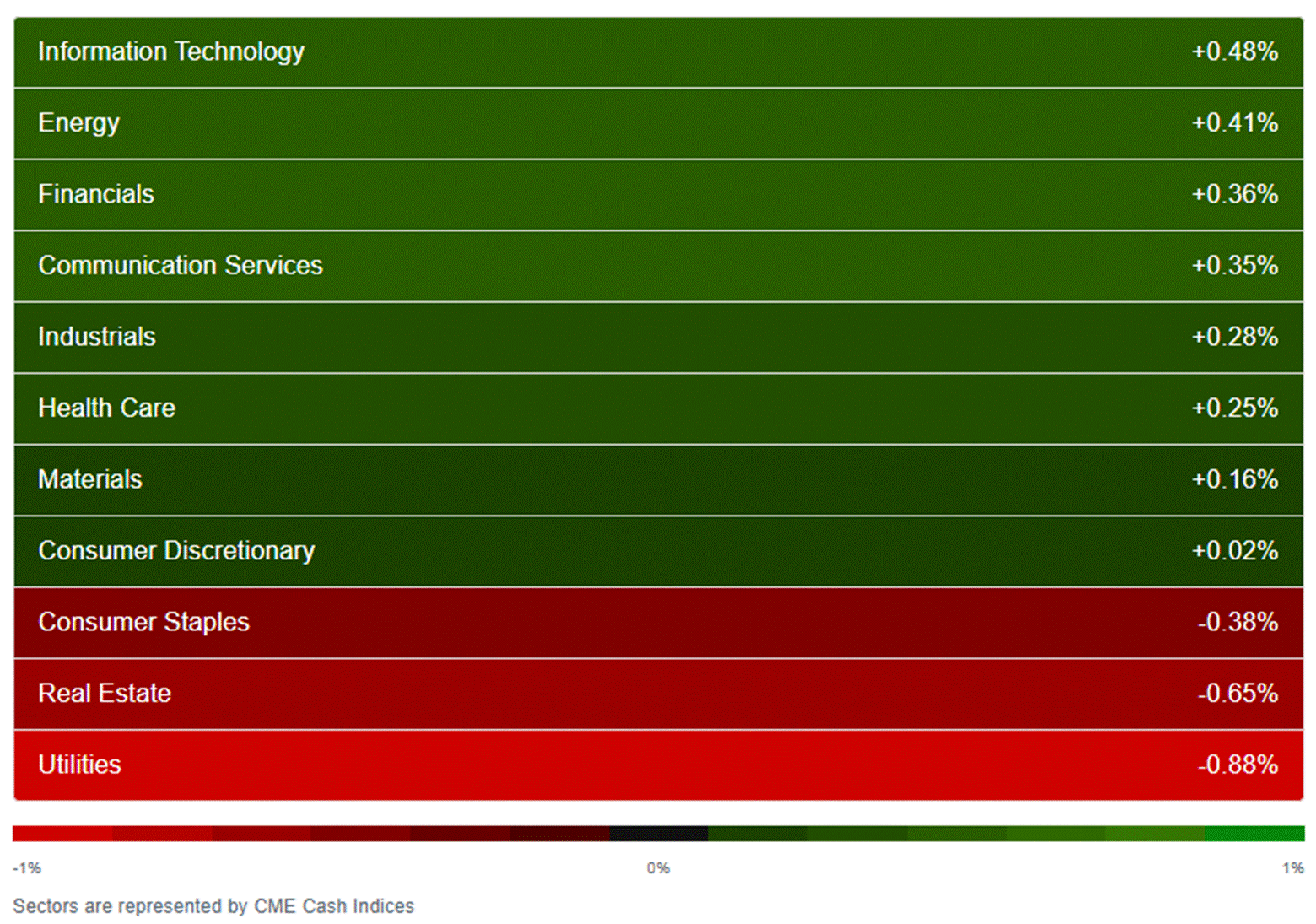
- Eight of 11 sectors rose, led by Tech (+0.48%), while rate-sensitive Utilities (-0.88%), Real Estate (-0.65%) and Consumer Staples (-0.38%) lagged as longer-term yields rose modestly. Breadth was mixed, with decliners narrowly outnumbering advancers on the NYSE while advancers led about 4-to-3 on the Nasdaq, per Briefing.com.
- Short-dated Treasuries outperformed. The 2-year yield finished the cash session unchanged at 4.74% while the 10-year rose 5 basis points to 5.05% and the 30-year 6 basis points to 5.36% per Briefing.com.
- WTI rose 2.9% to $102.74 a barrel on renewed Iran concerns, with regional mediators led by Qatar pressing Iran for nuclear concessions as the possibility of US strikes after the midterms looms, per Axios.
- The September goods trade gap widened to an 18-month high on record capital goods imports, the category which contains AI-related equipment (more here: AI Imports Push Goods Trade Gap to 18-Month High).
- After the close, Microsoft (MSFT) rose over 2% after a double beat as Azure growth accelerated (more here: Microsoft Rises on Double Beat as Azure Growth Accelerates), while Alphabet (GOOGL) fell about 9% on an earnings miss and negative free cash flow (more here: Alphabet Drops on Earnings Miss, Cash Flows Turn Negative).
- Thursday brings Q3 GDP and September PCE prices, the ECB decision and Amazon’s (AMZN) results after the close.
Schwab
Market Commentary
Equities:
- “We are in the middle of the largest infrastructure build-out and it’s accelerating,” Vertiv Holdings CEO Giordano Albertazzi said in a statement. “The demands on data center infrastructure are evolving faster than ever, and Vertiv’s role in that buildout keeps expanding.”
- “The near-term cycle remains incredibly healthy,” said Bill Northey, investment director at U.S. Bank Asset Management Group. “It’s really about can it remain durable for many years, and what are the returns to those who are investing significantly today. Will it be universally a profitable endeavor, or will there start to be some winners and losers that emerge there, and we tend to think that it leans towards the latter.”
Bonds/Fed:
- The “Fed may well be one and done again this time around,” David Rosenberg, founder and president of Rosenberg Research & Associates, wrote in a Wednesday client note. “Based on what is priced in, that could well set us up for a return next year to 4.25% for the 2-year note and 4.5% for the 10-year (a nice +9% net total return).”
- “The Fed appears comfortable being patient for now as financial conditions have evolved broadly in line with expectations,” said Luis Alvarado at Wells Fargo Investment Institute. “But patience should not be confused with complacency.”
- “While more Fed hikes remain in store in the coming months, we think the current backdrop remains favorable,” said Ulrike Hoffmann-Burchardi at UBS Chief Investment Office. “We do not believe a measured tightening cycle will derail the US economy.”
- “Nothing from today rules out another 25 bp hike before year-end,” said Jeff Schulze, head investment strategist at Franklin Templeton Institute. “The key question for markets is the pace of tightening, and the Committee seems content to unwind last year’s cuts at a measured pace which historically has been more favorable for risk assets.”
- “The Fed has time on its side. Inflation expectations remain anchored and second-round effects are limited, giving policymakers room to wait for more data. AI may be booming, but the broader economy is not firing on all cylinders, and elevated geopolitical uncertainty argues against rushing another hike. But the direction of travel remains clear. The Fed is still taking back some of last year’s rate cuts, and the two dissents underline that tightening bias,” said Seema Shah, chief global strategist at Principal Asset Management.
- “Warsh noted that there will be few policy setting meetings going forward, suggesting that some meetings may price for greater moves and risks and more rate-market volatility around meetings, particularly if forward guidance continues to be reduced,” said Bloomberg Intelligence’s Ira Jersey. “The market isn’t yet pricing for this type of increase volatility, but we suspect realized volatility may rise due to this shift.”
- “The change in meeting schedules and implications for perceived Fed dovishness/hawkishness will be highly relevant for the mid-term dollar dynamics,” said Bloomberg Intelligence’s Audrey Childe-Freeman. “In fact, this may not help Fed’s predictability a lot, and that may explain the dollar selloff on this announcement. Meanwhile, those hoping for a clear hint that a December rate rise was on the table may also be slightly disappointed and have to adjust back to a data watching mode into the December meeting, again slightly disappointing for dollar bulls.”
Stock and Sector Breakdown
Schwab
A more muted day overall with no sector gaining or losing more than 0.9%. Eight of 11 sectors rose, led by Tech (+0.48%) — its ninth straight session in the top two or bottom two sectors — with Energy (+0.41%), Financials (+0.36%), Communication Services (+0.35%), Industrials (+0.28%), Health Care (+0.25%), Materials (+0.16%) and Consumer Discretionary (+0.02%) also higher. The rate-sensitive sectors lagged as longer-term yields rose, with Utilities (-0.88%), Real Estate (-0.65%) and Consumer Staples (-0.38%) the only decliners.
Vertiv Holdings (VRT) (+16.5%) was the best performer in the S&P 500 after third-quarter EPS of $1.95 on revenue of $4.31 billion beat estimates of $1.82 and $3.75 billion, with revenue up 61% and updated guidance (TipRanks). F5 (FFIV) (-20.4%) was the worst as its fiscal first-quarter guidance came in light and drew a downgrade, overshadowing a fourth-quarter beat (TipRanks).
Oracle (ORCL) jumped 10.7% after it unveiled long-term growth and profit targets (TipRanks) on top of news that OpenAI and Oracle will use Google’s chips. Doug Kass noted that he found it “more interesting that Nvidia is rolling over” (On Nvidia and Oracle), with Nvidia (NVDA) down 1.2%. Rev Shark summed up the day by saying the “Oracle reassurance moved the market more than the Fed did” (Microsoft Beats, Alphabet Misses and Fed Holds Steady).
Memory and chip-equipment names extended the chip rebound after SK Hynix (SKHY) said it’s sold out of DRAM and high-bandwidth memory through 2029 (more here: SK Hynix Gives Another Boost to Chip Stocks). Sandisk (SNDK) rose 7.7%, Micron Technology (MU) 5.9%, Lam Research (LRCX) 5.4% and Applied Materials (AMAT) 5.1%, while Seagate Technology (STX) added 4.5% after its report. Stephen Guilfoyle updated his Micron price target, Chris Versace is increasing the Portfolio’s exposure to Applied Materials, and Bob Lang asked whether this is the right spot for Applied Materials. The Philadelphia Semiconductor Index (SOX) gained 1.8% for a fourth straight gain.
Earnings drove most of the rest. Flex (FLEX) (+11.6%), Labcorp (LH) (+8.8%), GE HealthCare (GEHC) (+6.6%) and Amphenol (APH) (+3.5%) rallied on their reports. On the downside, CoStar Group (CSGP) (-14.0%) fell even after a record quarter and higher outlook (TipRanks), C.H. Robinson (CHRW) dropped 11.1%, Lennox International (LII) slid 10.6% after third-quarter adjusted EPS of $6.84 missed the $7.36 consensus (TheFly), Baker Hughes (BKR) lost 7.4%, and Old Dominion Freight Line (ODFL) fell 7.3% despite beating EPS estimates (TheFly). Boston Scientific (BSX) (-5.8%) was downgraded to neutral at JPMorgan (TheFly), and Waste Management (WM) fell 4.5% after its quarter fell short (Chris Versace: New Waste Management Price Target After Shortfall).
Outside the index, Brinker International (EAT), the owner of Chili’s, jumped 12.2% after raising its full-year guidance to adjusted EPS of $13.30 to $13.90, above the FactSet consensus of $13.28, and lifting its revenue projections. TD Cowen raised its price target to $270 from $250 (TheFly).
After the close, beyond Microsoft and Alphabet, ServiceNow (NOW) sank about 16% after third-quarter EPS of $1.00 came in a penny below the $1.02 consensus (TheFly). Ford Motor (F) slipped about 2% even after third-quarter EPS of 49 cents beat the 40-cent consensus and it raised the low end of its full-year adjusted EBIT outlook to $10.5 billion to $11 billion (TheFly). Chipotle Mexican Grill (CMG) rose about 6% even though third-quarter adjusted EPS of 27 cents missed the 29-cent consensus, as it backed its full-year outlook for low-single-digit comparable sales growth (TheFly). After-hours moves are as of about 5:30pm ET.
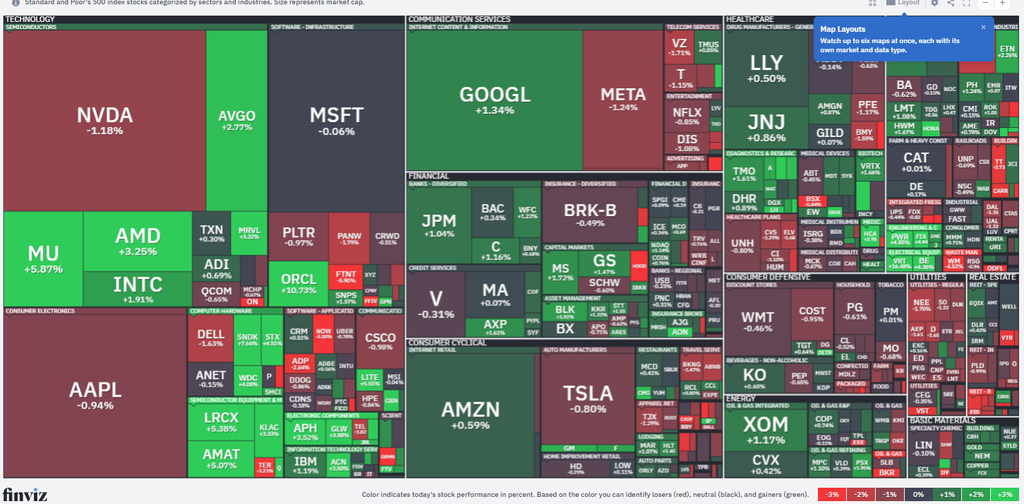
The number of large SPX winners (up over 3%) fell to 33 from about 70 Tuesday, while large losers (down over 3%) slipped to 23 from about 30.
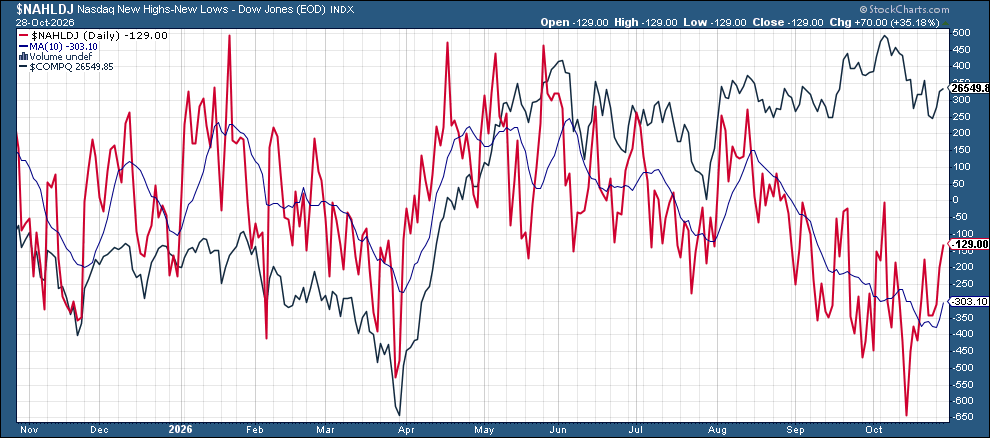
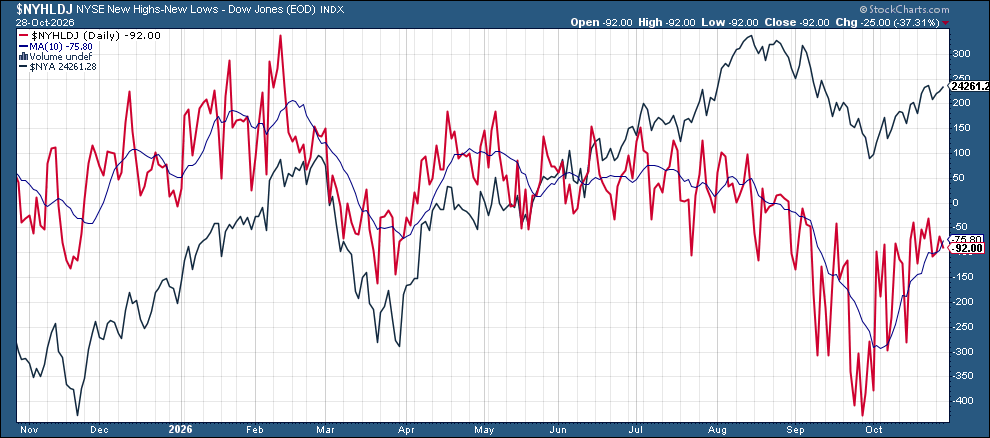
52-week highs minus lows also weakened to -92 on the NYSE but improved to -129 on the Nasdaq. That’s still 43 straight negative sessions for the Nasdaq, tying the stretch that ended April 22, 2025.
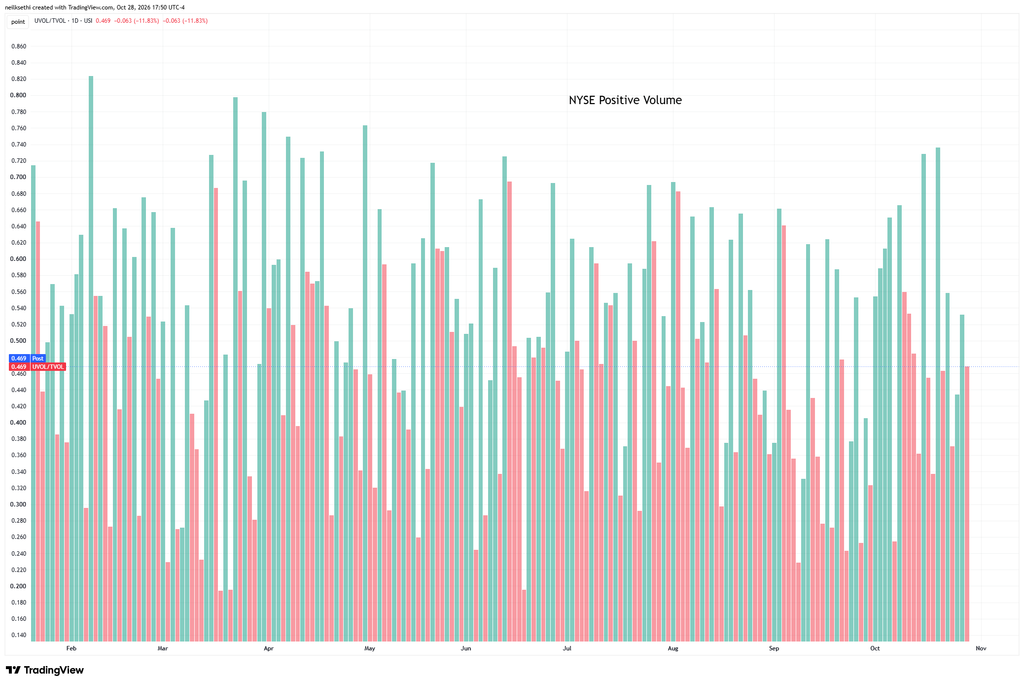
Positive volume was disappointing at 46.9% on the NYSE despite the index gaining 0.21% vs 0.10% Tuesday.
Some other stock-specific commentary from TheStreet Pro:
Doug Kass — A Big Warning to Buyers of the Anthropic IPO: since 2010, the average drawdown in the first 12 months of the 20 largest IPOs is -60%. He also shorted more SPY and covered part of his Apple short.
James “Rev Shark” DePorre — As I Await Microsoft, Alphabet Earnings, Here’s What I’m Not Doing
Ed Ponsi — A Cloudy Forecast? Grading the Neocloud Stocks: CoreWeave (CRWV), Nebius (NBIS) and IREN (IREN).
Stephen Guilfoyle — Trading Around Small-Cap Names Ahead of Fed Rates Decision, including a new look at SoFi (SOFI).
A Look At The Charts
Note on all charts the colored lines are moving averages (the average price over the lookback period — days on the daily charts, weeks on the weekly charts):
20 = green
50 = purple
100 = blue
200 = brown
Exception is monthly charts where blue is 10-month moving average and brown is 20-month moving average.
MACD = Moving average convergence/divergence line, a measure of momentum that compares longer term and shorter term momentum to gauge if a move is strengthening or weakening. This is probably my favorite individual indicator.
RSI = Relative Strength Index (basically what it sounds like) = measures the strength of the move comparing gains to losses over the given lookback window (I use the standard 14 periods).
SPX
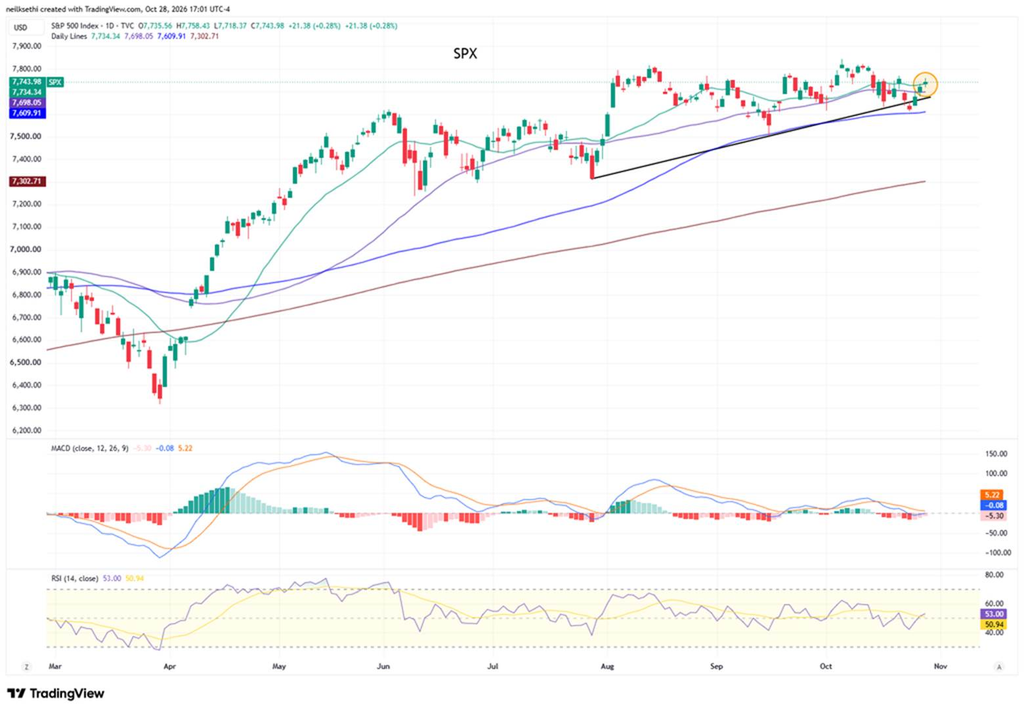
The SPX rose 0.28% to 7,743.98 for a third straight gain, closing above its 20-DMA (7,734) and holding above its 50-DMA (7,698) and the trendline from the July low (circled). It hit 7,758 intraday. The daily MACD remains in “sell longs” positioning but is close to crossing back, and the RSI is at 53.
Nasdaq Composite
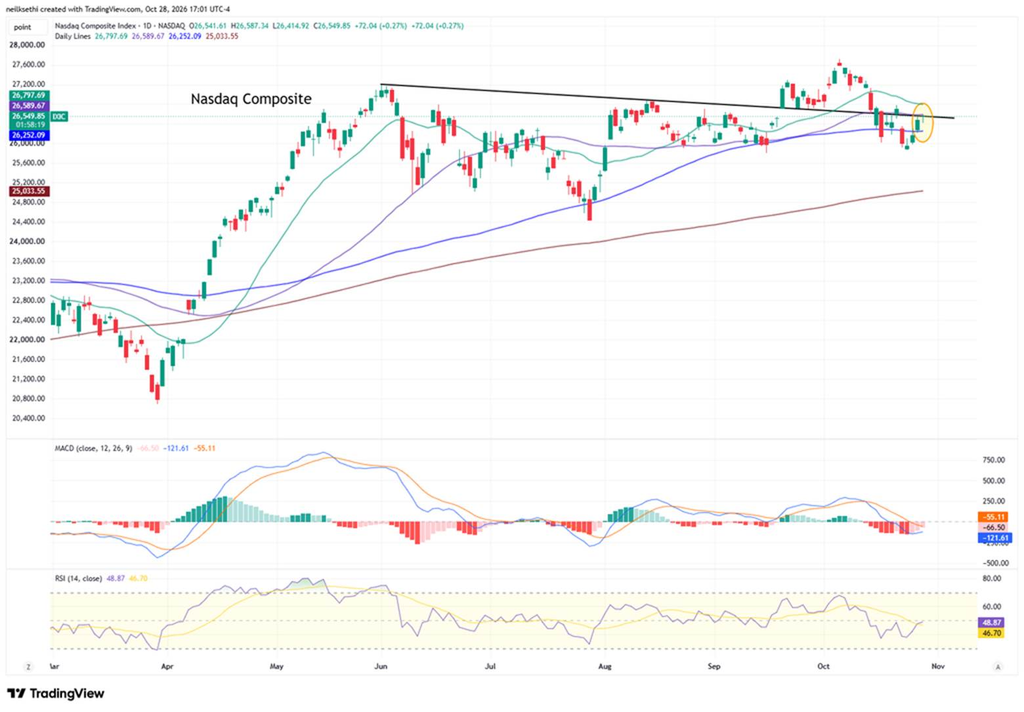
The Nasdaq Composite added 0.27% to 26,549.85, holding above its 100-DMA (26,252) but closing just under its 50-DMA (26,590) and the downtrend line from the June high (circled). The MACD remains in “sell longs” positioning, and the RSI is at 49.
The Nasdaq-100 (QQQ)
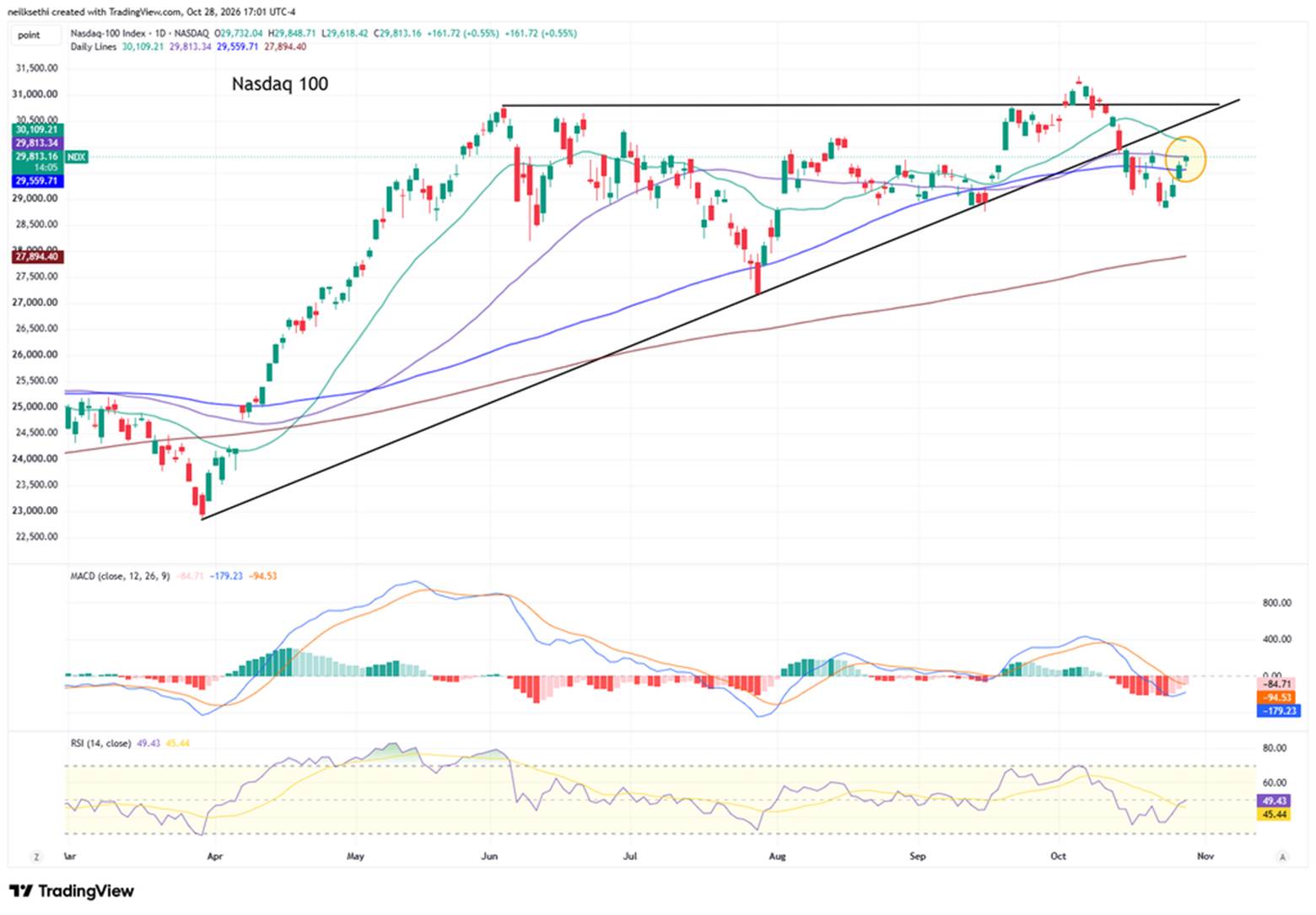
The Nasdaq-100 rose 0.55% to 29,813.16, closing right at its 50-DMA (29,813.34). As I noted, I’d sell bounces until it reclaims that level, so it’s sitting right at the decision point but will have trouble if Alphabet remains down sharply tomorrow. The MACD remains in “sell longs” positioning, and the RSI is at 49.
The Russell 2000 (IWM)
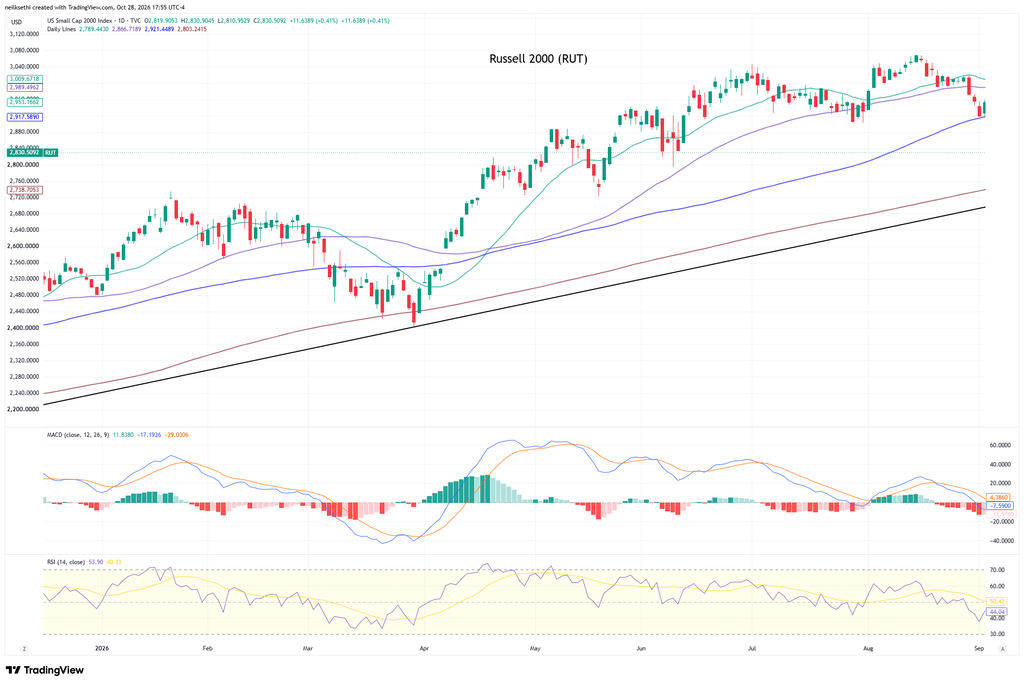
The Russell 2000 rose 0.41% to 2,830.51 for a third straight gain, holding above its 200-DMA (2,803) and 20-DMA (2,789) and the uptrend line from last year’s low (circled). The MACD remains in “cover shorts” positioning, and the RSI is at 54.
The equal-weighted SPX (RSP)
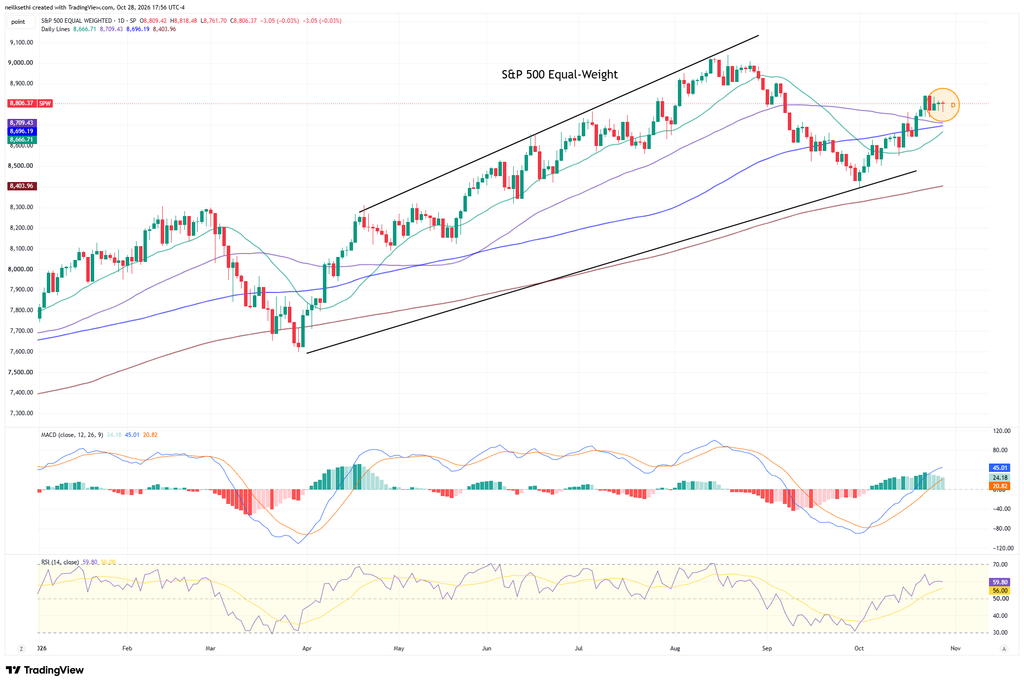
The equal-weighted SPX slipped 0.03% to 8,806.37, lagging the cap-weighted index for a third straight session, but it remains above all its moving averages, with the MACD in “buy longs” positioning and the RSI at 60.
The 2-year Treasury
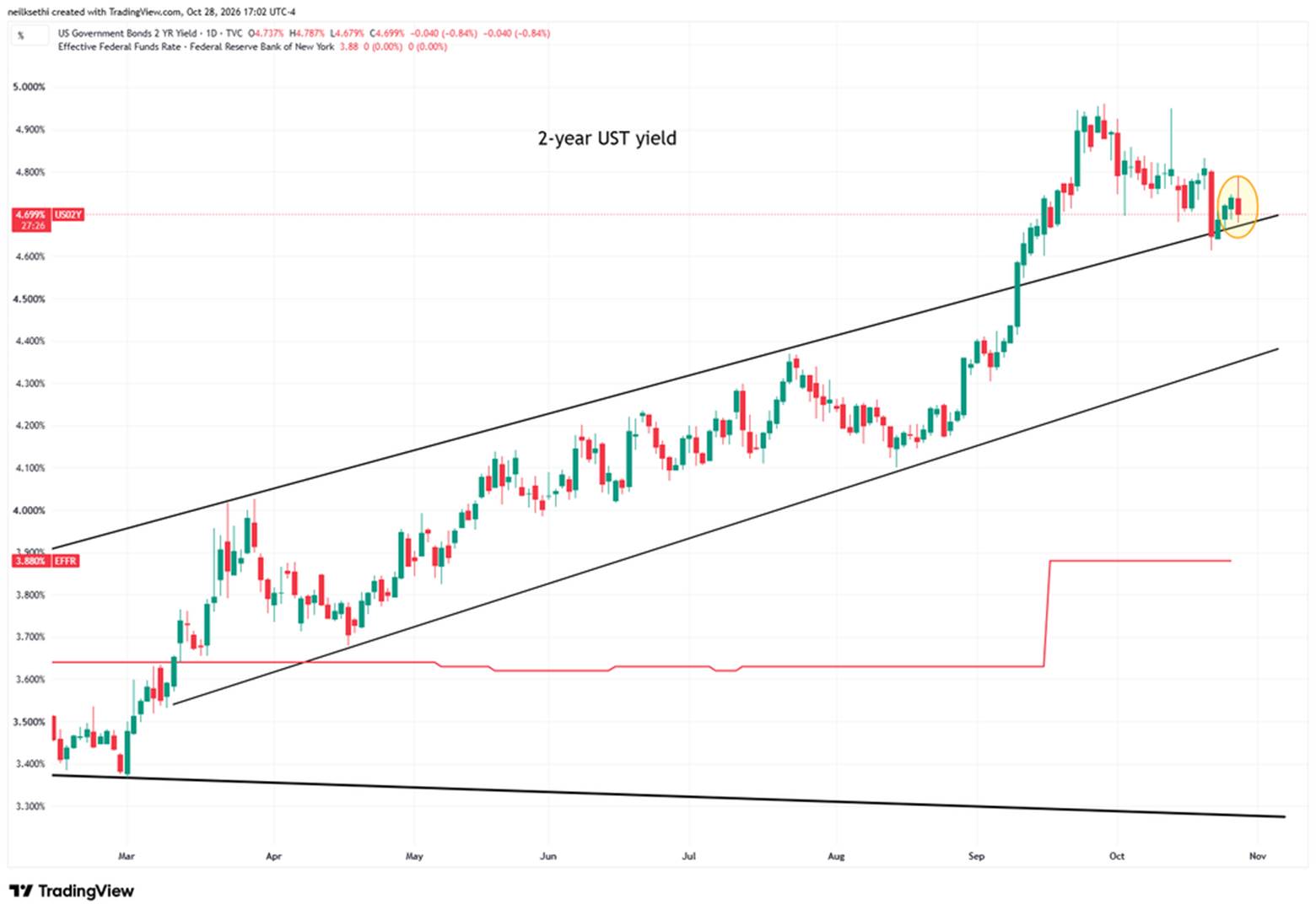
The 2-year yield fell 4.0 basis points (including post-market) to 4.699%, back to the top of its old channel (circled), which is acting as support. That leaves it about 82bp above the EFFR (3.88%). Ahead of the meeting, BofA flagged that short-maturity CTA shorts could be at risk from a dovish Warsh (2-Year Treasury Shorts at Risk?).
Fed rate hike expectations were little changed after the meeting. December is an 83% chance of a hike (from 84% before the decision), with 21 basis points of hikes priced by December 2026 (about 0.8 hikes) and 74 basis points through December 2027 (about three hikes), from 75bp, per CME FedWatch.
10-year yields
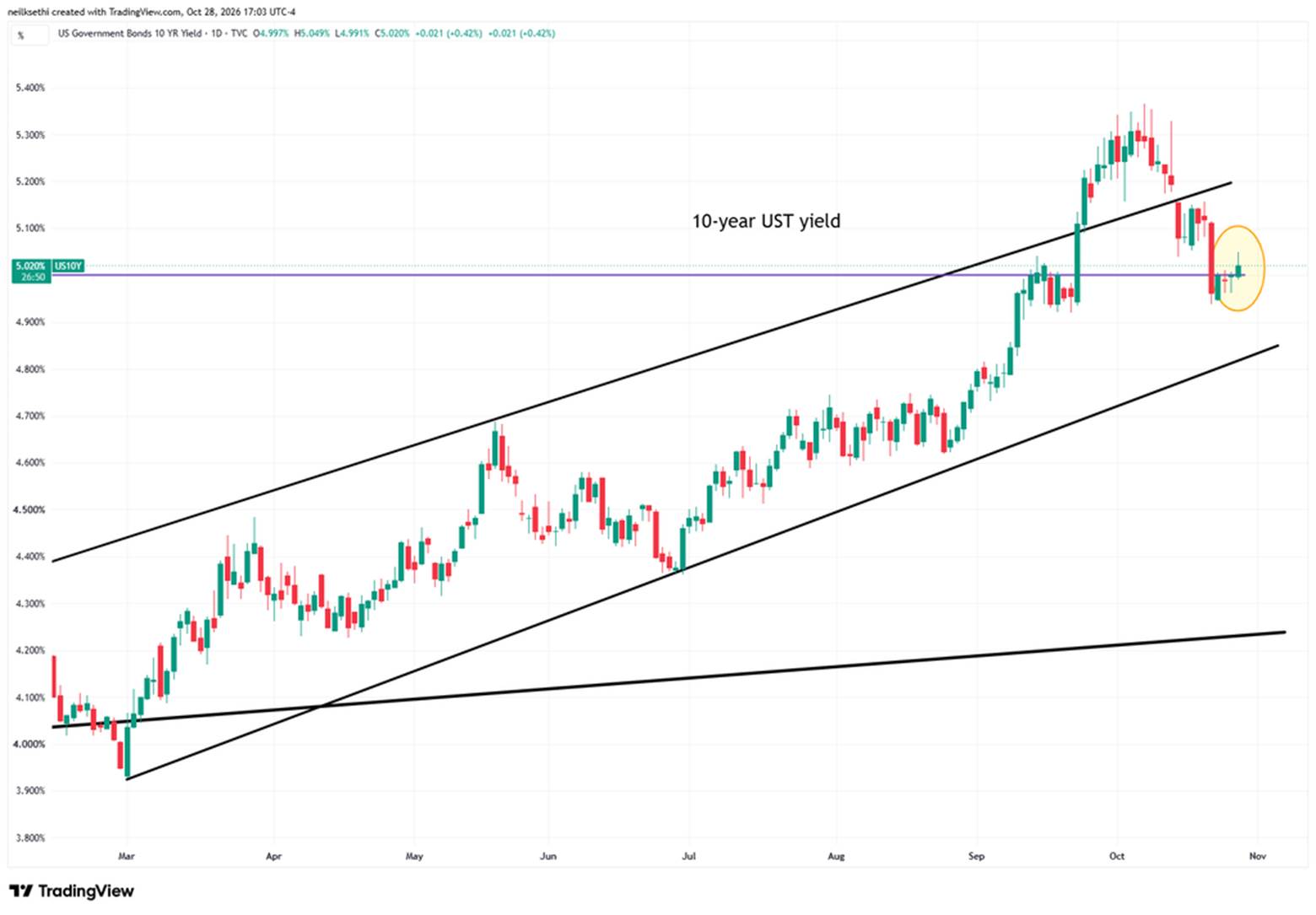
The 10-year yield rose 2.1 basis points (including post-market) to 5.020%, a second straight close above 5%, as the curve steepened with the long end selling off alongside higher oil prices.
30-year yields
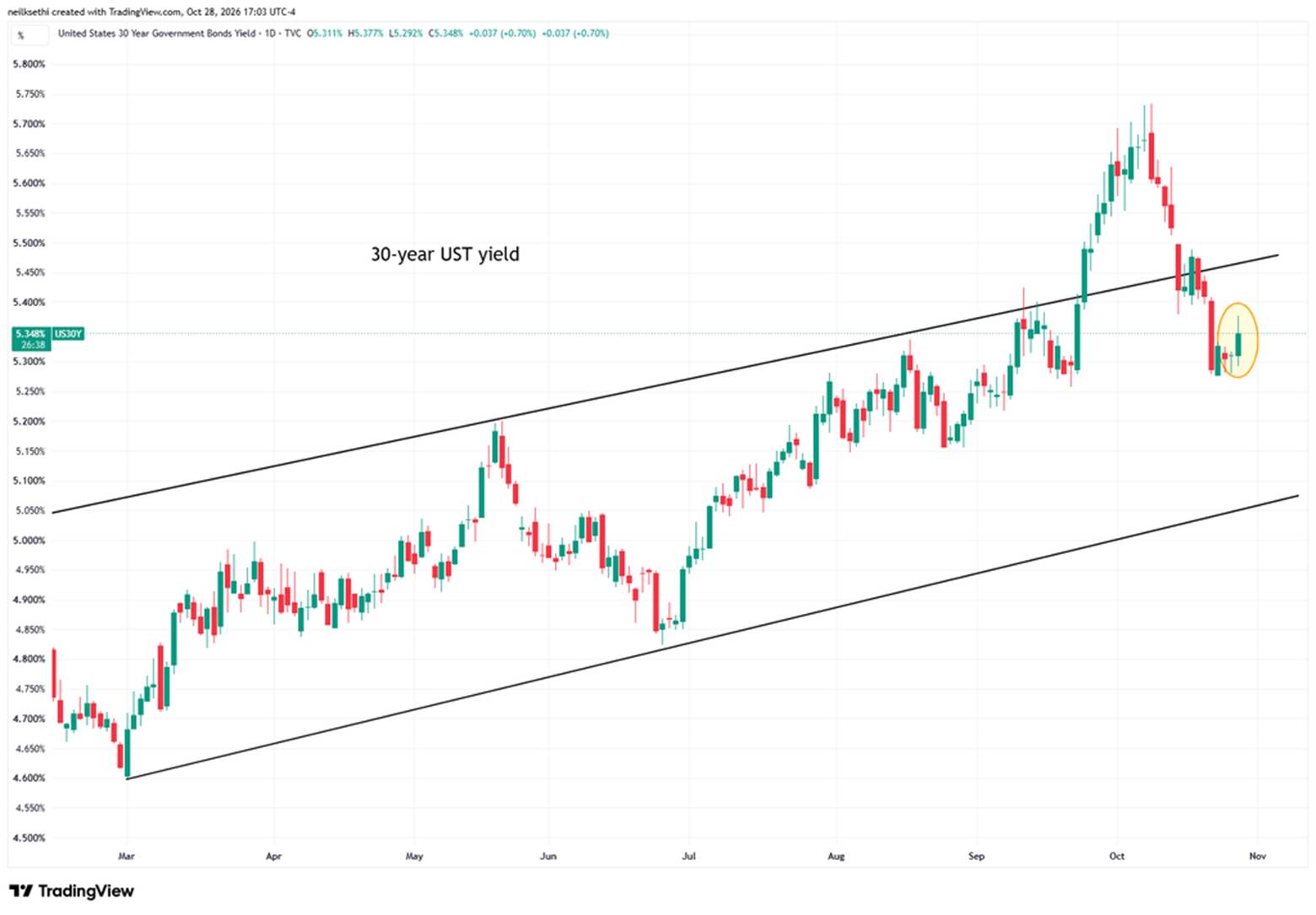
The 30-year yield rose 3.7 basis points (including post-market) to 5.348%.
VIX
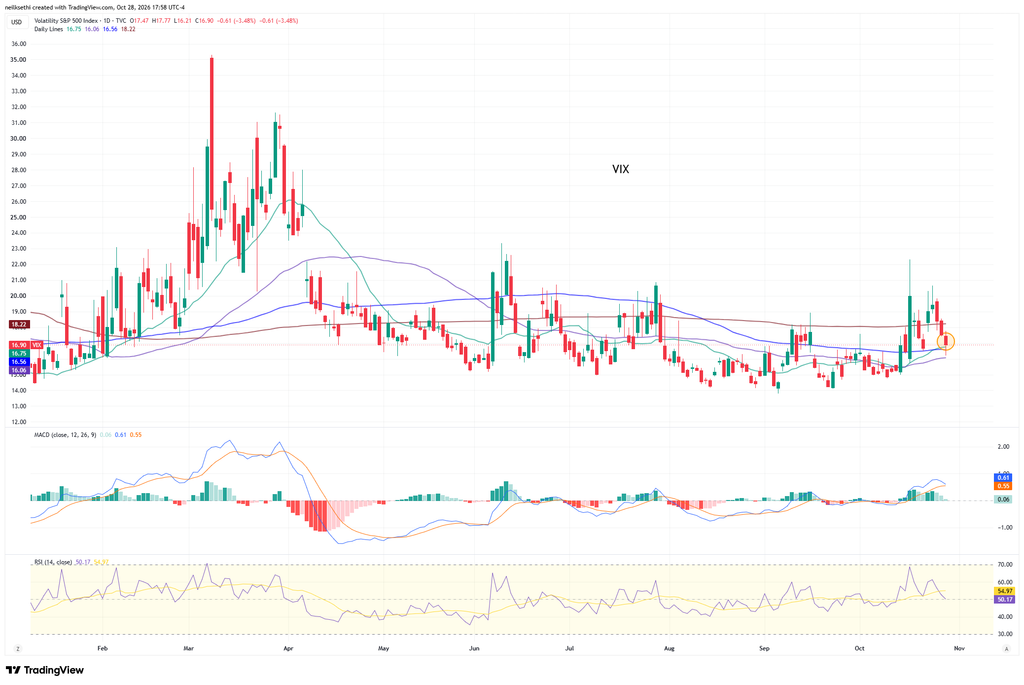
The VIX fell 3.48% to 16.90, implying a daily move of about 1.06% over the next 30 days.
The VVIX
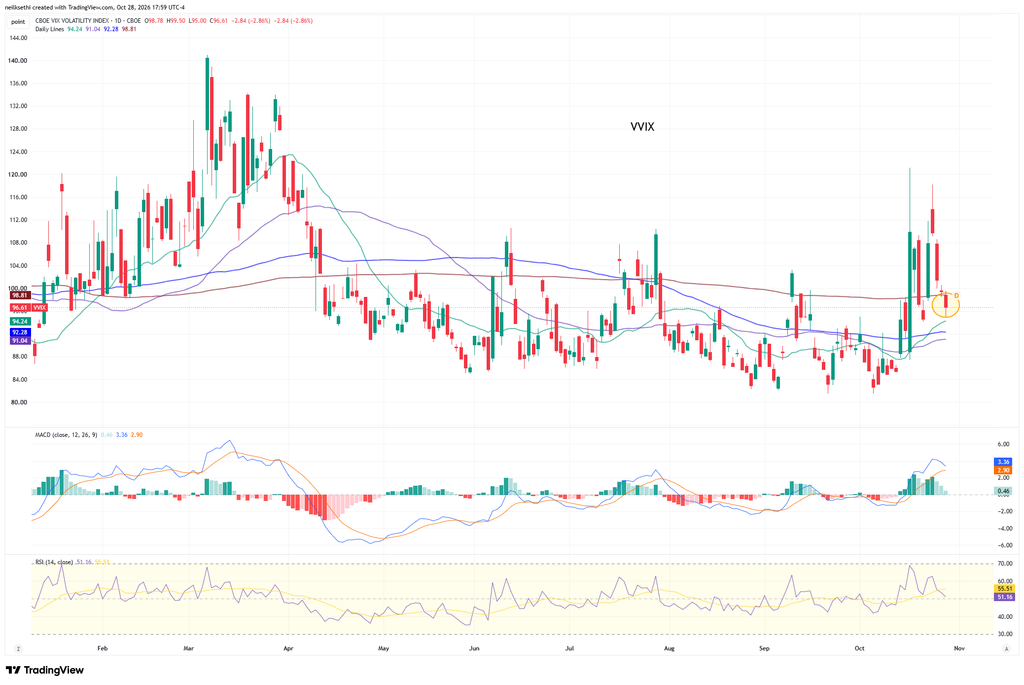
The VVIX (the VIX of the VIX) fell 2.86% to 96.61, a second straight close below 100. The current level is consistent with “moderate” daily moves in the VIX over the next 30 days (historically, normal is 80-100, although we haven’t been below 80 since July 2024), and it’s moved further below the 100 level flagged by Charlie McElligott as indicating higher stress.
1-day VIX
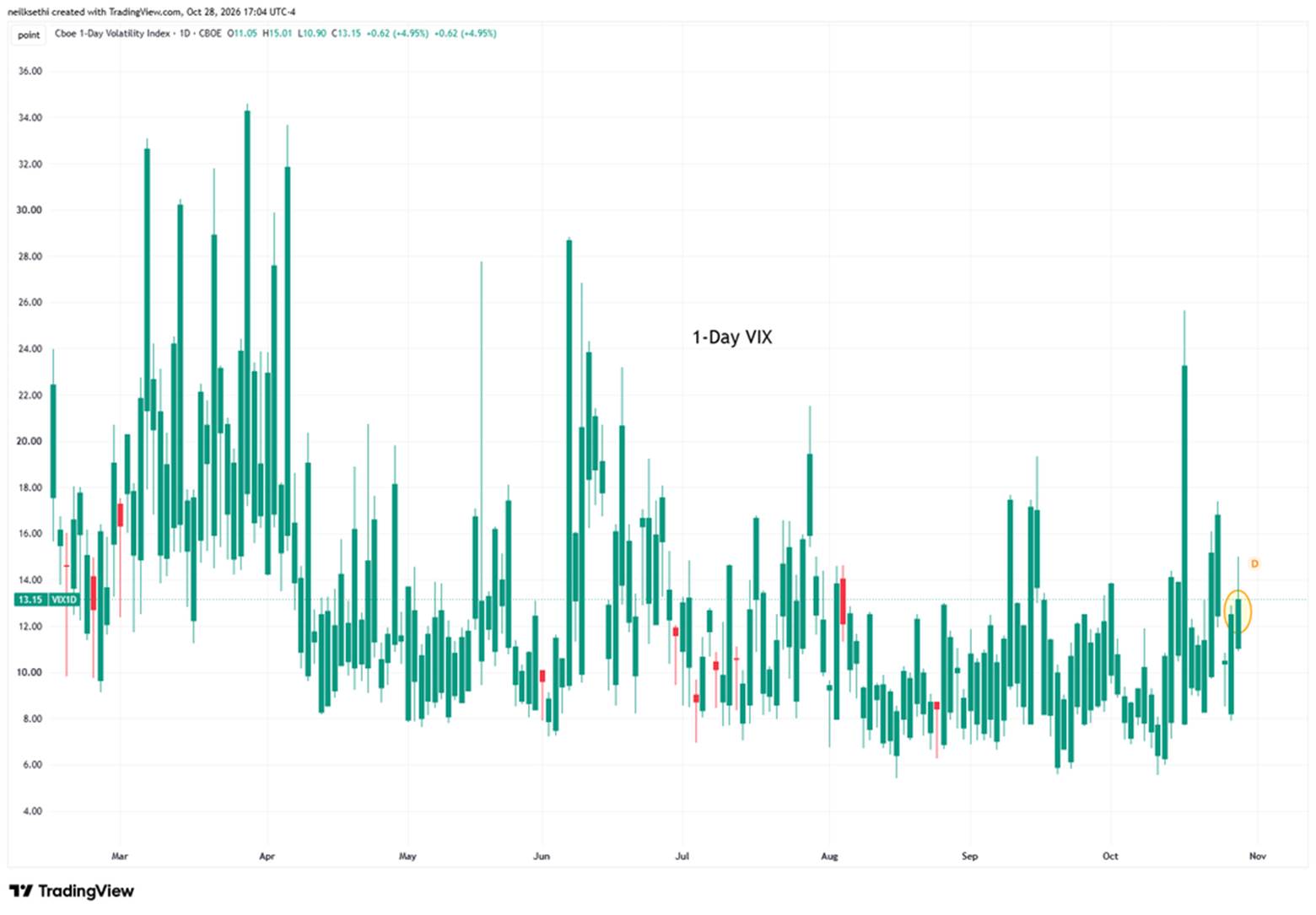
The 1-day VIX rose 4.95% to 13.15 from 12.53 Tuesday as it incorporated the megacap earnings. Tuesday’s level implied a move of about 0.79% for Fed day, and the SPX came in well under that at 0.28%. Tonight’s reading implies a move of about 0.83% for Thursday.
WTI futures (/CL)
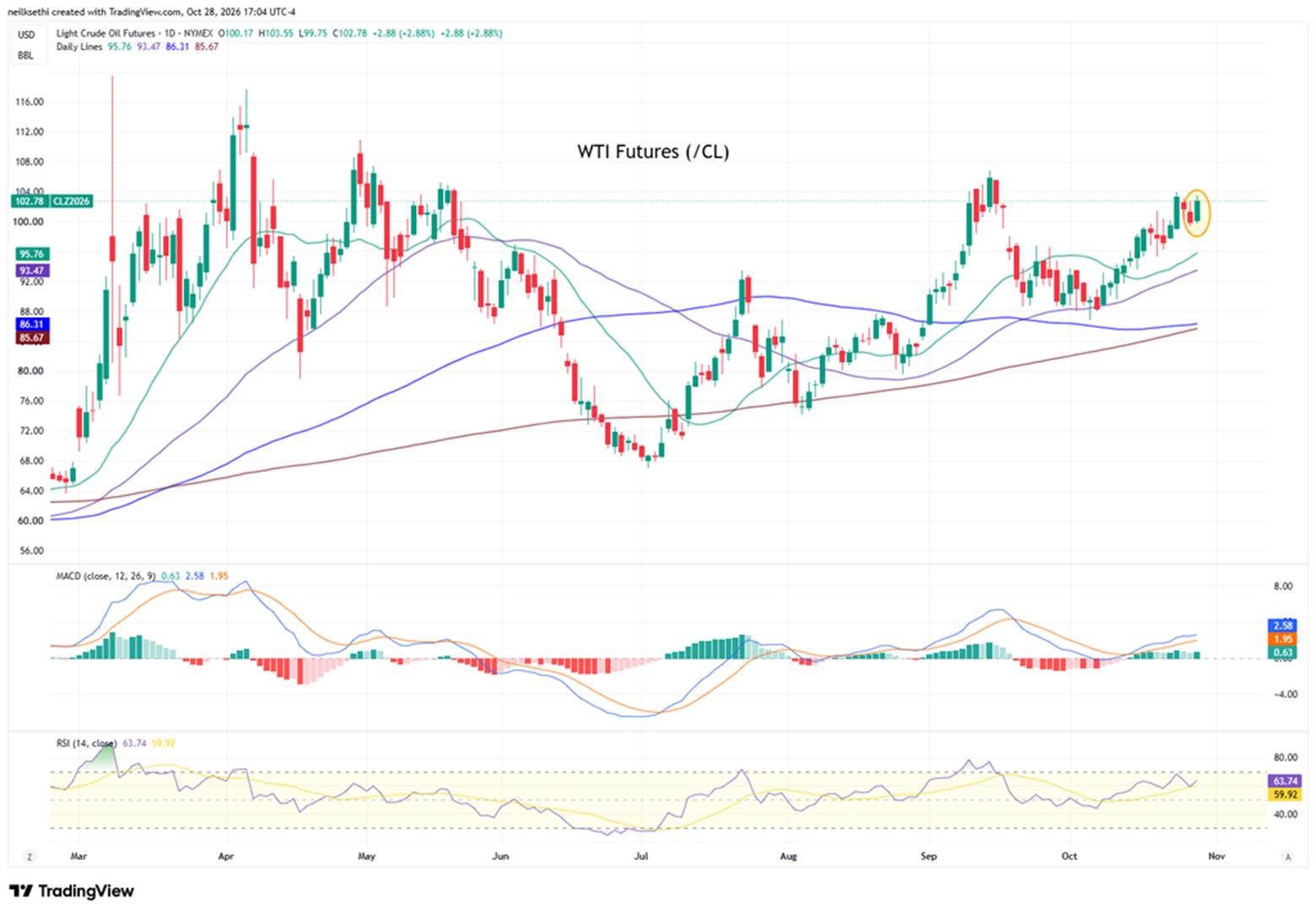
WTI futures, which TradingView has at December currently, rose 2.88% (including post-market) to $102.78 on renewed Iran concerns. They remain above all their moving averages, with the MACD in “buy longs” positioning and the RSI at 64.
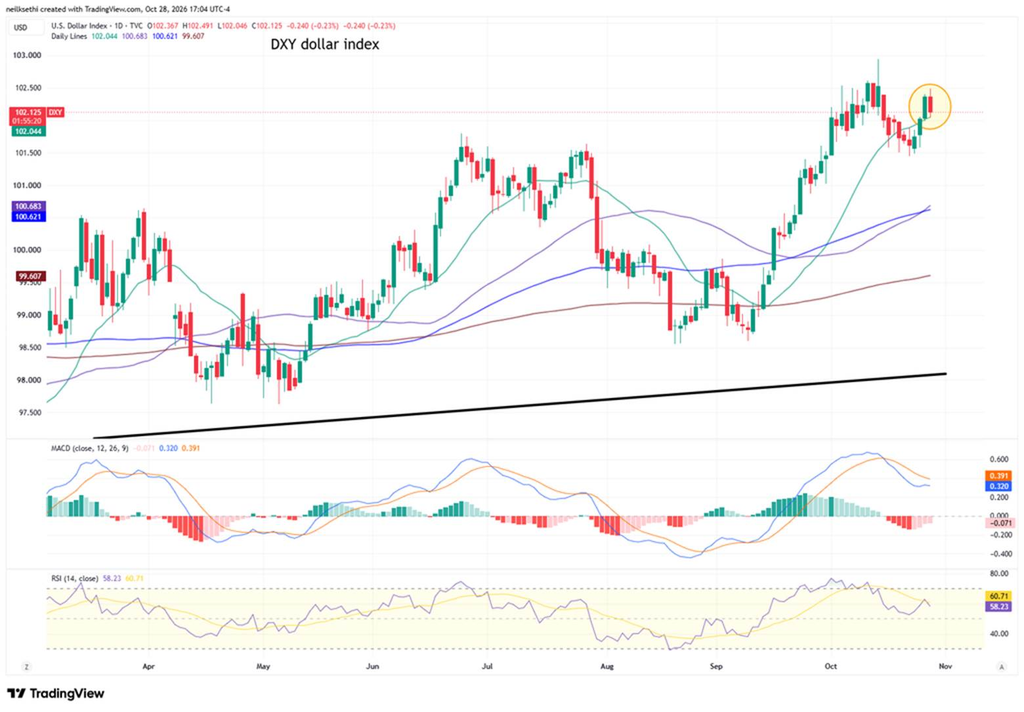
DXY
The DXY dollar index (which is fixed weighted with heavy – 57% – allocation to the euro) fell 0.23% to 102.125, snapping a three-day winning streak. Bloomberg Intelligence’s Audrey Childe-Freeman tied the dollar’s selloff to Warsh’s meeting-schedule announcement (see Market Commentary). It’s still holding just above its 20-DMA (102.044), with the MACD in “sell longs” positioning and the RSI at 58.
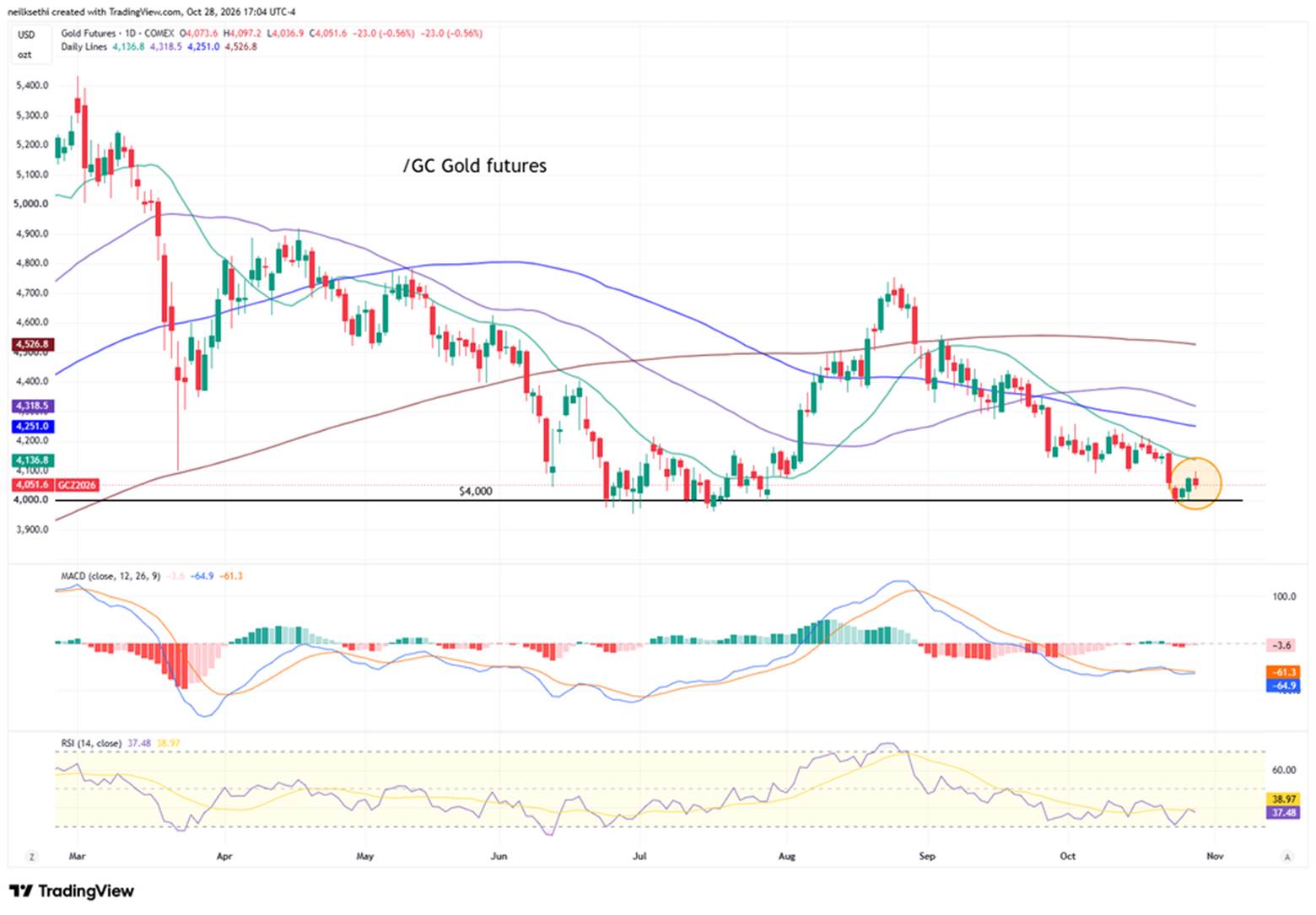
Gold futures (/GC)
Gold futures fell 0.56% (including post-market) to $4,051.60, still above $4,000 (low of $4,036.90) but below all their moving averages, with the MACD in “sell longs” positioning and the RSI at 37. Doug Kass looked at how gold and stocks have been trading together.
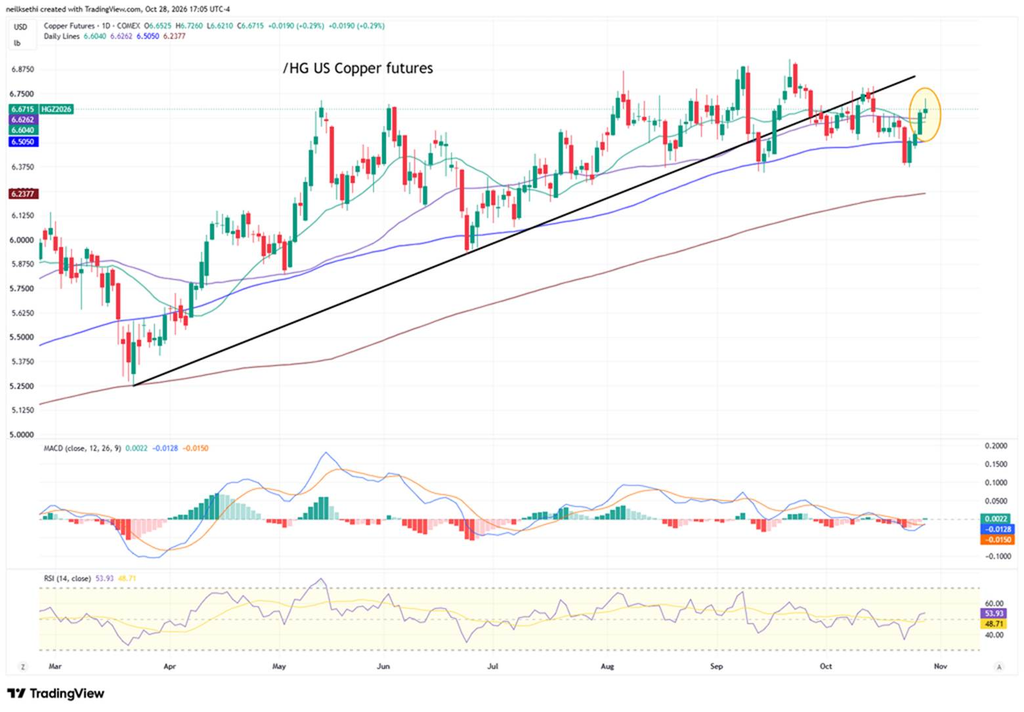
US copper futures (/HG)
Copper futures rose 0.29% (including post-market) to $6.6715, holding above all their moving averages, and the MACD has crossed to “cover shorts” positioning, with the RSI at 54.
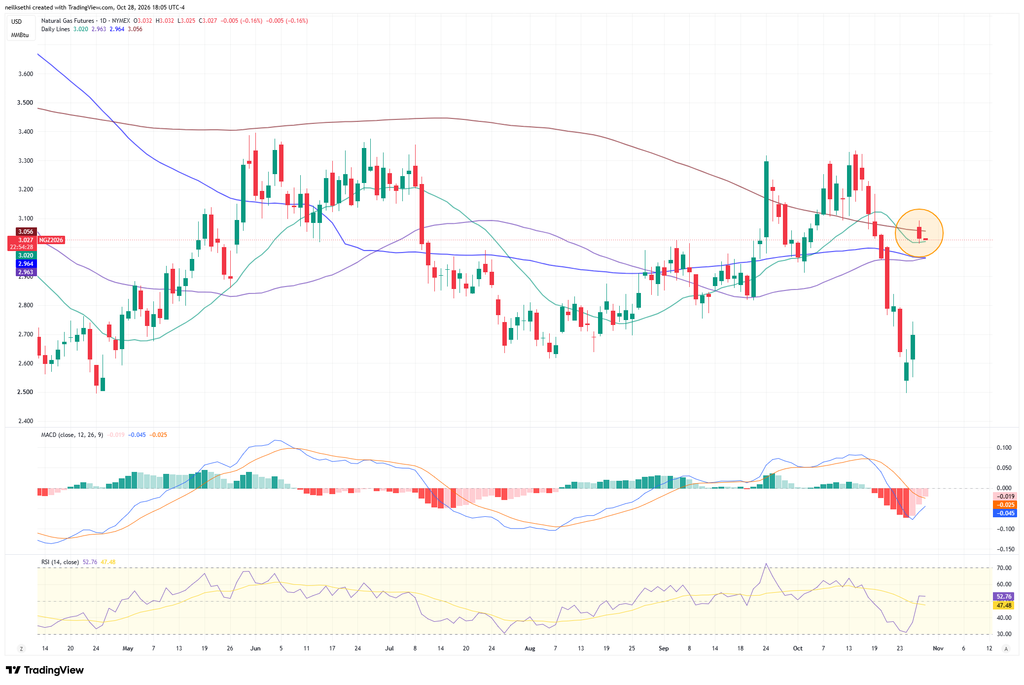
US natural gas futures (/NG)
Natural gas futures show a 12.42% jump (including post-market) to $3.032, but that’s TradingView rolling to the December contract after November expired today. The December contract itself was up about 0.8%. In the past, it has had a tendency to fill these “roll gaps”. We’ll see if that happens this time.
Bitcoin futures
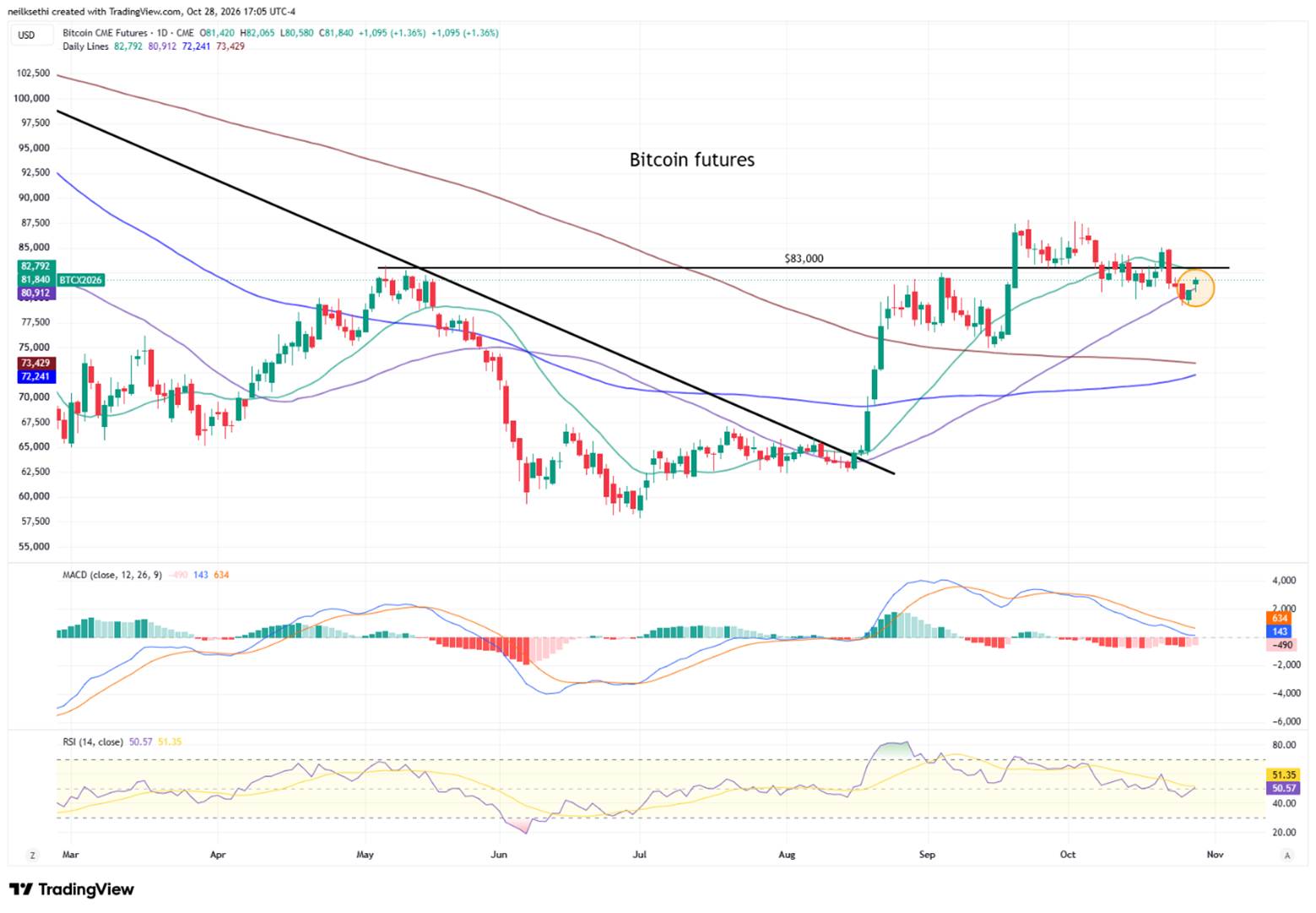
Bitcoin futures rose 1.36% to $81,840, back above their 50-DMA ($80,912) but still below their 20-DMA ($82,792) and the $83,000 level that had been support. The MACD remains in “sell longs” positioning, and the RSI is at 51.
More From TheStreet Pro
Chris Versace —
- Fed Leaves Funds Rate Unchanged, With Warsh Citing More Data Ahead,
- OpenAI and Oracle to Use Google Chips: 8 Key Items Shaping the Stock Market Wednesday
- What We’re Listening for on Waste Management’s Earnings Call
- Another 2027 Inflation Warning
James “Rev Shark” DePorre —
- Big Tech Earnings, the Fed and Iran Are in Play as the Market Tries to Recover
- Microsoft Beats, Alphabet Misses and Fed Holds Steady
Stephen Guilfoyle — ‘The Great Pumpkin Trade’ Spices Up the Market
Bret Jensen — Piling Up Cash as I Brace for the Storm
Peter Tchir — My List of 12 Items Investors Should Watch Today
Jason Meshnick — Question: How Do You Trade FOMC Releases?
Doug Kass —
And From Me If You Missed It
- It’s Not Just U.S. Companies Cutting Jobs With AI, the Dutch Government Is Too
- Wednesday: The Fed, Alphabet and Amazon
- SK Hynix Gives Another Boost to Chip Stocks
- The Fed and the 1-Day VIX
- AI Imports Push Goods Trade Gap to 18-Month High
- Earnings Misses Getting Light Treatment
- 2-Year Treasury Shorts at Risk?
- FOMC Holds Rates Steady; Governor Cook Dissents
- Alphabet Drops on Earnings Miss, Cash Flows Turn Negative
- Microsoft Rises on Double Beat as Azure Growth Accelerates
Miscellaneous
Wrap-Up — Day Four
I said yesterday:
[T]oday that bounce [in AI beneficiaries] continued. Still not a trend, but we haven’t put together three positive sessions on the SOX Semiconductor index in a month, so this is definitely a change from what we’ve been seeing. As a side note, the SOX bounced off its 200-DMA. I wish I had noticed that, as that’s a nice place to play a bounce. It’s got some room before running into more resistance, so technically this can go further even if it is a bounce to sell (which I’m not sure of yet).
Tomorrow though we get another dose of hyperscalers. I have a hard time believing they won’t provide more evidence that the buildout remains full on, further supporting the rally in AI beneficiaries, but I guess you never know.
But along with the AI bounce has come an end to the drop in Treasury yields (although interestingly they haven’t moved much higher either). But for whatever the reason we’ve seen the steam come out of some of those “rotation” plays with Staples down for a third day.
Other sectors though have held in better, so we’re not completely in an “either/or” market quite yet as Helene likes to call it, but it’s definitely a lot less broad than it was until last Friday. We’ll see how this all progresses after we get tomorrow’s earnings.
And now we’ve got four days of gains for the AI beneficiaries, led by chip stocks, and four days of losses for Staples. But, again, other sectors haven’t suffered the way Staples has (at least in terms of being down), and breadth improved today, with eight of 11 sectors up versus six Tuesday, even as rates edged higher again at the long end.
So far it’s still a bounce, but it’s been a good trade for those who caught it. We’ll figure out in the next week or two whether it’s more than that.
Tomorrow brings another hyperscaler, Amazon (AMZN), after the close, along with Q3 GDP and September personal income and spending in the morning. The PCE prices that come with that report are generally well telegraphed, so a hot or cool print would likely be market-moving.
Alphabet (GOOGL) also looks to be a drag on the indices tomorrow unless it turns itself around.
As always, let’s see what we get and go from there.
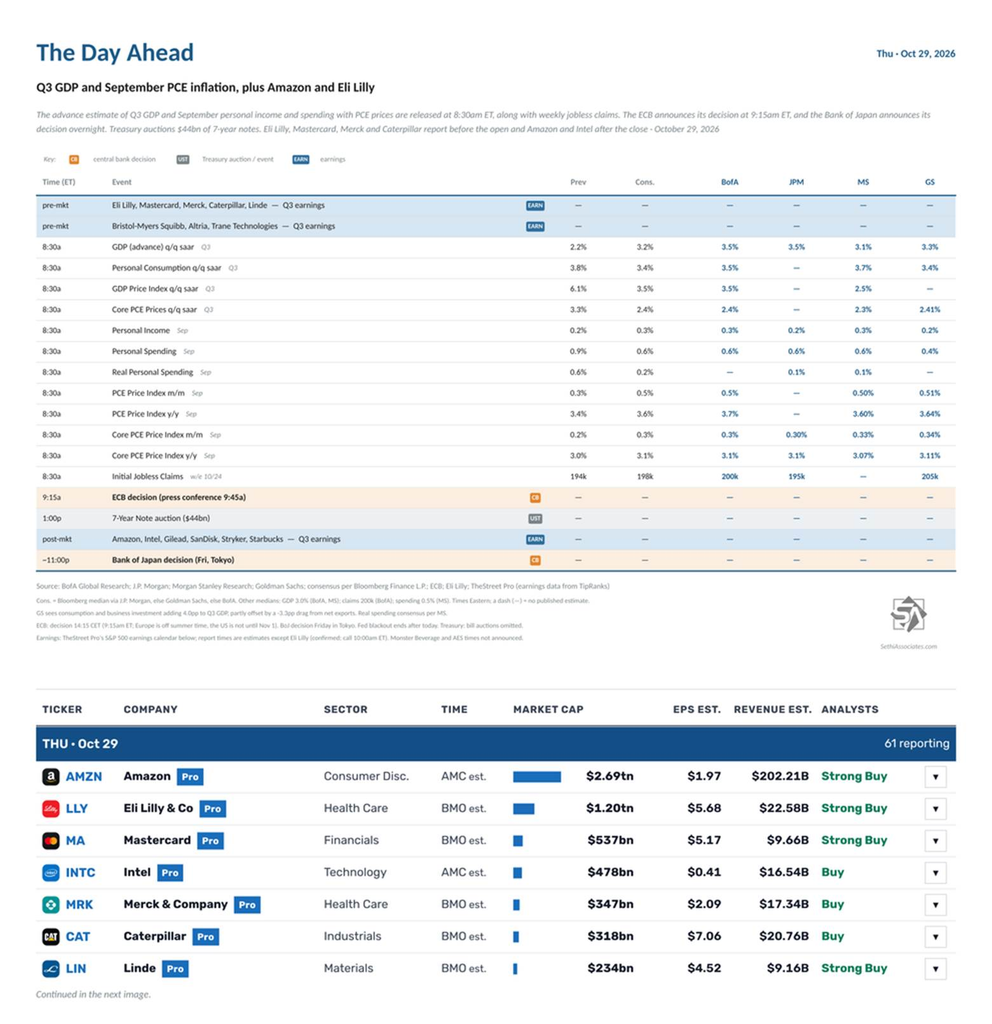
The Day Ahead — GDP and Amazon Headline Another Busy Day
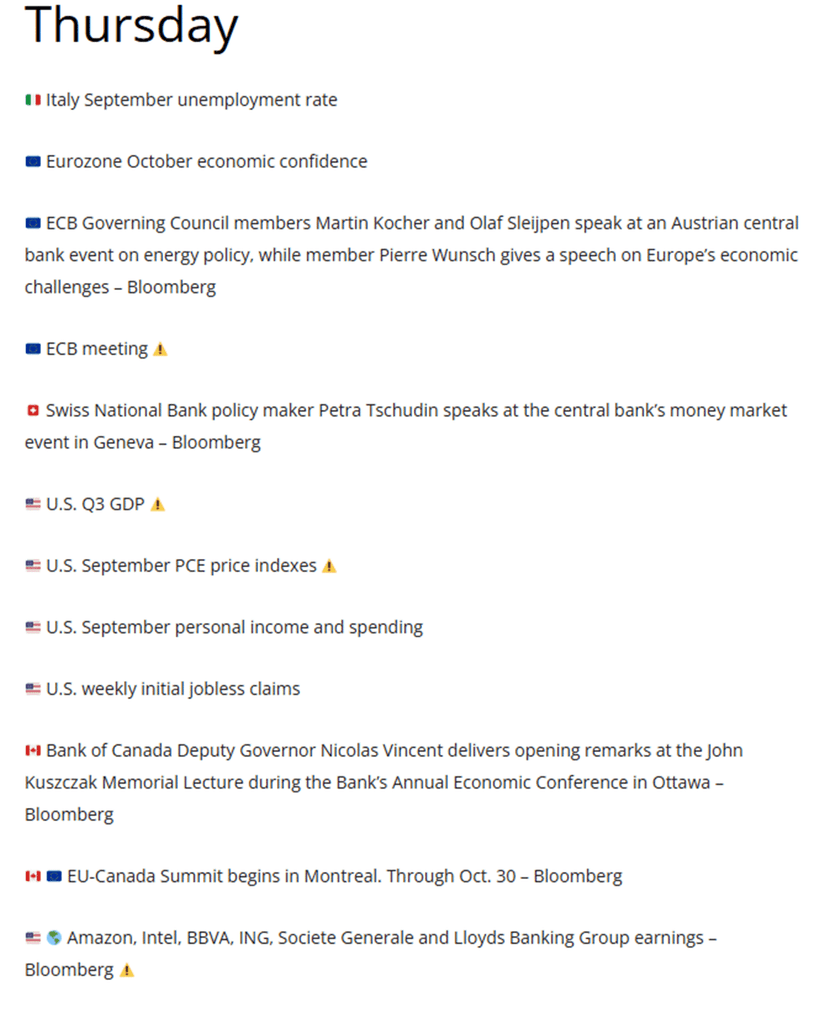
US economic data includes the advance estimate of Q3 GDP, which will incorporate September personal income and spending with PCE prices that will also be separately reported. We’ll also get the weekly unemployment claims.
The Fed’s blackout period ends Thursday night, with Fed speakers resuming Friday.
The non-Bill (>1yr in maturity) US Treasury auction is $44bn of 7-year notes.
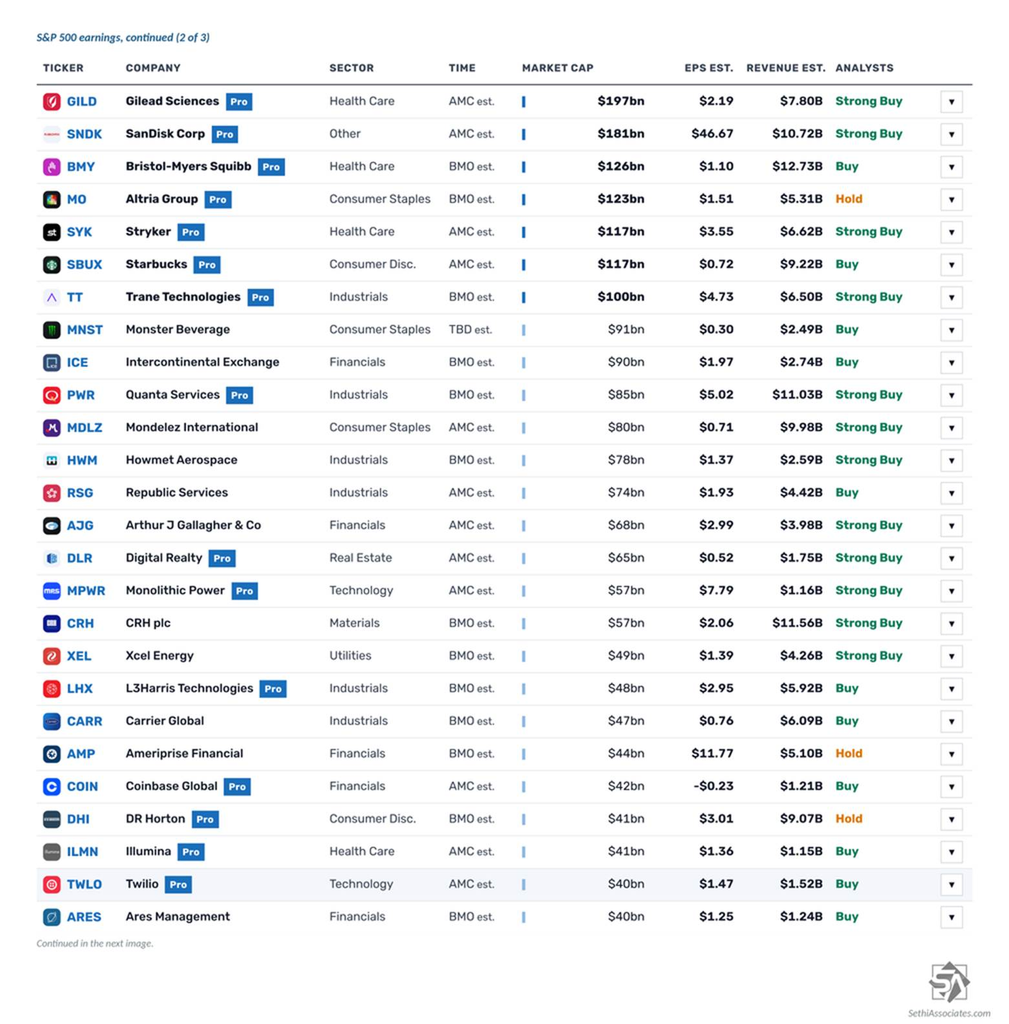
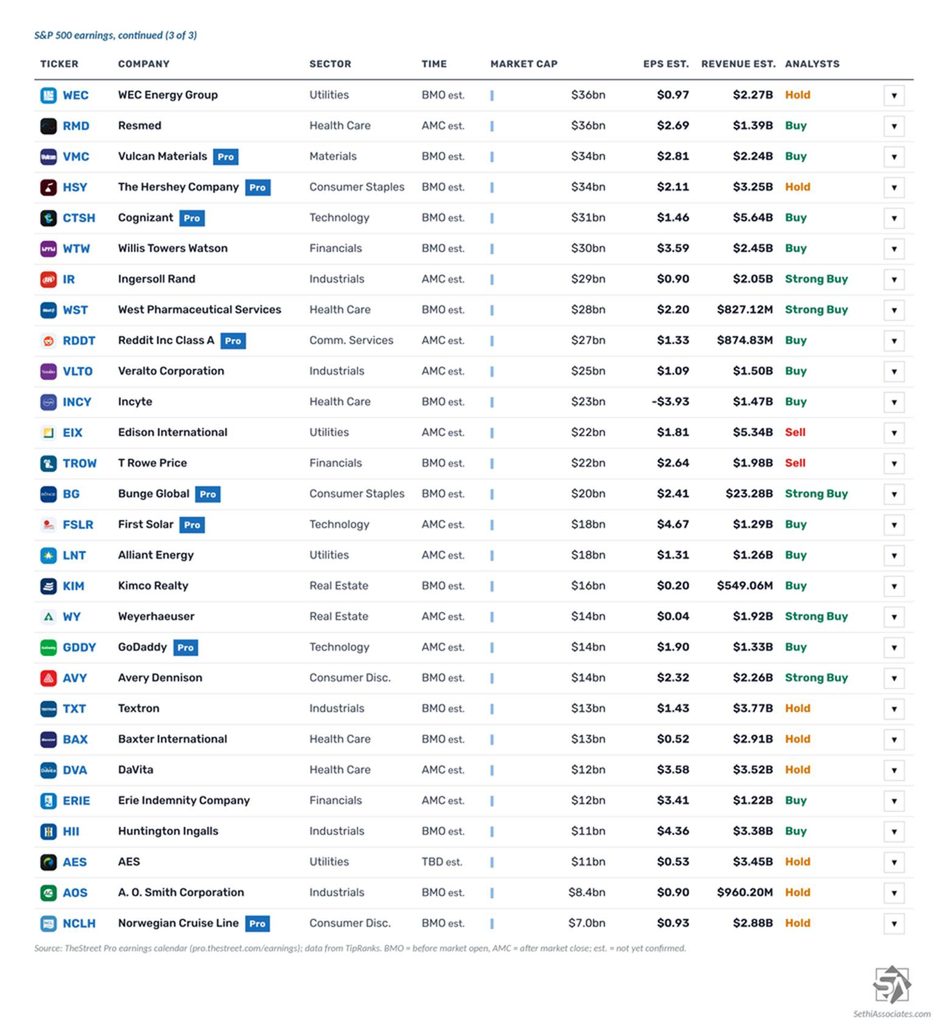
61 S&P 500 components report, 14 of them with market caps over $100bn:
Before the open: Eli Lilly (LLY), Mastercard (MA), Merck (MRK), Caterpillar (CAT), Linde (LIN), Bristol Myers Squibb (BMY), Altria (MO), Trane Technologies (TT), Intercontinental Exchange (ICE), Quanta Services (PWR), Howmet Aerospace (HWM), CRH (CRH), Xcel Energy (XEL), L3Harris (LHX), Carrier (CARR), Ameriprise (AMP), D.R. Horton (DHI), Ares Management (ARES), WEC Energy (WEC), Vulcan Materials (VMC), Hershey (HSY), Cognizant (CTSH), WTW (WTW), West Pharmaceutical (WST), Incyte (INCY), T. Rowe Price (TROW), Bunge (BG), Kimco Realty (KIM), Avery Dennison (AVY), Textron (TXT), Baxter (BAX), Huntington Ingalls (HII), A.O. Smith (AOS) and Norwegian Cruise Line (NCLH)
After the close: Amazon (AMZN), Intel (INTC), Gilead (GILD), SanDisk (SNDK), Stryker (SYK), Starbucks (SBUX), Mondelez (MDLZ), Republic Services (RSG), Arthur J. Gallagher (AJG), Digital Realty (DLR), Monolithic Power (MPWR), Coinbase (COIN), Illumina (ILMN), Twilio (TWLO), ResMed (RMD), Ingersoll Rand (IR), Reddit (RDDT), Veralto (VLTO), Edison International (EIX), First Solar (FSLR), Alliant Energy (LNT), Weyerhaeuser (WY), GoDaddy (GDDY), DaVita (DVA) and Erie Indemnity (ERIE)
Time not announced: Monster Beverage (MNST) and AES (AES)
Outside the US, Shell (SHEL), TotalEnergies (TTE) and Volkswagen (VWAGY) report.
Ex-US highlights include a policy decision from the ECB, UK September net consumer credit and M4, Japan October consumer confidence index, Italy September unemployment rate, October consumer confidence index, economic sentiment and manufacturing confidence, Eurozone October economic confidence and Sweden Q3 GDP indicator.
From Christophe Barraud’s international Week Ahead rundown:
At the time of publication, in terms of securities mentioned, Sethi was long AAPL, AMZN, APH, CTSH, DHI, F, GILD, GOOGL, INTC, MSFT, NOW, ORCL, SKHY, SPY, IWM, RSP, CPER and numerous Treasury ETFs.