‘The Great Pumpkin Trade’ Spices Up the Market
Let’s chart the market to see how this trade has the potential to absolutely roar into the holiday, and what could throw it off.
You've reached your free article limit
You've read 0 of 1 free Pro articles.

Rally caps? Sure feels nice. Is it real? Could be. Readers may recall that I, among others, have been pointing to the midterm elections as a release point for the bulls as one layer of uncertainty is removed from the risk/reward equation. That’s regardless of who beats who in those elections. Then again, Pres. Trump has also been pointing to the midterm elections. He’s not necessarily projecting electoral victory for his party, but more or less threatening to resume hostilities in the Middle East if Iran can’t learn to play nice in the sandbox. With that nation’s military capabilities reduced and that nation’s economy clearly in ruins, Iran has shown no ability, to this point, to co-exist with its neighbors.
A resumption of offensive kinetic warfare by U.S. naval and air forces would certainly put upward pressure on energy prices and downward pressure on the value of global equity markets. The only positive financial takeaway from such action for the short to medium-term could be a global flight to safety, which would put downward pressure on U.S. Treasury yields and therefore, interest rates.
Keep in mind, all things considered, this is, seasonally and traditionally, a time to get long U.S. equities. Last week, we discussed the “Great Pumpkin” trade. The Great Pumpkin trade runs through the final four trading sessions of October (making yesterday the first day) and the first three trading days of November. That would be this coming Wednesday, the day after Election Day.
Last week, I reminded readers that dating back to 1990, this trade has produced a profit 81% of the time for the Nasdaq 100 and 75% of the time for the S&P 500. The average return over that time for the Nasdaq 100 has been 2.2% with a median of 2.1%. For the S&P 500, the average return has been 1.6% with a median of 1.4%. This trade has even worked (more often than not), for the Russell 2000 (75% success rate, +12.1% avg, +1.9% median).
Sort of backing up that idea, and isolating only midterm election years, our old friend at TheStreet, Martin Baccardax, in his column at Barron’s, pointed something interesting out. Martin wrote that Bluekurtic Market Insights, which is a financial research group, noted that the S&P 500 has posted gains 18- of 19-times since 1950 in the five days before midterm elections, with a median return of 2.7%.
Martin also wrote that “Scott Rubner, head of equity at Citadel Securities and a former Goldman Sachs managing director, notes the average gain from Oct. 27 to year end is typically 5%, with that advance at 6% for election years.” Food for thought. There are never guarantees in love or life, but right now is when portfolio managers usually put cash on the sidelines, in some cases, since May, to work.
Fed Day!
Today is the day. or is it? The Federal Open Market Committee will publish its latest official statement on monetary policy this afternoon at 2 p.m. ET. A half hour later, Fed Chair Kevin Warsh will take the podium for the eight times a year policy-focused press conference. Warsh, in my opinion, has been excellent in keeping his opinions close to the vest, even if I do not always agree with him on the implementation of policy. He is clearly independent thinking, and has demonstrated an ability to be apolitical, which is a net positive.
With both consumer- and producer-level inflation still stubbornly above target, and the oil supply shock that began to unfold at the start of the Iran war, possibly spreading beyond gasoline prices and into the broader economy, short-term interest rates are obviously in focus. The fear would be that targeting higher short-term rates in order to drag on inflation would also drag on demand for labor.
Economic growth has been resilient, but we can thank capital spending on the development of artificial intelligence for that. The development of AI is not a labor-intensive business and the results of that development will likely pressure both job creation and wage growth.
A statistically strong economy, based on traditional metrics such as gross domestic product and aggregate economic activity in this modern era, will not be reflective of a healthy labor market. There is no way to sugarcoat that. Such an environment, in my opinion, will eventually be significantly deflationary in nature. Very difficult and almost certainly a policy error to increase short-term rates ahead of such a reality.
As For This Afternoon…
As interpreted through futures markets trading in Chicago, there is currently a 91% probability for no change to be made to the target range for the Fed funds Rate this afternoon. There is, however, an 84% likelihood being priced in for a quarter percentage point rate hike to be implemented by our central bankers on Dec, 9. In addition, there a half-percentage point worth of additional hikes beyond that December hike, being priced in (62% probability) by these markets by June 9, 2027.
I Looked at You
I looked at you
You looked me
I smiled at you
You smiled at me
And we’re on our way
No, we can’t turn back
Yeah, we’re on our way
And we can’t turn back
– Morrison, Densmore, Krieger, Manzarek (The Doors), 1967
For Joy, For Joy!!!
Anyone else notice that the S&P 500 took back its 50-day simple moving average on Tuesday?
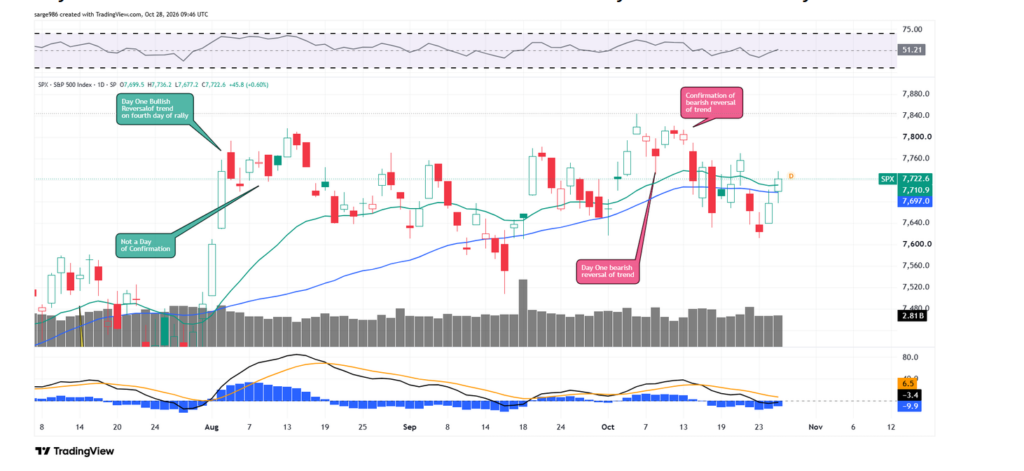
In fact, the index also took back its 21-day exponential moving average one day ahead of Fed Day? The Great Pumpkin Trade? The midterm election trade? Sure, looks like it. This is potentially huge technically, as this implies that swing traders are swinging net-long right now. Additionally, though the trading volume is not yet there, should the index hold these levels, professional managers who have been caught off guard (as sentiment has been weak) will have no choice but to play “catch up” and the “pay up” for US equities, the tech trade in particular.
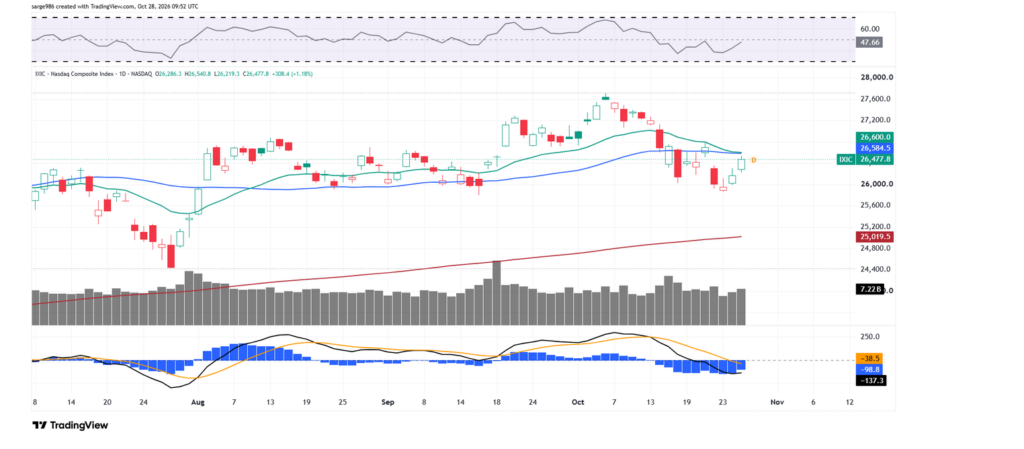
Note that the Nasdaq Composite has not yet pierced those levels from below, though clearly trading volume is growing here. Does that mean that at least some of those professionals have already shifted back into the tech trade? It almost certainly does. That said, they are dragging a little on the trade, in an attempt to hedge that bet.
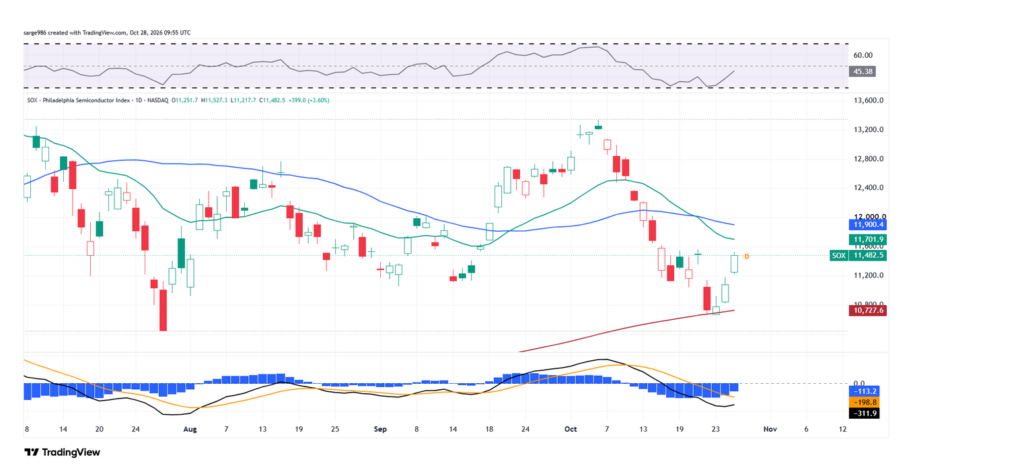
On that note, check out the Philadelphia Semiconductor Index. Should the Nasdaq Composite (and Nasdaq 100, not shown) retake these key moving averages, the semiconductor trade itself, has a long way to go to the upside. Especially, if the Relative Strength Index (above the chart) can retake the neutral line and the 12-day exponential moving average (below the chart) can cross over the 26-day EMA while the histogram of the 9-day EMA approaches the zero-bound.
This trade (no promises) has the potential to absolutely roar into the holidays. That said, the war in Iran could force a capital raise on the way there. You are going to have to wear your helmet and buckle your chinstraps. I don’t see any John Waynes out there. Good luck this afternoon.
Economics (All Times Eastern)
07:00 – MBA 30 Year Mortgage Rate (Weekly): Last 7.41%.
07:00 – MBA Mortgage Applications (Weekly): Last -5.3% w/w.
08:30 – Wholesale Inventories (Sep-adv): Expecting 0.5% m/m, Last 0.5% m/m.
08:30 – Goods Trade Balance (Sep):
Last $-132.1B.
10:30 – Oil Inventories (Weekly): Last -3.061M.
10:30 – Gasoline Stocks (Weekly): Last -2.952M.
The Fed (All Times Eastern)
2:00 p.m.- FOMC Policy Decision.
2:30 – FOMC Press Conference.
Today’s Earnings Highlights (Consensus EPS Expectations)
Before the Open: KEX (2.00), MAS (1.02)
After the Close: GOOGL ((2.97), CMG (.29), EBAY (1.41), F (.41), KLAC (1.19), MSFT (4.72), NOW (1.02), TMUS (2.89)
At the time of publication, Guilfoyle was long MSFT equity.