Market updates and conversation from TheStreet Pro team. Follow the latest and join the conversation below.
Stock Market Today: October 28, 2026
Newest first · All times Eastern · 7 updates
DATE:
By Neil Sethi
Earnings Misses Getting Light Treatment
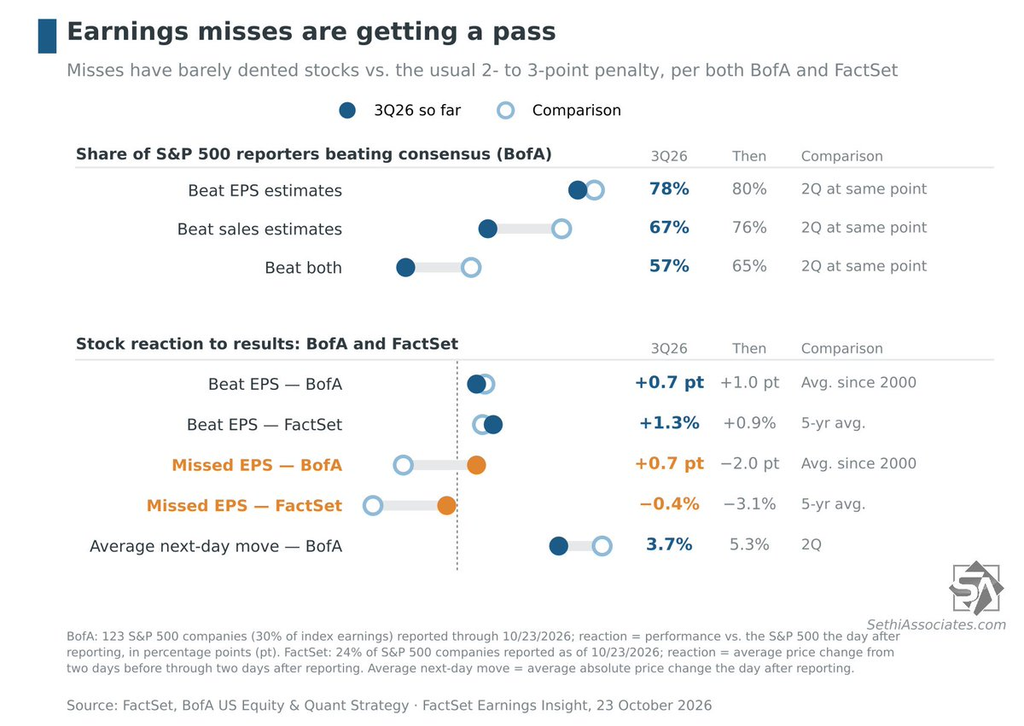
Ahead of this week’s batch of earnings, a little surprisingly, misses have been getting a relative pass.
Per BofA, companies missing EPS estimates have outperformed the S&P 500 by 0.7 percentage points the day after reporting, vs. a typical 2-point lag since 2000.
FactSet finds the same: misses have fallen just 0.4% from two days before their reports through two days after, vs. a 3.1% five-year average.
Beats, in contrast, are being rewarded at roughly normal levels (BofA +0.7 pt vs. +1.0 average; FactSet +1.3% vs. +0.9%)
Overall, the average next-day move is 3.7% vs. 5.3% in 2Q.
In today’s 8 Key Items alert, we mentioned expected 2027 pricing action from several companies as they look to cover rising costs. Now we can add the U.S. Postal Service (USPS) to that list.
In 2027, USPS will adopt a FedEx (FDX) and UPS (UPS) pricing tactic as it contends with high fuel prices.
In January, the agency will start levying a fuel surcharge on domestic shipments under Ground Advantage, Priority Mail, Priority Mail Express and Parcel Select. The surcharge will update weekly based on diesel and jet fuel prices.
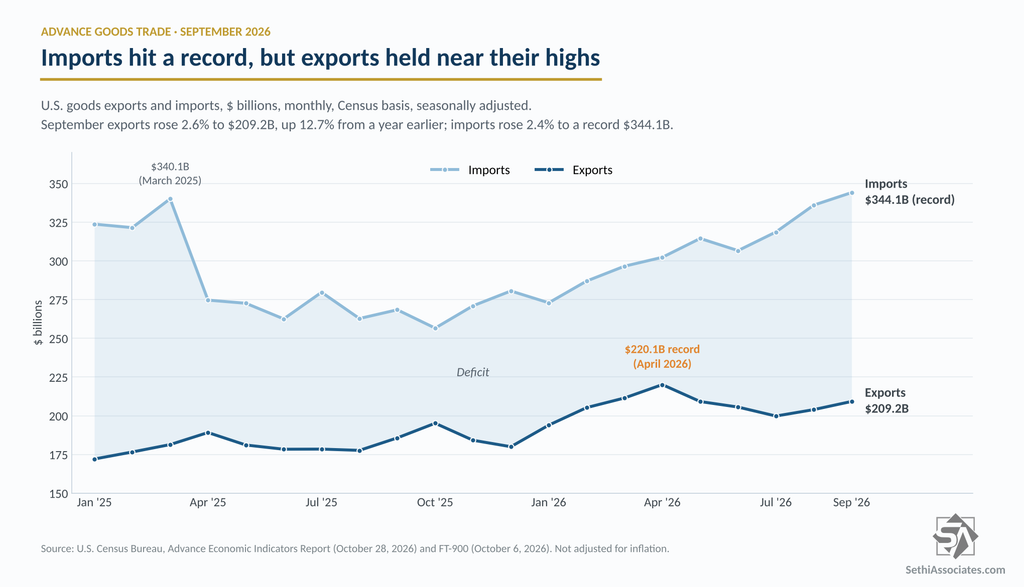
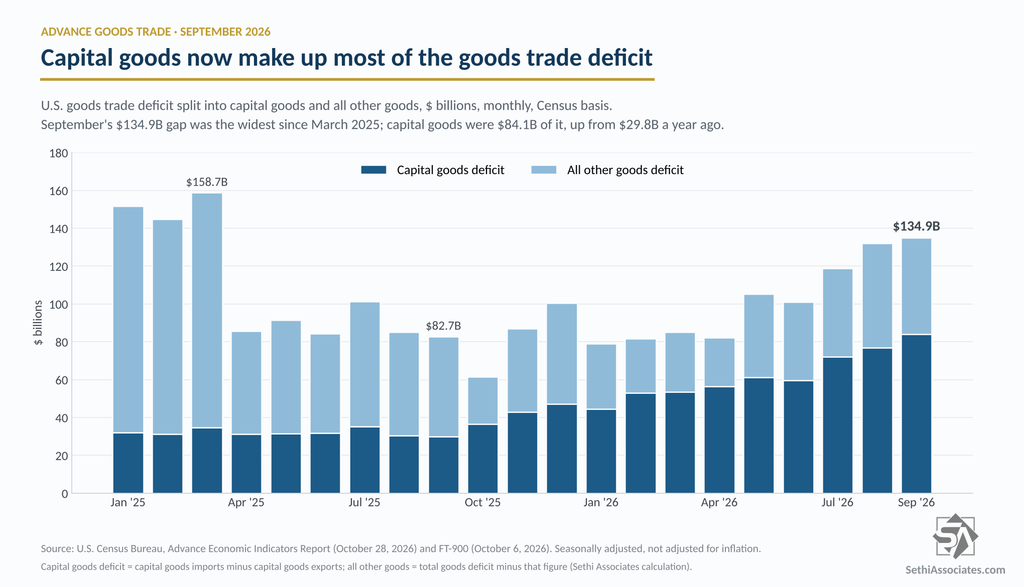
The U.S. goods trade deficit (goods are approximately three-quarters of U.S. trade) widened 2.1%, or $2.8 billion, to $134.9 billion in September, the largest since March 2025 and a third straight monthly increase, according to the Census Bureau’s advance report. Economists surveyed by Bloomberg had expected the gap to narrow to $130.2 billion. August’s deficit was revised to $132.1 billion from $132.6 billion.
Positively, goods exports rose 2.6% to $209.2 billion, but because exports are about 40% smaller than imports, the 2.4% rise in imports to $344.1 billion still widened the gap. That was the third-highest on record for goods exports, up 12.7% from a year earlier, while imports hit a record.
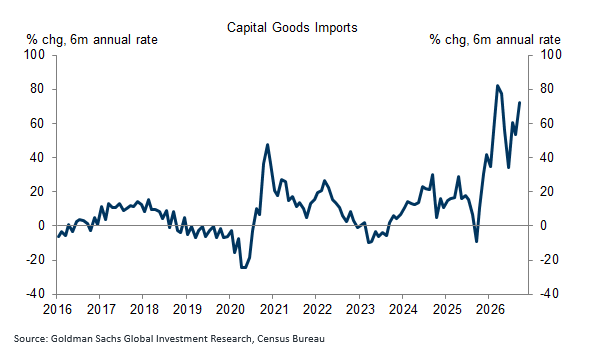
Notably, capital goods imports jumped 7.5%, or $10.9 billion, to a record $157.4 billion, up 77.2% from a year earlier. The category includes the computers, semiconductors and telecommunications equipment going into the AI buildout. The capital goods deficit is now $54.3 billion larger than a year ago, more than the $52.2 billion widening in the overall goods deficit over that period. Goldman noted: “The capital goods category has been a primary contributor to the widening trade deficit this year and has partially offset the impact of rapidly rising AI business investment on GDP growth.”
Consumer goods imports rose 3.1%, the most in four months, but were still 12.0% lower than a year earlier. Industrial supplies imports, which include petroleum and nonmonetary gold, fell 6.0% after jumping 17.1% in August, and auto imports fell 4.0%.
On the export side, foods, feeds and beverages jumped 12.8% to $16.0 billion, consumer goods rose 6.5% and capital goods rose 5.4%. Industrial supplies exports fell 1.6% and autos fell 5.6%.
I mentioned in the Week Ahead that my expectations for the Fed today were for no major fireworks:
The Fed has never hiked with less than a 10% chance priced into markets, so we’re either going to get the biggest surprise to markets the Fed has ever delivered (on par with the surprise 75 basis point hike in 2022) or a relative snoozer that is already priced. It would be quite something though if they did hike (which is what BofA still calls for by the way) as it would not only be a huge hawkish surprise – a handful of days before the election – but it would also mean the long-standing “troika” at the top of the Fed in Chair-Vice Chair-NY Fed President (Warsh-Jefferson-Williams) had been busted wide open.
In terms of the rest of the meeting it is expected to also follow the “snoozer” pathway, particularly as there is no new Summary of Economic Projections and Chair Warsh has consistently been cutting back the length of the press conference and providing little information. Again, a change to that would be a big surprise. But the one thing that won’t surprise is dissents. The other regional Fed Presidents (Hammack in particular) have expressed a preference for continued rate hikes.
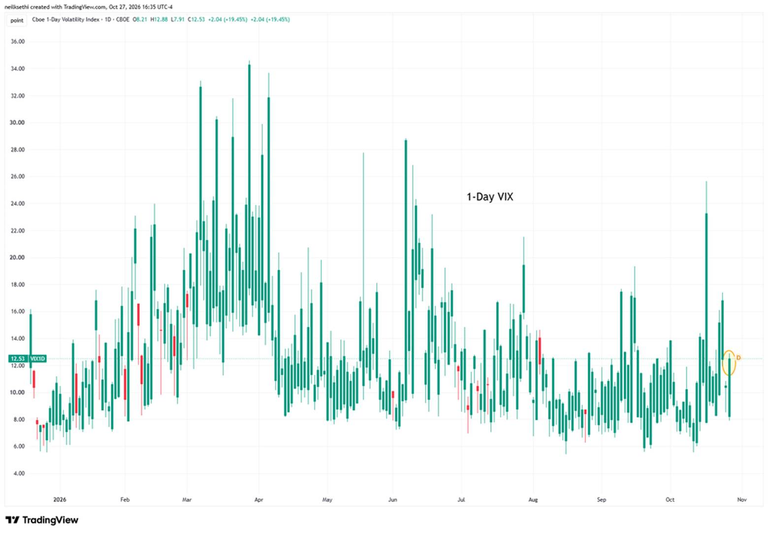
It seems markets are expecting a relative snoozer as well. I mentioned in last night’s update that “the 1-day VIX rose to 12.5 Tuesday, implying a move of about 0.79% for the S&P 500 today, pretty subdued.” I went ahead and looked back, and it’s the lowest pre-Fed day reading since April.
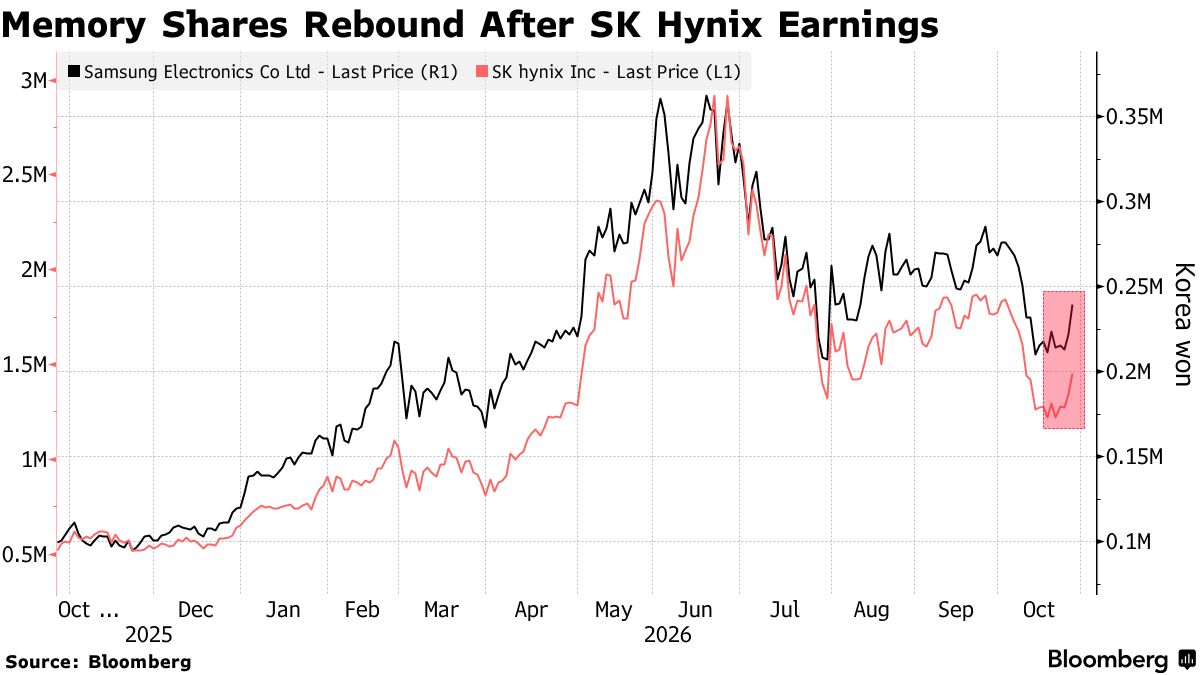
The chip rebound got another boost overnight as SK Hynix (SKHY) reported record third-quarter results, saying it has sold out of DRAM and high-bandwidth memory (HBM) through 2029 and that HBM demand is double what it can supply, per Reuters. It also unveiled about 60 trillion won (roughly $45 billion) of additional buybacks and dividends. Its shares closed up 10.9% in Seoul, Samsung Electronics rose 9% and the Kospi gained 6.6%, per CNBC. The iShares Semiconductor ETF (SOXX) is indicated up another 1% premarket as of 8:30 a.m. ET after gaining nearly 7% over the past two sessions.
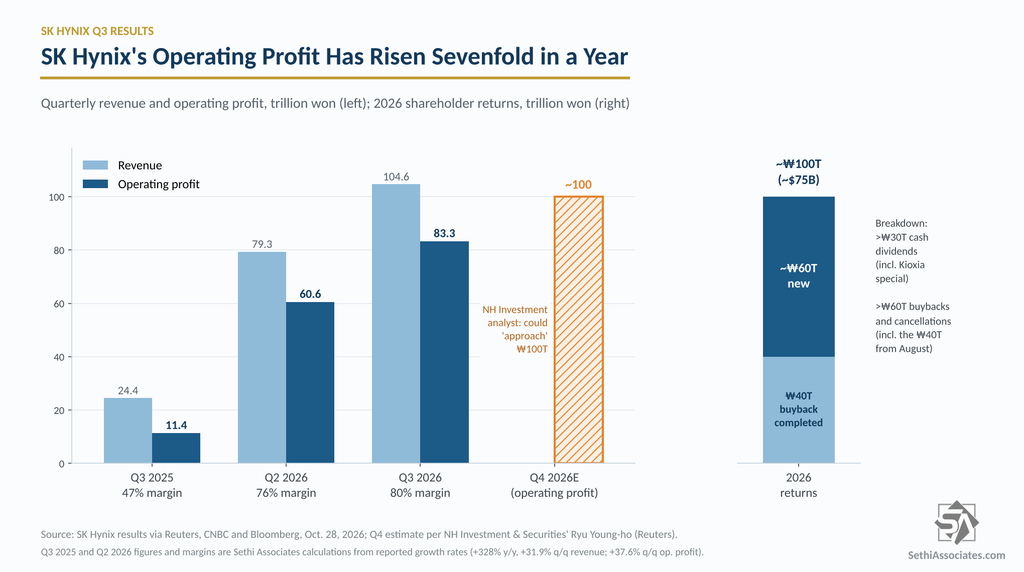
SK Hynix, which holds almost half the HBM market and supplies the memory for Nvidia’s (NVDA) AI chips, saw revenue more than quadruple from a year earlier to a record 104.6 trillion won ($78.9 billion), beating the 98.3 trillion won LSEG estimate. Operating profit rose more than sevenfold to a record 83.3 trillion won, versus 76.7 trillion won expected. DRAM average selling prices rose by a high-20s percentage from the prior quarter, and server DDR5 shipments jumped more than 40%, per CNBC. One analyst though sees that accelerating through the end of the year: “Given that the fourth quarter is traditionally stronger, operating profit could approach 100 trillion won,” NH Investment & Securities’ Ryu Young-ho told Reuters. Not everything beat, though: net profit of 39.8 trillion won fell well short of the 61.4 trillion won FactSet consensus, per the WSJ.
The outlook is moving the group. SK Hynix expects the memory shortage to last through 2030. It has long-term agreements, typically five years, with 14 major customers covering more than half its 2027-2028 capacity, and it plans to raise capex “significantly” next year from at least 40 trillion won this year. Memory already accounts for about a third of AI data center costs, and Macquarie expects HBM prices to more than double in 2027, per Bloomberg.
And in a sharp contrast with Meta’s equity raise, SK Hynix is sending money to shareholders. After Meta Platforms (META) announced this week it is raising $98 billion from investors to fund its AI spending, SK Hynix is returning about 100 trillion won (roughly $75 billion) to shareholders this year. That comprises more than 30 trillion won in dividends and more than 60 trillion won in buybacks and cancellations, including the 40 trillion won announced in August.
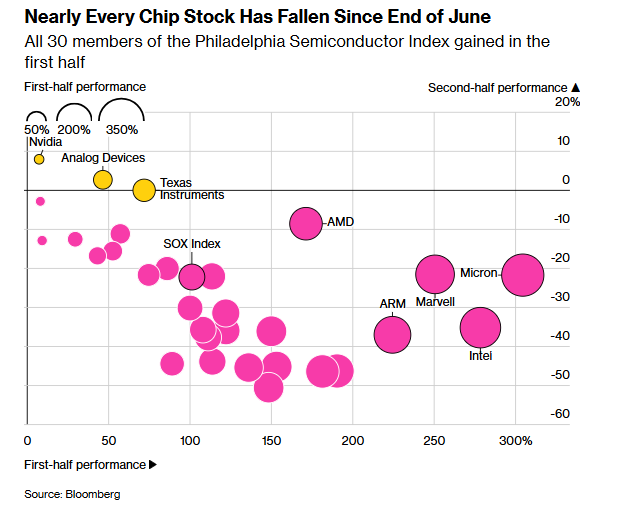
The rebound has ground to make up. SK Hynix shares have more than doubled this year but are still about half their June record, per Reuters, and nearly every chip stock has fallen since the end of June, per Bloomberg. Samsung reports Thursday.
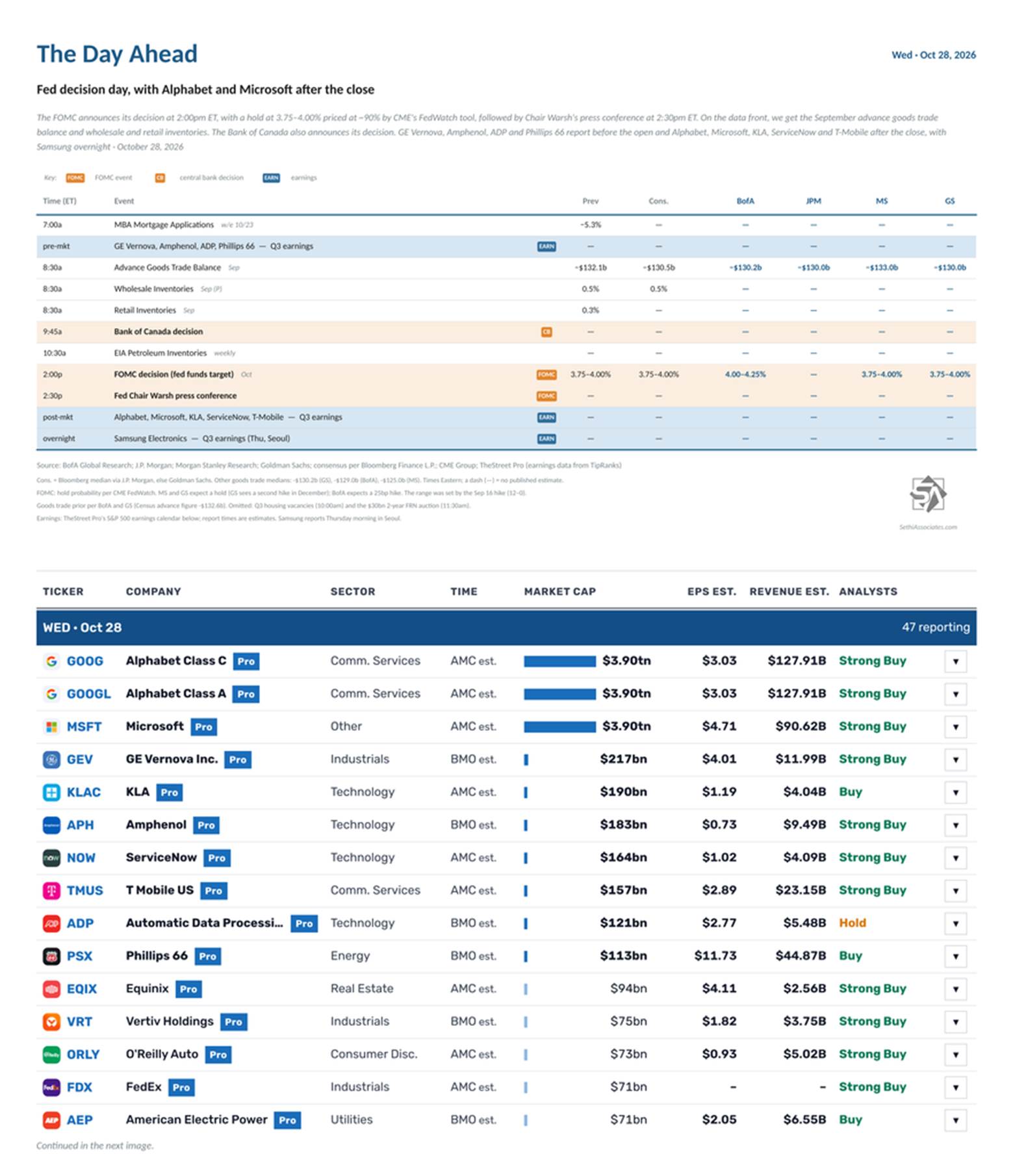
US economic data is light Wednesday, with just the September advance goods trade balance and wholesale and retail inventories plus weekly MBA mortgage applications and EIA petroleum inventories.
The FOMC takes center stage announcing its decision at 2pm ET, with a hold priced at ~93% by CME’s FedWatch tool, followed by Chair Warsh’s press conference at 2:30pm ET.
The only Non-Bill (>1yr in maturity) US Treasury auction is a $30B 2-year floating-rate note (not followed due to its floating nature).
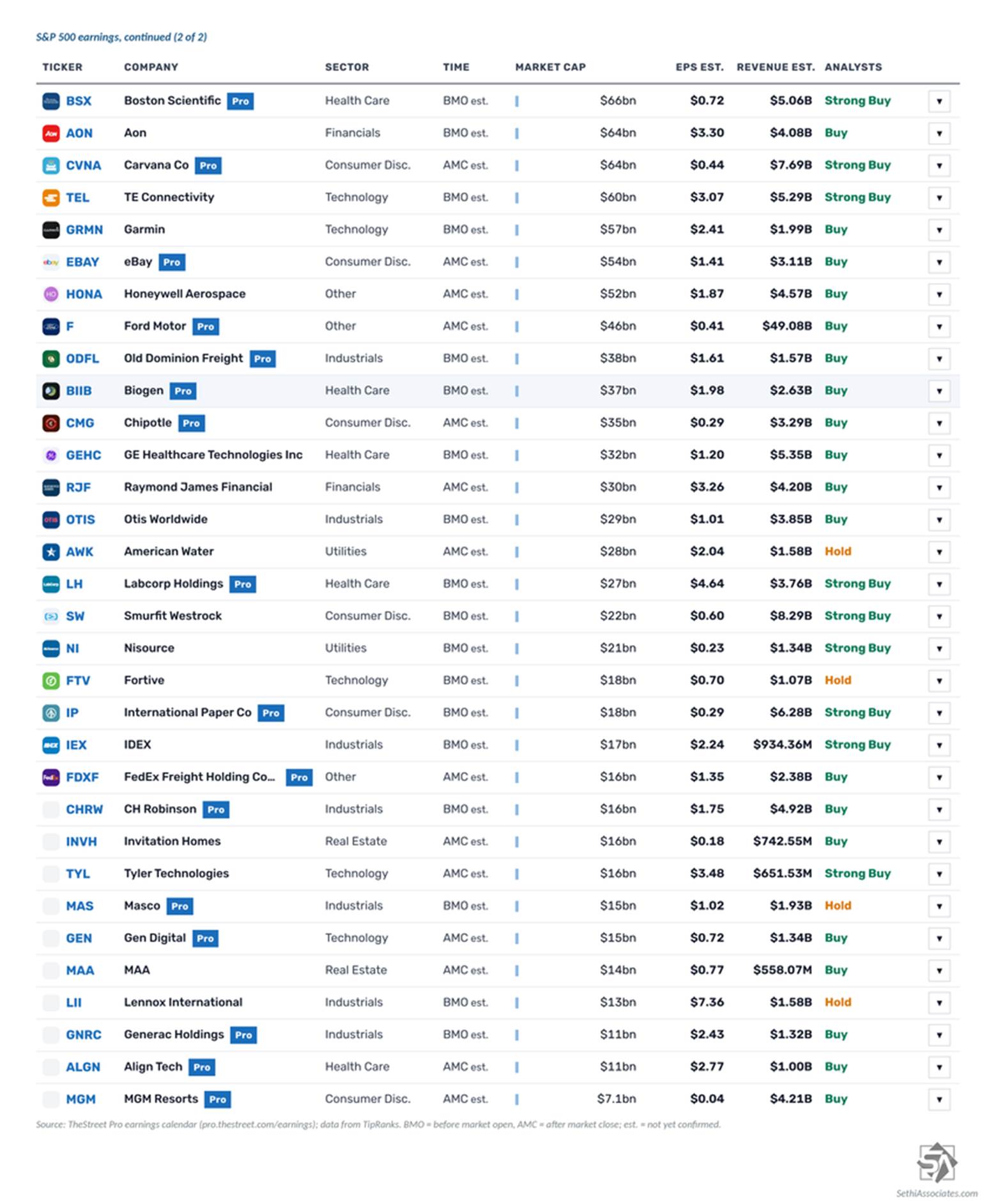
Alphabet and Microsoft lead 46 S&P 500 components reporting, nine of them with market caps over $100B:
Before the open: GE Vernova (GEV), Amphenol (APH), ADP (ADP), Phillips 66 (PSX), Vertiv (VRT), American Electric Power (AEP), Boston Scientific (BSX), Aon (AON), TE Connectivity (TEL), Garmin (GRMN), Old Dominion Freight Line (ODFL), Biogen (BIIB), GE HealthCare (GEHC), Otis Worldwide (OTIS), Labcorp (LH), Smurfit Westrock (SW), NiSource (NI), Fortive (FTV), International Paper (IP), IDEX (IEX), C.H. Robinson (CHRW), Masco (MAS), Lennox International (LII) and Generac (GNRC)
After the close: Alphabet (GOOGL), Microsoft (MSFT), KLA (KLAC), ServiceNow (NOW), T-Mobile (TMUS), Equinix (EQIX), O’Reilly Automotive (ORLY), FedEx (FDX), Carvana (CVNA), eBay (EBAY), Honeywell Aerospace (HONA), Ford (F), Chipotle (CMG), Raymond James (RJF), American Water Works (AWK), FedEx Freight (FDXF), Invitation Homes (INVH), Tyler Technologies (TYL), Gen Digital (GEN), MAA (MAA), Align Technology (ALGN) and MGM Resorts (MGM)
Ex-US highlights include decisions from central banks in Canada and New Zealand, Germany November GfK consumer confidence, France Q3 total jobseekers, Italy August industrial sales and September PPI, and Australia September CPI.
It’s Not Just U.S. Companies Cutting Jobs With AI, the Dutch Government Is Too
You can’t go more than a few days without a headline about a U.S. company cutting headcount as it leans into AI. Look no further than Microsoft (MSFT) offering voluntary buyouts to about 60,000 employees, more than a quarter of its roughly 223,000-person workforce, as it reins in costs amid soaring AI spending (Reuters). But it appears the AI efficiency push is reaching far and wide.
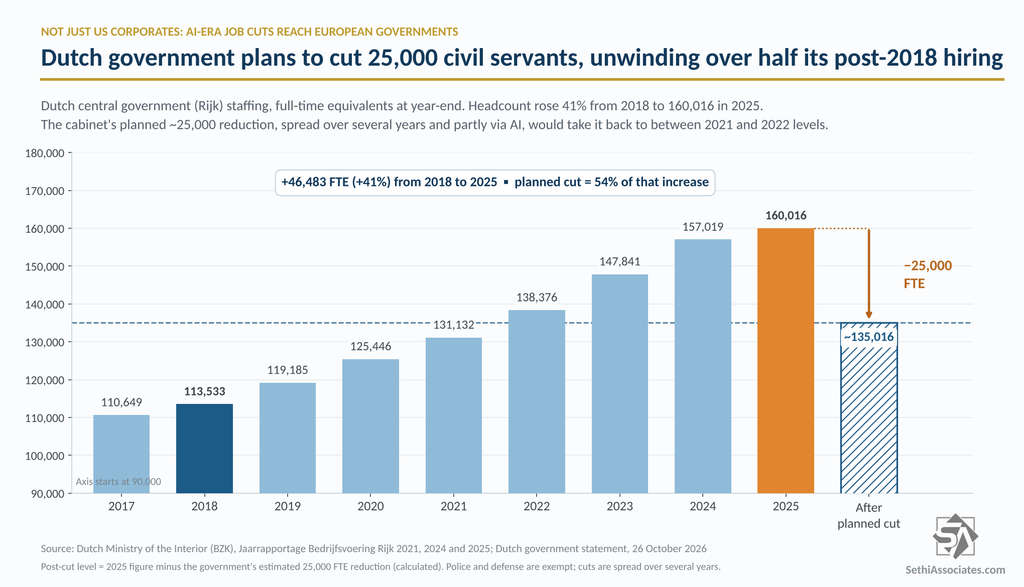
In that regard, the Dutch government plans to cut about 25,000 civil service jobs in an AI-led efficiency drive, per Bloomberg, citing a government statement on Monday, October 26. That’s roughly 15% of its central government workforce and more than half of its hiring since 2018. Central government staffing rose 41%, from 113,533 full-time equivalents at the end of 2018 to 160,016 at the end of 2025, according to the Interior Ministry’s annual operations report. Removing 25,000 would bring it back to about 135,000, between its 2021 and 2022 levels.
The cabinet is targeting savings of €900 million a year by 2027, rising to €3.5 billion ($3.9 billion) a year from 2035. The reductions will be spread over several years, and police and defense are exempt. Ministries, inspectorates and implementing agencies will be hit hardest, with some departments facing cuts of 45% or even 60%, according to a letter State Secretary Eric van der Burg sent to parliament. The cabinet will present goals and savings plans for using AI in the first quarter of 2027.
“We cannot keep doing what we have been doing,” Van der Burg said.
It should be said, though, that the Netherlands isn’t the first European government to go this route. The U.K. said in March 2025 that it would cut more than 10,000 civil service jobs as part of a push toward digital tools and AI, Bloomberg reported.
In the U.S., AI is the leading reason employers have cited for announced job cuts this year. AI accounted for 120,136 of the 573,195 announced job cuts through September, or about 21%, according to Challenger, Gray & Christmas, and I have a feeling that share is going to be much higher when we get the October report next week.
Conversation 0 Comments
One ongoing discussion across all days. Everyone can read; sign in to take part.
Your voice matters. Discussions are moderated for civility. Read our guidelines .
Log in to join the conversation