The AI Trade Stumbles Again, But This Time Investors Rotate
The SOX fell nearly 8% and Tech nearly 3%, but two-thirds of S&P 500 stocks rose as consumer confidence jumped to its highest since January 2025.
You've reached your free article limit
You've read 0 of 1 free Pro articles.

Executive Summary
A day after Jensen Huang’s return to Nvidia sparked the best day for stocks since April 2025, history called for some giveback (see Bespoke post in the Wrap-Up), and on cue the AI trade stumbled again, with chip stocks giving back nearly two-thirds of Monday’s surge. This time, though, the selling stayed largely in Tech as eight sectors and two-thirds of S&P 500 stocks rose.
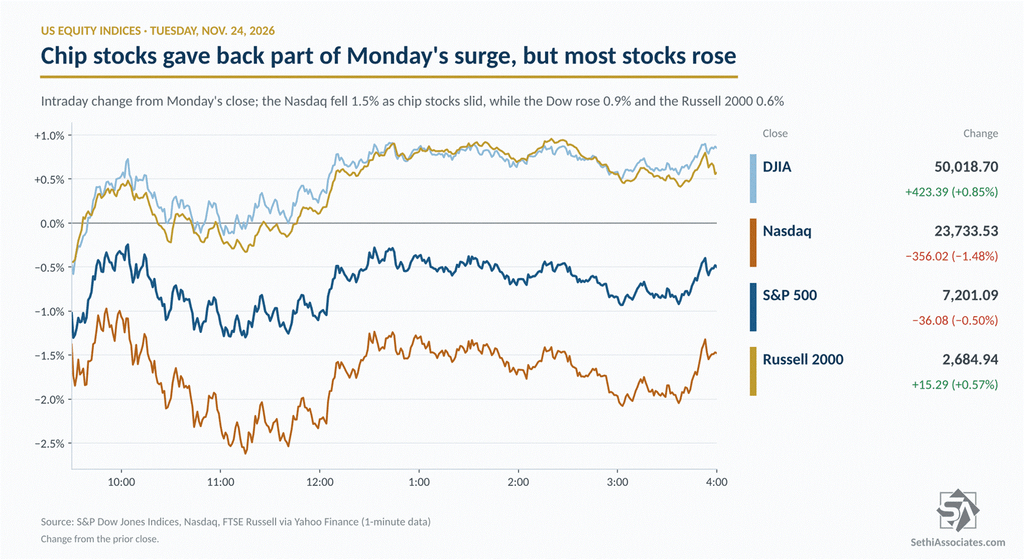
The S&P 500 fell 0.5% to 7,201 and the Nasdaq Composite 1.5%, after both opened lower and spent the morning near their lows before cutting their losses in a midday rally. But soon after the open, the Dow Jones Industrial Average (DJIA) and Russell 2000 would rise into the green. After a morning dip back into the red, they would climb in the afternoon to end up 0.9% and 0.6% respectively. The equal-weighted S&P 500 rose 0.5%.
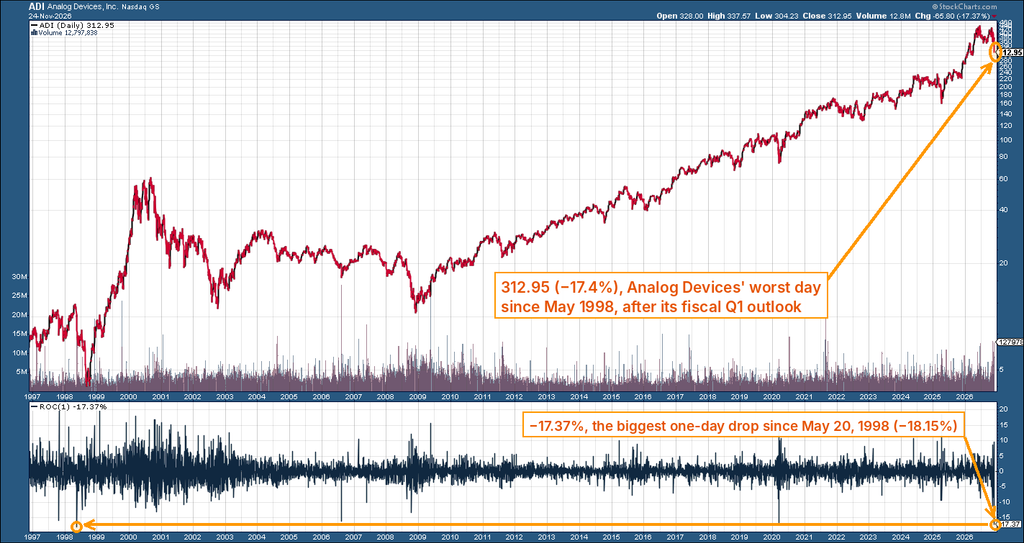
The SOX fell 7.9%, after Monday’s 14% jump, as Analog Devices (ADI) had its worst day since 1998 after guiding below expectations (chart), Micron (MU) fell 11% and Nvidia (NVDA) 5.9% (more in the Stock and Sector Breakdown).
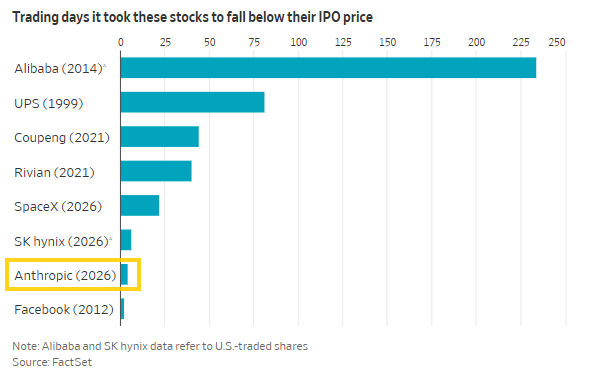
Anthropic (ANT) fell 6.5% to $81.90, closing below its $83 IPO price for the first time, closing below its $83 IPO price for the first time, the second quickest of any IPO with a market cap over $75 billion (per the WSJ). “Buyers who are underwater on the biggest AI deal of the year aren’t going to be in a hurry to add to other AI names,” Rev Shark wrote.
Trade also was back in focus late in the day, as reports said the Trump administration will announce tariff increases on China, the EU and more than a dozen other trading partners tonight, to rebuild duties the Supreme Court struck down. Bloomberg reported the new tariffs will be targeted and won’t push overall rates above the levels set in existing trade deals.
The VIX edged down 0.9% to 26.4. Treasury yields were little changed, with the 2-year up 1 basis point to 4.67% at the settle and the 10-year down 2bp to 4.90%. The $70 billion 5-year note auction tailed for a record 13th straight time, with indirect demand (which includes foreign buyers) the weakest since March 2020 (5-Year Auction Comes In Above Expectations for a 13th Straight Time). The dollar fell 0.5%, gold (-2.7%) and bitcoin futures (-1.9%) gave back part of Monday’s bounce and copper (-4.2%) all of it, while WTI crude rose 1.8% to $81.61 and natural gas 5.1% (including post-market).
In economic data, the Conference Board’s consumer confidence index jumped 11.4 points, the largest increase since May 2025, to 103.3 in November, the highest since January 2025 and above every estimate (Consumer Confidence Jumps to Highest Since January 2025, Beating Every Estimate). Redbook’s same-store sales rose 11.5% y/y in the week ended November 21 (Retail Spending Accelerates Heading Into Thanksgiving Week), and ADP’s weekly hiring estimate eased but stayed above the Fed’s breakeven estimates (ADP Weekly Hiring Slows, But Stays Above Fed Breakeven Estimates). FHFA home prices were flat in September, below the expected 0.2% gain.
Wednesday brings a pre-holiday data crush, including October PCE inflation, the second estimate of Q3 GDP, durable goods orders and the Beige Book, plus a $44 billion 7-year note auction at 11:30am ET and earnings from Deere (see the Day Ahead below).
My look at today’s charts follows in a separate post later this evening.
Market Commentary
- “The ebullience spilling across equities may prove fleeting, considering the way that government yields are grinding lower along with copper in the face of Jensen Huang-inspired relief rallies. The corollary is that the global economy is likely to slow down in a way that argues against a full revival of AI boom optimism,” said Garfield Reynolds, MLIV team leader at Bloomberg.
- “We suspect Jensen and Nvidia will remain in the crosshairs, and we don’t know what will turn up,” said Bernstein Research analyst Stacy Rasgon.
- Ron Adler, global co-head of equity high-touch trading at JPMorgan, said the resulting uncertainty over political interference in corporations after the president’s move could eventually weigh on equity multiples, especially with an incoming Democratic Congress. “The counterfactual is that this could support multiples for companies with strategic importance and close government ties,” he said. “The administration has made clear how much AI matters to it, and that’s definitely positive, and while this rally might have some legs given positioning, I don’t think this is getting us back to peak euphoria anytime soon.”
- “Markets are no longer pricing in unbridled optimism. … Valuations increasingly reflect concerns that AI-related spending may generate returns more slowly, less smoothly and less profitably than previously expected,” said Christian Stocker, lead equity strategist at UniCredit.
- Huang’s return doesn’t answer deeper questions about whether the AI financing will pay off, or address the risks of “stricter export conditions, governance demands or future tax changes,” Steve Pavlick, head of policy at Renaissance Macro Research, said in a Tuesday client note. “The policy line to watch runs between Washington’s support for U.S. AI capacity and its permission to sell that capacity abroad.”
- Mark Haefele, chief investment officer at UBS Global Wealth Management, said in a note Tuesday morning that his team does not believe the volatility in global tech names is “a signal that the structural AI investment story has broken.” “Cloud growth, rising usage, and continued demand for computing capacity remain supportive,” he said. “But we do expect greater differentiation between established platforms with visible monetization and strong balance sheets, and companies dependent on debt, scarce capacity, or continued speculative growth.”
- “While we believe that the low point for stocks during this recent volatility has already been reached, we still expect continued chop as this market still remains very headline sensitive when it comes to AI,” said Rick Gardner at RGA Investments.
- “With no significant positive catalysts on the horizon until off-cycle companies report EPS… yesterday’s price action suggests the start of a semi bear market rally, in our view,” Wolfe chief investment strategist Chris Senyek wrote in a Tuesday note.
- “There are no shortage of stats out there, but what many of them will show is that extreme one-day gains like today are more often associated with markets that are trending down, not up,” BTIG’s Jonathan Krinsky wrote in a Monday note. Krinsky said last week’s low was “not a final bottom” and was “likely temporary.”
- Famed short-seller Steve Eisman said he’s lowering his risk exposure amid the uncertainty. “Sometimes it’s OK to say I don’t know,” he said. “I’ve done a few things with my portfolio. My risk is lower than it usually is.”
- “We’re getting to a point in the AI trade where strong revenue growth and a growing order book may no longer be enough to excite investors,” said Louis LaValle, founder and CEO of Frontier Investments. He suggested that investors pay “more attention to margins, cash flow and what these companies are actually earning on the AI business they’re taking on.”
- The recent pullback is a “sentiment-driven reassessment of growth and of the interest-rate outlook, prompted by concerns around data-center spending and inflation, rather than a deterioration in fundamentals,” said Maximilian Bong-Maurer, senior investment strategist at Allianz. Still, he did not rule out further volatility in the near term, as investors work out how much of the AI story and the rate outlook is already priced in.
Stock and Sector Breakdown
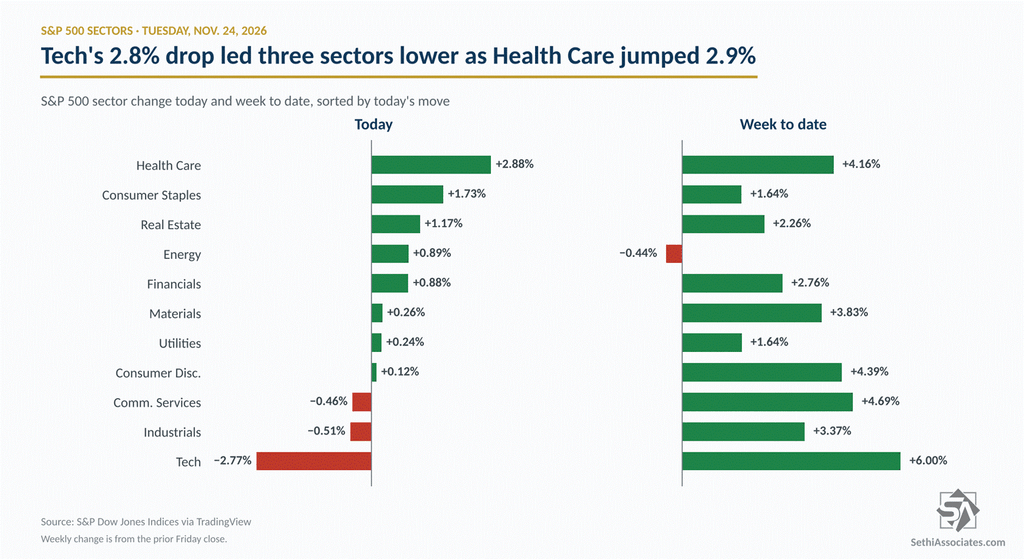
Eight of the 11 S&P 500 sectors rose, led by Health Care (+2.9%) and Consumer Staples (+1.7%), which bounced after lagging Monday’s rally. Tech (-2.8%) led the three decliners, with Industrials (-0.5%) and Communication Services (-0.5%) also lower.
342 S&P 500 stocks rose and 155 fell, after 416 gainers Monday. 58 rose more than 3%, and 55 fell more than 3%.
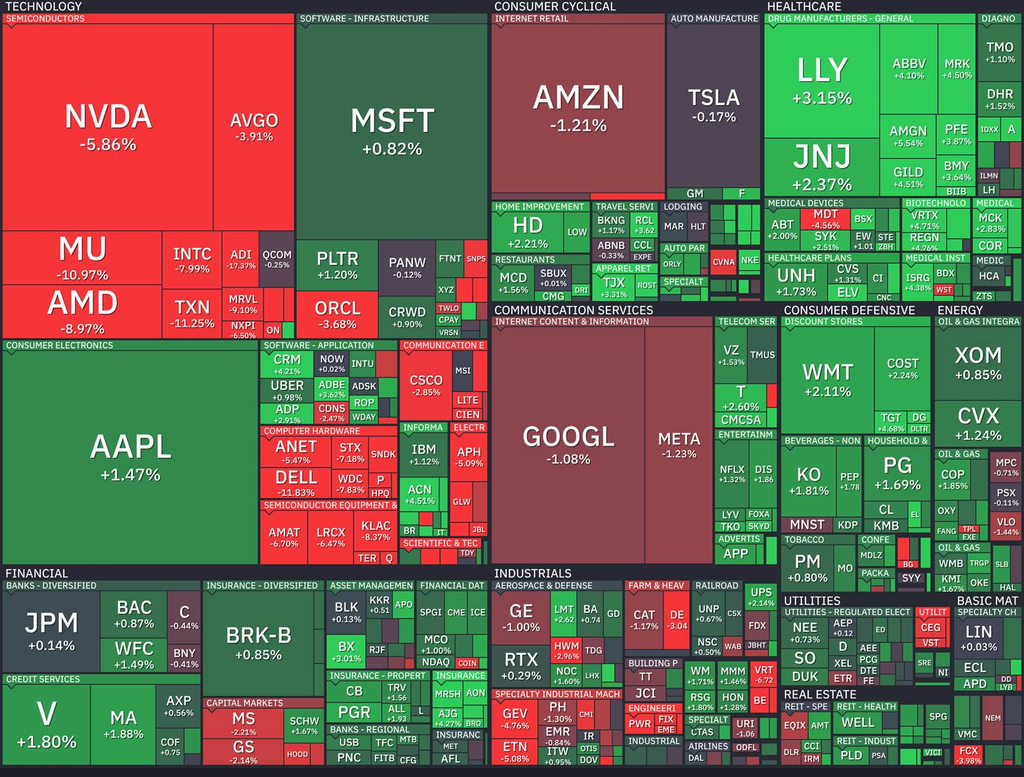
Analog Devices was the S&P 500’s worst performer, down 17.4%, even after record fiscal fourth-quarter revenue of $4.37 billion (+42%). Its fiscal first-quarter outlook ($4.4 billion of revenue and adjusted EPS of $3.82, each plus or minus) though disappointed on margins, with the EPS midpoint below consensus. Dollar Tree (DLTR) led the index, up 11.2%, its best day since May, after third-quarter comparable sales rose 4.6% on a 3.8% gain in traffic, above the high end of its outlook, and it raised its full-year adjusted EPS outlook to $8.05 to $8.25. Sarge walked through how he’d trade it.
The slide in chip stocks was much broader than ADI, though. Micron and Sandisk (SNDK) fell 11% after Goldman Sachs forecast Monday that conventional DRAM and NAND prices could fall about 20% in 2028, while Texas Instruments (TXN) fell 11%, its worst day since July 2025, Advanced Micro Devices (AMD) 9% and Intel (INTC) 8%. Broadcom (AVGO) fell 4%, and Bob Lang notes that even Monday’s rally couldn’t push it out of its downtrend channel.
Nvidia fell 5.9% to $155.38, giving back about a quarter of Monday’s 31.5% jump. Senate Democratic Leader Chuck Schumer alleged that Huang shipped advanced chips to China in violation of US export controls, and at an all-hands meeting Huang apologized to employees for the conduct that led to his brief ouster and told staff he is in therapy, per the Wall Street Journal. Several on TheStreet Pro think the hard questions are still ahead. Bob Byrne said Huang’s return doesn’t solve the real AI problem, Sarge said the stumbling will continue because the issues that sent investors elsewhere “have gone nowhere,” and Ed Ponsi said Nvidia holders need to course correct.
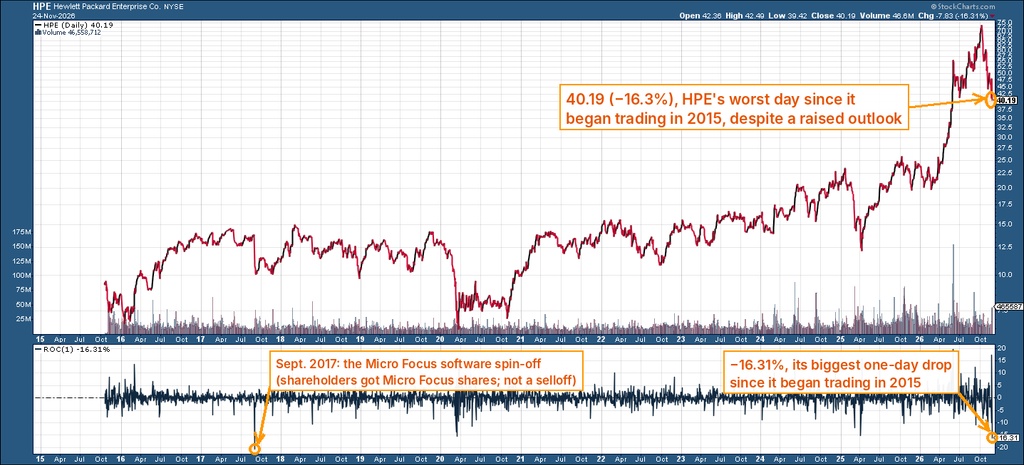
The selling also spread to AI hardware. Hewlett Packard Enterprise (HPE) fell 16.3%, its worst day since it began trading in 2015, despite record AI orders and a raised fiscal 2027 outlook, on worries that rising component costs and a growing mix of lower-margin AI systems will squeeze profits. “When good news is sold like that, it tells me that investors are more interested in reducing their exposure than in adding to it,” said Rev Shark, who noted early that Monday’s rally attempt was already under pressure. Dell (DELL) fell 12% ahead of its results (see after hours below), giving back more than half of Monday’s 20% gain.
Among the megacaps, Apple (AAPL) (+1.4%) and Microsoft (MSFT) (+0.8%) rose, while Alphabet (GOOGL), Amazon (AMZN) and Meta (META) fell about 1%, and Oracle (ORCL) fell 3.7%.
Health Care was the clear winner, with Eli Lilly (LLY) up 3.3% and the iShares Biotechnology ETF up 5.2%, helped by Sanofi’s agreement to buy Insmed (INSM) for $41 billion in cash (Insmed +14%). Moderna (MRNA) rose 7.2%, Amgen (AMGN) 5.5% and Humana (HUM) 5.6%, while Medtronic (MDT) fell 4.6% despite beating its own guidance and reiterating its full-year outlook. Rev Shark said the market is moving from volatility to stock picking, the sort of action a healthy market needs, since “when money rotates from one group to another instead of leaving altogether, it tells us that investors still want to own stocks,” and he’s looking to add to biotech names.
Retailers also rallied, with the SPDR S&P Retail ETF up 2.3%. Outside the S&P 500, Dick’s (DKS) jumped 14.5%, its best day since April 2025, and Abercrombie & Fitch (ANF) 19.8% after their reports. Best Buy (BBY) rose 2.7% after raising its full-year outlook, and Chris Versace says its report points to a seasonal lift for Apple and Microsoft hardware.
Helene called Monday a disappointing rally, since stocks gapped up and sat, and the put/call ratio was .91, showing there weren’t many believers. She said she expected some giveback after the S&P 500 ran into resistance at 7,300.
Doug Kass covered his small trading short in SPY and QQQ for a modest gain at 3:30am, then added modestly to Microsoft, Alphabet, Meta, Citigroup and Morgan Stanley, which he had cut back on Monday, and bought some Goldman Sachs.
After the close, Dell reported record fiscal third-quarter revenue of $54.9 billion (+103%) and adjusted EPS of $9.45, with a record $132.3 billion AI backlog after $60.2 billion of orders, up from the $95 billion Versace said was the number to watch. It now sees fiscal 2027 revenue of $202 billion (+78%) and adjusted EPS of $29.68, and added $25 billion to its buyback. The stock was up about 3% after hours, after swinging between gains and losses.
Workday (WDAY) fell about 7% after hours after guiding to fiscal fourth-quarter subscription revenue growth of 10%, a slowdown from 12.8% in the third quarter. Autodesk (ADSK) also fell about 4% despite raising the midpoints of its full-year billings and revenue outlook after third-quarter revenue rose 17%.
HP Inc. (HPQ) is up modestly after hours after fiscal fourth-quarter adjusted EPS of $0.83 topped its own outlook of $0.69 to $0.79, and it guided fiscal 2027 adjusted EPS to $3.15 to $3.45 and raised its quarterly dividend to $0.31.
FedWatch
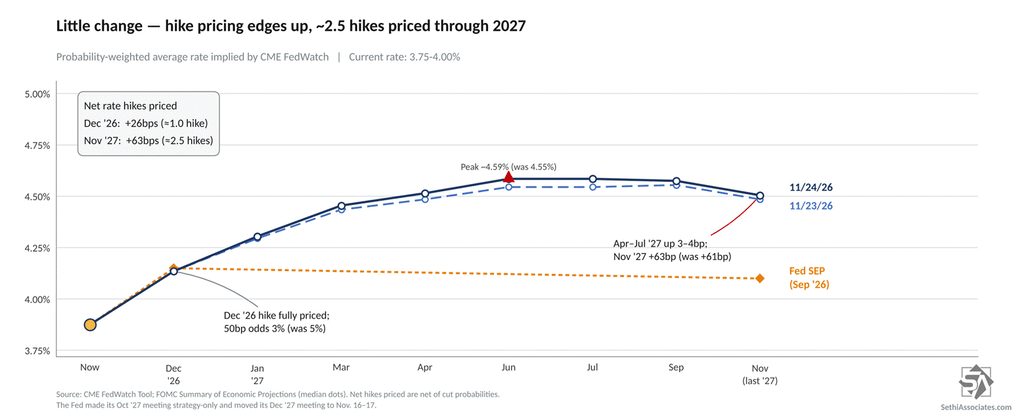
Fed rate hike expectations were little changed. A December hike remains fully priced, with a 3% chance of 50 basis points (from 5% Monday) and 26 basis points of hikes priced for that meeting. Pricing through the Fed’s final 2027 meeting in November edged up to 63 basis points, about two and a half hikes, from 61bp Monday, per CME FedWatch.
More From TheStreet Pro
Stephen “Sarge” Guilfoyle — Buying Back Rocket Lab After Mizuho’s New Price Target
Alex Frew McMillan — Most Important Market Lessons From a Couple of Crazy Days
Doug Kass’s Diary:
- S&P Short Range Oscillator Update
- Charting the Return
- Tech (XLK) vs. Financials (XLF) vs. Healthcare (XLV)
- Tuesday Midmorning Market Stats
- What Means More to Nvidia Than Huang’s Return
- Consumer Confidence Lifts
- Tuesday’s Intraday Sector Action
Note: Doug posted 24 Diary entries today; these are the market ones not linked above. You can see all of them here.
And From Me If You Missed It
- 5-Year Auction Yield Comes In Above Expectations for a 13th Straight Time
- This Correction Was Fast, History Says That Matters for a Rebound
- Consumer Confidence Jumps to Highest Since January 2025, Beating Every Estimate
- After VIX Drops Like Monday’s, Stocks Went Higher 6 and 12 Months Later Every Time
- Monday’s Solid 2-Year Auction
- BTIG Chief Called Drop and Bounce, Sees Another Leg Lower
Miscellaneous
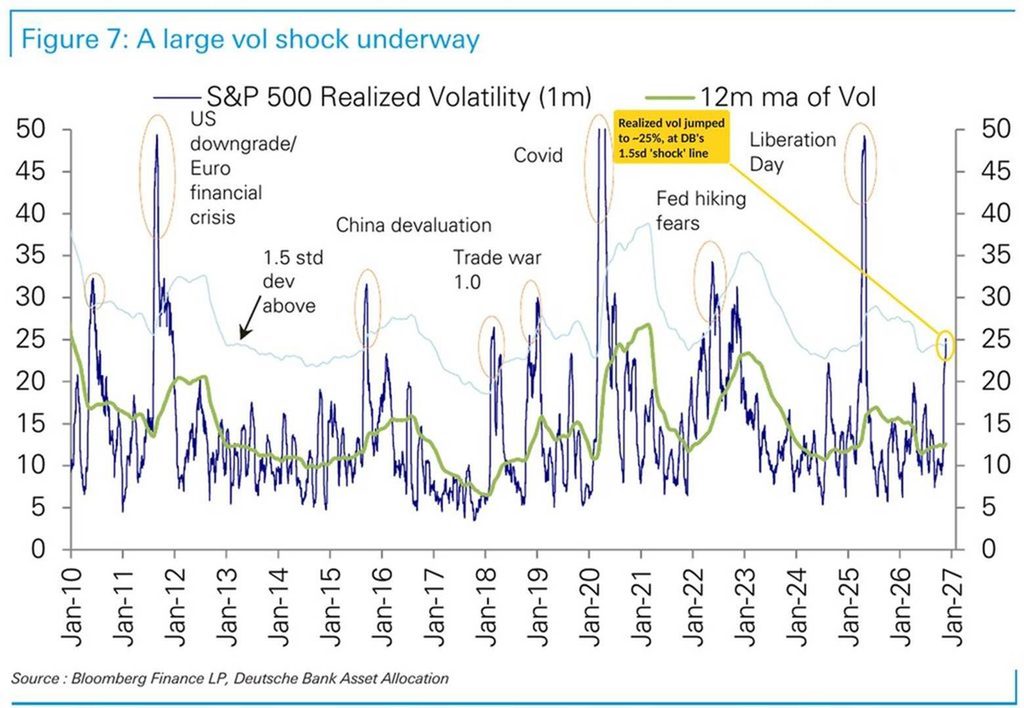
As a reminder from the Week Ahead, DB looked at what it characterizes as “a vol shock (a jump of more than 1.5sd)” in implied volatility, realized volatility, intraday ranges, the inversion in the VIX futures curve and implied correlations within S&P 500 stocks, which “all spiked well into the top decile.” That’s consistent with the VIX getting back below 20 within a month only once after closing above 30 at an options expiration. “In past vol shocks, it took an average of 6 to 8 weeks for vol to subside and equities to bottom. The S&P 500 declined on average -14% to -16% in these episodes outside recessions and took 4 to 6 months to fully recoup the declines.”
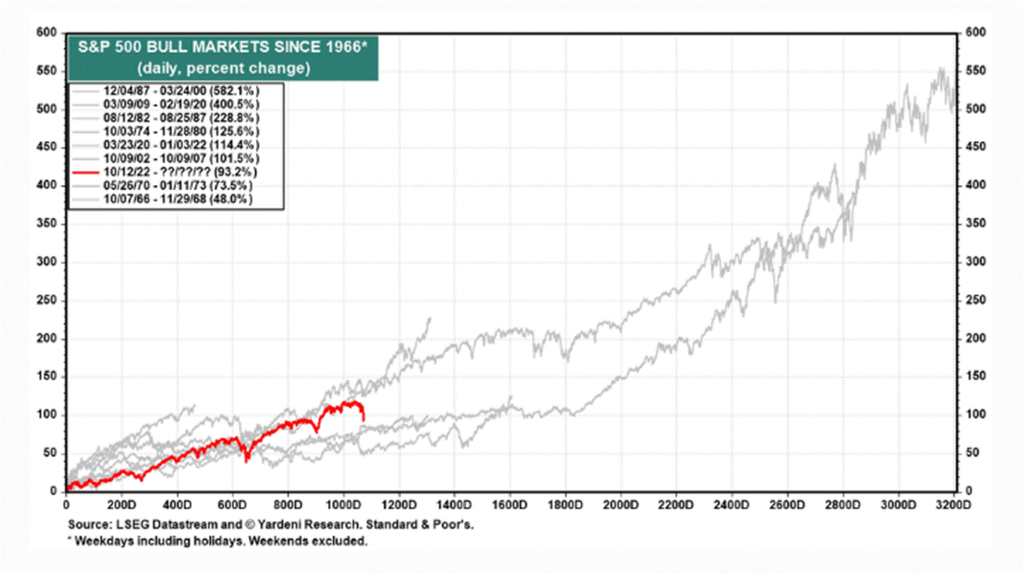
Ed Yardeni: “We view the recent S&P 500 selloff as another correction in the bull market that started on October 12, 2022.”
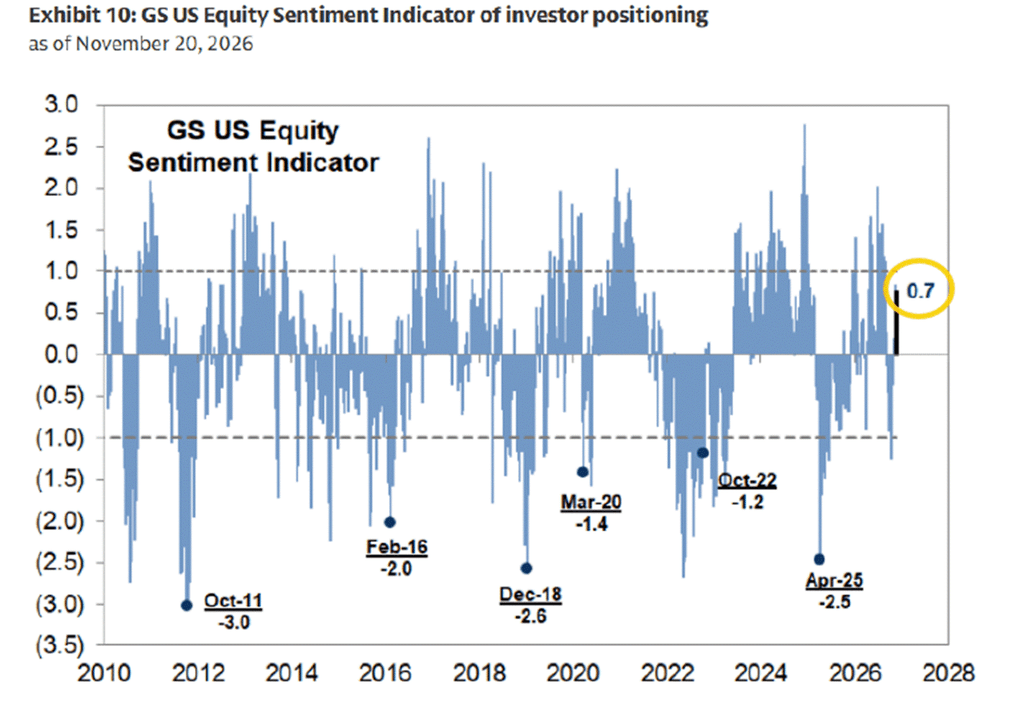
A correction to Monday’s Miscellaneous: the Goldman Sachs quote on panic during hiking cycles was from Lee Coppersmith, not Peter Callahan, and the second factor he said he was “getting pushback on” was positioning:
“Hedge funds have clearly been through an enormous unwind…. but other positioning cohorts are mixed. Our GS US Equity Sentiment Indicator, which incorporates nine different positioning measures across hedge funds, mutual funds, retail and others, still sits at the 75th percentile historically. US equity mutual funds and ETFs have attracted nearly $170B of inflows since the start of Q4, while asset manager equity futures length sits in the 82nd percentile over the last decade. So as our GS Research team notes, even though HF beta-adjusted leverage has fallen to five-year lows, other investor groups remain relatively well invested.”
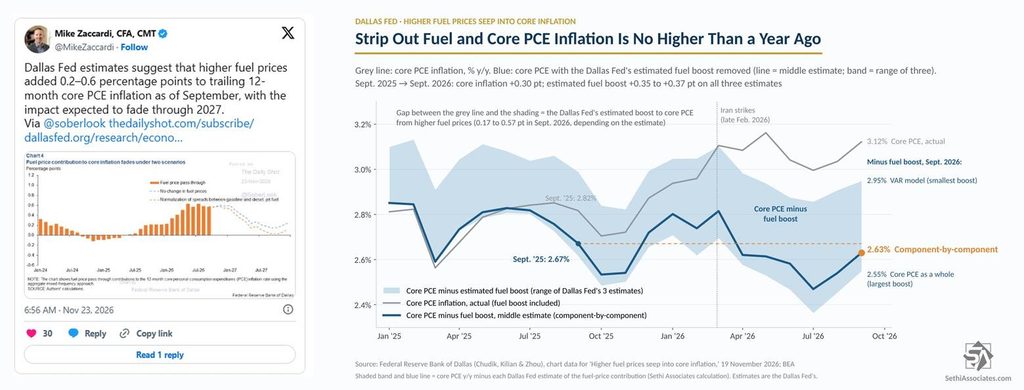
Ahead of Wednesday’s October PCE report, Christophe Barraud’s Morning Brief had a Mike Zaccardi post on a new Dallas Fed study estimating that higher fuel prices added 0.2 to 0.6 percentage points to 12-month core PCE inflation as of September, with the effect expected to fade through 2027. That range is the spread across three methods the authors used to estimate how much fuel prices (gasoline, diesel, jet fuel and natural gas) pass through to core inflation:
- The models: a statistical model of how fuel-price shocks feed through to inflation (a “VAR,” 0.17 point); an approach that estimates the effect on each of 149 individual PCE components and adds them up (0.49 point); and one that estimates it on core PCE as a whole (0.57 point).
- They disagree on exactly how big the effect is, but all three say the fuel contribution has risen 0.35 to 0.37 point since September 2025. Over that same span, core PCE rose 0.30 point (from 2.82% to 3.12%).
- So on every estimate, core PCE with the fuel effect taken out is no higher than a year ago (2.55% to 2.95% vs. 2.62% to 2.99%). It’s also down 0.07 to 0.11 point since February, before the Iran strikes.
- The size of the effect isn’t unprecedented. The core-PCE-as-a-whole measure peaked at 0.63 point in May, the highest since May 2023 (the high in data back to 2010 is 0.82 point in March 2023). The component-by-component measure’s 0.55 point in May was the highest since August 2022.
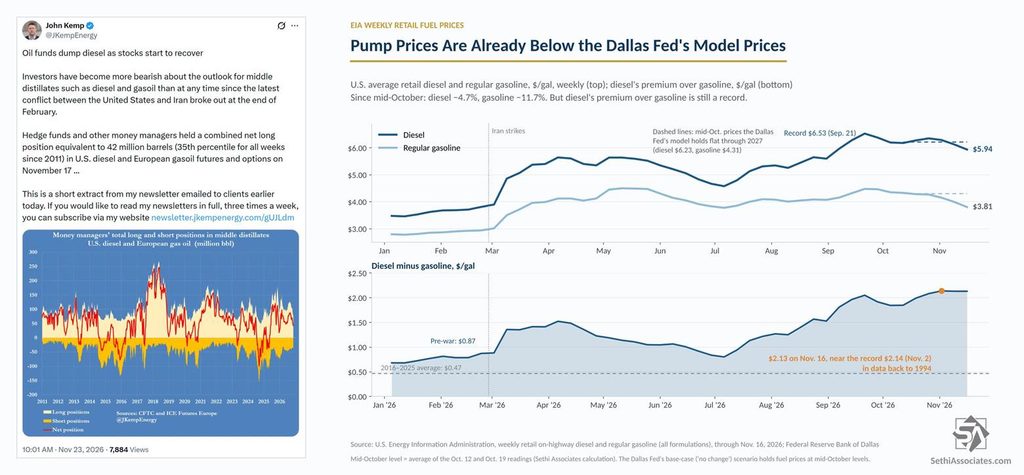
- Diesel, the fuel of the freight economy, is where the pressure has been. Retail diesel hit a record $6.53 a gallon on September 22, up about 70% from late February, vs. about 50% for gasoline, while natural gas has barely moved.
In the Dallas Fed’s “no change” scenario (fuel holding at mid-October levels), the fuel contribution stays around 0.57 to 0.60 point through January, so the core PCE prints for October through January still carry the full fuel boost. It only drops sharply from March to May, as the war-driven increases fall out of the 12-month comparison, and bottoms at 0.15 point in September 2027, a 0.42-point drag from today, before bouncing to 0.24 point by December (the study’s “roughly 30 basis points” decline).
But that “no change” scenario is already out of date. Retail diesel rose to $6.35 in late October, then fell for three straight weeks to below $6 by mid-November, per EIA data, and there’s evidence it will keep falling. John Kemp noted that fund managers are now more bearish on diesel and other middle distillates than at any point since the US-Iran conflict began in late February, betting record refinery output will keep easing what had been an extreme diesel shortage:
- As of November 17, hedge funds and other money managers held a combined net long of 42 million barrels in US diesel and European gasoil (35th percentile of all weeks since 2011), less than half the 88 million (76th percentile) they held at the start of September. US diesel alone is down to just 4 million (33rd percentile), vs. 80 million (83rd percentile) in gasoline.
- With elevated diesel margins, refiners have been processing crude at unprecedented rates into late autumn. US distillate stocks rose 6 million barrels from October 30 to November 13, the fastest for that time of year in more than 20 years, when that stretch usually brings a draw of about 3 million.
- Wholesale prices are already moving. Front-month US diesel futures have averaged almost $29 a barrel less so far in November than in September, vs. an $8 drop in crude. In inflation-adjusted terms, diesel’s premium over crude fell from a record $109 a barrel in September to $88 in November.
- At the pump, both fuels are already below the mid-October levels the Dallas Fed’s “no change” scenario holds flat. As of November 16, retail diesel was down 4.7% to $5.94 and gasoline down 11.7% to $3.81, per the EIA.
The caveat from Kemp: hedge fund selling likely got ahead of the diesel downturn, then sped it up and made it bigger. Stocks are still 17 million barrels (-14%) below the 10-year seasonal average heading into winter, and an $88 premium over crude is still around the 2022 peak, so there’s no guarantee this move sticks. The authors also say their estimates are imprecise and assume historical relationships still hold, and the VAR model leaves core PCE without the fuel effect near 3%, still well above the Fed’s 2% target.
So while Fed members have been insistent on a broadening of price pressures, according to this study at least, the past year’s acceleration in core PCE came from fuel, and that boost is set to reverse just as the Fed may be completing an accelerated hiking cycle.
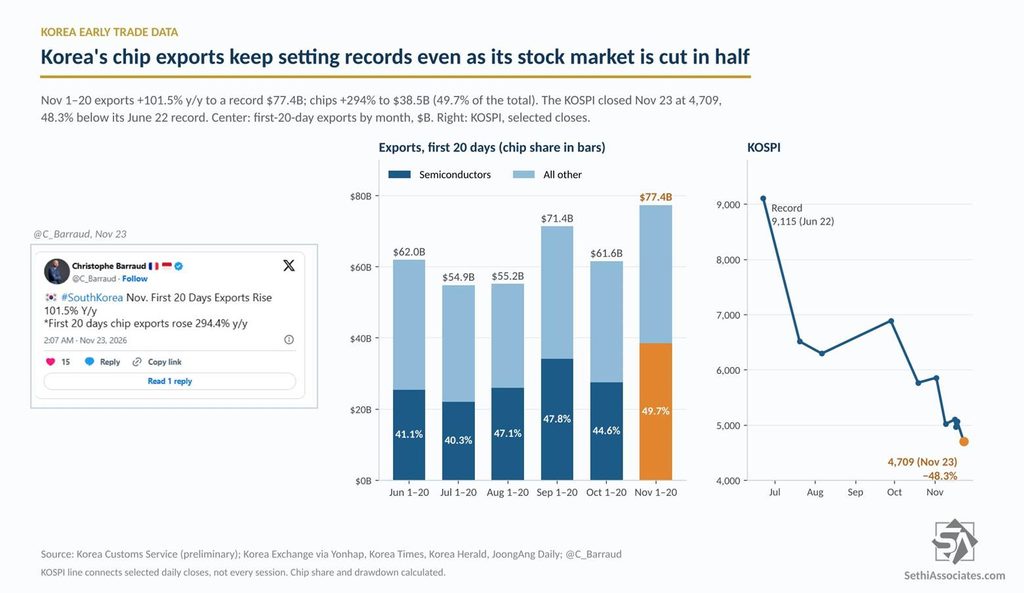
Christophe Barraud’s Monday Morning Brief flagged Korea’s early November trade data, and it shows no letup in the AI chip boom, even as Korean chip stocks have been cut in half. Per the Korea Customs Service, exports in the first 20 days of November:
- Rose 101.5% y/y to $77.4 billion, the most for the first 20 days of any month (the prior high was $71.4 billion in September).
- Adjusted for working days (16 vs. 15.5), the daily average rose 95.2% to $4.84 billion, also a record for any 1-20 stretch, topping October’s $4.74 billion.
- Chip exports jumped 294.4% to a record $38.5 billion, 49.7% of the total (up 24.3 points from a year ago). By my math, chips supplied about 74% of the $39 billion y/y gain.
- It isn’t only chips. Computer peripherals rose 330.5% and petroleum products 91.9% (mostly oil prices), while autos fell 5.6%. Non-chip exports were up about 36%.
- Year-to-date exports reached about $1.008 trillion through November 20, up 63.2%.
The disconnect with markets is striking:
- The KOSPI closed Monday at 4,708.54, its lowest since January 13 and 48.3% below its June 22 record (9,114.55).
- SK hynix is about 63% off its 2026 high and Samsung about 51%.
- Friday’s 5.2% drop came on a worsening outlook for chip prices and tighter US curbs on China’s access to chips.
So much of the export surge is price rather than volume that Korea’s 10- and 20-day releases are one of the fastest checks on how that is holding up. So far the data say very well: first-20-day chip exports have climbed from $25.5 billion in June to $38.5 billion in November. The next checks are the full November figures on December 1 and the December 1-10 data around December 11.
Wrap-Up — Now Comes the Hard Part
As I said Monday, calling for a bounce was the easy part. The harder part is figuring out where things go from here.
The indicators I mentioned Sunday pointed to a bounce. But as likely as that bounce was, history also said a pullback was a likely follow-up. Bespoke found that after the 25 largest one-day gains for the S&P 500 over the last 25 years, the index was lower the next day and the next week two-thirds of the time, and only a month out did the average gain and the win rate turn positive.
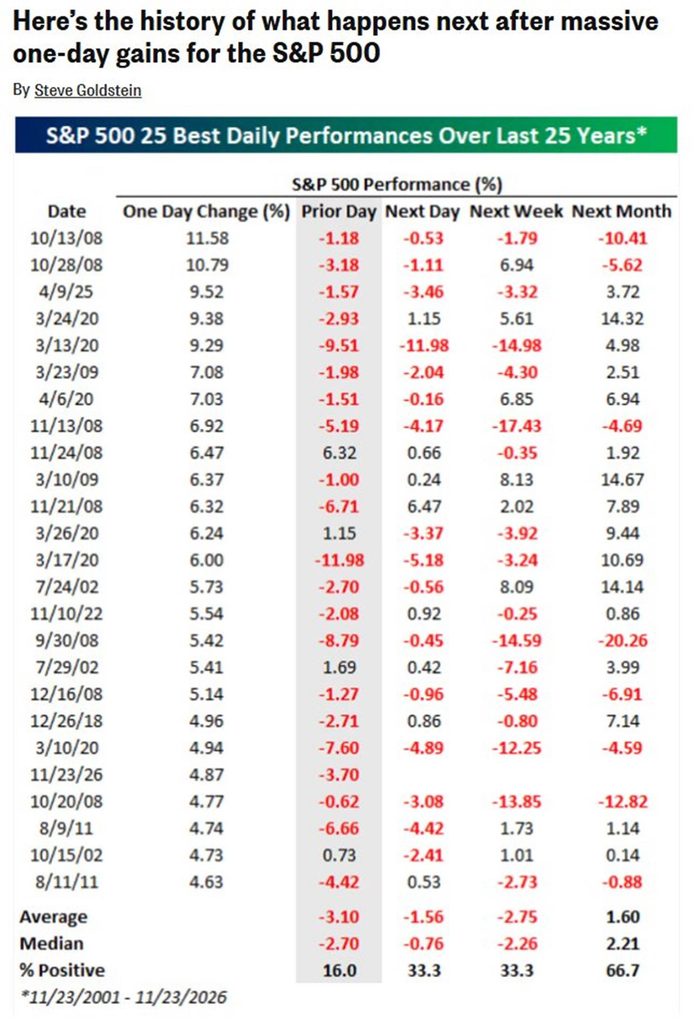
That’s consistent with my warnings today that things are likely to stay choppy after the initial surge (see After VIX Drops Like Monday’s, Stocks Went Higher 6 and 12 Months Later Every Time; This Correction Was Fast, History Says That Matters for a Rebound; and BTIG Chief Called Drop and Bounce, Sees Another Leg Lower). If history is our guide, we won’t get back above Monday’s highs (7,296 on the S&P 500) the rest of this holiday-shortened week. Helene’s indicators don’t call for a one-day rally, but she also expects some give back first, and in the piece linked above BTIG’s Krinsky is calling for another leg lower.
But it’s also important to remember that those same indicators that pointed to a bounce and chop mostly also point to more upside six and 12 months out. It’s between now and then that we’ll have to navigate a treacherous road. I’ll be watching and waiting for markets and individual equities to either get above Monday’s highs or drop below Friday’s lows. That will indicate to me what the near-term trend is.
As always, let’s see what we get and go from there.
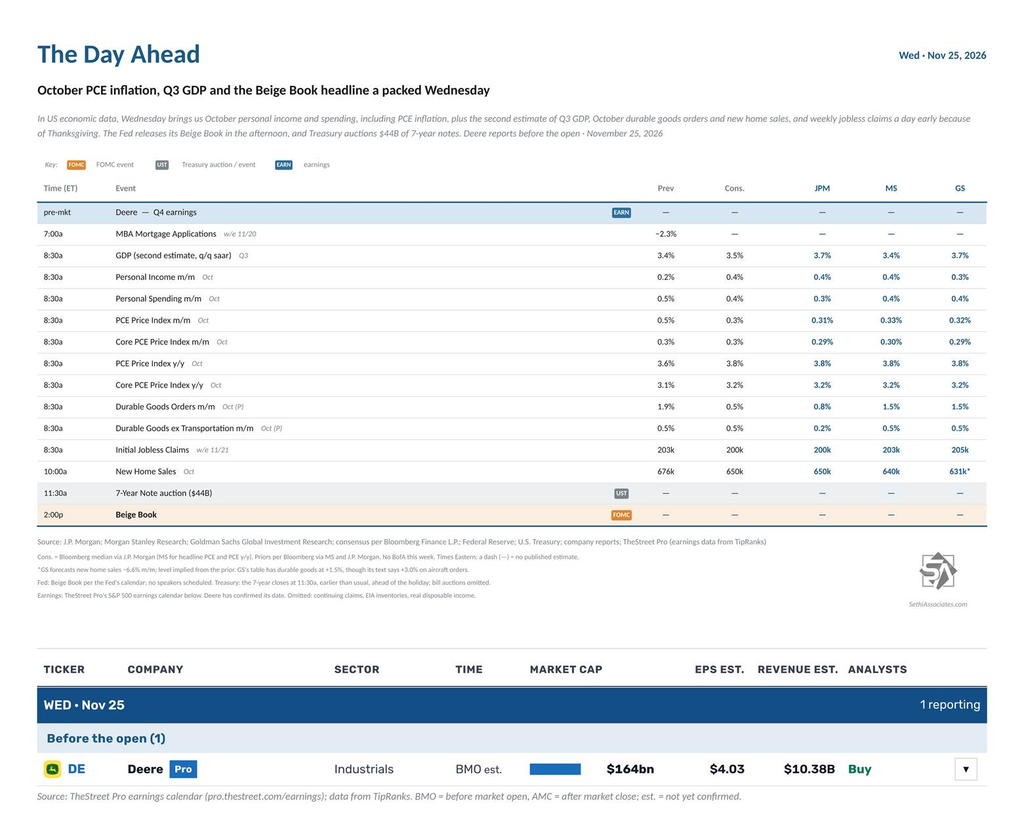
The Day Ahead — PCE, GDP and the Beige Book
Wednesday is packed ahead of Thanksgiving.
The most notable US economic data is October’s personal income and spending report, which includes core PCE inflation, the Fed’s preferred inflation metric. Bloomberg consensus is for core PCE to rise 0.3% m/m (3.2% y/y, from 3.1%) and headline PCE 0.3% (3.8% y/y, from 3.6%). J.P. Morgan and Goldman Sachs both expect core at 0.29%. Personal income and spending are both expected to rise 0.4%.
The second estimate of Q3 GDP comes at the same time (which should also include Gross Domestic Income, another key economic indicator), with consensus at 3.5% (the advance estimate was 3.4%), while J.P. Morgan and Goldman both expect 3.7%. We’ll also get October durable goods orders (consensus +0.5%) and new home sales (650,000), plus weekly jobless claims a day early because of the holiday (consensus 200,000).
The Fed releases its Beige Book at 2pm ET, its last major release before the December 8-9 FOMC meeting. As I mentioned in the Week Ahead: “The Beige Book is important…as the Fed pays a lot of attention to anecdotal ‘on the ground’ reports like that one.” As noted yesterday, there are no scheduled Fed speakers until the meeting.
Non-Bill (>1yr in maturity) US Treasury auctions include $44B of 7-year notes at 11:30am ET, earlier than usual ahead of the holiday.
Deere (DE) is the only S&P 500 component reporting earnings, before the open.
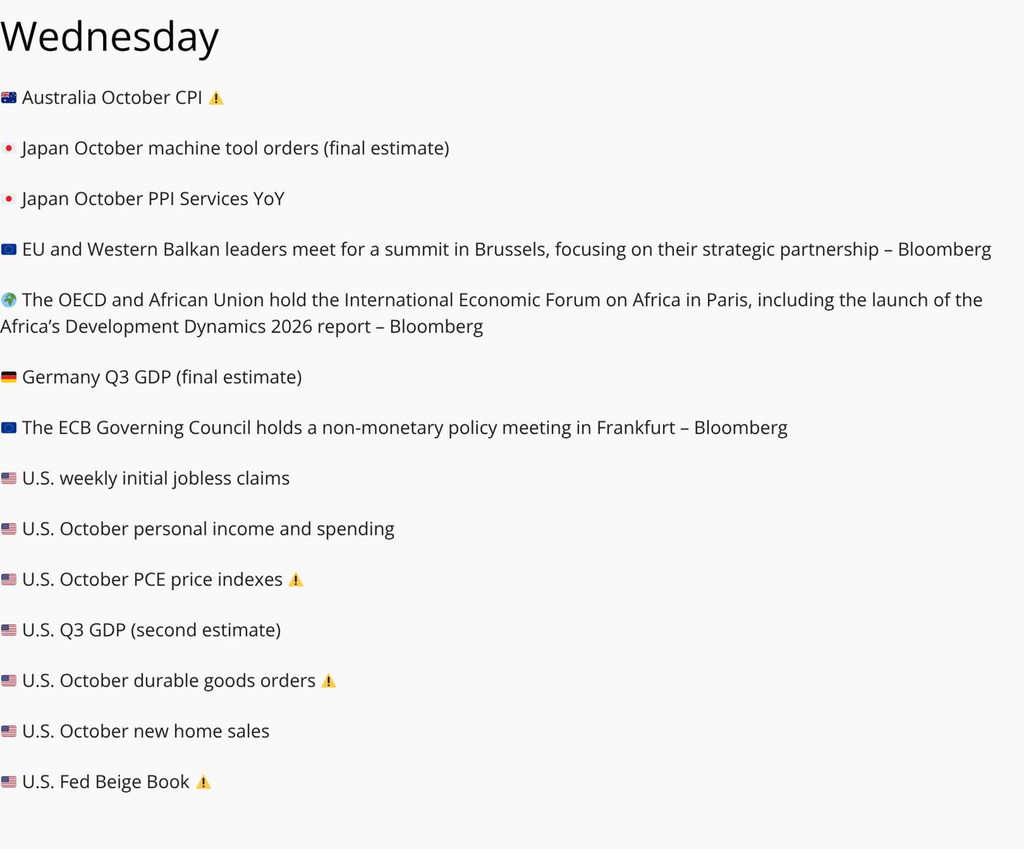
Ex-US highlights include Australia’s October CPI (7:30pm ET Tuesday), Japan’s October services PPI (6:50pm ET Tuesday) and final machine tool orders, Germany’s final Q3 GDP (2am ET) and French consumer confidence for November (2:45am ET). The ECB Governing Council holds a non-monetary policy meeting in Frankfurt, EU and Western Balkan leaders meet for a summit in Brussels, and the OECD and African Union hold their International Economic Forum on Africa in Paris.
From Christophe Barraud’s international Week Ahead rundown:
At the time of publication, in terms of securities mentioned, Sethi was long long AMZN, GOOGL, GS, NVDA, ORCL and numerous Treasury ETFs, and short IWM and VOO. In the last 24 hours Sethi sold his SOXL position.