Best Buy Report Suggests Lift for These 2 Portfolio Names
Expectations call for a wider use of AI shopping tools this holiday season.
You've reached your free article limit
You've read 0 of 1 free Pro articles.
Best Buy (BBY) topped its own expectations in its October quarter, with comparable sales up 6.1%, Growth was broad-based across nearly every product category, services and both online and in-store channels, and online revenue rose more than 10%.
Overall, average selling prices rose about 6% with units roughly flat, as higher prices in computing, consoles and phones were partly offset by a shift toward lower-priced items like trading cards. Beyond computing and phones, growth came from gaming, as shoppers bought hardware and accessories ahead of the “Grand Theft Auto VI” and “Zelda” launches.
We see those learnings supporting the expected seasonal lift for Apple’s (AAPL) and Microsoft (MSFT) hardware products even though Best Buy did not name drop any specific products in its comments.
Computing
Computing was the biggest upside surprise in the quarter and one of the largest contributors to comp growth, even as industry-wide memory cost increases pushed prices sharply higher. Average selling prices for computing rose about 25% year over year, while units fell by a mid-teens percentage. CEO Jason Bonfig credited two factors: higher memory costs and a shift toward new premium products, many of which launched during the quarter. Sales above the $1,500 price point were particularly strong, which he admitted was “maybe a little bit surprising in the environment we’re in.”
Looking ahead, Best Buy expects PC pricing to stay relatively stable through most of Q4. It strategically pulled forward computing inventory, which helped push total inventory up 11% and should let it hold current prices through most of the quarter, and it has enough supply to meet Q4 demand. However, this raises questions about supply and pricing beyond the current holiday quarter.
Management’s thinking is that trade-ins, financing and targeted promotions will help customers absorb the higher prices, but Bonfig was candid that he doesn’t know when memory supply will normalize. That comment about trade-in and financing meshes with our thinking for Apple’s Apple Upgrade leasing program.
Mobile
Mobile phones were one of the largest contributors to comp growth, extending a run of several straight quarters of growth. Management noted phone prices are rising along with computing and gaming consoles. What we found interesting was the comment that AI showed up mostly in emerging categories.
On the topic of AI glasses, Bonfig pointed to the Meta (META) Lab at Best Buy experiences and Meta’s plan to add Muse support to its AI glasses, and Best Buy is rolling out new in-store Google (GOOGL) Gemini experiences featuring Pixel and Samsung devices.
Holiday Promotional Environment and Guidance
Best Buy isn’t planning for an unusually promotional holiday. Its promotional calendar is similar to last year, with doorbusters and sales events that began at the end of October and run through the season under its “Open More” campaign. Q4 guidance calls for comparable sales growth of 2% to 4% and an adjusted operating income rate of 4.9% to 5.1%, with gross margin improving at a more modest pace than in Q3.
Given the inventory build and the expected announcement of President Trump’s new tariffs on Tuesday night, odds are that any impact in the current quarter will be minimal. But we’ll want to assess comments from retailers reporting after the Thanksgiving holiday, like Macy’s (M), American Eagle (AEO), PVH (PVH) and others for how these new tariffs could impact their business in 2027.
Best Buy and AI
During the earnings call, management noted that Best Buy’s product catalog is available inside ChatGPT, Gemini and Muse, with checkout built directly into ChatGPT and Gemini, alongside its own Ask Blue AI assistant. Surprisingly, there were no follow up questions on this to reveal regarding the degree of engagement or conversion from inquiry to sales. We’ll continue to look for such data points from Best Buy and other retailers making a similar move to leverage shopping via AI tools.
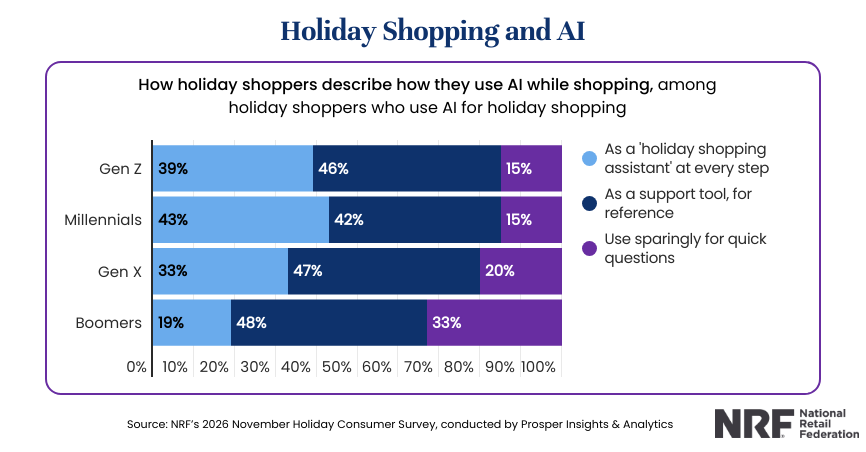
Data from research firm Epsilon finds that almost half of consumers plan to use AI to help with holiday shopping. Three in 5 Gen Zers say they use AI for holiday shopping often, almost or always, while Boomers are the least likely to use AI for holiday shopping. According to the National Retail Federation’s November consumer survey, half (49%) of all holiday shoppers plan to use artificial intelligence to support their winter holiday shopping, and it is settling in as a consumer habit.
We’ll look to see what data points emerge on this front between Black Friday and Cyber Monday. If you’re using an AI tool to help with your shopping, holiday or other, let us know in the Comments section below.
More Pro Portfolio
- We’re Adding to Our Robotics Holding
- Tracking Over 45 Portfolio Signals That Speak to Our Investment Strategies
- Weekly Roundup: Jensen Huang’s Exit Rattles AI as We Trade Boeing for SpaceX
At the time of publication, TheStreet Pro Portfolio was long AAPL and MSFT shares.