Consumer Confidence Jumps to Highest Since January 2025, Beating Every Estimate
The Conference Board’s index surged 11.4 points to 103.3, far above the 92.2 expected.
You've reached your free article limit
You've read 0 of 1 free Pro articles.
US CB Consumer Confidence Nov: 103.3 (est 92.2; prev 91.7; prev R 91.9)
– Present Situation: 132.8 (prev 120.4; prev R 119.1)
– Expectations: 83.6 (prev 72.6; prev R 73.7)
Executive Summary
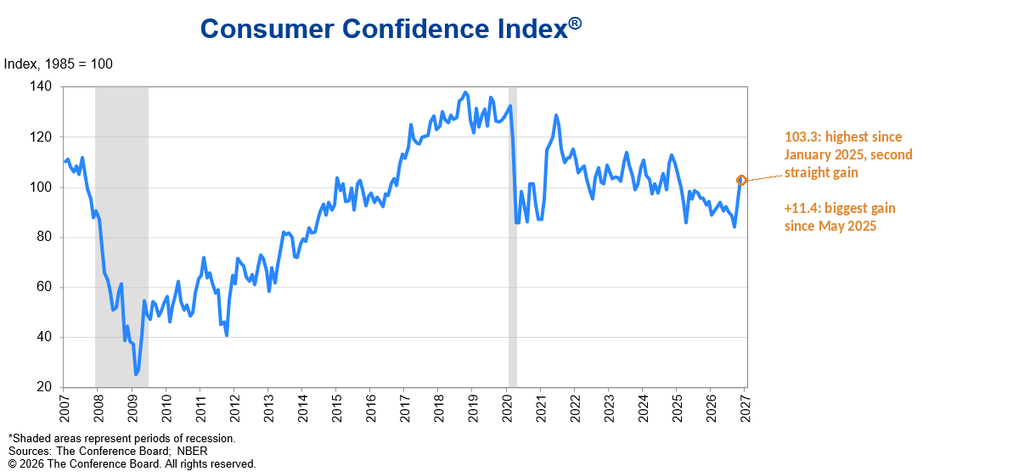
- The Conference Board’s Consumer Confidence Index jumped 11.4 points in November to 103.3, the highest since January 2025, crushing the 92.2 consensus and topping every estimate in Bloomberg’s survey. The 11.4-point rise was the biggest monthly gain since May 2025, per ZeroHedge, and a second straight beat of more than 10 points, with October revised up to 91.9.
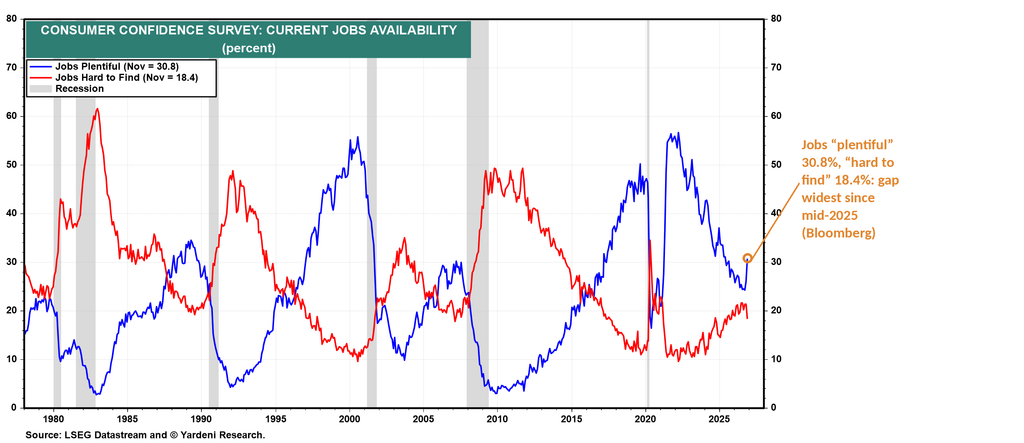
- The share of consumers saying jobs are “plentiful” rose to 30.8% and the share saying they are “hard to get” fell to 18.4%, the best readings of the year for both, and the gap between them widened to +12.4, the widest since mid-2025 per Bloomberg.
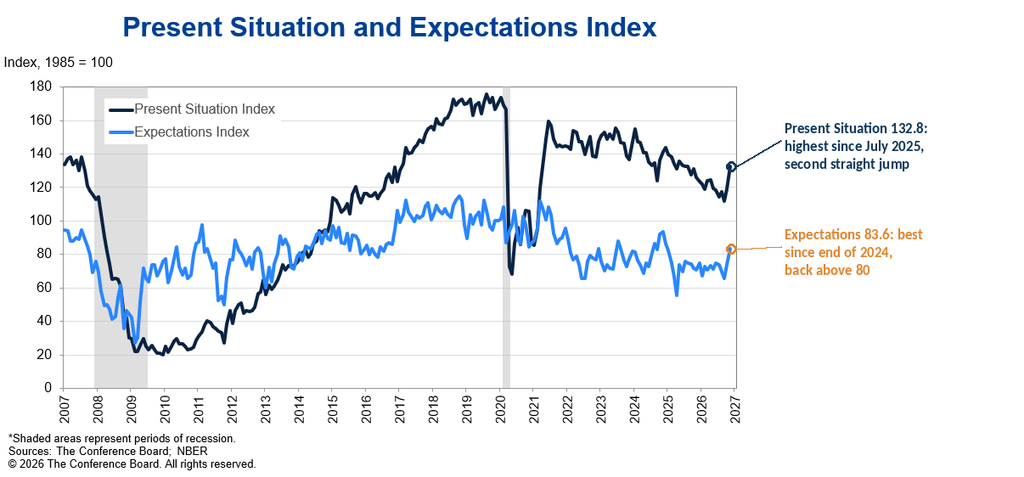
- The Expectations Index rose 9.9 points to 83.6, the best since the end of 2024 per Bloomberg and its first reading above 80 this year, the level the Conference Board has said in the past signals a recession ahead. The Present Situation Index climbed 13.7 points to 132.8, the highest since July 2025.
- Inflation expectations eased for a second month to 5.7%, and consumers planned more spending on goods and vacations. The Conference Board pointed to “lower uncertainty following the midterm elections.”
November Consumer Confidence
The Conference Board’s Consumer Confidence Index jumped 11.4 points, the biggest monthly gain since May 2025 per ZeroHedge, to 103.3, the highest since January 2025 according to the release. It beat the 92.2 consensus by 11.1 points, after a 10.7-point beat in October (covered here). That leaves it 9.5 points above April’s 93.8, which had been the previous high for 2026, and 19.1 points above September’s 84.2 low (covered here).
“Consumer confidence rallied again in November, potentially due to lower uncertainty following the midterm elections,” said Fergus McCormick, senior economist at the Conference Board. “The gain in confidence was led by stronger perceptions of present and future labor market conditions.” That post-election lift lines up with the University of Michigan’s sentiment survey earlier this month (covered here). Bloomberg also points to gasoline, which fell below $4 a gallon in November for the first time since July, according to AAA.
These are preliminary figures. This year the first print has been revised by an average of 1 point, and by as much as 2.5 points (May). Even a revision that large would leave November well above every other month of 2026.
Write-ins were less gloomy. McCormick: “While consumers continued to express frustration with high prices and rising costs, some comments cited hope for the general economy.”
The Present Situation
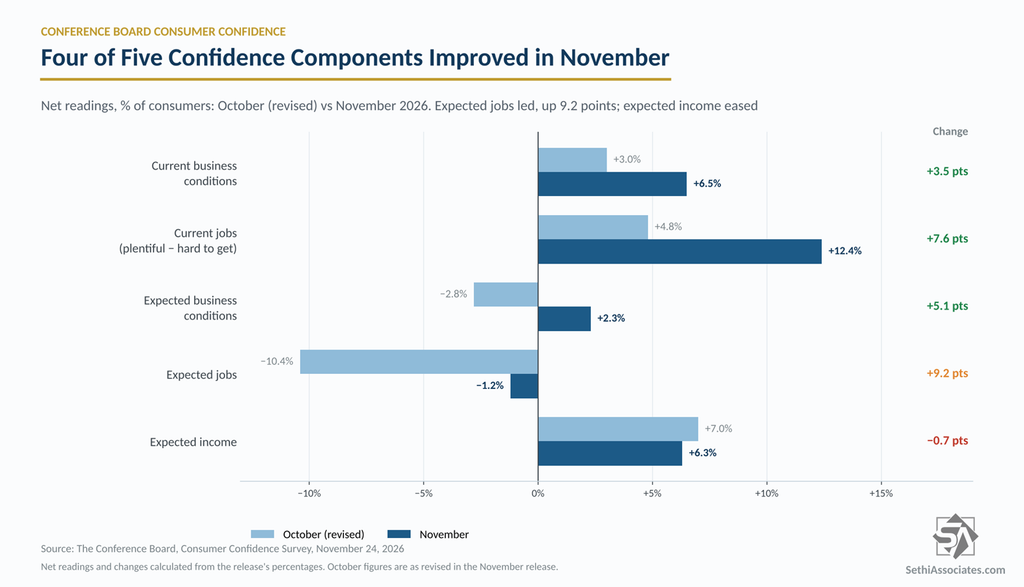
The Present Situation Index jumped 13.7 points to 132.8, the highest since July 2025 per Bloomberg, its second straight monthly gain, and 8.4 points above its previous 2026 high of 124.4 in April. Net views of current business conditions “increased by 3.5 percentage points to +6.5%,” but the job market did more of the work, with the labor market differential “improving by 7.6 ppts to +12.4%.”
The share saying jobs are “plentiful” rose to 30.8% from 26.2%, the highest of 2026, while “hard to get” fell to 18.4% from 21.4%, the lowest of 2026. The gap between them, at +12.4, is the widest since mid-2025 per Bloomberg, and more than four times July’s low of +2.7.
Expectations
The Expectations Index “improved by 9.9 points to 83.6,” the best since the end of 2024 per Bloomberg, and its first reading above 80 this year. The Conference Board has said in the past that readings below 80 signal a recession ahead, though the index spent long stretches below that level after the pandemic without one following.
Four of the index’s five components improved, with the outlook for jobs leading. Net expectations for business conditions “climbed back into positive territory, rising by 5.1 ppts to +2.3%,” the first positive reading this year. Net expectations for the labor market rose “by 9.2 ppts to just –1.2%,” the least pessimistic reading of 2026 by a wide margin. The one soft spot was income, where net expectations “eased by 0.7 ppts to +6.3%.”
Demographics
“All age groups and generations recorded an increase in confidence in November, with the greatest increase by Gen Z respondents. Improvements in confidence were largest among consumers with higher household incomes.”
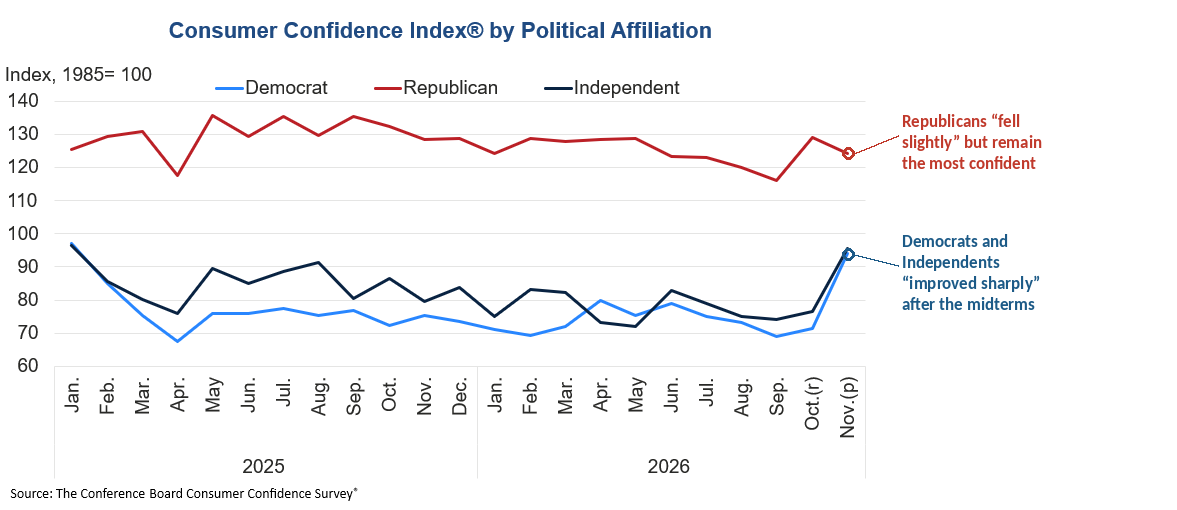
As might be expected, the politics flipped after the midterms. Confidence among Democrats and Independents “improved sharply,” while it “fell slightly” among Republicans, who still “remained the highest by political affiliation.”
Inflation, Rates and Stocks
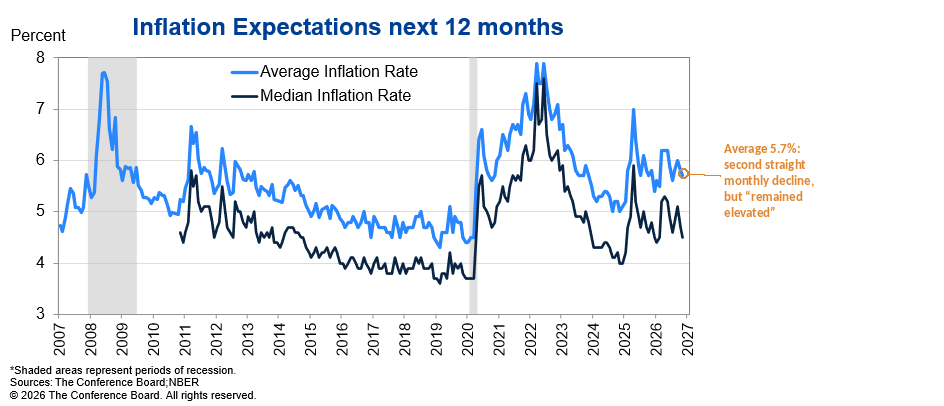
Average 12-month inflation expectations “declined for a second consecutive month in November, but remained elevated at 5.7%,” down from 6.1% in September’s first print.
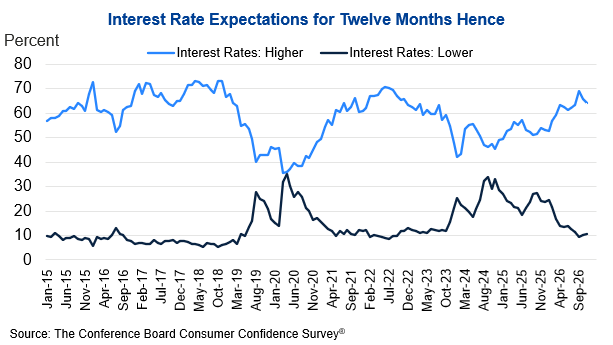
“Consumers still expected higher interest rates over the next 12 months.”
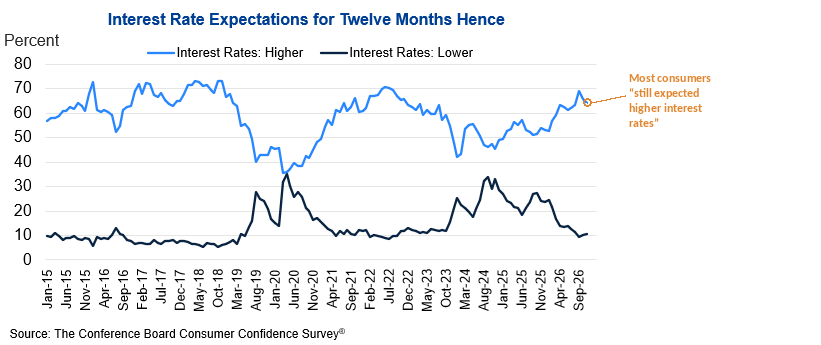
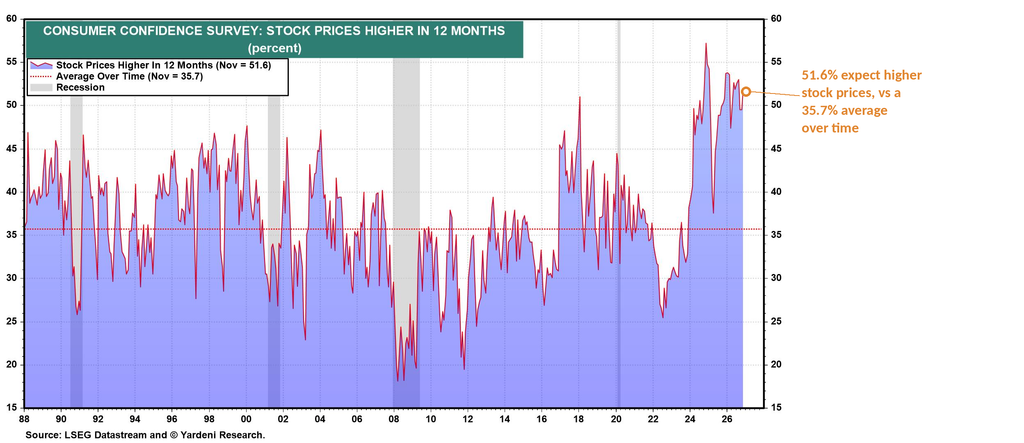
Stocks: “Market volatility in the first half of November notwithstanding, more consumers expected stock prices to increase rather than decrease in the next 12 months.” Per Yardeni Research, 51.6% expect higher stock prices, well above the 35.7% average over time.
Household Finances and Recession Odds
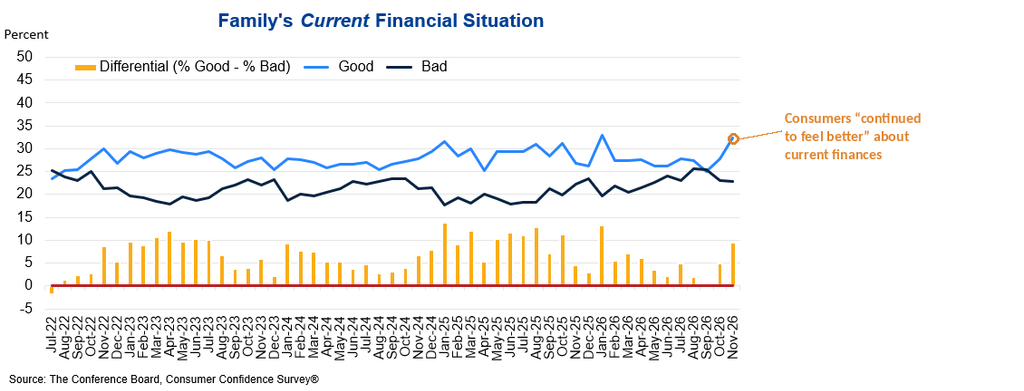
Consumers “continued to feel better about their Family’s Current Financial Situation in November.”
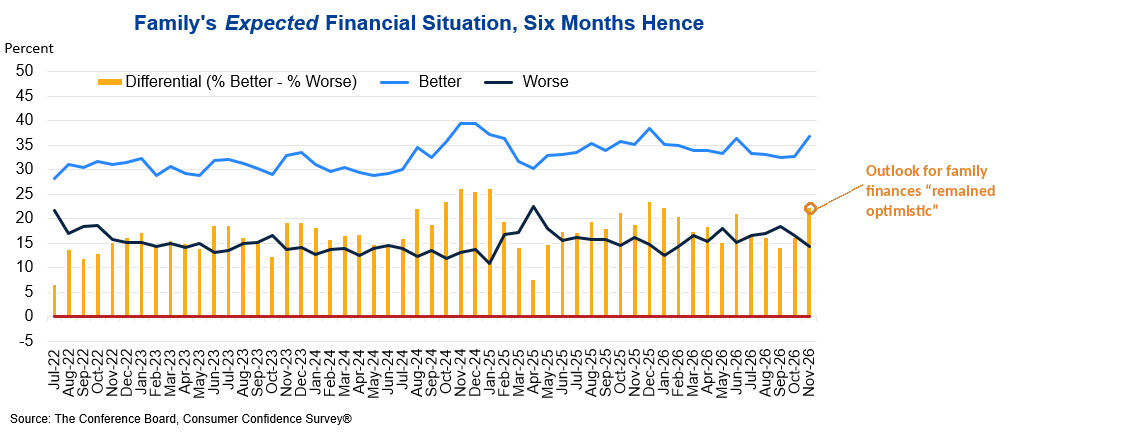
And their view of the next six months “remained optimistic.”
On recession odds, “the share of consumers citing ‘not likely’ as an answer advanced.” These measures are not included in the headline index.
Spending Plans
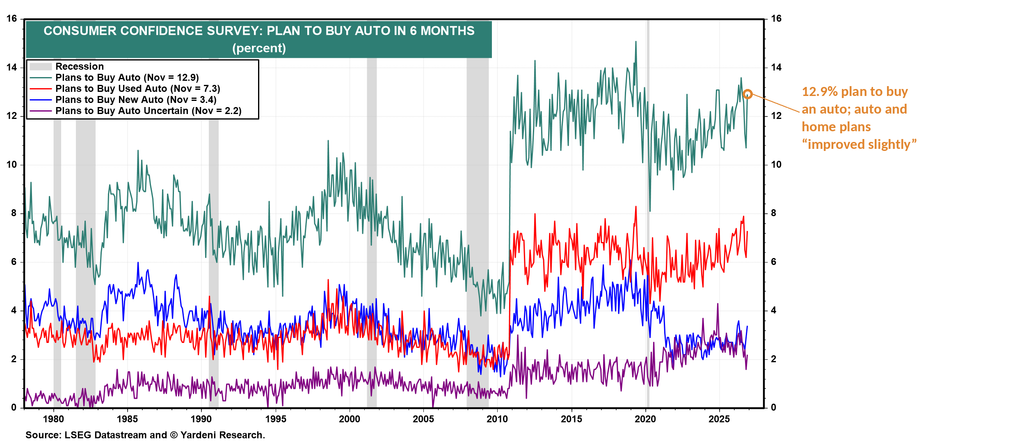
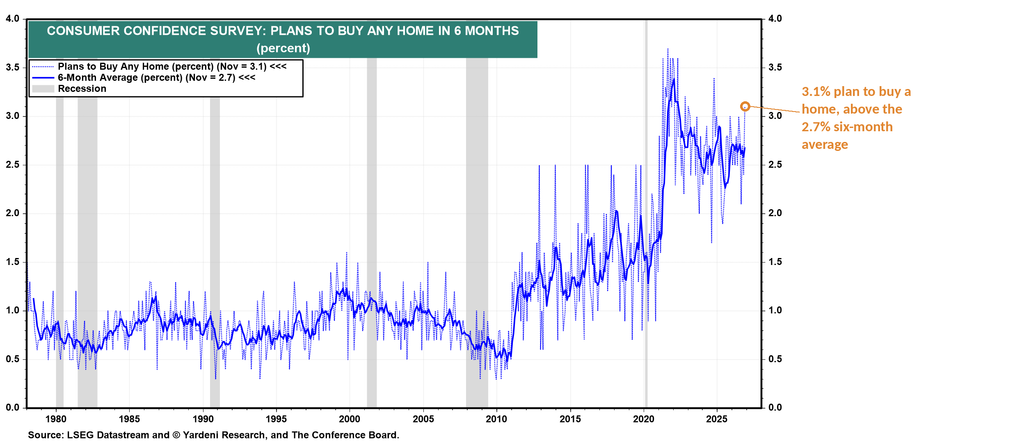
Spending plans turned up after October, when planned durable goods spending “dropped across the board.” In November, “plans to purchase autos and homes both improved slightly” and planned spending on durable goods “generally increased across the board.” Per Yardeni Research, 12.9% of consumers plan to buy a car and 3.1% plan to buy a home, above the 2.7% six-month average.
Services were “mixed.” Planned spending on hotels and airfare rose, and other gains were in discretionary items such as gambling and lottery, amusement parks and museums. The usual top categories, led by restaurants and streaming, were “somewhat less prioritized compared to previous months.”
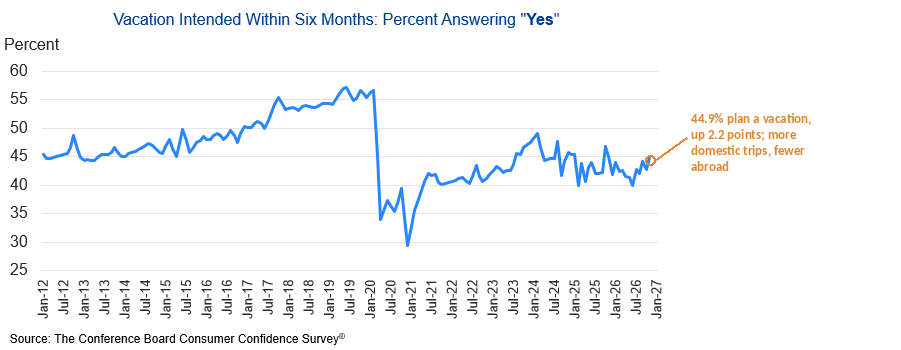
Vacation plans picked up: 44.9% of consumers are considering a vacation in the next six months, up 2.2 percentage points from 42.7% in October, with more planning domestic trips and fewer going abroad.
What to Watch
There has generally been a loose link between consumer confidence and consumer spending. Bloomberg noted in October that sentiment “has been a poor indicator of personal spending, which has been resilient.” But November’s jump came with firmer spending plans, as consumers “planned slightly higher spending on goods and vacations,” and plans to buy autos, homes and durable goods all improved. Whether that shows up in actual spending through the holidays is the thing to watch. The revised November figure comes with the December report on December 22, and with this year’s revisions averaging about 1 point, November should hold as the high for the year through that point.
Summary of Details From the Report
Consumers’ views of current business conditions improved in November:
- 23.3% of consumers said business conditions were “good,” up from 20.8% in October.
- 16.8% said business conditions were “bad,” down from 17.8%.
Consumers’ views of the labor market were more positive in November:
- 30.8% of consumers said jobs were “plentiful,” up from 26.2% in October.
- 18.4% of consumers said jobs were “hard to get,” down from 21.4%.
Consumers were hopeful about future business conditions in November:
- 19.6% of consumers expected business conditions to improve, up from 17.5% in October.
- 17.3% expected business conditions to worsen, down from 20.3%.
Consumers were significantly less negative about the labor market outlook in November:
- 18.1% of consumers expected more jobs to be available, up from 15.3% in October.
- 19.3% expected fewer jobs, down from 25.7%.
Consumers’ assessments of their income prospects eased slightly in November:
- 18.4% of consumers expected their income to increase, unchanged from October.
- 12.1% expected their income to decline, up from 11.4%.
Charts marked SethiAssociates.com are built from Conference Board data, charts from Yardeni Research carry its source line, and all others are from the Conference Board. The full release is available here.