After Earnings Beat, Can Dollar Tree Make You Some Cash?
Let’s dive into earnings, the outlook and the chart of this budget retailer.
You've reached your free article limit
You've read 0 of 1 free Pro articles.

Dollar Tree (DLTR) posted fiscal third-quarter financial results on Tuesday morning, revealing decisive top- and bottom-line beats. Dollar Tree earned an adjusted $1.16 (unadjusted EPS: $1.24) per share on revenue of $5.078 billion. That top-line print was for annual growth of 6.9%. Comparable store sales increased 4.6% on top of last year’s 4.2% growth. Those comp store sales included a 3.8% increase in traffic and a 0.8% increase in average ticket size.
The impact of tariffs did hit these numbers. Both sets of earnings-per-share numbers include the $0.42 impact of costs related to the net impact of tariff reinvestments. Those reinvestments also knocked had a negative impact on operating margin as well. The company raised its full-year adjusted EPS guidance in this report as well, even as it deliberately reinvested tariff-related benefits back into the business.
“Our third quarter results show the strength of Dollar Tree’s value proposition and the progress we’ve made to improve the customer experience. Comp traffic accelerated to 3.8% and drove comparable sales above the high end of our outlook,” said CEO Mike Creedon. “Our broader assortment, better stores and stronger customer engagement give shoppers more reasons to choose Dollar Tree and come back more often. We continue to invest in our brand, our stores and our people to build on this momentum. As the holiday season begins, our focus is clear: make Dollar Tree the destination for value, convenience and discovery, and position the business for sustained, profitable growth.”
Operations
As revenue generation grew 6.9% to $5.074 billion, the cost of those sales increased 7.2% to $3.263 billion. Gross profit margin decreased 10 basis points to 35.7% and included 45 basis points of net cost from tariff refund reinvestment. After factoring in 8.4% growth in operating expenses to $1.527 billion, the retailer was left with unadjusted operating income of $308.6 million.
After accounting for interest, other income & expenses and taxes, unadjusted net income landed at $232 million (-5.2%). This works out to a fully diluted unadjuted EPS of $1.24, up from the year ago comparison of $1.20 (fewer shares). Once adjusted, primarily for non-operating insurance gains, that EPS drops to $1.05 (fully diluted), down from $1.21.
Guidance
For the current quarter, Dollar Tree guided toward 3% to 4% comparable store sales growth and an adjusted EPS of $2.46 to $2.66, the latter including roughly a $0.25 cost impact from tariff refund reinvestments.
For the full fiscal year, Dollar Tree raised its adjusted EPS outlook to a range of $8.05–$8.25, which will include an approximate $0.65 benefit related to the net impact of tariff refunds. This takes the low end of the range well above the $7.93 or so that Wall Street was looking for.
Fundamentals
For the quarter reported, Dollar Tree generated operating cash flow of $375.3 million. Out of that number came capital spending of $253.7 million, leaving free cash flow of $121.6 million (up from -$57.1 million). “Out of that number” came the $205 million that the firm returned to shareholders through its share repurchase program. Dollar Tree does not pay shareholders a cash dividend.
Turning to the balance sheet, Dollar tree ended the quarter with a cash position of $1.011 billion and inventories of $2.751 billion. That left current assets of $4.067 billion. Current liabilities add up to $3.597 billion, including no short-term debt, which is impressive. Dollar Tree’s current ratio now stands at 1.13. We generally do not do quick ratios for retailers due to the inventory-centric nature of the business. This passes muster.
Total assets amount to $14.485 billion, of which about very little is labeled as either goodwill or other intangibles. Total liabilities less equity comes to $11.017 billion. There is long-term debt of $2.934 billion on the books which is a lot but none of it comes due within 12 months and there is positive free cash flow that can be put to work differently. This balance sheet is in better shape than I expected.
My Take and the Chart
I’m impressed. These results show a retailer focused on budget conscious consumers that is still generating consistent gains in foot traffic gains and executing well on its multi-price evolution strategy. The company is doing this even as it navigates the whole tariff-impacted environment by reinvesting the refunds rather than simply harvesting the benefit. Did I mention that I’m impressed? The stock will trade higher this morning, despite a weak tape.
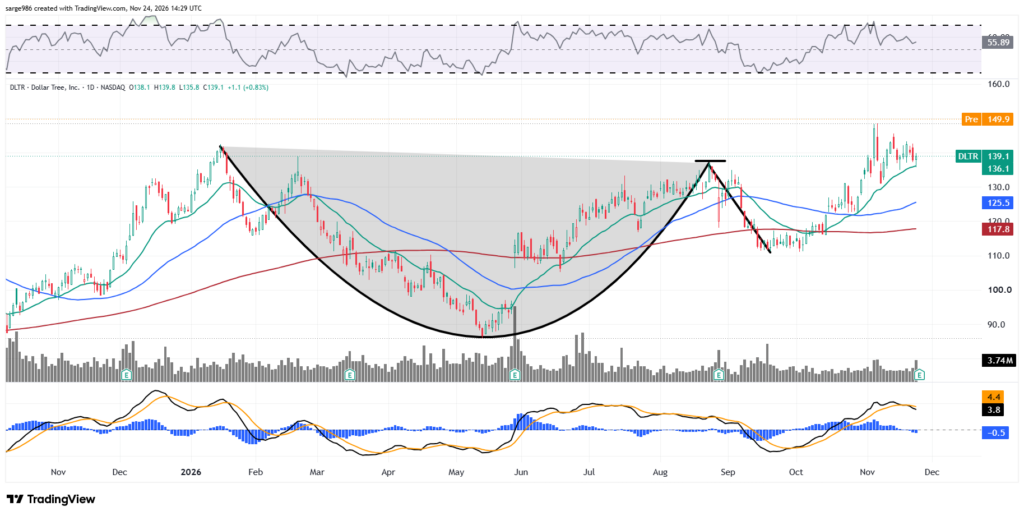
Readers will see that from very early 2026 into September, DLTR developed a beautiful “cup with handle” pattern of bullish reversal with a $137 pivot. The stock spent about three weeks trying to crack that pivot and will do so decisively this morning. The stock can also boast a robust Relative Strength Index and a daily moving average convergence divergence that is now sending bullish signals across all three of its components. DLTR is a buy. That’s my opinion. Now, I have to initiate.
Target Price: $171
Pivot: $137
Add: down to 21-day EMA (currently $137)
Panic: Loss of 200-day SMA (currently $118)
At the time of publication, Guilfoyle had no position in any security mentioned.