After VIX Drops Like Monday’s, Stocks Went Higher 6 and 12 Months Later Every Time
I promised more cautious SMT posts today, and this sort of qualifies in the short term, but for those who missed it (Monday’s Charts – Big Gains, but Most Charts Still Below Broken Support, Now Resistance), we got another long-term bullish indicator when the VIX fell 25.9% Monday to 26.61, a drop of 9.29 points. That was by both measures its biggest one-day drop since April 9, 2025, and its seventh largest percentage drop in data back to 1990.
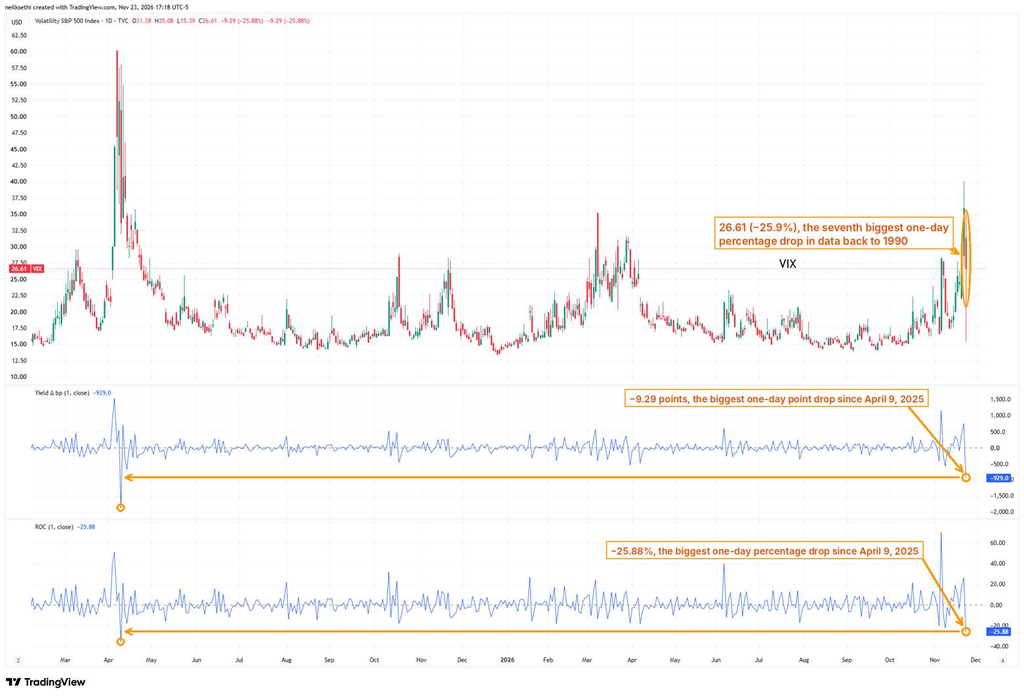
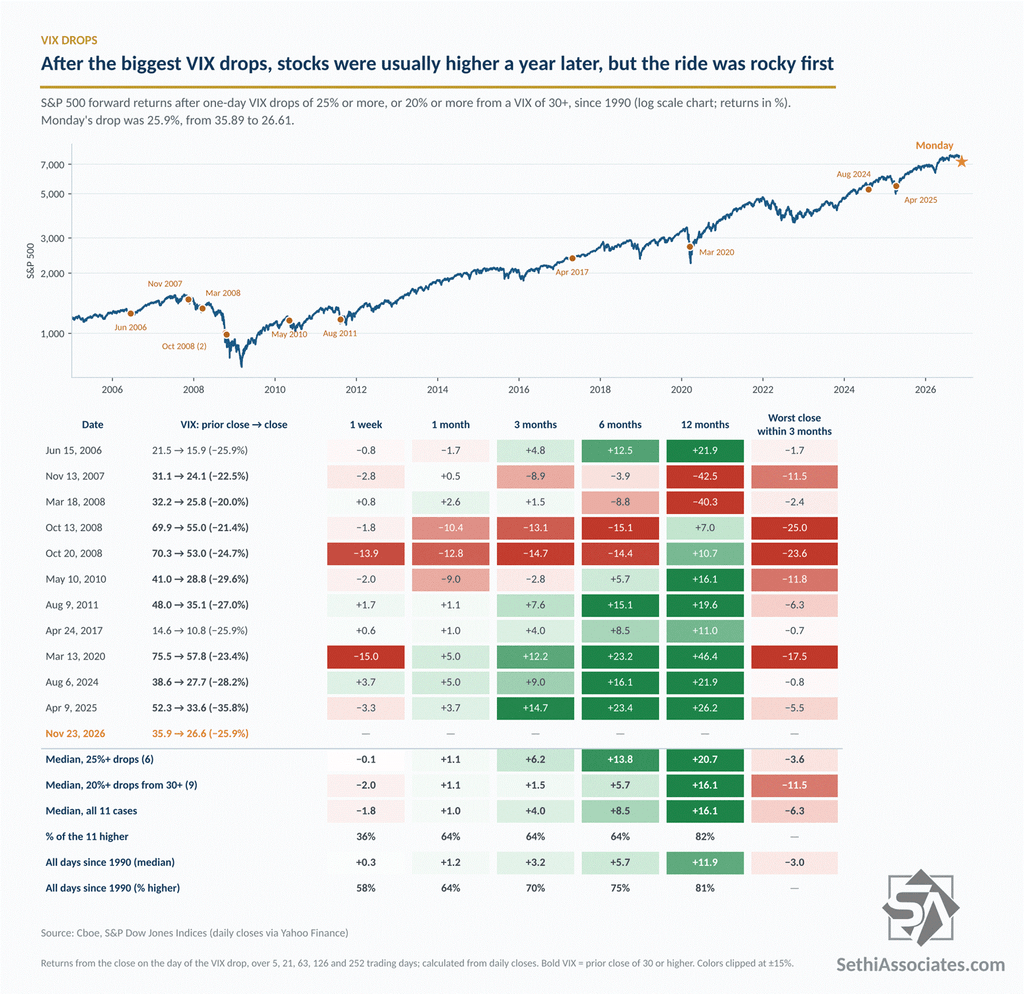
Since 1990, the VIX has fallen 25% or more in a day just six other times (June 2006, May 2010, August 2011, April 2017, August 2024 and April 2025). The S&P 500 was higher six and 12 months later every time, with median gains of 13.8% and 20.7%, vs. 5.7% and 11.9% for all days.
The near term was more of a coin flip, though. The S&P 500 was higher a week later in three of the six cases and a month later in four (median +1.1%), and in three of them (May 2010, August 2011 and April 2025) it fell more than 5% further at some point over the next three months.
Also, the medium-term record is more mixed when the drop came from a VIX of 30 or higher, as Monday’s did (it closed at 35.89 Friday). Including drops of 20% or more from those levels (nine cases), the S&P 500 was lower three months later in four of them, all between 2007 and 2010, and its median worst close over those three months was 11.5% below the close on the day of the drop.
One caution: VVIX (the VIX of the VIX) fell 15.0% to 117.36, but it remains well above the 100 level flagged by Charlie McElligott as indicating higher stress, a sign that volatility markets haven’t fully calmed down. And as noted in VIX Above 30 at Options Expiration Usually Means Higher Stocks Ahead, only once since 1990 (December 2018) has the VIX gone from above 30 at options expiration to below 20 within a month.
At the time of publication, in terms of securities mentioned, Sethi was short VOO.

Conversation 0 Comments
One ongoing discussion across all days. Everyone can read; sign in to take part.
Your voice matters. Discussions are moderated for civility. Read our guidelines .
Log in to join the conversation