The Dealmaker
Let’s look at how Jensen Huang got back, why he’s back and what likely it means and doesn’t mean for the market, national security and the AI trade. Also, my big Monday moves.
You've reached your free article limit
You've read 0 of 1 free Pro articles.

Where The Sidewalk Ends
Let us leave this place where the smoke blows black
and the dark street winds and bends.
Past the pits where the asphalt flowers grow
we shall walk with a walk that is measured and slow
and watch where the chalk-white arrows go
to the place where the sidewalk ends.
Yes we’ll walk with a walk that is measured and slow,
and we’ll go where the chalk-white arrows go,
for the children, they mark, and the children, they know,
the place where the sidewalk ends.
– Shel Silverstein (1974)
Market Euphoria…
Or whatever it is. Financial markets soared in response to the return of Jensen Huang to the position of chief executive to the firm he himself had co-founded back in April of 1993. Why did Huang’s highly questionable return force capital our back into equities broadly, and back into high-tech and the AI trade specifically? That’s not too difficult to figure out. Just remember, the AI trade was already stumbling badly prior to Huang’s resignation from that post 11 days prior to his return. The stumbling (volatility) will continue as the issues that caused investors to seek other avenues for investment have gone nowhere.
Huang’s return lifts a some uncertainty that had been hanging over the tech space. The whole episode, from disgraced exit to a far-less-than-triumphant return underscores his centrality, through to the entire AI ecosystem and perhaps most especially, his pivotal place in regard to U.S. national interests. The share price of Nvidia (NVDA) increased 31.5% on Monday as a cool $1T or so moved back into the company’s market cap.
Nvidia’s board of directors voted unanimously to reinstate Huang to his old position following a series of discussions and meetings with him. Nvidia’s board also said it had received input from senior levels of the U.S. government. Based on that input, the board says that it is confident that Huang’s reinstatement poses no national security risk. Am I the only one who sees a problem here?
I mean, it’s not just the fact that this CEO had inappropriate romantic relations with at least one client (who may have been a foreign asset) and multiple subordinate employees. The company is still under investigation from multiple directions. That includes both an Securities and Exchange Commision probe into the firm’s accounting practices and according to Bloomberg News, state level investigations that could have criminal consequences.
Why Was This Nvidia Move So Important?
For one, Jensen Huang is the man behind all of these head-scratching circular financing deals meant to keep the lights on at some of Nvidia’s customers. Does this guarantee those contracts? To some degree, I think it reinforces confidence in those deals. You may have noticed that CoreWeave (CRWV) was up 22.3% on Monday. This, for no, removes the risk of collapse across an entire sub-industry.
What got me was the involvement of the president of the United States. I don’t like that one bit. I am a free-market capitalist, and I believe that free markets, if not interfered with, do work for the public good. No system has come even close to lifting as many people out of poverty as capitalism. The problem can be when free markets become perverted through manipulation or outright interference.
Pres. Trump was heavily involved in and even publicly claimed a decisive role in Jensen Huang’s reinstatement as Nvidia CEO. Is that cool? Is picking winners in this economy OK? I have had doubts in the past when this administration has taken equity stakes in U.S. companies for varying reasons. That’s a bit socialist for me. This is one step further though. The president appeared on CNBC television on Monday morning. The president told CNBC he had been speaking to the board “directly and indirectly,” adding that “I convinced them,” and even said… “I made the deal.”
Some reports describe a weekend pressure campaign that also involved Vice Pres. JD Vance and other senior officials such as Treasury Sec. Bessent and Commerce Sec. Ludnick. The administration apparently assured the board there was no evidence that Huang had broken national-security laws.
The Real Reason Jensen Is Back…?
Pres. Trump did not publicly use the word “defect,” but I took it as a real concern. The president did say that the CEO’s removal at Nvidia “risked putting the U.S. behind Beijing in the race for (AI) dominance… if Huang… were to be poached by a Chinese firm,” citing “the vast amount of knowledge in his brain.”
Now, that is a concern that I understand. Trump framed this threat as a reason that the U.S. needed to “protect our geniuses” and keep Huang at Nvidia rather than risk a peer or near peer adversary gaining that talent. Trump told the interviewers on CNBC that the larger threat to national security was “losing the brain power of somebody like Jensen” and that Huang “could take the next plane to China, and I guarantee you, they would give him whatever he wanted.”
So, no… I don’t like federal intervention in U.S. corporate affairs. That said, do we really want to see someone this capable working on chip design for mainland China’s armed forces? I don’t think so. As someone who can certainly identify with those that events like that would put in an environment of greatly increased risk, I get it.
Now Back to Reality
Monday’s relief rally — because that’s what it was — is giving way to some selling pressure across the equity index futures space overnight. Nvidia shares themselves are giving back several percentage points. percent premarket. The VIX appears to be back on the rise. The Immediate risk to the AI trade has been terminated. The more gradual risk seemingly never went away.
On Monday, the S&P 500 gained 4.73%, but did not make a serious attempt at recapturing it’s crucial (to professionals) 200-day simple moving average. The Nasdaq Composite and Nasdaq 100 added 6.51% and 6.86% respectively. Neither came close to retaking any key moving averages. The Russell 2000 took back 3.4%, but also took back nothing important technically. The Philadelphia Semiconductor Index, in isolation, gained a stunning 14.03%.
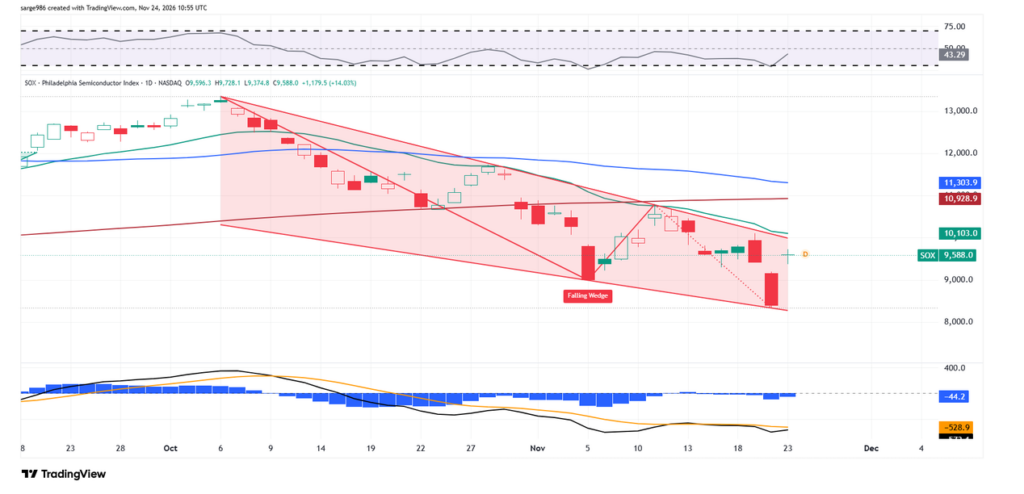
Readers will see that the Philadelphia Semiconductors also recaptured nothing important. Note that in order to retake the 21-day exponential moving average for that index, which would get the swing crowd behind the group, that this index also has to break out of a Falling Wedge of bullish reversal. The very similar Dow Jones U.S. Semiconductor index added 18% on Monday, led by Nvidia, Micron (MU), Intel (INTC) and Arm Holdings (ARM). Arm, by the way, got to keep their own CEO.
Monday’s Sarge-Folio Moves
- Bought CrowdStrike (CRWD), increasing weighting.
- Sold SoFi Technologies (SOFI), reducing weighting.
- Sold Lockheed Martin (LMT) exiting position.
- Sold IBM (IBM), reducing weighting.
- Sold Taiwan Semiconductor (TSM) reducing weighting.
- Took profits on my Nvidia (NVDA) bull call spreads. Now flat NVDA derivative positions.
Current Top Five Holdings
Advanced Micro Devices (AMD)
SoFi Technologies (SOFI)
CrowdStrike Holdings (CRWD)
Goldman Sachs (GS)
Walt Disney (DIS)
Economics (All Times Eastern)
08:15 – ADP Employment Change (Weekly): Last 23.75K.
09:00 – Case-Shiller HPI (Sep): Expecting 2.7% y/y, Last 2.7% y/y.
09:00 – FHFA HPI (Sep):
Expecting 0.2% m/m, Last 0.3% m/m.
10:00 – CB Consumer Confidence (Nov): Expecting 92, Last 91.7.
10:00 – Richmond Fed Manufacturing Index (Nov): Expecting -1, Last -2.
4:30 p.m. – API Oil Inventories (Weekly): Last +5.3M.
The Fed (All Times Eastern)
No public appearances scheduled.
Today’s Earnings Highlights (Consensus EPS Expectations)
Before the Open: ANF (3.10), ADI (3.88), BBY (1.49), BURL (1.72), DKS (1.41), DLTR (.92), SJM (2.56), MDT (1.33)
After the Close: DELL (6.55), HPQ (.74), WDAY (2.74)
At the time of publication, Guilfoyle was long CRWD, SOFI, IBM, TSM, AMD, GS, DIS equity.