A Broad Friday Rally Takes the S&P 500 Just Below Record Highs
Nine of 11 sectors rose, powering the S&P higher despite semiconductor weakness. Small-caps, though, posted a fifth straight weekly loss for the first time since 2022.
Stocks closed out a winning week with another broad rally pushing the S&P 500 to a hair beneath its all-time high as Treasury yields closed lower for the week across the curve for the first time in six weeks.
Indices opened higher and, after some early volatility, rose for most of the session, led by the Dow Jones Industrial Average (DJIA, +0.8%). The S&P 500 and Nasdaq each gained 0.6% and the Russell 2000 (RUT) added 0.5%. For the week, the S&P 500 led with a gain of 1.2%, the DJIA added 0.9% and the Nasdaq ended up 0.6%. The RUT though fell 0.9%, its fifth straight down week, the longest streak since 2022.
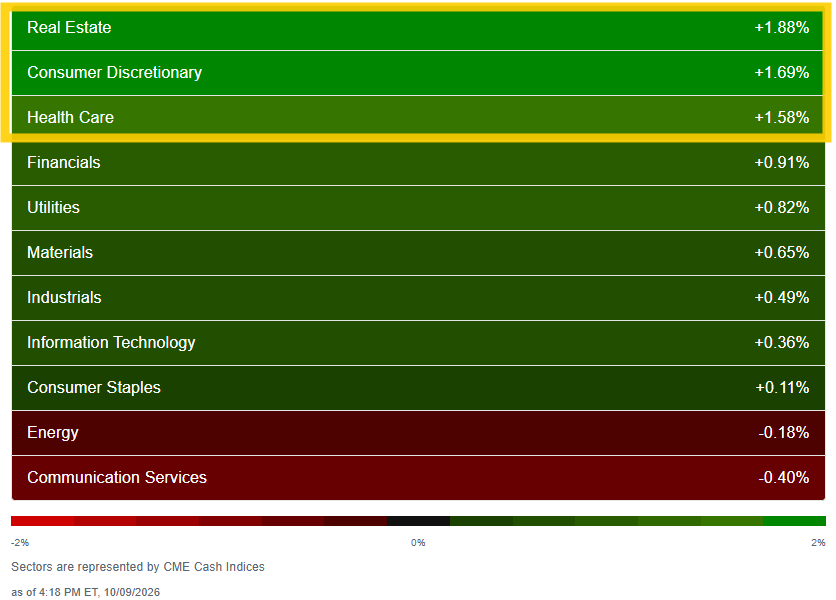
Breadth improved for a second straight session, with nine of 11 sectors higher, and again just a single mega-cap-growth sector (Consumer Discretionary) in the top half. Tech (+0.4%) lagged, but unlike Thursday closed in the green. Chipmakers slipped again.
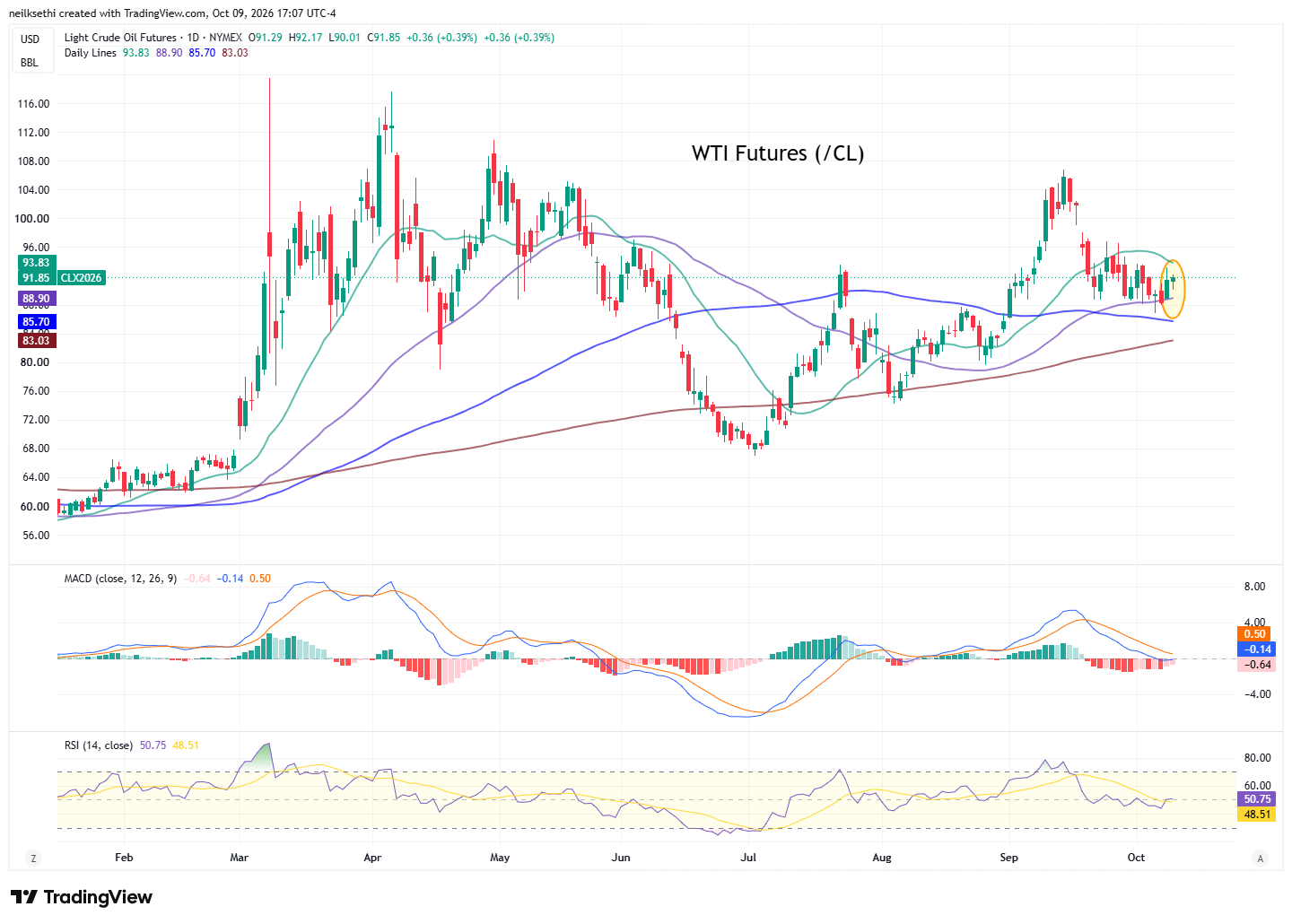
Oil edged higher, with WTI up 0.5% to about $92 as reports of another ship struck off the UAE offset President Trump’s announcement that Russia will supply diesel to U.S. and global markets. The 10-year yield rose 1 basis point to 5.24% in the cash session but fell 4bp on the week.
In economic data, preliminary October UMich consumer sentiment slid to 46.3, below expectations, weighed down by the current conditions component, which fell to a record low. Inflation expectations rose for a second month.
The Treasury market is closed Monday for Columbus Day, but stocks will trade. It’s a big week ahead full of important economic data, the unofficial start of Q3 earnings season and an appearance from Fed Chair Warsh.
Friday:
Schwab
For the week:
Schwab
Market Commentary
Equities:
Unease about the upcoming elections is swaying the market, according to Manulife John Hancock Investments strategist Matt Miskin. He notes that banks and industrials, which are sectors that “typically do better under Republican policies,” have recently weakened. That may signal the market is “pricing in a bit more of a blue wave.”
“Contrary to popular belief that stocks have shrugged off higher rates, plenty of damage has already been done. Nowhere is the strain more visible than in small caps.” —Tatiana Darie, Macro Strategist, Bloomberg Markets Live
“The sell-off reflected extreme positioning imbalances that have further to unwind in our view, which is why the whole AI-linked tech stock complex is unlikely to simply stage a sharp, V-shaped rebound,” wrote Adam Crisafulli of Vital Knowledge. “When it comes to AI, the main issue isn’t the gross vs. net issue with [annualized recurring revenue] but instead: 1) the fact that the standalone frontier labs are increasingly unattractive businesses … and 2) growing signs that markets are pushing back on the tidal wave of AI-linked debt and equity being thrown at them,” he added.
“People are worried, and that’s not a sign of a bubble,” Goldman Sachs Group Inc.’s Christian Mueller-Glissman told Bloomberg Television. “We generally are still in the camp that AI earnings growth is continuing to deliver,” he added.
“The biggest systemic risk in the market next year is not France but ‘something going wrong’ in the AI ecosystem: a safety event, a failed IPO, or disappointing revenues,” said George Saravelos, head of foreign-exchange research at Deutsche Bank. “Concentration risk is immense, and it is this dollar negative (and very bond positive) event risk that is most under-priced in markets at the moment,” Saravelos said.
Stock and Sector Breakdown:
Sector breadth improved for a second session to nine of 11 sectors higher (from six Thursday, three Wednesday), almost back to the 10 of 11 we had Monday and Tuesday. Three sectors finished over 1%, with again just one mega-cap-growth sector at the top of the leaderboard (there hasn’t been more than one of Consumer Discretionary, Communications, and/or Tech in the top 4 in a week).
Unlike Thursday though where Tech dragged the index lower, Friday it was just a throttle, ending up +0.4%. The two red sectors were Communications and Energy, neither down over 0.4%.
[chart uses futures prices]
Schwab
Consistent with my thoughts in last night’s wrap-up, fears about the AI trade were reduced after more details came out about yesterday’s report in the Financial Times that OpenAI’s revenue run rate was $50 billion in September, $20 billion lower than previously signaled, which Thursday sent AI-related shares lower. It turns out most of it was an accounting issue. Adding to the turnaround, Bloomberg reported that OpenAI is expecting to reach or exceed $70 billion in annualized revenue by the end of the year, according to people familiar with the matter, driven largely by growth in its enterprise business, on those same accounting metrics.
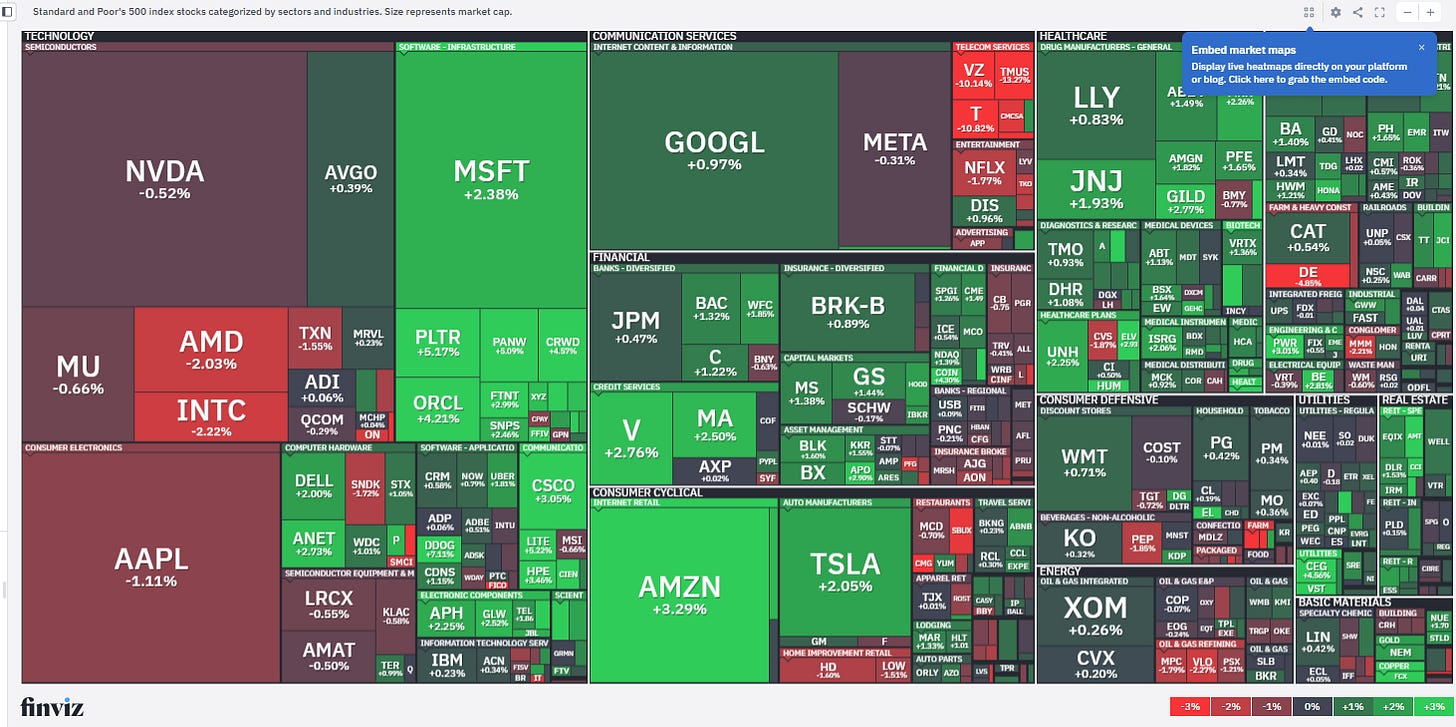
Oracle (ORCL) shares rose over 4%. That said, semiconductor stocks remained subdued with the PHLX Semiconductor index (SOX) finishing down 0.4%. Nvidia (NVDA) was -0.5%, Micron Technology (MU) -0.7%, and Advanced Micro Devices (AMD) -2.0%.
Lumenton (LITE) +5.2% shares got an extra boost after the company’s CEO Michael Hurlston told Bloomberg that Lumentum’s optical components are sold out through 2029. He said Lumentum will struggle to meet as much as 70% demand for some products through next year.
Shares of American Tower (AMT) +9.3% and Crown Castle (CCI) +15.6% rose sharply after SpaceX (SPCX) +1.3% agreed to buy nationwide spectrum licenses from Grain Management, a move that will bolster Starlink Mobile’s capabilities in a big play to become a wireless carrier. CCI was the best performer on the S&P 500.
Fellow Elon Musk company Tesla (TSLA) +2.1% was higher after Reuters reported that the company sold 95,366 China-made Model 3 and Model Y vehicles in September, which was an increase of 5% from 90,812 a year earlier. This was its 11th consecutive month of annual growth and an improvement from August’s 3.6% increase.
Palantir Technologies (PLTR) +5.2% was another large-cap growth winner hitting an all-time high amid favorable analyst commentary, including Barclays analyst Anthony Valentini initiating coverage of PLTR stock with a Buy rating and a $265 price target. That implies an upside of more than 27% from the current level.
As flagged in last night’s update, Humana (HUM) +11.5% was a big winner, hitting two-year highs after the insurer received sharply improved scores on bonus-generating Medicare quality measures. Humana said the result will translate into around $160 extra in revenue per member each month according to the WSJ, well above its goal and also the performance of peer companies.
Also boosting the health care space, shares of Moderna (MRNA) +14.2% (the second best performer on the S&P 500) and Novavax (NVAX) +15.8% jumped Friday after The New York Times reported that the NIH plans to launch a public-private effort to speed development of personalized cancer vaccines.
Shares of Delta Air Lines (DAL) were little changed, recovering from earlier losses after the world’s largest carrier by revenue missed analysts’ estimates for its fiscal Q3 2026 earnings. Notably, its adjusted fuel expense hit $4.1 billion, up 62% from a year ago. The Atlanta-based airline operator now expects full-year earnings per share (EPS) to come in between $5.10 and $5.60. This marks a drop from its previous estimates of $6.50 to $7.50.
Apple (AAPL) -1.1% ended the day lower after the tech giant asked some suppliers to cut production of components for its recently launched iPhone 18 Pro and iPhone 18 Pro Max models, Nikkei Asia reported. Price hikes to absorb soaring memory costs have weighed on consumer demand.
But at the bottom of the S&P 500 were the “big 3” wireless carriers, the flip side of the SpaceX news above. T-Mobile (TMUS) -13.3% was the worst performer on the S&P 500, followed by AT&T (T) -9.8% and and Verizon (VZ) -8.8%, the last the worst session for the stock since 2002.
The better sector breadth, though, was not really reflected in the number of large SPX winners (up over 3%), which eased back to ~35 from ~40 Thursday, while the number of large losers (down over 3%) fell to 12 from ~20.”
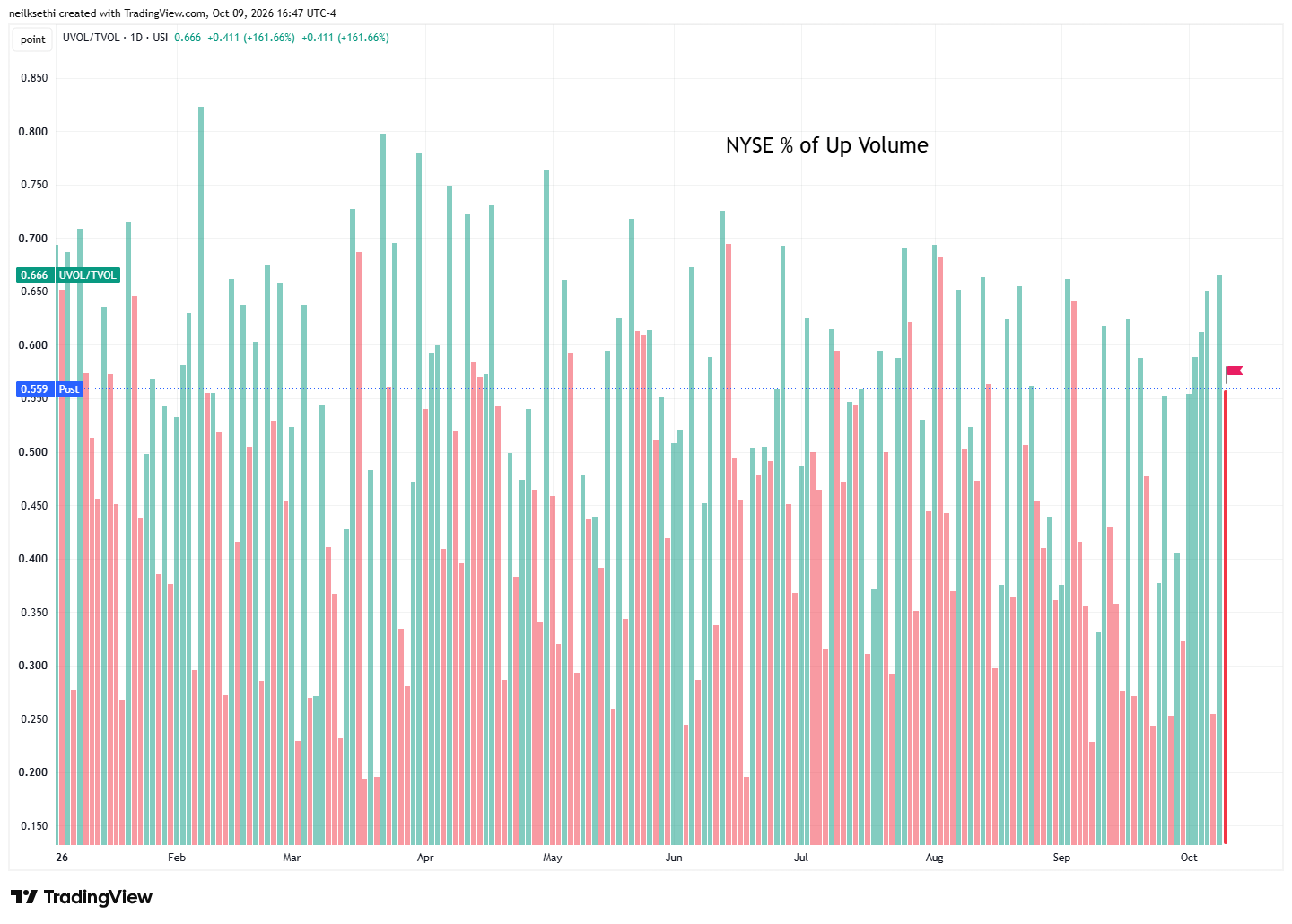
And positive volume also was disappointing with the NYSE falling back to 55.9% from 66.6% even as the NYSE index gain increased to 0.59% from 0.41%.
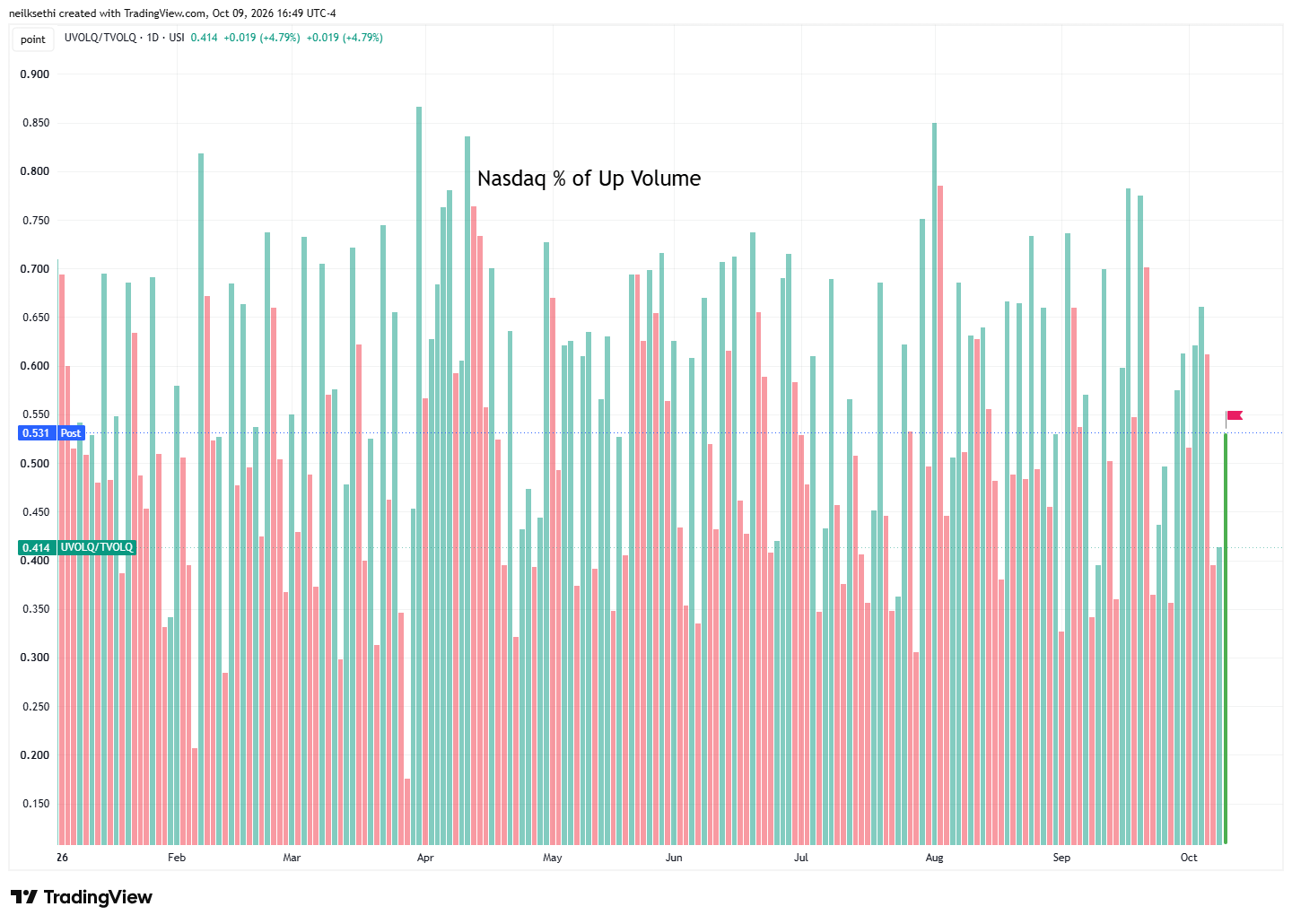
The Nasdaq improved to 53.1% but that was still weak for the 0.64% index gain. Compare to Tuesday when it was 61.1% with a smaller 0.45% gain.
New 52-week highs minus lows though saw improvement. The NYSE moved to -82, the least in a month (but still negative) and the Nasdaq to -206 from -397. That makes it the 30th straight session that the Nasdaq saw more new 52-week lows than new highs.
Some Other Stock-Specific Commentary From TheStreet Pro:
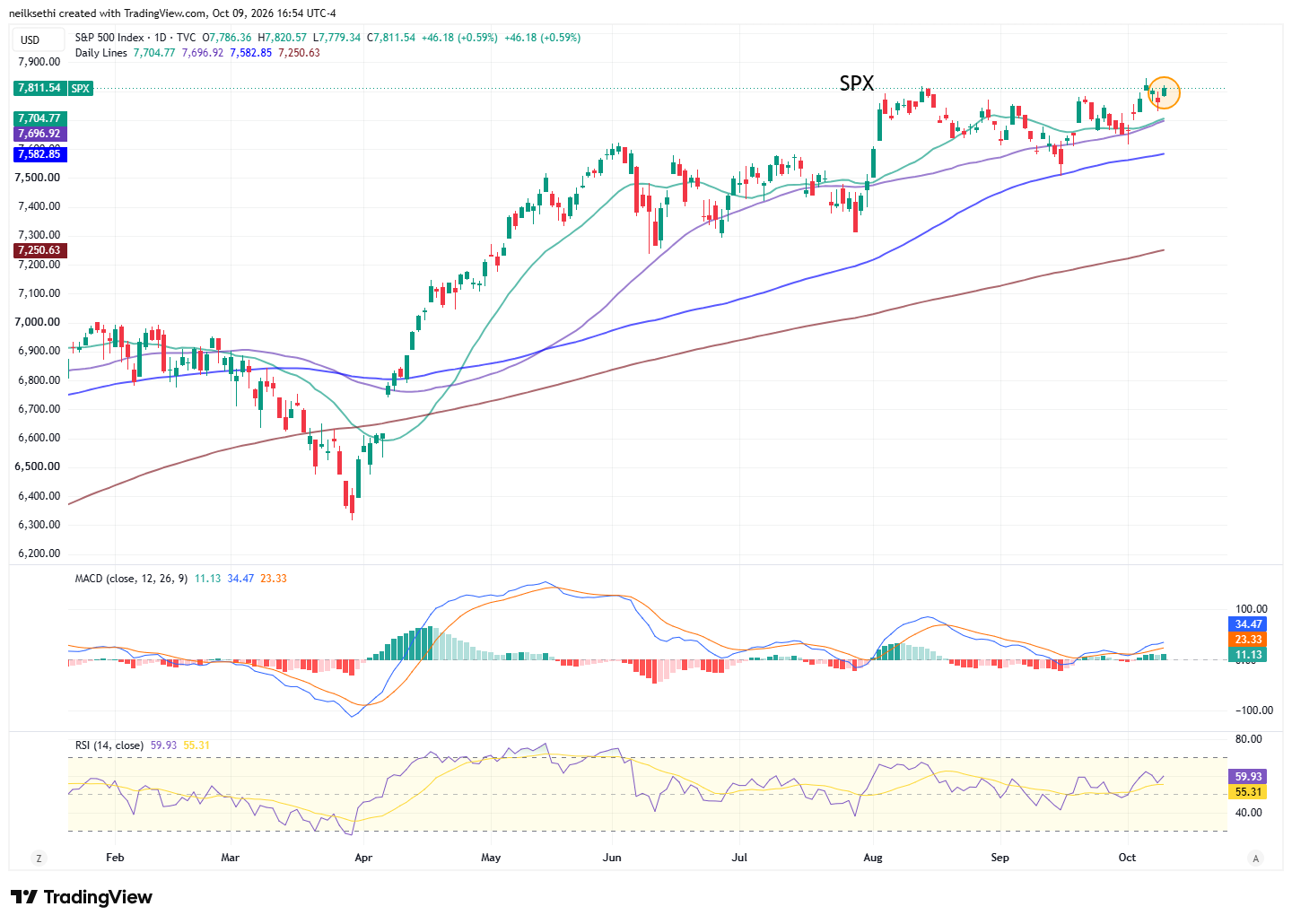
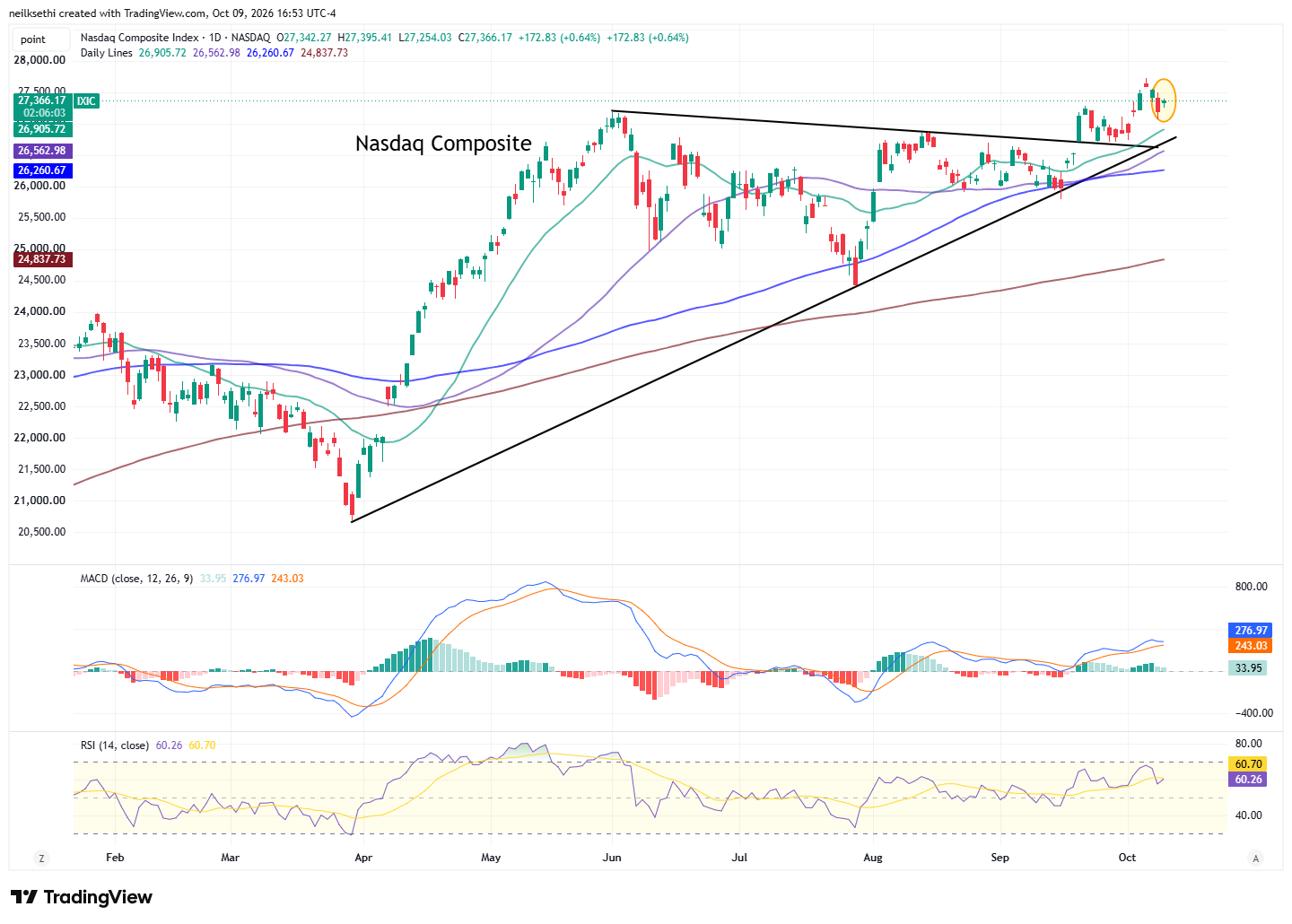
Note on all charts the colored lines are moving averages (the average price over the lookback period — days on the daily charts, weeks on the weekly charts): 20 = green 50 = purple 100 = blue 200 = brown
Exception is monthly charts where blue is 10-month moving average and brown is 20-month moving average.
MACD = Moving average convergence/divergence line, a measure of momentum that compares longer term and shorter term momentum to gauge if a move is strengthening or weakening. This is probably my favorite individual indicator.
RSI = Relative Strength Index (basically what it sounds like) = measures the strength of the move comparing gains to losses over the given lookback window (I use the standard 14 periods).
SPX back up to just under its all-time high. The daily MACD and RSI remain positive, and it remains above all moving averages I track.
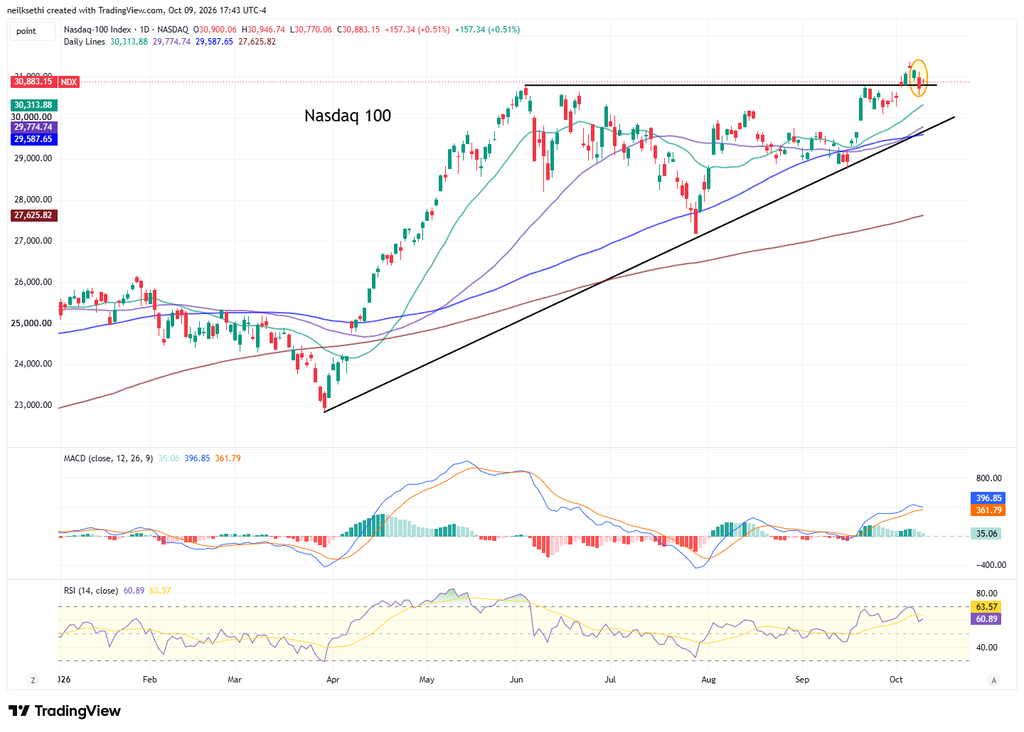
NasdaqComposite a similar story although a little further from its all-time high and its chart is no longer superior to the SPX due to that broadening.
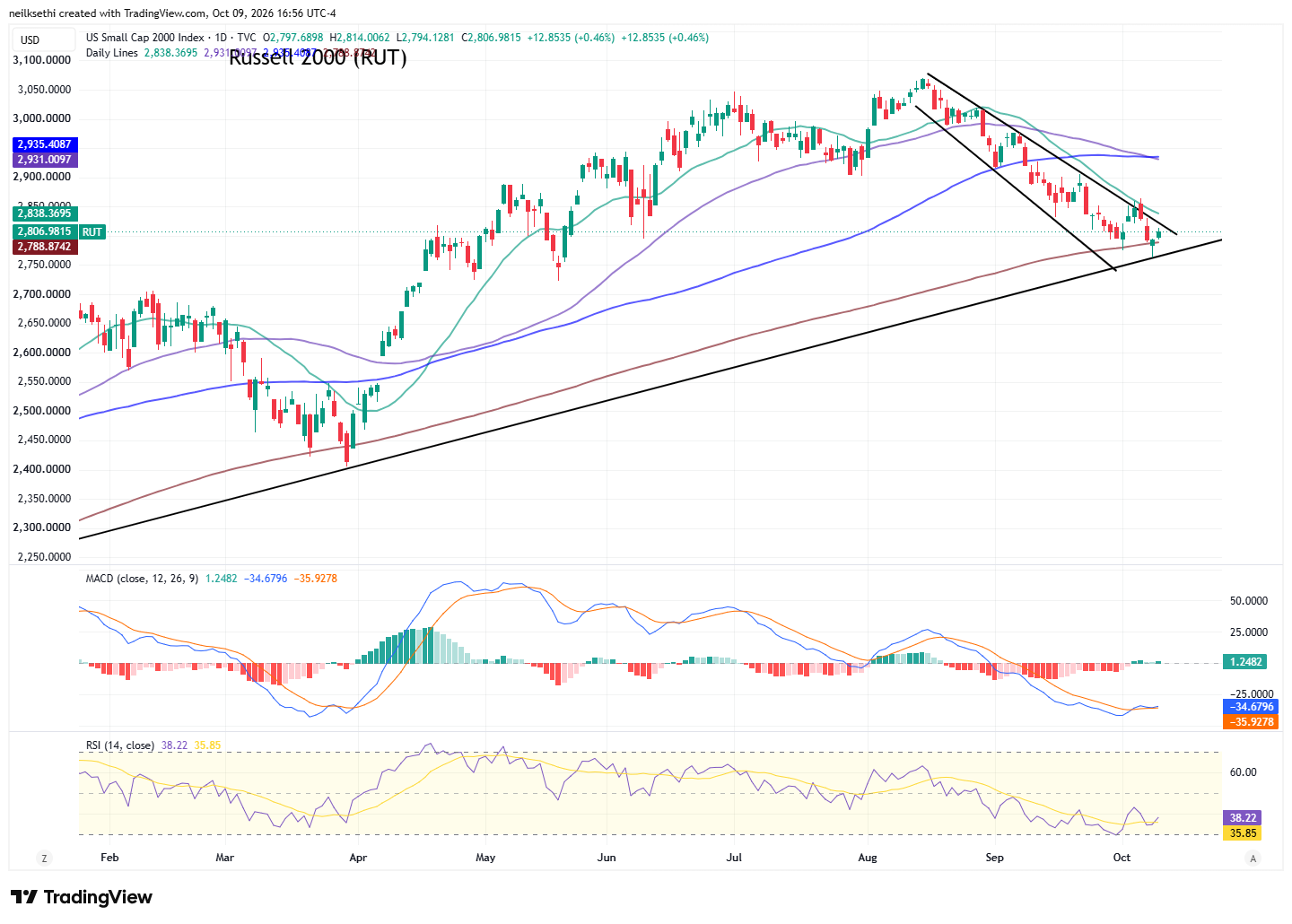
The Russell 2000 (RUT) continued its bounce from its trendline from the April 2025 lows. Still has a lot of resistance to work through. The daily MACD remains neutral, but the RSI under 40.
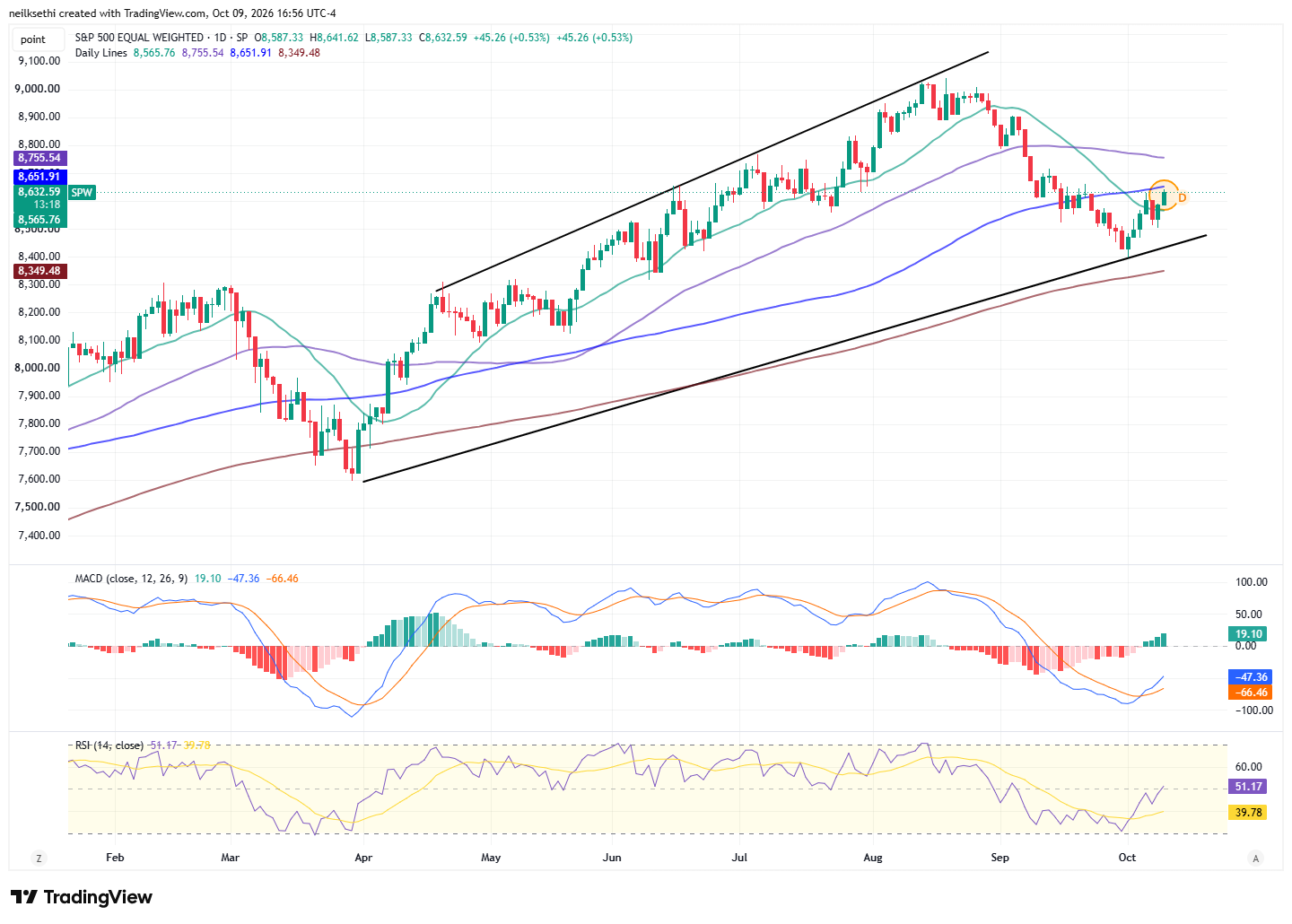
The equal-weighted SPX moved to the highest close in nearly a month, but still needs to clear the 100-DMA. It has a positive MACD, and the RSI is now 50, so the technicals support a continued move higher.
Treasury yields were overall very subdued with a “twist” with the short end rising a little and the long end softening slightly.
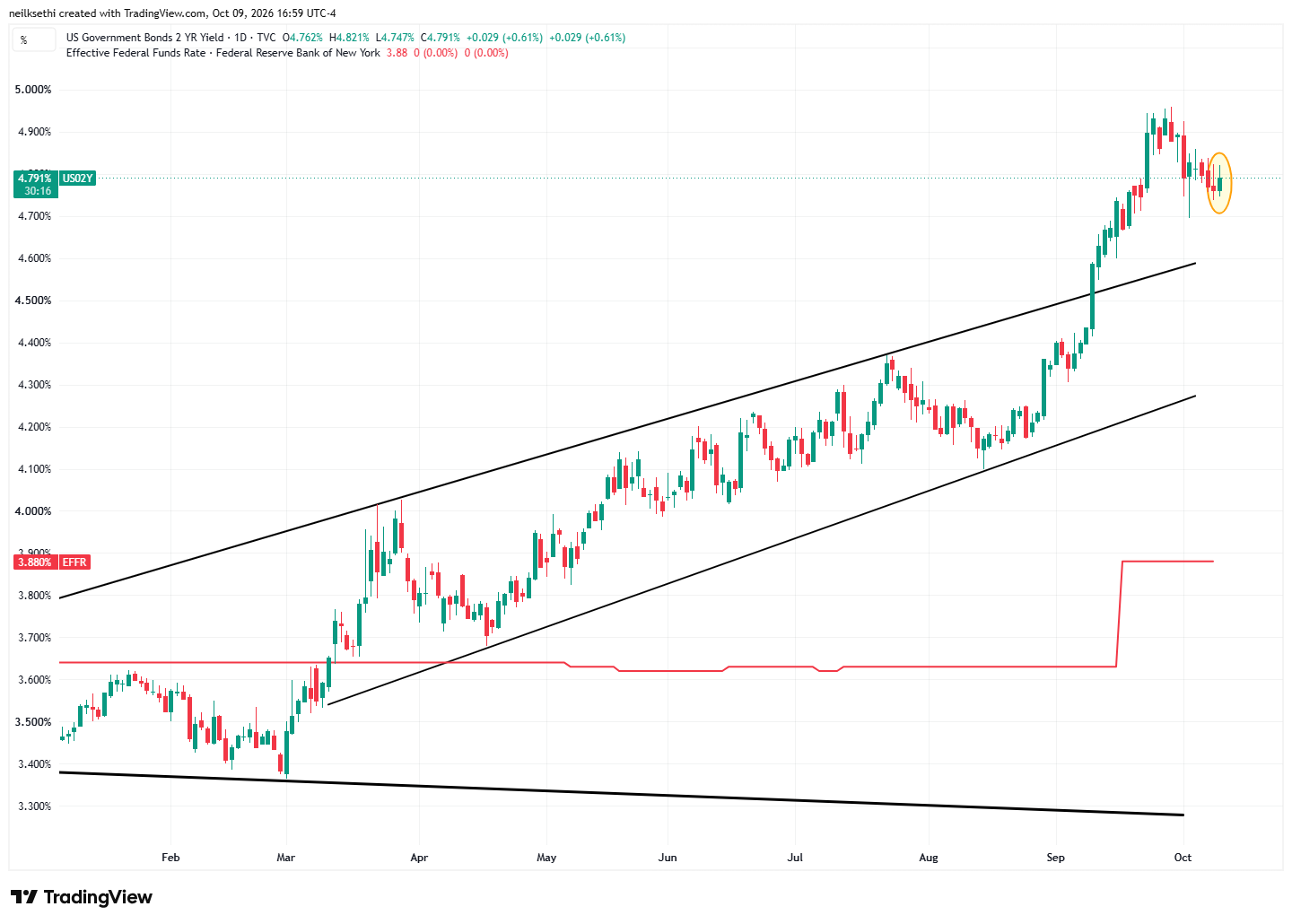
The 2-year Treasury rose around three basis points (including the after-hours) breaking a four-session streak of declines.
It is still ~91 basis points above the Effective Fed Funds rate, so still calling for (at least a couple) more rate hikes.
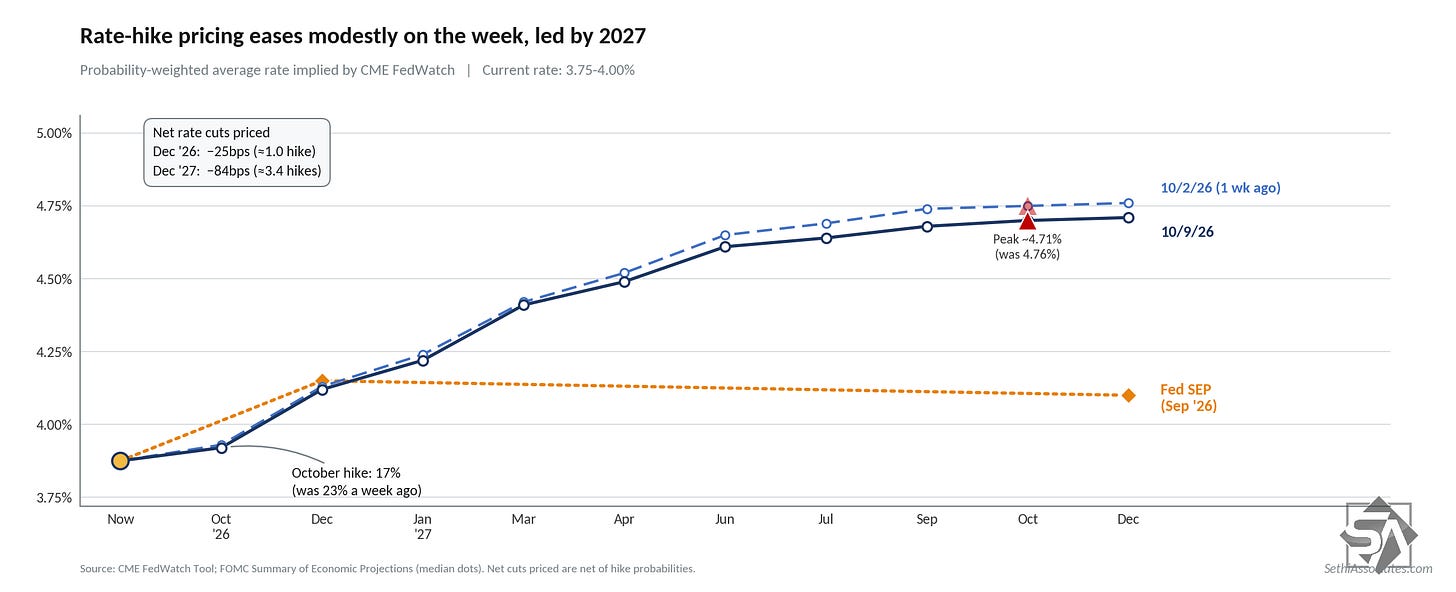
Consistent with the rise in the 2-year yield, FOMC rate-hike expectations firmed a little for 2027. October remains at a 17% probability and a 14% chance of two hikes this year. 2027 sees ~84 basis points of hikes through next December up from ~79 Thursday. Still it’s down over the past week (chart).
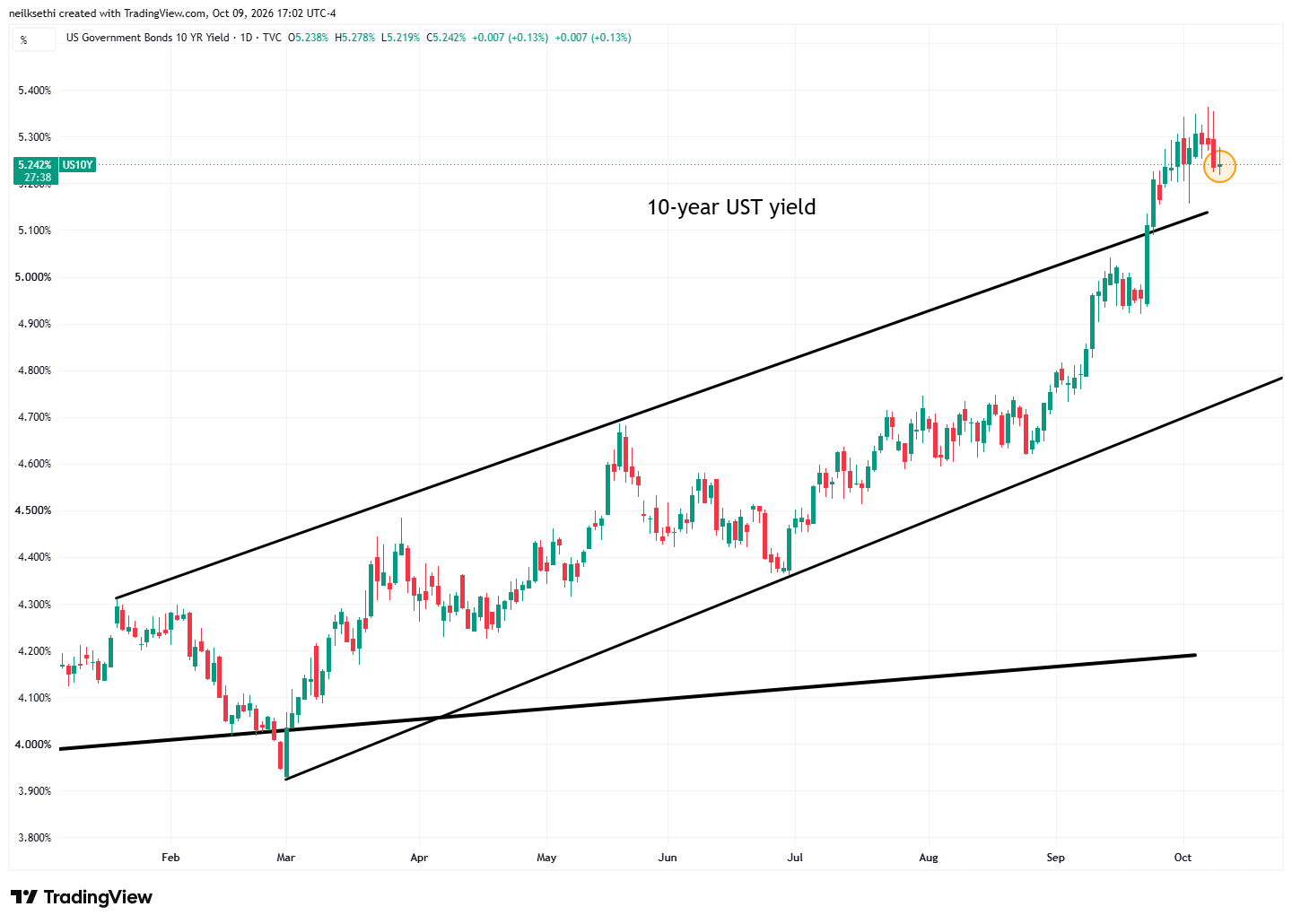
10-year yields flat on the session at 5.24% (including after-hours), remaining seven basis points from the highest close since 2002 Monday.
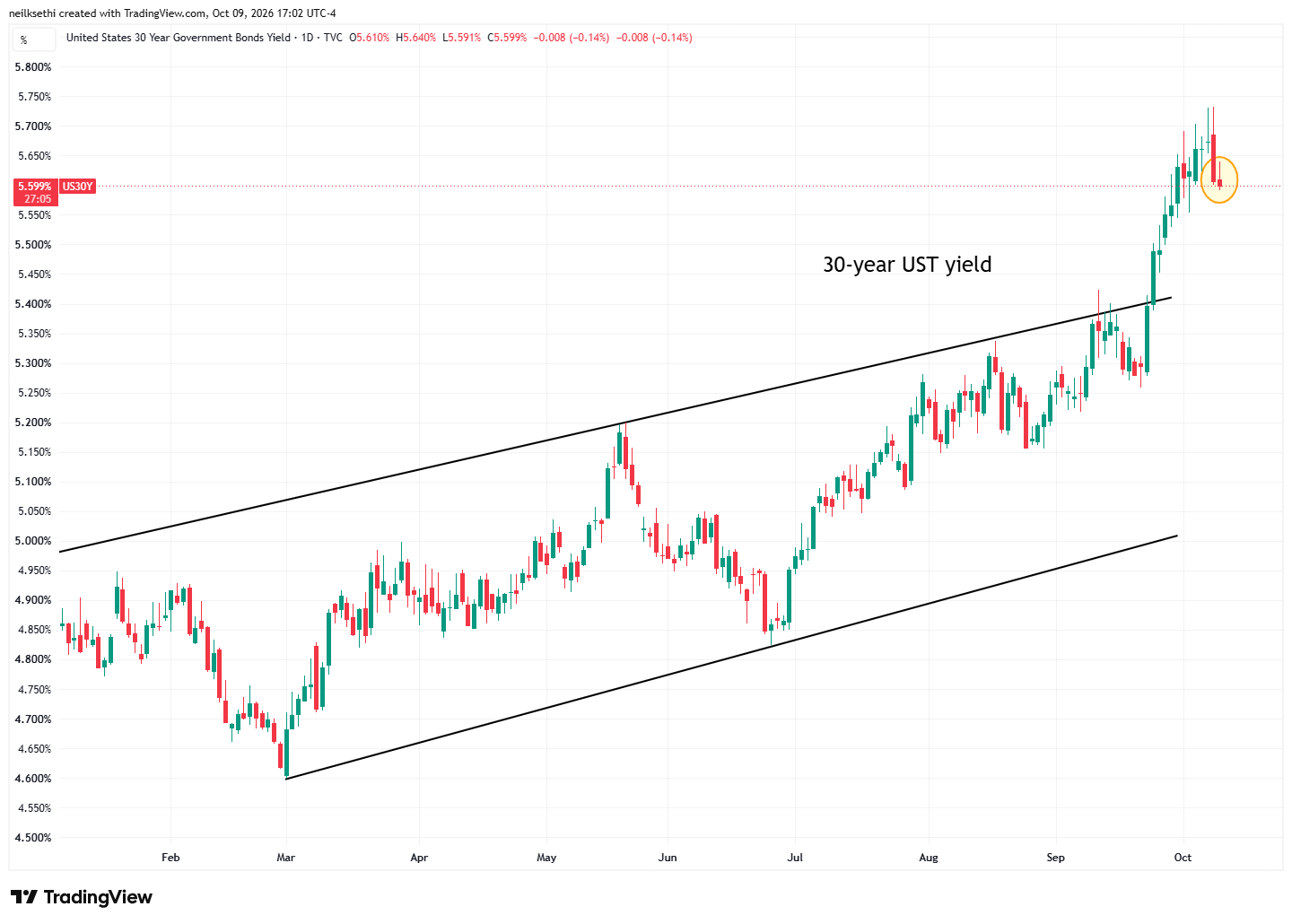
30-year yields eased a touch but not enough to round down remaining at 5.60% (including after-hours), after the first drop in a week on Thursday from Wednesday’s highest close since May 2002.
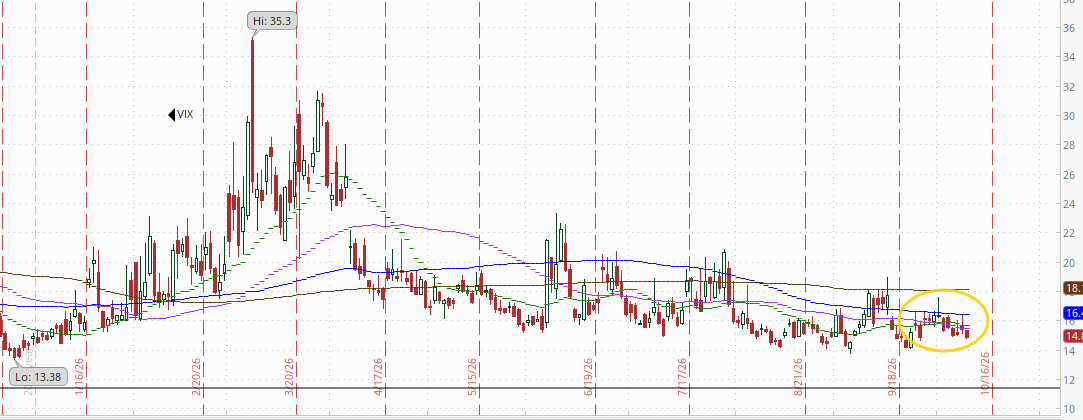
VIX eased back to the lows of the week at 14.8. That’s consistent with ~0.93% average daily moves in the SPX over the next 30 days.
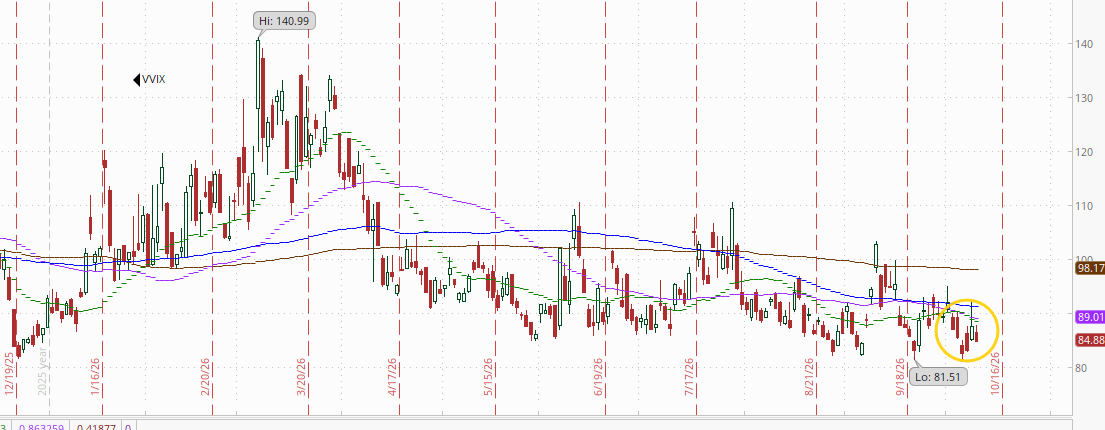
The VVIX (VIX of the VIX) eased back also to 84.9.
The current level is consistent with “moderate” daily moves in the VIX over the next 30 days (historically, normal is 80-100, although we haven’t been below 80 since July 2024). Above 100 is the level flagged by Charlie McElligott as indicating higher stress.
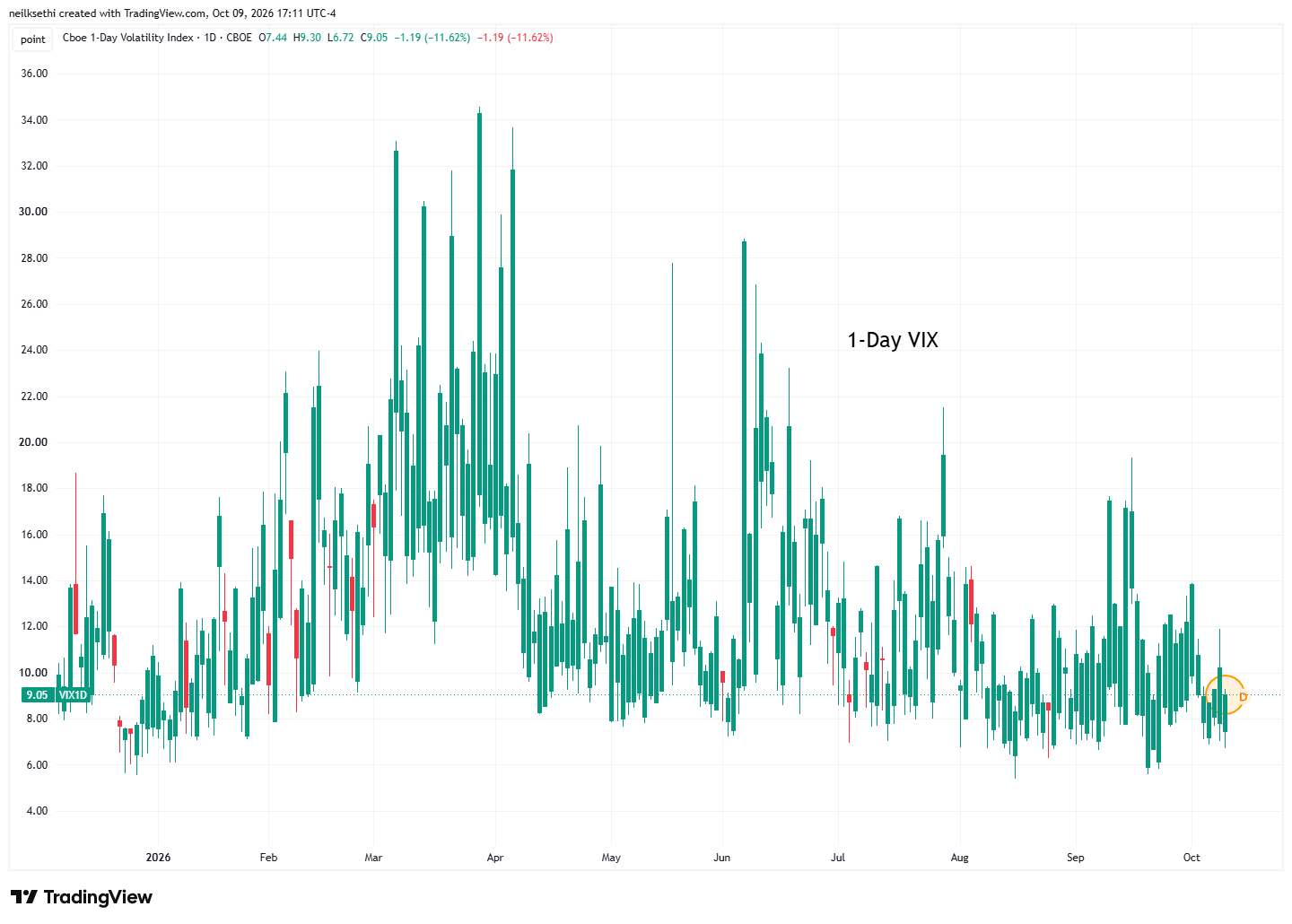
Despite the added weekend day, 1-day VIX also eased to 9.1, one of the lower closes of the year. The current reading is consistent with a move of 0.57% in the SPX next session.
WTI futures (/CL) up slightly (including after-hours).
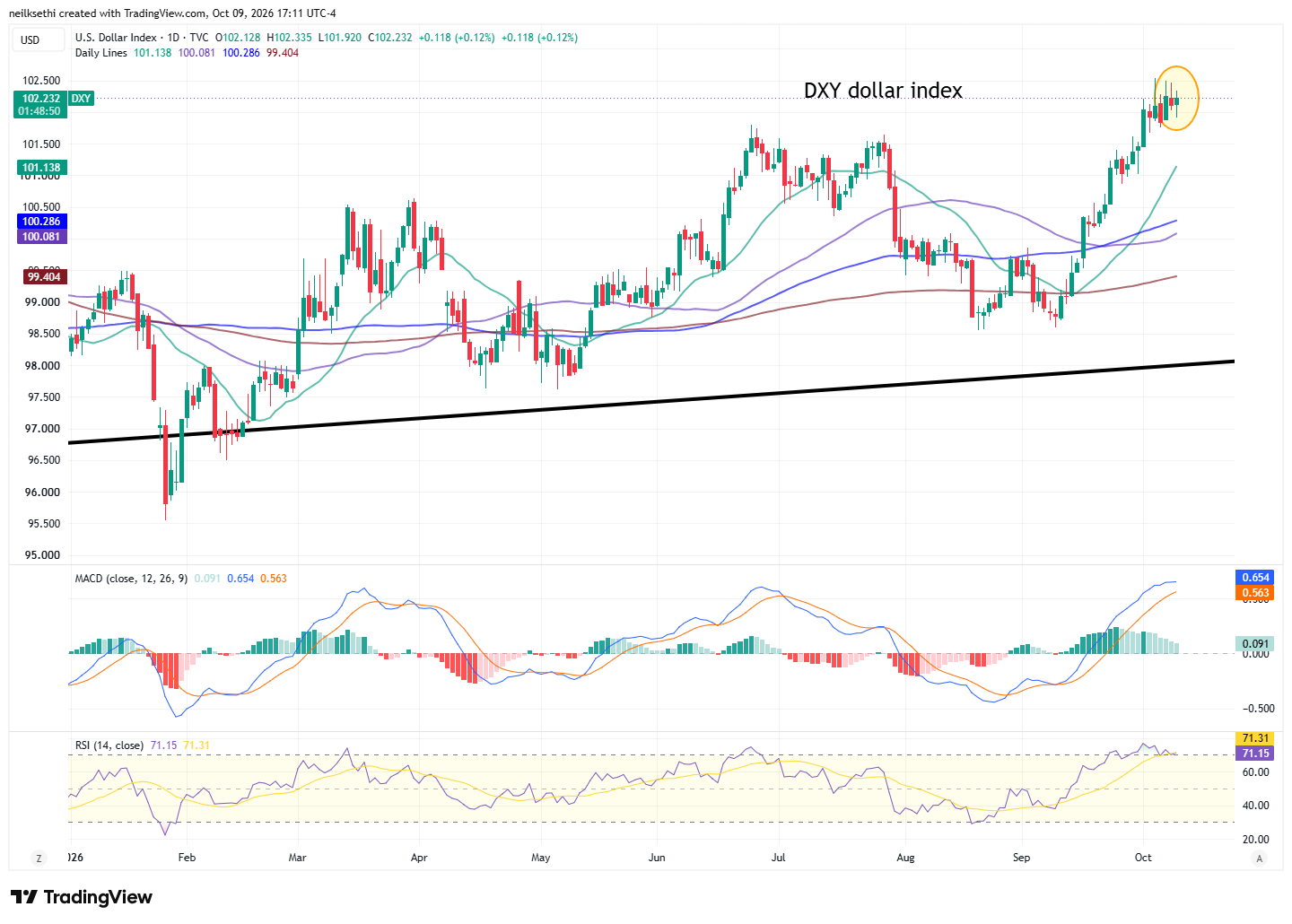
The DXY dollar index (which is fixed weighted with a heavy 57% weighting vs the euro) little changed remaining around the highest close since April 2025.
As I mentioned three weeks ago “The daily MACD remains positive and the RSI is above 60 so it continues to have strong technical support.” I said at the start of the month “This opens up a run higher, although it’s the most overbought since September 2023.” That overbought condition has relieved slightly.
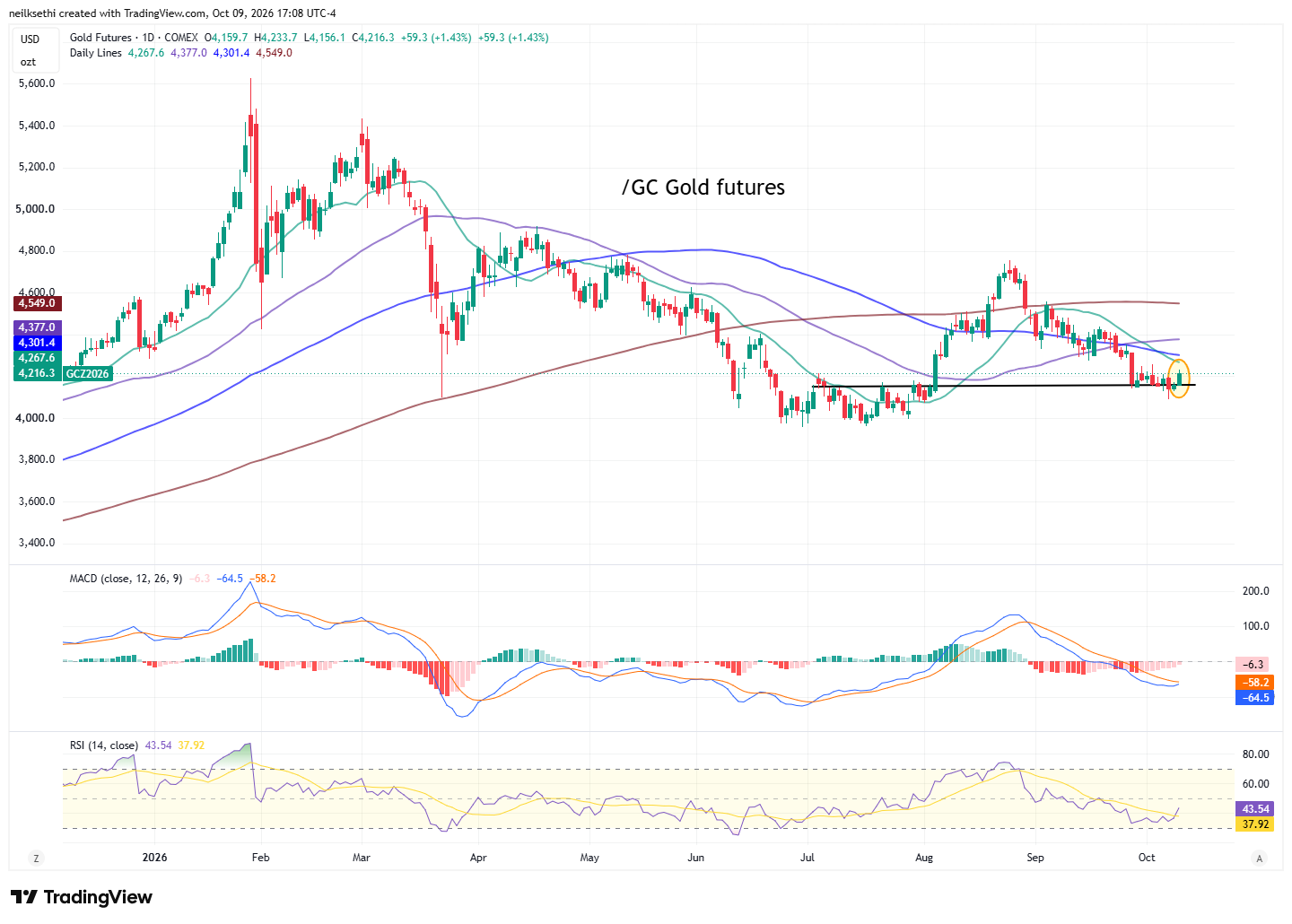
Gold futures (/GC) able to get more firmly back over support. Still has quite a bit of resistance above, thin margin below. The daily MACD remains negative and the RSI is around 40, but both are slowly firming.
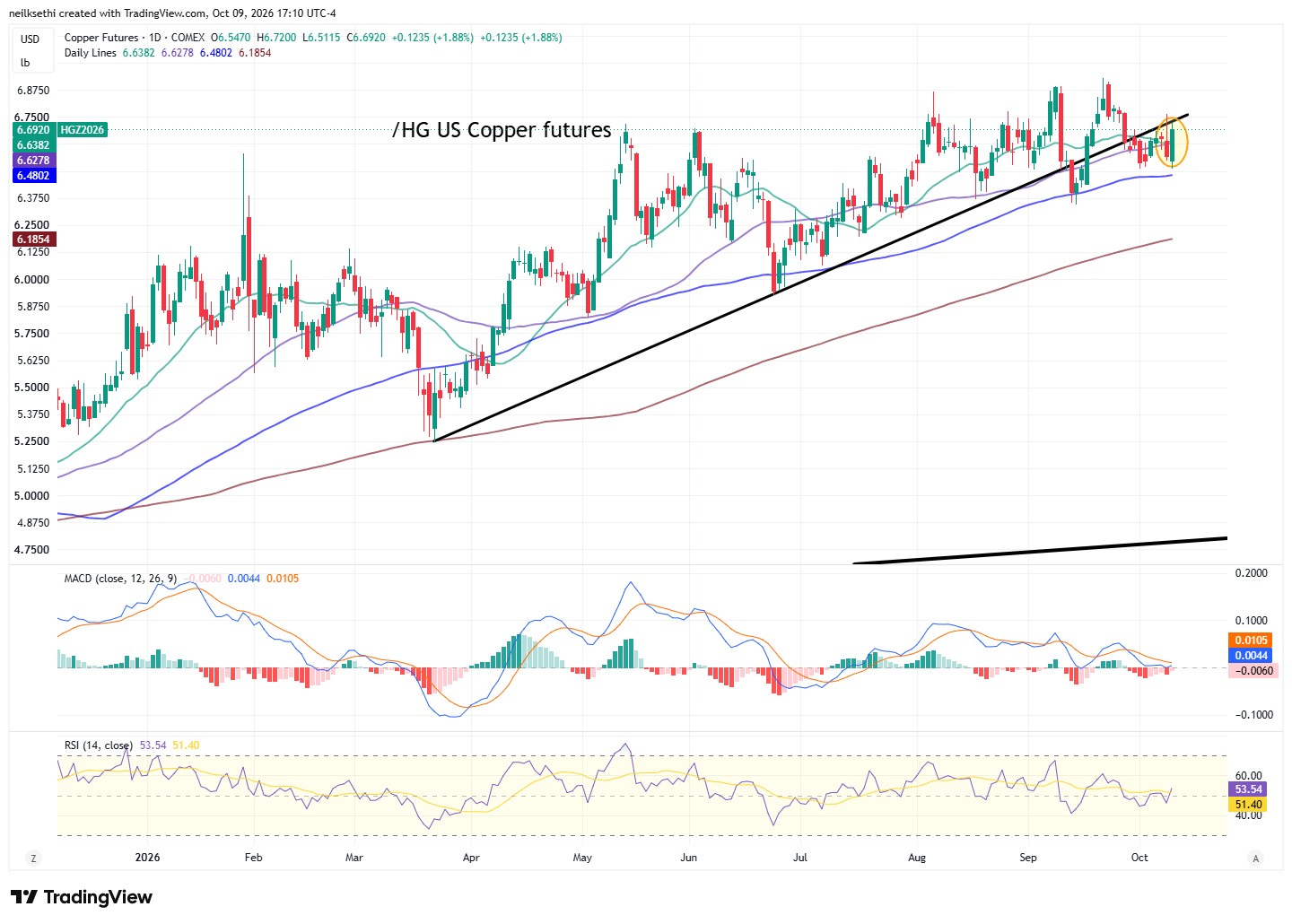
U.S. copper futures (/HG) up nearly 2% to the highest close in two weeks, although overall still remaining range bound. Daily MACD and RSI more neutral now (from negative).
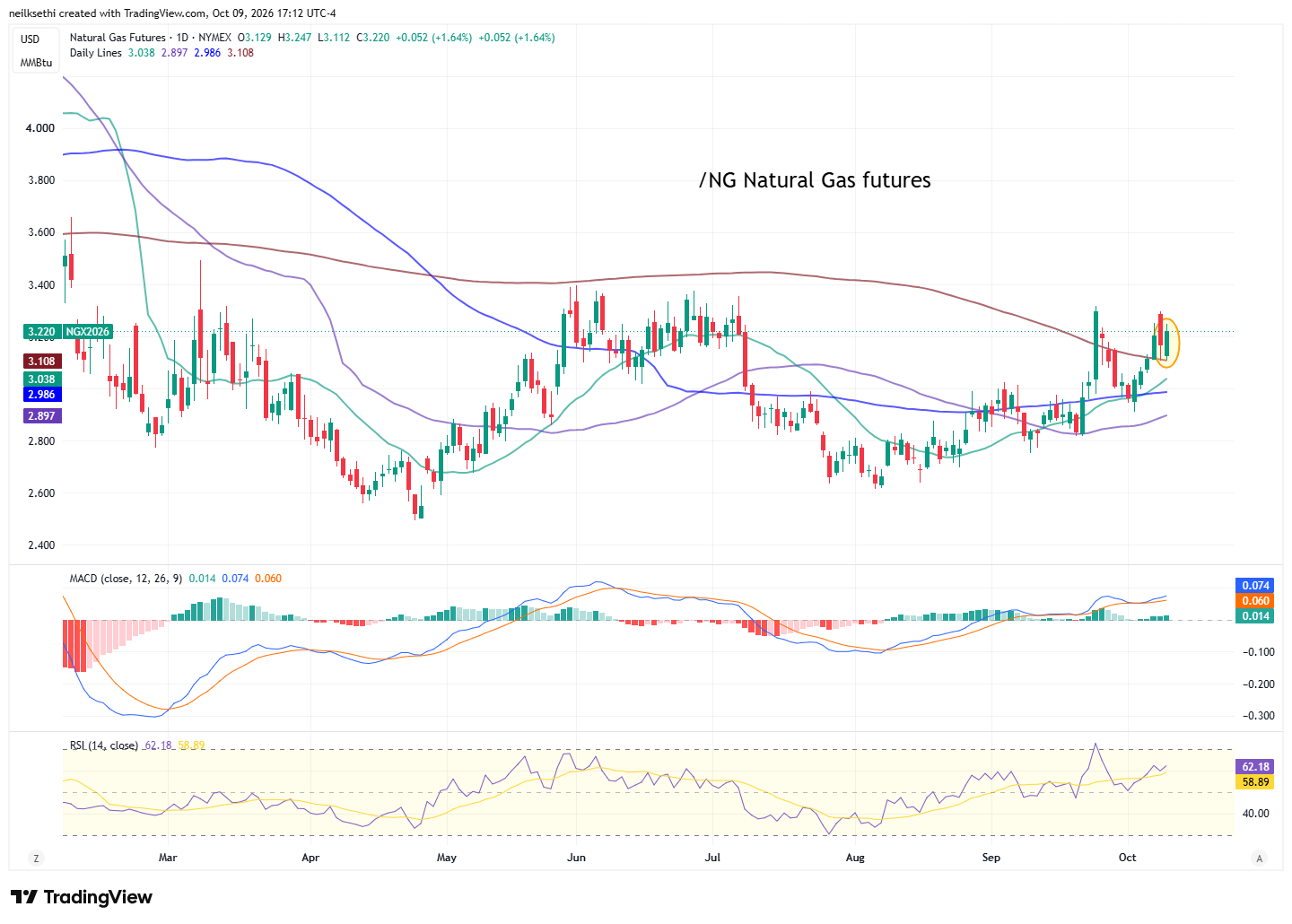
U.S. natural gas futures (/NG)up but remain in their range since March.
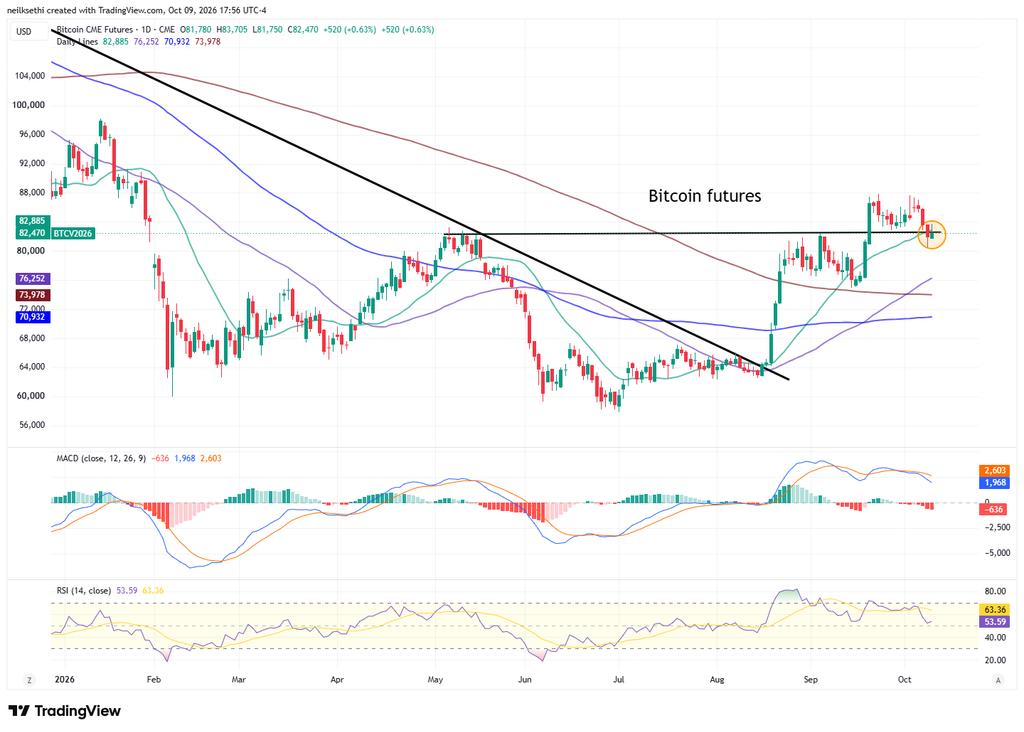
Bitcoin futures able to gain but not able to hold a close back above the $82,500 level. That keeps me looking lower until it reclaims it, as does the negative daily MACD although the RSI still holds just above 50.
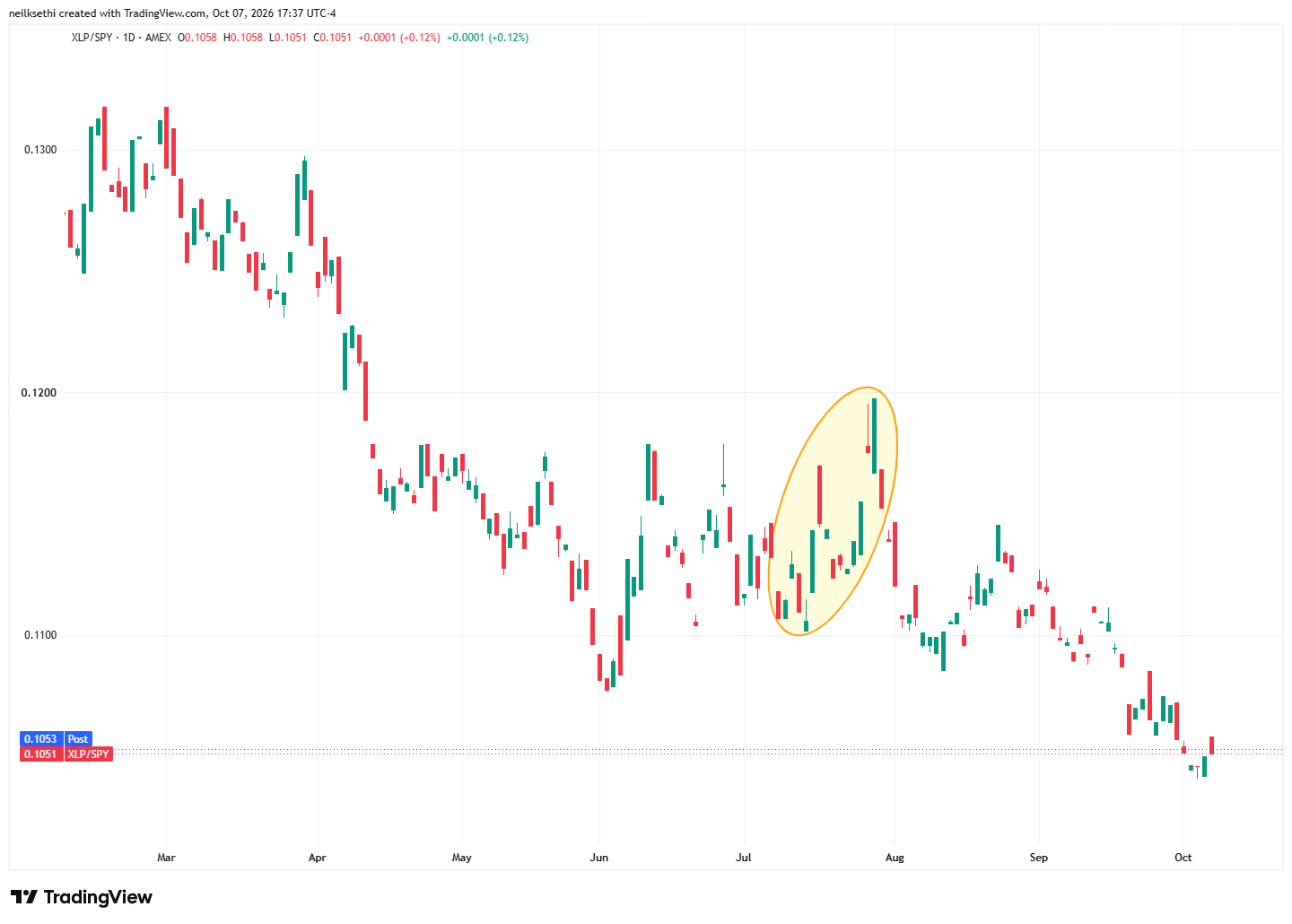
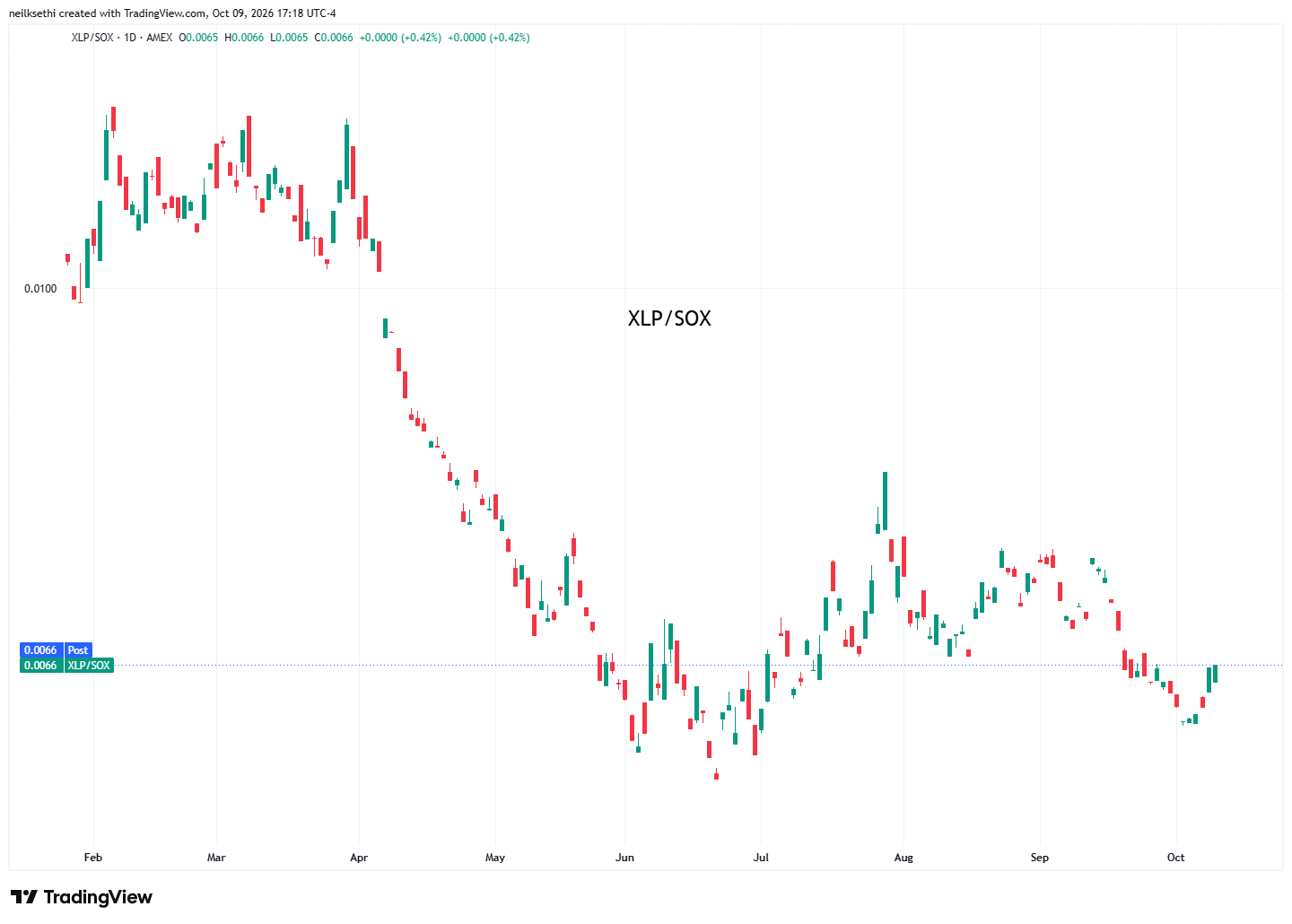
Today things turned weaker with the Tech trade taking a breather and all of the pro-cyclical sectors other than Consumer Discretionary falling with defensives leading. This is something we’ve seen from time to time, but it has yet to stick beyond a few days (remember staples big outperformance vs the SPX at the end of July? — yeah, neither did I until I looked at the chart).
One day doesn’t even make a pattern let alone a trend, so let’s see how things go tomorrow. It’s a very light day with the possible exception of us getting something noteworthy on monetary policy from Governor Waller or a bad 30-year auction (which seems unlikely after the stupendous 10-year auction today).
So now we’ve had three days of weaker Tech and stronger Staples, etc., which is starting to sound more like a trend. Couple of data points stuck out today. First, Staples just had their second-best week since 2022. That’s notable. Second, even with the OpenAI “kerfuffle” fading into the background as I mentioned Thursday (although quicker than I thought), the AI trade couldn’t get into gear with semiconductors closing lower.
But is this a chart you want to buy?
Perhaps. I’ll have more on Sunday after we get a chance to weigh all the indicators.
The Week Ahead: A Big Pick-Up
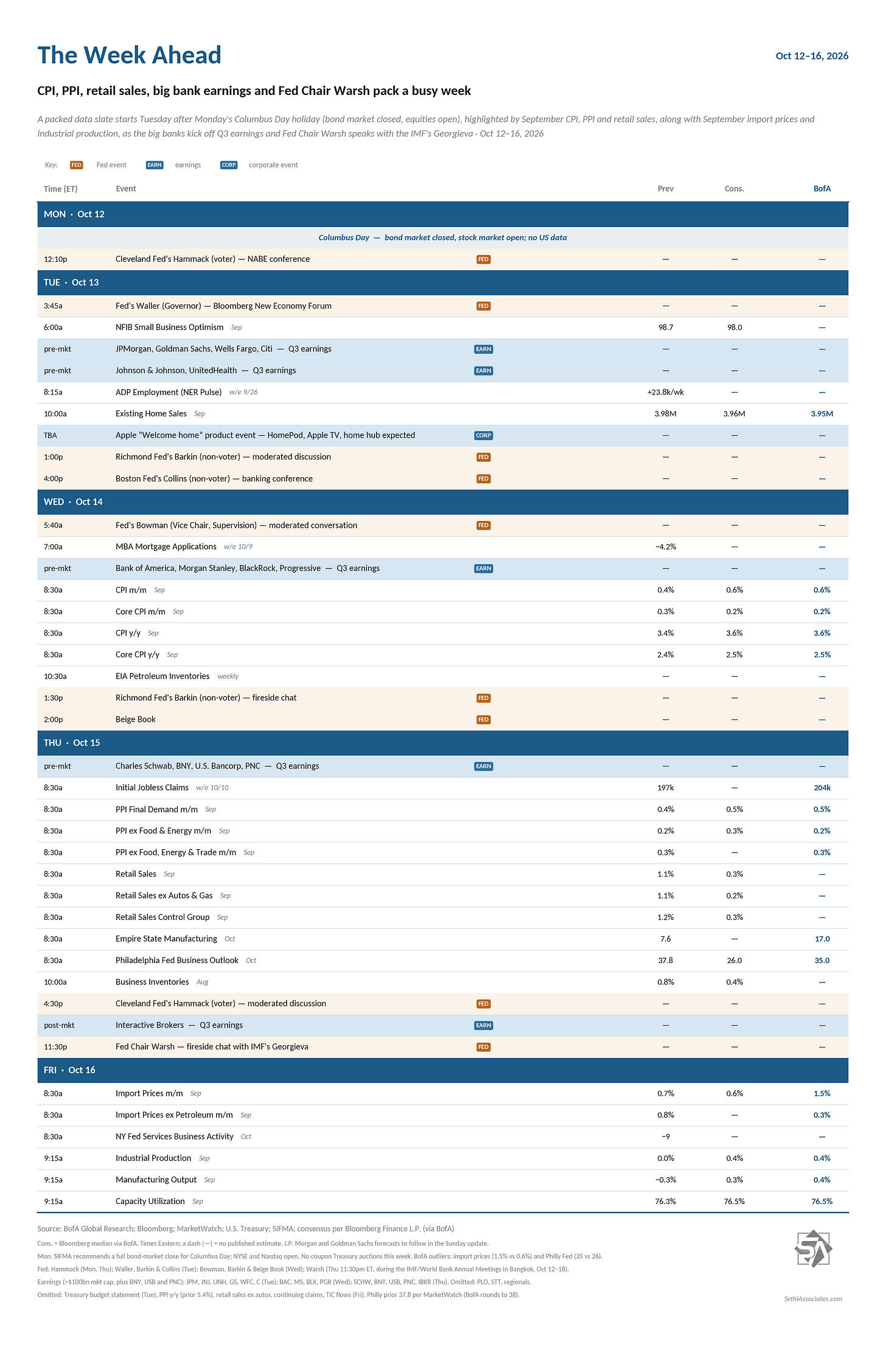
U.S. economic data heavy next week after we get past Monday’s Columbus Day holiday (bond market closed, but equities open), highlighted by the September CPI report Wednesday and September PPI and retail sales Thursday. Other reports next week include September NFIB small business optimism, existing home sales, import prices, industrial production and the monthly Treasury budget statement, August business inventories and TIC flows, a few regional Fed PMIs plus the normal weekly reports (ADP, MBA mortgage applications, unemployment claims, etc.).
Fed speakers stay busy in the last week before the blackout period ahead of the October 27–28 FOMC meeting, headlined by Fed Chair Warsh, who holds a fireside chat with IMF Managing Director Kristalina Georgieva late Thursday night (Friday morning in Bangkok, where the IMF/World Bank Annual Meetings are being held). We’ll also hear from Governors Waller and Bowman and regional Fed presidents Hammack, Barkin and Collins, with Hammack and Barkin each speaking twice. All of them we’ve heard from in the past two weeks. Wednesday afternoon also brings the Fed’s Beige Book, an anecdotal read on conditions across the 12 Fed districts that’s prepared for the upcoming FOMC meeting. Given how much regional Fed presidents rely on such anecdotes, it’s more important than many think.
No non-Bill (>1yr in maturity) US Treasury auctions next week.
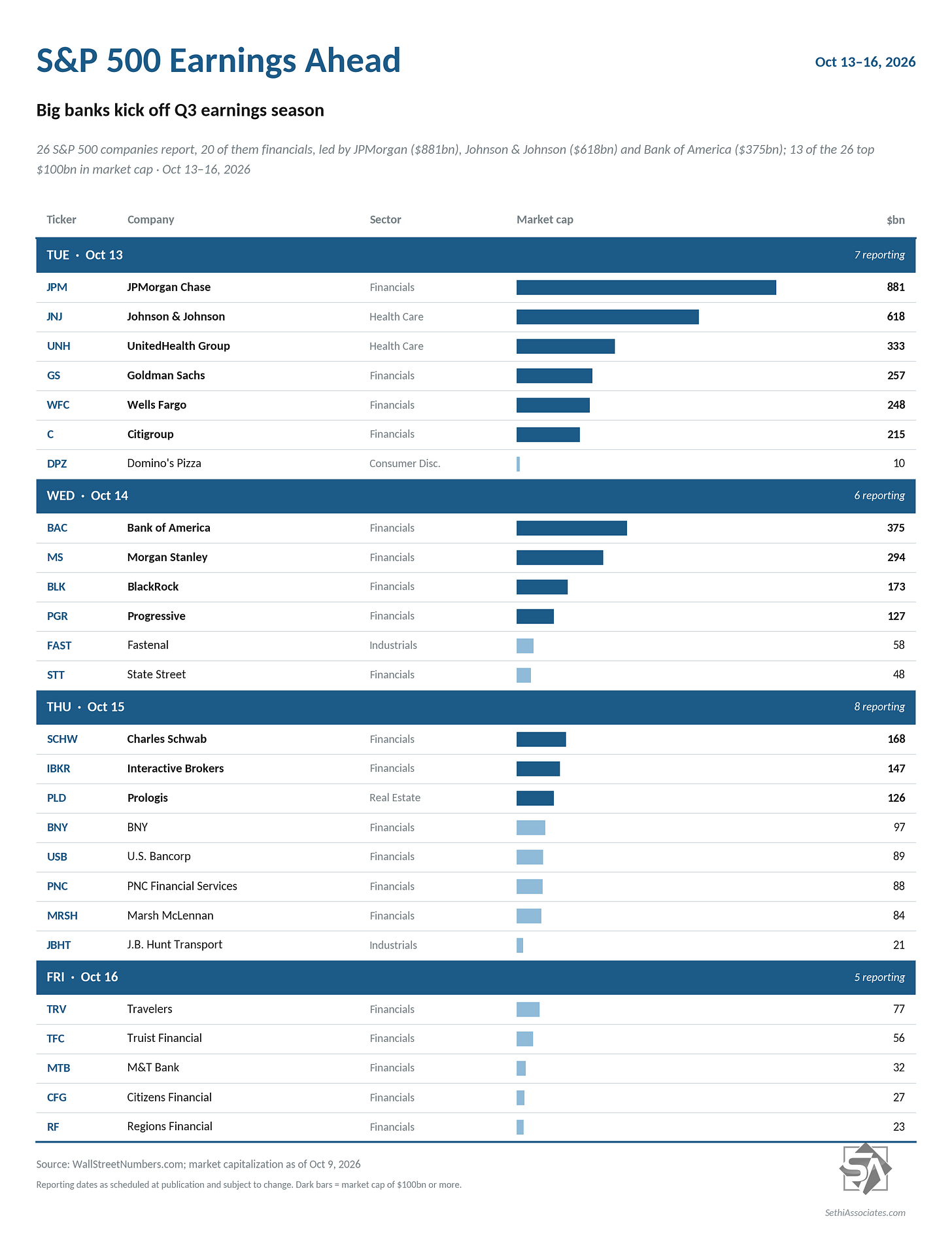
But Q3 earnings season unofficially kicks off Tuesday with the big banks: JPMorgan (JPM), Goldman Sachs (GS), Wells Fargo (WFC) and Citigroup (C) report, along with Johnson & Johnson (JNJ) and UnitedHealth (UNH). Bank of America (BAC), Morgan Stanley (MS), BlackRock (BLK) and Progressive (PGR) follow Wednesday. Charles Schwab (SCHW), BNY (BNY), U.S. Bancorp (USB), PNC (PNC) and Interactive Brokers (IBKR) report Thursday.
In other corporate events, Apple (AAPL) holds its “Welcome home” product event Tuesday. As Chris Versace previewed: “As that [title] suggests, Apple will showcase several new Home products, including refreshed HomePods and Apple TV devices, most likely with Siri AI added. Of greater interest will be the company’s expected HomePad and related connected home product that include a doorbell, thermostat, smart deadbolt lock, and indoor and outdoor security cameras. Those products would challenge Alphabet’s (GOOGL) Nest and other connected device vendors.”
At the time of publication, in terms of equities mentioned, Sethi was long LITE, SPCX, AMT, T, NVDA, MU, PLTR, ORCL, AAPL, EWZ, QQQ, SPY, RSP, IWM, CPER, and numerous equities in the energy sector.
As a reminder comments are encouraged. If they are directed at me, please put @NeilSethi in front.
BBG's John Authers: corporate profits are taking a historically high share of the economy. "As this data comes with a lag, they are almost certainly at a record high now."
I said in my Thursday wrap-up "let’s not pooh-pooh a $50 billion revenue run rate. That’s still incredible, just not as incredible as we thought it might be."
In that regard, the @dailychartbook nightly email found a great post from @TMTBreakout showing that a ~$50 billion runShow more
The Atlanta Fed’s Q3 real GDP tracker slipped to +3.59% as of October 8th, the least since it initiated tracking in late July, down from +3.74% on September 30th and the +5.83% peak on August 6th.
The decline was due to small pullbacks in the contributions from consumptionShow more
OpenAI Revenue Report Sinks AI, but the Rest of the Market Holds Up
An FT report that OpenAI’s revenue is running notably below earlier estimates sent AI shares sharply lower, but beneath the surface most stocks held up as Treasury yields eased and President Trump said the U.S.
Atlanta Fed
@AtlantaFed
On October 8, the #GDPNow model nowcast of real GDP growth in Q3 2026 is 3.6%: bit.ly/32EYojR. #ATLFedResearch
Download our EconomyNow app or go to our website for the latest GDPNow nowcast: atlfed.org/46BOWkD.
$VZ Shares of Verizon down around 9%, the worst day since 2002, following SpaceX’s announcement that it’s agreed to purchase a nationwide spectrum portfolio.
Heavyweights including Oracle Corp., Broadcom Inc. and SpaceX are among the borrowers that priced nearly half a trillion dollars of new debt this year to pay for the infrastructure powering artificial intelligence, according to data compiled by Bloomberg. The tally is widelyShow more
The iShares MSCI Brazil ETF ($EWZ) on track to finish the week up around 14%, the best since November 2020, taking it to the highest levels since just before the Covid crash.
Seems we are starting to get some pushback on AI-related private company valuations.
WSJ: "Nvidia NVDA -2.94%decrease; down pointing triangle-backed cloud-computing company Firmus Grid scrapped plans for Australia’s largest initial public offering in almost 30 years, a new signShow more
The Brazilian real and the country's stocks are jumping, with the former up 4.6%, the largest move since Sept 2022, and the iShares MSCI Brazil ETF ($EWZ) over 12% in pre-market trading taking it levels not seen since Feb 2020 on the gains made by Flávio Bolsonaro's conservative
Goldman: The move in US natural gas prices back above $3/mmBtu over the past two weeks has reflected a significant tightening in the balance during September that was primarily weather driven (extreme heat).
Going forward, however, barring a colder-than-average winter, weShow more
BBG: By one common measure of options sentiment — demand for calls that pay out on a 10% rise in the Russell 2000 relative to puts that protect against a similar decline — traders are largely ambivalent about what will come next for the index.
The so-called call-to-put skew isShow more
The Russell 2000 ($RUT), on track for a fifth straight weekly decline the longest losing streak since May 2022. It's also the seventh down week in eight.
S&P 500 consumer staples sector up ~4% for the week, the best since early February. It's also up six straight sessions for the first time since then.
Before February you have to go back to October 2022 for a week this strong.
BofA's Hartnett (Flow Show) says the "midterms remain most likely catalyst for +/-10% stocks into '27; we lean risk-off into midterms on central bank tightening cycle (54 hikes in '26), tighter financial conditions, credit event 'canaries.'"
Hartnett notes Polymarket now puts aShow more