Weekly Roundup: Oil, Yields and AI Jitters Make for a Choppy Climb
We added to one holding while our concern for higher energy prices starts to play out.
You've reached your free article limit
You've read 0 of 1 free Pro articles.
We finished off the first full week of the fourth quarter with the S&P 500 and the Nasdaq Composite adding to their year-to-date gains. Despite some setbacks with a few of our holdings, the Pro Portfolio also added to its gains, keeping our year-to-date lead over the S&P 500 nicely intact.
Tracing the market’s week, the S&P 500 rose on both Monday and Tuesday, with Tuesday’s close marking its 28th record finish of the year. Strength in mega-cap tech, an upbeat investor day from Marvell (MRVL) and a round of deal news did the heavy lifting. That led the market to overlook another confirmation point in ISM’s September Service PMI data that inflation pressures, including energy and fuel prices, are translating into higher costs. The market would be reminded of that on Friday, when Delta Air Lines (DAL) cut its profit outlook for the year.
On Wednesday, the minutes of the Fed’s September 15-16 meeting showed that most participants judged another increase “would likely be appropriate by year end.” Officials also saw inflation risks skewed to the upside, with energy prices among the drivers. No surprise given the move in oil, gas and diesel prices in recent months and the data we’ve received thus far.
The 10-year Treasury yield pushed toward 5.36%, its highest level since 2002. Oil added to the pressure with Brent crude rising nearly 4% on Thursday to move back above $100 a barrel as tensions with Iran flared, and a Gulf hurricane later shut in much of the region’s production.
On Friday, oil prices were little changed even though President Trump said the U.S. wouldn’t attack Iran before the November midterm elections. But earlier in the week Trump said he is no longer seeking a deal with Iran amid reports of a potential large-scale U.S. military operation in the coming weeks. As we see it, we remain stuck with ongoing uncertainty that will last several more weeks, keeping energy prices and inflation pressures elevated.
That suggests to us, as we saw with revised guidance from Delta Air Lines, there is downside risk to consensus earnings expectations for companies with meaningful exposure to oil, gas, diesel and other energy costs, as well as those exposed to transportation and certain other commodity prices. We talked about this during the week when we voiced our concern for the “other 50%” of the S&P 500 that isn’t Tech or Tech adjacent.
That downside risk raises questions about consensus EPS growth expectations for the second half of 2026. Our thinking is that as we move past big bank earnings next week, we will have a clearer sense of these higher prices on margins and bottom-line results.
One of our strategies with the Portfolio has been to focus on where capital, be it from companies, consumers, governments or other entities, is being spent. What we heard this week from Marvell and its upsized multiyear forecast, from Lumentum (LITE) and how its optical components are sold out for some time, from Samsung (SSNLF), Taiwan Semiconductor (TSM), Foxconn, and others, reaffirms our exposure to AI infrastructure in the Portfolio and also in the EPS All-Stars model. It also suggests chip capacity will remain tight for some time past 2028, and that keeps us bullish on Applied Materials (AMAT).
Outside that, Costco (COST), TJX (TJX) and Amazon (AMZN) remain well positioned as consumers combat inflation pressures sapping their spending dollars. Rising production levels at Boeing (BA) and Paccar (PCAR) should bring the power of incremental operating leverage at a time when their customers are looking for the benefit of added fuel efficiencies. And while the higher risk-free rate has cooled demand for REITs, the demographic shift powering our position in Welltower (WELL) isn’t going to slow down. We see slower construction activity being a positive for Welltower’s capacity utilization rates and pricing prospects.
Next week’s September inflation data and the beginning of Q3 2026 earnings season could keep the market on its toes. For that reason, we’ll double down on our practice of parsing the oncoming earnings reports and connecting the dots back to the Portfolio’s holdings, updating our investment rationale for those positions along the way.
In the Week Ahead section below, we dish more on which earnings reports we’ll be focusing on as well as what we’re expecting to hear from Apple (AAPL) and Anthropic at their expected events on Tuesday and Wednesday.
Enjoy your weekend and Saturday’s Signals alert. We’ll see you back here bright and early Monday.
Catching Up on the Portfolio This Week
Bolstered by strong performance from shares of Palantir (PLTR), Arista Networks (ANET), the First Trust Nasdaq Cybersecurity ETF (CIBR), Microsoft (MSFT), and TJX Companies (TJX) in particular, the Portfolio pushed ahead this week. Those and other gains relative to the S&P 500’s performance were partly offset by declines in Applied Materials (AMAT), Boeing (BA), Nvidia (NVDA), and Paccar (PCAR). Meanwhile, despite a decline in Seagate Technology (STX), strength in Ciena (CIEN) and Lumentum (LITE) has the new EPS All-Stars basket being a positive contributor so far this month.
After making several moves with Boeing and American Express (AXP) in late September and the first few days of October, the only trade we made this week was to further increase the Portfolio’s exposure to Axon Enterprise (AXON). We made that buy at $408.42 but kept some additional room to round out the position size subject to what we see near-term with the Q3 2026 earnings season.
After receiving Nvidia’s latest quarterly dividend payment last week, the Portfolio did not cash any dividend checks this week. The next such payment will be from Marvell (MRVL) late this month, followed by the next quarterly dividend from American Express in early November.
As we head into what for some will be a long weekend given the Columbus Day holiday on Monday, the Portfolio’s cash position sits at around 8.3% of its assets. Following our moves over the last two weeks and the reconstitution of the EPS All-Stars basket, that level of cash gives us some room to maneuver with our somewhat shortened shopping list that includes the XLV and ROBO ETFs and one or two other existing holdings. We are also continuing to do our work on SpaceX, especially after the company’s move to more directly compete with consumer wireless and broadband companies.
As discussed in this week’s Portfolio Office Hours, when it comes to Three-rated Netflix (NFLX), we are tracking the shares against the technical resistance levels ahead between $75-$77 and again above $83. Should we see NFLX flirt with those resistance levels, we may opt to reclaim some capital. If the Q3 2026 earnings season or other developments bring more pressure on the market, we may decide to close out the NFLX position sooner than later.
Now let’s see what others on Wall Street had to say about the Portfolio’s holdings during the week:
Monday: BNP Paribas lifted its Nvidia target to $345 from $285. Scotiabank added $115 to its Microsoft target, landing it at $615. UBS lowered its Bank of America (BAC) target to $67 from $70.
Tuesday: Jefferies raised the firm’s price target on Marvell to $450 from $325. Wells Fargo nudged its Alphabet (GOOGL) target to $417 from $411 but made a much bigger change to its Meta (META) target, resetting it at $1,000 from $796.
Wednesday: Oppenheimer raised the firm’s price target on Marvell to $425 from $325 and reiterated its Outperform rating. RBC Capital upped its MRVL target to $425 from $360, while Wolfe Research and Craig-Hallum reset theirs at $375-$380 from $280-$300. Evercore ISI raised the firm’s price target on Microsoft to $635 from $528.
Thursday: Barclays initiated coverage of Boeing with an Overweight rating and $300 price target. The firm also initiated coverage of Palantir shares with an Overweight rating and a $265 target. Goldman Sachs upgraded Palantir to Buy from Neutral with a $230 price target. Morgan Stanley analyst Sean Diffley lowered the firm’s price target on Netflix to $80 from $83 and keeps an Overweight rating on the shares. Citi raised the firm’s price target on Arista Networks to $248 from $215 and reiterated its Buy rating. TD Cowen raised the firm’s price target on Alphabet to $485 from $475 maintained its Buy rating.
Friday: BMO Capital Markets initiated coverage of American Express with an Outperform rating and a $380 target. RBC Capital lowered the firm’s price target on American Express to $400 from $415 but maintained an Outperform rating on the shares. Raymond James lowered its price target on Waste Management (WM) to $254 from $262 and keeps an Outperform rating on the shares. TD Cowen lowered the firm’s price target on Boeing to $240 from $250 and keeps a Buy rating.
Key Global Economic Readings
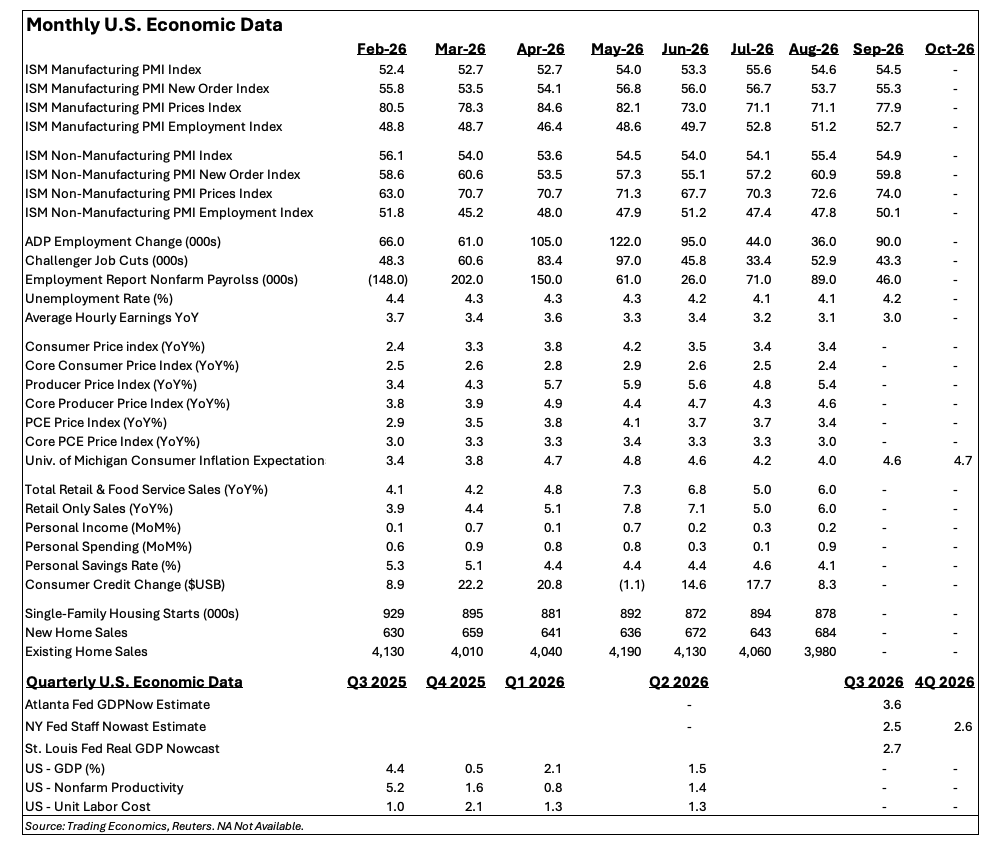
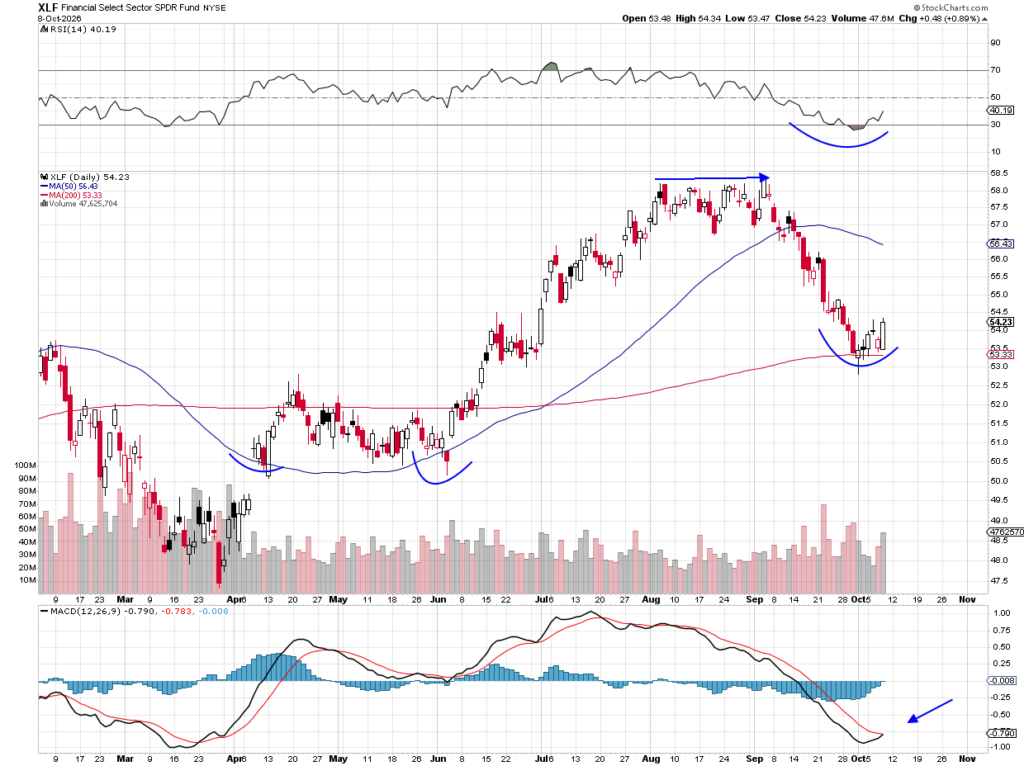
Chart of the Week: State Street Financial Select Sector SPDR ETF
It appears the financials have landed on some solid support, just in time for a big earnings season to begin. This one will be the biggest and most important earnings since… well… last quarter.
For the banks to do well in the economy certain conditions have to be met: a strong consumer, growing businesses, friendly interest-rate environment with tax benefits prevalent. Much of those have been part of the economy over the last couple of years, which speaks for the strength in banks such as JPMorgan Chase (JPM), Goldman Sachs (GS) and Bank of America (BAC).
These stalwarts have shown huge profit and revenue growth. Their charts have moved from the bottom left to the upper right. By now many may have forgotten about the trouble with banks during the Great Financial Crisis (GFC), about 18 years ago. Yet, many remember the challenges and difficulties from the financials that nearly pushed the global economy to the brink.
As for the chart, let’s examine the SPDR Fund XLF ETF (XLF). This vehicle contains the biggest and brightest of the banks and is often a leader for other groups. When the banks are performing well, so is much of the rest of the market.
The chart shows a bounce at the right spot, the 200-day moving average. A recent breach was rehabilitated in the following days and now there is a chance for this ETF to move toward the 50-day moving average (blue). The pullback shows up in recent patterns on the chart.
MACD is about to cross for a buy signal, RSI is turning up from a potential bottom and volume trends are turning bullish. We’ll see how the banks perform in the coming weeks. Most names report early next week and with potential inflation fans blowing and higher rates, we’ll be listening closely to what these leaders have to say.
Other charts we shared with you this week were:
Monday, October 5: Dow Jones Industrial Average – Correction in the Dow Industrials May Have Ended
Monday, October 5: Advanced Micro Devices (AMD) – AMD Proves Its Worth
Tuesday, October 6: Astera Labs (ALAB) – Another EPS All-Stars Winner?
Wednesday, October 7: Bank of America (BAC) – Bank of America Needs a Lifeline
Thursday, October 8: Axon Enterprise (AXON) – Keep a Close Eye on Axon
The Week Ahead
We have a somewhat funky next week with the Columbus Day holiday on Monday. Federal offices, U.S post offices, most banks as well as the bond market will be closed, but U.S. equity markets will be open — and that means we will be as well. Odds are it will be a slow start to the week, but following quarterly results this week from PepsiCo (PEP), Levi Strauss (LEVI), and Delta Air Lines (DAL), our radar will be finely tuned for earnings pre-announcements on Monday and the balance of the week.
Tuesday brings Apple’s event and the start of bank earnings (more on than below). The September CPI arrives Wednesday and following the insights obtained in the September PMI reports and the climb in oil and gas prices during the month, we will likely see a step-up in those figures compared to recent ones. If the figures are much hotter than the 3.6% year-over-year print expected for headline CPI and the 2.5% one for core inflation, we could see the market revisit the potential for an October rate hike. We’ll also want to revisit those September CPI learnings once we’ve read through the Fed’s latest Beige Book findings Wednesday afternoon.
Thursday will be rinse and repeat with the September Producer Price Index. We’ll also get the Retail Sales data for September, and in our view, it should confirm the consumer wallet share gains registered by Costco (COST) during the month.
As we clear the September CPI and PPI reports, we’ll want to listen closely to comments from subsequent Fed speakers ahead of the Fed policy meeting blackout period that begins on October 17. We suspect the market will attempt to read through comments Fed Chair Warsh may make on very late Thursday night, but we would be surprised if he would tip his hands so close to the October 28 policy decision.
Here’s a closer look at the economic data coming at us next week:
U.S.
Monday, October 12
Columbus Day – U.S. bond market closed; stock market open
No major U.S. economic data scheduled
Tuesday, October 13
ADP Employment Change Report (Weekly) – 8:15 AM ET
Existing Home Sales (September) – 10:00 AM ET
Wednesday, October 14
MBA Mortgage Applications (Weekly) – 7:00 AM ET
Consumer Price Index (September) – 8:30 AM ET
Fed Beige Book – 2:00 PM ET
Thursday, October 15
Initial & Continuing Jobless Claims (Weekly) – 8:30 AM ET
Retail Sales (September) – 8:30 AM ET
Producer Price Index (September) – 8:30 AM ET
Empire State Manufacturing Survey (October) – 8:30 AM ET
Philadelphia Fed Manufacturing Survey (October) – 8:30 AM ET
Business Inventories (August) – 10:00 AM ET
EIA Natural Gas Inventories (Weekly) – 10:30 AM ET
EIA Crude Oil Inventories (Weekly) – 11:00 AM ET
Fed Chair Warsh fireside chat with IMF Managing Director Georgieva (Bangkok) – 11:30 PM ET
Friday, October 16
Import & Export Prices (September) – 8:30 AM ET
NY Fed Business Leaders Survey (October) – 8:30 AM ET
Industrial Production & Capacity Utilization (September) – 9:15 AM ET
International
Monday, October 12
Japan: Markets closed (Sports Day)
Tuesday, October 13
Japan: Producer Price Index (September)
Japan: Bank Lending (September)
UK: BRC Retail Sales Monitor (September)
Germany: Consumer Price Index – Final (September)
Wednesday, October 14
China: Consumer Price Index (September)
China: Producer Price Index (September)
China: Trade Balance, Exports & Imports (September)
Germany: Wholesale Prices (September)
Thursday, October 15
Japan: Machinery Orders (August)
Japan: Industrial Production – Final (August)
UK: GDP (August)
UK: Industrial & Manufacturing Production (August)
Eurozone: Industrial Production (August)
Friday, October 16
Eurozone: Consumer Price Index – Final (September)
Eurozone: Trade Balance (August)
Turning to next week’s quarterly earnings, we’ll start off a little slow because of the Columbus Day holiday, but after that, the pace starts to pick up. As usual, financial stocks will kick things off and while Portfolio residents Morgan Stanley (MS) and Bank of America (BAC) won’t report until Wednesday, what JPMorgan (JPM), Goldman Sachs (GS) and Citigroup (C) say Tuesday will certainly shape expectations. When those three report, we’ll be parsing comments on investment banking activity outside of IPOs, trading volumes, and other parts of their business. We will be very interested in remarks about the IPO window, and what it will likely take to re-open it.
ASML’s (ASML) earnings Wednesday and Taiwan Semi’s (TSM) Thursday will be the key read-throughs for Applied Materials (AMAT), Nvidia (NVDA), Broadcom (AVGO), Marvell (MRVL) and Apple (AAPL). Fastenal (FAST), J.B. Hunt (JBHT) and CSX (CSX) will speak to industrial activity, freight and diesel costs, while Johnson & Johnson’s (JNJ) results and guidance will be one to watch given our position in the Health Care Select Sector SPDR ETF (XLV).
We also have two non-earnings events next week. On Tuesday, Oct. 13, Apple (AAPL) hosts its “Welcome Home” event, widely expected to center on the smart home with refreshed Apple TV and HomePod mini models. Of greater interest will be the company’s expected HomePad and related connected home products that include a doorbell, thermostat, smart deadbolt lock, and indoor and outdoor security cameras. Those products would challenge Alphabet’s (GOOGL) Nest and other connected device vendors.
As a reminder, the order book for Apple’s iPhone Duo opens on October 16 with the device expected to land on shelves October 23. We are also reading about another Apple event around October 27 that will introduce its first touch-screen MacBook and a new iPad mini. That late October event will also include versions of the 14-inch MacBook Pro and iMac with M6 chips.
The second non-earnings event next week is the reported Anthropic pre-IPO investor day slated for Wednesday, October 14. Following the news this week that competitor OpenAI targets $70 billion in revenue later this year, up from around a $50 billion run rate just a few months ago, the event should shed ample light on Anthropic’s business, spending and where both are headed.
With Anthropic expected to tap the IPO market after the midterm elections and before Thanksgiving, next week’s event has the potential to prime the order book and target IPO price range. The eventual S-1 filing with the SEC and the IPO roadshow will determine both. Given our position in AI infrastructure companies and Morgan Stanley’s front-running the deal, we’ll be watching next week’s event closely.
Here’s a closer look at the earnings reports coming at us next week:
Tuesday, October 13
Open: Citigroup (C), Goldman Sachs (GS), Johnson & Johnson (JNJ), JPMorgan Chase (JPM), UnitedHealth Group (UNH), Wells Fargo (WFC)
Apple “Welcome Home” event – 9:00 AM ET
Wednesday, October 14
Open: ASML Holding (ASML), Bank of America (BAC), BlackRock (BLK), Fastenal (FAST), Morgan Stanley (MS), Progressive (PGR), State Street (STT)
Anthropic pre-IPO investor day
Thursday, October 15
Open: BNY (BK), Charles Schwab (SCHW), PNC Financial Services (PNC), Prologis (PLD), Taiwan Semiconductor Manufacturing (TSM), U.S. Bancorp (USB)
Close: CSX (CSX), Interactive Brokers (IBKR), J.B. Hunt Transport Services (JBHT)
Friday, October 16
Open: Citizens Financial Group (CFG), M&T Bank (MTB), Regions Financial (RF), SLB (SLB), Travelers (TRV), Truist Financial (TFC)
Portfolio Investor Resource Guide
Economic Data: Here’s a List of Links to the Key Economic Data We Closely Watch
Investing Terminology: 16 Key Terms Club Members Should Know
10-Ks: Want to Know About a Stock? Read the Company’s Reports
10-Qs: Unlock the Numbers and Key Information Behind Your Stock With the 10-Q
Income Statement: Our Cheat Sheet to Understanding This Financial Document
Balance Sheet, Cash Flow Statements, and Dividends: How to Know If a Company Is Off-Kilter? Read Its Balance Sheet
Valuation Metrics: Everyone Wants a Value. Here’s How Investors Can Find
Thematic Investing 101 Webinar
Like the Benefits of ETFs? Let’s Talk About Models
The Portfolio Ratings System
1 – Buy Now (BN): Stocks that look compelling to buy right now.
2 – Stockpile (SP): Positions we would add to on pullbacks or a successful test of technical support levels.
3 – Holding Pattern (HP): Stocks we are holding as we wait for a fresh catalyst to make our next move.
4 – Sell (S): Positions we intend to exit.